




Abstract
A new kind of stochastic SIRS models with two different nonlinear incidences are extended. The obtained results can be expressed in two dimensions. In mathematics, the threshold values
Keywords
Introduction
According to the World Health Organization’s published data in 2017, of the 56.4 million deaths worldwide in 2015, more than 10% were due to infectious diseases. 1 Therefore, analysis and control of the spread of the epidemic disease have become an important topic. Thanks to the groundbreaking research of Kermack and McKendrick, 2 mathematical modeling is an advisable method for us to thoroughly investigate the spreading of epidemic disease. In the early work, many well-known classic model which investigated disease control was deterministic.3,4 In 1927, the SIRS epidemic model was proposed and studied. From then on, the SIRS model has been pursued by many researchers. As we all know that the spreading of disease is unpredictable due to the impact of environmental variations, proper and realistic stochastic differential equation models are proposed for studying the spreading of disease under various environmental conditions.5–8 An increasing number of researchers investigate and improve the stochastic SIRS models, such as one susceptible individual with one infectious individual,9–15 two susceptible individuals with one infectious individual, 16 and multiple susceptible individuals with one infectious individual. 17 In the previous papers, the susceptible individuals be infected with only a disease, whether multifarious or onefold species. However, that susceptible individuals can be infected by multiple diseases at the same time in the real world. Recently, a stochastic SIRS model with two infectious individuals was proposed, 18 the model is given by

where
There arise following problems: how does the noise fluctuations impact the spreading of diseases for the model which one susceptible individual was infected by n group of disease species? Whether the noise fluctuations can effectively prevent the outbreak of diseases?
In this article, for convenience, we research a new stochastic SIRS model: one susceptible individual with two infectious individuals. Moreover, the data could determine the type of incidence for real world.
19
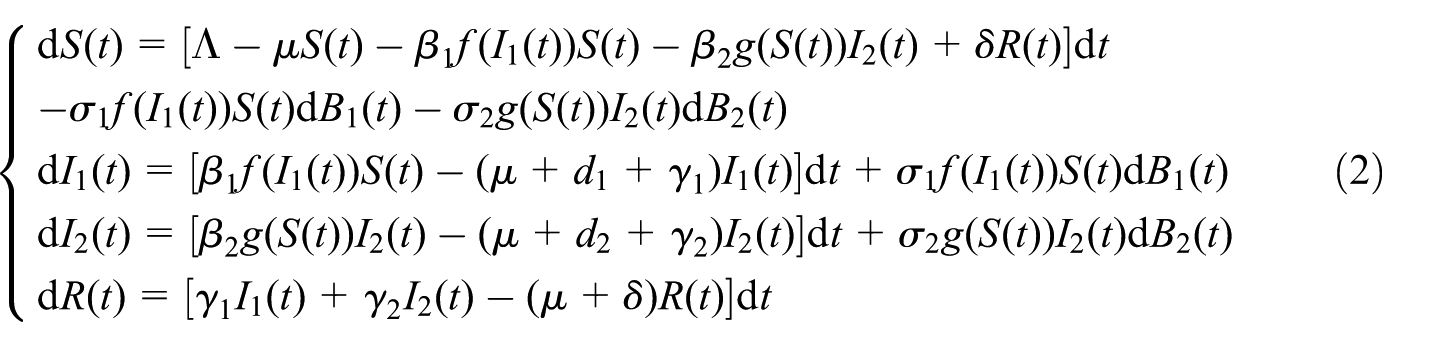
For the purpose of more realistic and the “psychological” effects,20,21 we investigate the general nonlinear incidences of the forms
whose state space is
The article is organized as follows. In section “Preliminaries,” we present several preliminaries and notions. The existence or uniqueness and stochastic boundedness of the global solution for model (2) are discussed in section “Existence or uniqueness and stochastic boundedness of global positive solution”. In section “Extinction of diseases”, sufficient conditions for the two diseases that are extinct are given are established. In section “Persistence in mean”, we obtain the sufficient conditions for the two diseases that are persistence for model (2). In section “Almost sure exponential stability,” a sufficient condition for the almost sure exponentially stable disease-free equilibrium is established. In section “Numerical simulations and examples,” some simulations are given to demonstrate the obtained results. Finally, a brief conclusion is present in section “Conclusion.”
Preliminaries
In the section, we give several preliminaries as follows. Throughout the article, consider the process
Definition 1
Meng et al.
22
define
Definition 2
For any initial value

Then solution
Definition 3
For any initial value

Then solution
Lemma 1
Set

Proof
From model (2), one can obtain

By integration, we obtain

Hence, one has

Remark 1
By Lemma 1, one could conclude that for solution

Therefore, one has

for
Existence or uniqueness and stochastic boundedness of global positive solution
Theorem 1
For any given initial value
Proof
Because coefficients for stochastic model (2) satisfy locally Lipschitz continuous, model (2) has a unique local solution
Choose

Let

Denoting

From model (2), one can obtain

One has

Defining a Liapunov function
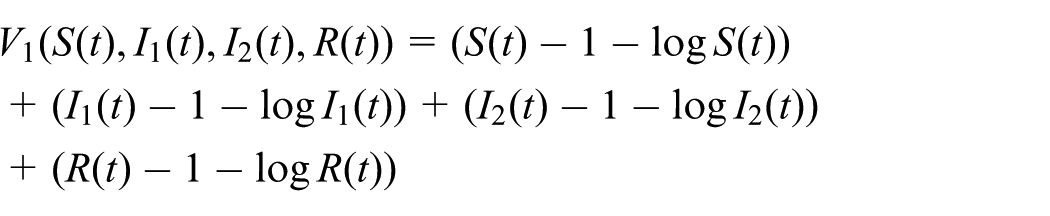
Using the Itô’s formula of

where
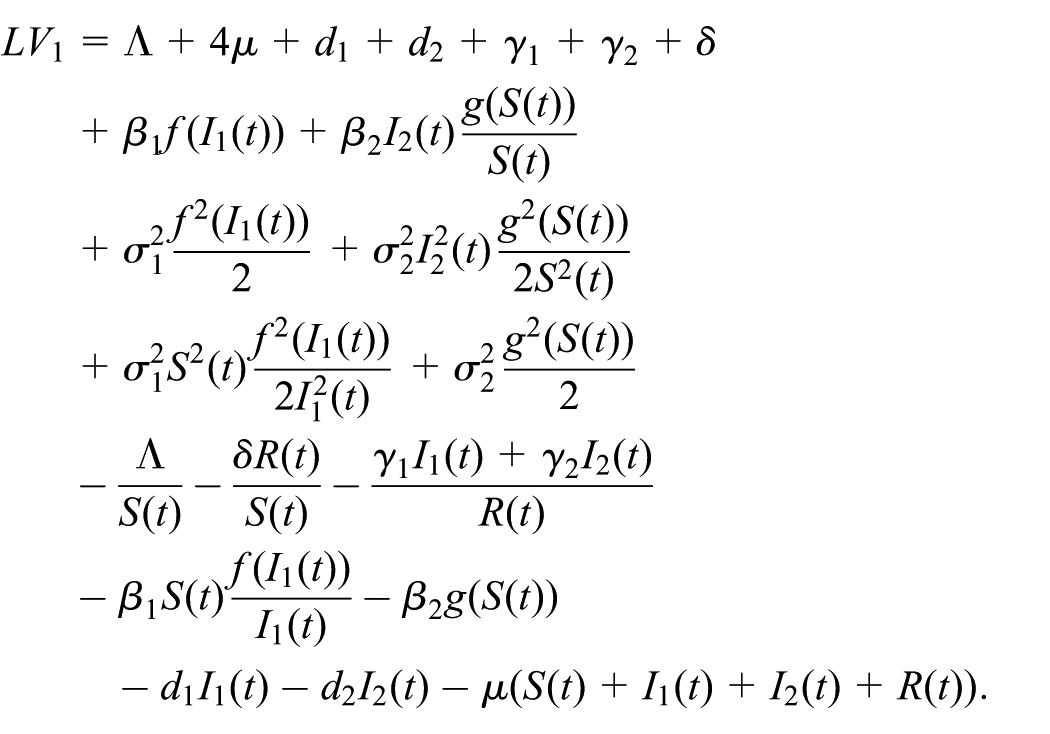
From assumptions (H1) and (H2), one has
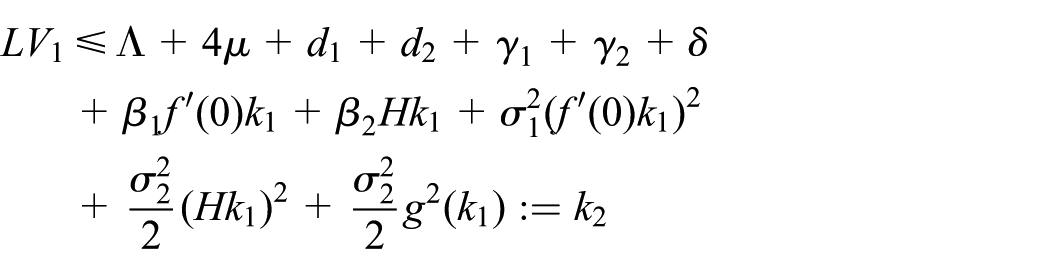
Then, one can obtain

This implies that

where

Then, one has

Let

Hence, one can obtain

where

As a consequence, one can have
Theorem 2
For any
Proof
Define a function as follows

where

where
By integrating the above inequality, we obtain

Hence, one has

This implies that

Let a constant

Then, one gets

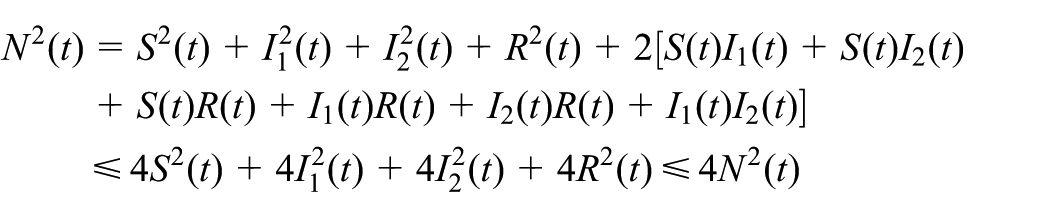
Applying the inequality
This implies that

where
Then, one can obtain

By Definitions 2 and 3, one can obtain the conclusion. □
Extinction of diseases
Theorem 3
For any given initial value
If condition (a) or (b) is satisfied, then the two diseases

Proof
Case (a).
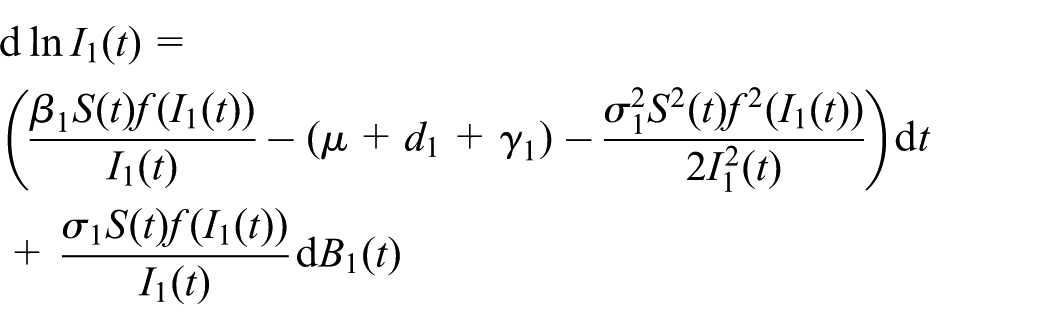
Using the Itô’s formula to the stochastic model (2), one can obtain
Integrating the above equality, one can obtain


Let

Applying the strong law of large numbers for martingales,28,29 we obtain
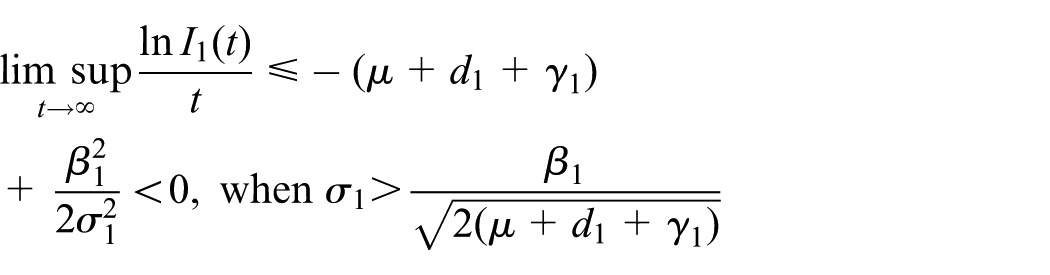
Dividing t and
Similarly, from the stochastic model (2), thus

Integrating the above equality, one can obtain


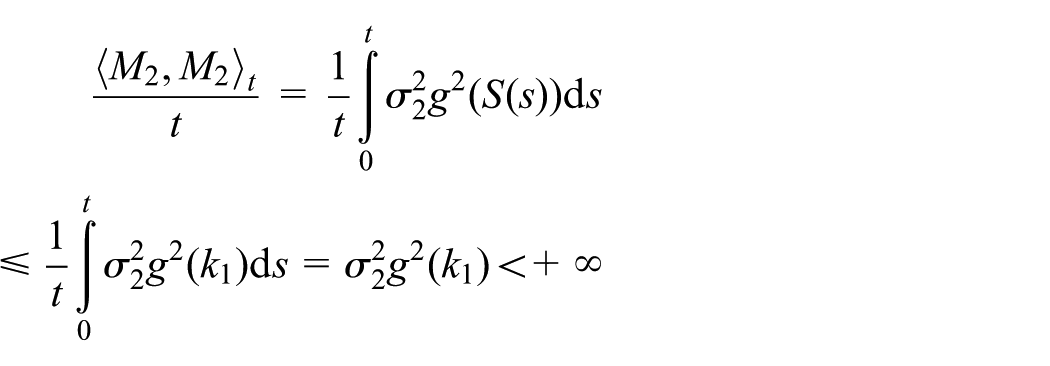
Let
Analogously, we can obtain

Case (b).
First, one concentrates on

Defining a function as follows

It is easy to see that
Hence, when

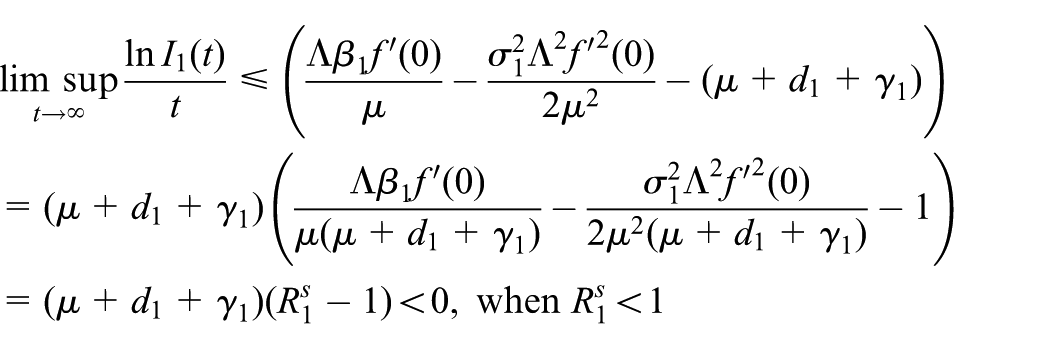
Then, one can obtain that
It implies that

Finally, one concentrates on

Define a function as follows

Similarly,
When

It leads to the following

This implies that

From the stochastic model (2), one can get

Taking the limit of the above equality, in the view of equations (10) and (12), it leads to

Directly from model (2), one can get

where
Integrating this equation, we obtain

Taking the limit of the above equality, from equations (10) and (12), then

Hence, one has
Remark 2
By Theorem 3, when
Remark 3
When functions
If condition (a) or (b) holds, then the two diseases of model (1) go to extinction.
This result has been obtained in Chang et al. 18 Obviously, Theorem 3 is an extension of Theorem 3.2 of Chang et al. 18
Persistence in mean
Theorem 4
For the stochastic model (2) with initial value
(a) When

(b) When

(c) When

where

Proof
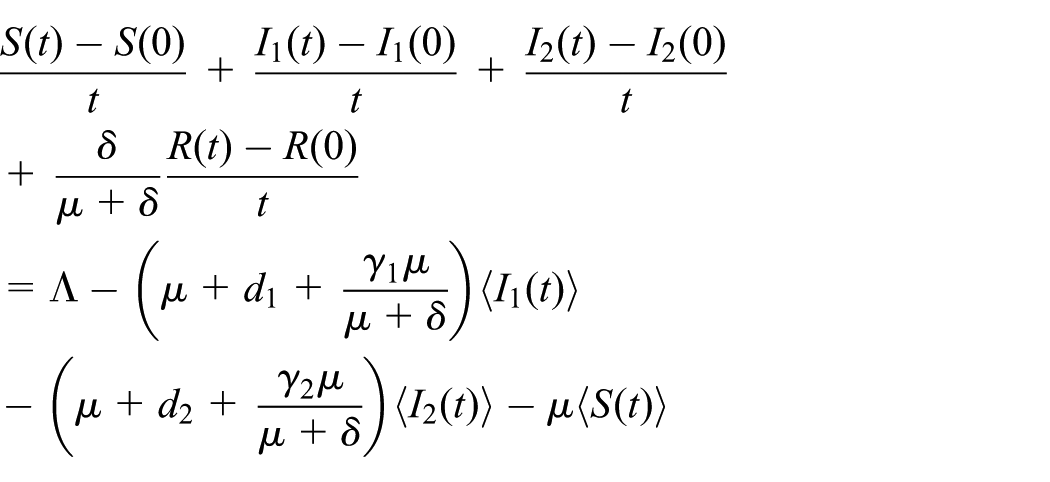
By integrating of the model (2), we obtain

It leads to
Then

where

From Theorem 3, one can get that if

Analogously, if

Choose
Case (a).
Define a Liapunov function

Applying Itô’s formula, one has

From assumption (H1), one can see that

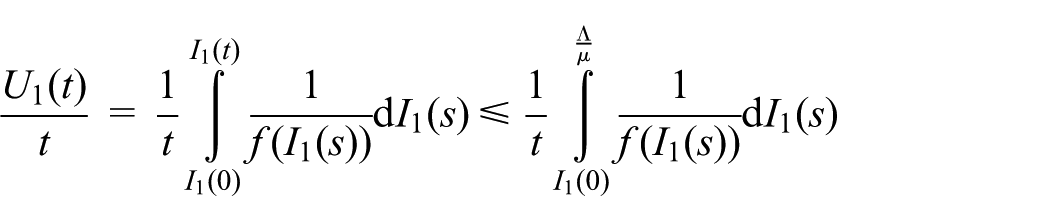
By integrating, we obtain

Define a function

Where

Then

Therefore,
Combining equations (15) and (18), for

When
In the view of equation (16)

where

Let

Thus, one gets

Since
Taking the limit of equation (20) and letting

Case (b).
Define a Liapunov function

Applying Itô’s formula, one gets

When

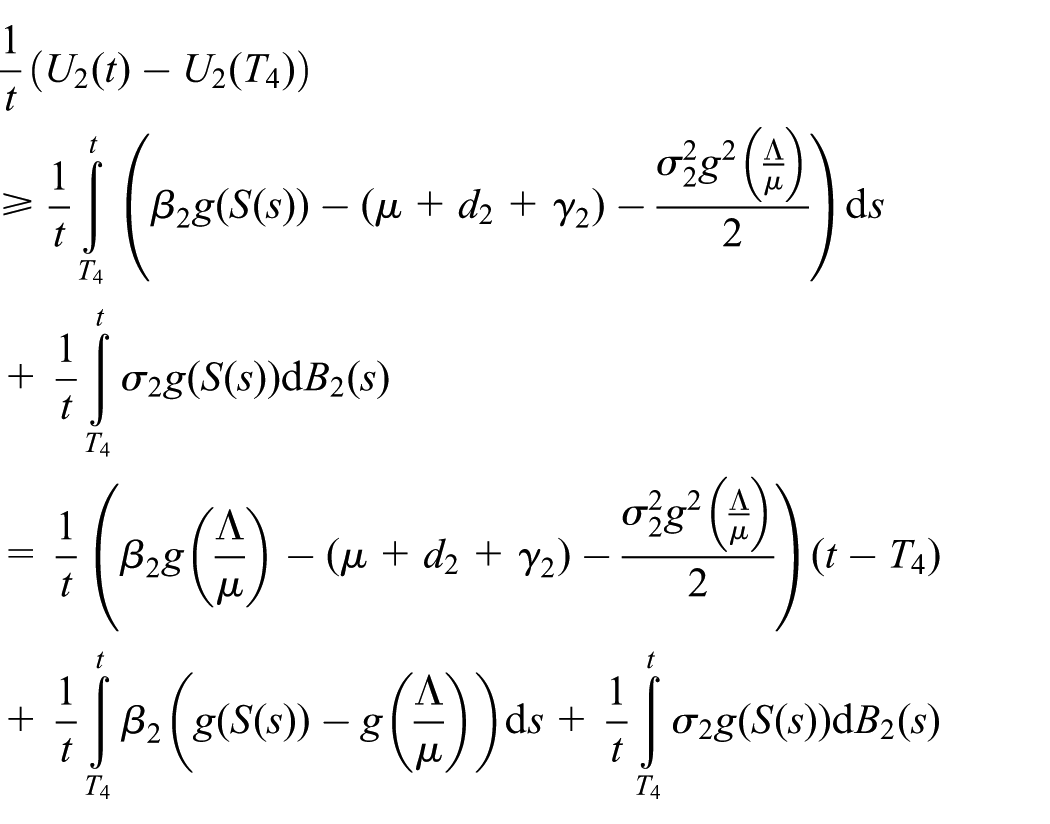
By integrating, we obtain
By mean value theorem

Combining equations (14) and (21), for
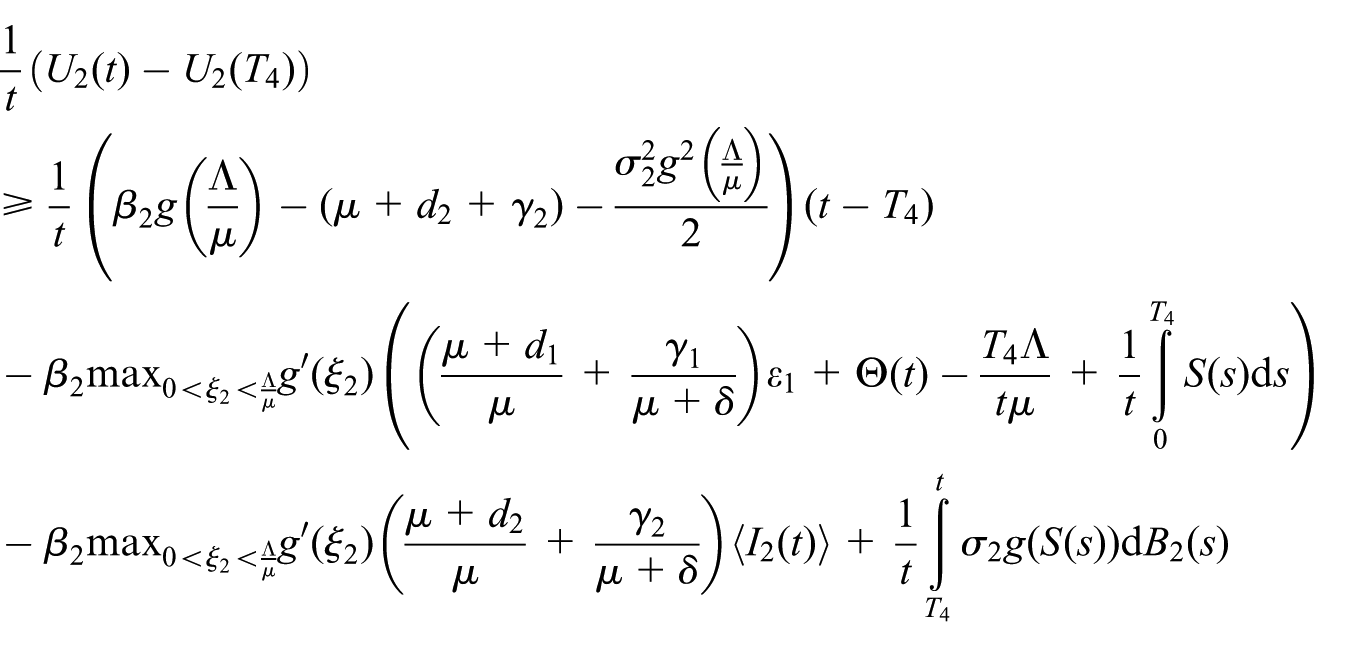
It leads to

where

Similarly, one also gets

From Lemma 1, one can obtain
Taking the limit of (22) and letting

Case (c).
Define a Liapunov function

Applying Itô’s formula, one has

When
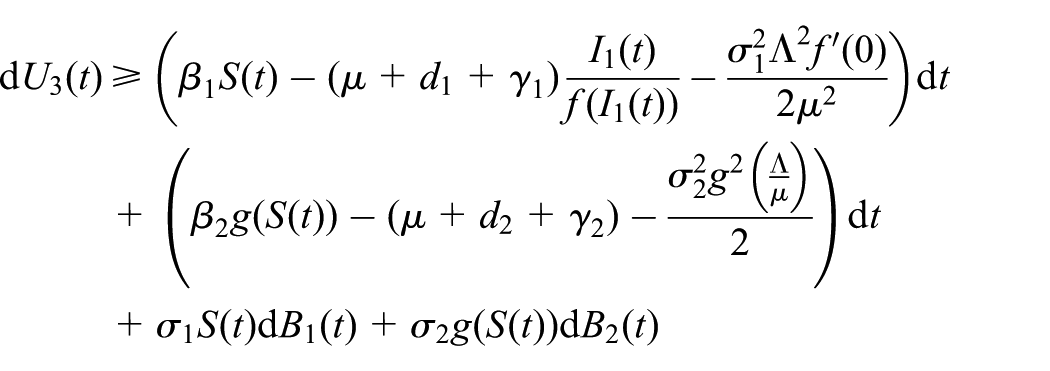
By integrating, we obtain

Similarly, applying Lagrange’s mean value theorem of the above inequality, in the view of equation (13), one can obtain

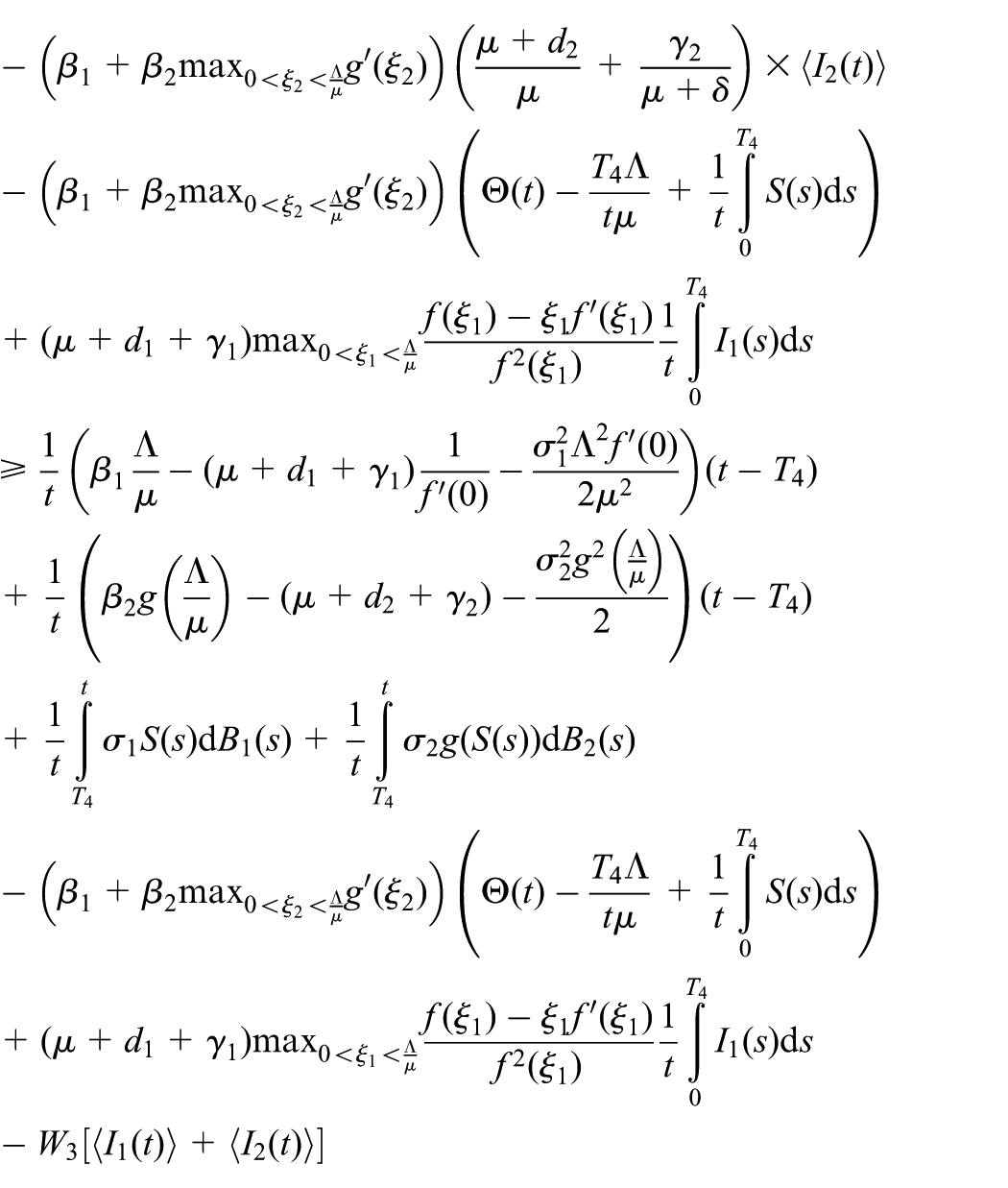
Accordingly

where

In the view of Cases (a) and (b), one obtains

when
Almost sure exponential stability
It is easy to see that model (2) has a disease-free equilibrium
Theorem 5
If

is a positive invariant set of model (2).
Proof
The proof is similar to Zhou et al. 30 One defines the function

Applying Itô’s formula, one has

Let
Then, one obtains

Integrating both sides of the above inequation from 0 to t, one has
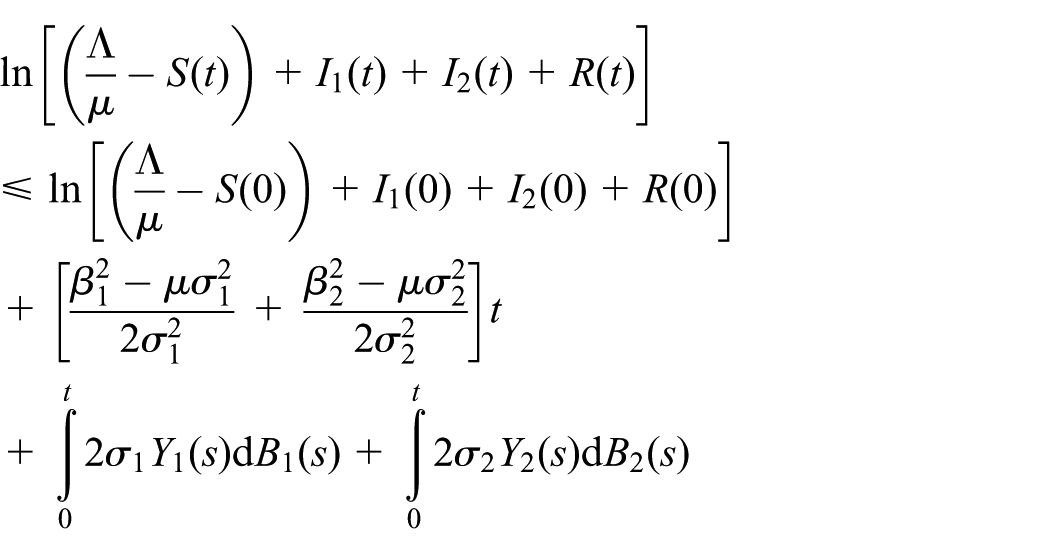
By the strong law of large number for local martingales, one gets

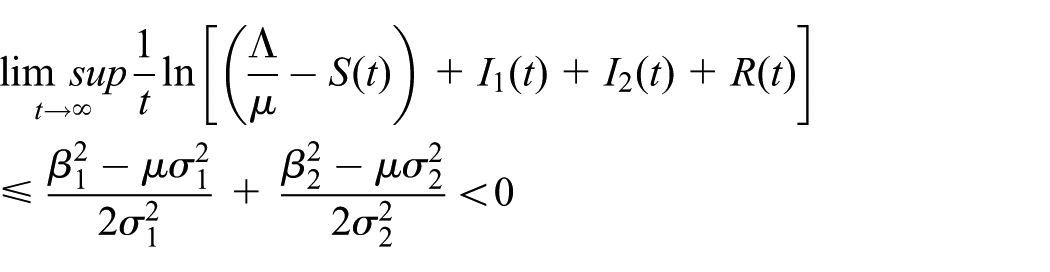
Under the condition that
Numerical simulations and examples
Now, numerical simulations can be demonstrated by the findings obtained. One considers functions

The stochastic model for model (24) is given as follows

It is easy to verify that

Compute that
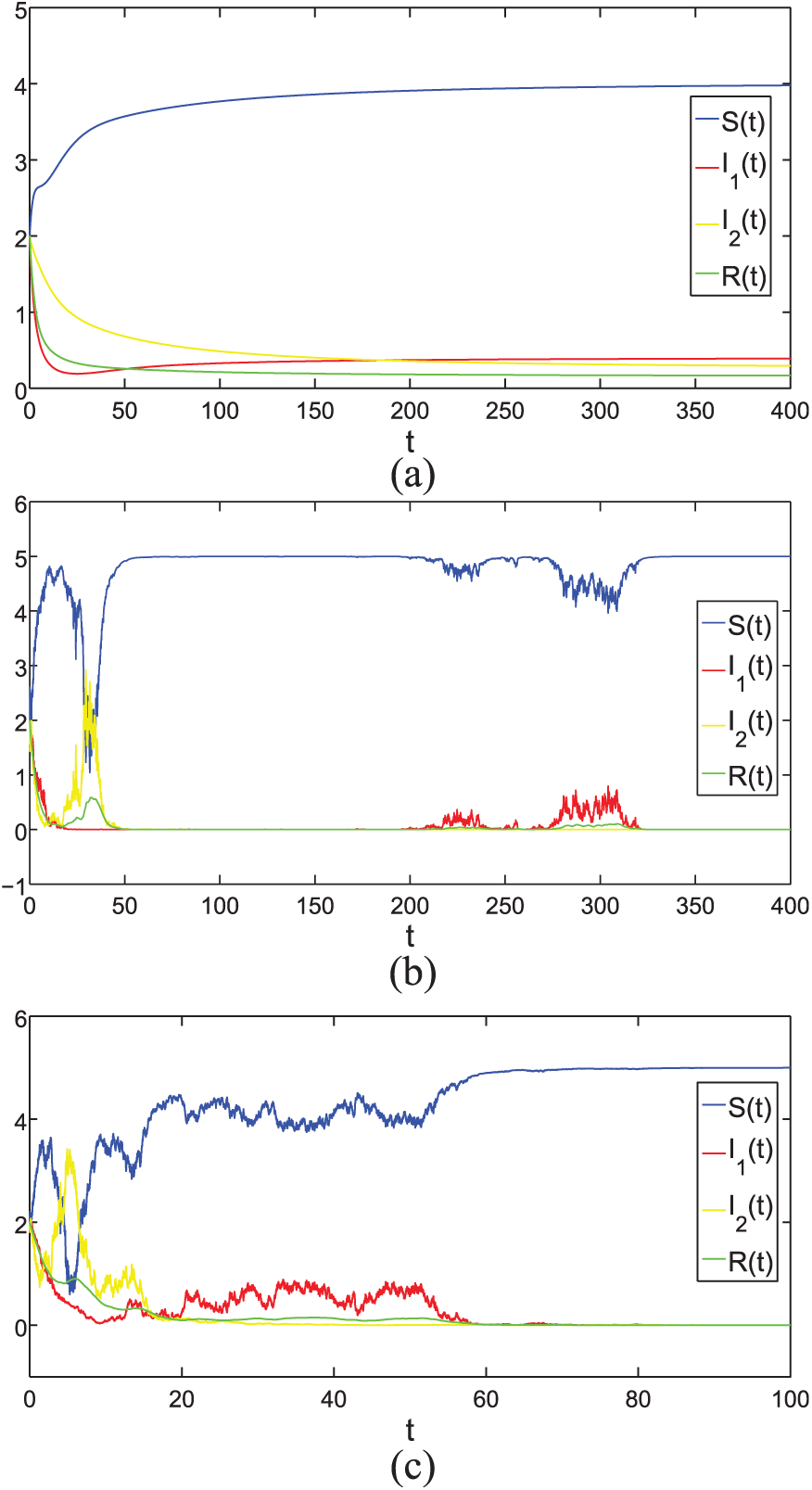
Some paths for
Considering the stochastic model (25) with the intensity of environmental noise
Considering the stochastic model (25) with the environmental noise
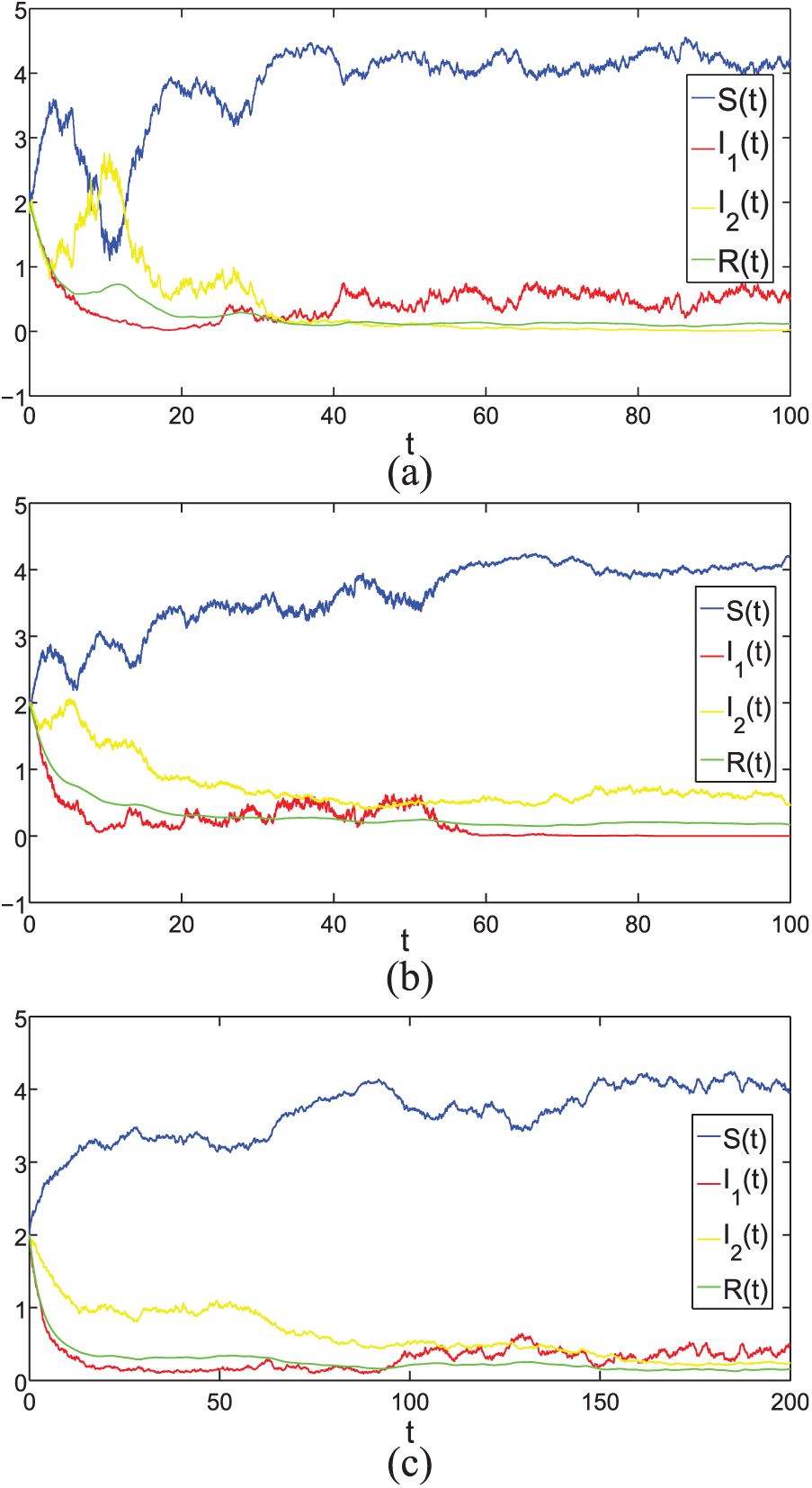
Some paths for
Consider the stochastic model (25) with the environmental noise
Consider the stochastic model (25) with the intensity of environmental noise

The probability density function of
And there naturally comes an interesting and significant question: how do the two diseases spreading with

Some paths for
We consider the other sets of parameters as follows


In this case,
Furthermore, we consider the stochastic model (25) with the parameters (26) and the initial value
Conclusion
In the article, a new kind of stochastic SIRS models with two different nonlinear incidences is extended. The model is introduced with multiplicative noise to the valid contact coefficients
Footnotes
Handling Editor: James Baldwin
Declaration of conflicting interests
The author(s) declared no potential conflicts of interest with respect to the research, authorship, and/or publication of this article.
Funding
The author(s) disclosed receipt of the following financial support for the research, authorship, and/or publication of this article: This work was supported by the National Natural Science Foundation of China (Grant No. 11561069), the Guangxi Natural Science Foundation of China (Grant No. 2016GXNSFBA380170, 2017GXNSFAA198234), and Guangxi University High Level Innovation Team and Distinguished Scholars Program of China (Document No. (2018. 35).
