




Abstract
To solve the problems of multiple parts, high cost of disassembly, and imperfect maintenance in multi-component complex systems, an opportunistic maintenance model of multi-component complex systems based on a time threshold is proposed in this article. The influence of the disassembly sequence and hybrid evolution factors on maintenance and learning-forgetting effects are considered in the proposed model. In this article, the learning-forgetting effect of the field strip in the components on the same level or components on different levels is considered in addition to the shortest disassembly path of multi-component complex systems. Imperfect and preventive maintenance is applied in a complex system, and random failure involves minor repairs. Multiple objectives that minimize maintenance costs and maximize operation time rate are proposed. Monte Carlo simulation is used to solve the model and obtain the time threshold of optimal opportunistic maintenance. The results show the feasibility of the opportunistic maintenance model.
Keywords
Introduction
In general, systems can be divided into three categories: simple systems, stochastic systems, and complex systems. 1 Simple systems are characterized by a particularly small number of elements. A stochastic system has many elements and variables, but the coupling between them is weak or random. Complex systems are featured by a large number of elements with strong coupling between them, such as in spacecraft and computer numerical control (CNC) machine tools.2,3 Traditional maintenance methods include breakdown maintenance and preventive maintenance. Breakdown maintenance is defined as maintenance after equipment failure. Enterprises are liable to suffer losses when using this maintenance method. Preventive maintenance can prevent or delay the occurrence of dimensional failures to a certain extent. Opportunistic maintenance is a combination of breakdown maintenance and preventive maintenance: when a component is maintained during system shutdown, whether or not other parts meet the maintenance requirements is simultaneously judged. If so, the components can be maintained together, minimizing the cost of disassembly and disassembly maintenance. 4 The opportunistic maintenance model has a wide range of applications. Many scholars have studied the opportunistic maintenance in-depth and many kinds of opportunistic maintenance models have been introduced. A detailed discussion of opportunity maintenance is presented in detail in section “Literature review.”
Literature review
Opportunistic maintenance model
Usually, due to the complexity of the system, multi-component systems require overall shutdown and disassembly during the maintenance process, which requires opportunistic multi-component system maintenance. Ding and Tian 5 studied the opportunistic maintenance strategy of wind-generated equipment and reduced maintenance costs by adopting an imperfect and opportunistic maintenance strategy. Cavalcante and Lopes 6 defined opportunistic maintenance in thermoelectric system as a basis for decision-making with minimum maintenance, opportunistic maintenance, and preventive maintenance. They considered the benefits and maintenance costs in a complex system and illustrated the multi-criteria model that immediately benefits energy companies. Hu and Zhang7,8 proposed a global optimization opportunistic maintenance model of advance fault defense to judge the potential for opportunistic maintenance using the timing and method of advanced defense as well as other factors. Due to the randomness of equipment degradation, Tao and Zhou 9 established an analysis model of cost maintenance completed under limited time with the total cost as the optimization target. Hou et al. 10 established an opportunistic maintenance model for multi-device hybrid production systems with maintenance cost as the optimized objective based on reliability. Shao and Zhou 11 proposed a modeling method of preventive and opportunistic equipment maintenance based on capacity-constrained resources. Zhang et al.12,13 established a prophylactic maintenance model for serial-parallel production systems with reliability and minimum total cost as optimization targets. They then considered the constraint theory and established an opportunistic maintenance model that optimizes the production capacity of a string/parallel production line and maintenance costs. Xia et al. 14 studied the characteristics of equipment’s degradation based on the production-driven opportunistic maintenance strategy and constructed the multi-attribute model and advance-postpone balancing (MAM-APB). Zhou et al. 15 established a dynamic opportunistic maintenance strategy and decision optimization model for three device serial systems based on device reliability. This kind of model mainly uses the serial system as the research object. To guarantee the production plan, the opportunistic maintenance strategy is chosen to reduce the maintenance costs by merging the maintenance operation. Hou et al. 16 established an opportunistic maintenance model of multi-component system based on reliability. They introduced a reliability recovery factor that overcomes the non-linear shortcomings of the traditional model based on run-time modeling while neglecting the relationship between deterioration process and time. Zhang et al. 17 proposed a comprehensive decay and evolution rule for independent equipment. Combined with multi-objective value theory and dynamic cycle decision-making model, they established a multi-objective predictive maintenance planning model for a device layer. Zhou et al. 18 studied a dynamic decision-making and optimized model for multi-device serial system opportunity maintenance based on equipment reliability and introduced the age reduction factor and the failure rate increase factor. This maintenance strategy uses the opportunistic maintenance strategy to reduce maintenance costs by combining maintenance operations. However, component similarity was not considered in this model.
Learning-forgetting effects
The learning-forgetting effect is widely used in education, supply chain management, and other fields. 19 Enterprises that consider the learning-forgetting effect can better develop mass production. 20 Tarakci 21 studied the learning-forgetting effect on maintenance outsourcing. Considering the employee’ learning-forgetting effect in the process of group production, Wang et al. 22 proposed three models to express the actual processing time and validated the model. Liao and Zhang 23 studied the learning-forgetting effects of employees on the group production process. They established a multi-objective model that considers the degradation effects of equipment to minimize costs and completion time. This model illustrates that the learning-forgetting effect is the objective in the production process. However, the field strip is different from the production of the product, which is characterized by the disassembly of all the components in a system not necessarily occurring in all cases. In most cases, only part of the system is disassembled while other products continue to be created in the process, so it is the production order that is studied. Due to the similarity between the finished products in group production, there is a learning-forgetting effect in the production process. Therefore, if there is similarity between the components in the multi-component system, there will be a learning-forgetting effect in the system disassembly process.
Time threshold of opportunity maintenance
Hu et al. 24 introduced opportunity preventive maintenance strategies into the maintenance of the entire system and considered the repair, unloading, and installation costs. Guiras and Turki 25 proposed a maintenance strategy for two—stage disassembly and assembly system integration. Wang and coworkers 26 proposed a time-based threshold and demountable multi-component system opportunistic maintenance strategy. Considering the impact of the field strip on maintenance, they introduced the N-ary tree and disassembly sequence planning. This type of strategy reduces the maintenance costs by merging the disassembly paths. However, during the disassembly of the multi-component system, the maintenance staff are affected by learning-forgetting due to the similarity between the components. The disassembly time changes with the learning-forgetting effects. Therefore, the strategy above lacks consideration of the learning-forgetting effects of the maintenance staff. Other authors studied the situation where the multi-component complex system does not implement opportunistic maintenance after failure. There are many ways of determining opportunistic maintenance thresholds. Bedford et al. 27 proposed a system reliability model based on fault distribution that releases a risk signal, which was used for decision-making for an opportunistic maintenance model. Huang et al. 26 considered the elimination of the weight matrix multi-correlation and proposed an intelligent fault diagnosis method. Huang et al. 26 proposed a method of using the Monte Carlo simulation. Tambe et al. 28 considered the impact of opportunistic maintenance on the equipment in the production planning model and solved the model using a genetic algorithm.
Summary of literature review
Although the above authors have completed considerable research on the opportunistic maintenance model, there are still some shortcomings: (1) no clear description is provided about whether opportunistic maintenance occurs after the multi-component complex system malfunctioned; (2) in the maintenance of complex systems with high disassembly costs, the similarity between parts is accompanied by the learning-forgetting effect, which results in changes in maintenance time. This influence factor exists objectively but is often ignored; (3) under normal circumstances, the equipment cannot be restored to as new condition after being used for a certain period of time, even with preventive maintenance (Figure 1). In this article, an opportunistic maintenance model for a complex system based on a time threshold is proposed, which introduces the effects of disassembly sequence and hybrid evolution factors on maintenance. The effect of learning-forgetting on demolition time was considered and the time threshold of opportunistic maintenance was scientifically and effectively deter-mined, providing a more cost-effective maintenance program for maintenance activities. To address the problems of multiple parts, high cost of disassembly, and imperfect maintenance in multiple component complex recession systems, a scheme was given in accordance with practical production.

Summary of relevant literature review.
Methodology
Problem description
Introducing the effect of disassembly sequence and hybrid evolution factors on maintenance, we studied the integration problem of equipment maintenance in a class of complex fading system equipment maintenance. Considering the effect of learning-forgetting on maintenance time, the advanced maintenance threshold with the lowest equipment maintenance cost and maximized equipment running time was studied. The basic assumptions were as follows:
The study object is a detachable complex system.
When the system is maintained, the final source of the fault involves the least amount of disassembly of the part, which is called the component of root node.
The multi-component system maintenance activities fall into three types: random failure maintenance, preventive maintenance, and opportunistic maintenance. Among them, preventive maintenance and opportunistic maintenance must consider the impact of hybrid evolution factors on maintenance and involves “repair non-new.” Random failure maintenance takes the approach of “recovery as old.”
Serial logic that exists between the components of a multi-component system and the system can process something or perform maintenance operations in the same normal operation time. The whole system is shut down for random failure maintenance, preventive maintenance, and opportunistic maintenance.
Maintenance of the shortest path disassembly operation should apply when any component must stop for maintenance.
Considering the multi-component system’s decision-making algorithm for disassembly cost, each component requires a preventive maintenance plan. Preventive maintenance should be carried out when the reliability of the component drops below a certain threshold.
Only one component can be disassembled at a time when the system is being maintained and maintenance cannot be interrupted. The total disassembly time is related to the similarity between the components.
The complex systems have many types of subsystems and hierarchical structures. The connections between them are complex and coupled.
The maintenance time that is closely related to the similarity between components includes maintenance setting time and maintenance processing time.
The possible benefit of the advanced maintenance of other parts that require no maintenance activities is considered when a part in the system is destroyed, and the model determines whether other components have opportunistic maintenance based on threshold policy.
The tree traversal algorithm can be used to find the optimal disassembly path of a specific part in a multi-component complex system. Based on the standard processing time and unit maintenance cost of each component, the actual dismantling time is calculated and the actual disassembly cost is obtained by multiplying the demolition cost while considering the influence of the learning-forgetting effect given the similarity between components. Incorporating the disassembly sequence and hybrid evolution factors into the influence of maintenance, we adopted reparative non-new preventive maintenance for the system. With the goals of minimizing maintenance costs and maximizing operational time, we applied minor repair when a random failure occurs to build an opportunistic maintenance model that considers disassembly sequence and the learning-forgetting effect. Monte Carlo simulation was used to solve the model and determine the time threshold for opportunistic maintenance.
Influencing factors and model
Disassembly tree model
The connection structure between parts includes a tree or a ring, and the tree structure can effectively express the disassembly model. 25 Gao et al. 29 proposed the concept of disassembly priority and verified the effectiveness of the disassembly tree method. Cao and Zhang 30 proposed a generation algorithm for disassembly tree that conforms to the disassembly rules and disassembly relations table. This algorithm was implemented on the virtual maintenance platform using examples that verified the feasibility of the disassembly tree structure. In this article, the complex decay system disassembly process is expressed by a tree disassembly structure.
As shown in Figure 2, the disassembly structure includes three factors: the disassembled parent node, the disassembled child node, and the disassembly relation. The disassembly relationship is divided into four types: no direct disassembly, parent-child disassembly, sequential disassembly, and synchronous disassembly. The parent node represents the structure before the disassembly and the child node represents the structure obtained after disassembly. Taking Figure 2 as an example, j1 is the parent node of j2, and j2 is the child node of j1. At the same time, j2 is the parent node of j6, and j6 is the child node of j2. The parent-child disassembly relationship indicates the relationship between the disassembled parent node and child node obtained after disassembly, denoted by j1 and j2 in Figure 2. The sequential disassembly relation means that other nodes must first remove the non-parent node when removing a node, as shown by j2 and j6 in Figure 2. Synchronous disassembly means that when a node needs to be removed, another node must be removed at the same time, as shown by j4 and j5 in Figure 2. The disassembly relationship outside the disassembly relationship between father and son, the disassembly relation in sequence, and the synchronous disassembly relation have no direct disassembly relationship, as shown by j2 and j3 in Figure 2.

Disassembly structure model.
Definition 1
For each node j, the disassembly time

With the basic disassembly structure model shown in Figure 2, we constructed an N-ary disassembly tree model and found the shortest path path(j) for disassembly by disassembly sequence planning. The shortest path’s acquisition steps are as follows:
Step 1. Set the root node j and set path(a), path(b), and path(c) to be empty.
Step 2. Judge whether a synchronization node of the root node j exists in the node incorporation path(a).
Step 3. Judge whether a sequential node of the root node j exists in the node incorporation path(b).
Step 4. Judge whether there is root node j’s parent node exists in the node incorporation path(c).
Step 5. Merge the nodes in path(a), path(b), and path(c). The nodes are subtracted to obtain the set D. Sets each node in the collection to the root node and all nodes in D return to the first step for recursion. Proceed to the sixth step if the element in set D does not change after two consecutive recursions.
Step 6. The shortest path consists of the path(j) and nodes in the set D.
We can obtain the shortest path through the above arrangement of tree traversal

Without considering the similarity between the components, that is, without considering the learning-forgetting effects, the total disassembly time


Learning-forgetting effect model
In the N-ary disassembly tree, the components of the system can be divided into different component layers. The number of components in the system depends on the root nodes in the N fork and the maximum number of parent–child disassembly relationships between the initial node plus 1. For example, all root nodes in Figure 2 are j4, j5, j6, j7 and the number of parent–child disassembly relationships between them and the initial node j1 are 2, 2, 1, and 1, respectively. The number of layers of the N-ary disassembly tree is 3, and the area of j1 is 0. According to the similarity between the components, each component layer includes several types of components; each of them has a certain number. We supposed that the N-ary disassembly tree includes


where
Definition 2
The degree of similarity between the component layers is equal to the degree of similarity between disassembly operations. The number of component layers is one more than the number of disassembly operation layers, and the disassembly operation layers are one more than the dimension of similarity. The formula is as follows

where
In the disassembly tree model, if the jth component in the ith component layer has a certain number, the degree of similarity between the same components in the same component layer is specified as 1, meaning there is no need to have a disassembly preset time between the same components in the same component layer. The disassembly preset time is supposed to be set when considering the disassembly between the different component classes in the same component layer and the disassembly operations between the different component layers.
In the process of disassembly, it is necessary to consider the degree of similarity between the component layers and between the different component classes in the same layer. The operation time shortens with experience gained from the previous disassembly process when the worker is dismantling the same component. The disassembly time should be scheduled for switching tools when a worker moves from one component to another. Given the time interval of the disassembly operation, the learning effect of the disassembly workers decreases and the forgetting effect will be shown. The forgetting model expression in a previous report 22 is adopted in this article


where
Three kinds of learning and forgetting models were introduced in the literature, 22 as shown in Figure 3.

Learning-forgetting model.
The actual disassembly operation time of each node in the N-ary disassembly tree can be calculated using the above three learning and forgetting models.
Preventive maintenance model based on effectiveness factor
Preventive maintenance and sudden failure maintenance must be considered when the N-ary disassembly tree is used to represent the equipment maintenance process in a complex system. The non-new repair model is based on the effectiveness factor, which includes the age reduction factor and failure rate increase factor. Preventive maintenance adopts the non-new and non-perfect repair maintenance methods and the failure rate function of front and rear components are 29


where
Due to the opportunistic maintenance that our proposed model adopts, we supposed the service age


Optimal opportunistic maintenance threshold model of a single component
The failure time of equipment components usually obeys the Weibull distribution. A similar error was corrected. The failure rate function



where mj represents the shape parameter of the jth node in N-ary disassembly tree and nj represents the dimension parameter of the jth node in N-ary disassembly tree.
A single component of the jth node in the N-ary disassembly tree undergoes minor maintenance if there is a sudden failure, and the service age of the component will not change. In this article, repair non-new preventive maintenance methods are adopted based on the preventive maintenance model of the failure factor. The preventive maintenance of components is supposed to be completed when the service age of components achieve the preventive maintenance interval Tj. The service age is aijTij.
A maintenance period for each node consists of four parts: preventive maintenance interval, disassembly time, preventive maintenance time, and minor repair time. The disassembly operation includes disassembly preset time and disassembly operation time. The cost incurred during the cycle consists of disassembly costs, preventive maintenance costs, minor repair costs, and downtime costs. The downtime includes disassembly time, preventive maintenance time, and minor repair time. The formulas are as follows


where
Opportunistic maintenance model based on threshold
When a component j (component j is an arbitrary root node in the N-fork disassembly tree) in the N-fork disassembly tree is randomly faulty or preventive maintenance is performed, all the machines need to stop and the other components can possibly be maintained. We select the components for opportunistic maintenance by setting the threshold Tw. If the difference in the optimal opportunistic maintenance threshold
In this opportunistic maintenance strategy, the ith downtime is composed of three operation parts: minor repair maintenance work, preventive maintenance work, and opportunistic maintenance work (all components that meet the opportunistic maintenance requirements, and j itself is also eligible opportunistic maintenance, including disassembly work of component j). The calculation formula of downtime

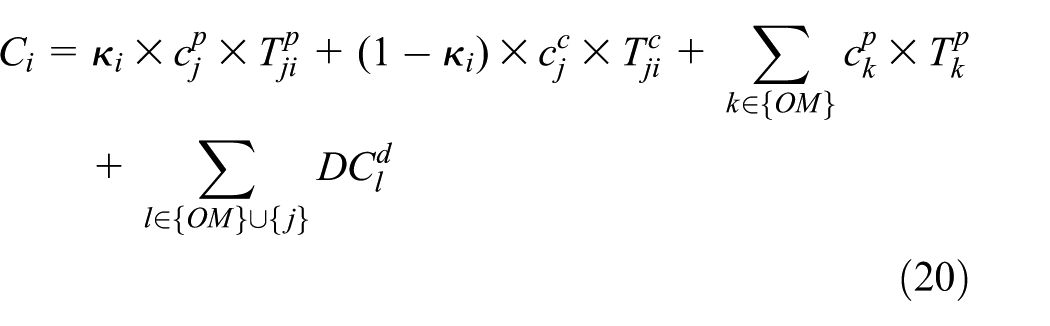
where

The normal working time of system is




Aiming at minimizing the total maintenance costs ZC and maximum operation time rate, the optimal opportunistic maintenance threshold
Simulation solution
Fusing the N-ary disassembly tree model, the learning-forgetting model of similarity between components, and the failure-based device prevention repair non-new preventive maintenance model, and considering the single-piece optimal opportunistic maintenance threshold model and opportunistic maintenance model of optimal maintenance interval, we constructed the opportunistic maintenance model for a complex recessive system considering the disassembly sequence and learning-forgetting effect.
The opportunistic maintenance model is a dynamic process that uses the Monte Carlo simulation to solve the questions of the model effectively. The process of solving the model is shown in Figure 4. The shortest disassembly path and disassembly time of each node obtained first discretizes the normal working time. Compare the relationship between the maintenance threshold and the disassembly time. If the conditions are met, the next calculation and selection, such as the comparison between CS and B and the comparison between t and

Flow chart followed for solving the model.
Case study
Parameter setting
In order to verify the effectiveness of the proposed model, we design a suitable complex fading system. Suppose the normal working time

N-ary disassembly tree of complex fading systems.
Parameters related to a N-ary disassembly tree node in a complex fading system.

The nodes in each rectangle in Figure 5 are the same component in the same layer, which includes 4 layers and 12 components in Figure 4. For example, j1, j2, and j3 are the first component in the second layer, denoted as
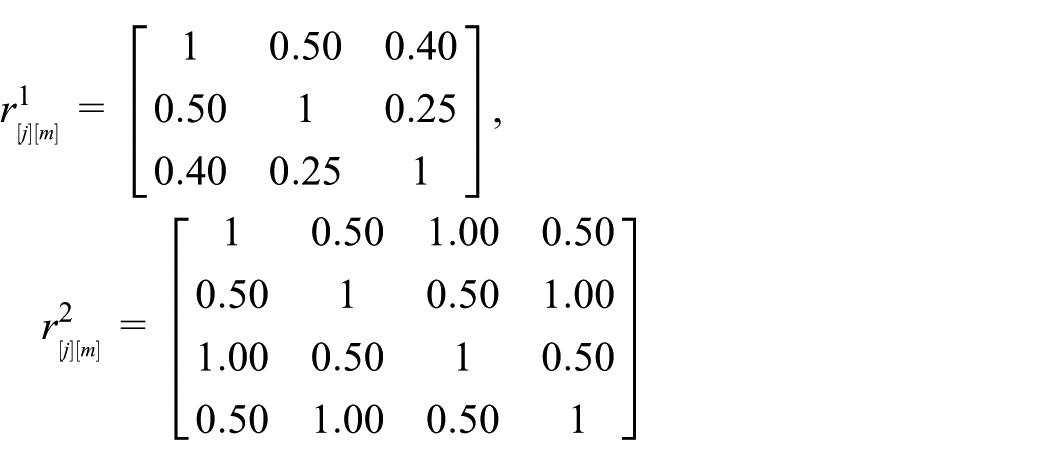

Calculation results of
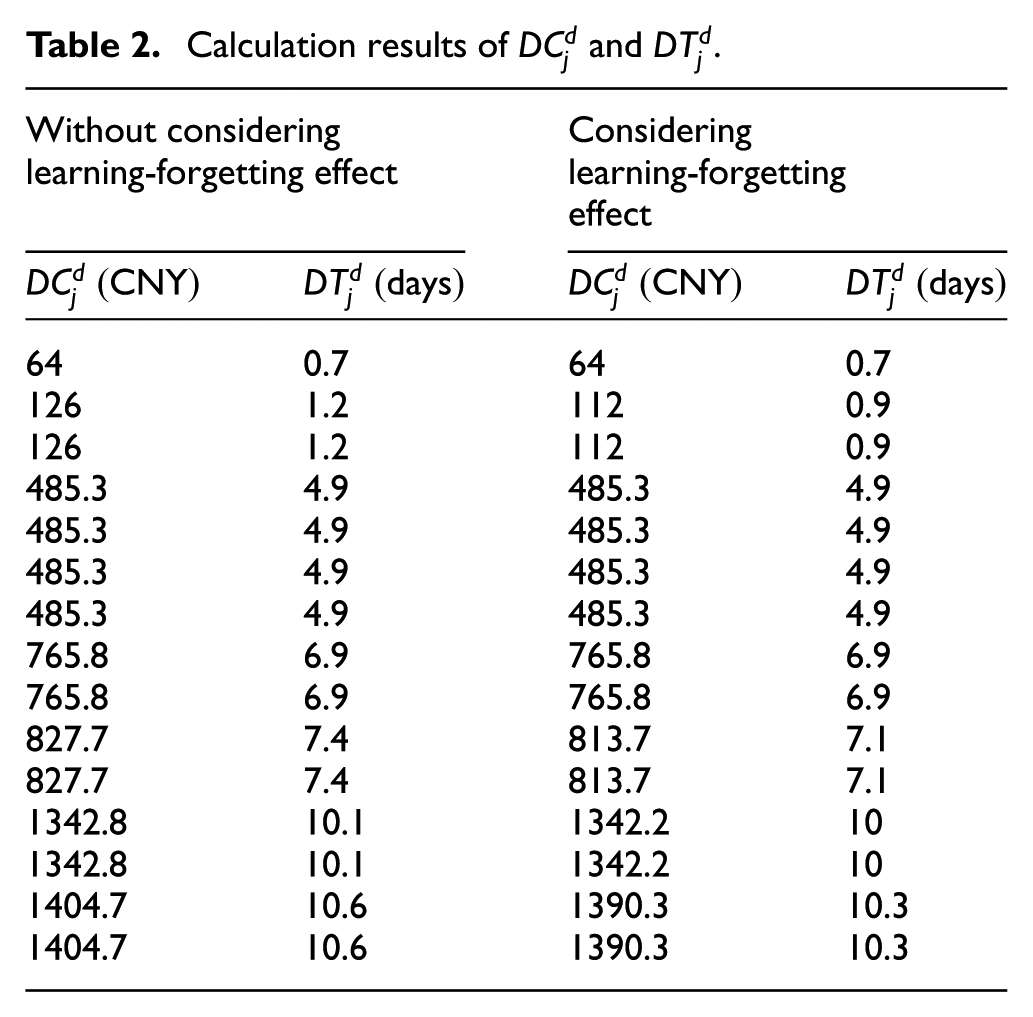
We set the shape parameter
Optimal maintenance time interval of root node considering learning-forgetting effect.
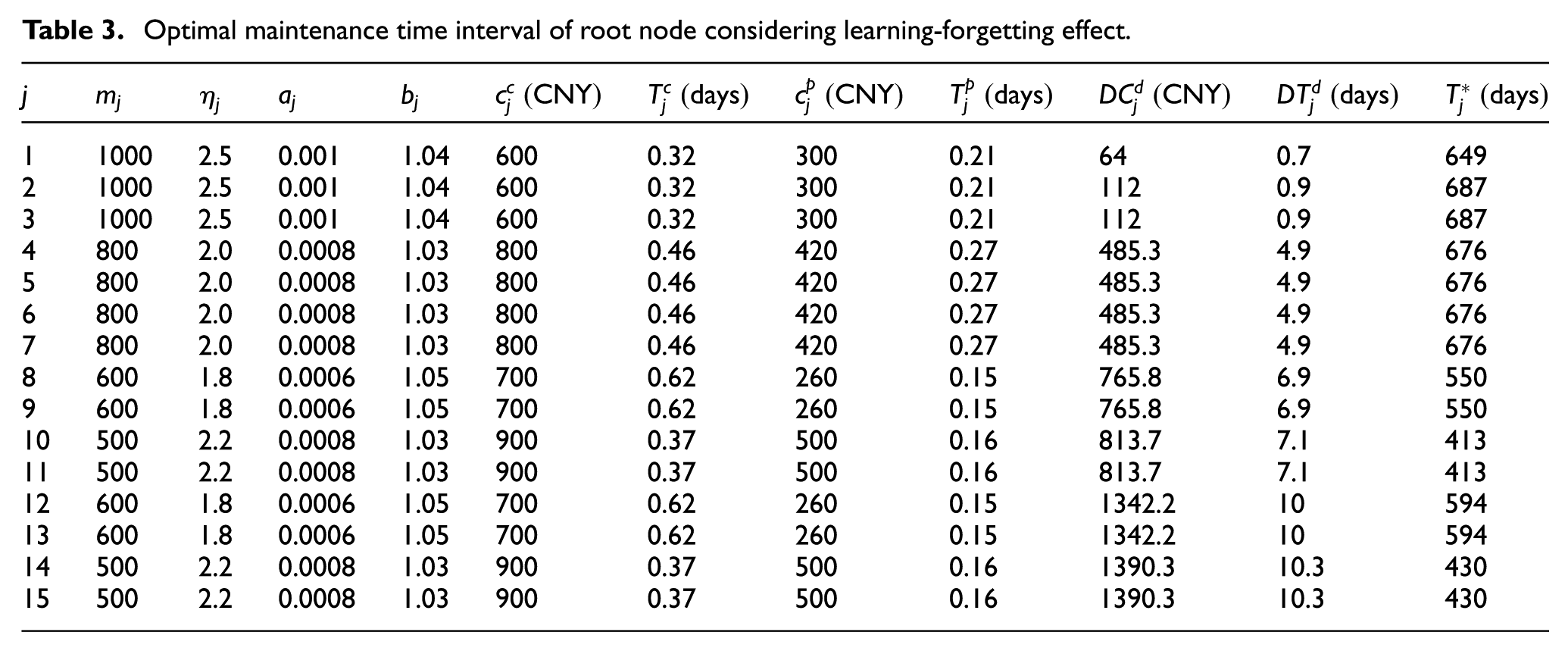
By combining all the analysis results, it is helpful to determine the disassembly cost, disassembly time, and opportunity maintenance threshold through considering learning-forgetting effects. Therefore, it is feasible to consider the learning-forgetting effects in the model.
Monte Carlo simulation
On the MATLABR2015a platform, Monte Carlo simulation was used to simulate and example. Taking 1 day as a unit, the normal working time of the system can be divided into 4000d time units. Monte Carlo simulation of a component based on service age was run for each time unit to judge whether a random fault occurs within the time unit by generating a random number. The core step involves calculating the number of random failures for the service age of a unit component. Compared with the random number that occurs in [0,1], a random failure occurs if the random number is less than or equal to the number of random failures. This situation requires a minor repair. Otherwise, it is assumed that no random failure occurs. Other components make a judgment as to whether or not to perform opportunistic maintenance using the opportunistic maintenance model based on threshold Tw when there is a random failure in a part of the system or the optimal maintenance interval met for preventive maintenance. After preventive maintenance and opportunistic maintenance, the components are not as good as new. The service age of the component is not zero due to the age reduction factor and the failure rate increment factor. The similarity between components should be considered for the learning-forgetting effect in the process of component maintenance. In particular, when the equipment experiences a random failure and meets the conditions for opportunistic maintenance, the component should receive opportunistic maintenance immediately after a minor repair. The total maintenance operation time ZT and total maintenance cost ZC can be obtained by the

Monte Carlo simulation result.
As shown in Figure 6, the curve is smooth and there is a unique minimum point after 2000 simulations. The threshold
Analysis of impact of preventive maintenance
When a random failure occurs and the opportunistic maintenance condition is satisfied, the differences in the impact on ZC and ZT with and without preventive maintenance is shown in Figure 7(a) and (b), respectively. Preventive maintenance is considered for components that have random breakdowns and meet the conditions for opportunistic maintenance. The opportunistic maintenance has less influence on the threshold of optimal opportunistic maintenance and the curve shifts to the right.

Influence analysis chart of preventive maintenance.
Analysis on the effect of hybrid evolution factors
Impact analysis of age reduction factor
Taking the simulation results of the original parameters of the model as the control group, the value of the age reduction factor was adjusted by multiplying six different adjustment magnifications of

Effect of age reduction factor.
Simulation results of changes in age reduction factor.
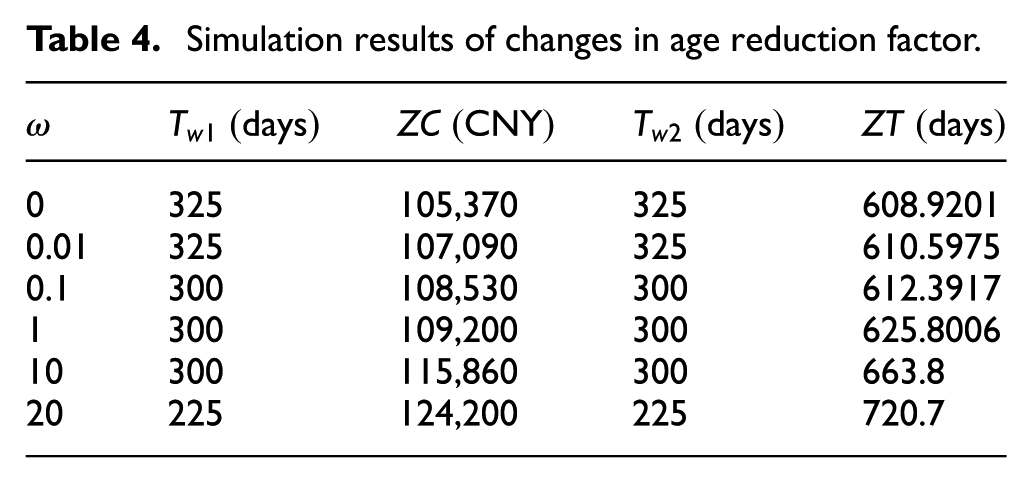
The results show that the minimum values of the ZC and ZT curves shift to the left, the threshold of optimal opportunistic maintenance decrease, the minimum total maintenance cost ZC and the minimum total operation time ZT increase, the range of the increase continually expands, and is obvious especially after multiples of greater than 1 with multiple increase in the age reduction factor. However, other influencing factor parameters remain unchanged. The results show that the optimal opportunistic maintenance threshold
Analysis of the effect of failure rate increase factor
The simulation results of the primary model parameters were used as the control group. The incremental factor of the failure rate was adjusted by adding to the numerical value

Influence diagram of failure rate increase factor.
Simulation results for failure rate increase factor’ changes.

The analysis showed that the minimum points of the ZC and ZT curves shifted to the left, the optimal opportunistic maintenance thresholds
Analysis of influence for learning-forgetting effect
Analysis of influence of fixed learning rate
Regarding the simulation results produced by the model parameters as the control group, the fixed learning rate

Influence diagram of fixed learning rate.
Statistical table of simulation results for different fixed learning rates.

The analysis showed that (1) the learning coefficient
Analysis of influence of forgetting parameters
Regarding the simulation results produced using the model parameters as the control group, the forgetting parameters

Influence of forgetting parameters.
Statistical table of simulation results for change of forgetting parameters.
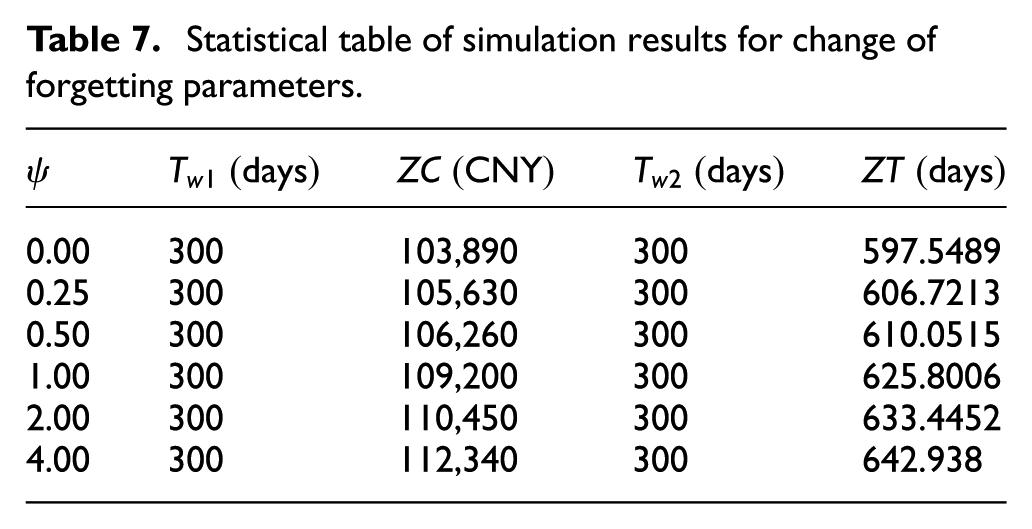
The analysis showed that the minimum point
Comprehensive factor influence analysis
A special case for comparative analysis was examined where the opportunistic maintenance is completed with and without considering three factors. These three factors were considered in the original parameter model in this article. Under the condition that the other parameters remain unchanged and without considering the model of the three factors, the parameters were as follows: (1) preventive maintenance is not performed for the component when it experiences a random failure and meets the conditions of opportunistic maintenance, (2) the age reduction factor
We performed 2000 Monte Carlo simulations and the results are shown in Figure 12 and Table 8.

Comprehensive impact of three factors.
Statistics table of simulation results with and without considering three factors.

By comparing the graphs without considering three factors, the minimum points of the ZC and ZT curves in the graph that considers three factors, and with a small threshold
Decision loss without considering the three factors.

Conclusion
Considering the influence of the learning-forgetting effect and the hybrid evolution factors during maintenance operation, we proposed an opportunistic maintenance model for a complex fading system based on a time threshold by introducing a learning-forgetting effect model into complex system maintenance planning. We quantitatively analyzed the influence of the choice to perform preventive maintenance on the thresholds for components that have suffered random failures and met the conditions for opportunistic maintenance. We also examined the influence of the age reduction factor and the failure rate increase factor on the threshold, and the influence of the learning-forgetting effect on the threshold. The research showed that the variation trend in ZT is same as ZC and their extreme points are similar, but their pattern curves are not exactly the same. The numerical values of the multiple targets of minimizing maintenance cost and maximizing operation time are same in terms of results. Performing preventive maintenance for components that have random failure and meet the condition of opportunistic maintenance is superior to not performing preventive maintenance in terms of maintenance cost and maintenance time. The system tends to perform the opportunistic maintenance conservatively. The optimal opportunistic maintenance threshold
In this article, an opportunistic maintenance model for complex system based on time threshold was proposed, which introduces the effect of disassembly sequence and hybrid evolution factors on maintenance. At the same time, the effect of learning-forgetting effect on demolition time was considered and the time threshold of opportunistic maintenance was determined scientifically and effectively, which provides a more cost-effective maintenance program for maintenance activities.
However, the limitation of the research is that the proposed model ignores the correlation between components in complex system. In future research, the correlation between components of the system will be discussed.
Footnotes
Appendix 1
Acknowledgements
The authors gratefully thank all the editors and reviewers for their valuable suggestions on the improvement of this paper. We also thank Wentao Yu of Beijing Jiaotong University for his helpful suggestions on the quality improvement of our paper.
Handling Editor: Zhaojun Li
Declaration of conflicting interests
The author(s) declared no potential conflicts of interest with respect to the research, authorship, and/or publication of this article.
Funding
The author(s) disclosed receipt of the following financial support for the research, authorship, and/or publication of this article: This research was supported by the National Natural Science Foundation of China (Grant No. 71701113), the Project of Shandong Province Higher Educational Science and Technology Program (Grant No. J17KA167), the Shandong Provincial Natural Science Foundation, China (Grant No. ZR2016GQ11), and the Qingdao Social Science Planning Research Project (Grant No. QDSKL1801113). The research is also supported by SDUST Research Fund (Grant No. 2018YQJH103).
