




Abstract
The non-stationary properties of the strong ground motions are considered to have dominant influence on the dynamic response of structures. In this article, a new method is proposed to study the instantaneous frequency by constructing analytic signals with two orthogonal horizontal components of ground motion vectors directly. Comparing with the traditional method of constructing analytic signals based on Hilbert transforms, the new method is digestible and simple in calculation, and it can also avoid some associated limits of Hilbert transform. In this article, instantaneous frequency obtained from the new method is simulated with an exponential decay model, and its attenuation rules which can be used for synthesizing design ground motions are investigated. By comparing the attenuation rules between vector and unidirectional ground motions, the difference between new method and traditional method are investigated. The results show that the new method of constructing analytic signals is feasible, and the exponential decay model is effective to describe the change of instantaneous frequency with time.
Keywords
Introduction
The conventional properties of amplitude, frequency, and duration represent the basic characteristics of ground motions. And they are important factors to specify and select strong ground motions for structure dynamic analysis and seismic design. While they are not enough to describe all the characteristics of ground motions, there are other nonnegligible properties that need more attention. The non-stationary properties in amplitude and frequency contents are important. Herein “non-stationary” means the property of signal is changing with time. In both time and frequency domains, ground motions are typical non-stationary signals. The non-stationary property has been widely studied, 1 methods to generate non-stationary ground motions,2,3 especially non-stationary ground motion in two orthogonal horizontal directions,4,5 have gained increasing attention recently. The non-stationary frequency content is harder to describe than amplitude content; therefore, some methods are put forward, such as Fourier transform, physical spectrum, 6 Hilbert transform and Hilbert-Huang transform,7,8 wavelet transform,9,10 zero-crossing rate, 11 and univariate phase spectrum model. 12
Armstrong found that the frequency modulation was able to reduce disturbances in radio signals, which drew the attention of people to the properties of frequency. 13 The concept of instantaneous frequency (IF) was initially put forward based on the frequency modulation theory of communication and was further developed benefited from research results of analytic signals. Because of its clear physical meaning and simplicity, Dong 14 used IF to describe non-stationary frequency content of ground motions and achieved satisfactory results.
Both ground motion itself and its structures dynamic response are three-dimensional in nature. It is obvious that researches based on one-dimensional ground motion cannot fully describe the whole characteristics nor reveal the nature of seismic response on structures, it is necessary to consider ground motion as a vector in research.
The traditional method to obtain IF consists of the following processes (1) seismic signal is processed through Hilbert transform to get its orthogonal complex signal; (2) an analytic signal is constructed by the original and its complex signal; and (3) a complex plane is built where IF can be obtained as the derivative of instantaneous phase. However, the calculations of Hilbert transform are complicated and are limited with restrictions, such as the limits related to the Bedrosian 15 theorem and the Nuttall theorem. 16 This article presents a new method to obtain IF, that is, using two orthogonal horizontal components of ground motion to construct vector signal, the derivative of instantaneous phase in real plane is IF. An exponential decay function is used to simulate IF based on optimization algorithm; then the corresponding model parameters are simulated with an attenuation model. Finally, the attenuation rules of IF model parameters between vector and unidirectional ground motion are compared, and the new method and traditional method to obtain IF are compared.
IF of signals
Definition of IF
Before introducing the process of obtaining IF of ground motion vector, the definition and limits of traditional frequency must be introduced to make the concept of IF clearly. Frequency is only physically meaningful for monocomponent signals with invariant frequency, or frequency fluctuates within a narrow range. 17 For multicomponent signal, Fourier transformation can be used to decompose it into sum of harmonic signals with particular frequencies. However, there are some limits that Fourier transformation is only suitable for stationary signals. In addition, the frequency obtained this way only represents global information rather than local properties of signals; therefore, a new concept generalized from constant frequency is necessary.
The concept of IF was initially put forward in the frequency modulation theory by Carson and Fry 18 in 1937. They argued that IF is the rate of phase angle changing with time. IF can describe instantaneous properties and has advantages in the study of non-stationary signals. Balth 19 proposed the definition of IF, based on a harmonic oscillation written in the form

where

Constructing analytic signal using Hilbert transform
Most signals are not harmonic signals. To obtain the IF of a real non-harmonic signal, the first step is to construct an analytic signal, whose real and imaginary part represent orthogonal information in the complex plane.
Gabor
20
proposed a practical method of constructing an analytic signal and laid the foundation for further study. That is, first creating a complex signal from the real one using the Hilbert transform and then combining the two orthogonal signals into an analytic signal. For a real signal

where PV is the Cauchy principal value. Then a corresponding analytic signal

With Euler’s formulation,


In the complex plane constructed by an analytic signal
The classical definition of the IF

In addition, IF was also expressed as

Constructing analytic signal using ground motion components
One important step to obtain IF with the aforementioned method is Hilbert Transform. However, it has some disadvantages and is complex in comprehension and computation.
To avoid the aforementioned problems, this article presents a new method which is free from Hilbert Transform. The new model proposes to construct an analytic signal with two orthogonal components of the seismic vector, instead of the original seismic signal and its Hilbert transformation. Equations (4)–(9) are still available in this new case, where
As Figure 1 shows,

Envelope and instantaneous phase of signal.
Modeling of IF
IF was modeled by an exponential decay function by Dong 14


where instantaneous phase

In this model,
Results and discussion
Ground motions used
It is a basic step to collect many seismic records and screen them properly for research. Parameters obtained based on enough records can achieve statistical significance and can be applied to structural design as well as structural analysis. This article collected seismic records from the following database institutions: NGA (PEER), 22 ISESD (Europe), 23 NIED (Japan), 24 and GeoNet (New Zealand). 25 Most of the records were collected from NGA and NIED, and only a small part of them came from ISESD and GeoNet.
To make analysis results statistically significant, only corrected records with complete time history were used. And every record is composed of one vertical component and two orthogonal horizontal components. Moreover, records with magnitudes below than 4.0 and peak ground acceleration (PGA) less than 0.2 m/s 2 are not used. After screening, 4904 seismic records are adopted for following analysis. Since the distributions by magnitude and epicentral distance of those records are uneven, it is inappropriate if they were analyzed with equal weight. 26 Therefore, they are classified into several categories by magnitude and epicentral distance (Figure 2). After classification, they are weighted according to the size of their categories in order to improve the confidence of the statistical results.
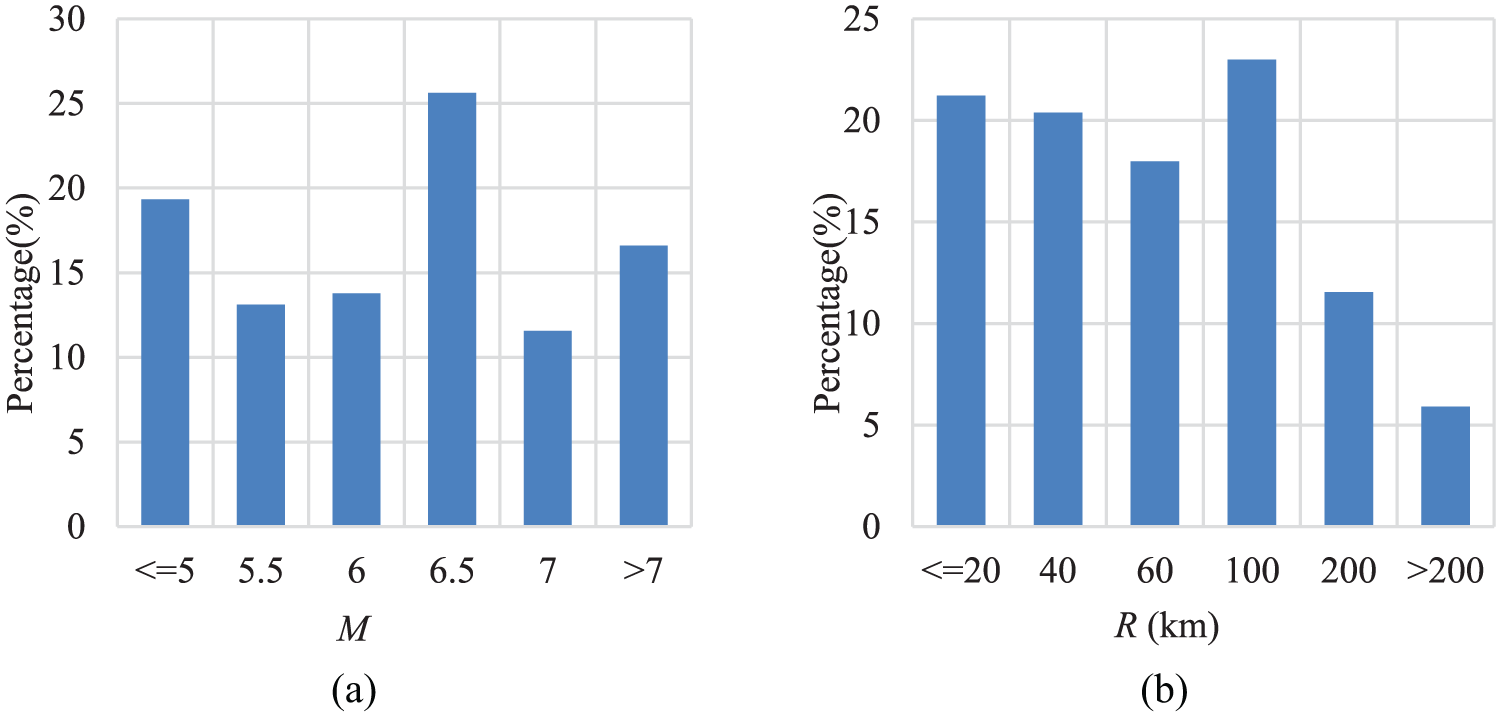
Distributions of magnitude and epicentral distance: (a) distribution of magnitude and (b) distribution of epicentral distance.
Fitting results of IF model
Figure 3 shows the time history of vector envelope of record TCU031. Besides its vector envelope, time histories of two orthogonal acceleration components, that is, TCU031-E and TCU031-N, are also represented as references.

Time history of vector envelope.
Figure 4 shows the estimated results of instantaneous phase and IF. While fitting, amplitude is used as weight to ensure the fitting accuracy of strong motion. The instantaneous phase model derives from the exponential attenuation IF model (equation (10)) which fits the actual instantaneous phase precisely, it indicates that the IF model can simulate the changing rules of the ground motion IF vector accurately. Although the more complicated model can improve the fitting accuracy, this exponential decay model is an appropriate choice considering its practicability, simplicity as well as high fitting accuracy.

Estimation results of instantaneous phase and instantaneous frequency: (a) estimation result of IP and (b) estimation result of IF.
Attenuation rules
Previous researches on the attenuation rules of ground motion parameters showed that they are dominated by magnitude M, epicentral distance R, and site characteristic. PGA and PGV, respectively, represent PGA and peak ground velocity. In addition, the PGV/PGA ratio is used to represent the site characteristic. 14 After reviewing attenuation models of other ground motion parameters, the following model is used

where Y represents the IF parameter (
Unidirectional non-vector records are always used in previous researches, so besides the IF attenuation rules of vector ground motions, the rules of non-vector ground motion also needed to be explored as references. To remain the information of two ground motion components comprehensively and keep the nature of non-vector, a special “unidirectional ground motion,” whose partial parameters are geometric average of parameters obtained from two components, is constructed. The regression coefficients of both vector and unidirectional ground motions are given in Table 1.
Regression coefficients of instantaneous frequency parameters.

Regression coefficients are substituted into attenuation model equation (13) to ion attenuation rules, Figure 5 shows the results of attenuation rules of

Attenuation rules of f0 and cf: (a) attenuation rules of f0 and (b) attenuation rules of cf.
Comparison of vector and unidirectional cases
Figure 6 shows the comparison results on attenuation rules of IF model parameters

Comparison of attenuation rules of f0 and cf when M = 6: (a) attenuation rules of f0 and (b) attenuation rules of cf.

Comparison of attenuation rules of f0 and cf when PGV/PGA = 0.1: (a) attenuation rules of f0 and (b) attenuation rules of cf.
For
For
Conclusion
This article has studied the frequency non-stationary property of horizontal ground motion vectors by investigating IF. A new method of constructing analytic signal is proposed to obtain IF, that is, two orthogonal horizontal seismic signal from the same seismic record are used to construct analytic signal. Then the IF of analytic signal is mathematically represented as an exponential decay model which is validated by instantaneous phases. For the next step, the attenuation rules of IF parameters are regressed, the fitting results show that both the IF model and the attenuation rules model have accurate simulation. The initial frequency
Footnotes
Handling Editor: Wen-Hsiang Hsieh
Declaration of conflicting interests
The author(s) declared no potential conflicts of interest with respect to the research, authorship, and/or publication of this article.
Funding
The author(s) disclosed receipt of the following financial support for the research, authorship, and/or publication of this article: This work was supported by the National Natural Science Foundation of China (grant no.: 10802104).
