




Abstract
A computational finite element model of a brake disc for determining transient axisymmetric (two-dimensional) temperature field during repeated brake application has been proposed. The presented research is a subsequent stage of a previous study on the coupling of velocity and maximum temperature for a single braking in accordance with the system of equations of heat dynamics of friction and wear. In the analysed case, changes in the mean, flash, maximum and bulk temperature of the disc were determined and discussed. The calculations were carried out at the temperature-dependent coefficient of friction, the thermophysical properties of cast-iron disc combined with cermet brake pads and the time-varying contact pressure. The obtained results were compared with the reference values from the braking simulation at constant operating parameters and independent of temperature properties of materials. It was shown that the maximum values of the mean temperature for both cases differed slightly during the entire process. The flash temperature determined from the heat dynamics of friction and wear system of equations was the highest at the beginning and gradually decreased with the number of brake applications.
Keywords
Introduction
Frictional heat generation in brakes may consist of repeated cycles. The characteristic feature of such a process is that the brake cannot cool down to the initial temperature after short periods of heat dissipation; therefore, the bulk temperature of the contacting components becomes higher. Another type of braking with a substantial thermal load is termed continuous or drag braking process. 1 Irrespective of that fact, analytical and numerical solutions of thermal problems of friction for the braking of vehicles, aircrafts or working machines concern mostly a single event. Partly, this stems from the assumption of a uniform temperature in the entire volume of sliding bodies at the initial point in time. Whereas for successive applications, it should match the final thermal state from the prior temperature field. However, using numerical methods, a non-uniform temperature field occurring after one braking event may be directly applied to the next step; for the analytical methods, it becomes a serious difficulty or even impossible.
In preliminary calculations, one-dimensional analytical models and empirical formulas are taken. An example is determining an average temperature of a brake disc before and after multiple braking actions. 1 Dynamic development of computer technology in recent decades has enabled the broad use of three-dimensional computational models. However, taking into account a number of interdependent parameters of the braking process in the case of a series of brake applications, it still constitutes a significant load on computing units, especially when the substantial dimensions above those known in motor vehicles, such as brake systems used for mine hoists, 2 railway tread brakes or long-lasting processes are analysed, as for a specific route of a railway vehicle.
When analysing the braking process, either single or repetitive, at a constant coefficient of friction and in consequence at a known change in braking torque, the time intervals between subsequent applications and braking time itself are known and equal. In such calculations, first, the initial value problem for the equation of motion at the given initial velocity and kinetic energy is solved. This allows determining the velocity change during braking and thus braking time. Then, for the known time profile of contact pressure and calculated velocity, variation of power density of friction force is found. The next step concerns the solution for the heat conduction problem. As can be seen, the dependence of velocity and temperature has a one-sided nature, which means that the influence of temperature on velocity is not taken into account.3,4
In the other approach, it is assumed that the coefficient of friction changes with respect to time, and this relationship is mutual. Then, the initial value problem for the equation of motion and heat conduction problem require to be solved simultaneously. Both analytical and numerical solutions of such modelling are known.5,6 The issues concerning repeated braking will be divided into three sections: (1) uncoupled problems, (2) coupled problems and (3) experimental results at time-dependent coefficient of friction.
Uncoupled problems
Temperature fields and thermal stresses during multiple intermittent braking for the first approach neglecting the dependence of the coefficient of friction were studied using finite element method (FEM) by Adamowicz. 4 The main purpose of the analysis was to evaluate the effect of heat transfer coefficient on the temperature of the disc. Changes in the temperature field and the corresponding radial, circumferential and equivalent Huber–Mises–Hencky stresses for two extreme states of heat dissipation by convection cooling from 0 to 100 W/(m2 K) were determined and compared. The time profile of the load consisted of frictional heating during short braking to stop, acceleration period of 10 s and after the last 10th braking event 300 s of cooling. It was shown that at a single braking, heat dissipation can be ignored, whereas with an increasing number of brake applications, an incorrect value of the heat transfer coefficient will falsify the results, particularly during long-lasting cooling. The calculations were done only for a brake disc, based on the assumption that the ratio of heat separated between contacting bodies is constant (heat partition coefficient).
The thermomechanical problem of heating a motorcycle disc in repeated braking conditions was analysed by Kang and Cho. 7 One out of five cycles consisted of a linear decrease in velocity to stop and followed by a period of cooling. The calculations of changes in temperature and thermal stresses were performed for three drilled discs with different thicknesses and one solid type.
Optimization of the shape of the rotor to find the minimum of the mass with correlation to the thermoelastic instability phenomenon was carried out by Song and Lee. 8 Kriging metamodels and commercial FE-based software were used. Based on the obtained results, the methodology of conducting numerical calculations combined with manufacturing a prototype and performing experimental studies has been proposed.
At long-term repeated braking, one of the important aspects of evaluation of the temperature field of components of a friction couple is heat dissipation by convection and thermal radiation. The computational fluid dynamics (CFD) to analyse heat transfer coefficient in a full and a ventilated brake disc was carried out in the article by Belhocine and Bouchetara. 9 Fourteen braking cycles with constant deceleration at two different modes, to study temperature variations of the disc, were simulated.
Qi and Day 10 investigated the effect of changes in real contact surface areas on the temperature of a sliding system during repeated braking. The data from finite element analysis (I-DEAS CAE) were compared with the results of measurements using thermocouples. The advanced procedure of statistical design of experiments (DoE) was developed to study the influence of several parameters on braking performance. It was found that the number of braking events has the utmost impact on contact temperature compared to other parameters such as load, slip velocity and materials. FE modelling and experimental studies have also provided new insights into the bedding-in and burnishing processes during braking. An influence of the coefficient of friction on the deformation of the disc and the pads was analysed in the article by Belhocine et al. 11 It was found that an increase in the deformation for higher values of the coefficient of friction of the assumed range 0.25–0.35 is slight.
The ventilated type of rotor with variation of shape in circumferential direction is unable to be represented precisely by simplified axisymmetric models. The three-dimensional (3D) FE simulations require taking into account mutual sliding of the disc over the stationary pads. The numerical model of the brake pads and the ventilated disc during repeated cycles of braking was developed by Yevtushenko et al. 12 The obtained temperatures before the succeeding brake applications, as well as the temperature changes in the disc and on its working surface, were consistent with the results of analytical calculations and experimental data from the article by Ginsburg et al. 13 in the entire process of nine braking applications.
An analytical solution to the heat conduction problem for a ring sector of a disc brake of a mine locomotive during a repeated cycle of braking was obtained in the article by Monya. 14 The methodology used was based on the Laplace and Hankel transforms in the framework of theory of generalized variables and similarity method. As stated, the derived formulas allow to find the temperature in each location in the brake disc at any mode of braking of the analysed mine locomotive brake disc. The ratio of heat separated between two sliding components of the friction couple was found by means of heat partition coefficient.
Temperature changes on the specific depths of a brake disc during multiple brake applications based on a one-dimensional analytical model and during experimental studies (thermocouples and pyrometer) were analysed by Siroux et al. 15 The disc was made of cast iron and the pads were an organic matrix composite used in the railway industry. The main objective was to identify the periodic function characterizing the process of successive heating and cooling in the course of deceleration and after the stop, which depends on the heat partition coefficient, coefficient of friction, contact pressure and initial velocity.
A thermomechanical FE axisymmetric two-dimensional (2D) model to study the influence of wear of various materials of the brake pads on the thermal behaviour of the disc brake was developed in the article by Wu et al. 16 A simulation of a multiple braking process was performed with the convection heat transfer coefficient dependent on the angular velocity of the disc. It was assumed that the load applied as hydraulic pressure has a known time profile, whereas contact pressure was found from the solution of thermal–mechanical analysis in ABAQUS with coupled temperature and displacement fields. The simulated temperature at all points on the friction surface of the pad increased with the pressure and the applied velocity, which agreed with the experimental data and other numerical solutions from Zhang et al. 17
Coupled problems
The methodology for determining changes in the maximum temperature, average and flash temperature of the friction surfaces of sliding elements of the braking system during a single and multiple applications based on the system of heat dynamics of friction and wear (HDFW) was proposed in the monograph. 18 Among others, a calculation of changes in the contact temperature of the rough surfaces of a shoe-brake during repeated braking, separately for two friction pair elements, was proposed. The drum was steel (30KhGSA), and the shoe was made of FK-16L Retinax. It has been found that during each single application of braking, the flash temperature increases from the beginning of braking, reaches the maximum value in the initial stage and decreases to the zero value at the moment of stopping. The maximum values were approximately three times higher than the average mean surface temperature of the harder material in each subsequent braking application.
Several types of carbon frictional composite materials (CFCM) used in aircraft multidisc brakes have been investigated in the framework of the HDFW system of equations by Chichinadze et al. 19 The purpose of the study was to identify friction couples with the optimum wear rate and consistent coefficient of friction based on the performed computations and experimental studies. A number of dependencies of the coefficients of friction and wear on temperature were obtained taking into account the negative effect of water and detergents. The procedure of 15 brake applications on the IM-68 friction machine, representing successive landing of the aircraft, allowed to find relations between the above-mentioned operating parameters and the number of braking applications. It was shown that some fluctuations of the mean coefficient of friction appeared approximately up to 2–6 applications when exposed to water, whereas after having contact with detergent, it did not go back to the values of dry conditions until the final cycle. Another important parameter during repeated braking concerned the resistance of the material to oxidation, which has a great effect on the wear rate. It was found that one of the basic parameters that decreases the negative effects on the coefficient of friction and wear is increasing the density of the material by applying finishing heat treatment.
Numerical calculations of temperature, velocity and von Mises stresses in a drum and a disc brake were carried out in the article by Baranowski et al. 20 A complete dynamic equation of motion was solved using a direct integration method with slightly modified central difference scheme implemented in LS-Dyna software. Based on the obtained results in the first stage of the study, the authors proposed an improved design of the disc brake.
A one-dimensional analytical solution of the system of equations of HDFW for repeated braking was obtained in the paper by Nosko and Nosko. 21 The problem of heat generation of two bodies using two different approaches was studied. The first was based on a heat energy partition coefficient dependent on contact pressure – static conditions – while the second used a contact heat transfer coefficient. It was assumed that the coefficient of friction depends on temperature, and the properties of materials are thermosensitive. Multiple braking was considered with four periods distinguished in one cycle: linear acceleration from zero to a specific angular velocity, fixed time of operation at constant velocity, deceleration to stop found from the solution of the considered problem, and the final cooling at zero velocity but with static contact and heat flow. It was found that the evolution of the temperature of the disc during braking intersected a change in the temperature of the pad two times.
An analytical solution for a model of two semi-spaces of frictional heating during a single braking process was obtained by Yevtushenko et al. 5 The mutual influence of velocity and temperature was studied at the coefficient of friction dependent on the mean temperature and at thermosensitive materials. The results of the initial value problem for the equation of motion and thermal problem of friction were compared with the corresponding data calculated at the constant value of the coefficient of friction. The oscillating time profile of contact pressure was applied.
A mathematical–experimental model for calculating temperature and wear during repeated brake applications was proposed by Feldmanis. 22 The experimental procedure consisted of three loading regimes: soft, medium and heavy (1, 2 and 3 braking applications per minute, respectively). Four pad materials (DBE-1 TWG, Cosid 516, Dafmi and EM-1) combined with a steel St45 disc were considered. Temperature and wear were calculated analytically based on simplified empirical formulas. Part of the heat entering the disc was found using the heat partition coefficient. Temperature measurements were performed by means of three thermocouples located under the contact surface and a micrometre at nine points during several tests for specific initial angular velocities to stop and the applied nominal values of contact pressure. The coefficients of friction, wear and the properties of materials depended on temperature. The results of the calculations and experimental data agreed for all considered materials and conditions.
Experimental results at time-dependent coefficient of friction
The topography of the friction surfaces varies with time, load, number of applications, distance and wear rate. Experimental studies to investigate changes in the coefficient of friction of a disc brake were carried out by Gajek and Szczypiński-Sala. 23 A cast-iron brake disc and composite pad materials used in the automotive industry were tested during a number of braking applications and at different initial angular velocities with respect to time history. The surface roughness for a running-in process was also analysed.
A series of 15 braking events with different initial velocities in the aspect of changes in the coefficient of friction was analysed by Collignon et al. 24 The materials of the components of the brake dimensions corresponded to truck disc brakes subject to robust load conditions. The study aimed to elongate the duration of working time until failure and to find features responsible for the development of new improved materials.
Temperature changes in the railway ventilated disc brake of the diesel multiple units (DMU DR-1) were studied by Ginsburg et al. 13 A cast-iron brake disc was combined with two pads made of KF-2 asbestos friction material on a rubber–resin binder. In this article, a one-dimensional analytical solution of a boundary value heat conduction problem and experimental data were presented. The calculations were carried out separately for the pads and for the disc using a heat partition coefficient. Nine repeated cycles of braking and the following cooling periods were analysed. Experimental studies were carried out on the inertial test stand in the Research Diesel Institute (Moscow). The temperature was measured in the pad and the brake disc using six thermocouples. The results obtained analytically agreed with the experimental data.
The system of equations of HDFW for the 2D axisymmetric contact problem was adapted to determine temperature fields during a single braking in the article by Grzes. 6 In this article, the main purpose was to analyse the mutual dependence of velocity and maximum temperature during repeated braking for the 2D axisymmetric FE model of the brake disc. It should be noted that the problem does not take into account bedding-in and burnishing on the disc brake like in paper by Qi and Day, 10 but only the effects of temperature change (maximum, mean, bulk and flash) during subsequent brake applications were studied.
Statement of the problem
Consider a braking process of a vehicle with translational of kinetic energy


Finite element mesh of a disc with boundary conditions.
The thermal load of the brake represents conditions of repeated brake application. One braking event consists of heat generation due to friction during deceleration

Schematic diagram of a change in velocity of a vehicle during repeated braking applications.
Furthermore, the following has been assumed:
The friction couple consists of a solid disc (without hat section) and two pads located opposite its midplane; since the shape of the disc and thermal load resulting from the sliding contact with two pads are symmetric, only half of the disc and one pad represent the considered process.
Materials are isotropic, and their properties depend nonlinearly on temperature. It is known that in the case of anisotropy or even orthotropy of the material, the number of constants significantly increases compared to the case of an isotropic material. However, the calculations for anisotropic materials are performed on the basis of problems for isotropic materials, using the averaged effective properties. 25
The coefficient of friction depends on the maximum temperature, being a sum of the mean
For each period of braking and further acceleration, a constant average value of heat transfer coefficient h has been taken; thermal radiation was neglected according to Adamowicz. 4
The aim of the study was to calculate the maximum friction–surface temperature18,25

where
Initial value problem for equation of motion
A reduction in the velocity of the vehicle during braking describes the solution of the following initial value problem for the equation of motion 26


Taking into account assumption (1), the time-dependent friction force opposing the motion of the vehicle on the right-hand side of equation (3) is equal to

where the surface area of the nominal contact region

the equivalent radius

the coefficient of friction can be calculated as

Taking relations (5)–(8) into account, the solution of the initial value problem for the equations of motion (3) and (4) will be written in the form

where

The braking time

Solution of the nonlinear functional equation will be found using an implicit backward difference formula (BDF) scheme with an adaptive time step.
Boundary value heat conductionproblem
A disc brake system resists movement and heat is generated. The transient temperature field given in the cylindrical coordinates
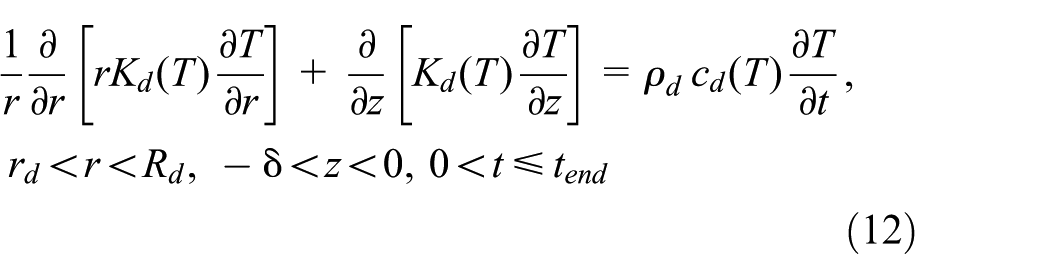
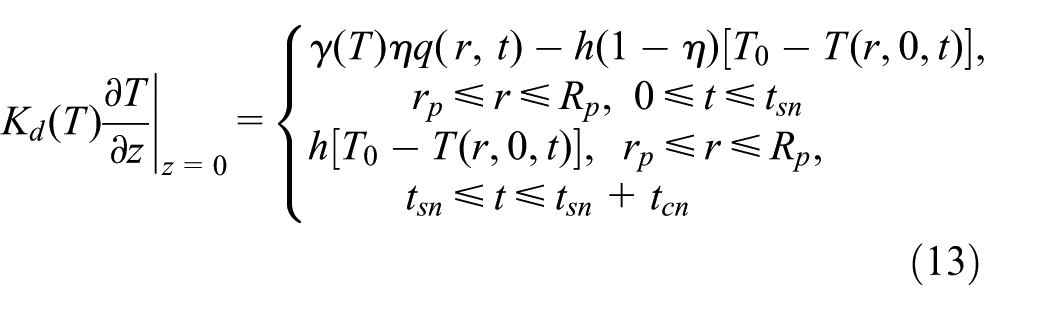


where the total heat flux density

and the heat partition coefficient is determined using formula 3

It should be noted that in the circumferential direction, only one condition may be set, therefore to include conditions of cooling (equation (13)), resulting from the relative motion of the rotating disc against the stationary pads of the cover angle
Initially, the disc is at ambient temperature

The experimental dependencies of the properties of the materials on temperature appeared in equations (12)–(15), which were obtained using standard approximation function 6

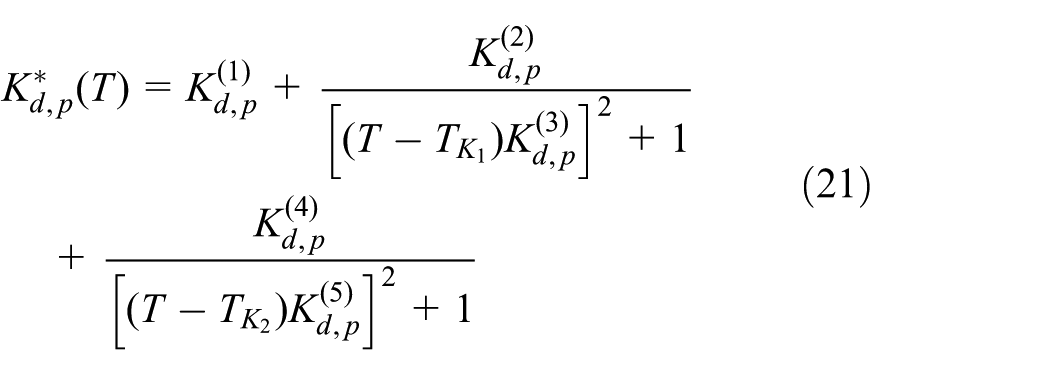

Whereas the coefficient of friction f depends on the maximum temperature

where

The solution to the problem (12)–(24) enables to calculate the mean temperature

and the bulk temperature

which in simplified analytical solutions is a uniform initial temperature, for example,
It is known that at the beginning periods of each brake application, the flash temperature should be also taken into account.23,29 The formula for calculating the flash temperature during braking has the following form 6
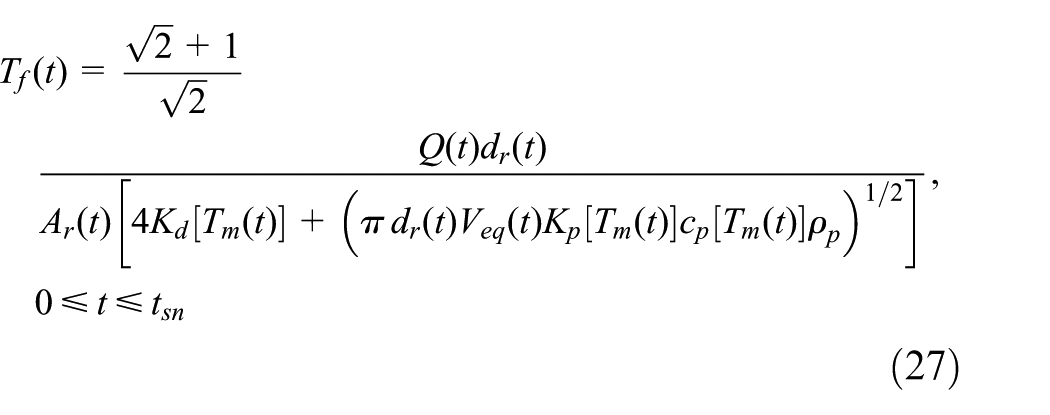
where power of friction Q is

and the slip velocity on the equivalent radius is equal to

A change in a diameter of an average spot of actual contact


where
A change in the Brinell hardness of the friction deformable material has the following form 6

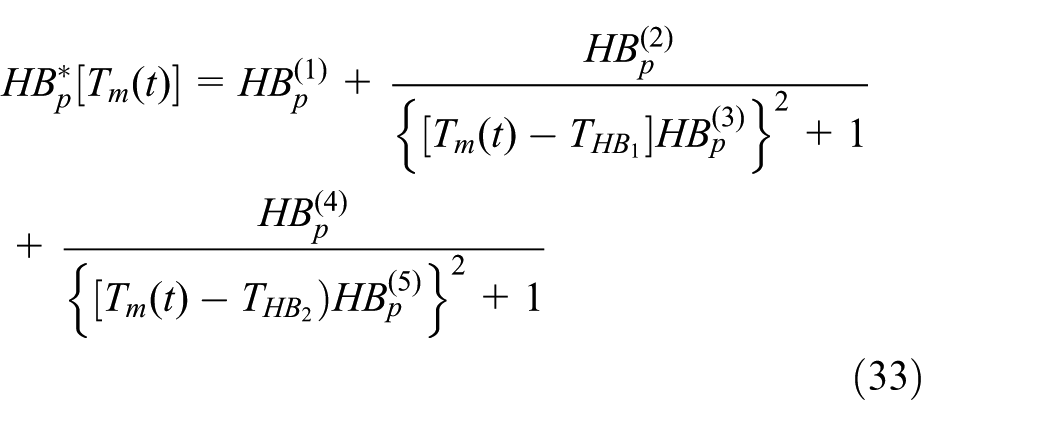
Computational scheme and numerical analysis
Calculations of the transient axisymmetric 2D temperature fields were carried out using the FEM.
30
The FE mesh consisted of 520 quadrilateral elements with quadratic Lagrange shape functions. The mesh area was equal to the disc cross section
In this article, repeated braking applications for a disc brake are analysed. The considered system consists of two pads made of cermet material FMC-11 and a single disc made of cast-iron ChNMKh. The input parameters for thermal analysis were taken from the study by Adamowicz:
4
The obtained results of the specific point on the contact surface of the disc
Verification of the presented modelling of the frictional heating process is also the finite element analysis of temperature field of the ventilated brake disc proposed in the article by Yevtushenko et al., 12 where, it was shown that at each out of nine braking cycles, the temperature from numerical calculations using heat partition coefficient and constant operating parameters corresponded with the experimental data from the article by Ginsburg et al. 13
All the outcomes from this study, shown in Figures 3–9, are denoted with solid lines, whereas curves marked in dashed lines are taken from the article by Adamowicz.
4
According to equation (1), contact pressure has a known exponential time profile for each out of 10 braking applications, whereas velocity has been found from the solution of the boundary value of the heat conduction problem and the initial value problem for the motion equation. The schematic diagram of changes in the velocity of the vehicle V is shown in Figure 2. The polylines during each braking event represent an unknown change in velocity, after which its linear 10 s increase from zero to nominal value

Changes in the applied contact pressure p and calculated coefficient of friction f, total force opposing motion of the vehicle F, velocity of the vehicle V and heat flux Q during the first braking application.

Changes in the flash
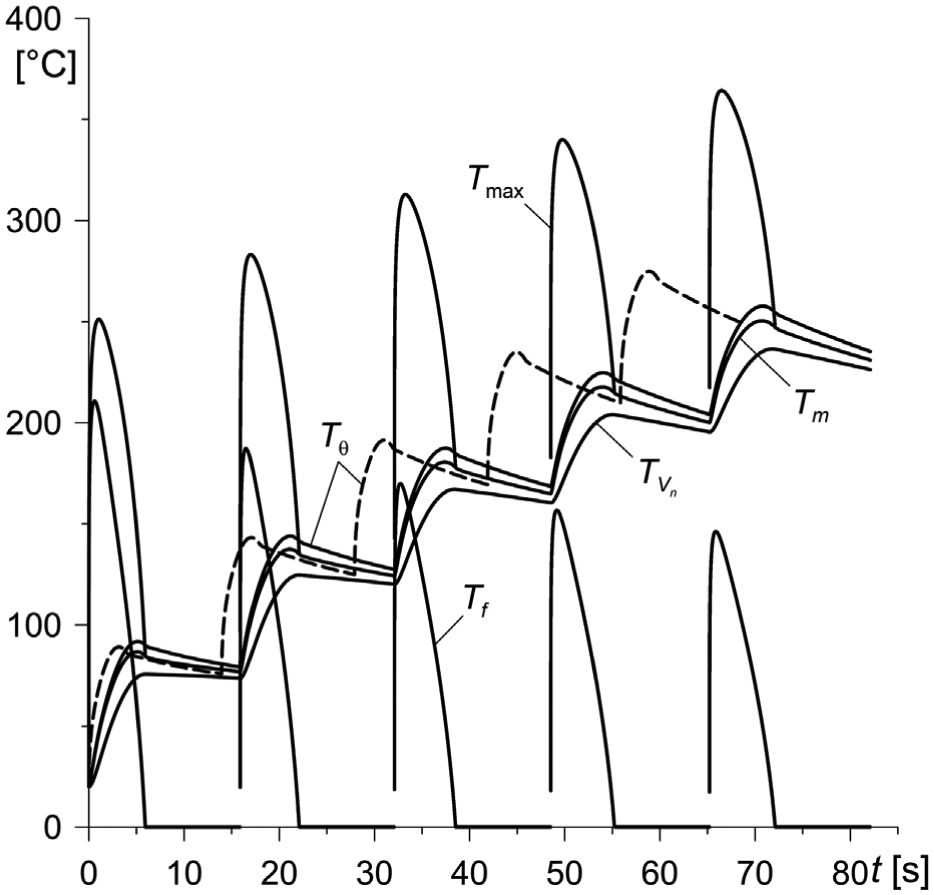
Changes in temperature during five braking and cooling applications; solid lines represent FEA HDFW; dashed lines represent FEA with constant parameters from the study by Adamowicz. 4

Changes in temperature during 10 braking and cooling applications; solid lines represent FEA HDFW; dashed lines represent FEA with constant parameters from the study by Adamowicz. 4
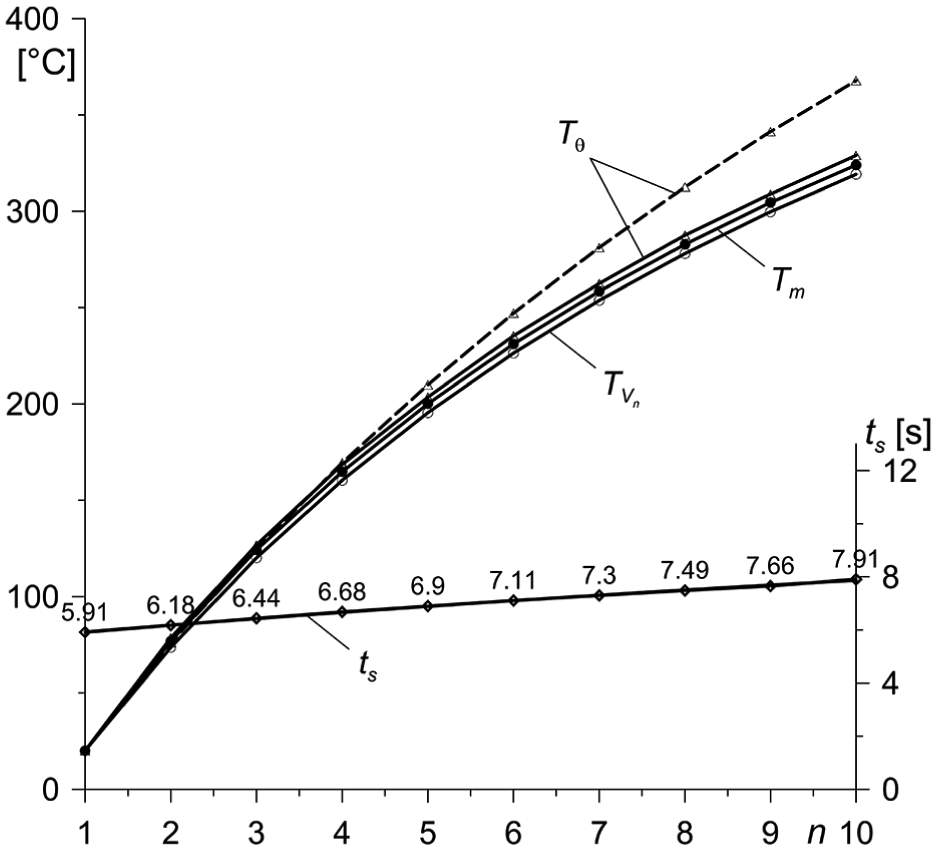
Mean
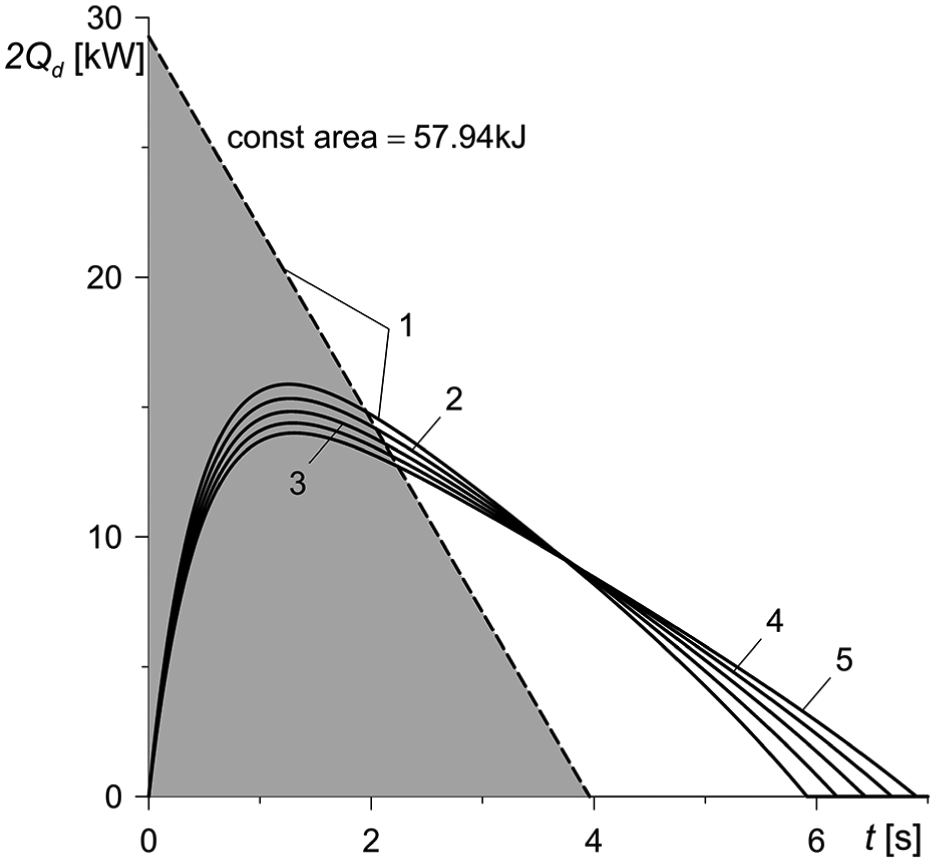
Changes in the heat flux acting on two opposite friction surfaces

Changes in the mechanical energy converted into heat
The applied contact pressure and calculated changes in the temperature-dependent coefficient of friction f, total force F opposing the motion of the vehicle (equation (5)), heat flux entering the disc Q on a single friction surface area
Maximum temperature (equation (2)), flash temperature
One should note that the zero value of the flash temperature is not connected with the taken scale, as it is a temperature difference. The dashed curve of
Changes in temperature during five brake applications are shown in Figure 5. The braking time as expected is lengthened with each application n from
The evolutions of the bulk temperature
From the formulated problem, the mechanical energy converted into heat which enters the disc
Changes in mechanical energy converted into heat during braking per disc


where
Summary and conclusion
Analysis of operation of brakes has shown that the temperature mode is an essential factor in braking performance. In this article, a method of calculation of the maximum temperature of the friction surfaces of a disc during repeated braking application was proposed. The method is based on mathematical and physical modelling of the frictional heating process using the HDFW system of equations, which includes the following:
Dynamics of braking with time-variable contact pressure and frictional characteristics.
Heat conduction.
Experimental dependencies of the coefficient of friction on temperature.
Changes in mechanical and thermophysical properties of materials on temperature.
Changes in surface areas and diameters of the actual contact during braking.
Based on these equations, three main problems were formulated:
The initial value problem for the equation of motion with temperature-dependent force of friction.
The nonlinear axisymmetric boundary value of the heat conduction problem taking into account the frictional heating and cooling of the surfaces of the disc.
The nonlinear problem of determining the flash temperature.
In nonstationary friction, such as braking, all the parameters are mutually dependent. Obtaining the solution for a nonlinear system of equations of HDFW is only possible using numerical methods. The main idea accomplished in the developed finite element model is based on parallelly taking into account three factors at each step: mean temperature
It has been established that
For the studied cast-iron disc combined with cermet pads and the operating parameters of an emergency braking of a vehicle, the flash temperature and in turn approximately maximum temperature during a single braking is more than twice higher than the mean temperature of the rubbing ring of the disc.
The flash temperature in each braking application at the beginning of the process increases from the zero value, attains maximum and decreases again to zero.
The peak value of
The maximum temperature
The obtained results that allow to estimate an average value of the coefficient of friction during a single and multiple braking, its consistency and an average value of its oscillations are an essential element in the comprehensive assessment of the characteristics of the materials of the given friction couple.
The HDFW system of equations developed in this article can be further expanded to subsystems such as the contact thermoelasticity problem for the pad–disc tribosystem, determining the state of mechanical and thermal stresses of the disc and the next development of numerical models of disc fracture. 33
Footnotes
Appendix 1
Handling Editor: Shun-Peng Zhu
Declaration of conflicting interests
The author(s) declared no potential conflicts of interest with respect to the research, authorship and/or publication of this article.
Funding
The author disclosed receipt of the following financial support for the research, authorship and/or publication of this article: This study was performed within the framework of research project no. 2015/19/D/ST8/00837, financed by the National Science Centre, Poland.
