




Abstract
Maintenance plays a crucial role in the entire life cycle of equipment. With the acceleration of industrialization, the evaluation of equipment maintenance quality has undoubtedly become more challenging due to the complex mechanical structure, various maintenance modes, and so on. In order to make decisions scientifically, a hybrid multi-criteria decision-making approach integrating triangle fuzzy number, λ-fuzzy measure, TOPSIS, and Choquet fuzzy integral is proposed in this article. First, the interaction among criteria can be handled reasonably by fuzzy integral based on λ-fuzzy-measure. Second, fuzzy numbers which are given by experts are applied to deal with fuzzy linguistic value. In addition, artificial bee colony algorithm is first introduced to identify λ-fuzzy-measure. The comparison results of three optimization algorithms which include artificial bee colony algorithm, genetic algorithm, and particle swarm optimization prove artificial bee colony algorithm is more effective than genetic algorithm and particle swarm optimization. A case study which contains six maintenance alternatives is practiced to prove the effectiveness of the proposed hybrid multi-criteria decision-making approach. Finally, the comparison is made between the proposed method and two classical multi-criteria decision-making approaches which refer to TOPSIS and gray correlation, and the results demonstrate the proposed method is suitable to solve maintenance quality evaluation problem.
Keywords
Introduction
Maintenance has become crucial throughout the entire life cycle of a product.1,2 Maintenance refers to all activities of maintaining or restoring equipment to a specified state.3,4 With the rapid development of modern manufacturing industry, the maintenance methods and structure of equipment are becoming more complex.5,6 Moreover, equipment maintenance involves many subjective factors such as the personal qualities of technicians and collaborative approaches. 7 Obviously, the evaluation of maintenance quality is challenging. 8 Equipment maintenance quality evaluation is an important part of equipment management. Maintenance quality affects not only the reliability of equipment but also the safety. Scientific maintenance quality evaluation is helpful for decision-makers to master equipment maintenance status in time and to provide theoretical support for further improvement of maintenance alternatives. It is essential to establish a reasonable multi-standard system to evaluate the quality level of maintenance activities. 9 More importantly, the key to the problem is to explore an effective evaluation method.
There is no doubt that multi-criteria decision-making (MCDM) provides a feasible way for the evaluation of maintenance quality. In the current study, many MCDM methods, including the analytic hierarchy process (AHP),10–12 the Technique for Order of Preference by Similarity to Ideal Solution (TOPSIS),13–15 fuzzy comprehensive evaluation, 16 fuzzy VIKOR, 17 and some other hybrid MCDM methods,18–22 have been applied in many fields. Besides, many scholars have made in-depth studies on maintenance field. For instance, Ozcan et al. 23 adopted AHP-TOPSIS approach to select the most appropriate maintenance strategy in hydroelectric power plants. Similarly, the operational maintenance processes were evaluated by Dhanisetty et al. 24 with a multi-criteria-weighted decision-making approach. Ighravwe and Oke 25 rank maintenance strategies for sustainable maintenance plan using fuzzy axiomatic design principle and fuzzy-TOPSIS. Kirubakaran and Ilangkumaran 26 selected maintenance strategy based on an integrated method of fuzzy analytic hierarchy process (FAHP) and gray relational analysis (GRA)-TOPSIS. In addition, a hybrid MCDM method 27 was adopted to evaluate green maintenance initiatives in the design and development of mechanical systems.
As can be seen, it is obvious that many researches are associated with AHP, but the AHP method is based on the independence of the criteria. In other words, there should be an interaction among the criteria28–30 when evaluating the maintenance quality system in practice. Hence, the interaction among criteria must be taken into consideration when making decisions for many maintenance alternatives. To address interaction among criteria, fuzzy measure and fuzzy integral are introduced into the equipment maintenance quality evaluation in this article. Fuzzy measure is developed based on classical measure. Up to now, there are mainly five kinds of fuzzy measures including the trust measure, plausibility measure, quasi-additive measure, k-addictive fuzzy measure, and λ-fuzzy measure.31–33 The λ-fuzzy measure is applied in this article since it has apparent advantages over others. For example, it can fully reflect the relationship between criteria, and the structure is relatively simple. Note that the identification of fuzzy measure aiming to obtain more accurate solutions is a difficult point. 34 In this work, artificial bee colony (ABC) algorithm35,36 is first introduced to identify the λ-fuzzy measure and achieve superior results. Fuzzy integral mainly includes Sugeno fuzzy integral, Choquet fuzzy integral, and Zhenyuan fuzzy integral.37–39 Among these fuzzy integrals, Choquet fuzzy integral is preferable in dealing with nonlinear aggregation of MCDM problems. 40 TOPSIS is regarded as an efficient method for solving MCDM problems. It ranks the schemes by calculating the distance between each pre-evaluation scheme and the positive ideal solution and the negative ideal solution.
The evaluation of equipment maintenance quality is rather complex and difficult due to its uncertainty and fuzziness, and few researchers focus on it. The whole evaluation process involves not only quantitative criteria but also qualitative criteria. The evaluation values of quantitative criteria are accurately obtained by means of measurements. However, the evaluation values of qualitative criteria are difficult to be obtained due to its fuzziness. Moreover, the criteria of the maintenance quality evaluation system are usually not independent, and there are positive or negative effects among them, that is, there are interactions among criteria. In addition, a reasonable sort method is required to accurately compare the existing schemes. In summary, the complexity of the proposed method is mainly reflected in three aspects: the fuzziness of qualitative criteria, interaction among criteria, and the effectiveness of the sort method.
Hence, for complex maintenance quality evaluation, it is impossible to accomplish the evaluation process through only one method or theory. A hybrid MCDM method integrating multiple methods is needed to evaluate equipment maintenance quality. In this work, a hybrid MCDM method is proposed to deal with the problem. In this method, fuzzy theory is used to deal with the fuzziness of qualitative criteria. λ-fuzzy measure is implemented to obtain the measure values among criteria, which is based on ABC algorithm. Choquet fuzzy integral is applied to get the final evaluation value of maintenance alternatives based on the distance among criteria obtained by TOPSIS. This work makes two major and two secondary contributions. (1) Based on the main characteristics of the equipment maintenance process, a hierarchical structure about evaluation criteria considering personnel, materials, implements, methods, and environment is established. (2) Considering the difficulties of equipment maintenance quality evaluation, a novel hybrid MCDM method integrating multiple methods is proposed to deal with the interaction among criteria and to obtain the final evaluation scores. (3) ABC algorithm is first introduced to identify λ-fuzzy measure and the results of identification prove that ABC algorithm is more effective than genetic algorithm (GA) and particle swarm optimization (PSO). (4) Fuzzy theory is adopted to reasonably solve the fuzziness of qualitative criteria in the evaluation system.
The structure of this article is organized as follows. Section “Method description” describes each of the methods used in this study in detail. Section “Integrated assessment process for maintenance quality” provides a specific description of the proposed evaluation method that combines λ-fuzzy measure, TOPSIS, and Choquet fuzzy integral. In section “Empirical examples,” a case study of equipment maintenance quality evaluation is introduced to prove the effectiveness and feasibility of the proposed method. In section “Conclusion,” the conclusions are presented. The future work is described in section “Future work.”
Method description
In this article, the proposed approach integrates many methods to evaluate equipment maintenance quality. The diagrammatic sketch of the equipment maintenance quality evaluation is presented in Figure 1. As can be seen in Figure 1, ABC algorithm participates in the calculation of λ-fuzzy measure, and the final evaluation results are obtained through a combined approach of fuzzy integral, λ-fuzzy-measure, and TOPSIS.

Diagrammatic sketch of the equipment maintenance quality evaluation.
The triangle fuzzy number
Based on fuzzy set theory, fuzzy mathematics provides a new method for dealing with uncertain information, especially for human decision-making. 41 The related mathematical definitions of the triangle fuzzy number are as follows.
Definition 1

Besides, the membership function of a triangular fuzzy number is represented in Figure 2.

Membership function of a triangular fuzzy number.
Definition 2


Defuzzification of triangular fuzzy numbers
At present, many defuzzification methods, including distance measure, central value, and gravity, have been applied to transform the fuzzy number into a numerical value.
43
If the fuzzy number is assumed to be
Distance measure method 44

where the value of the fuzzy number
Central value method 45

Gravity method

where
However, all the above methods have their own limitations. In this article, the mean value of the three results is taken as the final synthesis result, and the corresponding mathematical calculation is

Identification optimization of λ-fuzzy measure based on ABC algorithm
Fuzzy measures and λ-fuzzy measure
First, the definitions of fuzzy measure and λ-fuzzy measure will be reviewed as follows.
Fuzzy measures. 46
If g is a fuzzy measure on (X, F), then the following conditions must be satisfied:
Triviality: if
Monotonicity: if
Lower continuity: if
Upper continuity: if
where
λ-fuzzy measure
λ-fuzzy measure identification
The identification of fuzzy measure is employed to acquire fuzzy measure values g(A). Fuzzy density gi (i = 1, 2, …, k) can be obtained by means of λ-fuzzy measure identification. In general, it is rare to obtain consistent measure values from different experts, which can satisfy the properties of fuzzy measures. Two kinds of identification methods used most frequently are introduced as follows:
Type 1: Polynomial identification
Type 2: Optimization function identification
Optimization function aiming to obtain the λ parameter is established. Note that

This method is feasible but may fall into local optimum as measure values are not always consistent from different experts.
λ-fuzzy measure identification based on ABC algorithm
ABC algorithm which imitates foraging behavior of the honey bees is a very efficient intelligence optimization algorithm. In ABC, a possible solution can be denoted by a food source position, and three main components, including employed bees, onlooker bees, and scout bees, are contained in ABC algorithm. We can divide the process of ABC algorithm into three sections: (1) Employed bees search randomly to discover better food sources in the neighborhood of the parent food source and share food information with onlooker bee. (2) The information shared by employed bees can be used by onlooker bees to select food source and to search better food sources. (3) If a food source is not updated after limited iteration, then the food source can be abandoned. Subsequently, the employed bee turns into a scout bee to explore a new food source randomly in all search space.
Here, we first propose ABC algorithm for λ-fuzzy measure identification, which deals with drawbacks of the existing methods. The steps of λ-fuzzy measure identification involved based on ABC algorithm are as follows:
Step 1. Population initialization and evaluation function
In ABC algorithm, N food sources are initialized, which represents many feasible solutions for the problem. Each individual is supposed to involve fuzzy density gi (i = 1, 2, …, k).

where j = 1,2, …, N, i = 1, 2, …, k, k + 1. k + 1 represents the dimensionality of the search space;
The evaluation function is as follows

where
Step 2. Employed bees phase
At this stage, employed bees search better food sources around the current food location. The mutation operation is as follows

where M represents the individual which needs to be mutated, N represents the individual selected randomly in the current population, and L represents the location needed for the mutation of individual M. The previous individual will be replaced on condition that fitness of the mutated individual is less than the previous individual.
Step 3. Onlooker bees’ phase
After all employed bees perform the search procedure, onlooker bees select food source with a probability. The probability pi is given as

Subsequently, the corresponding food source is updated. Similarly, a greedy selection is also put into use in this phase.
Step 4. Scout bees’ phase
The food source can be abandoned under the condition of not improving quality after a predetermined number of cycles. Namely, the employed bee is turned into a scout bee and generated a new solution randomly by equation (8). The pseudo-code of measure identification based on ABC algorithm is shown in Figure 3.

Pseudo-code of measure identification for ABC algorithm.
Finally, we calculate the fuzzy measure set G according to the following formula

Choquet fuzzy integral
Fuzzy integral is a kind of nonlinear function based on fuzzy measure, which does not require the independence of criteria. The Choquet fuzzy integral is a great way to handle the interaction among criteria.
33
A related mathematical algorithm is presented in formula (13).

where u represents the fuzzy measure and
TOPSIS method
TOPSIS is one of the most classic MCDM methods due to its effectiveness and robustness, which has been applied in many fields. The basic idea of TOPSIS is that all schemes participating in the evaluation are sorted according to their distance to the ideal solutions and the negative ideal solutions, and the quality of the evaluation schemes can be expressed by the final order. 47 The ideal solution is the set of each attribute’s optimal value, which refers to the highest benefit or the lowest cost. Similarly, the negative ideal solution is the set of each attribute’s worst value, which refers to the lowest benefit or the highest cost. 48 TOPSIS is efficient in dealing with MCDM problems, and the calculation steps are as follows:
Step 1. The initial decision matrix is constructed based on each attribute value of each scheme

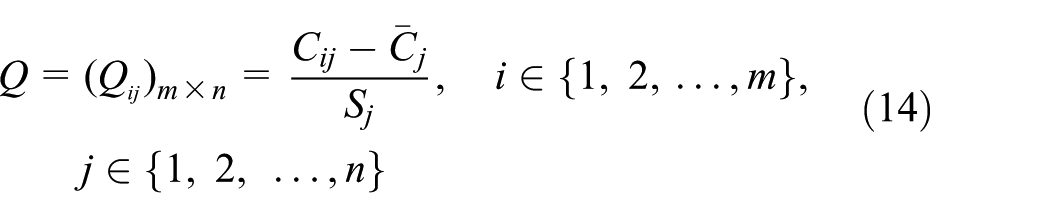
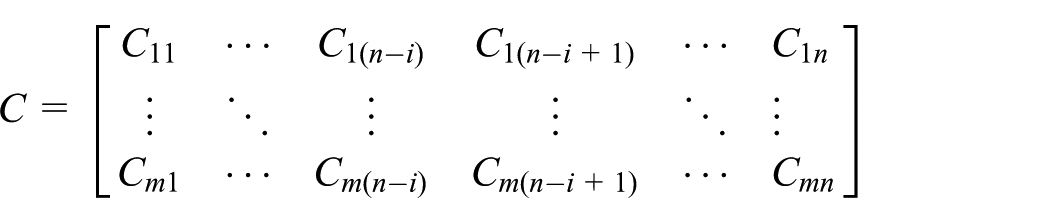
where C represents the initial decision matrix, Cij (i = 1, …, m; j = 1, …, n) represents the values of jth attributes of ith scheme, Di (i = 1, …, m) represents the schemes, and Ej (j = 1, …, n) represents the attributes.
Step 2. Standardize initial decision matrix
To remove the impacts of orders of magnitude, standardization of matrix C is carried out according to equation (14)
where Q represents the standardized matrix;
Step 3. Obtain the positive ideal solution and the negative ideal solution
The positive ideal solution is a set of the best values of all criteria. It can be obtained by formula (15). Besides, the negative ideal solution can be obtained by formula (16)


where
Step 4. Obtain the Euclidean distance between each scheme and the positive ideal solution, as well as the negative ideal solution
The Euclidean distance can be obtained according to formulas (17) and (18)


Step 5. Calculate the relative similarity degree
The relative similarity Fi is calculated by formula (19)

Then, compare the relative similarity degrees of all the schemes. The bigger the relative similarity degree, the better the scheme will be.
Integrated assessment process for maintenance quality
The traditional MCDM methods, such as AHP, can only work in the case where the criteria are independent of each other. However, in practice, especially in the equipment maintenance quality system, the interaction of criteria and fuzzy information existing in equipment maintenance quality system is unavoidable. We propose a hybrid MCDM approach that integrates λ-fuzzy measure, the Choquet fuzzy integral, and TOPSIS, which can handle both the challenges reasonably. On one hand, this approach takes full advantage of fuzzy set theory to handle fuzzy information that exists in the process of evaluation. However, the interaction between criteria can be well revealed by the Choquet fuzzy integral based on the λ-fuzzy measure. In addition, ABC algorithm is applied to identify the λ-fuzzy measure, which makes the weight of each index more reasonable. The specific process can be divided into three stages.
In the first stage, relevant criteria should be established according to the characteristics of the equipment maintenance quality system in practice. Then, the initial evaluation matrix is constructed according to the following procedure.
Step 1. Obtain the fuzzy linguistic value of each criterion which is given by experts and transform it into triangular fuzzy numbers according to Table 1
Linguistic triangular fuzzy number.

In this study, to evaluate the performance of each criterion more comprehensively, the authors adopted the evaluation results of many experts.
The experts evaluated all criteria of each alternative scheme. The evaluation matrix is described as

where
Step 2. Obtain the evaluation matrix of qualitative criteria
The evaluation results upon each criterion

where
Step 3. Obtain the evaluation matrix
Step 4. The initial evaluation matrix C can be obtained by integrating
In the second stage, the final evaluation result can be obtained by calculating the data collected in the first stage. The specific steps are as follows:
Step 5. Standardize initial decision matrix C by equation (14).
Step 6. All the fuzzy density
Step 7. Calculate the fuzzy measure set G by equation (12) after obtaining the values of all the fuzzy density and parameter λ.
Step 8. Obtain the positive ideal solution
Step 9. For the convenience of calculation, the positive ideal solution distance matrix can be obtained by equation (20), and the negative ideal solution distance matrix can be established by equation (21)


Step 10. Obtain the final evaluation result of each alternative.
Step 10.1. Positive ideal distances of all criteria of each scheme can be reordered in the ascending order as

Step 10.2. Negative ideal distances of all criteria of each scheme can be reordered in the ascending order as

Step 11. Calculate the relative similarity degree

where the bigger the value of

Measure identification for artificial bee colony algorithm.
In the last stage, rank the alternatives according to the value of
The procedure of the proposed MCDM approach is well presented in Figure 5.

Procedure of the proposed MCDM approach.
Empirical examples
In this section, the crucial criteria are selected to build an equipment maintenance quality evaluation system. Criteria should satisfy two conditions: (1) involving the aspects of equipment maintenance system as more as possible, namely, the quality of the maintenance activities can be comprehensively evaluated by the criteria selected; (2) containing both quantitative and qualitative information. Equipment maintenance system is established scientifically by studying maintenance practical activities and related literature.50–53
Establishment of equipment maintenance quality evaluation system
The criteria of the maintenance quality evaluation system are selected from five aspects, which include quantitative and qualitative information. The system is presented in Figure 6, and the detailed explanation is also provided below.

Structure of equipment maintenance quality evaluation system.
Maintenance personnel (criterion D1)
Maintenance personnel include maintenance operator and maintenance manager. The influence of the maintenance personnel on the maintenance quality mainly depends on the personnel quality, technical capability of maintenance operators, the operating error rate of operators, and managerial ability of maintenance manager. Maintenance personnel is considered a qualitative criterion due to its fuzziness.
Spare parts and raw materials (criterion D2)
The quality grade of the spare parts used for maintenance process has a direct impact on the maintenance quality. The quality level of raw materials can also affect the reliability and service life of the equipment. Since the quality grades of both spare parts and raw materials are available in their relevant standards, they are considered as quantitative information.
Maintenance implements and maintenance facilities (criterion D3)
Maintenance implements include machinery, electrical appliances, and instruments needed for equipment maintenance activities. The more advanced the maintenance implements, the higher the maintenance quality. Maintenance facilities refer to the facilities used in carrying out maintenance tasks, which include maintenance shops, lathes, and supply stores. The more superior the maintenance facilities, the more efficient the maintenance operators. Therefore, this aspect is also considered a qualitative criterion.
Maintenance methods (criterion D4)
Maintenance methods include technical methods and quality management methods. Maintenance technical methods refer to heat treatment, welding, fault diagnosis, and so on. Maintenance quality management reflects the completeness of maintenance quality system. Hence, maintenance methods are considered a qualitative criterion.
Environment (criterion D5)
The environment refers to the conditions of temperature, humidity, noise, lighting, power supply (whether the voltage is stable), and water supply (whether the water is clean) in the maintenance workplace. Since the environment has an indirect effect on the maintenance activities and maintenance quality, it can be considered a qualitative criterion.
Evaluating equipment maintenance quality through the proposed approach
In this article, to prove the effectiveness of the proposed approach, a convincing case is provided. There are six alternatives
Step 1. Obtain the fuzzy linguistic value matrix of the eight experts on the six alternatives. Note that the first line of each matrix is the fuzzy linguistic value of criterion D1, which is given by experts. The second line of each matrix is the fuzzy linguistic value of criterion D2, and so on


Step 2. The evaluation matrix of qualitative criteria is shown below

Step 3. The evaluation matrix of quantitative criteria can be obtained easily
Step 4. The initial evaluation matrix C can be obtained by integrating
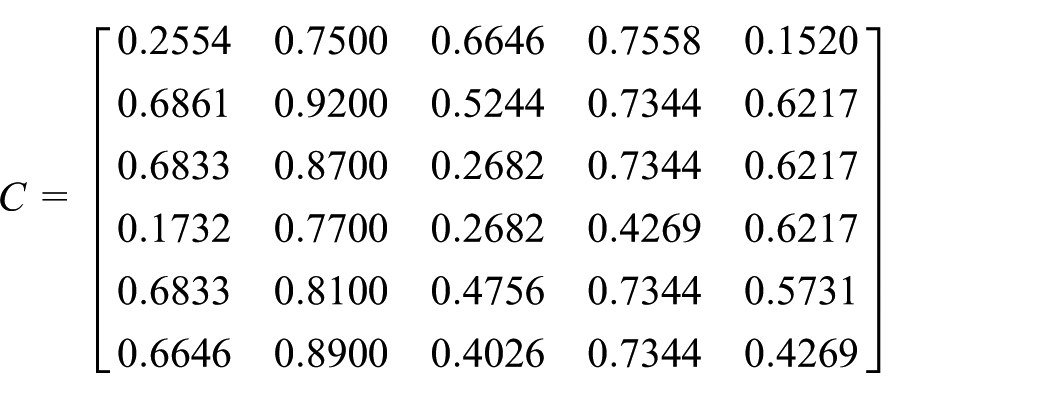
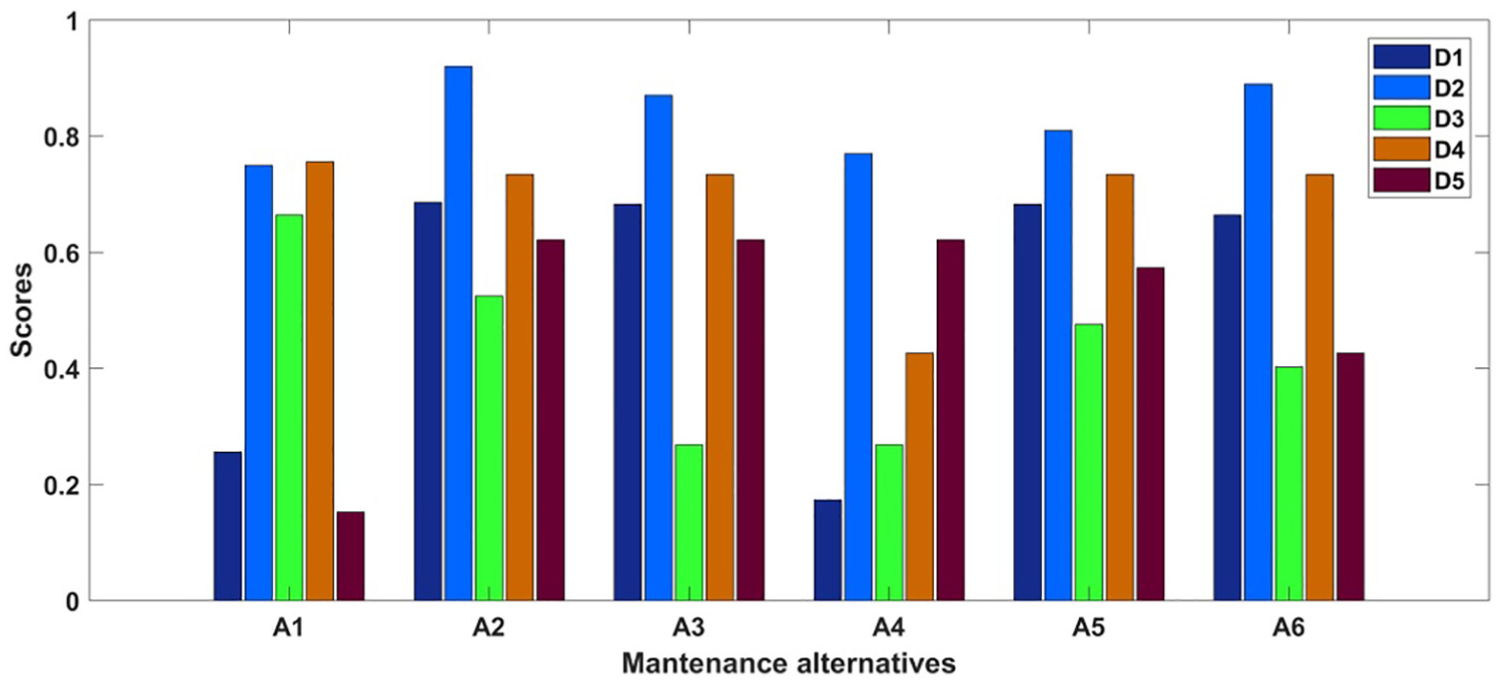
Then, the initial data matrix C can be transformed into a columnar graph, which is intuitionistic for alternative analysis. The columnar graph is shown in Figure 7.
Step 5. Obtain standardized decision matrix, as follows

Step 6. ABC algorithm is applied to identify the λ-fuzzy measure according to Table 2 which contains the weight information given by experts. Appropriate values for the control parameters of ABC, that is, the maximum cycle gmax = 1000, the population size PS = 50, and the limit of predetermined number of cycles = PS/2, are determined in this work. Note that with the increase in population size and number of iterations, the accuracy of fuzzy-measure identification based on heuristic algorithms becomes more higher, that is, the error of identification becomes more smaller. These parameters are finally determined by a series of preliminary experiments according to the following two principles: (1) the increase in population size and iteration times has no effect or a slight effect on the final identification accuracy. (2) The error obtained by the fuzzy measure identification should be controlled below a certain value such as 0.1 to ensure the accuracy of the identification results.
Columnar graph of the initial data matrix.
Fuzzy measure values given by experts.

Considering that selecting these parameters is not the primary research target, details are not shown in this article. In addition, to guarantee the effectiveness of comparison experiments among ABC, GA, and PSO, the encoding method, population initialization assessment of the objective function, population size, and the maximum cycle are identical. The experiments are run on an Intel(R) Core(TM) i5 CPU (3.20 GHz, 8GB RAM) and coded by MATLAB 7.14. Finally, the comparison results are shown in Table 3.
Step 7. The fuzzy measure set G can be seen in Table 4
Step 8. Obtain the ideal solution and the negative ideal solution, as follows


Step 9. Obtain the positive ideal solution distance matrix and the negative ideal solution distance matrix

Step 10. Obtain the final evaluation results of each alternative
Comparison of fuzzy measure identification result for ABC, GA, and PSO.

ABC: artificial bee colony algorithm; GA: genetic algorithm; PSO: particle swarm optimization.
Fuzzy measure set G.

First, what should be calculated is the positive fuzzy ideal solution distance
Evaluation results of each alternative.

Comparison and analysis
In this study, a large percentage of researchers are inclined to evaluate multi-attribute system through TOPSIS method and gray correlation (GC) method, although these methods do not consider the interaction among criteria. There is no doubt that TOPSIS and GC have other advantages such as being simple to operate and being easy to understand. To prove the rationality of the proposed approach, the results of the proposed approach are compared with the results of TOPSIS and GC. Note that the same weight w0 is adopted when using these three MCDM approaches. The comparison results are shown in Table 6. Also, the performance comparison of three methods is clearly shown in Figure 8.
Comparison results obtained from three approaches.

TOPSIS: Technique for Order of Preference by Similarity to Ideal Solution; GC: gray correlation.
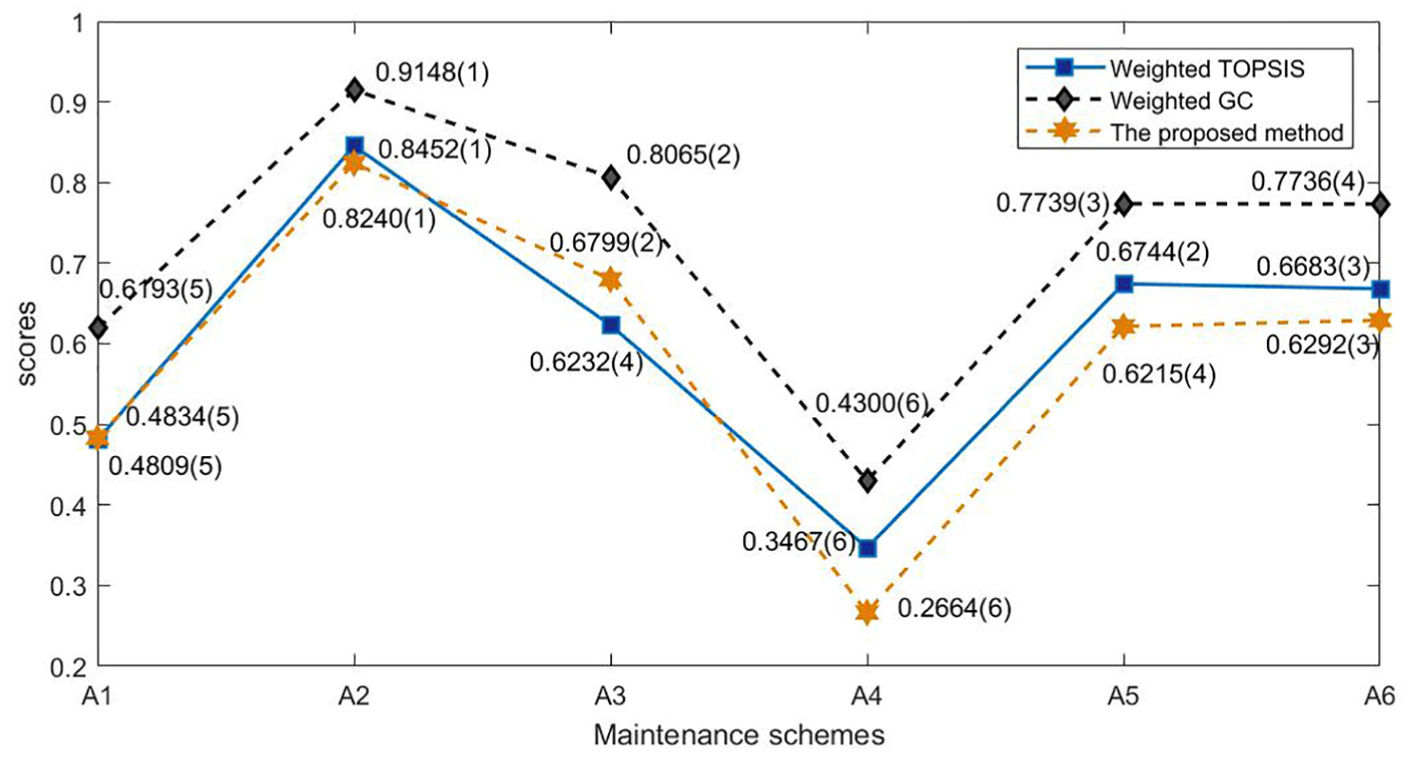
Performance comparison of the three methods.
It can be seen from Table 6 that the results of these three methods are consistent basically. From the data, the second alternative ranks first among all the maintenance alternatives. The ranking of the second alternative can be verified in Figure 7 which visually shows the original evaluation data that most of the attribute values of the second alternative are better than other alternatives. Moreover, the final evaluation results of the first and fourth alternatives obtained from these three methods are also completely consistent. Also, as can be seen clearly from the curves of the three methods in Figure 8, the trend of results given by three methods is consistent. The second of all alternatives from different methods is best and the fourth is worst. Thus, the hybrid MCDM method proposed in this work is reasonable and effective for equipment maintenance quality evaluation. However, the results in Table 6 also show the differences among these methods. For example, the third alternative is ranked fourth by weighted TOPSIS but ranked second by weighted GC and the proposed method. The sixth alternative is ranked third by weighted TOPSIS and the proposed method but ranked fourth by weighted GC. Several reasons for this difference are listed as follows: (1) the principle of TOPSIS focuses on the distance from the positive/negative ideal solutions, nevertheless, GC only considers the degree of similarity to the ideal solutions.54,55 (2) there are some differences in the degree of information utilization for the three methods, and certain information will be lost in the process of information aggregation. In addition, a comparison of the identification results of ABC algorithm included in the proposed hybrid MCDM method is also made with GA and PSO. From Table 3, it can be seen that ABC algorithm generates smaller error than GA and PSO under some control conditions described in step 6, which demonstrate the ABC algorithm is more effective.
Conclusion
It is difficult to effectively select a maintenance alternative with optimal quality from a large number of alternatives. In this article, many criteria which are closely associated with the maintenance quality system are selected to establish the equipment maintenance quality evaluation system. Moreover, the criteria include qualitative criteria and quantitative criteria. In addition, the comprehensive evaluation approach which integrates fuzzy measure, fuzzy integral, and TOPSIS is proposed to evaluate the maintenance quality system. Through the analysis of the data, the result obtained through the proposed approach is basically consistent with the results obtained through TOPSIS and GC. The proposed approach is demonstrated to be more scientific than some traditional methods. First, this approach handles the interaction among criteria successfully, which makes the criteria not independent of each other any longer. This defect is very common in some traditional evaluation methods. Second, the fuzzy theory is applied to deal with the fuzzy information in maintenance quality system. Third, in order to weight more reasonably, ABC algorithm is first selected to identify λ-fuzzy measure and the identification results prove that ABC is more accurate than GA and PSO algorithms. In short, the proposed approach provides a great reference for equipment maintenance quality evaluation.
Future work
In the future, our studies will focus on two directions: (1) to construct a more complete equipment maintenance quality evaluation system, many factors concerned by society will be considered, such as green attribute and economy attribute; (2) due to the uncertainty and fuzziness of experts’ decision-making information, uncertain theory and fuzzy theory can be deeply studied and applied in MCDM evaluation methods.56–63
Footnotes
Handling Editor: Dumitru Baleanu
Declaration of conflicting interests
The author(s) declared no potential conflicts of interest with respect to the research, authorship, and/or publication of this article.
Funding
The author(s) received no financial support for the research, authorship, and/or publication of this article.
