




Abstract
Based on quasi-dynamic and moving heat source methods, this article presents a new model to investigate skidding and overheating in ball bearings considering dynamic-thermal coupling effect. Using this model and finite element method, the critical minimum loads for prevention of skidding and the critical maximum loads for prevention of overheating are obtained by the developed software. The limiting speeds of high-speed ball bearings are defined considering prevention of skidding and overheating conditions. Results show that a smaller initial contact angle, oil lubrication, and hybrid ceramic bearing can enlarge the limiting speeds of angular contact ball bearings. Experiments prove the reliability of the method in this article.
Introduction
Ball bearings in high-speed machine tool spindles and aviation engine parts often work in very high speed. The limiting speed performance is one of the most basic performances of rolling bearings, which is affected by various factors. 1 One of the most important factor is allowable temperature of bearing, 2 and the other is skidding between balls and raceways. 3
Skidding occurs when loads cannot provide enough tractive forces between the balls and raceways. Skidding is gross sliding of the contact surface relative to the opposing surface. Hirano 4 investigated the gross ball slip phenomenon by measuring the change in magnetic flux induced by a magnetized ball. He found the critical condition when gross skidding occurs. Using this criterion, Liao and Lin 5 analyzed the skidding in ball bearings considering centrifugal forces under radial and axial load conditions. He found that the dominant factor was the axial deformation for avoiding surface skidding. Xu et al. 6 calculated the optimum preload for ball bearings using the skidding criterion. He also used an experiment to prove the optimum preload value. Dong et al. 7 optimized bearing preload for machine tool spindle, he studied a minimum bearing preload value for avoiding bearing skidding and the maximum preload for considering fatigue load. However, the preloads for ball bearings should be changed with different working conditions. This article will give the minimum axial loads for ball bearings based on a quasi-dynamic model using the skidding criterion.
Heat analysis of high-speed ball bearings has attracted substantial attention because of heat stability. In order to obtain friction heat in ball bearings, friction status and oil film thickness should be calculated accurately. Cheng 8 studied the thermal influence coefficient of oil film thickness in the thermal elasto-hydrodynamic problem considering rolling and sliding. Jang et al. 9 gave the correction formula for EHL film thickness based on a shear rheological model. A modified formula for calculating the minimum film thickness considering thermal effect was given by Gupta. 10 The above results show that oil film thickness varies with viscosity of lubricant, velocity, and pressure of contact area in bearing, which is determined by dynamic and thermal properties of ball bearings. Based on thermal elasto-hydrodynamic lubrication theory, dynamic and thermal behaviors in ball bearings have the coupling effect. 11 In order to obtain accurate film thickness, thermal modification coefficient and dynamic- thermal coupling effect should be considered.
There are some methods for calculating heat and temperature of rolling element bearings. Jeng 12 introduced an infinite surface heat transfer method for temperature analysis of ball bearings based on Laplace transform. However, the study only considered the gyro heat. Kim and Lee 13 modified friction heat equation of ball bearing through the test of the temperature of high-speed ball bearings. Creighton et al. 14 proposed a method of thermal displacement compensation for spindle, which was used to reduce the machining error caused by heat. Yana et al. 15 developed a network approach to analyze transient thermal properties of spindle-bearing system, considering thermal–structure interaction. Ma et al. 16 studied a finite element analysis (FEA) model to calculate transient thermal analysis of a spindle bearing system. The results show that the three-dimensional (3D) FEA model was more accurate than the traditional model, and experiments were performed to verify the model. However, the power loss and temperature analysis of the bearing system were based on empirical formulas. These methods cannot consider local friction in contact area of ball bearings and cannot consider the interaction effect between thermal and dynamic characteristics as well as oil film thickness. This article will present a dynamic-thermal model and moving heat source method considering local friction to calculate temperature distribution of ball bearings.
Lacey and Kemble 17 studied limiting speeds of ball bearings for machine tools, the limiting speed was defined as the maximum speed at which the outer ring temperature remained stable but not exceed 70°C. Experiments proved that the limiting speed depends on preload and lubrication. Calculation method of the thermal limiting speed of rolling bearings was given in ISO 15312:2003. 18 According to this standard, bearing temperature was used as a limit criterion to determine rotational speed capability of bearing. Under assumed loads and lubrication conditions, the thermal limiting speed can be calculated using an empirical formula by the following formula

where
The thermal limiting speed of rolling bearing will change with loads and lubrication conditions according to the definition. 19 However, most of the existing researches did not explore the effect of operating parameters on its working performance.
The limiting speeds of high-speed ball bearings under dynamic-thermal coupling have not been performed. An in-depth research should be done for a comprehensive understanding about the limiting speeds analysis of high-speed ball bearings.
This article will present a new model to investigate skidding and overheating in ball bearings under dynamic-thermal coupling effect, based on quasi-dynamic and moving heat source methods. Limiting speeds are given by solving the critical minimum loads for prevention of skidding and the critical maximum loads for prevention of overheating.
Theoretical calculation model
Criterion for bearing skidding
Figure 1(a) gives the sketch of an angular contact ball bearing without load, where oxyz is the inertial coordinate system of the bearing; d1, d2 are diameters of outer ring and inner ring, respectively; and
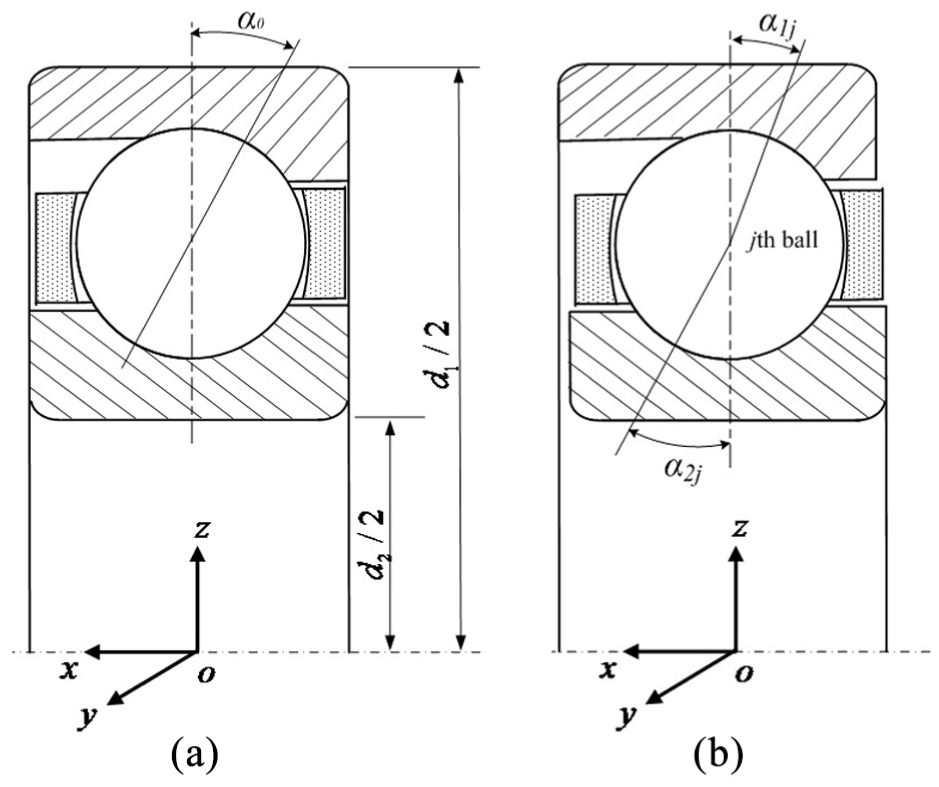
The sketch of an angular contact ball bearing: (a) initial contact angle without load and (b) contact angles after loading.
Skidding of ball bearings will cause heat generation, which will lead to bearing failure. Because contact stress between balls and outer raceway is higher than that of inner raceway because of the centrifugal force in ball bearings, skidding at ball-inner raceway is earlier than that at ball-outer raceway.
According to the gross skidding experiments of ball bearings, the criterion for ball bearing skidding can be stated as follows 6

where
Local friction and power loss model
Figure 2(a) gives a contact model of a ball and inner raceway, and the contact area is ellipse surface. Figure 2(b) shows a local friction model in the elliptical contact surface. Because friction forces and directions of each contact element are different, local friction force of element
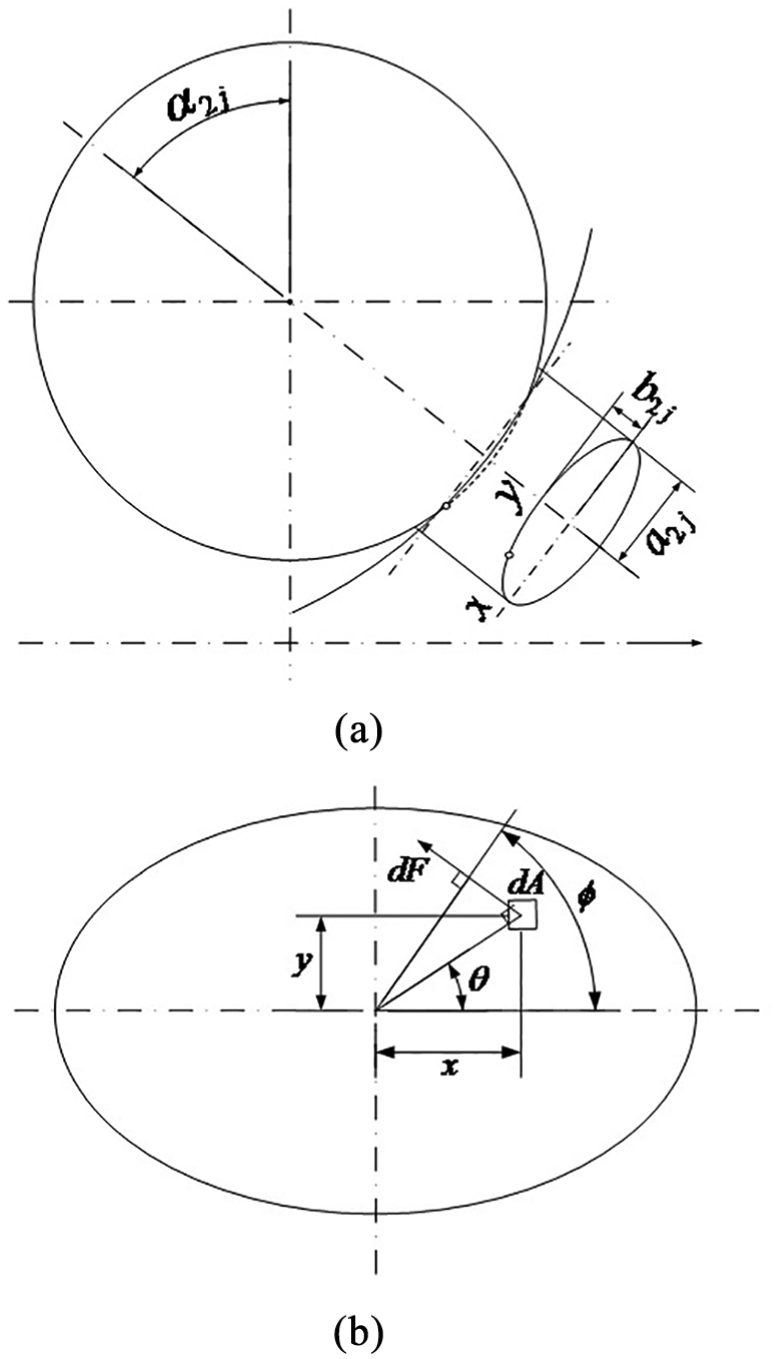
Contact and local friction model of a ball and inner raceway: (a) contact of a ball and inner raceway and (b) local friction in elliptical contact surface.
Sliding friction force between the jth ball and inner raceway can be calculated by integration of local friction in the elliptical contact surface

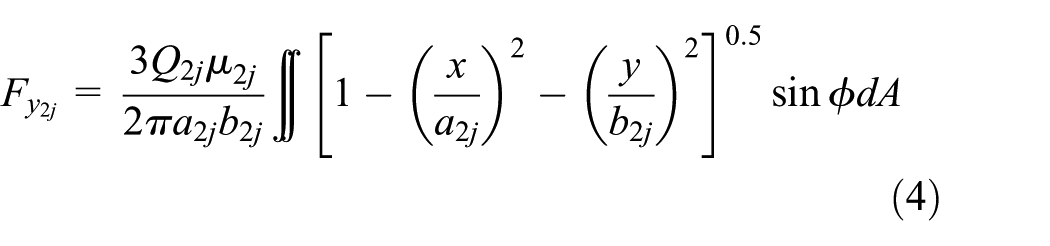
where
Sliding friction moment on the center of the elliptical contact area is written as follows

A modified coefficient for calculating the minimum film thickness considering thermal effect is given 9

where
Considering the thermal modified coefficient, the minimum film thickness can be given based on the Hamrock–Dowson formula 19
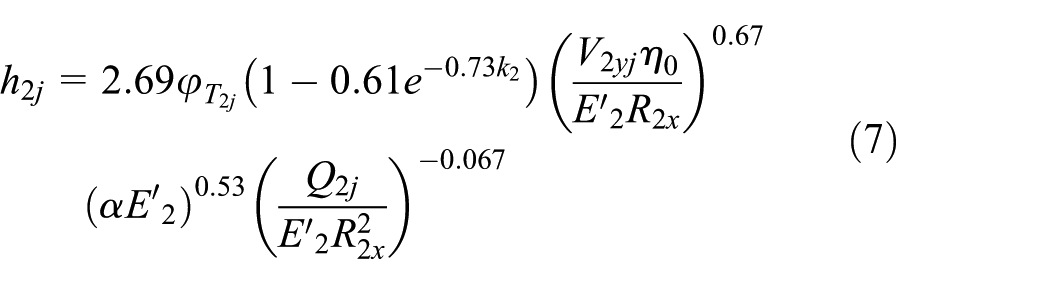
where
Film thickness ratio is used to judge the lubrication status of ball bearings

where
If

where A, B, C, and D are decided by viscosity, viscosity temperature coefficient, viscosity pressure coefficient, thermal conductivity, and density of lubricating oil, respectively.
If
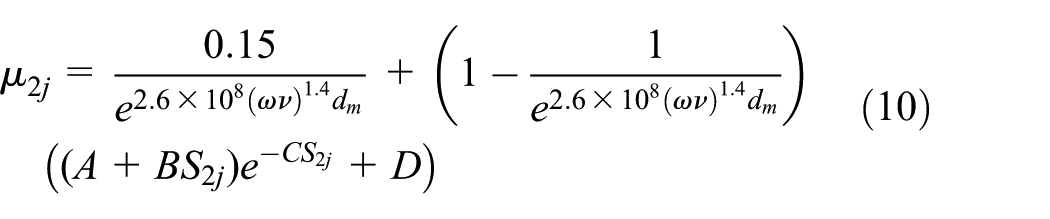
where
If
If ball bearings are grease lubricated, friction moment of seals can be written as follows

where ds is the diameter of the contact area between seal and inner ring and
The rolling friction is caused by rolling elastic lag, and the drag friction from lubricant is much smaller than the sliding friction, which is not considered. Total power consumption is the sum of every local heat source, which includes gyratory motion, differential sliding, and spin sliding of balls, sliding between seal face and rings. Power loss of the jth ball and inner raceway can be given as follows

Power loss of the jth ball and outer raceway H1j can be calculated by the same method. Total power loss of the bearing is defined as follows

where
Temperature calculation considering dynamic-thermal coupling
Heat generation rate of the elliptical contact area between the jth ball and inner raceway can be calculated follows 22

where
When ball bearings are oil lubricated, forced convection exists between oil and the internal surfaces. The convection heat transfer coefficient is given as follows 1

where
Because position of the elliptical contact area between ball and raceway is moving when bearing is working, moving heat source method for ball bearings is proposed. In this method, the elliptical contact areas are considered as heat source, and each elliptical contact area in the raceway undergoes a finite number cycles of heating and cooling. Finally, it achieves a steady temperature field. Transient temperature calculation model can be constructed in ANSYS software based on the moving heat source method.
Figure 3 gives a calculation flow chart of the temperature in ball bearings considering dynamic-thermal coupling.

Calculation of temperature distribution of ball bearings.
Friction moment and power loss are calculated based on quasi-dynamic method. Then, temperature rising of bearing is calculated by moving heat source method. Because viscosity and film thickness are changed with the working temperature, the temperature distribution is necessary to recalculate considering dynamic-thermal coupling. When the difference of average temperatures of the outer ring between two times calculation is less than 1%, calculation is stopped and the average temperature of the outer ring is output.
Results and discussions
Taking an angular contact ball bearing as an example to build the model, the bearing parameters are shown in Table 1.
Bearing parameters.

It is assumed that the outer ring is fixed. The initial contact angle can be designed as 15° or 25°. Material of rings is GCr15, material of cage is brass, and material of balls can be GCr15 or Si3N4 ceramics. Lubricant can be lubricating oil 4050 or grease SKF LGLT 2. Material parameters are given in Table 2.
Material parameters of balls.

If the bearing is oil lubricated, allowable temperature of the bearing is set as 150°C considering dimensional stability. If the bearing is grease lubricated with sealing, allowable temperature of the bearing is set as 80°C. Thermo-physical parameters of lubricant and air are shown in Table 3.
Thermo-physical parameters of lubricant and air.

Assuming transient temperatures of ball bearings distribute symmetrically along the axis, the 3D solid model of the bearing system can be simplified to a two-dimensional model. Figure 4 shows FE model of the angular contact ball bearing system. Plane77 element and Surf151 surface effect element are used. Ball surface coincides with the inner and outer raceways. However, the elliptical contact areas between balls and inner ring and outer ring are calculated and separated. As Figure 4 shows, nodes are only connected on the section of the contact areas. Heat generation rate is directly applied on these nodes. Physical properties parameters are provided in Table 3. The convective heat transfer coefficient of the bearing surface is exerted by the Surf151 element. In the model, the contact areas are heated when the heat source passes and cooled when the heat source leaves. Finally, temperature distribution of the bearing can be obtained when the transient temperature becomes stable.

FEA model of the angular contact ball bearing system.
Temperature simulation based on moving heat source method is programmed in software ANSYS based on APDL language. Quasi-dynamic calculation and thermal coupling analysis for angular contact ball bearing are programmed in software MATLAB.
The critical minimum load for prevention of skidding
If inequality (2) is true, skidding between balls and inner ring will occur. Using the above formula, the minimum load for the bearing can be solved. When the load acting on ball bearing is greater than the critical minimum load, the skidding of ball bearing is effectively controlled.
However, the minimum load of ball bearing can be a variety of axial loads under various radial loads. 5 Therefore, the minimum equivalent dynamic load is used to represent the minimum load at a certain speed

where
Assuming initial contact angle of the bearing is 15°, steel balls and oil lubricant are used. Figure 5 shows that force ratio Q2/Fc varies with bearing position angle under different load conditions. The red line for Q2/Fc is equal to 10, which is the threshold of skidding. The data at one position angle below the red line indicates that skidding occurs.

The force ratio Q2/Fc varying with bearing position angle: (a) when radial load is 0 N at 10,000 r/min and (b) when radial load is 1000 N at 10,000 r/min.
When radial load is 0 N, Figure 5(a) shows that the force ratio keeps constant at different bearing position angles, the critical minimum load for prevention of skidding should be 1500 N at 10,000 r/min. When radial load is 1000 N, Figure 5(b) shows the force ratio varies with bearing position angle. The minimum axial load for prevention of skidding should be 2500 N.
Figure 6 shows that the threshold for skidding of the angular contact ball bearing can be expressed as a curve under different axial loads and radial loads. In the sub-region above the threshold curve, bearing skidding can be avoided by applying proper axial load and radial load. In order to avoid gross skidding at a certain rotating speed, axial preload should be increased when radial load increases. As rotating speed increases, loads threshold should be increased to avoid gross skidding.

The skidding criterion of the bearing.
Figure 7 illustrates that the minimum equivalent dynamic load for prevention of skidding increases obviously with rotating speed of bearing. The minimum equivalent dynamic load increases slightly when lubricant changes from oil to grease. For hybrid ceramic bearing, the minimum equivalent dynamic load reduces evidently. When initial contact angle increases to 25°, the minimum equivalent dynamic load becomes larger than initial contact angle which is 15°.
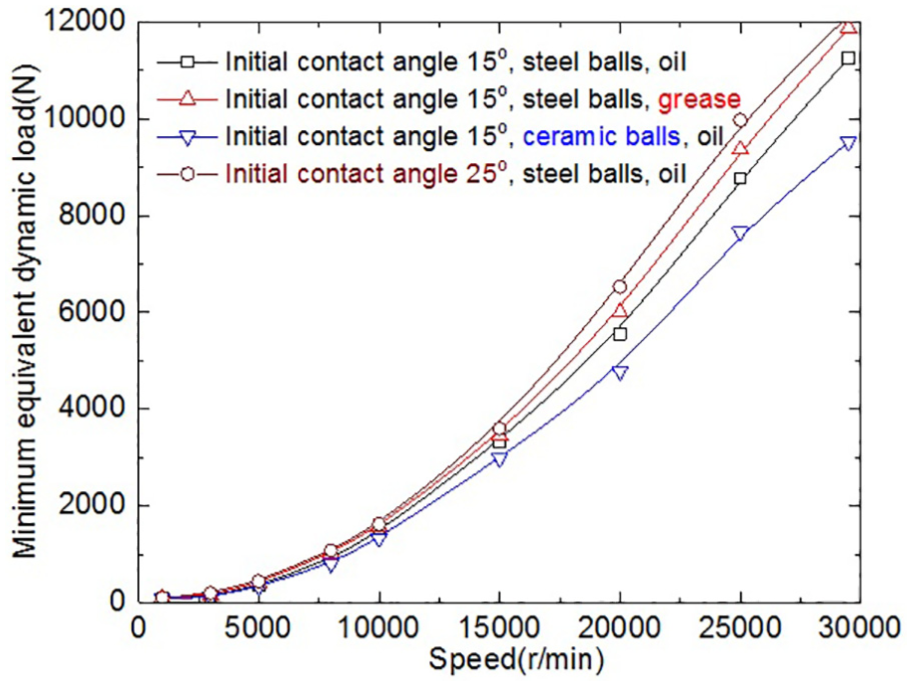
The minimum equivalent dynamic load of the bearing.
The critical maximum load for prevention of overheating
Allowable bearing temperature is set as 150°C in oil lubrication and 80°C in grease lubrication, respectively. The allowable temperature stands for the maximum value of the average temperatures of the outer ring. If bearing temperature is higher than the allowable temperature, the bearing will fail due to overheating.
Using dynamic-thermal coupling method, temperatures of ball bearings can be solved. If the average temperature of the outer ring is lower than the set allowable temperature, the axial load is increased until the average temperature of the outer ring reaches the set allowable temperature. Then, the critical maximum load can be obtained.
If mean temperature of outer ring is above the allowable bearing temperature, the load is output as the critical maximum load because the maximum load can be a variety of axial loads and radial loads. Therefore, the maximum equivalent dynamic load is defined to represent the maximum load at a certain speed

where
Assuming initial contact angle of the bearing is 15°, steel balls and oil lubricant are used. Figure 8 shows bearing temperature under various loads at 10,000 r/min. Bearing transient temperature increases first and then becomes stable, mean temperature of the bearing is lower than the temperature of contact area between ball and inner ring, also the contact area between ball and outer ring, as shown in Figure 8(a). Figure 8(b) shows the critical maximum load for prevention of overheating can be found.

Temperature results of the bearing at 10,000 r/min: (a) transient temperature curve and (b) Bearing temperature under various loads.
Figure 9(a) shows the threshold for angular contact ball bearing overheating can be expressed as a curve under different axial load and radial loads. In the sub-region below the threshold curve, bearing overheating can be avoided by applying proper axial load and radial load. For no overheating to occur in an angular contact ball bearing at a certain rotating speed, axial preload should be reduced when radial load increases. As rotating speed increases, loads threshold should be reduced to ensure no overheating. When mean temperature of outer ring is 150°C, the threshold for bearing overheating occurs, as shown in Figure 9(b).

The overheating criterion of the bearing: (a) critical temperature under various loads and (b) temperature distribution of bearing.
Figure 10 illustrates that the maximum equivalent dynamic load for prevention of overheating decreases rapidly with rotating speed of bearing. The maximum equivalent dynamic load reduces greatly when lubricant changes from oil to grease. For hybrid ceramic bearing, the maximum equivalent dynamic load increases slightly. When the initial contact angle increases to 25°, the maximum equivalent dynamic load becomes smaller than initial contact angle which is 15°.
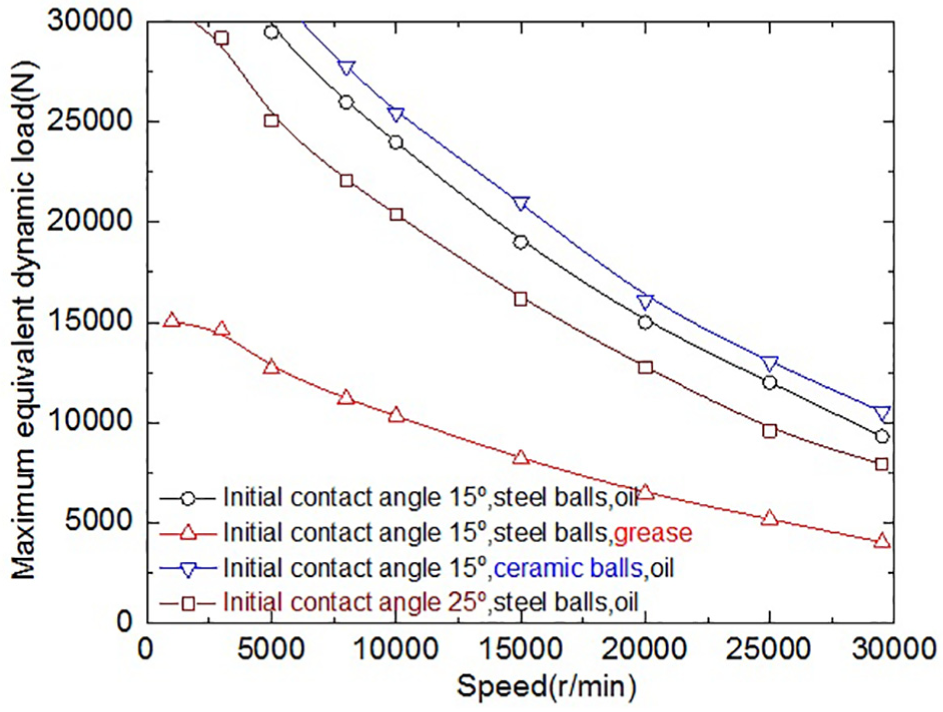
The maximum equivalent dynamic load of the bearing.
Limiting speed considering prevention of skidding and overheating
Considering skidding and overheating, limiting speeds of ball bearings are therefore bounded by the critical minimum loads to prevent skidding and the maximum loads to prevent overheating. Because the maximum load should not exceed dynamic load rating considering fatigue life, safe operating range of ball bearings can be obtained by the method. If the equivalent dynamic load is lower than the minimum load to prevent skidding, the bearing will work in skidding operating range. If the equivalent dynamic load is larger than the maximum load to prevent overheating, the bearing will work in overheating operating range. When the critical minimum load curve and the critical maximum curve intersect, limiting speed ωlimit is obtained.
Figure 11 gives limiting speed of the angular contact ball bearing shown in Table 1. In order to avoid skidding and overheating, the bearing should work in the safe operating range. ωlimit can be obtained from Figure 11. If rotating speed exceeds ωlimit, the bearing will work in unsafe region, skidding or overheating cannot be avoided. Figure 11(a) shows ωlimit is 28,800 r/min when initial contact angle is 15°. Figure 11(b) shows ωlimit reduces to 24,900 r/min when initial contact angle is 25°. Meanwhile, the safe operating range of the bearing also decreases. Figure 11(c) shows ωlimit reduces to 20,500 r/min when the bearing is grease lubricated with sealing, and the safe operating range of the bearing decreases greatly. Figure 11(d) shows ωlimit increases to 32,100 r/min when steel balls become ceramic balls, and the safe operating range of the bearing increases obviously.
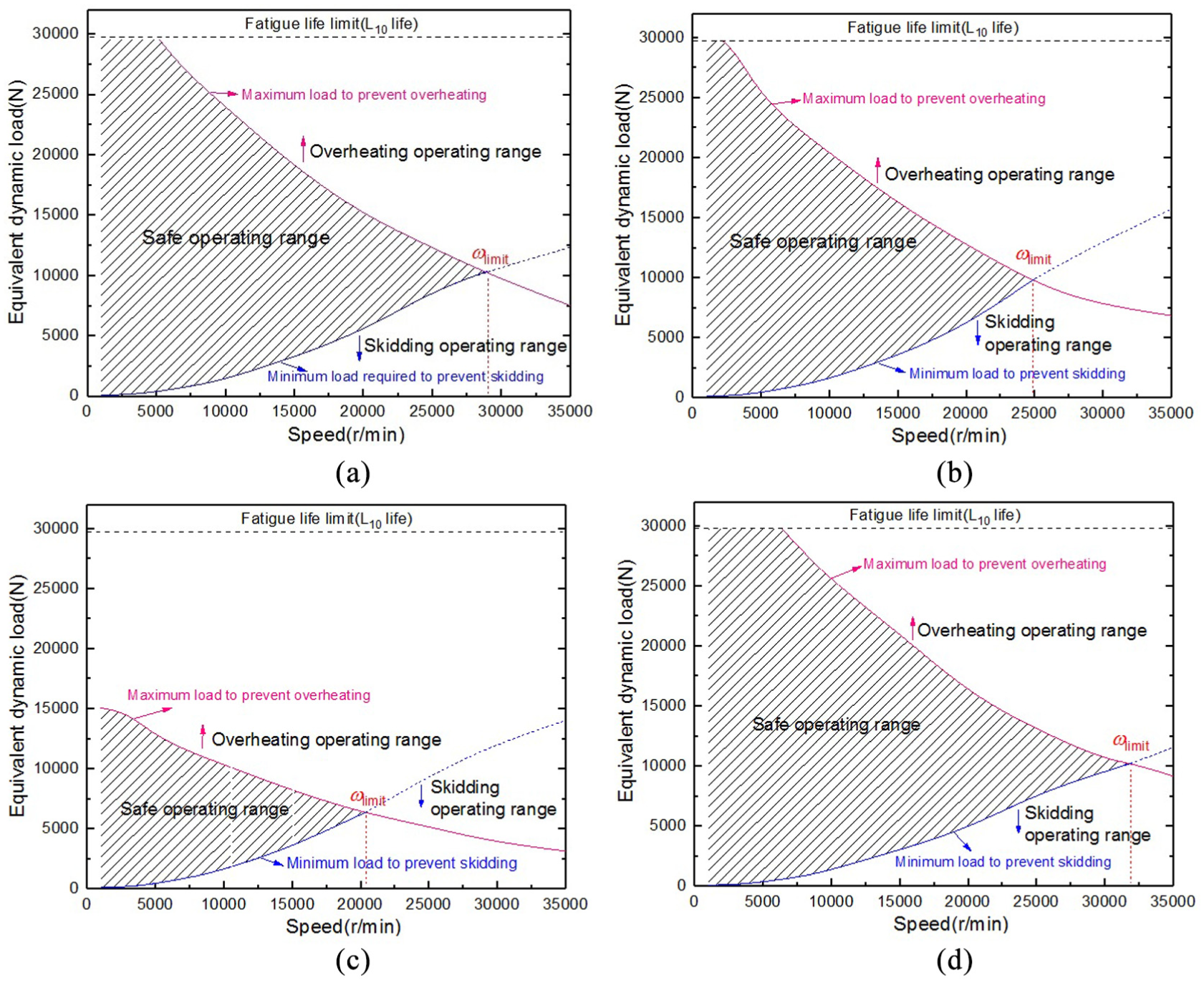
Limiting speed of the angular contact ball bearing in Table 1: (a) initial contact angle 15°, steel balls, and oil; (b) initial contact angle 25°, steel balls, and oil; (c) initial contact angle 15°, steel balls, and grease; and (d) initial contact angle 15°, ceramic balls, and oil.
Experimental verification
To verify the validity of the calculation results, experiments are performed. Figure 12 illustrates the setup of the high-speed rolling bearing experiment. The shaft of the test rig is driven by a high-speed motorized spindle at 0–24,000 r/min. The shaft is supported by two pairs of angular contact ball bearings, which are assemble into three bearing sleeves. Radial load is applied to the middle sleeve and passes through from the two middle bearings to the test bearings on both sides. Axial load is applied to the two pairs of ball bearings. The bearing can be tested under oil lubrication and grease lubrication. The temperature can be measured by thermocouple sensors arranged on the outer rings of the test bearings.

High-speed rolling bearing test rig: (a) schematic of the bearing experimental setup and (b) experimental setup.
Figure 13 shows contrast between experimental results and theoretical results under various speeds and load conditions.
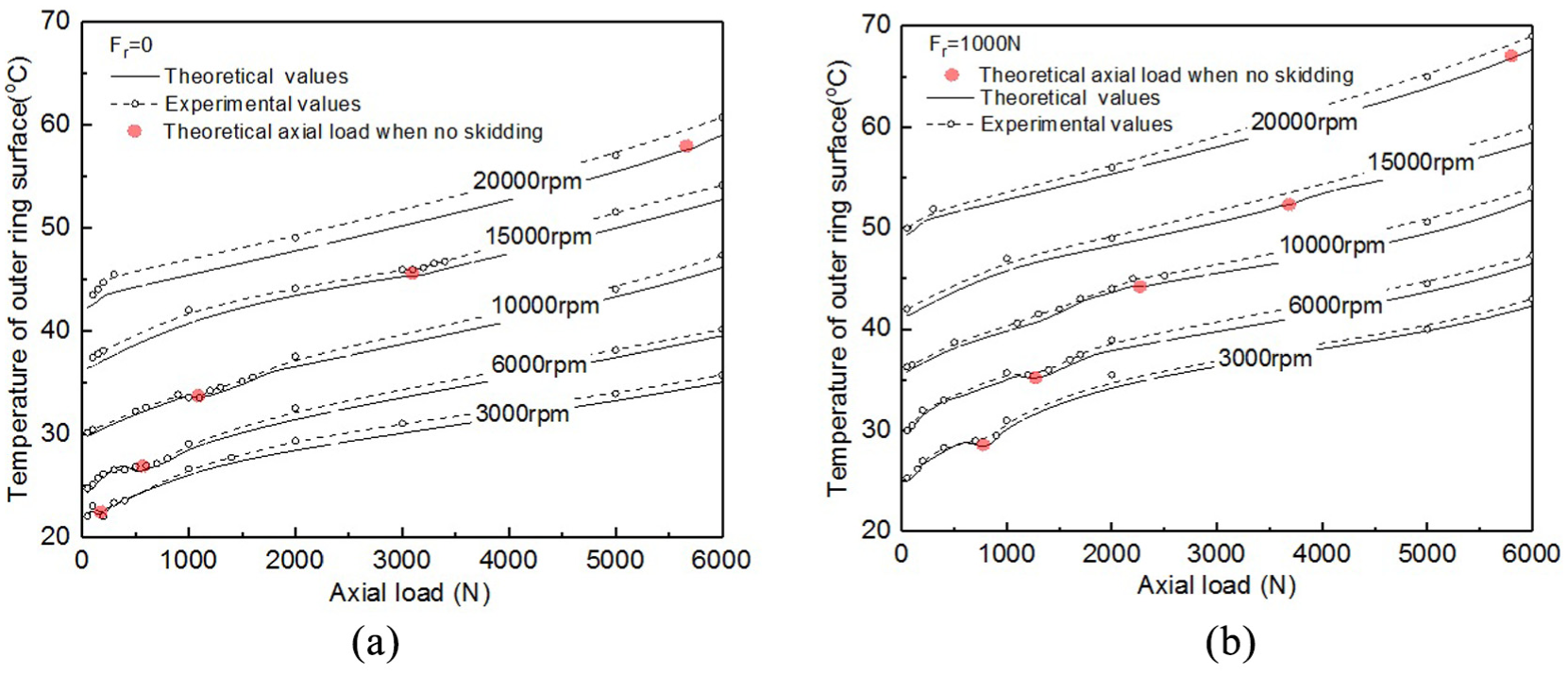
Contrast between experimental results and theoretical results: (a) radial load is 0 N and (b) radial load is 1000 N.
It can be seen that the bearing surface temperature increases gradually with the increase in speed. The test results demonstrate that theoretical results are close to the experimental results, and the maximum difference is 3.4%. As axial load increases, bearing temperature increases gradually, then enters the local minimum value, and then increases gradually. The reason for the local minimum temperature is that there is no skidding when the axial load reaches a certain value. However, the local minimum temperature phenomenon is not obvious over 10,000 r/min. If radial load is not zero, Figure 13(b) proves that the critical minimum axial loads increase, and the temperature of bearing also increases. Figure 13 verifies the reliability of the method in this article.
Conclusion
There exists critical minimum load for prevention of skidding. In order to avoid gross skidding in an angular contact ball bearing at a certain rotating speed, axial preload should be increased when radial load increases. As rotating speed increases, loads threshold should be increased to avoid gross skidding.
For no overheating to occur in an angular contact ball bearing at a certain rotating speed, axial preload should be reduced when radial load increases. As rotating speed increases, loads threshold should be reduced to ensure no overheating.
The limiting speeds of ball bearings are bounded by the critical minimum loads to prevent skidding and the maximum loads to prevent overheating. Smaller initial contact angle, oil lubrication, and hybrid ceramic bearing can enlarge the limiting speeds of angular contact ball bearings.
This article gives a new method to obtain limiting speeds of angular contact ball bearings considering prevention of overheating and skidding. Experiments prove the accuracy of the theoretical model.
Footnotes
Handling Editor: Xiao-Jun Yang
Declaration of conflicting interests
The author(s) declared no potential conflicts of interest with respect to the research, authorship, and/or publication of this article.
Funding
The author(s) disclosed receipt of the following financial support for the research, authorship, and/or publication of this article: This work was financially supported by the National Natural Science Foundation of China (No. 51675323), Shanghai Natural Science Foundation (No. 14ZR1416800), and The key subject of Shanghai Polytechnic University (Material Science and Engineering, XXKZD1601).
