




Abstract
Remaining life prediction is an effective way to optimize maintenance strategy and improve service life for light-emitting diode driving power in rail vehicle carriage. In this article, a Wiener process–based remaining life prediction method is proposed with the analysis of performance degradation data of light-emitting diode driving power in rail vehicle carriage. First, the temperature and humidity stress accelerated degradation tests are put forward in order to measure the output current of light-emitting diode driving power. Based on the output current, the accelerated degradation model is established. The drift and diffusion coefficients of the Wiener process are then obtained without prior information. Finally, the reliability of light-emitting diode driving power in rail vehicle carriage is assessed and the remaining lifetime is predicted after updating the degradation model parameters with Bayesian inference. The results show that the proposed method can improve the precision of assessment and reduce the uncertainty of prediction significantly. It also provides a potential solution for life prediction of other similar products.
Keywords
Introduction
The light-emitting diode (LED) lighting control system is a complex electrical control system in rail vehicle carriage. Its performance affects the normal illumination of the rail vehicle carriage. As the “heart” of the LED lighting control system, the status of LED driving power is related to the stability of the LED lighting control system closely. Its failure may not only break down the lighting control system, but also break down the other systems like air conditioning system, operation control system, and some related systems, which will cause unexpected damage for the whole system. Therefore, research related to reliability assessment and remaining life prediction is essential for designing and optimizing the LED driving power. It is also of great significance to the safe, stable, and efficient operation of the rail vehicle.1,2
In traditional remaining life prediction experiment, failure data can be used to predict the remaining life of a product. But for high-reliability products, failure data are often difficult to be obtained in a short time. 3 Fortunately, some of the characteristics of a product will degrade over time. A large amount of information related to reliability and remaining life can be obtained from the degradation data which can be used to evaluate reliability and predict the remaining life of the LED driving power. 4 Through the accelerated degradation test, both reliability and life information under different environmental conditions of the LED driving power can be obtained. At present, the commonly used accelerated degradation methods include Arrhenius model, 5 Eyring model, 6 inverse power law (IPL), 7 and Hallberg–Peck model. 8 Arrhenius and Eyring models are always used for thermal accelerated stress in systems in which temperature is the major factor in aging. IPL is always used for other different kinds of accelerated stresses expect thermal accelerated stress. Hallberg–Peck model which synthesizes both temperature and humidity can describe the aging test more accurately. For the LED driving power in rail vehicle carriage, the factors affecting the performance include temperature, humidity, and vibration. With the continuous improvement of technology, LED driving power packaging technology has been improved greatly. In practical applications, because the running state of the rail vehicle tends to be stable, the temperature and humidity are the main factors affecting the performance of the LED driving power. Therefore, the Hallberg–Peck model is chosen to be the accelerated degradation method of the LED driving power in the LED lighting system of the rail vehicle carriage in this article.
The prediction methods can be generally divided into the following two types, i.e., physics-based prediction method 9 and data-driven prediction method. 10 With the development of related technologies such as signal acquisition and signal processing, abundant data of the system operation can be obtained. According to these data, the corresponding mathematical model can be utilized, which is mainly composed of two kinds of techniques: artificial intelligence and probability statistics. The artificial intelligence methods have a higher degree of data fitting. The probability statistics can predict the future state better. Wiener process model is a kind of the most commonly used probability statistical models, which can describe the degradation process accurately.11,12 The degradation model based on Wiener process has obvious advantages in mathematics. 13 Now, Wiener process has been widely applied in many research fields14–17 including the degradation process because of its excellent capability of analyzing and describing the process of degradation.18,19 Zhu et al. 20 proposed a reliability assessment method that fused both prior and on-site degradation data. To update the parameters of the Wiener process, the prior data were used and the on-site data were fused by Bayesian method. In Liu et al., 21 the degradation of aero-engine was modeled based on multi-stage Wiener process. Based on the historical degradation data and the historical failure time data, the prior distribution of the model parameters was estimated using the expectation maximization (EM) algorithm. In Si et al., 22 the recursive filtering algorithm and EM algorithm were combined to update the parameters of the Wiener process, and the method is applied to the inertial navigation system to predict the remaining life accurately. However, for rail vehicle carriage LED lighting system, there have been very few results on the remaining life prediction and this constitutes the main motivation of our study.
In this article, we pay special attention to the remaining life prediction for the rail vehicle carriage LED lighting system. We endeavor to handle the following two fundamental questions: (1) how to develop a recursive algorithm suitable for online applications in response to accelerated degradation test of LED driving power under consideration and (2) how to reasonably improve the accelerated degradation test precision in the presence of temperature and humidity phenomena? To solve the two questions, we employ the Wiener process and Bayesian method. Therefore, we augment the degradation process for LED driving power of rail vehicle carriage under the frame of Wiener process. Different temperature and humidity gradients are investigated to accelerate the degradation process, and the accelerated degradation model is then presented based on the measured electric data of the LED driving power. Hallberg–Peck model is used to model the relationship between the drift parameters
This article is organized as follows. In section “Degradation model of LED driving power based on Wiener process,” the degradation model of LED driving power based on Wiener process is formulated. In section “The estimation and updating of parameters,” the estimation and updating method of parameters is described. Section “Remaining life prediction of the LED driving power based on the Wiener process” presents a case study for the remaining life prediction of the LED driving power. Finally, the conclusions are given in section “Conclusion.”
Degradation model of LED driving power based on Wiener process
If

where
Property 1.
Property 2. For any two different time points
According to the characteristics of
The failure threshold of the LED driving power of the rail vehicle carriage is a fixed value, which is set as a constant C. When the electric data reach the threshold value for the first time, the LED driver power has failed. Therefore, its remaining useful life can be defined as

It is proved that its first failure threshold time

and the cumulative distribution function is expressed as

where
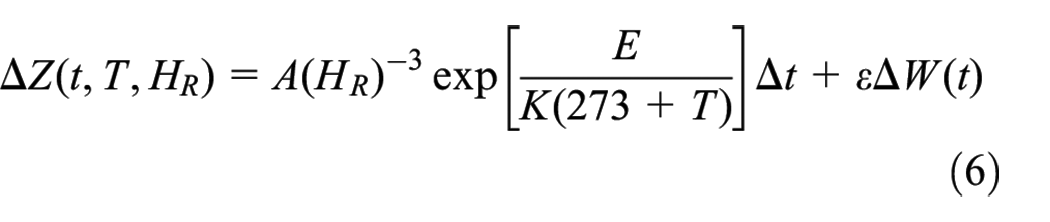
In the accelerated degradation test, temperature and humidity are the most common accelerated stresses that can aggravate the reaction to degenerate the product. Temperature and humidity are also the most important factors for reliability of LED driving power in rail vehicle carriage. A high-temperature and humid environment may make the service life of the internal electrolytic capacitor in the power supply decrease, and therefore the entire life of the driving power is affected. Therefore, the Hallberg–Peck acceleration model is used to construct the relationship between the drift coefficient and the temperature and humidity stresses. Considering the influence of temperature and humidity comprehensively, the Hallberg–Peck model 8 can describe the accelerated degradation test of the product under the condition of temperature and humidity accurately. It can be achieved from the following equation

where A > 0 is a constant,
The estimation and updating of parameters
The accelerated stresses in the accelerated degradation test are set to


In the period of

The likelihood function of
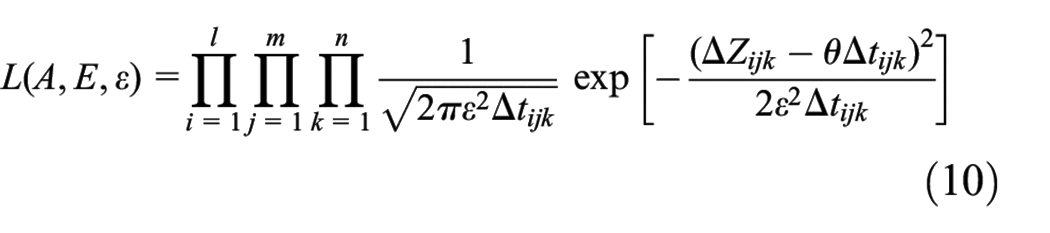
The maximum likelihood estimation can be used to estimate the values of

where
If the distribution of the measured data of the first set sample in stress

Let

In order to update the parameters, the estimated parameters

The equation (14) finally becomes the following formula (15)

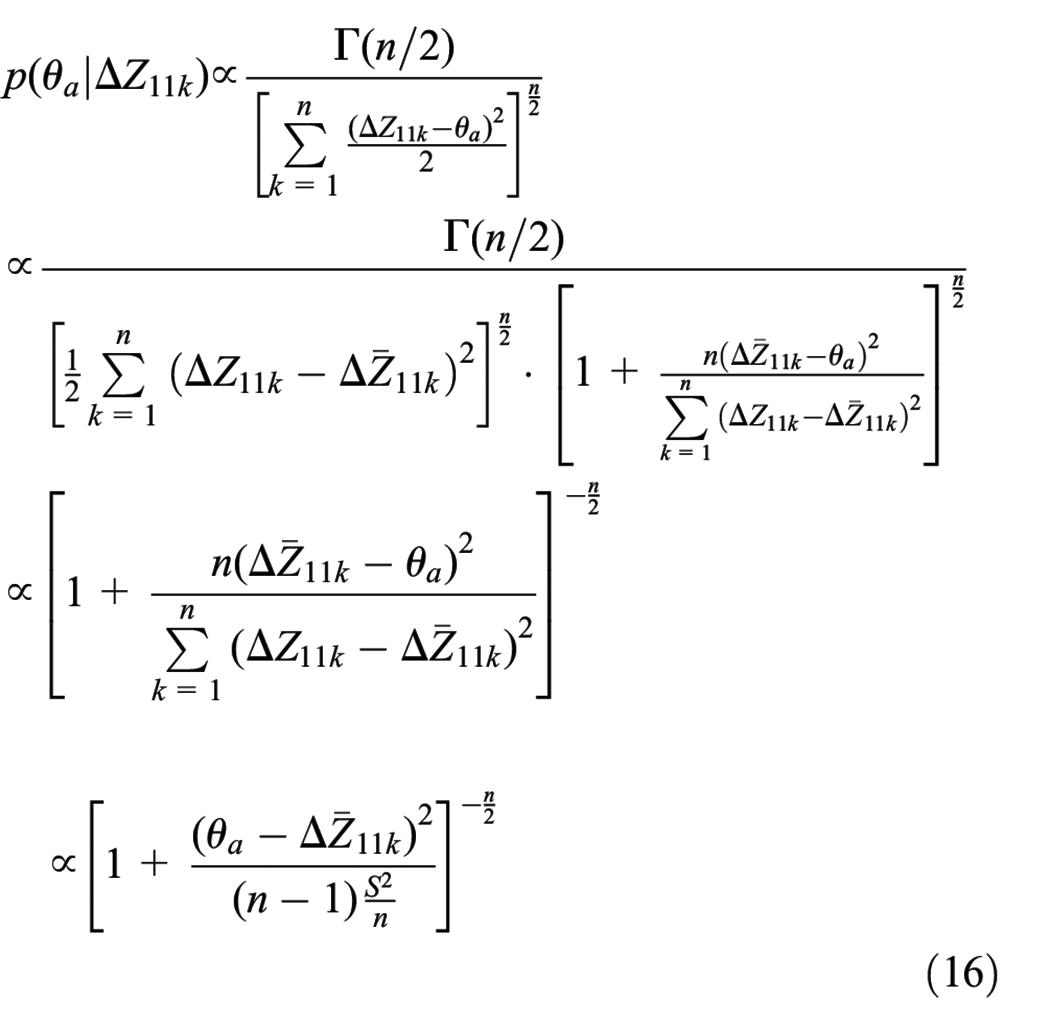
where
The estimated parameter

From equation (17), it can be observed that the posterior distribution of

In the same way, the estimated parameters can be obtained under
In order to obtain

Therefore, we have
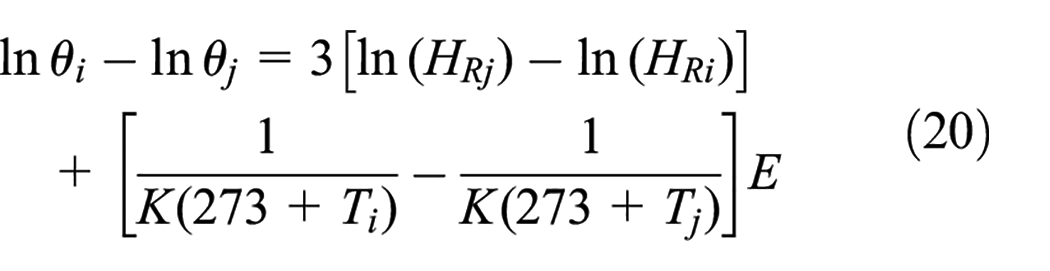
Substitute the estimated value of equation (18) into equation (20)

The estimated value of E can be calculated as

Based on equation (5), the estimated value of A is

Because the diffusion coefficient

Therefore, the mean and variance of the degradation data under normal stress level can be obtained according to the accelerated degradation model. The values of the parameters in the degradation model are acquired. The corresponding failure distribution can be gained by substituting them into equation (3).
Remaining life prediction of the LED driving power based on the Wiener process
LED driving power plays a role in electric energy conversion in the rail vehicle carriage LED lighting control system, which is the key link affecting the entire lighting control system life. As the LED drive current is an important factor affecting the life of LED, the luminous efficiency will change with the driving current. Thus, the electric current degradation of the LED driving power is used to measure the reliability and the remaining life of the LED driving power in this article (Figure 1).

LED driving power performance testing.
Temperature and humidity are selected as the accelerated stresses, and the constant stress accelerated degradation test is used to accelerate the degradation test of LED driving power. Three groups of stresses are chosen under the condition of combination stress T including
Values of combination stress T.


Electric current degradation under three sets of stress conditions.
As shown in Figure 2, the degradation data of the three sets present linear trajectory, random process, and its increment is not strict. It can be determined that the degradation process can be described in the Wiener process initially. According to the characteristics of the Wiener process,
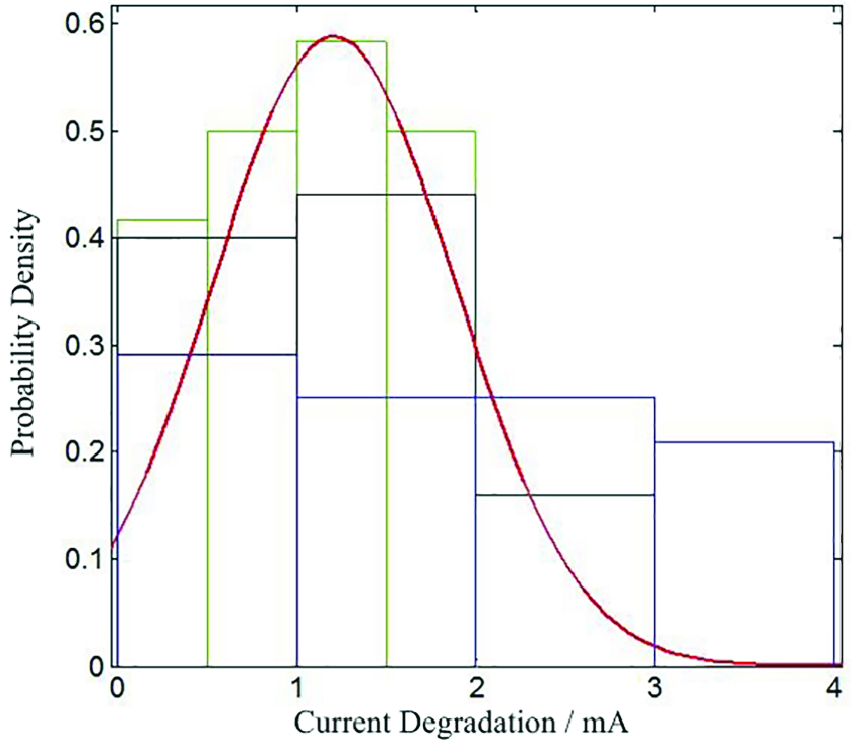
Fitting of degradation quantity.
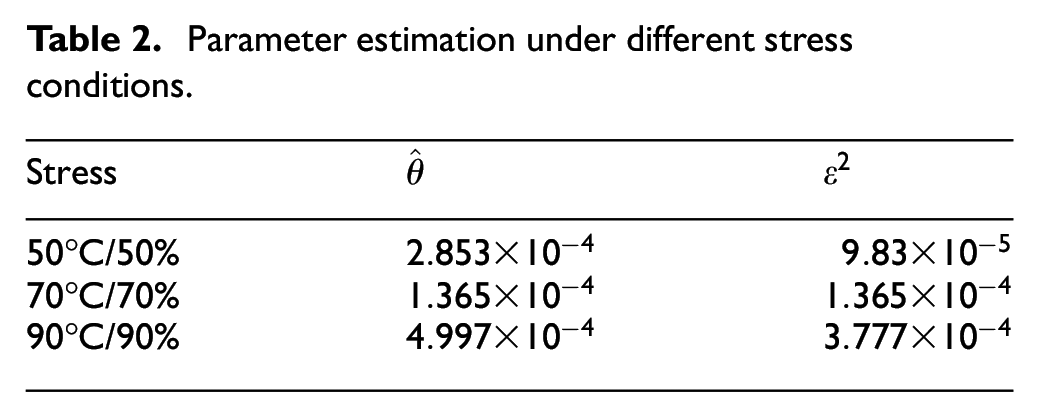
Using the above method, three groups of degenerate data are updated to obtain the normal inverse gamma posterior distribution parameters
Parameter estimation under different stress conditions.
Estimated value of
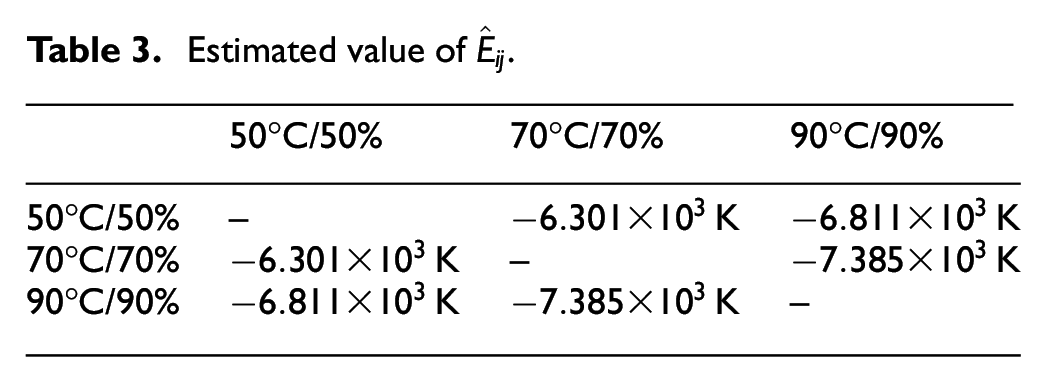
The estimated value of

As a result, the relationship between the drift coefficient

In general, the temperature and humidity of the LED driving power working environment are 25°C and 30%, respectively, in the rail vehicle carriage. So the drift coefficient

where
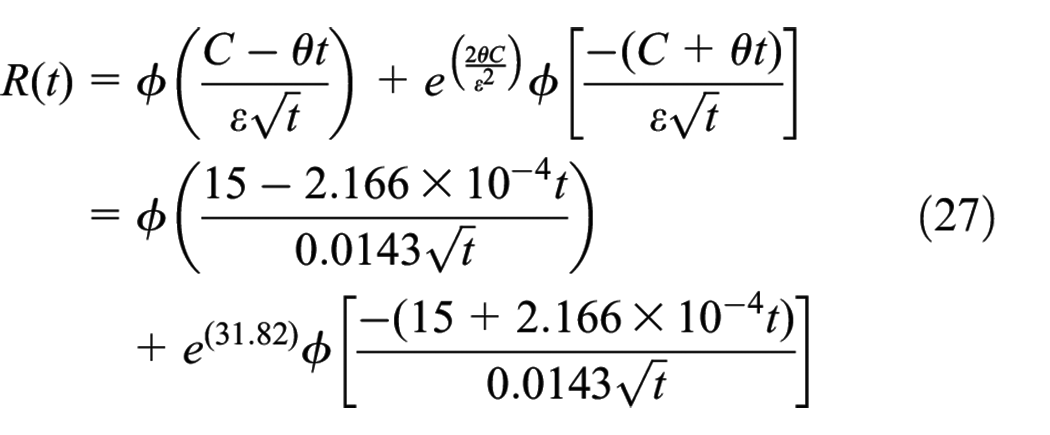
The relationship between reliability and remaining life under different stress conditions is shown in Figure 4.

Reliability curve of remaining life (h).
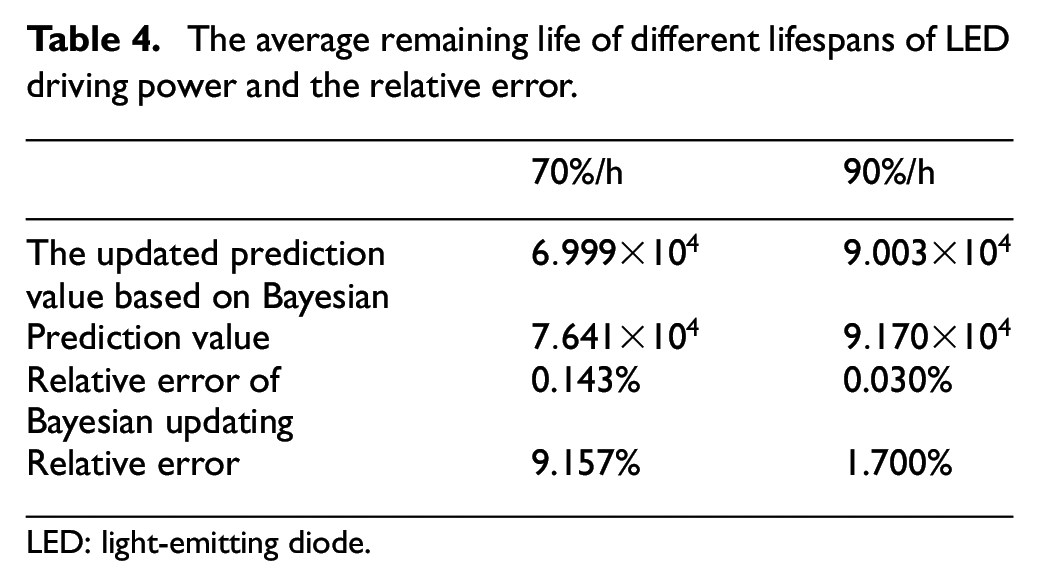
In order to verify the accuracy of the updated data, the PDF curves of the data updated based on the Bayesian method and the non-updated data are shown in Figure 5. As can be seen from the graph, the remaining life distribution predicted by the Bayesian method is higher and narrower than that of the non-updated method, which indicates that the variance of the updated method is smaller, in others words, the uncertainty of the updated method is smaller. By contrasting the updated data based on the Bayesian method and the non-updated data, it can be concluded that the prediction accuracy is improved after the Bayesian updating. 5 At the same time, to validate the method can be improved by the accuracy of the remaining life estimation, the relative error of the mean remaining life and the estimation about Bayesian updated and non-updated in 70% and 90% lifetime is calculated and the relative error expression is

where Δ is the absolute error and L is the theoretic service life of LED driving power in railway vehicles, the value of which is 1 × 10⁵. The calculated results are shown in Table 4. From Table 4, it can be seen that the proposed Bayesian method has a higher prediction accuracy and a small relative error. It validates the effectiveness of this method.

Contrast of distribution of remaining life probability density.
The average remaining life of different lifespans of LED driving power and the relative error.
LED: light-emitting diode.
The results of the case show that the remaining life can be effectively predicted based on Wiener model for LED driving power. The proposed parameter updating method based on the Bayesian method can improve the precision of assessment and reduce the uncertainty of prediction significantly.
Conclusion
In this article, a method has been proposed to provide effective decision support for designing a maintenance strategy of the LED lighting control system for estimating the remaining life based on Wiener process with drift parameters. The parameters are updated by the Bayesian method. Moreover, the detailed process of parameter estimation and the PDF of remaining life have been explicitly derived by means of the above methods. Then, the reliability evaluation and remaining life prediction of LED driving power have been obtained under different temperature and humidity conditions, which provide an important reference for the reliability optimization and improvement of LED driving power. Finally, a simulation example about the remaining life prediction problem for the LED driving power has been provided to show the effectiveness of the proposed method.
Footnotes
Handling Editor: Guian Qian
Declaration of conflicting interests
The author(s) declared no potential conflicts of interest with respect to the research, authorship, and/or publication of this article.
Funding
The author(s) disclosed receipt of the following financial support for the research, authorship, and/or publication of this article: This work was supported by the National Nature Science Foundation under Grant No. 61751304, Achievements transformation project of Jilin science and Technology Department under Grant No. 20160307003GX, and Key R&D Projects of Jilin Science and Technology Department under Grant No. 20180201125GX.
