




Abstract
In a bolted disk–drum joints structure, assembly parameters, such as the number and pretightening force of the tightening bolts, will affect the vibration characteristics of the structure. In this article, the influences are discussed. First, the influences of contact and structural stiffness on the natural characteristics of the joint structure are analyzed theoretically. Considering the micro-contact between the contacting surfaces of the bolts’ connected structure, the stress diffusion between the bolt head and the disk is investigated. Then, the relationship between the tightening torque and contact stiffness, as well as the relationship between the number of tightening bolts and structural stiffness, is established. Furthermore, the relationship between assembly parameters and the natural frequencies is obtained. Hence, the regularity of the influence on the structural natural frequencies can be summarized as a consequence. The results of experiment showed that the minimum error between theoretical calculation and experimental data was 1.5%, which provides a reliable analysis tool for the investigation of vibration characteristics on the bolted disk–drum joints structure.
Keywords
Introduction
Bolt connection has been widely used in the structure of aeroengine. Based on the requirement of high speed and thrust–weight ratio, the connection’s influence on the aeroengine’s vibration characteristics has become increasingly important. The structure of the engine cannot be regarded as a continuum because of the existence of the connection, which may change the engine’s vibration characteristics. Therefore, the investigations of the bolt connection’s effect on the vibration characteristics of aeroengine have been considered by many researchers.
For example, Zhao et al. 1 simulated the pretightening force on the bolted disk–disk connection structure, with the layer element method and multi-point constraint technique; besides, the results of modal analysis and experiment were compared. Based on the finite element (FE) calculation and experimental validation, Chen et al. 2 analyzed the influence of bolts’ stiffness and pretightening forces on the structure’s vibration modes and transmission characteristics, respectively. The virtual material method was used to simulate the bolt pretightening force in the modal analysis by Huang and Jin, 3 where the simulation results of natural frequencies and vibration mode had an excellent fit with the experiment. The method of the dynamic stiffness identification was studied based on the theory of modal analysis by Dong et al. 4 Zhou et al. 5 used the structural module of FE of ANSYS to calculate the stress, deformation, inherent frequencies, and mode shapes of gas compressor disk. Langer et al. 6 focused on the FE modeling of bolted joints for structural dynamic analysis to achieve a reasonable accuracy in simulation results. Langer et al. 7 focused on the critical points concerning the FE modeling for structural dynamic analysis of bolted connections to achieving reasonably accurate simulation results. Grzejda 8 presented the concept of a new modeling method of multi-bolted connections dealt with as multi-bolted systems. The model assumptions and modeling bases of separate subsystems of a physical model of the multi-bolted connection were given.
There are only a few studies on vibration characteristics of a bolted disk–drum joints structure (where the disk and drum are joined by a number of bolts), because of the particularity of this structure. Tang et al. 9 investigated the modeling and dynamic analysis method of a bolted joined cylindrical shell. Different kinds of factors, including the number of bolts, load frequency, excitation amplitude, and preload, were considered to influence the dynamic behaviors of the cylindrical shell. Qin et al. 10 proposed an analytical model for the bending stiffness of the bolted disk–drum joint and the approaches of implementing the joint into a rotor model. And in Qin et al., 11 the influence of the bolt loosening at the rotating joint interface on the rotor dynamics was studied. The time-varying joint stiffness resulting from the bolt loosening and its influence on steady-state response of the rotor were investigated.
To directly draw out the relationship between parameters of bolts joints and vibration characteristics of the bolted disk–drum joints structure, how the joint stiffness and contact stiffness are affected by the number and pretightening force of bolts is studied in this article. And the effect of the stiffness on the natural characteristics of the bolt connection is analyzed. The summary of those influences not only can provide a theoretical perspective to investigate the vibration characteristics of bolt connection but also contribute to the further design and control of this structure, by meeting the practical engineering requirement.
This article is organized as follows. In section “Natural characteristics analysis on bolted disk–drum joints structure,” the vibration characteristics of the bolted disk–drum joints structure, considering the stiffness transformation occurred in bolts connection, are analyzed. Meanwhile, in section “Evaluation process and simulation analysis,” the simulation of vibration characteristics with different number and pretightening force is conducted. Finally, in section “Experimental verification,” the experimental validation and the influence of these two parameters on the vibration characteristics of the structure are discussed. Conclusions are finally drawn in section “Conclusion.”
Natural characteristics analysis on bolted disk–drum joints structure
Considering contact stiffness
Considering the nonlinear contact force, the rotor-bearing system, placed horizontally with an unbalanced disk, is simplified (as the rotor is rigid) and supported by two symmetrical rolling bearings with the same parameters.
Each components of the bolt connection structure are contacted through the micro-convex bodies of the contacting surfaces. The relationship between the contact pressure

where the constants
The normal contact stiffness

where
Back et al.
13
formulated the relationship between tangential stiffness

where R and the superscript s are related parameters determined by the material.
Hence, the tangential stiffness



where

Schematic diagram of stress distribution in bolt connection structure.
According to formulas (2)–(5), the stiffness of structural tangential contact and normal contact has a proportional relationship with the bolt pretightening force. Based on the structural dynamics theory, the existence of the assembly stress will lead to deformation and structural combination changes of the structure and cause the structural parameter changes as a consequence. Furthermore, due to deformation and structural combination changes of the structure, the dynamic characteristics of the structure will also be affected. The change of vibration mode can be evaluated by comparing the dynamic response under the normal scenario.
15
For multi-degree-of-freedom (MDOF) linear systems,

where
Considering structural stiffness
Structural stiffness is a physical quantity that describes the relationship between structural deformation and force. The existence of assembly stress will reduce the structural deformation and correspondingly increase the structural stiffness. In other words, the deformation of structure under assembly stress often affects its stiffness matrix. Therefore, this state’s natural frequency
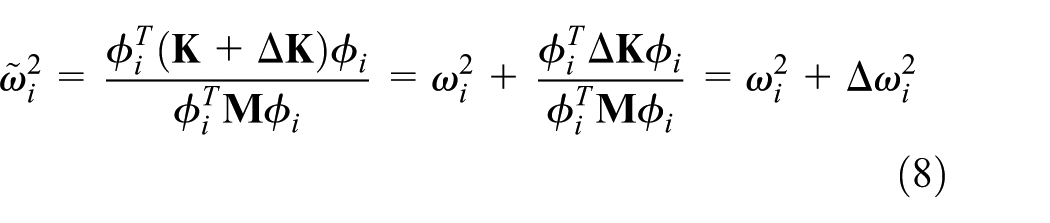
where
The stiffness of bolted joints structure with different number of tightening bolts and torque is calculated through the FE method.7,16,17 As shown in Figure 2, the tightness between the matching surfaces and structural stiffness has the proportional relationship with the pretightening force, which will affect the natural characteristics of the structure. Moreover, as the number of bolts increases, the effect of pretightening force on the structural stiffness will become more obvious.

Variation in stiffness of the bolted disk–drum joint structure.
Evaluation process and simulation analysis
The FE model of the disk–drum joints structure is established by using workbench, as shown in Figure 3, the elastic modulus G = 210 GPa, Poisson’s ratio

Bolted disk–drum joint structure.

Diagram of bolted disk–drum joint structure.
The pretightening torque and the number of tightening bolt are the important assembly parameters of the bolt connection structure. Their effects on the natural characteristics of the cylinder structure will be analyzed in details as follows.
First, because that the change in bolt pretightening torque has little effect on the change in structural natural frequencies when the value of pretightening torque is too small or too big, the pretightening torque of the bolts are defined as T = {5, 7, 9, 11} N m. Then, the natural characteristics of the disk–drum joints structure are simulated and calculated. The pretightening force exerted on the bolt can be calculated as

where
Structural natural frequencies with different preload torque.
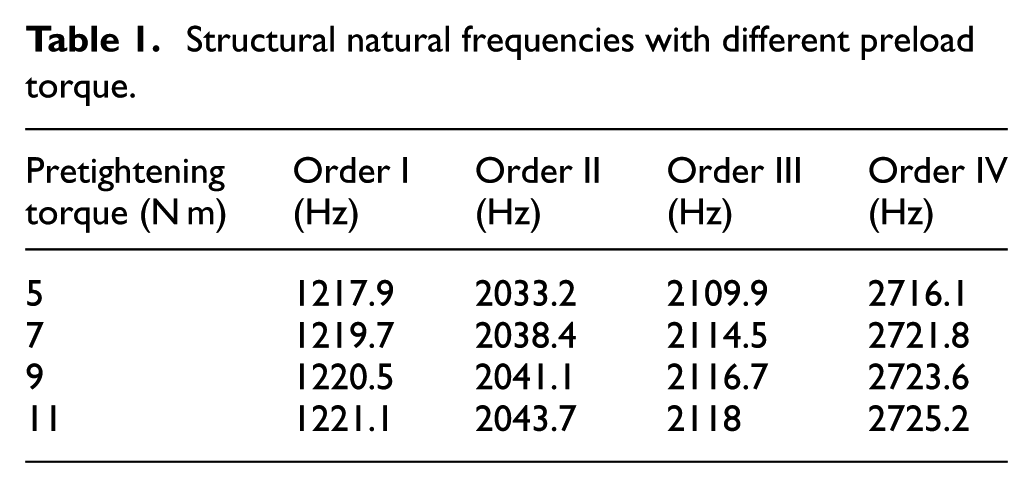
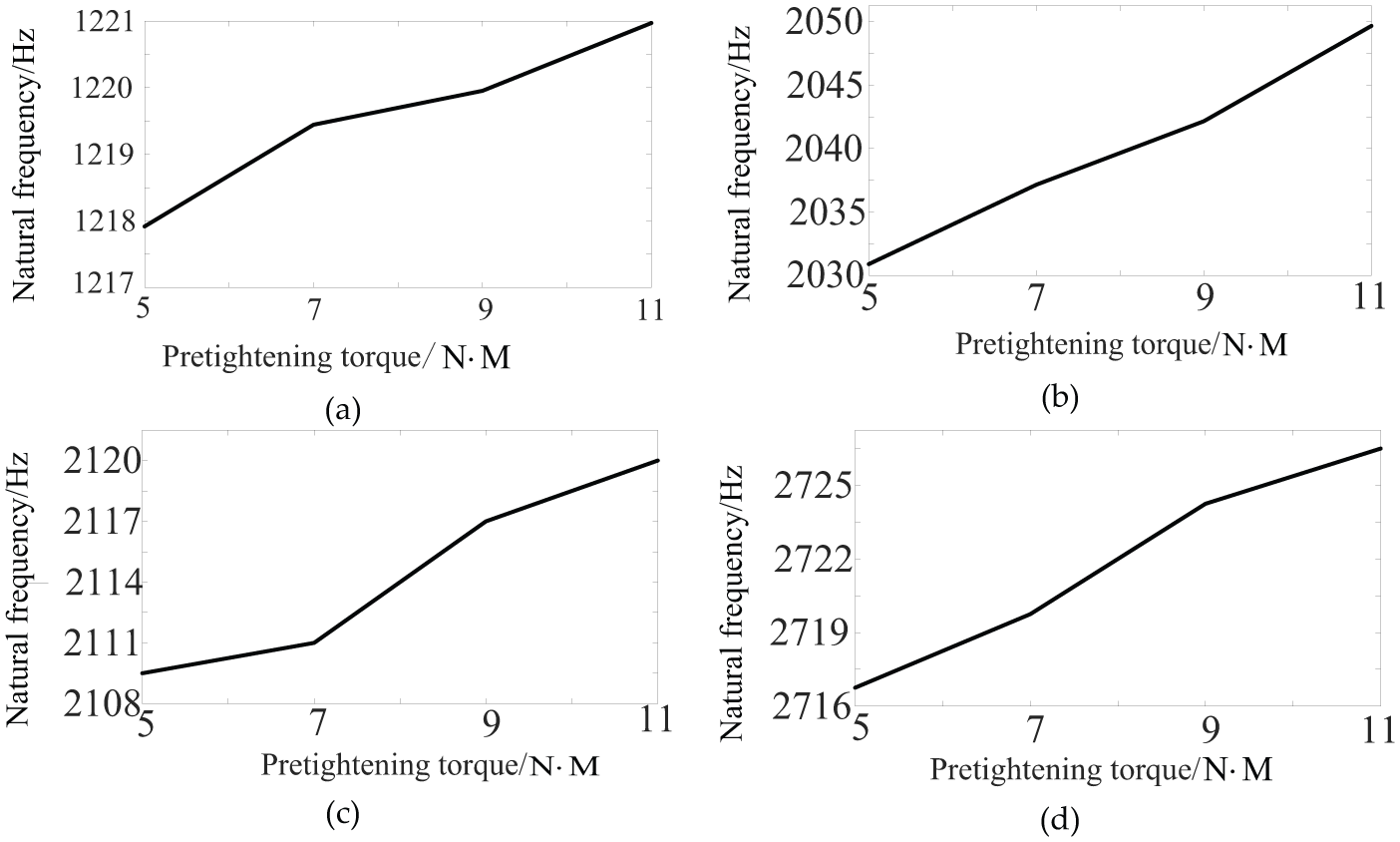
Variation in each order natural frequencies under different pretightening torque ((a)–(d) show the relation of pretightening torque of bolts and the first- to fourth-order natural frequencies).
The vibration modes of the disk–drum joints structure are shown in Figure 6.

Vibration pattern of bolted disk–drum joint structure ((a)–(d) show the first- to fourth-order mode of vibration).
According to the analysis in section “Natural characteristics analysis on bolted disk–drum joints structure,” when the number of bolts is large enough, the contact pressure between the two contact surfaces will be also large enough, and the change in the number of bolts will have no effect on the natural frequencies of the structure. Experiments in Wei et al. 12 show the same results. Keeping the pretightening torque as 11 N m, and changing the number of tightening bolts from 4 to 8 and 16, the variation in the natural frequencies of the structure is shown in Table 2 and Figure 7.
Structural natural frequencies with different number of tightened bolts.


Variation in each order natural frequencies with different number of tightened bolts ((a)–(d) show the relation of the number of tightening bolts and the first- to fourth-order natural frequencies).
The above analysis indicates that the disk–drum joints’ structural natural frequencies have the proportional relationship with the bolt tightening torque, as well as the number of tightening bolt. Furthermore, the number of the tightening bolts has more significant effect.
Experimental verification
The disk–drum joints structure, which is lifted by elastic rope in the free modal test, was taken for experimental verification. The learning management system (LMS) is a widely used testing system that was applied in the modal test to obtain the natural frequencies that are stimulated by hammer method.20,21 The experimental setup is shown in Figure 8.

Experimental setup.
Comparing the results of observation points on the disk and drum, the acceleration transducers are located on both of them, as shown in Figure 9. And modal tests are carried out by hanging the structure with a rope.

Location of sensors and percussion point: (a) measuring point, (b) measuring point, and (c) excitation point.
The pretightening torque was to be designed in the range of T = {5, 7, 9, 11} N m with 16 bolts, where the corresponding natural frequencies were tested. Keeping the pretightening torque as T = 11 N m and changing the number of bolts to be 4, 8, and 16, the structural natural frequencies will be obtained. The results of the tests are shown in Tables 3 and 4 and Figures 10 and 11.
Structural natural frequencies with different preload torque.

Structural natural frequencies with different number of tightened bolts.


Variation in each order natural frequencies with different preload torques ((a) to (d) show the relation of pretightening torque of bolts and the first- to fourth-order natural frequencies).

Variation in each order natural frequencies with different numbers of tightened bolts ((a) to (d) show the relation of the number of tightening bolts and the first- to fourth-order natural frequencies).
As shown in Tables 3 and 4 and Figures 10 and 11, the test results can provide a good fitting performance with the simulation. When tightening torque changes, the error between simulation and experiment has inverse relationship with the order of natural frequencies. Specifically, the first-order natural frequencies have the largest error, which refers to about 10%, while the third or fourth order takes the least one.
When changing the number of tightening bolts, the comparison between simulation and test results shows that 85% of the data errors are less than 10%, while the remaining are relatively large. As shown in Figure 10, the error is getting smaller with the increase in pretightening torque, which has the similar rule applied in the relationship between the structural nonlinear characteristics and the pretightening torque, since the modal analysis in the FE simulation is linear.
As for Figure 11, the error will reduce obviously with the increase in the number of tightening bolts, which imply that the number of tightening bolts has a great effect on the nonlinear characteristics of the structure. Based on the analysis of the experiment and simulation, the main causes can be summarized as follows: (1) the friction coefficient has an effect on the result in the FE simulation, because of the limited test conditions. Furthermore, the accurate friction coefficient between the contact surfaces cannot be obtained, which leads to a certain deviation between the test and the simulation. (2) The contact interval of the matching surfaces under the free vibration mode is constantly changed, resulting in the nonlinear change in the contact stiffness. Since the modal analysis of ANSYS is a linear method, the nonlinear vibration cannot be fully considered. 2 (3) Among hundreds of testing process, due to the various uncertainties in the assembly process, the actual connection was inconsistent with the ideal one in each time. In further studies, standardization of experimental process and the compensation method should be carefully considered to decrease the error.
Besides, when keeping either the number of tightening bolt or tightening torque as a constant, both the simulation and test results imply that the natural frequencies of the bolt connection structure have the proportional relationship with the other parameter, which is in good agreement with the results in Tang et al. 9 and Wei et al. 12
Conclusion
Based on the theoretical analysis of contact stiffness and structural rigidity of bolt connection structure, the structural natural frequencies will change with the increase in pretightening force and the number of tightening bolts. This is mainly due to the deformation of the micro-convex body between the matching surfaces, causing the contact to be closer and then increase the structural stiffness and the natural frequencies. The mechanism of the bolt’s pretightening force and number affecting the natural frequencies of the structure are preliminarily revealed in this study.
The tests of simulation and experiment show that the structural natural frequencies have proportional relationships with the tightening torque and number of the bolts, which is coincident with the theoretical analysis. These two assembly parameters of the bolt connection structure have important influence on the structural natural characteristics.
The nonlinear characteristics of bolt connection structure are also significantly affected by the pretightening torque and number of the bolts. With the increase in pretightening force and number of the bolts, the structural nonlinear characteristics are gradually suppressed, while the linear characteristics perform oppositely.
Footnotes
Acknowledgements
LI Jiang and LI Yu-qi conceived and designed the study. LI Jiang performed the experiments. Fei Wang wrote the manuscript. Zhong Luo and Fei Wang reviewed and edited the manuscript. All authors read and approved the manuscript.
Handling Editor: Farzad Ebrahimi
Declaration of conflicting interests
The author(s) declared the following potential conflicts of interest with respect to the research, authorship, and/or publication of this article: The founding sponsors had no role in the design of the study; in the collection, analyses, or interpretation of data; in the writing of the manuscript; and in the decision to publish the results.
Funding
The author(s) disclosed receipt of the following financial support for the research, authorship, and/or publication of this article: This work was supported by the National Natural Science Foundation of China (grant no. 11572082); the Fundamental Research Funds for the Central Universities of China (grant nos N160312001 and N150304004); and the Excellent Talents Support Program in Institutions of Higher Learning in Liaoning Province of China (grant no. LJQ2015038).
