




Abstract
This article studies the location problem of maritime emergency supplies repertories under the joint of government and enterprises, and it proposes the two-stage optimization location model by integrating the location of maritime emergency supplies repertories, the distribution of emergency supplies, and the cooperation game between the government and enterprises. The first-stage model solves the location–allocation problem of maritime emergency supplies repertories; the second-stage model solves the cooperation game. In view of the model, it designs a genetic, greedy heuristic algorithm. The numerical example results indicate that the joint of government and enterprises can reduce the total cost, the cooperation enterprises can benefit from the alliance, and the alliances are stable, so the model and the algorithm are feasible.
Keywords
Introduction
Maritime emergencies occur frequently, causing great damage to environment and society. Examples in recent years include the ConocoPhillips oil spilling in Bohai bay in 2011, Huang Dao petrochemical explosion in 2013, airplane lost event of Malaysia Airlines in 2014, capsizing of the eastern star tourist ship in 2015, and capsizing of the oil tanker Sanchi in 2018. When a maritime emergency occurs, an immediate response is important to minimize the damage. The reserve of emergency material can improve response efficiency greatly, which is proved in practices.
The emergency material reserve problem belongs to the emergency resource allocation in the emergency management prevention stage. The storing of emergency supplies usually occurs before the water incident happens; some scholars studied the location of emergency reserve facilities based on the set covering theory, which takes a part of a region or area as a whole to seek the best location for emergency facilities.1,2 Based on the set covering model, many scholars have improved the location model by taking into account more influence factors and more goals, and the models and algorithms have become more complex and diverse than before.3–5
The government emergency materials physical reserve needs to invest a lot of manpower and material resources. The high cost of government and the low utilization of emergency reserves are the common features in the location of emergency supplies bases. For some emergency materials that are time-sensitive and difficult to store, such as medicines and food, the enterprise reserve can update the inventory by means of market sales, greatly reducing the losses caused by failure or overdue. With the development of research and application, the cooperation mode of government and enterprises in the location of emergency supplies repertory is gradually recognized by people, as it can solve the low utilization rate of supplies through the cooperation and gain the additional benefits by the regular updation of reserves than the government reserves alone.
In view of China’s emergency supplies system, Chen and Huang 6 divided China’s disaster emergency supplies into three main parts, including the national supplies, the emergency replenishment, and the social donations. The reserve of national supplies contains government reserves and joint reserve of government and enterprises. The joint reserve of government and enterprises contains corporate production capacity reserve and corporate physical reserve. Ding and Gui 7 analyzed the cost of enterprises and governments storing emergency supplies, respectively, for the issue of joint supplies between governments and enterprises, and different forms of reserve cost function were established to find the lowest one under the demand was a random variable case. Ai et al. 8 studied the cooperative mechanism of the joint reserves of government and enterprises, analyzed the game relationship among the participants in the alliance, and used the Shapley value to solve the cooperative income distribution problem.
It can be seen from the existing studies that the cooperation between the government and enterprises in the emergency reserve can achieve win–win results. The government can save overall costs and the enterprises can obtain certain benefits. The cooperation of government and enterprises in the emergency supplies repertory has been proved feasible and can be applied to the storage of water emergency supplies, but the amount of total emergency reserves and the amount of emergency reserves that government needs to reserve should be recognized in advance, which were affected by the location–allocation problem of the emergency material reserve bases.
This article studies the optimization location problem of maritime emergency supplies repertories under the joint of government and enterprises. We integrate the location of emergency supplies reserve bases and the cooperation of government and enterprise in the reserve of emergency supplies:
Based on the previous research results, this article proposes the two-stage optimization model aimed to maximize the total cost and the benefit of enterprises.
The first-stage model solves the location and allocation of maritime emergency supplies repertories of the entire water region.
The second-stage model selects the government as the head of the cooperation and solves the problem of joint government and enterprises.
A genetic, greedy hybrid heuristic algorithm is designed for the model, and the validity of the model and algorithm is verified by case study.
The remainder of this article is organized as follows: we describe the literature review in section “Literature review,” establish the models and design the algorithms in view of the models in section “Modeling process.” Finally, the models and the algorithms are applied in a case study in section “Case study,” and conclusions are drawn in section “Conclusion.”
Literature review
Aimed at emergency resource reserve for prevention phase, Li 9 studied the location model of rescue vessels on the sea based on the large number of data sets acquired from the Canadian Coast Guard Search and Rescue branch. Three coverage location models (maximal covering location problem, maximal expected covering location problem, and maximal covering location problem with workload capacity) are applied. Azofra et al. 3 studied the placement of sea rescue resources and formalized a general methodology based on gravitational models which allowed us to define individual and zonal distribution models. Goerlandt et al. 10 proposed an account of advances in the construction of a simulation model aimed at evaluating the response characteristics of the maritime voluntary sea rescue system. The simulation model was driven by a historical incident data, augmented with wave data and expert-elicited search and rescue unit characteristics.
There are some papers concerning oil spilling and response. Montewka et al. 11 presented a model to analyze the risk of two common marine accidents: collision and grounding. For the assessment of a grounding probability, a new approach was proposed, which utilizes a gravity-like model, where a ship and navigational obstructions are perceived as interacting objects and their repulsion is modeled by a formulation inspired by gravitational force. The considered situation in this case was the movement of oil tankers in the approach channel to an oil terminal at Skoldvik, near Helsinki. Lehikoinen et al. 12 developed a Bayesian network to examine the recovery efficiency and optimal disposition of the Finnish oil combating vessels in the Gulf of Finland, Eastern Baltic Sea. In total, 4 alternative home harbors, 5 accident points, and 10 oil combating vessels were included in the model to find the optimal disposition policy that would maximize the recovery efficiency.
The above methods of emergency reserve in the prevention phase are mostly used in the emergency reserve system established by the government or enterprises. However, it is costly to establish the emergency reserve system separately. In recent years, some emergency reserve systems based on government and enterprise cooperation have attracted more and more attention.
The agent reserve strategy has gradually gained the characteristics of lower stocking costs, decreased funding, and reduced waste. However, the enterprise’s effort has significant influence on the value of the emergency supplies during this reservation strategy. 13 On one hand, the enterprise owns the emergency supplies in the agent reserve strategy, and although the government has the right to use the materials, there are inevitable benefits to the relationship between the government and the enterprise. The government expects to maximize the value of the emergency supplies, and the less in subsidies that the government must pay, the better it is for the government. The enterprise seeks to maximize its economic benefits through the lowest input costs, so the enterprise as the agent often cannot earnestly perform its duties when the two parties’ interests are not aligned. On the other hand, asymmetric information is widespread in supply networks. 14 In the process of agent reserve strategy, the government and enterprises share some common information but also have their own private information. The government is at a disadvantage when faced with information acquisition because it cannot obtain complete information from the enterprise, whereas the enterprise, which has advantages in information sharing, cannot consciously handle matters in accordance with the wishes of the government, especially when it is only receiving fixed subsidies. Furthermore, the enterprise is likely to reduce its input of manpower and material resources over the long term, thereby maximizing its interests at the cost of sacrificing government benefits. Yang and Pei-Hua 15 analyzed the dynamic evolution factors affecting the cooperation or competition mechanism between producers and suppliers in the supply chain through evolutionary game theory, including the initial proportion of the game subject, distribution of benefits, initial investment cost, and discount factor. Gao and Tian 16 extend the one-period incentive contract model to multi-periods to constrain the enterprise’s behavior and stimulate it to exert more effort.
In conclusion, based on the literature of the emergency reserve location method and the literature of the government–enterprise joint game, we consider that the government–enterprise joint reserve can effectively reduce the cost of the government and enterprises and achieve win–win results. But, this can not only result in the enterprise’s effort but also lead to potential problems with the supply of materials in emergency conditions. Our study is based on the two-layer optimization model of improved genetic algorithm, which realizes the optimal allocation of government and enterprise and realizes win–win for both government and enterprise.
Modeling process
Problem description
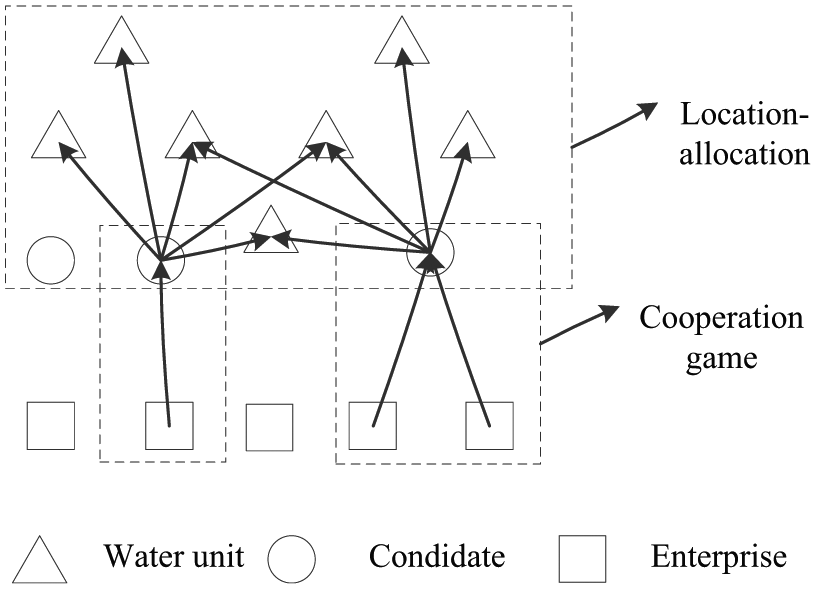
This article studies the location problem of maritime emergency supplies repertories under the joint of government and enterprises, including the location of maritime emergency supplies repertories, the allocation of maritime emergency supplies, the selection of cooperative enterprises, and the interest share of government and enterprise alliance, as shown in Figure 1.
Location–allocation of water emergency supplies repertories under the joint of government and enterprises.
There are some candidate sites for maritime emergency supplies repertories (as shown in the round shape in Figure 1). Up to one emergency supplies repertories is set up in each candidate site. The whole water area is divided into several water units (as shown in the triangle shape in Figure 1). The demand of each water unit is allocated between the repertories that can cover it. After the location–allocation problem is determined, the amount of emergency supplies in all the repertories is known and then we will carry out the selection of government and enterprise alliance and the allocation of income in the alliance.
The maritime emergency supplies repertories are owned by the government. For each candidate repertory, all the candidate enterprises can be carried out (as shown in the square shape in Figure 1), so the cooperation alliance can be formed between the government and the enterprises. In the cooperation alliance, the government can reduce relevant costs and the enterprises can get additional benefits, it can obtain a “co-surplus” which is from the regular updation of emergency reserves. Meanwhile, the alliance should comply with the individual rationality and alliance rationality of the participants.
The whole model ultimately determines the best location–allocation results, and the joint reserve of government–enterprise results through the interaction between the two stages of models.
Modeling process
The first stage is the location–allocation of maritime emergency supplies, and the second stage is the cooperative game between the government and enterprises in the reserve of maritime emergency supplies, as explained in section “Problem description.”
Location–allocation model of emergency supplies repertory
Parameters
Location–allocation model
Models (1)–(5) solve the location–allocation problem of maritime emergency supplies repertories, and the decision-making subject of first-stage model is the government (repertories). The objective function is shown as

The constraints are shown as


Objective model (1) is the minimum of the total cost: the first part is the fixed construction cost of emergency supplies repertories and the second part is the reserve cost of the emergency supplies; the joint stock of government and enterprises needs to be considered when calculating the reserve cost of government, and it will be influenced by the second-stage model.
It is necessary to consider the fairness and efficiency when configuring the emergency resources, so we propose that the location of emergency supplies repertories should achieve not only the full coverage of the water units but also the multi-coverage of the important water units. Model (2) represents that all the water units are covered at least by one emergency supplies repertory. Model (3) represents that all the water units whose importance exceeds the threshold need to be covered at least by two repertories.
Most of the literatures consider the allocation of emergency resources using all-or-nothing assignment. Emergency event has great uncertainty and the probabilistic distribution of demand is more suitable. Based on the gravity model,11,17 we put forward the improved probabilistic distribution method, as shown in model (4). Model (5) represents the distribution plan of the emergency supply demand of water units among the repertories.
Cooperation game of government and enterprise in the reserve of maritime emergency supplies
The government and the enterprises are both the decision-making subject in the second-stage cooperative game. The first-stage model can determine the specific repertories and the target amount of emergency supplies in each repertory and then the result can be calculated in the second-stage cooperation game between the government and enterprises. There are a number of emergency supply repertories in this article, and each one should decide whether it joins the alliance of government and enterprises or not.
Parameters
Revenue calculation model of alliance
The cooperation of government and enterprises is government-led, and the alliance can be profitable when the government is involved, so the government has an advantage in the distribution of revenue in the alliance. 8 As a result, when the revenue of alliance joined by the government (repertories) and enterprises reaches the maximum, the repertories can get the maximum revenue, meanwhile the reserve cost gets the minimum (government cost is minimum).
In the government and enterprises alliance participated by the repertory j, the objective function to solve the alliance with the maximum benefit is

The constraints is shown as



Model (6) represents the maximum revenue of alliance joined by repertories
Model (7) represents that the actual reserve amount cannot exceed the target reserve amount. Model (8) represents that the amount of enterprise
Revenue distribution of alliance
Once the alliance is formed, the revenue each participant can acquire can be calculated. In the alliance joined by repertory
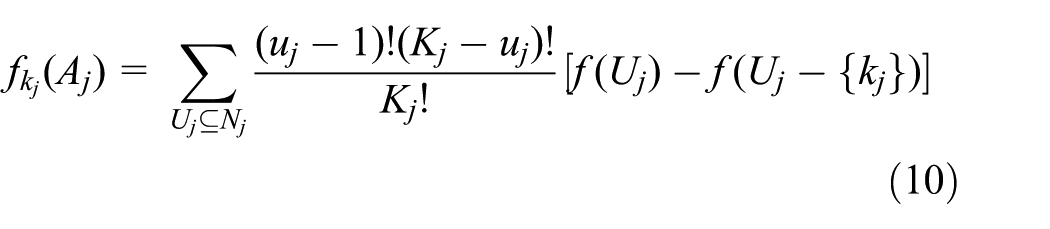
Stability of alliance
Individual rationality is that the revenue of participants should exceed their opportunity cost


The rationality of alliance is that the exit of anyone of the members will lead to the decrease in total revenue of the alliance. If the participant

Revenue of repertory
If the individual rationality and alliance rationality can be met meanwhile, the alliance will be stable. In the alliance that repertory

Calculation algorithm
This article establishes a nonlinear integer programming model, and it is similar to the set cover model with ability constraints which can be solved by location–allocation heuristic algorithm. The location–allocation heuristic algorithm was used to solve the problem of facility location in uncertain needs. 19 The model framework consists of three main steps (the location and allocation, alliance income calculation, and income distribution) as shown in Figure 2.

Calculation logic.
Models (1)–(5) are the nonlinear programming problem, models (6)–(9) that calculate the revenue of the alliance are linear programming problem, and models (10)–(13) that allocate the revenue of the alliance are nonlinear programming problem. We design a genetic, greedy hybrid heuristic algorithm, as shown in Figure 3.

Hybrid heuristic algorithm.
As can be seen from model (1), the goal of the problem is to obtain the minimum total cost, including two main parts: the first part is the construction cost of repertories and the second part is the reserve cost of emergency supplies (calculated by the second-stage model (14)). To reach the best solution, it is necessary to put the second-stage solving algorithm nested inside the first-stage solving algorithm. For the first-stage model, this article designs a genetic algorithm to solve the problem; the total cost is the fitness function of genetic algorithm, and during the calculation of fitness function, this model calls the second-stage greedy algorithm.
Once the repertory is settled down, then the enterprises that are in the alliance can be determined. For each proposed emergency supply repertory, its possible portfolio alliance revenue needs to be calculated and sorted from big to small, and then, the biggest alliance revenue selected and calculated through the Shapley method to allocate the revenue; meanwhile, the rationality of participants and alliance needs to be judged.
If the distribution result meets the constraints of rationality, the calculation of distribution ends; otherwise, the sub-optimal alliance revenue is selected to do revenue distribution and judge. And so on, the calculation of distribution ends when the alliance meets the individual rationality and alliance rationality. The first-stage and second-stage models are linked through model (14), the results of greedy algorithm return to the first stage, and the genetic algorithm fitness function can be acquired.
Case study
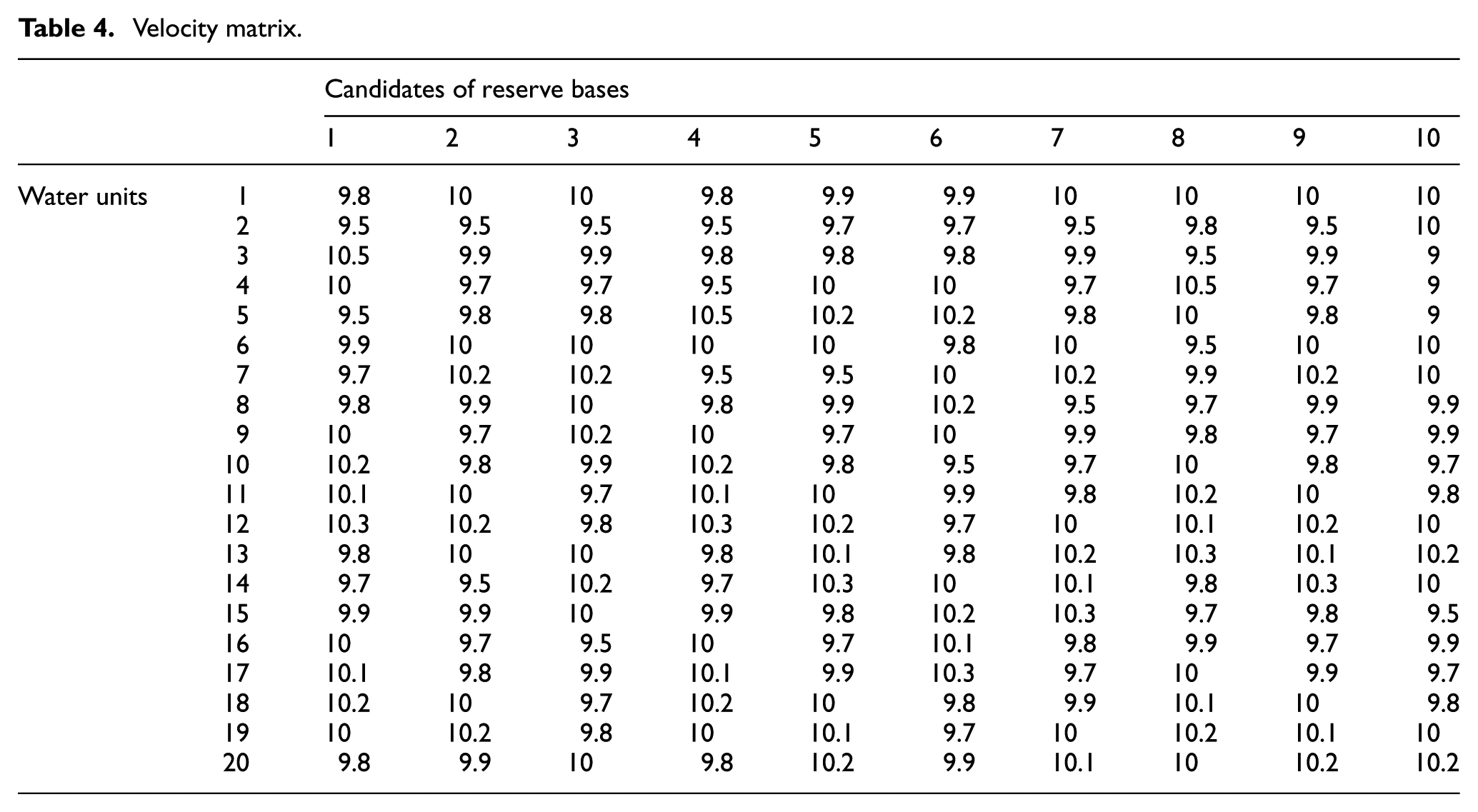
In this case, we assume that the whole water area has been divided into 20 water units. There are 10 repertory candidates, and each repertory candidate corresponds to three candidate enterprises, as shown in Tables 1–3. The velocity matrix and velocity distribution of the ship affected by wind and flow are shown in Table 4, and the ship is driven to each water unit by emergency supply repertories. The threshold value of the importance of the water unit is 5, and the emergency response time is assumed to be 40 min.
Date of water units.

Data of emergency supplies reserve candidates.

Data of the candidate enterprise.

Velocity matrix.
As shown in Figures 4 and 5, numbered circles of different colors and sizes represent the importance and demand of emergency supplies for different water units, respectively. The shallower the color of the circle means the greater the demand for water units, and the larger the radius of the circle means the greater importance degree of water units. It can be seen from the above figure that the emergency supplies of water unit 3 and unit 9 of water area are in high demand and of high importance; the emergency supplies of unit 4, unit 14, and unit 19 of water area are in high demand, but not high demand; and the emergency supplies of unit 5, unit 12, and unit 17 of water area are in high demand, but of low importance.
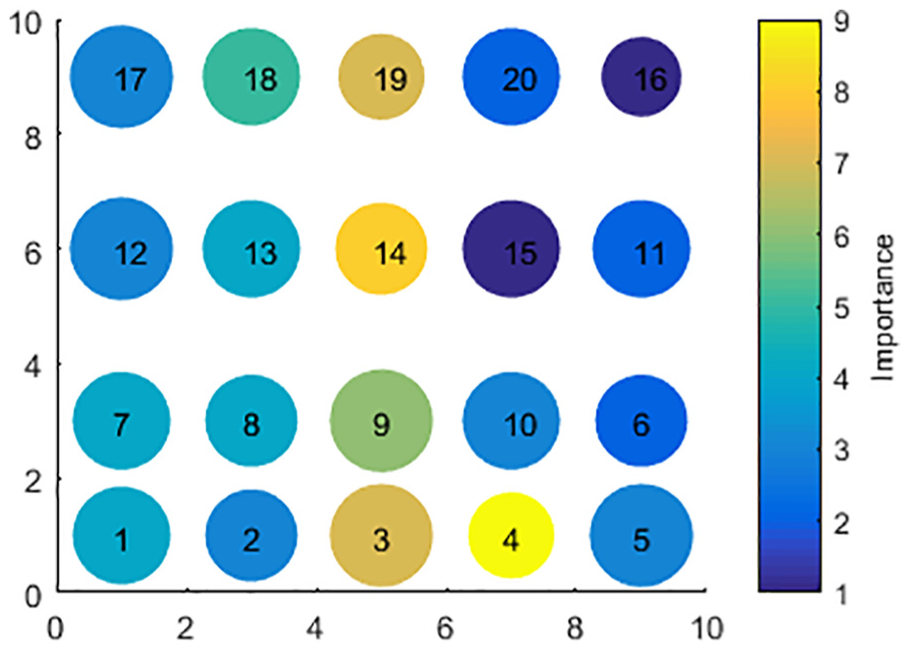
Importance of each water unit.
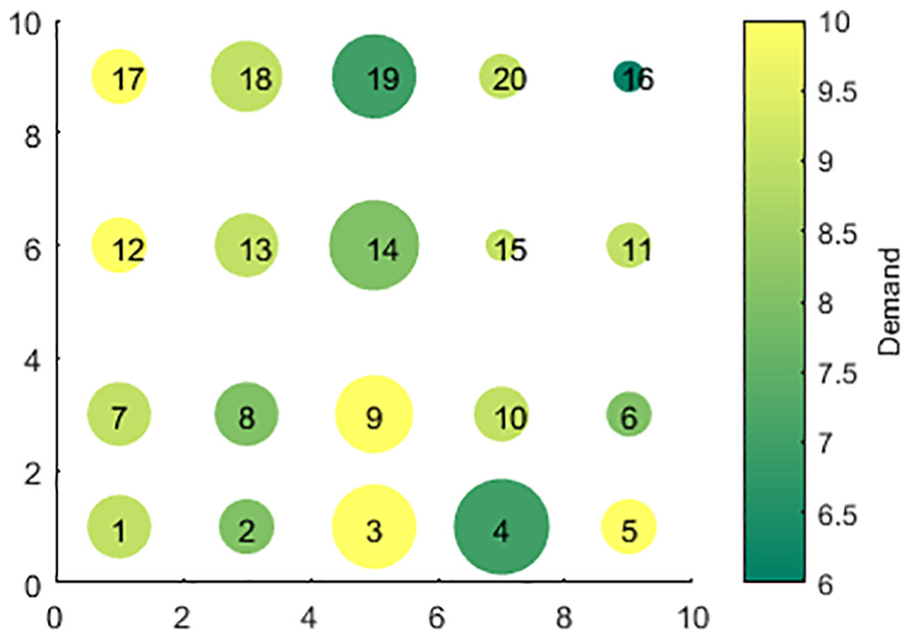
Demand of each water unit.
In this article, the heuristic algorithm is programmed with MATLAB, the population is 50, the chromosome length is 10, the probability of crossover is 0.9, the probability of mutation is 0.1, and the population should be iterated 200 times. Two elite individuals are reserved in each iteration. A good design for our chromosome has been trained and iterated for 100 times, and the results show that the optimal candidates might be 4, 6, 9, and 10, which are recommended to establish emergency supply repertories; the amount of reserves are, respectively, 66, 40, 39, and 30. The location of the program achieves a comprehensive coverage of water units and backup coverage of important water units, and results are shown in Figure 6.
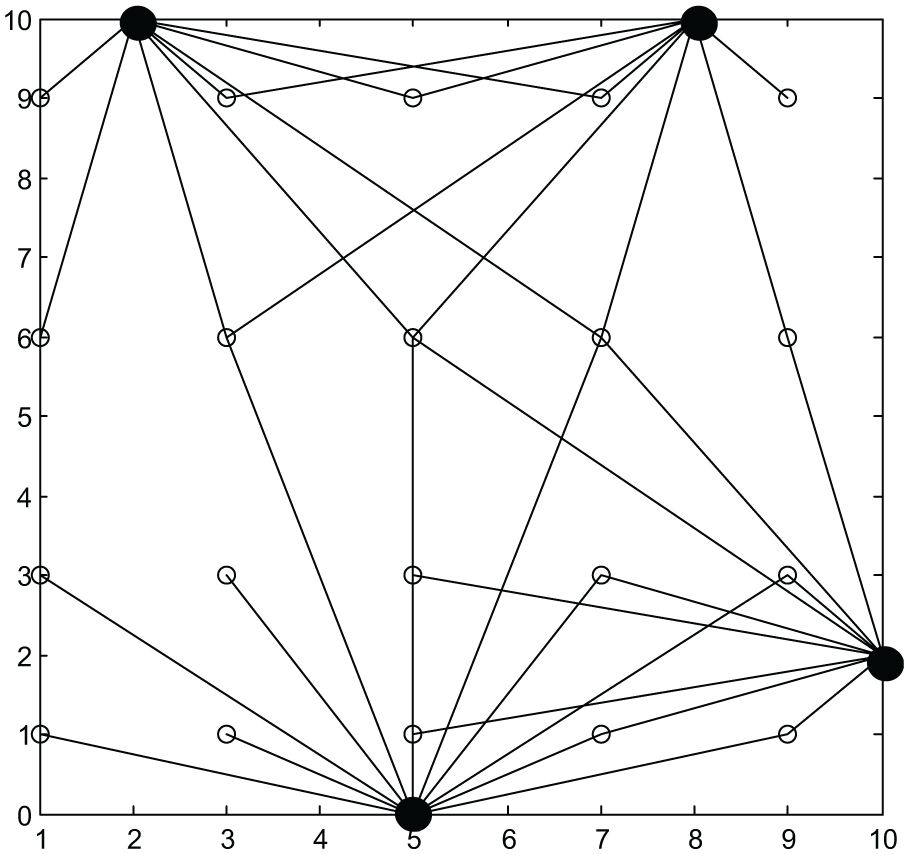
Location results.
The total cost of the construction of the emergency supply repertory is 10,053. If the joint reserve of government and enterprises is not considered, then the cost will be 14,331; as a result, this model saves a total of 4278. Enterprises 10, 12, 16, 25, and 28 are selected to carry out joint reserves, they can obtain a certain income, and this income is greater than the opportunity to participate in the alliance, so the alliance is stable. Specific material distribution and income are shown in Table 5.
Details of the enterprise reserves.

As shown in Figures 7 and 8, most enterprise cooperation reserves are close to or reached the maximum reserve capacity, which proves that the model proposed in this article can maximize the enterprise participation in enterprise alliance. Under the condition of the lower opportunity cost of enterprise, their profit is twice as much as their opportunity cost, which is great to maintain the enthusiasm of the enterprise, thus proving the stability of the alliance.

Comparison chart of the maximum and the amount of reserves.
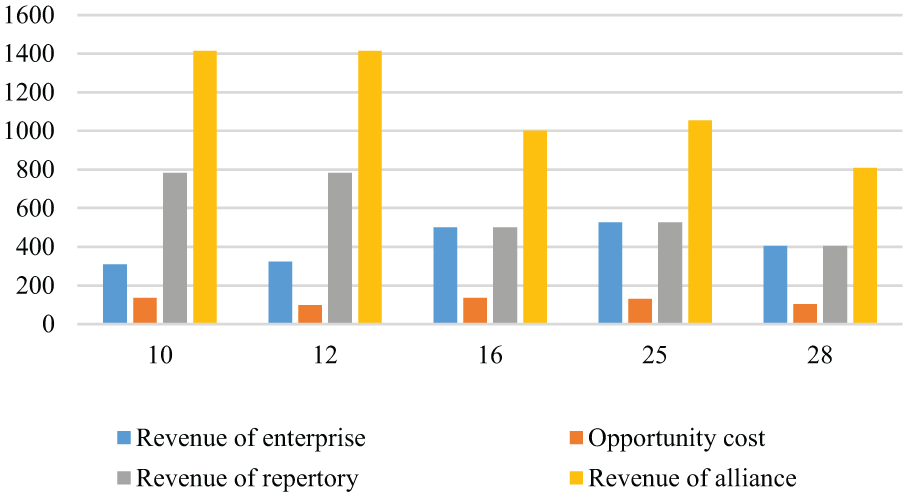
Cost and benefit comparison chart of each enterprise.
Conclusion
It can be seen from the existing studies that the cooperation between the government and enterprises in the emergency reserve can achieve win–win results. The government can save and reduce overall costs, and the enterprises can obtain certain benefits. We focus on cooperation between government and enterprises on emergency supplies and propose a two-stage optimization model considering both location–allocation of maritime emergency supplies repertories and the cooperation of government and enterprises. In view of the model, we design a genetic, greedy hybrid heuristic algorithm. We apply the model in a case study:
It concludes that the final scheme can achieve the goal of full coverage of the water unit and the multiple coverage of the key water areas.
The total cost of the repertories can be reduced by considering the joint of government and enterprises.
Enterprises in the alliance can obtain certain benefits from the alliance, and the alliance is stable.
The study provides a reference for the configuration decision of emergency resource. But, our study is limited; it is assumed that the demand of the water unit is known, and we consider the calculation method of the demand of each water unit.
Footnotes
Acknowledgements
The language modification of this paper is completed with the help of Danyang Geng and Shan Zhu.
Handling Editor: Zhixiong Li
Declaration of conflicting interests
The author(s) declared no potential conflicts of interest with respect to the research, authorship, and/or publication of this article
Funding
The author(s) disclosed receipt of the following financial support for the research, authorship, and/or publication of this article: This study was supported by the National Key R&D Program of China (no. 2017YFC0803900) and National Natural Science Foundation of China (no. 71473023).
