




Abstract
Compared with biomass combustion and biogas technology, biomass gasification based combined cooling, heating, and power (BGBCCHP) system provides an opportunity for better using biomass energy. Three operating strategies (following the thermal load, following the electric load, and following the hybrid electric–thermal load) were investigated. The economic, energetic, and environmental performance of a BGBCCHP system operated under the above three operating strategies were evaluated, respectively. Annual total cost, annual primary energy consumption, annual primary energy ratio, and annual carbon dioxide emissions were used as evaluation criteria. The integrated performance was analyzed by introducing a reference separation production system. A BGBCCHP system for a seven-story office building built in Beijing, China, was used as the case study. Results showed that following the hybrid electric–thermal load yielded the best economic and energetic performance, and following the electric load yielded the best environmental performance. The BGBCCHP system under following the thermal load achieved the worst economic and environmental performance, and the BGBCCHP system under following the electric load achieved the worst energetic performance. Furthermore, following the hybrid electric–thermal load yielded the best integrated performance, while following the thermal load yielded the worst integrated performance. Finally, calculation results indicated that BGBCCHP system was superior to reference separation production system from the environmental perspective.
Keywords
Introduction
Biomass energy is an important renewable energy source.1–3 Biomass energy comes from the photosynthesis of green plants, so it is a manifestation of solar energy. According to the requirements of global sustainable development, renewable energy such as biomass is considered one of the most important segments. 4 Biomass resources available for development and utilization include crop straw, core wood, forest waste, livestock manure, domestic and industrial organic waste, and so on. Compared with fossil fuels, biomass energy has the advantages of large reserves, renewability, easy access, low pollution, and so on. The annual global biomass energy was 3.54 billion tons of standard coal equivalent (tce). 5 In China, theoretical biomass energy resources are approximately 5 billion tce. 6 As for crop straw in China, its theoretical amount is about 820 million tons (15% is regarded as its water content) in 2009, equivalent to about 400 million tce.7,8 However, the total amount of crop straw that has been discarded reaches 215 million tce every year in China.6,7 Biomass energy is also an environmentally friendly energy source with a zero carbon dioxide net emission. 9 Therefore, efficient use of biomass resources is a feasible approach to such problems. Combined cooling, heating and power (CCHP) systems provide an opportunity for the application of biomass energy. CCHP systems are based on the integrated cascade utilization of energy. Electricity and usable thermal energy can be simultaneously provided for users by CCHP systems, with an overall efficiency up to 75%–88%.10–12 Compared with conventional separation production systems, CCHP systems can be characterized by high efficiency, low greenhouse gas (GHG) emissions, and high reliability.10–14 In addition to fossil fuels such as natural gas, renewable energy (e.g. biomass, solar, wind, etc.) can also be used as the driven sources of CCHP systems, contributing greatly to the sustainable energy development. Compared with other fossil fuels, biomass is more difficult to be collected. CCHP systems belong to distributed energy supply systems which are suitable for the utilization of decentralized energy such as biomass energy.
The use of biomass energy in CCHP systems has become a new research direction.10,11 Related technologies mainly include direct combustion technology, gasification technology, and biogas technology. However, as pointed out in Puig-Arnavat et al., 15 Wang et al., 16 and Gao et al., 17 biomass gasification technology is more efficient than biomass combustion technology. Moreover, biomass with high water content or low heat value is not applicable to combustion technology. Also, compared with other technologies, biogas technology put forward higher requirements on the organic content of biomass.17,18 Biomass gasification based CCHP (BGBCCHP) systems have the advantages of high overall efficiency, small pollution emissions, and wide range of biomass sources. In BGBCCHP systems, biomass is usually converted into producer gas in the gasification subsystems which mainly include gasifier, purifier, and gas storage tank. Then the producer gas is supplied to BGBCCHP system as driven source. Performance evaluation criteria of BGBCCHP system include energy efficiency,15,16,19,20 exergy efficiency,15,16 generating efficiency, 19 thermodynamic coefficient,10,19 and so on. However, the effect of operating strategies on the performance of BGBCCHP systems was not discussed in the investigations mentioned above. It was pointed out that operating strategy is one of the key factors that affect the energetic, economic, and environmental performance of CCHP systems.21–26 Mago and Hueffed 21 evaluated the CCHP systems under three different operating strategies, that is, following the thermal load (FTL), following the electric load (FEL), and following the seasonal strategy (FSS). Results showed that the two strategies providing the best CCHP system performance are FEL and FSS. In Mago et al., 22 CCHP systems operated following a hybrid electric–thermal load (FHL) were proposed. FHL strategy is compared with FTL and FEL strategies. Results indicated that CCHP systems operated under FHL strategy showed higher reductions of operating cost, carbon dioxide emissions, and primary energy consumption than those obtained under the other two operating strategies. Li et al. 23 evaluated five different operating strategies, that is, FTL, FEL, FHL, FSS, and following the electric–thermal load of buildings (FLB). Results showed that CCHP-FEL and CCHP-FLB yielded better performance than CCHP-FTL, CCHP-FHL, and CCHP-FSS. In Li et al., 24 two incentive policies, that is, the feed-in tariff and carbon emission trading, were proposed. The effects of the policies on the performance of CCHP systems running in office and residential buildings under five different operation strategies (i.e. FEL, FTL, two types of FHL, and following the maximum efficiency of power generation unit (PGU)) were analyzed. Results showed that the best operation strategies depended on the incentive policies. Wang et al. 25 deduced the fuel energy consumptions of CCHP system under FEL and FTL, respectively. Results showed that when the excess electricity is not allowed to be sold to the grid or the excess heat is directly discharged, it was suggested to select the FEL strategy. In Wang et al., 26 the inlet air throttling (IAT) operation method for gas turbine combined with FEL, FTL, and FHL operation strategies were employed to analyze the primary energy consumption, operation cost, and carbon dioxide emission of a CCHP system. Results showed that the performance of the CCHP system was better than that of the reference separation production (RSP) system regardless of which operation strategy was used. Lorestani and Ardehali 27 analyzed the performance of autonomous renewable energy based CCHP systems operated under FEL and FTL operating strategies. Results showed the most cost-effective configuration alternative of the autonomous renewable energy based CCHP system was photovoltaic-thermal panel + wind turbine + thermal energy storage + electrical energy storage + absorption chiller + electric heater operated under FTL operating strategy. It should be noticed that the above analysis is based on the CCHP systems mainly powered by natural gas or renewable energy. However, BGBCCHP systems were not involved in their research.
This study aims to evaluate the performance of BGBCCHP systems operated under three different operating strategies, that is, FTL, FEL, and FHL. The schematic, energy flow, and evaluation criteria of the modeled BGBCCHP system are presented in the “Methodology” section. In the “Case study” section, a case study based on an office building in Beijing is carried out. The economic, energetic, and environment performance of the BGBCCHP system for the office building under FTL, FEL, and FHL operating strategies are presented in the “Results” section. In the “Discussion” section, the integrated performance of the BGBCCHP system is evaluated by introducing a RSP system. In the “Conclusion” section, some conclusions are summarized.
Methodology
BGBCCHP system description
The schematic of the modeled BGBCCHP system is shown in Figure 1. Biomass is converted into purified producer gas through gasifier and purifier. When the system is on the balance status, the governing equations of the biomass gasification model are as follows 5


Schematic of the modeled BGBCCHP system.
Then it is stored in producer gas tank. Producer gas is supplied to PGU to provide electricity for users. Waste heat rejected from PGU is recovered through heat recovery system, which supplies thermal energy to heating unit and absorption chiller to meet the heating demand and cooling demand, respectively. If there is not enough recovered heat from the PGU, a biomass-fueled boiler is used to offset the deficit heat. When the system is on the balance status, the governing equations of the biomass combustion model are as follows 28
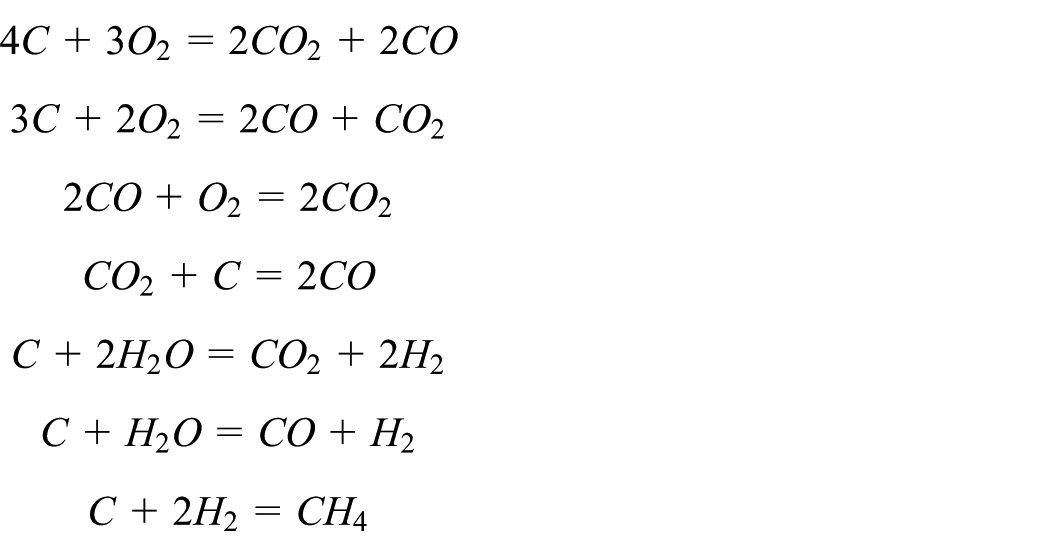
On the contrary, if there is more recovered heat than that required for the building, excess heat is discharged directly. If the PGU cannot generate enough electricity, the additional electricity can be imported from the electric grid. On the contrary, if the PGU generates more electricity than that required for the building, excess electricity is discharged because the electricity selling technology is not mature in some areas.23,29,30
It should be noted that the storages for electricity and heat was not considered in the analysis. There are two reasons for this. On one hand, this study focuses on the impact of three operating strategies on the performance of BGBCCHP systems. On the other hand, the use of storages for electricity and heat makes the systems more complicated, leading to the difficulty of operation and management.
In addition, some assumptions are as follows:
The equipment can be operated between 0% and 100% of its rated capacity. The ramping rate of output under load adjustment is negligible.
The BGBCCHP system is reliably operated throughout the year.
The capacity of equipment is continuously distributed.
A complete flowchart for the study indicating all steps for analysis is shown in Figure 2.
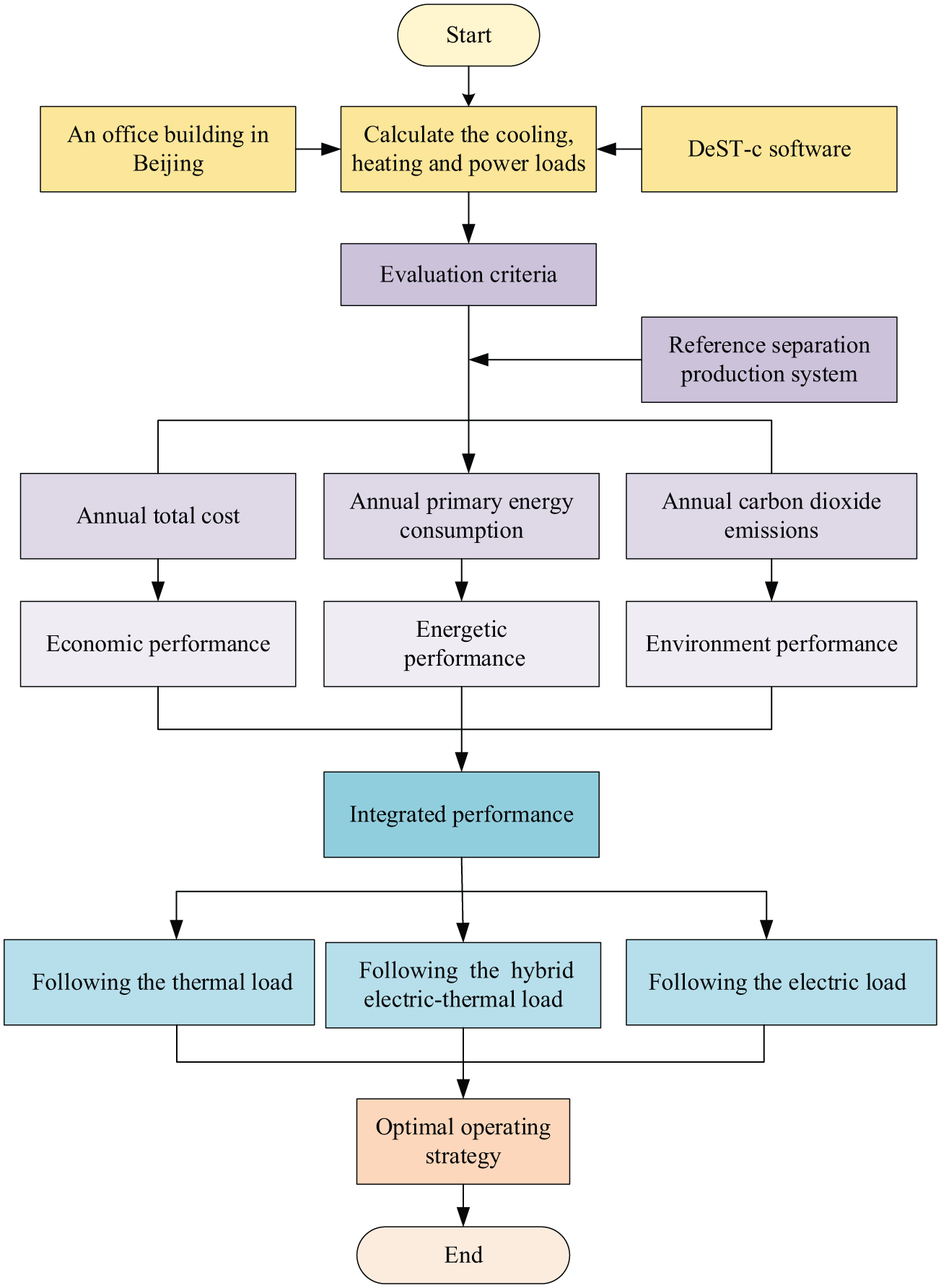
A flowchart for the study.
Energy flow
Energy flow of the BGBCCHP system under three operating strategies is explained. It includes heat balance and electricity balance characterized by different operating strategies.
FTL
As for the FTL operating strategy, the BGBCCHP system is operated based on the heating and cooling demand. The amount of waste heat rejected from PGU is dependent on the thermal energy required for the building, which is expressed as equation (1)

The electricity generated by PGU can be obtained by equation (2)

The efficiency of PGU varies according to the PGU load, which is calculated by equations (3) and (4)


Biomass consumption of the BGBCCHP system is calculated by equation (5)

If the electricity generated by PGU is less than that required for the building, additional electricity is purchased from the electric grid. Otherwise, the excess electricity is discharged. They can be calculated by equation (6)

Herein, the electricity from the grid is assumed to be generated in coal-fired power plant. Thus, primary energy consumption, primary energy ratio, and carbon dioxide emissions can be obtained by equations (7)–(9), respectively


FEL
As for the FEL operating strategy, the BGBCCHP system is operated based on the electricity required for the building. So there is no electricity purchased from or sold back to the electric grid. Biomass consumption of gasifier can be obtained by equation (10)

As for PGU, the amount of waste heat rejected from PGU can be calculated by equation (11)

The thermal energy required for the building is dependent on the heating and cooling load, which can be calculated by equation (12)

If the rejected heat is more than the required heat, excess heat is discharged directly. Otherwise, deficit heat is offset by the biomass-fueled boiler. The biomass consumption of such boiler is calculated by equation (13)

Then, the biomass consumption of the BGBCCHP system can be calculated by equation (14)

Primary energy consumption, primary energy ratio, and carbon dioxide emissions can be obtained by equations (15)–(17)



FHL
When the BGBCCHP system is operated under FHL strategy, it means that there is no excess heat or electricity produced by the system. Thus, the operating strategy should be switched between FTL and FEL. The procedure to determine the strategy which is applicable to the BGBCCHP system is as follows:22,23,31
If the value of
Evaluation criteria
The performance of a BGBCCHP system under different operating strategies is evaluated from economic, energetic, and environmental perspectives. Thus, the annual total cost (ATC), annual primary energy consumption (APEC), annual primary energy ratio (APER), and annual carbon dioxide emissions (ACDE) are used as the evaluation criteria, which are explained below.
1. ATC
ATCBGBCCHP includes the equivalent annual capital cost, annual maintenance cost, and annual energy cost of a BGBCCHP system, which is calculated by equation (18)

The equivalent annual capital cost can be calculated as equation (19)

As for the BGBCCHP system described in Figure 1, the equipment mainly includes gasification sub-system (i.e. gasifier, purifier, and producer gas tank), prime mover (PGU and heat recovery system), biomass-fueled boiler, heating unit, and absorption chiller.
Dynamic method is used to calculate the annual capital recovery factor, which is expressed as equation (20) 32

In equation (20), it is assumed that the lifetime of all the equipment is the same.
The annual maintenance cost (i.e. the repairing cost and manpower cost) can be calculated based on the equivalent annual capital cost,33,34 which is expressed as equation (21)33,34

where
The annual operating cost of a BGBCCHP system mainly includes the annual charge of biomass and grid electricity, which is expressed as equation (22)

2. APEC
APECBGBCCHP is the annual primary energy consumption of a BGBCCHP system caused by biomass and coal consumption (only biomass consumption for FEL strategy), which is expressed as equation (23)

3. APER

4. ACDE

Case study
A case study based on a BGBCCHP system for a seven-story office building built in Beijing, China, was carried out. Total net floor area of the building was 10,300.15 m2. The geometry of the building is shown in Figure 3. DeST-c software was used to simulate the hourly load of the building, as shown in Figure 4. The hourly peak load of cooling, heating, and power is 1320.75, 662.43, and 196.06 kW, respectively. It can be seen that the annual cooling, heating, and power demand is 54.39, 49.77, and 174.90 kWh/m2, respectively. Table 1 shows the monthly average load of the building. It can be seen in Table 1 that the maximum value of the monthly average load of cooling, heating, and power is 277.61, 213.91, and 70.89 kW, respectively. Input values to evaluate the performance of BGBCCHP system are shown in Table 2.5,23,30,35,36 Based on the above analysis, the rated capacity of equipment in the BGBCCHP system is shown in Table 3.
Monthly average cooling, heating, and power load of the office building.


BGBCCHP: biomass gasification based combined cooling, heating, and power; PGU: power generation unit.
The temperature range of hot water required for absorption chiller is 70°C–130°C, and the impact of such temperature on the COP of absorption chiller is neglected.
Carbon dioxide emissions of biomass is caused by fuel consumption in the transport and biomass gasification.
Rated capacity of equipment in the BGBCCHP system.

BGBCCHP: biomass gasification based combined cooling, heating, and power; FTL: following the thermal load; FEL: following the electric load; FHL: following a hybrid electric–thermal load; PGU: power generation unit.

Geometry of the office building.

Hourly cooling, heating, and power load of the office building.
Results
The performance of the BGBCCHP system was evaluated based on the values of the evaluation criteria (i.e. ATC, APEC, APER, ACDE) per square meter of the office building in order to make the analysis clearer.
Economic performance
The compositions of the equivalent annual capital cost and annual maintenance cost for different operating strategies are shown in Figure 5.5,23,34 It can be seen that the gasification sub-system cost accounts for the largest proportion of the capital cost, while the heating unit cost accounts for the least proportion of the capital cost. As for the FTL operating strategy, the gasification sub-system cost accounts for 61.37% of the capital cost, while the heating unit accounts for only 0.73% of the capital cost. As for FEL and FHL operating strategies, the gasification sub-system cost accounts for 43.15% of the capital cost, while the heating unit cost accounts for only 2.04% of the capital cost.

Annual cost per square meter of the office building was used to analyze the annual economic performance of the BGBCCHP system. Details of the annual economic performance of the BGBCCHP system for the office building under FTL, FEL, and FHL operating strategy are shown in Table 4. As can be seen in Table 4, the ATC of the BGBCCHP system under FTL operating strategy is 1.55 and 1.73 times that under FEL operating strategy and FHL operating strategy, respectively. Therefore, FHL operating strategy yields the best economic performance, while FTL operating strategy yields the poorest economic performance. There are two reasons for the above. First, as can be seen in Table 3, the rated capacity of PGU and gasification sub-system for FHL operating strategy is smaller than that for FTL operating strategy. So the capital cost for FTL and FHL is 258.87 and 91.86 $/m2, respectively. The former is 2.82 times the latter. It results in the minimum equivalent annual capital cost for FHL. Second, there is no excess electricity or heat for FHL operating strategy, which results in the minimum operating cost. However, the annual operating cost for FTL and FEL operating strategy is 15.89 and 16.31 $/m2·year, respectively. It means that BGBCCHP system under FTL and FEL operating strategy achieves the similar annual operating cost.
Details of annual economic performance of the BGBCCHP system under different operating strategies.

BGBCCHP: biomass gasification based combined cooling, heating, and power; FTL: following the thermal load; FEL: following the electric load; FHL: following a hybrid electric–thermal load. 1fdethinsp;= 6.8639 Yuan.
Energetic performance
Details of annual energetic performance of the BGBCCHP system for the office building under FTL, FEL, and FHL operating strategies are shown in Table 5. As can be seen in Table 5, the APEC of the BGBCCHP system under FHL operating strategy is 88.39% and 73.52% of that under FTL and FEL operating strategies, respectively. On the contrary, the APER of the BGBCCHP system under FHL reaches the maximum value. Therefore, FHL operating strategy yields the best energetic performance, while FEL operating strategy yields poorest energetic performance. The most important reason for the above is that there is no excess electricity or heat for FHL operating strategy. Also, the annual excess heat for FEL is about 17.59 times the annual excess electricity for FTL. Thus, the energetic performance for FTL is better than that for FEL. The hourly primary energy ratio and excess energy for different operating strategies are shown in Figures 6 and 7. It can be integrally found that the hourly primary energy efficiency also decreases with the increase of excess energy, which is consistent with the impact of annual excess energy on annual primary energy efficiency.
Details of annual energetic performance of the BGBCCHP system under different operating strategies.

BGBCCHP: biomass gasification based combined cooling, heating, and power; FTL: following the thermal load; FEL: following the electric load; FHL: following a hybrid electric–thermal load.

Hourly primary energy ratio for (a) FTL, (b) FEL, and (c) FHL.
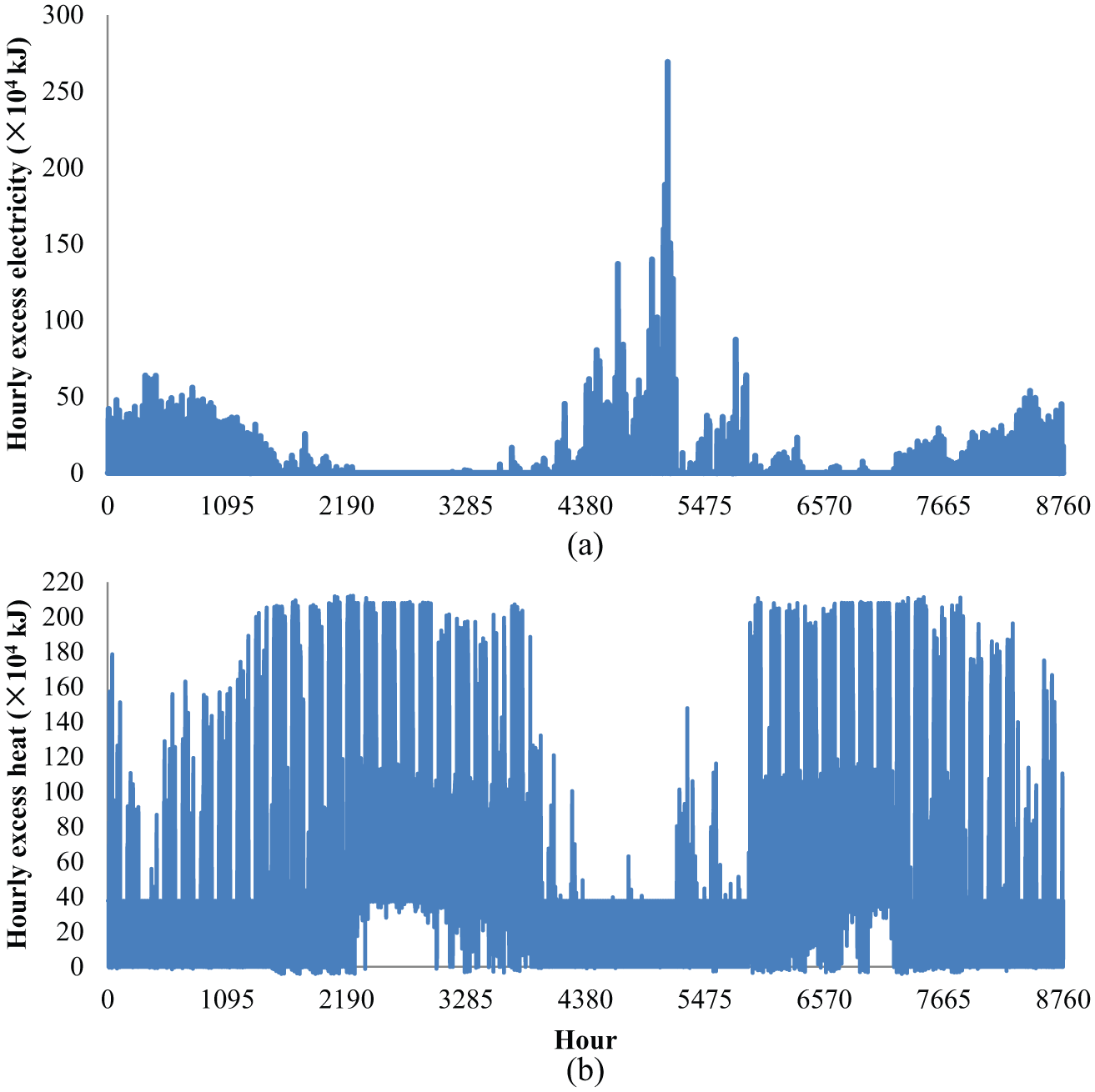
Hourly excess energy for (a) FTL and (b) FEL.
However, it should be noted that the primary energy efficiency is influenced by many factors, such as equipment efficiency, required energy (cooling, heating, and electricity), unit power supply energy consumption, operating strategies, and so on. In order to study the impact of required energy on primary energy efficiency, the ratio of required thermal energy to electricity demand,

Figure 8 shows the ratio of required thermal energy to electricity demand. As can be seen in Figures 6 and 8, PER for FEL increases with the increase of

Ratio of required thermal energy to electricity demand.
Here, the ratio of rejected heat to generated electricity of a BGBCCHP system,

As for FEL operating strategy, when the electricity demand is determined, the required thermal energy increases with the increase of
When
When
When
As for FTL operating strategy, when the required thermal energy is determined, the electricity demand decreases with the increase of
When
When
When
Environmental performance
Details of annual environmental performance of the BGBCCHP system for the office building under FTL, FEL, and FHL are shown in Table 6. As can be seen in Table 6, the total ACDE of the BGBCCHP system under FEL operating strategy are 16.25% and 19.34% of those under FTL and FHL operating strategies, respectively. Therefore, FEL operating strategy yields the best environmental performance, while FTL operating strategy yields the poorest environmental performance. The most important reason is that only biomass is used as fuel for the BGBCCHP system under FEL operating strategy. As can be seen in Table 2, the carbon dioxide emission factor of biomass and standard coal is 14 and 326.37 g/kWh, respectively. The former is only 4.29% of the latter. Moreover, the ACDE caused by electricity from grid account for a large proportion of the total ACDE, 90.36% and 89.63% for FTL and FHL, respectively. It can also be seen in Table 6 that the total ACDE of the BGBCCHP system under FHL are 84.03% of that under FTL. There are two reasons for this. First, the BGBCCHP system under FTL and FHL consumes 416,733.9 and 347,346.54 kWh grid electricity, respectively. The former are 1.2 times the latter. Second, the APER of the BGBCCHP system under FTL and FHL strategy is 40.65% and 45.99%, respectively. The former is 88.39% of the latter.
Details of annual environmental performance of the BGBCCHP system under different operating strategies.

BGBCCHP: biomass gasification based combined cooling, heating, and power; ACDE: annual carbon dioxide emissions; FTL: following the thermal load; FEL: following the electric load; FHL: following a hybrid electric–thermal load.
Discussion
In the above analysis, the FHL operating strategy yielded the best economic and energetic performance, and the BGBCCHP system under FEL operating strategy achieved the best environmental performance. However, it is very necessary to evaluate the integrated performance of each operating strategy.
In order to evaluate the integrated performance of the BGBCCHP system, a RSP system is introduced. The schematic of the RSP system is described in Figure 9. In the RSP system, electricity is provided from electric grid, and electric chiller and gas boiler are used to supply cooling and heating to the building, respectively. The integrated performance of the BGBCCHP system can be evaluated as equations (28)–(31)



where

Schematic of the RSP system.
Input values to evaluate the RSP system are shown in Table 7.20,23,30,33,34

RSP: reference separation production.
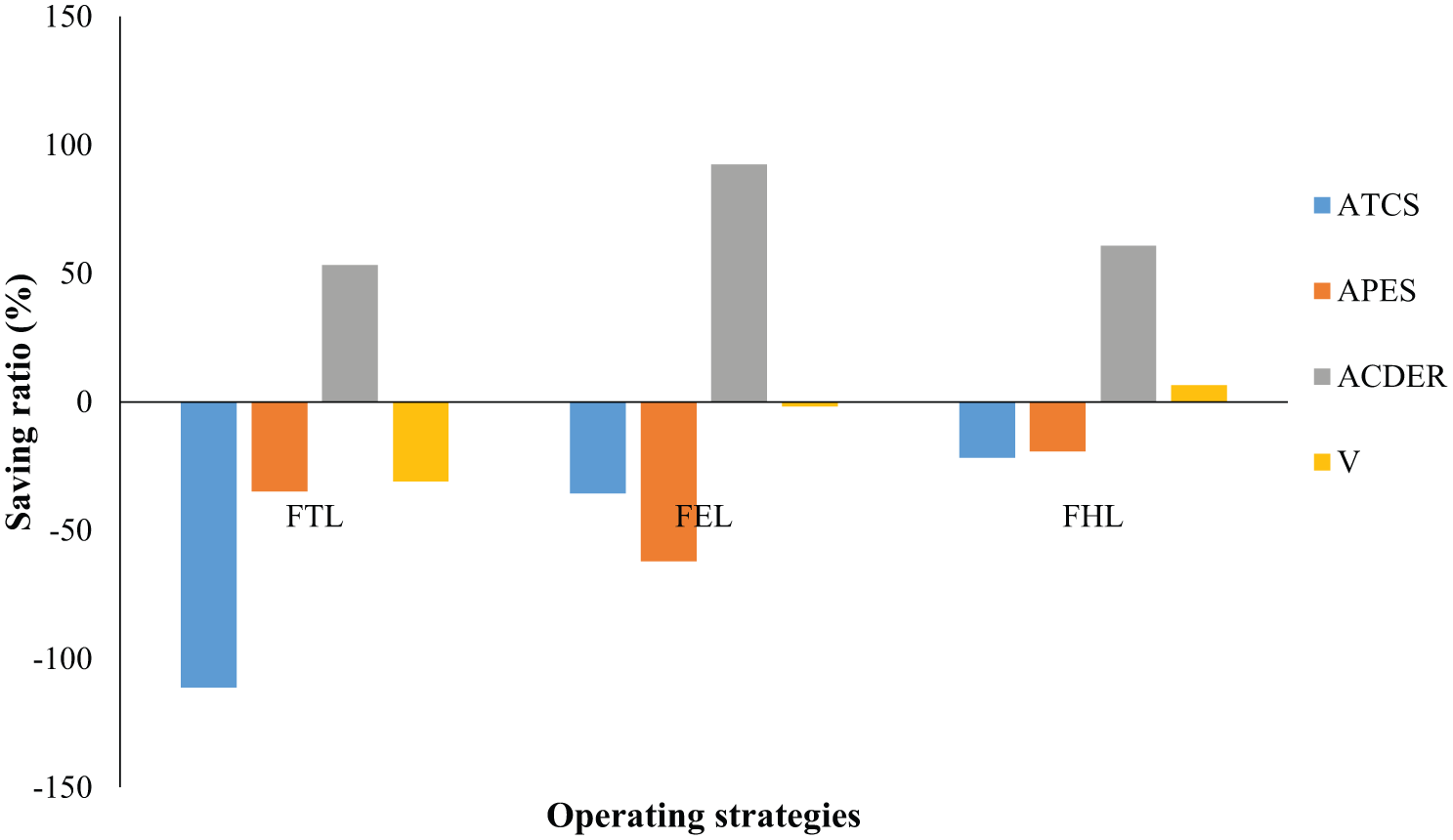
ATCS, APES, ACDER, and V of the BGBCCHP system.
Conclusion
The impact of three operating strategies on the economic, energetic, and environmental performance of the BGBCCHP system was analyzed. Three operating strategies, that is, FTL, FEL, and FHL, were evaluated in a BGBCCHP system providing cooling, heating, and power for a seven-story office building built in Beijing, China. The evaluation criteria included ATC, APEC, APER, and ACED. In order to evaluate the integrated performance of the BGBCCHP system, a RSP system is introduced. The following conclusions were drawn:
As for the BGBCCHP system under FTL, FEL, and FHL, the proportion of gasification sub-system cost to the capital cost was 61.37%, 43.15%, and 43.15%, respectively, which showed that the gasification sub-system accounted for the largest proportion of the capital cost. On the contrary, the heating unit accounted for the least proportion of the capital cost. The ATC of the BGBCCHP system under FTL, FEL, and FHL was 37.1, 23.84, and 21.4 $/m2·year, respectively. Thus, the BGBCCHP system under FHL operating strategy achieved the best economic performance, while FTL operating strategy yielded the poorest economic performance.
The APEC of the BGBCCHP system under FTL, FEL, and FHL was 144.75, 174.02, and 127.95 kJ/m2·year, respectively. Also, the APER of the BGBCCHP system under FTL, FEL, and FHL was 40.65%, 33.81%, and 45.99%, respectively. Therefore, FHL operating strategy yielded the best energetic performance, while the BGBCCHP system under FEL operating strategy achieved the poorest energetic performance. It could be also found that under equivalent conditions, PER for FEL increased with the increase of
The ACDE of the BGBCCHP system under FTL, FEL, and FHL were 41.65, 6.77, and 34.99 kg/m2·year, respectively, which showed that FEL operating strategy yielded the best economic performance, while the BGBCCHP system under FTL operating strategy achieved the poorest economic performance.
The integrated performance of the BGBCCHP system under different operating strategies was analyzed by introducing the RSP system. The saving ratio of the integrated performance of the BGBCCHP system under FTL, FEL, and FHL operating strategies was –31.91%, –1.78%, and 6.59%, respectively, which showed that FHL operating strategy yielded the best integrated performance, FEL operating strategy yielded the relatively better integrated performance, and the BGBCCHP system under FTL achieved the poorest integrated performance. Also, the ATC and APEC of the BGBCCHP system were larger than those of the RSP system, which showed that the BGBCCHP system was not superior to the RSP system from the economic and energetic perspectives. But the annual carbon dioxide emission reductions of the BGBCCHP system under different operating strategies were 53.25%, 92.40%, and 60.71%, respectively, which showed that the BGBCCHP system was an environmental-friendly energy system compared to the RSP system.
Footnotes
Appendix 1
Acknowledgements
We acknowledge Dr. Craig Larson for his useful correction of the English language use. We would like to thank the reviewers for their help. We also appreciate the authors of the references.
Handling Editor: Assunta Andreozzi
Declaration of conflicting interests
The author(s) declared no potential conflicts of interest with respect to the research, authorship, and/or publication of this article.
Funding
The author(s) disclosed receipt of the following financial support for the research, authorship, and/or publication of this article: This work was supported by Scientific Research Project of Beijing Municipal Education Commission, China (KM201810017004); Youth Backbone Individuals of Excellent Talent Project of Beijing, China (2016000020124G057); and the National Natural Science Foundation of China (No. 51325603), which are hereby greatly acknowledged. The work was also supported by “Engineering and Technology R&D center of Shandong Huayu University of Technology in Colleges of Shandong (Shandong Huayu University of Technology),” which is hereby greatly acknowledged.
