




Abstract
The reliability analysis of low-voltage switchgear is of great importance to the safety of power system. Bayes theory is a widely used reliability evaluation method because it can make full use of historical data. Therefore, the reliable prior information is the key factor to ensure the correctness of the reliability analysis results when the Bayes method is used to evaluate the reliability of the low-voltage switchgear. In order to obtain the priori information of low-voltage switchgear with high reliability, a feasible prior information fusion method was proposed and a reliable prior distribution function was obtained. First, kinds of historical data and effective information were collected from manufacturers and users. Then, to get more accurate prior distribution, the parametric and nonparametric test method was used to test the compatibility of the collected historical data, the effective information and the field information. Finally, the prior distribution and the expert experience were fused, and the conjugate prior distribution of the reliable low-voltage switchgear was constructed, which provided the theoretical basis for improving the accuracy of reliability evaluation of the low-voltage switchgear.
Introduction
The low-voltage switchgear is composed of varieties of low-voltage electrical appliances, which can be composed of main and auxiliary circuits. It is suitable for complete sets of equipment used with power generation, transmission, distribution and electrical energy conversion equipment and the equipment used to control electrical energy consumption. It also applies to a complete set of equipment with higher frequency and equipped with control and power devices. According to statistics, most of electricity is provided by low-voltage switchgear; then its safe and stable operation is the key to ensure the quality of power supply in enterprises and institutions. Therefore, it is very necessary to evaluate the reliability of low-voltage switchgear. 1
Compared with the traditional methods, the reliability evaluation method based on Bayes theory has the greatest advantage of using prior information. Therefore, it is widely used in many fields, such as artificial intelligence, 2 software,3–5 genetics, 6 electrical engineering,7,8 mechanical engineering, 9 chemical industry10,11 and so on. KS Sultan et al. 12 used Lindley’s approximation to get the Bayes estimators and used Gibbs sampling method to obtain the posterior credible intervals of the parameters. By using a Bayesian perspective, Fernandez 13 discussed the problems of estimating the Rayleigh parameter, hazard rate and reliability function and predicting future observations. To obtain the parameters, K Rekab et al. 14 refined these estimates in an iterative manner and proposed a method to determine how to allocate test sequentially. Finally, the proposed method was compared with Monte Carlo simulations to demonstrate its superiority. Taheri and Zarei 15 spread the classical methods to fuzzy system and researched a computational procedure to evaluate the fuzzy Bayes estimate of system reliability. According to the proposed prior, CB Guure et al. 16 obtained the estimation of unknown parameters, the reliability and hazard functions by Bayes method for the two-parameter Weibull failure time distribution. According to Bayes method, X Jia and B Guo 17 discussed the reliability of k-out-of-n cold-standby system and derived the posterior distribution of Weibull parameters according to all the information. For small failure sample data, ZH Dai et al. proposed a reliability assessment method for protection system. In the method, the parameters of the Weibull distribution were estimated by regression analysis, and Monte Carlo simulation was used to determine the prior distribution and then the poster probability and reliability indices were obtained. 18
In summary, the introduction of different prior distributions and the solution method of the prior distribution parameters are the basis of Bayesian reliability evaluation method. However, before using prior distributions in the analysis process, the rationality and credibility of prior information should be discussed. In order to introduce credible prior information, a feasible prior information fusion method was proposed and a reliable prior distribution function was obtained. First, the historical data of the low-voltage switchgear were collected, classified and arranged. Then the credibility and compatibility of the prior information were tested by the parametric and the nonparametric method. Finally, the reliable conjugate prior distribution of the low-voltage switchgear was obtained by fusing the weights determined by the expert information with the prior information.
Acquisition of the prior information data
Classification of prior information
Prior information is the degree of information available before the experiment. There are different kinds of priori information in reliability assessment. It is a key problem that how to express and use the prior information in the application of Bayes method. Because different kinds of prior information need to deal with different methods, it is very important to classify the prior information properly.19,20
According to the characters of information, it can be classified into subjective prior information and objective prior information. 21 The former usually refers to the experience information accumulated by reliability experts in long-term engineering practice. The latter refers to some previous test information related to the product, such as simulation information, similar product test information and so on.
According to the form of information, it can be divided into two types: (1) priori information in the form of historical data, such as test information and simulation information before product finalization and (2) statistical information, such as moments, upper and lower bounds, confidence intervals and quantiles of parameters. 22
The collection of prior information
The prior information of low-voltage switchgear was fully collected and then the prior distribution was formed by the multi-source information fusion to improve the efficiency and quality of the reliability evaluation.
In order to obtain thorough and real prior information, we spent a lot of time collecting the information of the low-voltage switchgear. We went to the workshop for an in-depth investigation with workers. We discussed the failure factors, failure mode and distribution of failure probability. By communicating with relevant experts and manufacturers, we know that the production techniques of low-voltage switchgear have been relatively stable. The failures of low-voltage switchgear are mainly distributed main switch, moulded case switch, connection plug-ins, drawer mechanism and auxiliary equipment. The first three are the main failures, accounting for about 85%.
By communicating with the head of the workshop and the related experts, we confirmed the fault factors, the failure modes and the distribution of the failure probability of the low-voltage switchgear. It provided the important subjective prior information for the low-voltage switchgear and the basis for the further classification and sorting of the prior information.
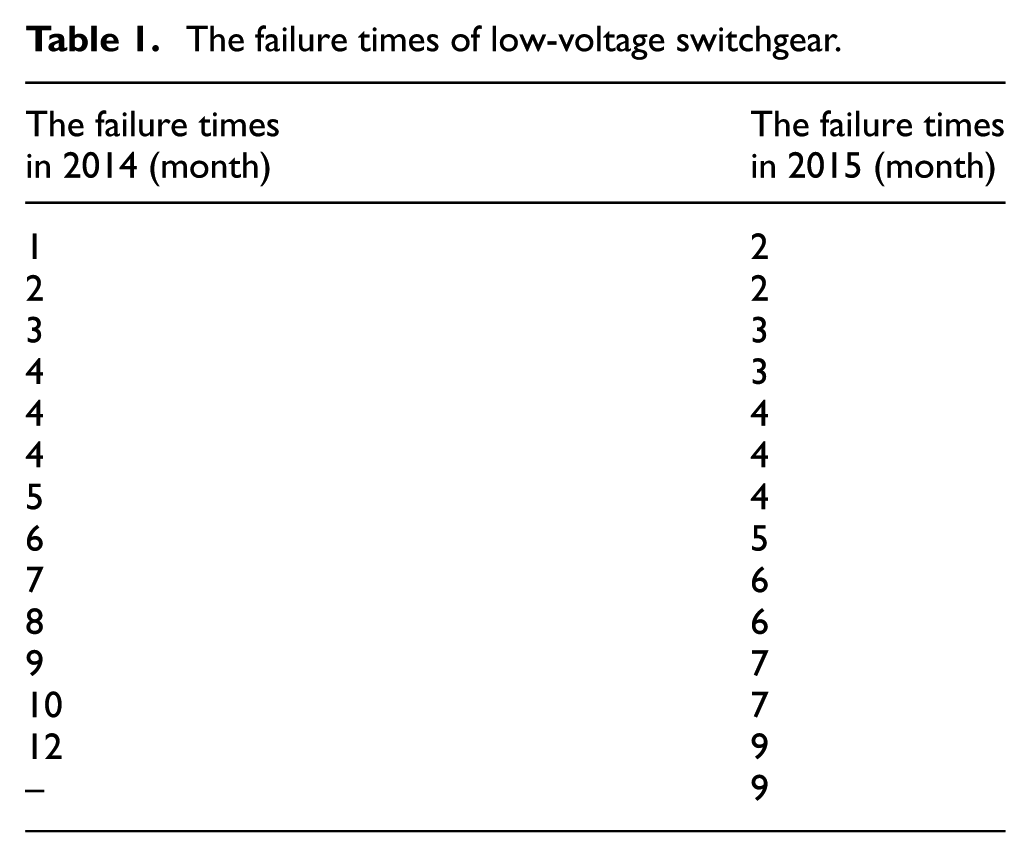
To collect more objective information, we commanded the applicable conditions, factory test, repair and maintenance, operation of equipment and fault condition of low-voltage switchgear from the year 2014 to 2015. In total, 13 and 14 failures occurred in 2014 and 2015, respectively, and the failure times are shown in Table 1.
The failure times of low-voltage switchgear.
Parametric test method
Failure properties and failure mechanism of the product can be deduced roughly from the type of life distribution of the product. Weibull distribution is widely used in the reliability analysis of electrical appliances because it has three parameters and can fit a wide variety of fault rate curves very well. The probability density function of Weibull distribution23–25 is as follows

where
The failure data are arranged in order from small to large as

where
When the hypothesis was accepted, W obeys

Taking the data of low-voltage switchgear in the year 2014 as an example, from Table 1, it can be obtained that r = 13, r1 = 6. Therefore, it can be calculated that W = 1.158, F0.95(12, 13) = 2.69 and F0.05(12, 13) = 1/ F0.95(12, 13) = 0.37. F0.05(12, 13) < W < F0.95(12, 13), the hypothesis is accepted. The failure times of low-voltage switchgear obey Weibull distribution.
Non-parametric test method
By checking the type of parameter distribution of the collected prior data, it can be ascertained that the low-voltage switchgear obeyed Weibull distribution. Compared with every prior information obeying Weibull distribution with field information, the compatibility of prior information is determined by nonparametric test compatibility. And Wilcoxon rank-sum test is used to test the nonparametric test compatibility between the prior information and the field information.26,27
The prior information was denoted by
H0. Prior information X and field information Y belong to the same population.
H1. Prior information X and field information Y do not belong to the same population.

If the significance level
According to data in Table 1, it can be known that n = 13, m = 14, N = 27, R1 = 1, R2 = 4, …, R13 = 27. The statistic
The construction of a priori distribution
Weighted fusion method based on expert information
Weighted fusion is one of the most commonly used methods and the most convenient method for multi-source information fusion. The basic idea of the weighted fusion method is the collation of prior data and the deduction of the prior information characteristic parameters, such as the mean, variance and so on; then the weight of prior information was determined according to the actual situation. The feature parameters of priori information were compiled into one characteristic parameter by the weighted method to complete the fusion method of multi-source information.
Generally, the researches and developments of new products are created by improving or upgrading existing product and the reliability and performance will be improved. Sometimes, the phenomenon cannot be found by historical data. Especially, the change of reliability and performance cannot be obtained by compatibility test if the reliability of the production of new products is not obvious. Then the relevant expert experience can overcome this shortcoming.
The reliability evaluation of products often needs to consider the influence of many factors, such as design, manufacturing, installation and debugging, maintenance and working environment and other factors that cannot be obtained directly and objectively. Therefore, it is necessary to communicate with the expert personnel responsible for the production assembly, installation and commissioning and maintenance for the collection of historical data. And the fusing coefficient of prior information can be obtained by the expert experience.
First, every expert judges the collected prior data and calculates the similarity coefficients of the prior information
The selection of the conjugate prior distribution
According to the Bayes formula, the posterior distribution is directly proportional to product of likelihood function and prior distribution. Therefore, the properties of the likelihood function, especially the integrability of the likelihood function, are very important for the posterior distribution. Generally, in the case of known posterior distribution, a priori distribution is often constructed as a function form that is the same (or similar) as the posterior distribution to construct a conjugate prior distribution for the posterior distribution.
The selection of the conjugate prior distribution is usually determined by the factors with the parameters
In the reliability evaluation of low-voltage switchgear, we often regarded the life distribution as a Weibull distribution with two parameters,28,29 and the probability density function was as follows

According to the collected prior information, the likelihood function of low-voltage switchgear was as follows

In formula (6),
The distribution function of logarithmic inverse Gamma distribution is as follows

where the parameter
Formula (7) was transformed with parameter

In formula (8), the key factor of
The determination method of prior distribution
The conjugate prior distribution of low-voltage switchgear was logarithmic inverse Gamma distribution. The mean and variance of logarithmic inverse Gamma distribution were as follows

The prior information of
The determination of low-voltage switchgear
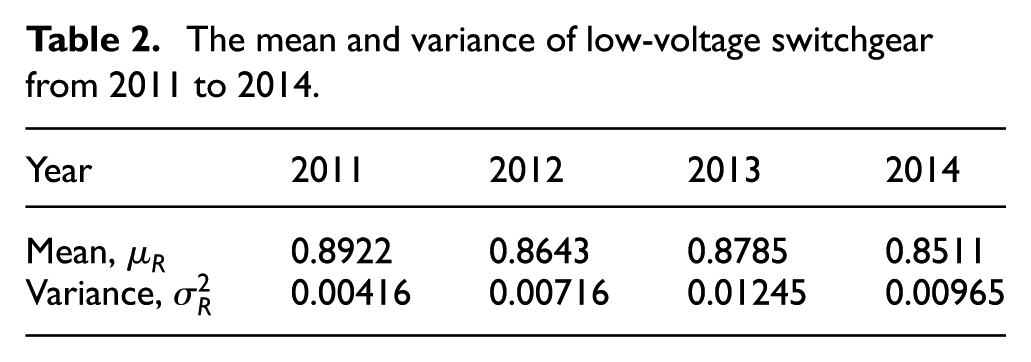
According to the data of low-voltage switchgear produced during the year from 2011 to 2014, the mean
The mean and variance of low-voltage switchgear from 2011 to 2014.
According to the judgement of experts, the coefficients of the prior information
The
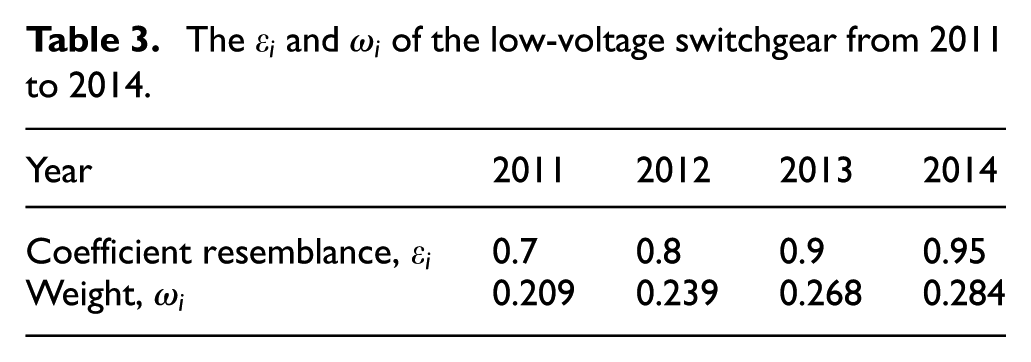
According to data in Table 3,
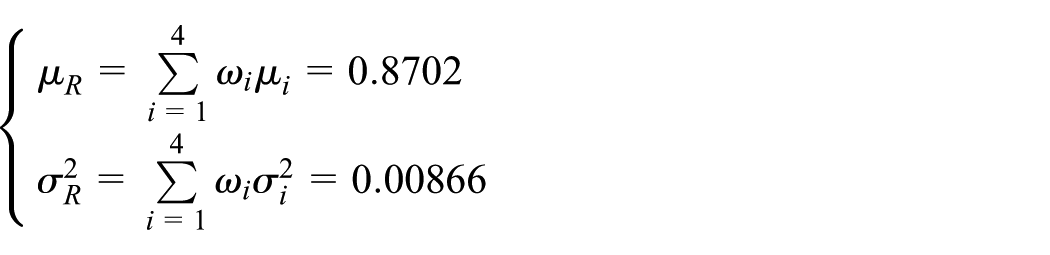
According to formula (9), parameters a and b can be calculated

Therefore, when

Conclusion
In order to obtain a priori information of low-voltage switchgear with high reliability, a feasible prior information fusion method was proposed in this article, and a reliable prior distribution function of low-voltage switchgear is obtained. First, the prior information of the low-voltage switchgear was collected, classified and arranged, and the failure times of low-voltage switchgear from 2014 to 2015 were obtained. Then, the failure data were tested by the parameter test method, which showed the distribution type of the data was Weibull distribution. The nonparametric test method was used to test the compatibility, which showed that the field test data obeyed the same distribution with historical data. The results of the parametric and nonparametric test method show the rationality and credibility of prior information of low-voltage switchgear. Finally, the weighted fusion method was used to analyse the weight of the expert information. The conjugate prior distribution function of the low-voltage switchgear was obtained according to the fusion information. In the future, we could do further study on the reliability terms of low-voltage switchgear, such as mean time between failures and so on.
Footnotes
Handling Editor: Xihui Liang
Declaration of conflicting interests
The author(s) declared no potential conflicts of interest with respect to the research, authorship and/or publication of this article.
Funding
The author(s) disclosed receipt of the following financial support for the research, authorship and/or publication of this article: This work was supported by the Foundation of Hebei Province Natural Science Foundation of China (grant no. E2016202134).
