



Abstract
In this article, a novel multi-cell conical tube is designed. First, a detail analysis about the crashworthiness of three structures, that is, the multi-cell conical tube, multi-cell square tapered tube, and fourfold-cell conical tube, is made and compared at the condition of keeping the same mass with different oblique load angles. Then, the influences of the internal cell walls, load angle, the cone angle, and wall thickness on the performances of crashworthiness are investigated. The multi-cell conical tube has better energy absorption capacity than multi-cell square tapered tube and fourfold-cell conical tube at small load angles. The normalization of average gradients of the cone angle on specific energy absorption reached 48.25% compared with the wall thickness. The full factorial design and the optimal Latin hypercube design method are adopted to define the sample points and error analysis points. A numerical simulation on the sample points and error analysis points are performed using Abaqus/Explicit. According to different working conditions, different optimization objects are determined, and corresponding surrogate models with different indicators are constructed using Kriging method. The accuracy of surrogate model is evaluated. The non-dominated sorting genetic algorithm-II is utilized to optimize the multi-objective problem. Finally, the influence of structural parameters on crashworthiness is discussed.
Keywords
Introduction
Thin-walled structure is widely used in the collision safety field of automobile because of its good crashworthiness.1,2 Different materials and structures with various cross-sections have been studied, such as the circular,3–6 square,7,8 polygonal,9–11 multi-cell12–15 and star-shaped tube, 16 sandwich structure, 17 filled tubes 18 . Conical tube has been considered to be more preferable in terms of energy absorption compared with straight tube due to their relatively stable mean load–deflection response and resistance to oblique loading. 19 In addition, conical tube is less likely failed by global buckling compared with straight tube. 20 From the view point of structural optimization, the design domain of conical tube is larger than that of straight tube. 21 Current studies on ordinary conical tube have been investigated from the aspects of experiment,22,23 numerical simulation,24–26 and optimization.27–29 The study of energy absorption of thin-walled structures under oblique loading has also been carried out, for example, Reyes et al.30,31 carried out the experimental and numerical analysis on the aluminum extrusions subjected to oblique loading. Reid and Reddy 32 studied the static and dynamic crushing of tapered sheet metal tubes with rectangular cross-section.
In recent years, the thin-walled structure combining the multi-cell tube and ordinary conical tube has drawn much attention. Qi et al. 2 carried out studies on axisymmetric thin-walled square tube under oblique loading with four different configurations using the LS-DYNA. The results show that the energy absorption capacity of multi-cell tube is the best subjected to oblique loading. The crashworthiness behavior of the conical multi-cell tube is theoretically and numerically investigated by Mahmoodi et al. 33 The results show that the increase of the cone angle, the wall thickness, and the number of cells in the cross-section would improve the crashworthiness capacity of the structure. Zou et al. 34 investigated the energy absorption characteristics of an aluminum alloy thin-walled tube with different cone angle and cell numbers. The results show that the initial peak force of the single-cell conical tube, double-cell conical tube, and fourfold-cell conical tube (FCT) drops with the increasing of cone angle and specific energy absorption (SEA) increases with the increasing of cone angle. It can be concluded that the cone angle and cell number of conical multi-cell tube can effectively improve the crashworthiness of thin-walled structures.
It should be noted that the above study simply inserted the clapboard into the middle of the square conical or circular conical tube. The multi-cell tube energy dissipation is mainly achieved through the plastic deformation at the corner part, 35 and the energy dissipation of the clapboard is relatively limited. Circular tube has a better energy absorption capacity according to the literature, 21 where the energy absorption of thin-walled circular tube structure can be improved by increasing the wall thickness and decreasing the diameter. It should be noted that when the tube diameter is reduced to a certain value, the energy absorption capacity will drastically decrease because the deformation mode will change from ring mode to Euler buckling. 35
From the literature review on current studies, it seems that there is still a big space to explore new structure to improve the energy absorption capacity. We made a try in this article, where a novel multi-cell conical tube (MCT), which has not been reported so far in the literature, is proposed and studied. Tang et al. 36 designed a cylindrical multi-cell column, and their research shows that cylindrical multi-cell thin-walled column is superior to conventional square and multi-cell square column. The double layer cylindrical multi-cell column is most efficient under the conditions of same mass. It should be noted that it is easy to lead to the global buckling when the wall thickness increases since the outer tube of the cylindrical multi-cell columns is a straight tube. Tang et al. 36 also mentioned the phenomenon in their paper. The MCT proposed in this article can effectively overcome this problem because MCT has internal cell walls and outer conical tube, they can effectively avoid the Euler buckling of internal circular tube. Therefore, MCT is expected to fully integrate the advantages of conical tube and circular tube. By increasing the mass of the inner tube of MCT, energy absorption effect can be effectively improved.
The paper is organized as follows: first, the new structure of MCT is proposed and comparative analysis of different conical tubes under oblique loading is carried out using the explicit nonlinear finite element analysis (FEA) code Abaqus/Explicit. Then, the effects of wall thickness, cone angle, and internal cell walls on the crashworthiness of MCT under different load angles are discussed. Third, the sample points are created using the full factorial design. Fourth, the Kriging surrogate model under both the multiple load cases (MLC) and single load cases (SLC) is established, and the multi-objective optimization is performed using the non-dominated sorting genetic algorithm-II (NSGA-II). Finally, the influence of structural parameters on crashworthiness is discussed and the conclusion is given.
Calculation model
Crashworthiness indicators
SEA is the total energy absorbed (EA) by the structure of a given structural mass (mt) and defined as equation (1)

where the F(x) is the impact force and d is the crash displacement.
The mean crush force (Pm) is defined as equation (2)

The maximum crush force (Pmax) is a critical indicator and large impact force often leads to an injury of the occupant, and it is defined as equation (3)

Finite element model
The impact model consists of three parts, the impacting rigid plate, the thin-walled tube, and the supporting rigid plate. The diagrammatic sketch and finite element model are shown in Figure 1. The specimens are loaded by the impacting rigid plate with a prescribed velocity of 10,000 mm/s, and the impacting rigid plate with a mass of 110 kg about 10% of the compact car’s mass according to Djamaluddin et al., 37 and Witteman 38 is inclined at a pre-defined load angle α in oblique loading. The tube length is 200 mm and the crush displacement is 60% of the initial length.

Diagrammatic sketch of the impact model and finite element model.
In this article, Abaqus/Explicit software is used to carry out the dynamic model thanks to the wide applications of FEA tools in the analysis of dynamic crushing of thin-walled structure and cellular materials.16,19,26,33,39–42 The finite element model is built with four-node reduced integration shell elements with five integration points across the thickness. The contact between the impacting rigid plate and the thin-walled tube is a node-to-surface contact with friction coefficient of 0.2, and the supporting rigid plate and the thin-walled tube are defined as “tied.” In order to avoid the thin-walled structure in the compression process itself to penetrate each other, the contact algorithm used to simulate the contact interaction between all components is regarded as the “general contact algorithm.”
Researchers carried out a large number of crashworthiness experiments and simulation studies24–26,28,29 and provided sufficient confirmation to support the validation and accuracy of numerical simulation technology. The experimental and simulation studies of lateral corrugated tube were carried out in our previous investigations, 42 and the energy absorption and the deformation mode of the experiment are contrasted with simulation shown in Figure 2. Considering the boundary conditions and the setup of finite element model are all kept as the same as that in the literature, 42 it could be used as a benchmark to support our subsequent simulation analysis.
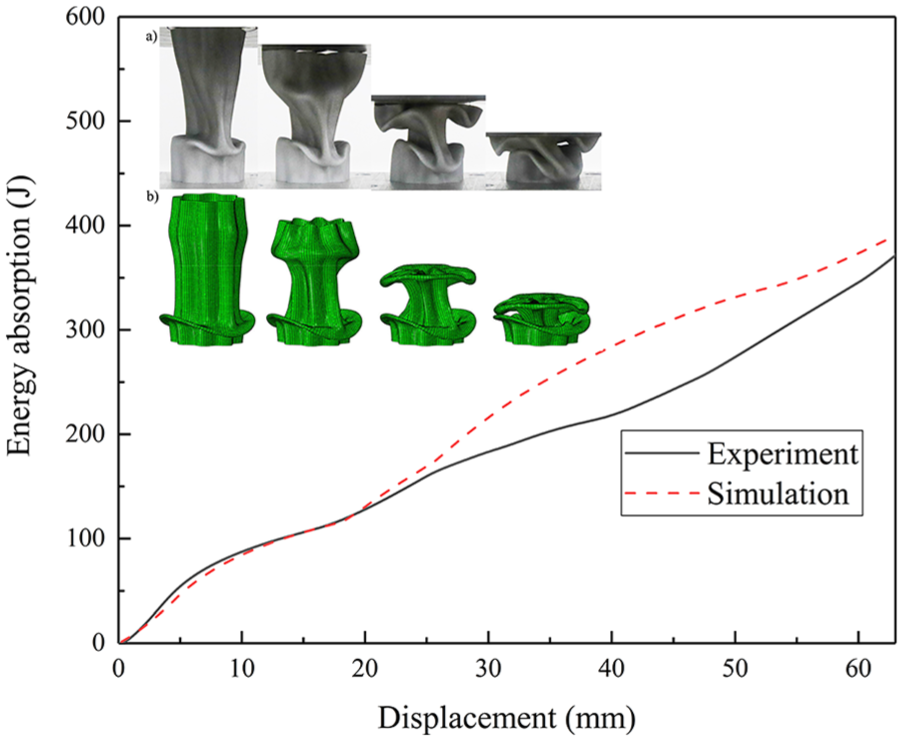
Validation of the finite element model in our previous investigations. 42
In order to minimize the effect of mesh size on the accuracy of numerical results, a convergence test is carried out. Figure 3 shows mesh convergence test of MCT (d1 = 100 mm, d2 = 65 mm, d3 = 35 mm, t = 1 mm, θ = 5°) in the different mesh sizes at the load angle of 0°. As can be seen from Figure 3(a), the mean crush force and the initial peak force change only 2.90% and 0.86% when the mesh size changes from 2 mm × 2 mm to 1.5 mm × 1.5 mm, indicating the mesh size of 2 mm × 2 mm can satisfy the simulation accuracy.

Mesh convergence test: (a) the mean crush force and the initial peak fore, (b) force–displacement curves, and (c) deformation mode of MCT with different mesh sizes.
Material properties
The finite element model was assigned with aluminum alloy AA6061T4, and the engineering stress–strain curve of AA6061T4 is shown in Figure 4 obtained by tensile test using electronic universal testing machine in accordance with ASTM E8M-2004 standard method. The properties of AA6061T4 are show in Figure 4(d). The strain rate effect was not considered here due to the insensitivity of aluminum alloy.2,14,28

The specimens and engineering stress–strain curves of AA6061T4: (a) electronic universal testing machine, (b) specimens parameters, (c) specimens, and (d) engineering stress–strain curves.
Multi-objective optimization process and algorithm
Multi-objective optimization process
The optimization problem can be expressed as follows

where

Flowchart of the multi-objective optimization.
Kriging surrogate model
Kriging surrogate model is based on variation function theory and structural analysis, 43 and it could achieve unbiased and optimal estimation within a limited area. The Kriging model has a fairly good accuracy for highly nonlinear functions and multi-peak functions.44,45 Therefore, in this article, we mainly utilize the Kriging method to construct the surrogate model.
The Kriging method is mainly composed of stochastic component and the polynomials, and it can be expressed as follows

where
The accuracy evaluation of surrogate model
The accuracy of the surrogate model is usually evaluated using the following four indicators, namely R square values (R2), relative absolute average error (RAAE), relative maximum absolute error (RMAE), and root mean square error (RMSE). The expressions are shown in equations (6)–(9)
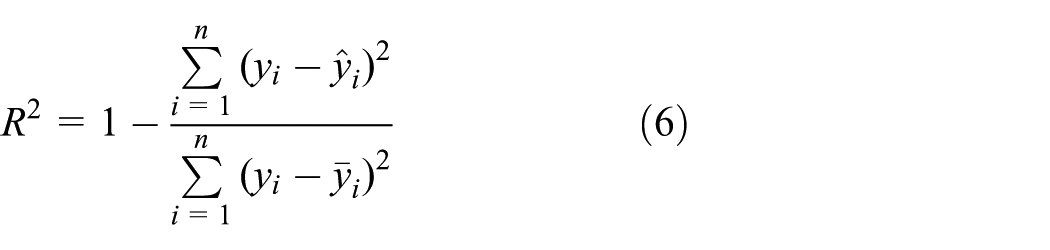



The closer the RMSE, RAAE, and RMAE values are to 0 or the closer the
Multi-objective optimization algorithm
The problem of simultaneous optimization of multiple sub-targets is called multi-objective optimization. The NSGA-II is one of the most popular multi-objective optimization algorithms and has a good convergence of the solution set. 46 The SEA and Pmax are important indicators of crashworthiness. In order to achieve a balance among the indices of SEA and Pmax, and NSGA-II is utilized to produce Pareto frontiers for the optimization problems in this article.
Comparative analysis of different conical tubes
Through a large number of previous surveys, including Qi et al. 2 and Zou et al. 34 who proposed multi-cell square tapered tube (MSTT) and FCT individually which were shown in Figure 1 mentioned before, we did not find other studies on the conical multi-cellular tubes. In order to compare the performance of the three different conical tubes under oblique loading, numerical analysis of their crashworthiness is first carried out. It should be noted that it is only meaningful to compare the three structures under the condition of keeping the same mass. Therefore, it is necessary to establish the relationship between thickness and mass of different tubes with same tube length.
The expression of mass is shown in equation (10)

where
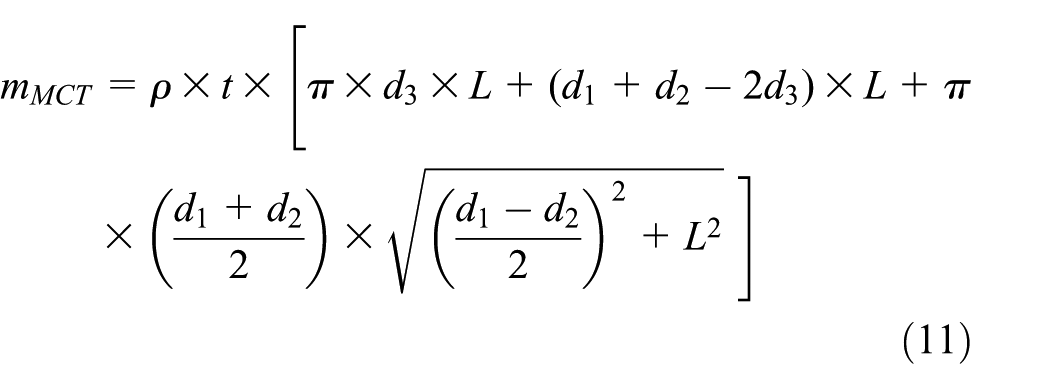
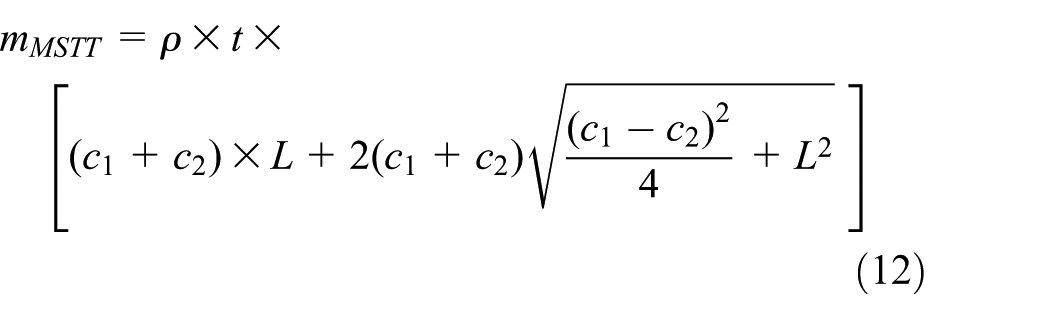
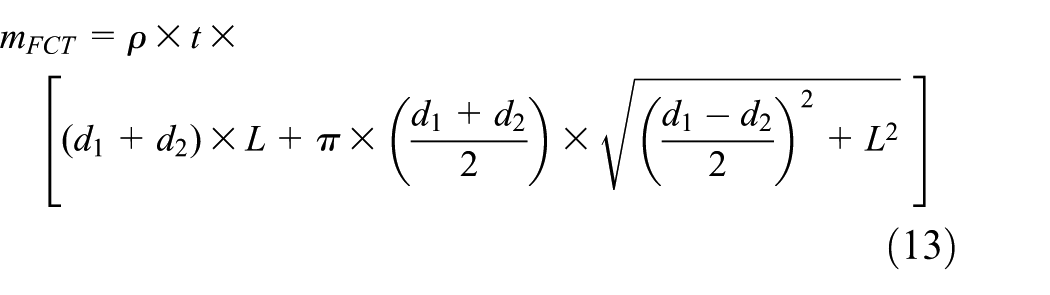
where
The structural parameters of MCT, MSTT, and FCT at different masses.

MCT: multi-cell conical tube; MSTT: multi-cell square tapered tube; FCT: fourfold-cell conical tube.
The second figure indicates the different mass values of conical tube.
Boldface represents MCT to make it easier to read and distinguish tubes with different mass.
According to the structural parameters of Table 1, three different structural tubes were analyzed systematically using Abaqus/Explicit. Figure 6 shows the SEA of three different structural tubes. Figure 7 shows Pmax comparisons of different structure tubes. Figure 8 shows force–displacement curves of different structural tubes at different load angles and masses. Three deformation modes, that is, the progressive collapse, transition region, and global collapse, are generated according to different load angles. As can be seen from Figure 8, the force–displacement curve of the progressive collapse mode is similar to that of circular tube. The force first reaches the initial peak and then fluctuates. However, the force–displacement curve of the global collapse is that the force begins to decrease drastically after reaching the initial peak force. The greater the load angle, the more prone to global collapse deformation, three different types of structural tubes have shown the same trend. Tube at different mass, the greater the mass, the more prone to global collapse, the overall structure is more likely to instability because of increased mass lead to increased wall thickness.

SEA comparisons of different structure tubes under different load angles: (a) mt = 0.251 kg, (b) mt = 0.377 kg, (c) mt = 0.502 kg, and (d) mt = 0.628 kg.

Pmax comparisons of different structure tubes under different load angles: (a) mt = 0.251 kg, (b) mt = 0.377 kg, (c) mt = 0.502 kg, and (d) mt = 0.628 kg.

Force–displacement curves of different structural tubes at different load angles and mass: (a) MCT with 0.251 kg,(b) MSTT with 0.251 kg, (c) FCT with 0.251 kg, (d) MCT with 0.377 kg, (e) MSTT with 0.377 kg, (f) FCT with 0.377 kg, (g) MCT with 0.502 kg, (h) MSTT with 0.502 kg, (i) FCT with 0.502 kg, (j) MCT with 0.628 kg, (k) MSTT with 0.628 kg, and (l) FCT with 0.628 kg.
The comparison between SEA and Pmax is shown in Figures 6 and 7. At progressive collapse, MCT exhibits the most excellent SEA compared with MSTT and FCT, and the lighter the mass, the more obvious the advantage. With the increase of mass (i.e. wall thickness), the SEA of the three structures are all improved. However, due to the increase of the mass, the three structures are more prone to global collapse under the impact of large load angles.
Figure 7 shows the Pmax of three different structural tubes. It is easy to see from Figure 7 that all Pmax of the three tubes increase with the increase of the mass and decrease as the load angle increases. Pmax of the different structures is mainly related to the wall thickness, the collapse mode, and the load angle. When the load angle is imposed under the condition of same mass and same load angle, their Pmax do not show much difference. Table 2 shows crashworthiness data of different structural tubes at different load angles and masses.
Crashworthiness data of different structural tubes at different load angles and masses.

SEA: specific energy absorption; MCT: multi-cell conical tube; MSTT: multi-cell square tapered tube; FCT: fourfold-cell conical tube. Boldface represents MCT to make it easier to read and distinguish tubes with different mass.
Figure 9(a) shows the comparative analysis of SEA for three structural tubes when their mass mt is 0.251 kg and 0.502 kg, respectively. When mt = 0.251 kg, the MCT transition angle is 20°∼ 25°, MSTT and FCT are 25°∼ 30°. When mt = 0.502 kg, the transition angle for MCT and MSTT becomes 15°∼20°, while the FCT is 20°∼25°. The result also shows that as the mass increases, the transition angles of the three different structural tubes are reduced from progressive collapse to global collapse. Figure 9(b) shows the comparative analysis of Pmax for three different structural tubes with mt = 0.251 kg and mt = 0.502 kg. When the mass is mt = 0.251 kg, the Pmax of MCT, MSTT, and FCT is not much different. When the mass increases to mt = 0.502 kg, the Pmax of FCT impacted at angles of 5°, 10°, and 15° is lower than the other two tubes. However, the Pmax of MCT and MSTT is basically the same. Figure 9(c) and (d) are the corresponding collapse mode of different absorbers compared. Figure 10 shows a comprehensive comparison of the three tubes at different masses and load angles. It is obvious that the crashworthiness of MCT is superior to both MSTT and FCT at small load angles.

SEA and Pmax comparisons of different structure tubes under different load angles with mt = 0.251 kg and mt = 0.502 kg:(a) SEA; (b) Pmax; (c) collapse mode at mt = 0.251 kg, and (d) collapse mode at mt = 0.502 kg.

Comparison of crashworthiness between MCT and MSTT and FCT.
Parameter study of MCT
Effect of the number of internal cell walls on crashworthiness
Here, the energy absorption performance of MCT with wall thickness of 1 mm at different load angles is analyzed, and the results are shown in Figure 11. It can be seen from Figure 11, the overall mass of MCT increases as the number of the internal cell walls increases, and its SEA is improved accordingly. When the number of the internal cell walls is 12, the SEA decreases more obvious at 15° than 10°, which means that more internal cell walls are not good at resisting large angle impacting. When the load angle is between 25° and 30° respectively, MCT with different numbers of internal cell walls all present overall global collapse mode, which means MCT has low SEA at larger impact angle. It also shows that blindly increase the number of internal cell walls is not an effective way to improve the crashworthiness of MCT. It is worth noting that with the increase of the number of internal cell walls, the Pmax also increases significantly. Therefore, the number of internal cell walls is set to be 8 for the following discussion.
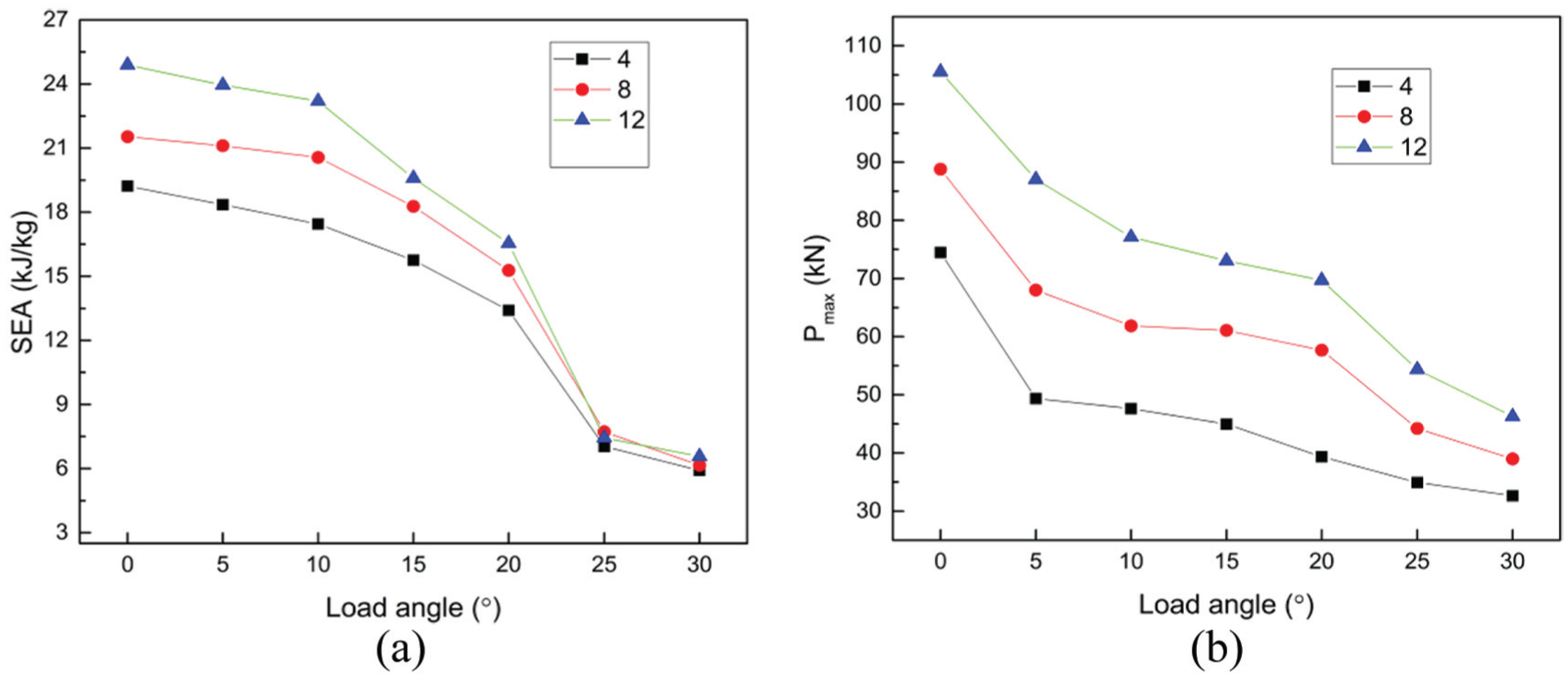
Effect of internal cell walls on crashworthiness: (a) SEA and (b) Pmax.
Effect of wall thickness and load angle on the crashworthiness
Figure 12 shows that when the cone angle maintains at 5°, how the load angle and wall thickness of MCT take effect on the crashworthiness under oblique loading. When the load angle is less than 10°, SEA increases with the wall thickness increasing. When the load angle changes from 10° to 15°, the SEA of MCT with thickness of 2 and 2.5 mm respectively both decreases drastically, this indicates that the deformation mode of MCT has been changed. Now, the parameters are tuned to the following values, where the wall thickness are 1.5 mm and 1 mm, respectively, while the critical load angle is 15°∼20° and 20°∼25°, respectively. The result shows that the deformation mode has a direct relationship not only with the load angle, but also with the wall thickness. Thicker thickness of MCT is more prone to the overall collapse. Pmax shows a tendency to decrease with the increase of the load angle and the decrease of wall thickness.

Effect of wall thickness and load angle on crashworthiness: (a) SEA and (b) Pmax.
Effect of cone angle and load angle on crashworthiness
Figure 13 shows the effect of cone angle and load angle on crashworthiness under oblique loading when the wall thickness of the MCT maintains at 1.5 mm. In general, in the progressive collapse mode, the SEA of MCT with large cone angle is larger than small cone angle. The effect of cone angle on SEA of MCT is less than that of wall thickness. The cone angle also has a certain effect on the maximum crush force. In general, the Pmax of MCT with large cone angle is less than small cone angle. It is worth noting that at 20° loading angle, the MCT with the conical angle of 1°, 3°, and 5° deforms from progressive collapse mode into global collapse mode. Whereas, SEA does not immediately decrease when the cone angle of MCT is 7°, indicating that the cone angle also takes some effect on the transition of deformation mode.

Effect of cone angle and load angle on crashworthiness: (a) SEA and (b) Pmax.
Optimization results and discussion
Definition of optimization problem
Through the analysis of the previous parameters, the wall thickness and cone angle are two important parameters that affect the crashworthiness of the structure. Therefore, wall thickness and cone angle are used as optimization variables. SEA and Pmax are the optimization target. Therefore, the mathematical description of the established multi-objective optimization is as follows

Determine the sample points and error analysis points
In this study, surrogate models for predicting SEA and Pmax of MCT under oblique loading with different load angles were constructed. The full factorial design is adopted to generate the sample points, and the crashworthiness of sample points at different load angles is simulated using Abaqus/Explicit. The sample points and simulation results are shown in Table 3.
The sample points and finite element simulation results.

SEA: specific energy absorption.
After the surrogate model is constructed, its accuracy needs to be evaluated. For this reason, five other points are introduced into our discussion to make the error analysis. It is necessary to point out that the sampling points could not be used to evaluate the accuracy, since Kriging method could go through all the sample points themselves. Using the same analytical method as the sampling points, the crashworthiness of the five points used for error analysis at different load angles is analyzed. The results are shown in Table 4.
Evaluated points and simulation results.

SEA: specific energy absorption.
Multi-objective optimization for different SLC
In order to systematically analyze the MCT, the multi-objective optimization of MCT at four different impact angles, that is, α = 0°, α = 10°, α = 20°, and α = 30°, is optimized at the first place. In order to conduct the optimizations for four different SLC, only one load angle is considered in each case.
The surrogate model of MCT for SEA and Pmax was constructed based on Kriging under different load angles. The accuracy of SEA and Pmax at different load angles is evaluated using the surrogate model accuracy assessment method listed in section “The accuracy evaluation of surrogate model.”Table 5 shows that the surrogate model has high accuracy and meets the requirement of optimization design.
Error analysis for the surrogate model of SLC.

SLC: single load cases; RAAE: relative absolute average error; RMAE: relative maximum absolute error; RMSE: root mean square error; SEA: specific energy absorption.
In this article, the NSGA-II algorithm is used to optimize different SLC. The converged Pareto frontiers for different SLC of α = 0°, α = 10°, α = 20°, and α = 30° are plotted together in Figure 14. It is clearly observed that the increase of SEA will directly lead to an increase in Pmax. From Figure 14, it can be observed that the load angle has a significant effect on the crashworthiness of the entire structure. The Pareto frontiers of case I and case II of SLC are very similar, mainly because MCT demonstrates a progressive collapse mode at the load angles of 0° and 10°. The pure axial impact has a higher SEA relative to oblique impact at 10°. SEA of case III and case IV was significantly reduced due to the global collapse of the deformation. The feasible-better solutions under different cases are also shown in Figure 14, and the feasible-better solution is mainly located at the position where the cone angle is larger and the thickness is thinner. This is mainly due to the fact that the increase of the cone angle can improve both SEA and Pmax. The thin MCT is more prone to the progressive collapse mode and more efficient in resisting the large angle impact.

Pareto frontiers for different SLC.
Multi-objective optimization for different MLC
In the present study, MLC in terms of different load angles will be considered in view of achieving the best performances. In order to comprehensively compare performances of the three different structural tubes at different load angles. The following formulas are utilized by referring to the literature28,47


where n denotes the number of different load angles and

In this article, three different MLC are considered by referring to the literature2,42
Case I of MLC:
Case II of MLC:
Case III of MLC:
Case I gives an equal importance to the four load angles, case II defines that small impact angles are more important, and case III means that large impact angles are more important. The surrogate models for the three cases were constructed. The error analyses for the surrogate model of MLC are shown in Table 6. It can be found that all the surrogate models have very high accuracy.
Error analysis for the surrogate model of MLC.
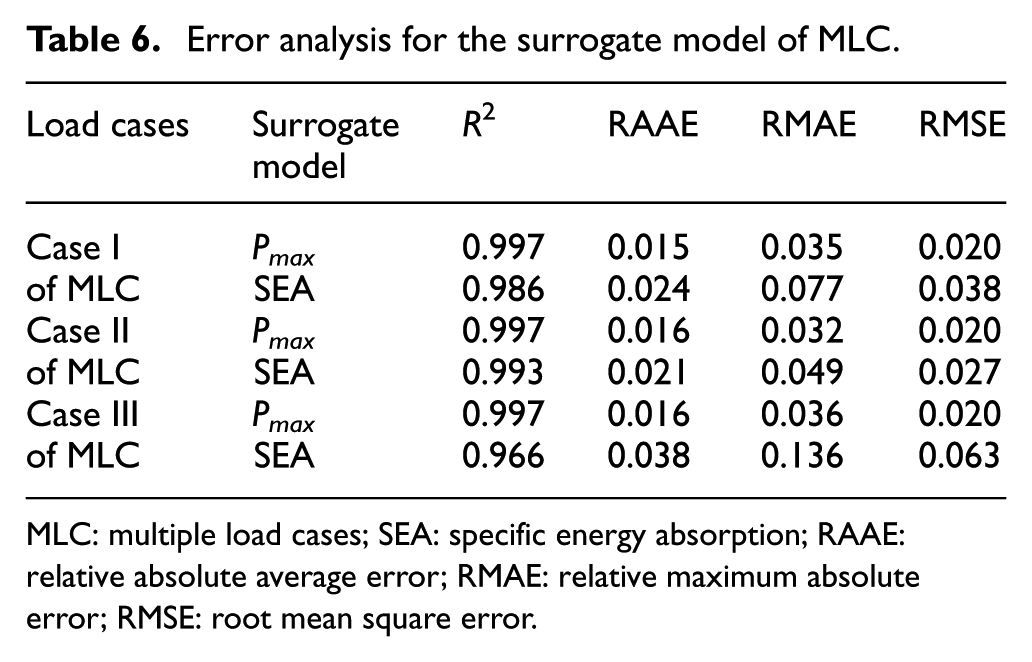
MLC: multiple load cases; SEA: specific energy absorption; RAAE: relative absolute average error; RMAE: relative maximum absolute error; RMSE: root mean square error.
Multi-objective optimization of three different MLC was performed using NSGA-II, and the optimization results are shown in Figure 15. As can be seen from Figure 15, the Pareto frontiers of the three different cases have a nearly parallel shape. Because the MCT has a greater SEA under small angular impact loads, the Pareto frontier of case II moved downward because small impact angles have a greater weight ratio. The Pareto frontier of case III moved upward because small impact angles have a smaller weight ratio. It should be noted that, in practice, the ratio of the relevant weight can be specified according to the actual situation so that the final optimization of MCT can be more adapted to the corresponding conditions.

Pareto frontiers for different MLC.
Checking performances of surrogate model–based optimization using FEA
In order to evaluate the optimization results based on surrogate model, the numerical model is built with the structural parameters achieved in multi-objective optimization. The simulation is carried out using Abaqus/Explicit. The results are shown in Table 7. It can be observed that both the errors of SEA and Pmax for all cases are within 5%, indicating that the accuracy of the optimal results is accepted.
FEA of the optimum tube configurations obtained via surrogate model–based optimization.
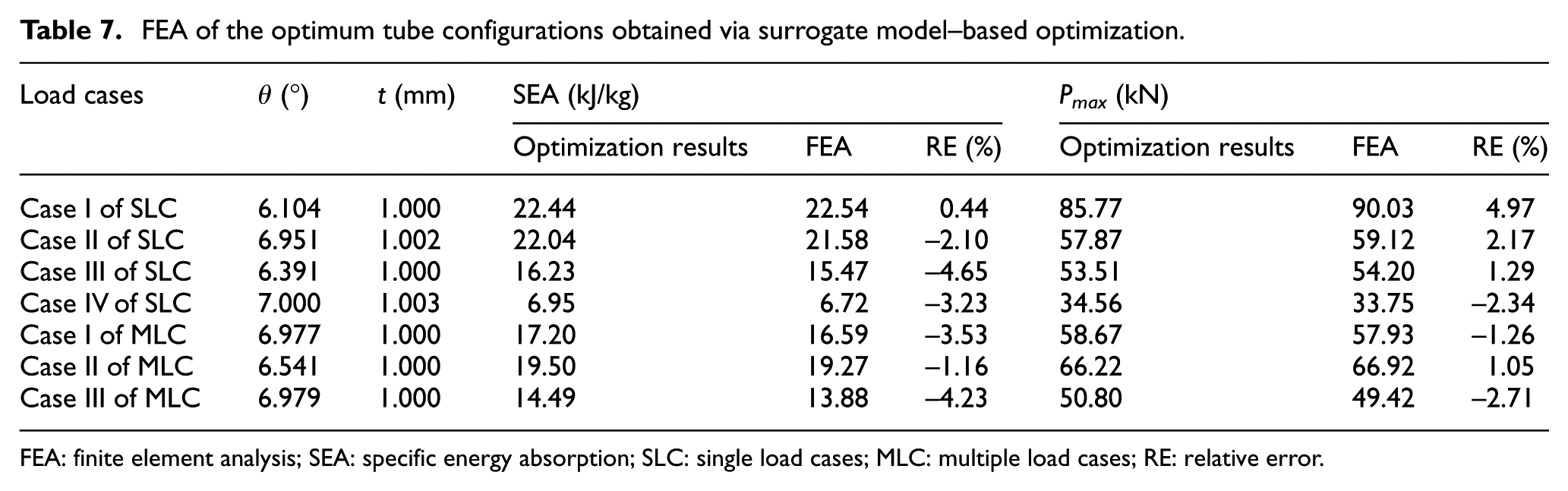
FEA: finite element analysis; SEA: specific energy absorption; SLC: single load cases; MLC: multiple load cases; RE: relative error.
Discussion of the effect of structural parameters on crashworthiness
The influence of an individual factor on the indices of crashworthiness can be obtained through keeping parameter (e.g. t = 1.5 mm, θ = 5°) constant. The influence of structural parameters on crashworthiness under different load angles, α = 0°, α = 10°, α = 20°, and α = 30°, is shown in Figure 16. When the load angles are 0° and 15°, the MCT is progressive collapse deformation mode, its SEA increases rapidly with the increase of wall thickness. Also shows that increasing the wall thickness is an important way to improve its SEA. However, when the load angle increases to 20°, the SEA decreases sharply as the wall thickness increasing. This is mainly because MCT just in the transition region when the load angle is 20°, the overall structure is more likely to lead to the global collapse with the increase in wall thickness. Therefore, its SEA will decrease with the increase of wall thickness. When the loading angle is 30°, the SEA has a certain increase with the increase with the increase of wall thickness. Whereas, as the structural deformation mode is the global collapse, the overall energy absorption is very low. The Pmax increases monotonically with the increase of the wall thickness. Therefore, simple increase wall thickness cannot effectively solve the overall crashworthiness of the structure. SEA and Pmax crashworthiness and resistance to large angle impact can be improved simultaneously by increasing the cone angle. Figure 17 is the normalized result of the averaged gradient about the indices of crashworthiness relative to the structural parameters (SEA, Pmax). It is clear that wall thickness has a greater effect on crashworthiness than cone angle. But when the load angle is 20°, the cone angle contributes 48.25% to SEA compared with the wall thickness. As mentioned in section “Effect of cone angle and load angle on crashworthiness,” the effect of cone angle and load angle on crashworthiness is obvious, because the cone angle can affect the deformation mode of MCT when the load angle is 20°. In general, the cone angle has an important effect when the load angle is 20°, which directly corroborates the results shown in Figure 13(a).

The influence of structural parameters on crashworthiness under different load angles: (a) α = 0°, (b) α = 10°, (c) α = 20°, and (d) α = 30°.

The normalization of average gradients measures of SEA and Pmax at different SLC: (a) SEA and (b) Pmax.
The effect of structural parameters on crashworthiness under different MLC through keeping parameter (t = 1.5 mm, θ = 5°) constant is shown in Figure 18. The effect of structural parameters on three different cases has similar results. The increase of wall thickness can increase SEA and Pmax, while the increase of cone angle can improve SEA and Pmax. The cone angle has less influence on the impact resistance of the whole structure than the wall thickness. Figure 19 gives the normalized result of the averaged gradient about the indices of crashworthiness relative to the structural parameters (SEA, Pmax). Case I of MLC gives an equal importance to the four load angles, case II of MLC defines that small load angles are more important, and case III of MLC means that large load angles are more important. As can be seen from Figure 19, the effect of the cone angle on case III of MLC is significantly greater than case II and case I of MLC. This is mainly because the cone angle can effectively improve the impact performance of the structure at large angle impact, and case III of MLC assigned a larger weight factor relative case II and case I of MLC. Therefore, the cone angle has the greatest effect on case III of MLC, and the effect on case I of MLC is the weakest. However, in general, wall thickness plays a major role in structural crashworthiness. In the three cases of MLC, the relative wall thickness of cone angle has little effect on the overall crashworthiness of the structure.

The influence of structural parameters on crashworthiness at different cases of MLC: (a) case I, (b) case II, and (c) case III.
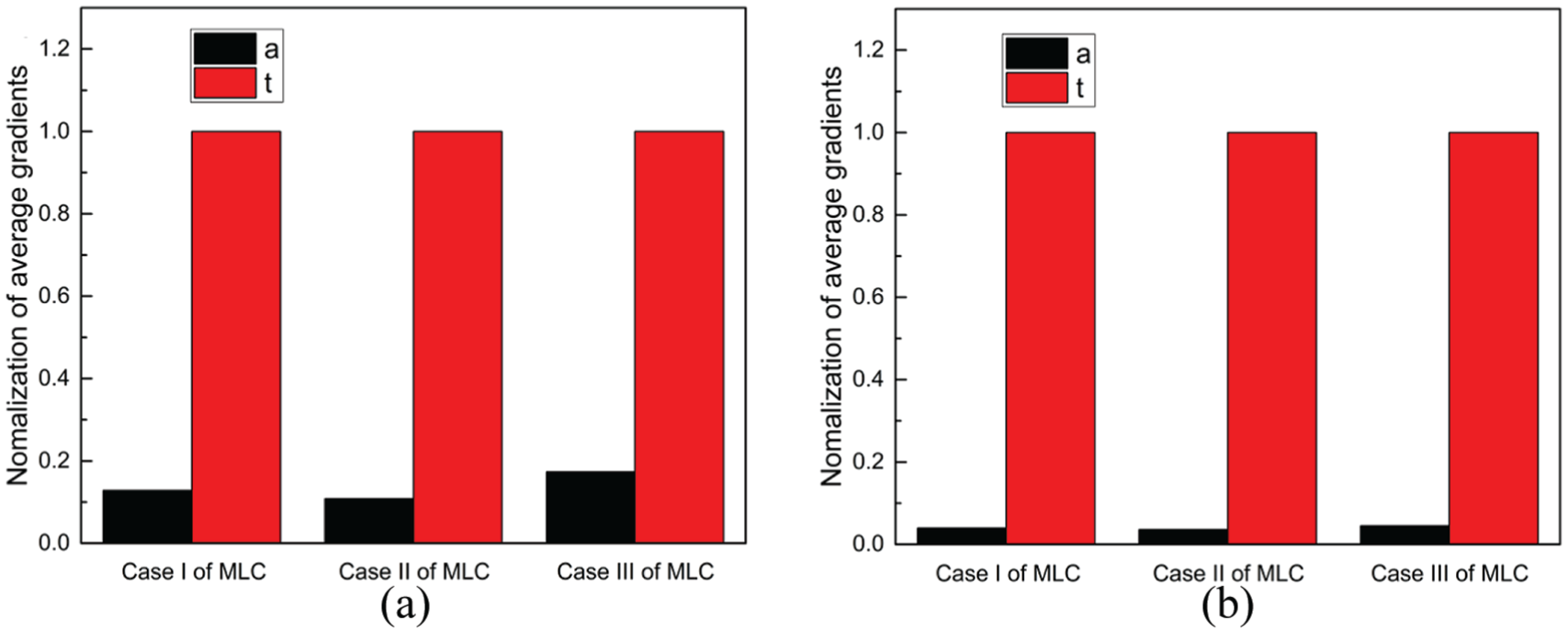
The normalization of average gradients measures of SEA and Pmax at different MLC: (a) SEA and (b) Pmax.
Conclusion
In this study, a novel MCT is proposed and investigated. The surrogate model is constructed with Kriging surrogate model, and the multi-objective optimization is carried out by NSGA-II. The conclusion is as follows:
The MCT proposed in this article has better energy absorption capacity than those of MSTT and FCT proposed in the literature under progressive collapse. When the load angle is 0°, the SEA of MCT is up to 29.95% higher than the FCT, and Pmax is reduced by 6.36%. The SEA of MCT is up to 13.59% and Pmax decreased by 0.72% compared with MSTT. With the increase of mass, the SEA of the three structures is all improved. However, they are all more prone to global collapse under the large load angle.
The load angle has a significant effect on SEA and Pmax. When the mass increases, the transition angle from progressive collapse to global collapse of the three structural tubes is reduced. The greater the mass, the worse the ability to resist large load angle.
The deformation mode is not only related with the load angle, but also with the wall thickness and cone angle. The wall thickness has a greater effect on crashworthiness than cone angle. But when the load angle is 20°, the effect of cone angle on the crashworthiness of the structure is greatly improved. The normalization of average gradients of the cone angle on SEA reached 48.25% compared with the wall thickness.
According to the optimization objectives, NSGA-II can be used to obtain the Pareto frontier. It is found that SEA and Pmax conflict with each other and they cannot reach an optimum solution simultaneously. It is suggested that different optimization goals should be determined according to practical situation so that the final optimization scheme of the MCT can be more adaptive to the real conditions. It should be pointed out that although MCT has a great advantage in energy absorption, under the existing processing conditions, there are problems such as processing difficulty and high cost. In summary, the proposed structure in this article provides a reference for energy absorption of the buffer system.
Footnotes
Handling Editor: Davood Younesian
Declaration of conflicting interests
The author(s) declared no potential conflicts of interest with respect to the research, authorship, and/or publication of this article.
Funding
The author(s) disclosed receipt of the following financial support for the research, authorship, and/or publication of this article: This work is supported by Natural Science Foundation of Guangdong Province (no. 2014A030313251), Natural Science Foundation of Guangxi Province (no. 2016JJA110045), Guangxi Natural Science Foundation Co-sponsored Cultivation Project (no. 2018JJA110101) and thousands of young and middle-aged backbone teachers in Guangxi Universities.
