




Abstract
In this article, Timoshenko’s beam model is established to investigate the wave propagation behaviors for a fluid-conveying carbon nanotube when employing the nonlocal stress–strain gradient coupled theory and nonlocal fluid theory. The governing equations of motion for the carbon nanotube are derived. The small-scale influences induced by the nanotube are simulated by nonlocal and strain gradient effects, and the scale effect induced by fluid flow is first investigated applying nonlocal fluid theory. Numerical results obtained by solving the governing equations indicate that the nonlocal effect induced by the nanotube leads to wave damping and a decrease in stiffness, while the strain gradient effect contributes to wave promotion and an enhancement in stiffness. The scale effect caused by the inner fluid only leads to a decay for a high-mode wave since there is no influence from fluid flow on the low-mode wave. The numerical solution is validated by comparing with Monte Carlo simulation and interval analysis method.
Keywords
Introduction
Since the development of nano- and micro-electromechanical systems in medicine, biology, and mechanical engineering, microscale transport has become an active research topic. The key relationship for the design and application of a microscale conveyance structure is the interaction between the microfluid and the solid channels or tubes, especially the dynamic characteristics of fluid-conveying nanotubes, including wave propagation and vibration behaviors.1–3
The research approaches for the dynamic behaviors of fluid-conveying carbon nanotubes (CNTs) include experimental investigation and theoretical analysis. Because implementing an experimental investigation is quite difficult in terms of control and maneuverability at the nanoscale, 2 many computational and theoretical approaches have been developed, including molecular dynamic (MD) simulations,4,5 classical continuum models, 6 and nanoscale continuum models based on different scale cross theories such as couple stress theory, nonlocal elastic theory, and strain gradient theory.7–21 However, since the size effects are the key factors on the material properties of CNTs and cannot be ignored directly, the microscale continuum model is an effective method to investigate the scale effects on the material properties of CNTs. One of these new and effective models is the nonlocal elastic stress model proposed by Eringen. 22
Due to the simplicity of the differential nonlocal constitutive relation, many research articles on the dynamic behaviors of fluid-filled CNTs based on these nonlocal elastic stress models have been published in the last decade.18–21 However, the numerical results based on nonlocal continuum models for nanotubes and microtubes are unsatisfactory, since two problems are not solved all the time. First, the nonlocal model cannot simulate some static and dynamic properties accurately, such as the high-frequency wave propagation and vibration behaviors, 12 and the bending behaviors of nanotubes or beams with clamped-free boundary conditions. 13 Furthermore, the numerical results of scale effects induced by fluid flow recently simulated by a model based on slip boundary theory are unsatisfactory because the slip boundary theory is not appropriate for liquids.19–21
To improve the deficiency of the nonlocal model, Lim et al. 23 proposed a new coupled model that considers the two scale effects of nonlocal stress and strain gradient together and couples them in a single constitutive equation. According to Lim’s new model, different small-scale effects induced by nonlocal stress and strain gradients could be considered and analyzed simultaneously. By employing this new nonlocal strain gradient constitutive equation, many studies on the mechanical behaviors of nanostructures were investigated. Lim et al. 23 studied the wave propagation characteristics of a single-walled CNT (SWCNT) based on the nonlocal strain gradient Euler–Bernoulli beam model, and the numerical results indicated better agreement with MD results than other continuum models. By applying this nonlocal strain gradient model, Li et al.24–29 investigated the wave propagation behaviors of functionally graded beams and fluid-conveying nanotubes when considering scale effects, and more accurate results were obtained compared to other numerical methods. Yang and colleagues30,31 analyzed the wave propagation behaviors of fluid-filled CNTs based on nonlocal strain gradient Euler–Timoshenko beam models when employing the slip boundary theory for fluid flow. Zeighampour and colleagues applied the nonlocal strain gradient beam and shell models to analyze the wave propagation and vibration behaviors of fluid-conveying CNTs. The critical flow velocity for double-walled CNTs has been discussed in detail.32–37 Mohammad and colleagues38–41 employed the nonlocal strain gradient beam models to study the wave propagation and free vibration behaviors for functionally graded piezoelectric and magneto-electro-elastic nanorods.
Though the numerical results obtained by nonlocal strain gradient models were more reasonable than other methods, the wave dispersion relation did not meet well with Monte Carlo simulation (MCS) results since the slip boundary model was inappropriate for nano-liquid. 31
In this article, a nonlocal strain gradient Timoshenko beam model is established to study the wave propagation behaviors of fluid-conveying CNTs. To overcome the shortage of slip boundary theory for a liquid, the nonlocal fluid theory proposed by Eringen 22 is employed here to simulate the small-scale effects of fluid flow. The governing equation of motion for the fluid-conveying CNT is derived, and the influences contributed by the scale effects of the CNT and the inner flow on dynamic behaviors are both analyzed and discussed in detail.
Analytical model
The fluid-filled SWCNT beam is simplified as a shear deformable Timoshenko beam in the Cartesian coordinate system as shown in Figure 1, where x and y denote the axial and vertical coordinates, respectively. In Figure 1, w denotes the vertical deflection, U is the flow velocity of inner fluid, and L0 is the beam length.

Simply supported fluid-filled SWCNT.
The governing equations for the free vibration of a classical fluid-filled Timoshenko beam with respect to rotation angle


where M is the bending moment, Q is the shear force,
The bending moment and shear force in equations (1a) and (1b) are taken as


In equation (3),
According to nonlocal strain gradient theory, the one-dimensional constitutive relation is presented as 23

where
The geometry relationship between strain and rotation angle is taken as

Substituting equation (5) into equation (4) and applying equation (2), the bending moment with the size effects is obtained as

where

Employing equations (1a), (1b), (3), and (6), the governing equations of the fluid-filled CNTs as shown in Figure 1 is derived as
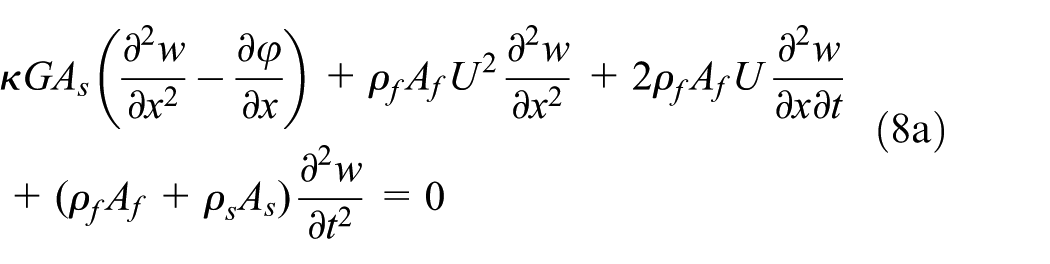
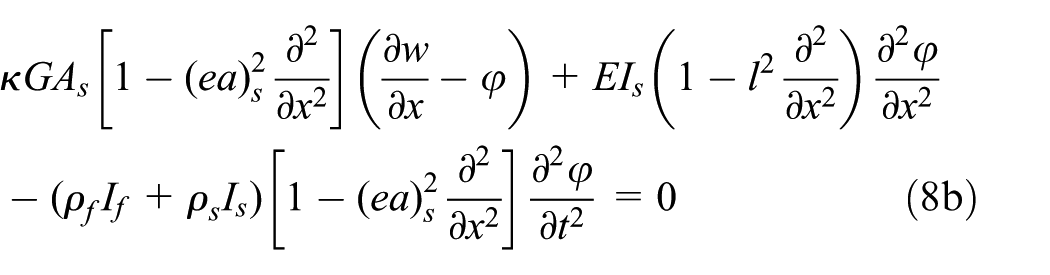
In equations (8a) and (8b), the small-scale effects of the CNT are measured by the nonlocal stress parameter
The slip boundary theory is one of the popular theories used to study the dynamic behaviors of micro- and nanofluids since in some researchers’ opinion, the fluid sliding effect leads to main influence at nano- and microscale.30–37 However, the slip boundary condition is not appropriate for liquids because the free path for a liquid molecule is too small to calculate. 2 Therefore, we apply nonlocal fluid theory to investigate small-scale effects induced by the microfluids in the channels. 22
According to the nonlocal fluid theory proposed by Eringen,
22
the shear stress

where h is the radius of the tube, P is the pressure gradient, and
Thus, the incompressible fluid flow in the tube shown in Figure 1 satisfies the equation of motion as

where μ is the fluid viscosity coefficient and C is the integration constant. The nonlocal effect could be neglected when

where

where

Equation (12) is further changed into

According to equations (12) and (14), the fluid shear stress

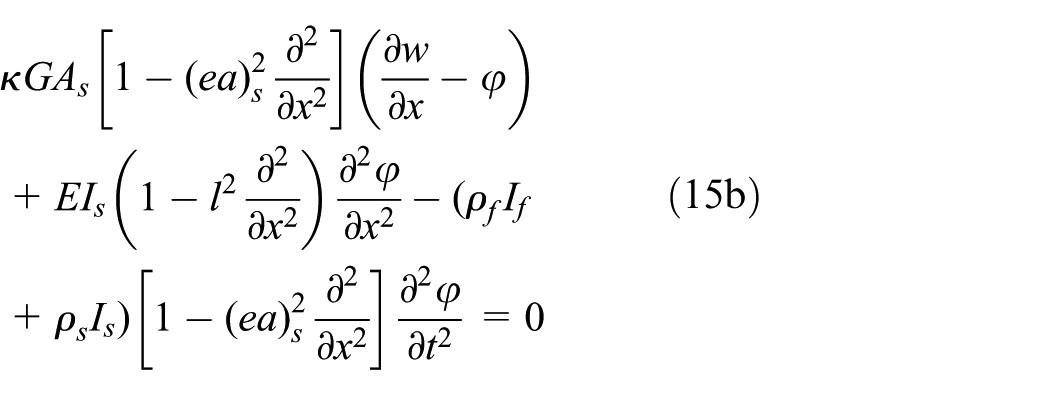
Equations (15a) and (15b) are the governing equations of free vibration and wave propagation for the fluid-conveying CNT when considering the scale effects contributed by both the tube and the fluid. To the author’s knowledge, equations (15a) and (15b) are the first governing equations for fluid-conveying CNT based on nonlocal fluid theory. Compared to our previous work based on slip boundary theory, the nonlocal fluid model will be more appropriate for nanoscale liquid.30,31 The solution of equations (15a) and (15b) is assumed as


where W is the amplitude of the wave,

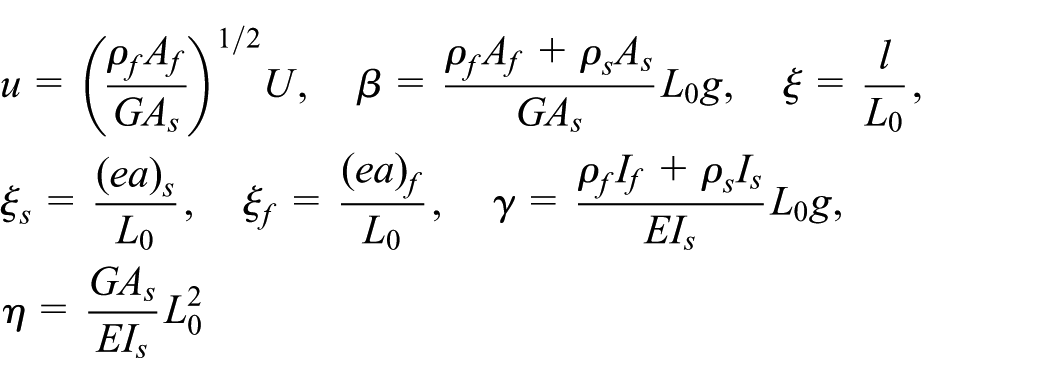
To simplify the numerical calculation, we employ the dimensionless form for all variables as
Then, equations (16a) and (16b) are changed into


where

and equation (17) is rewritten as

where



As we know, a condition for the existence of nontrivial solutions of equation (19) is that the determinant of the coefficient matrix vanishes, namely

Equation (21) is the fourth-order characteristic equation of Ω when the four different solutions correspond to the four modes of the wave. Furthermore, the solutions of equation (21) are complex values, that is, Ω = Re(Ω) + Im(Ω). The real part Re(Ω) and the imaginary part Im(Ω) stand for the promotion and damping effects for wave propagation, 43 respectively.
Results and discussions
Based on the solution of equation (21), the dynamic behaviors of the CNT can be analyzed, and the influence on angle frequency Ω contributed by small-scale effects can be investigated in detail. The mechanical and physical parameters are set as follows: 31 P = 1 × 10³ Pa·m−1; h = 0.34 × 10⁻⁹ m; μ = 1 × 10⁻³ Pa·s; L0 = 10 × 10−9m; E = 1.0 × 10¹² Pa; G = 0.4 × 10¹² Pa; κ = 1.1; Af = 6.36 × 10⁻¹⁹ m2; As = 1.49 × 10⁻¹⁹ m2; If = 3.22 × 10−38 m4; Is = 1.69 × 10−38 m4; ρf = 1.0 × 10³ kg·m−3; and ρs = 2.3 × 10³ kg·m−3.
Because of the difficult operation for the experiment, the reasonable methodologies for the verification of the numerical solution are an MD simulation and MCS. 44 However, there are few studies on fluid-conveying nanotubes based on MD and MCS due to the time-consuming computation and numerical instability. Liu et al. 44 investigated the wave propagation behaviors of fluid-conveying nanotubes by MCS and the interval analysis method (IAM). We now employ the dispersion relation proposed by Liu to verify the present nonlocal strain gradient models. The wave dimensional dispersion curves obtained by MCS, IAM, and a nonlocal strain gradient model were compared and indicated in Figure 2, where all physical and geometric parameters of fluid-filled nanotubes take the same values as the ones given in the study of Mohammad. 40
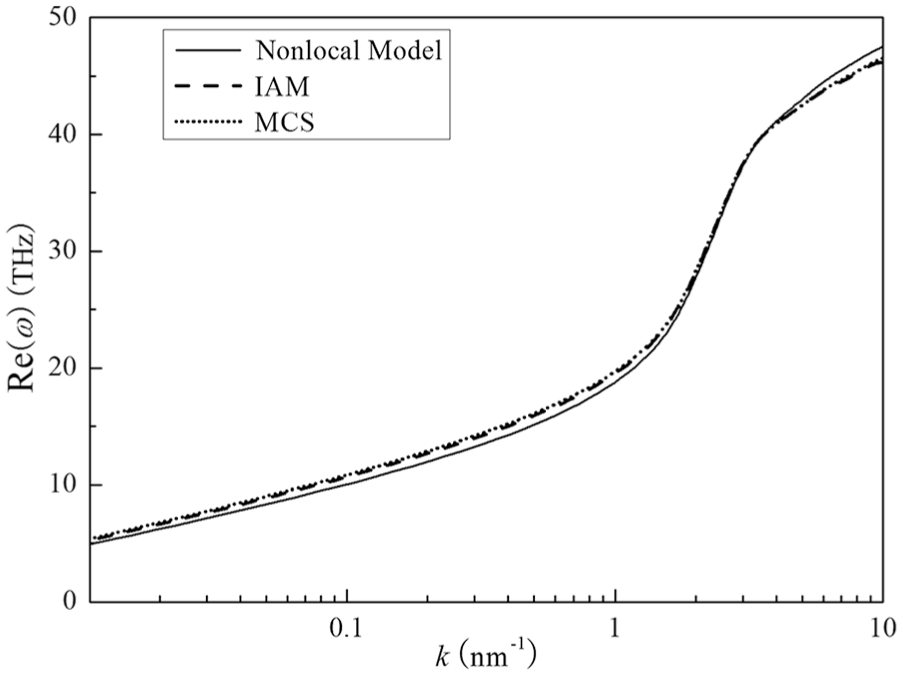
Dispersion relation by various approaches.
Figure 2 first illustrates the good agreement of the numerical results based on MCS and IAM as proposed by Liu et al. 44 However, the frequency based on IAM is slightly higher than the one by MCS according to Liu’s study, but the difference is very small. Thus, both MCS and IAM are reliable methods for the verification of other analytical models. 44 It is shown in Figure 1 that the frequency predicted by the nonlocal strain gradient model at low wave number is slightly lower than those predicted by MCS and IAM when the one at high wave number is larger than the MCS and IAM results. However, the dispersion curve obtained by the nonlocal strain gradient model indicates the same trend as the MCS and IAM results, and the difference between the frequency obtained by the nonlocal strain gradient model and the MCS is very small. Therefore, the nonlocal strain gradient models could provide accurate results and incur fewer computational costs for wave propagation analyses of fluid-conveying nanotubes. A similar result for a nanotube without fluid has been verified by comparison with MD and other models. 23 Here, the conclusions are further improved for a fluid-conveying nanotube.
How to determine the value of small-scale parameter is a tough and different problem for all constitutive models with scale effects, including nonlocal model, strain gradient model, and slip boundary condition model. In Figure 2, the numerical solution based on nonlocal model is obtained when ξf = ξs = 0.09 and ξ = 0.12 and meets well with MCS and IAM results. Thus, the reasonable values of all material length scale parameters are nearly 0.1 for our models in this case. However, the value of length scale parameters varies and difficult to confirm since the geometric and physical parameters of nanotube are changeable. Furthermore, these parameters take distinct values when we investigate different mechanical behaviors. According to the works of Yang and colleagues,18,45 the nonlocal parameters of nanotubes applied for wave propagation analysis are different with the one for buckling research. Therefore, validating the nonlocal numerical solutions by comparing with MD, MCS, or experiment results is the main approach to determine the value of small-scale parameters. 14 In order to rigorously analyze the scale effect in details, we take the value of ξs, and ξ between 0 and 3.5, and ξf between 0 and 10 in this article.
Figure 3 shows the dispersion relation for the first mode of Re(Ω) versus wave number K with different ξs when ξf = ξ = 0.1 and u = 10−3. It can be seen that the frequency keeps increasing when the wave number becomes larger. The frequency also increases when ξs decreases from 0.2 to 0.05, which means the nonlocal stress effects of the microchannel lead to wave damping and a decrease in stiffness. Similar conclusion has been confirmed for nanotubes without fluid.19,23

Real part of angular frequency Re(Ω) via ξs and wave number K.
Figure 4 presents the dispersion relation for the first mode of Re(Ω) versus wave number K with different ξ when ξf = ξs = 0.1 and u = 10−3. Similar to Figure 3, the frequency also keeps increasing when the wave number K becomes higher. However, contrary results can be seen here where the frequency increases when ξ changes from 0.05 to 0.2, since the strain gradient effect leads to wave promotion and an enhancement of stiffness. Though the stress nonlocality and strain gradient are both caused by small-scale effects, they lead to an opposite influence on the stiffness of the nanotube.
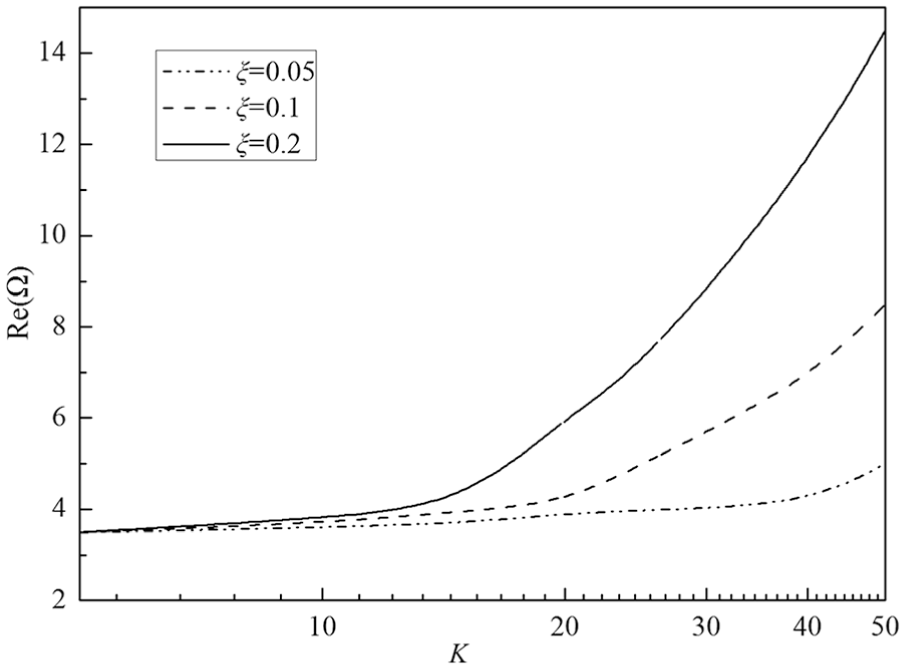
Real part of angular frequency Re(Ω) via ξ and wave number K.
To further confirm the nonlocal stress effect on wave propagation behaviors, the relation for the four modes of Re(Ω) and Im(Ω) versus ξs is illustrated in Figure 5(a) and (b), respectively, when K = 10, u = 10−3, and ξf = ξ = 0.05. It is seen in Figure 5(a) that the real parts Re(Ω) for modes 1 and 2 are opposite numbers with the same absolute value, which decrease with increasing ξs. Thus, the wave damping caused by the nonlocal effect is further confirmed. Furthermore, the influence of the nonlocal effect on Re(Ω) for modes 3 and 4 cannot be illustrated in Figure 5(a), since Re(Ω) remains zero here. However, the wave damping effects of modes 3 and 4 caused by stress nonlocality are confirmed in Figure 5(b) since the imaginary part Im(Ω) for modes 3 and 4 becomes higher when ξs increased here, which means the damping effect of the wave is enhanced when the nonlocal effect becomes powerful.

Frequency Ω via ξs with different modes: (a) Re(Ω) via ξs and (b) Im(Ω) via ξs.
Figure 6(a) and (b) depicts Re(Ω) and Im(Ω) as a function of dimensionless strain gradient parameter ξ when K = 10, ξf = ξs = 0.05, and u = 10−3. Figure 6(a) shows that the Re(Ω) of modes 1 and 2 keeps increasing when ξ becomes higher, and the value of modes 3 and 4 remains zero. In Figure 6(b), Im(Ω) for modes 3 and 4 keeps decreasing with increasing ξ. All information in Figure 6(a) and (b) confirm the wave promotion and stiffness enhancement induced by strain gradient effects. This result is contrary to the nonlocal stress effects illustrated in Figure 5(a). Therefore, the conclusion that the nonlocal stress and strain gradient lead to an opposite influence on wave propagation behavior and stiffness of the nanotube is further confirmed.
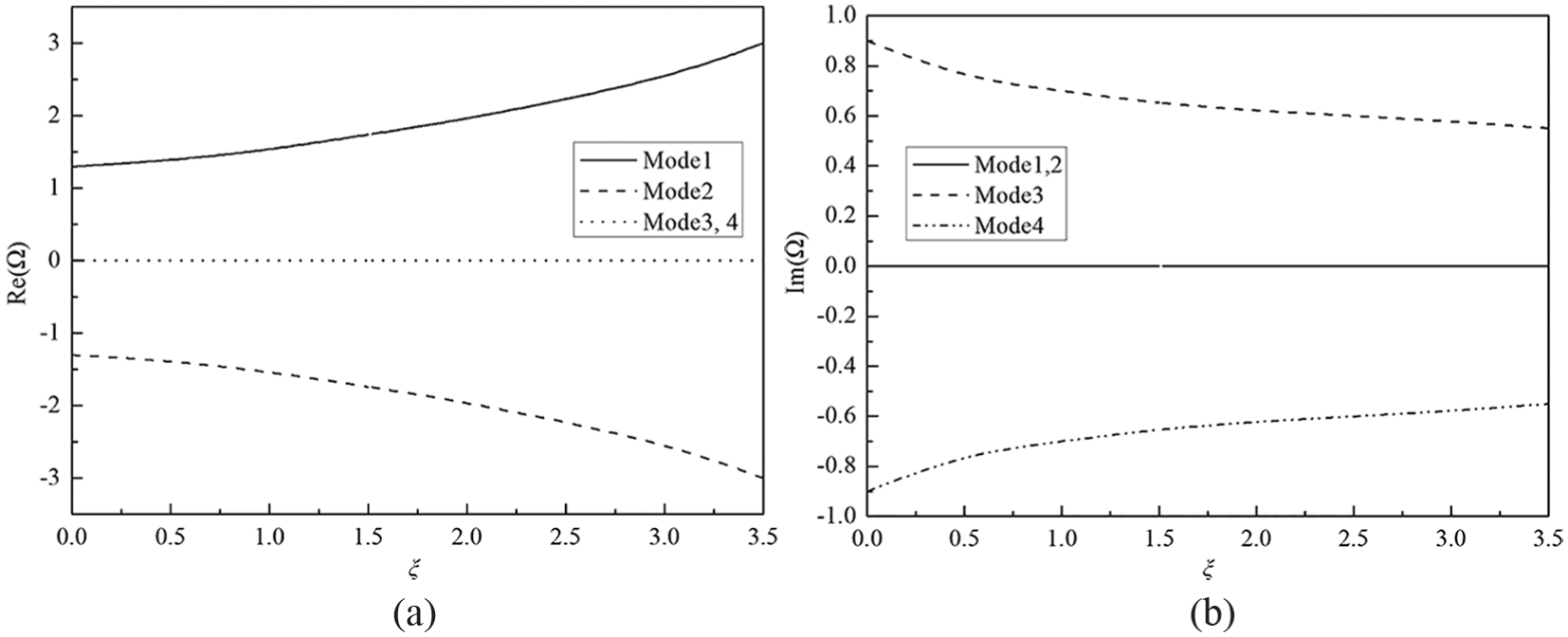
Frequency Ω via ξ with different modes: (a) Re(Ω) via ξ and (b) Im(Ω) via ξ.
In addition to the nonlocal stress and strain gradient effects of the nanotube, the small-scale effect of fluid flow also influences the dynamic behaviors of the system. Figure 7(a) and (b) presents the relation of Re(Ω) and Im(Ω) with dimensionless flow velocity u when K = 10 and ξs = ξ = ξf = 0.05. The real part Re(Ω) for modes 1 and 2 remains constant in Figure 7(a), which means the low-mode wave is not influenced by the fluid flow. However, the absolute value of Re(Ω) for modes 3 and 4 keeps increasing when u becomes higher in Figure 7(a). Meanwhile, Im(Ω) for modes 3 and 4 also has an increasing absolute value when u is enhanced, as shown in Figure 7(b). Therefore, the fluid flow induces both promotion and damping effects for the high-mode wave, and the final results depend on the superposition of the two effects.

Frequency Ω via u with different modes: (a) Re(Ω) via u and (b) Im(Ω) via u.
Figure 8(a) and (b) illustrates that Re(Ω) and Im(Ω) vary with nonlocal fluid parameter ξf when ξs = ξ = 0.05 and u = 10−3. Since the fluid flow contributes no influence on the waves of modes 1 and 2, Re(Ω) of the two modes also remains constant in Figure 8(a). However, the nonlocal effect leads to damping for the waves of modes 3 and 4 when the corresponding absolute value of Re(Ω) decreases with increasing ξf in Figure 8(a). Similar results are obtained when the imaginary part Im(Ω) of the high-mode wave in Figure 8(b) becomes higher when ξf increases. Therefore, the nonlocal effects of the nanotube and fluid flow both cause wave damping and dynamic decay for the system.

Frequency Ω via ξf with different modes: (a) Re(Ω) via ξf and (b) Im(Ω) via
Conclusion
In this article, a new analytical Timoshenko beam model for wave propagation in a fluid-filled nanotube is developed based on nonlocal strain gradient theory. The small-scale effects induced by the nanotube and the inner fluid flow are simulated by nonlocal strain gradient effect and nonlocal fluid effect, respectively. The governing equation of motion for the tube is derived when the nonlocal stress parameter, strain gradient parameter, and nonlocal fluid parameter are employed to quantifiably measure for the scale effects caused by nanotube and inner fluid, respectively.
By comparing with similar results obtained by an MCS and IAM, this numerical model is confirmed to be reasonable and reliable. The analytical solution of the governing equation shows that the real part of angle frequency Re(Ω) increases when both the nonlocal stress parameter and the nonlocal fluid parameter become larger and decreases when strain gradient parameter keeps increasing. However, the imaginary part of angle frequency Im(Ω) indicates contrary results, especially for the high-mode wave. Thus, it is confirmed that the nonlocal effects contributed by the nanotube and fluid flow both lead to wave damping and a decrease in stiffness of nanotube. In contrast, the strain gradient effect causes wave propagation promotion and an enhancement of stiffness for the nanotube.
Footnotes
Acknowledgements
The authors thank the Research Group for their support in multi-field coupling theory at Kunming University of Science and Technology.
Handling Editor: Mohammad Arefi
Declaration of conflicting interests
The author(s) declared no potential conflicts of interest with respect to the research, authorship, and/or publication of this article.
Funding
The author(s) disclosed receipt of the following financial support for the research, authorship, and/or publication of this article: This project was supported by the National Natural Science Foundation of China (Grant no. 11462010).
