




Abstract
A new hybrid conjugate gradient method is proposed in this article based on the gradient operator and applied to the structural dynamic load identification problem. It has proved that the present method with the strong Wolfe line search possesses sufficient descent property. In addition, the present method is globally convergent when the parameter in the strong Wolfe line search conditions is restricted in some suitable intervals. Three example problems from engineering are solved by the newly developed conjugate gradient method to demonstrate the robustness and effectiveness of conjugate gradient method in solving multi-source dynamic load identification problems. Compared with the traditional Landweber iteration regularization method (Landweber), the proposed conjugate gradient method can more stably and effectively overcome the influences of noise, largely reduce the number of iterations, and provide accurate results in identifying multi-source dynamic force in practical engineering structure.
Keywords
Introduction
Nowadays many experts have been involved in different kinds of load identification problems.1–15 With the rapid development of computer technology, it becomes realistic to realize more complex design requirements in modern industry and national defense, which often requires accurate dynamic external loads. However, it is difficult or even impossible to directly measure dynamic loads, such as wind loads acting on a tall building and ice loads acting on offshore platform, because of the limitation of technical or economical condition and costs. Therefore, we should develop the theory of load identification. As an important branch of inverse problems, the usual method is to determine the unknown force acting on the practical engineering structure by measuring the features of the system, such as the dynamic responses of structure, velocity, acceleration, and strain.
The load identification technique which is an important indirect method for obtaining dynamic loads usually solves inverse problems about load identification exploiting the dynamic characteristics of system and the measured responses of structure. Over the years, many researchers have made great achievements in the dynamic load identification methods.16–25 Lifschitz and D’Attellis 26 proposed a computational inverse technology based on wavelets and applied it to a pulsed plasma thruster. Liu and Shepard 27 used enhanced least-squares and total least-squares schemes to calculate the dynamic forces in the frequency domain. B Zhang et al. 28 presented a practical method to solve the load reconstruction for advanced grid-stiffened composited plates. Hou et al. 29 and Zhang and Gao 30 predicted the statistics of moving forces on a bridge structure using an inverse pseudo excitation method that they proposed. Zhou et al. 31 proposed a new method to analyze the grinding damage induced stress (GDIS) distribution in silicon wafers, and the results show that the stress is independent of direction. Gursoy and Niebur 32 exploited a statistical signal-processing technique which is known as independent component analysis for harmonic load identification and estimation. Yan and Zhou 33 presented a new computational inverse method that is based on a genetic algorithm to realize the impact load identification, and this method can stably identify the impact location and reconstruct the impact force history simultaneously. Mitra and Gopalakrishnan 34 developed a new wavelet-based spectral finite element method and used it to study the propagation of longitudinal and bending waves in rods, beams, and frame structures. Granger and Perotin 35 presented an inverse method for estimating a distributed random excitation from the measurement of the structural response at a number of discrete points and made a presentation of the theoretical development. Pezerat and Guyader 36 proposed a force analysis technique which is based on the computation of the force distribution and dealt with the identification of stationary force distributions. Law et al. 37 proposed a modified iteration scheme and applied it to identify the wind load over the full height of the structure from the structural displacement or strain responses, and only two displacement or strain responses in two orthogonal directions at a reference level are needed to obtain accurate results.
In fact, these inverse problems about load identification mentioned by the references above are generally identified as ill-posed. It means that we cannot directly reconstruct the unknown loads which act on the practical engineering structure. Therefore, from the point of mathematical theory, it is necessary to develop some indirect computational inversion techniques to deal with these usually seriously ill-posed inverse problems.4–7,38,39 Furthermore, any direct numerical treatment of ill-posed problems will generate useless solutions and it will lead to large deviations from exact solutions of the large-scale inverse problems.40,41 Up to now, lots of experts and scholars have developed many regularization methods to deal with this ill-posedness.42–46 In addition, Hager and Zhang
47
proposed a new nonlinear conjugate gradient method based on an inexact line search. Because of the simplicity and low memory requirement, conjugate gradient methods are widely used to solve large-scale optimization problems. In the past decades, a variety of conjugate gradient methods were developed. There are some well-known conjugate gradient methods, such as Fletcher–Reeves (FR) method,
48
Hestenes–Stiefel (HS) method,
49
Polak–Ribiere–Polyak (PRP) method,50,51 and Dai–Yuan (DY) method.
52
Yao and Ning
53
proposed a three-term conjugate gradient method based on self-scaling memoryless Broyden–Fletcher–Goldfarb–Shanno (BFGS) matrix. Fatemi
54
proposed a new efficient conjugate gradient method combining the good features of the linear conjugate gradient method and some penalty parameters. However, the application of these new developed conjugate gradient methods was only limited to solve the pure mathematical numerical examples without application to practical engineering problems, and it should be improved to exclude jamming of noises in engineering. Moreover, at present, there is little research on some regularization methods in engineering. Also, we usually prefer to exploit iterative regularization methods to deal with large-scale inverse problems. More importantly, Neubauer studied that Landweber iteration regularization method is a stable and effective method in solving large disturbed ill-posed problems. However, the convergence rate of its corresponding regularized solution is very low.
55
In addition, in our previous work,
56
the proposed method is based on a new gradient operator which is given by
The article is organized as follows. In the next section, we construct a new hybrid conjugate gradient method and give our specific algorithm. In section “The convergent analysis of the proposed method,” the sufficient descent property of the proposed method is also investigated under strong Wolfe line search conditions, and its global convergence is provided. In section “Numerical examples and discussion,” numerical examples are performed to disclose the problems and verify the theoretical results which are presented in sections “The establishment of a new hybrid conjugate gradient algorithm” and “The convergent analysis of the proposed method.” Some concluding remarks are made in section “Conclusion.”
The establishment of a new hybrid conjugate gradient algorithm
First, the following unconstrained optimization problem is considered in this section

where

where

where
We will propose a new formula as follows
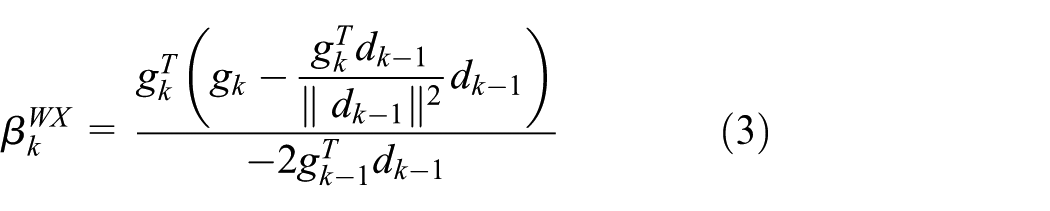
The corresponding algorithm is defined as follows.

The convergent analysis of the proposed method
Lemma 3.1
Suppose the sequence
Proof
Suppose

It is easy to check
Assuming
Notice

It is not difficult to check

Thus, we complete the proof of Lemma 3.1.
Lemma 3.2
If

Proof
Let
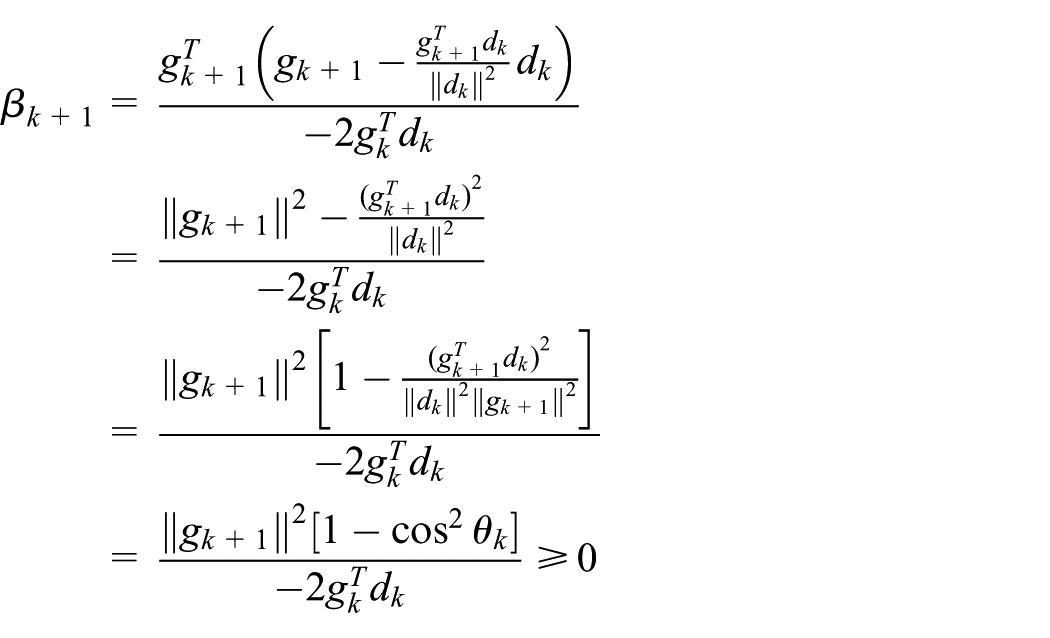
According to

Then

Since
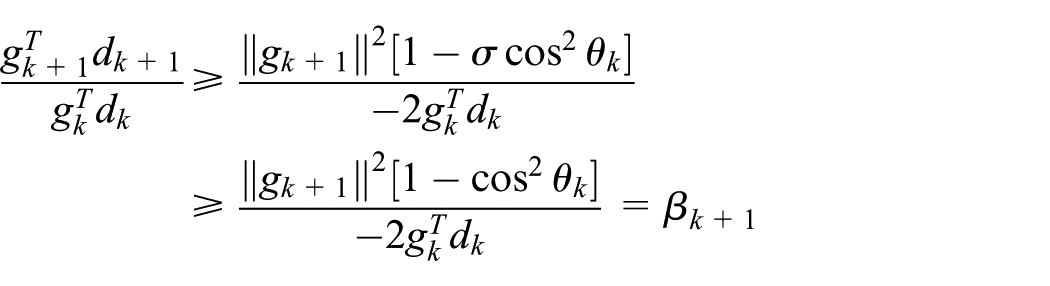
Then, we complete the proof of Lemma 3.2.
In the following part, we will prove the convergence of the proposed method. First, we need to make some assumptions:
H1. f is continuously differentiable in a neighborhood N of the level set
H2. The gradient
According to the two hypotheses mentioned above, we can get the following lemma at once. 58
Lemma 3.3
Let

By Lemma 3.3, we get the convergence theorem of this method immediately.
Theorem 3.4
Suppose

The proof is very obvious and similar to the developed methods used in Tikhonov et al., 44 Hestenes and Stiefel, 49 and Dai and Yuan 52 and we omit it here.
Numerical examples and discussion
In order to prove the stability and effectiveness of conjugate gradient methods proposed in this article, three engineering examples are provided next. Dynamic load need to be expressed as a superposition of the unit pulse signal in time domain. We discretize the dynamic load as a series of unit pulse load superposition under the conditions of linearity and time-invariant suppositions of dynamic load identification problems. Considering that the response is caused by unit impulse load system, we can compute the corresponding response. Then, the response at an arbitrary receiving point in a structure can be expressed as a convolution integral of the forcing time history and the corresponding Green’s kernel in time domain59–61

where
By discretizing this convolution integral, the whole concerned time period is separated into equally spaced intervals, and equation (9) is transformed into the following system of algebraic equation

or equivalently

In order to reconstruct
For the purpose of verifying the proposed method, three numerical examples are investigated. A stiffened plate problem is first provided to illustrate how to identify dynamic load by the Landweber iteration regularization method, and its identified results are compared with MCG. Then, the proposed method is applied to a composite laminated cylindrical shell structure and a 3 degree-of-freedom mass-spring system. In these three examples, we directly add the noise to the computer-generated response in order to simulate the noise-contaminated measurement, and the corresponding noisy response is obtained as follows

in which
In addition, in order to evaluate the approximation of the identified results, the relative estimation error and the average error are defined as


where
A stiffened plate problem
A stiffened plate problem which is shown in Figure 1 is studied and discussed. The properties of the material used are listed as follows:

Herein,

The finite element model of stiffened plate.

The vertical concentrated random load acting on the outside surface.
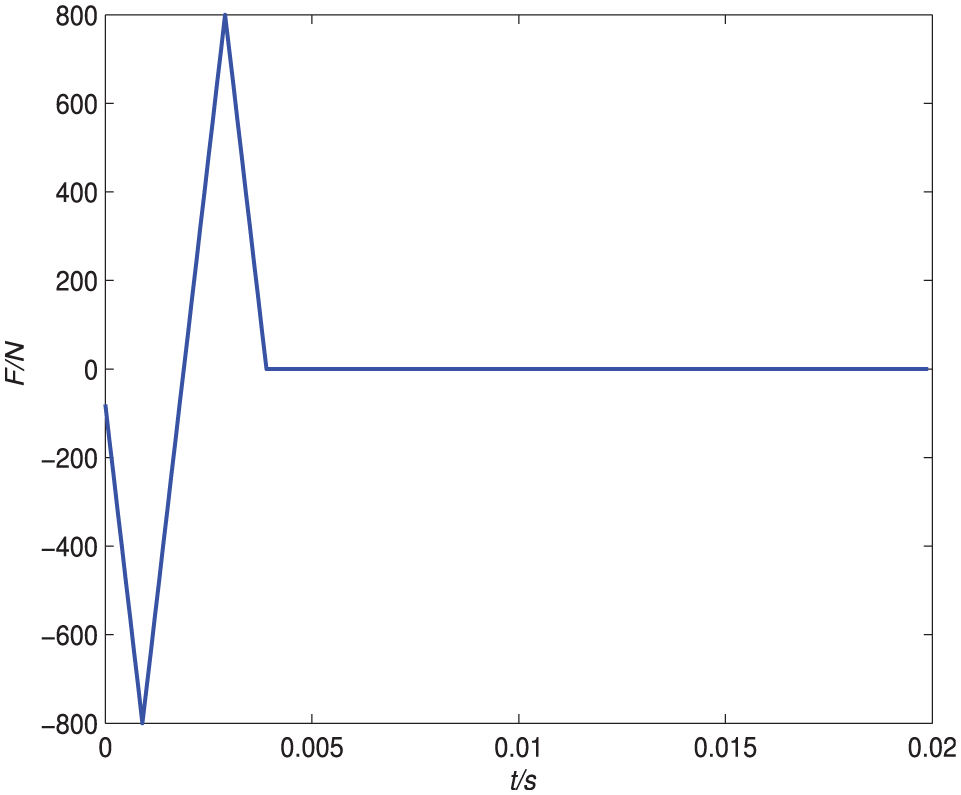
The vertical concentrated triangle load acting on the outside surface.

The corresponding vertical displacement response at one point.

The corresponding vertical displacement response at the other point.
We consider the performances of two regularization methods in two cases with noise levels of 5% and 15%, respectively, which are traditionally considered.5,16,18 Using the relative estimation error equation, we compare the performances of Landweber iterative regularization method with the MCG method according to equations (12) and (13). In addition, we only need to select five time points and compare the recognized force of each point with the corresponding actual load.
5% noise level
Numerical results are given as follows. As can be seen from Figures 6–9, Landweber iterative regularization method and MCG can accurately identify the multi-source dynamic loads stably. In addition, in Figures 10 and 11, we can see that MCG is better than Landweber iterative regularization method. The performances of two regularization methods in the relative deviations of identified dynamic load are shown in Figures 12 and 13. These performances show that the deviation of Landweber iterative regularization method is greater than that of MCG method, so MCG method is superior to Landweber iterative regularization method. This shows the advantage of the proposed method in this article.

The identified random force by Landweber at noise level 5%.

The identified triangle force by Landweber at noise level 5%.
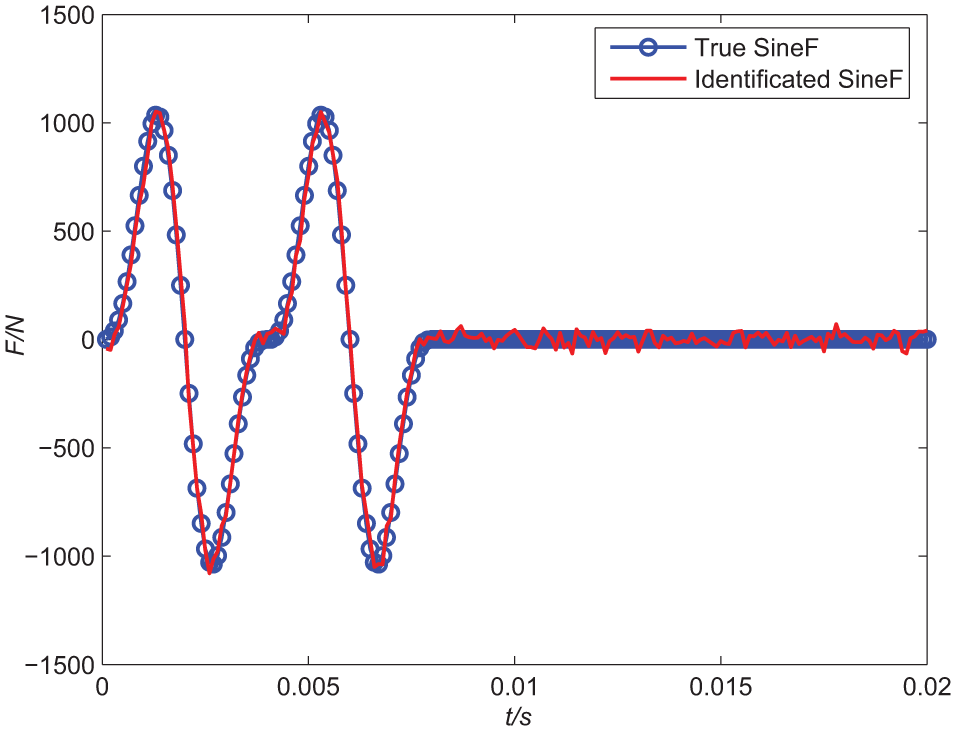
The identified random force by MCG at noise level 5%.

The identified triangle force by MCG at noise level 5%.

The identified random force by Landweber and MCG at noise level 5%; the number of iterations:

The identified triangle force by Landweber and MCG at noise level 5%; the number of iterations:

The relative deviations for the identified random force by Landweber and MCG at noise level 5%.

The relative deviations for the identified triangle force by Landweber and MCG at noise level 5%.
Moreover, the more detailed results at five time points are listed in Table 1. This table shows that the Landweber iterative regularization method has greater deviations than the proposed method in identifying loads at these five time points under the noise level (±5%), which mainly reflects the superiority of the proposed method in reconstructing expected dynamic loads. This shows that the deviation between the proposed method and the Landweber iterative regularization method is mainly between 9.69% and 15.17%, respectively. In addition, this present method is superior to the Landweber iterative regularization method in the random force identification. The latter has the corresponding maximum deviation of 13.80% and average deviation of 3.86%. The maximum deviation of MCG is 8.10%, and the average deviation is 2.34%. The maximum deviation and average deviation of MCG are obviously smaller than those of Landweber iterative regularization method. The results validate that this proposed method has better performances than the traditional Landweber iterative regularization method in triangle force identification, and the maximum and average deviations for the present method are 9.69% and 2.57%, respectively, which are smaller than the traditional Landweber iterative regularization method. In addition, the Landweber iterative regularization method has 420 iterations, which is more than the MCG method with 40 iterations. In a word, the present method is better than Landweber iterative regularization method in dynamic load identification.
The identified force at five time points at noise level 5% for stiffened plate.

15% noise level
Similar to the analysis above, we can obtain the following assertions.
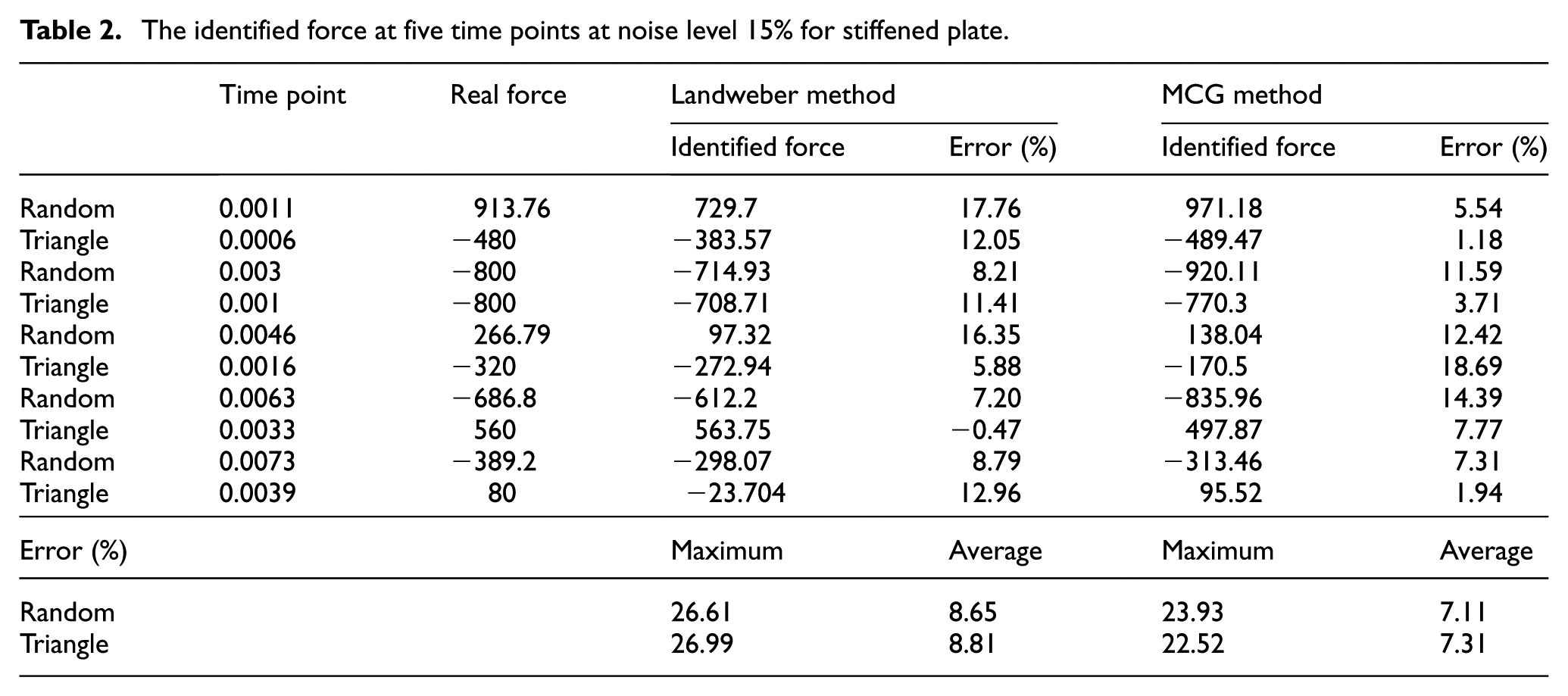
It follows from Figures 14–17 that two regularization methods mentioned above can obtain both stable and effective identified results. Actually, the proposed method deals with this problem better than Landweber iteration regularization method, which can be shown in Figures 18 and 19. Figures 20 and 21 display the capability of the proposed method and Landweber iterative regularization method in the aspect of the relative deviation of identifying dynamic loads. From these figures, we can see that most deviations of Landweber iteration regularization method are bigger than MCG method. In addition, Table 2 displays more detailed computational results of two regularization methods mentioned above at five time points. From this table, we can find that most deviations of MCG are smaller than Landweber iteration regularization method. Also, most deviations of Landweber iteration regularization method and MCG are mainly in the range of
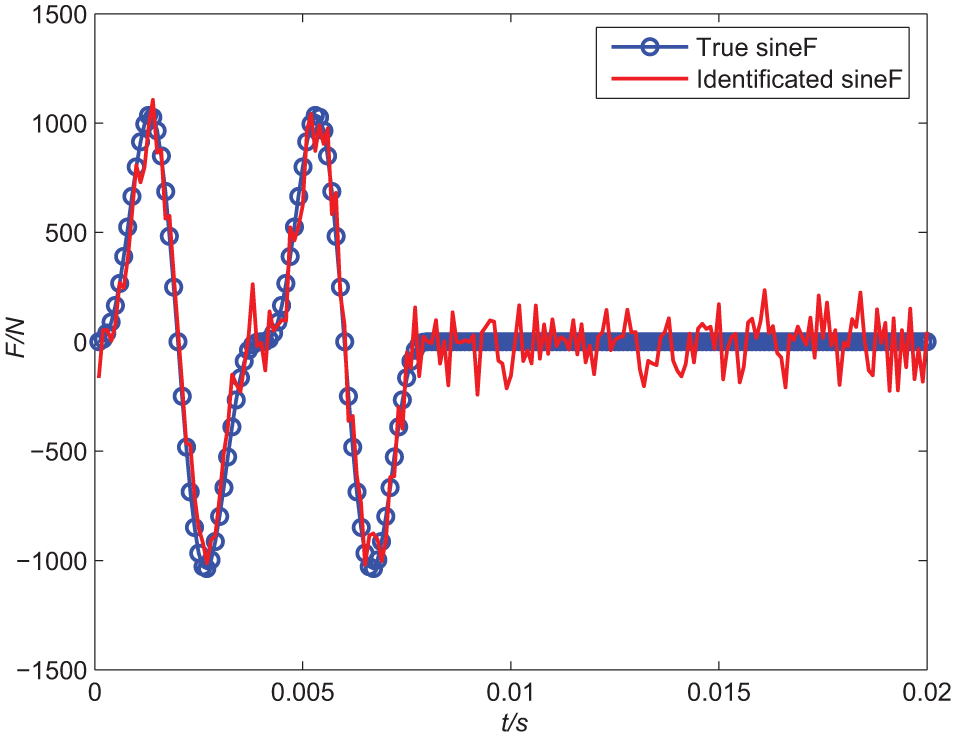
The identified random force by Landweber at noise level 15%.
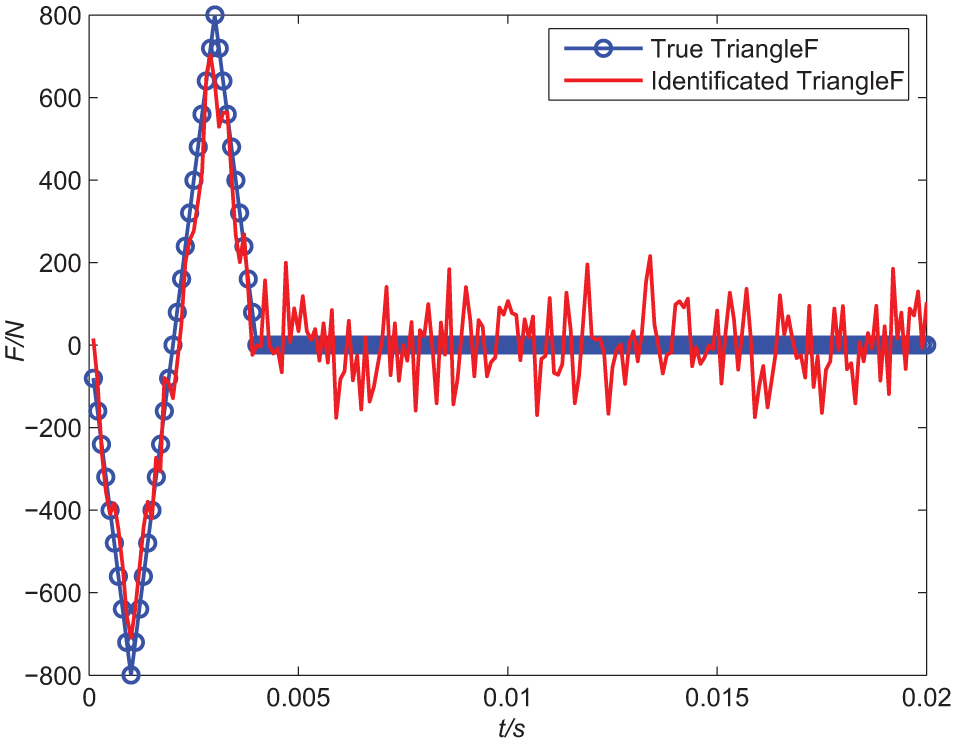
The identified triangle force by Landweber at noise level 15%.

The identified random force by MCG at noise level 15%.

The identified triangle force by MCG at noise level 15%.
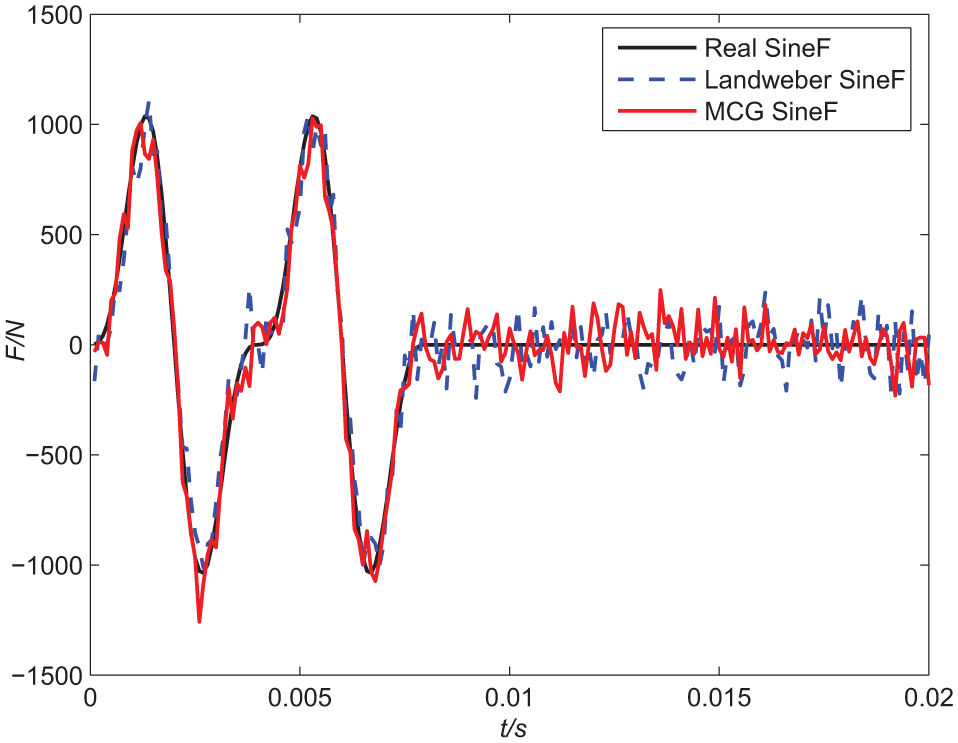
The identified random force by Landweber and MCG at noise level 15%; the number of iterations:

The identified triangle force by Landweber and MCG at noise level 15%; the number of iterations:

The relative deviations for the identified random force by Landweber and MCG at noise level 15%.

The relative deviations for the identified triangle force by Landweber and MCG at noise level 15%.
The identified force at five time points at noise level 15% for stiffened plate.
A composite laminated cylindrical shell problem
In order to further verify the stability and effectiveness of the proposed method in identifying the radial forces of composite laminated cylindrical shells, a problem of composite laminated cylindrical shells as shown in Figure 22 is also presented. 5 Its material properties of carbon/epoxy and glass/epoxy given are shown in Table 3.

The FEM model of composite laminated cylindrical shell.
The material properties of composite laminated cylindrical shell.

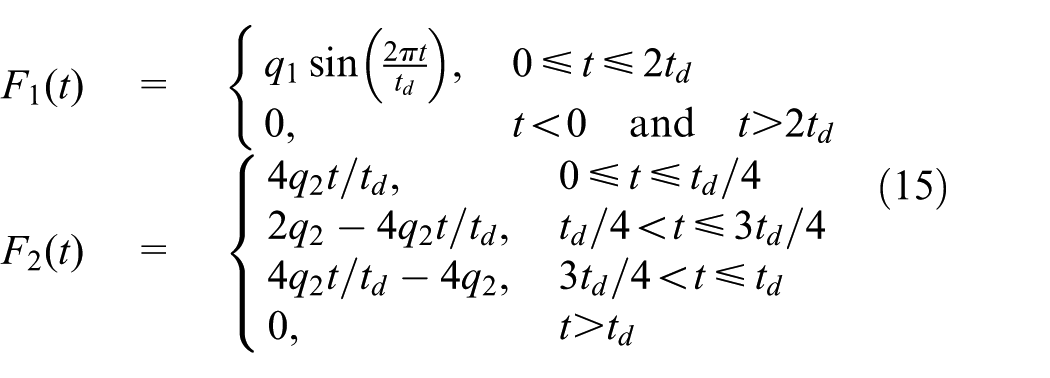
Similarly, the radial concentrated load acts on the outer surface. We measured the displacement response along the radial direction. One end of the shell structure is free, and the other end is fixed. In this way, the corresponding finite element model is established, as shown in Figure 22. The arrow in Figure 22 represents the action point of the dynamic load. The concentrated loads are defined as follows
Herein, we choose

The radial concentrated sine load acting on the outside surface.

The radial concentrated triangle load acting on the outside surface.

The corresponding radial displacement response at one point.
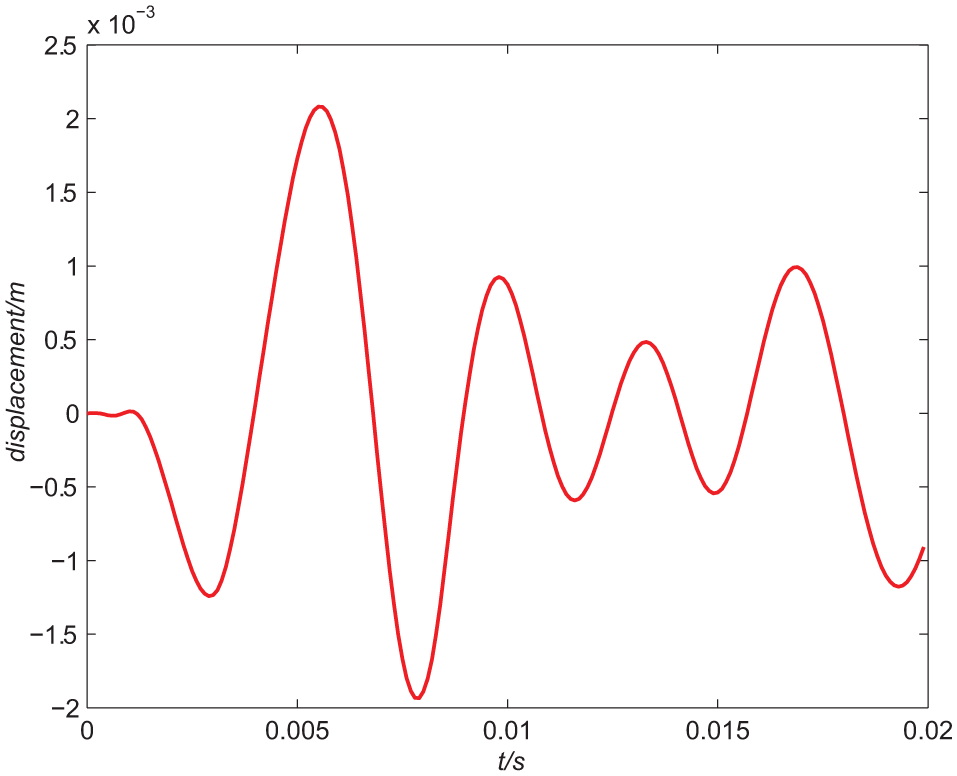
The corresponding radial displacement response at the other point.
In order to evaluate the performances of the proposed method and Landweber regularization method, 5% and 15% noise level are investigated, respectively. We will compare their performances by the relative estimation error equation (12) and the average error equation (13). In addition, we only need to select five time points, at which the identified loads will be compared by the actual loads.
5% noise level
Numerical results are provided as follows. It can be found from Figures 27–30 that Landweber iteration regularization method and MCG method can accurately realize the identification of multi-source dynamic load. Moreover, it can be shown in Figures 31 and 32 that the present method does better than the Landweber iteration regularization method. The relative deviations for identified loads by two regularization methods above are shown in Figures 33 and 34. Figures 33 and 34 show the performances of MCG and Landweber iteration regularization method in the aspect of relative deviations of the identified loads. They illustrate that most deviations of Landweber iteration regularization method are larger than MCG. This also validates the effectiveness of the proposed method.

The identified sine force by Landweber at noise level 5%.
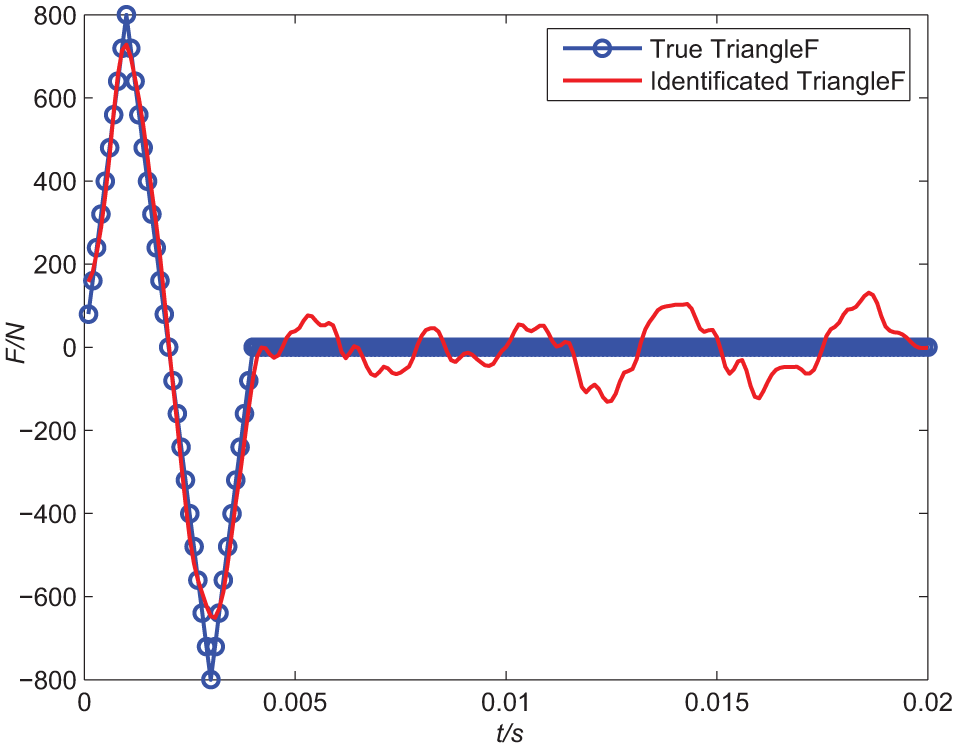
The identified triangle force by Landweber at noise level 5%.

The identified sine force by MCG at noise level 5%.

The identified triangle force by MCG at noise level 5%.

The identified sine force by Landweber and MCG at noise level 5%; the number of iterations:

The identified triangle force by Landweber and MCG at noise level 5%; the number of iterations:

The relative deviations for the identified sine force by Landweber and MCG at noise level 5%.

The relative deviations for the identified triangle force by Landweber and MCG at noise level 5%.
Moreover, more detailed results at these five time points are enumerated in Table 4. From this table, we can see that most of the deviations of the Landweber iterative regularization method in identifying loads at these five time points are larger than those of the proposed method at noise level (±5%), which mainly reflects the superiority of the proposed method in reconstructing the expected dynamic loads. The deviation between the proposed method in this article and the Landweber iterative regularization method is mainly between 15.86% and 19.10%, respectively. Moreover, in identifying the sine force, the present method in this article is better than the latter, and the latter’s maximum deviation and average deviation are 15.63% and 5.08%, respectively. The maximal deviation and average deviation of MCG are
The identified force at five time points at noise level 5% for composite laminated cylindrical shell.

15% noise level
Likewise, the following assertions are provided: it follows from Figures 35–38 that MCG and the Landweber iteration regularization method can obtain both stable and effective identified results. Actually, the proposed method deals with this problem better than Landweber iteration regularization method, which can be shown in Figures 39 and 40. Figures 41 and 42 show the performances of relative deviations of the present method and Landweber iteration regularization method in identifying dynamic loads. From these figures, we can find that most of the deviations of Landweber iterative regularization method are larger than those of the proposed method, and the superiority of the present method is illustrated at the same time. Moreover, Table 5 displays more detailed computational results of two regularization methods mentioned above at five time points. From this table, we can find that most deviations of the present method at these five time points are smaller than Landweber iteration regularization method. Also, most deviations of Landweber iteration regularization method and MCG are mainly in the range of

The identified sine force by Landweber at noise level 15%.

The identified triangle force by Landweber at noise level 15%.

The identified sine force by MCG at noise level 15%.

The identified triangle force by MCG at noise level 15%.

The identified sine force by Landweber and MCG at noise level 15%; the number of iterations:
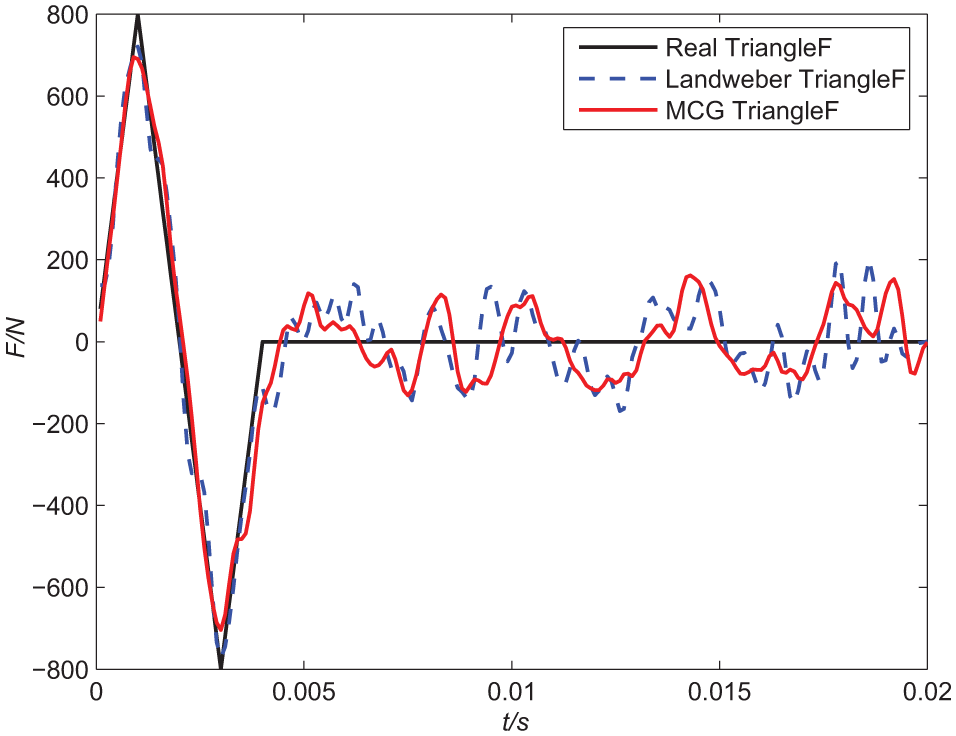
The identified triangle force by Landweber and MCG at noise level 15%; the number of iterations:

The relative deviations for the identified sine force by Landweber and MCG at noise level 15%.

The relative deviations for the identified triangle force by Landweber and MCG at noise level 15%.
The identified force at five time points at noise level 15% for composite laminated cylindrical shell.
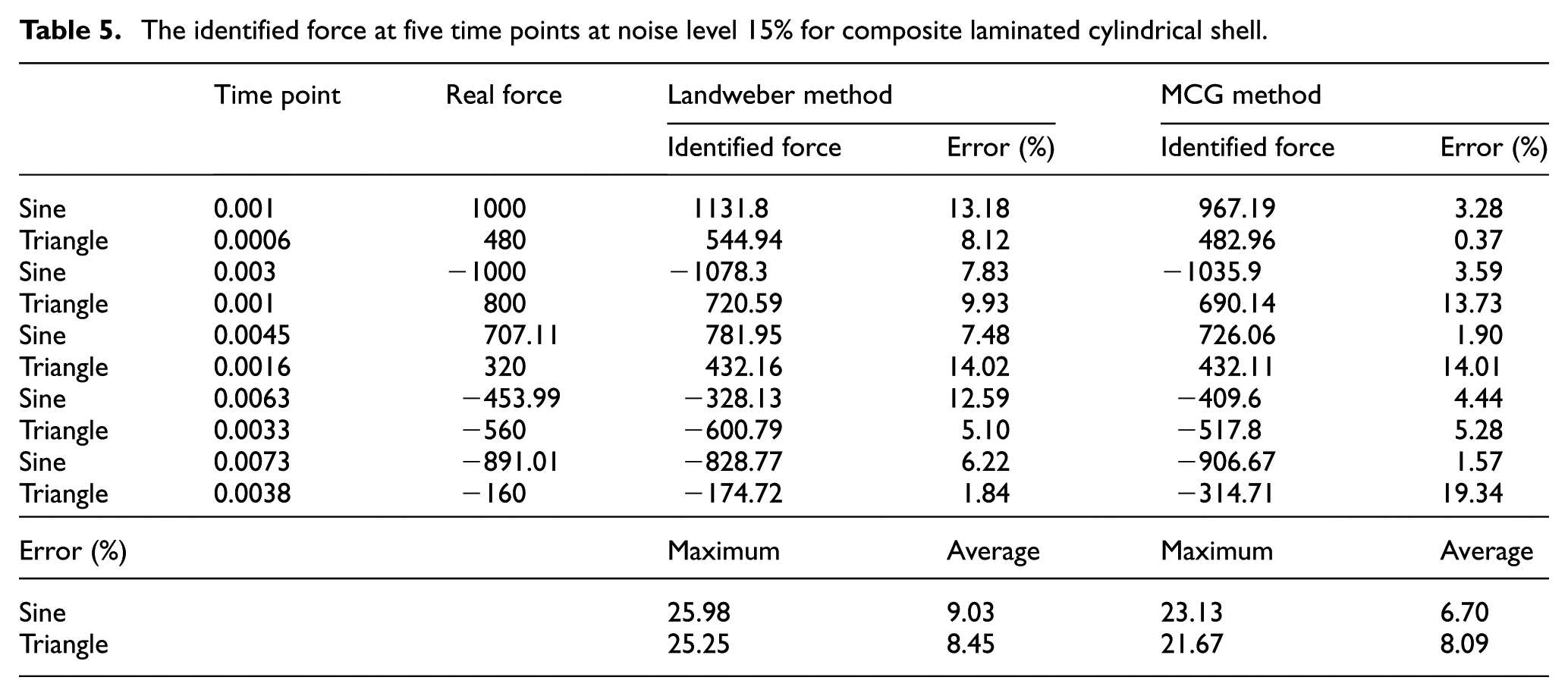
It also follows that the maximal deviation and average deviation of our present method in identifying triangle force are
A 3 degree-of-freedom mass-spring system
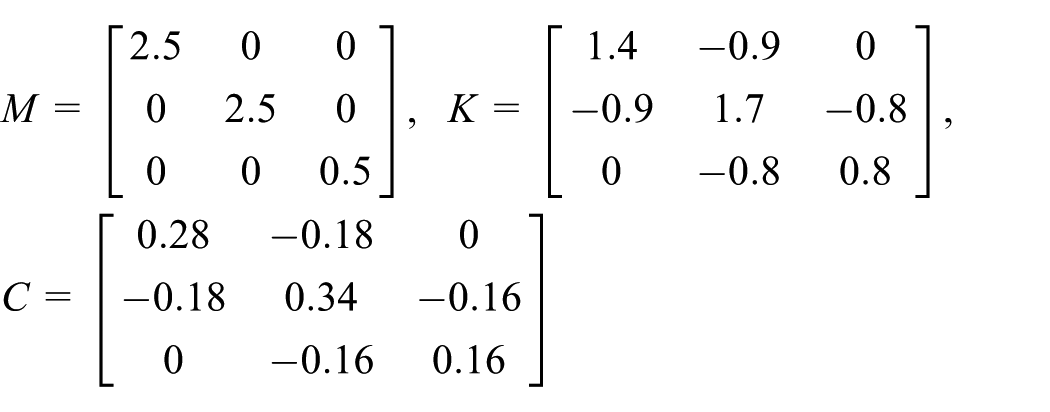
The numerical model consists of a 3 degree-of-freedom mass-spring system. The values used for M, C, and K are
In order to demonstrate the effectiveness of the present method, the simulated exact concentrated loads as formula (15) are used in the simulation study. A direct integration technique, such as the precise integration method, is applied to generate simulated displacement responses. In the same way, we add 5% noise level to the computer-generated response to simulate the noise-contaminated measurement. Then, as shown in Figures 43 and 44, we calculate the corresponding noisy response through equation (11).

The corresponding displacement response at one point.

The corresponding displacement response at the other point.
In order to evaluate the performances of the proposed method and Landweber regularization method, 5% noise level is investigated. Their performances are compared by the relative estimation error (12) and the mean error (13). In addition, we only need to select five time points, at which the identified loads will be compared by the actual loads.
It can be found from Figures 45–48 that Landweber iteration regularization method and the proposed method can both accurately realize stable identification of multi-source dynamic load. Moreover, the performances of the present method are better than those of the Landweber iteration regularization method, and This can be seen clearly in Figures 49 and 50. The relative deviations of the identified loads by two regularization methods above are shown in Figures 51 and 52. Figures 51 and 52 show the performances of MCG and Landweber iteration regularization method in the aspect of relative deviations of the identified loads. They illustrate that most deviations of Landweber iteration regularization method are larger than MCG. This also validates the effectiveness of the proposed method.

The identified sine force by Landweber at noise level 5%.

The identified triangle force by Landweber at noise level 5%.

The identified sine force by MCG at noise level 5%.

The identified triangle force by MCG at noise level 5%.
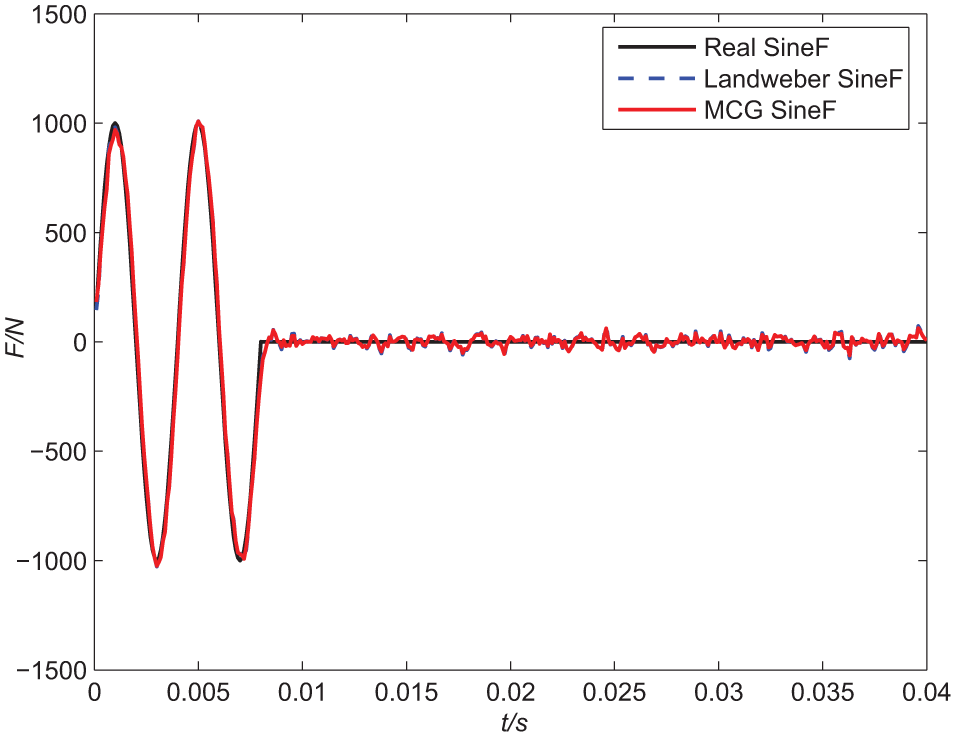
The identified sine force by Landweber and MCG at noise level 5%; the number of iterations:
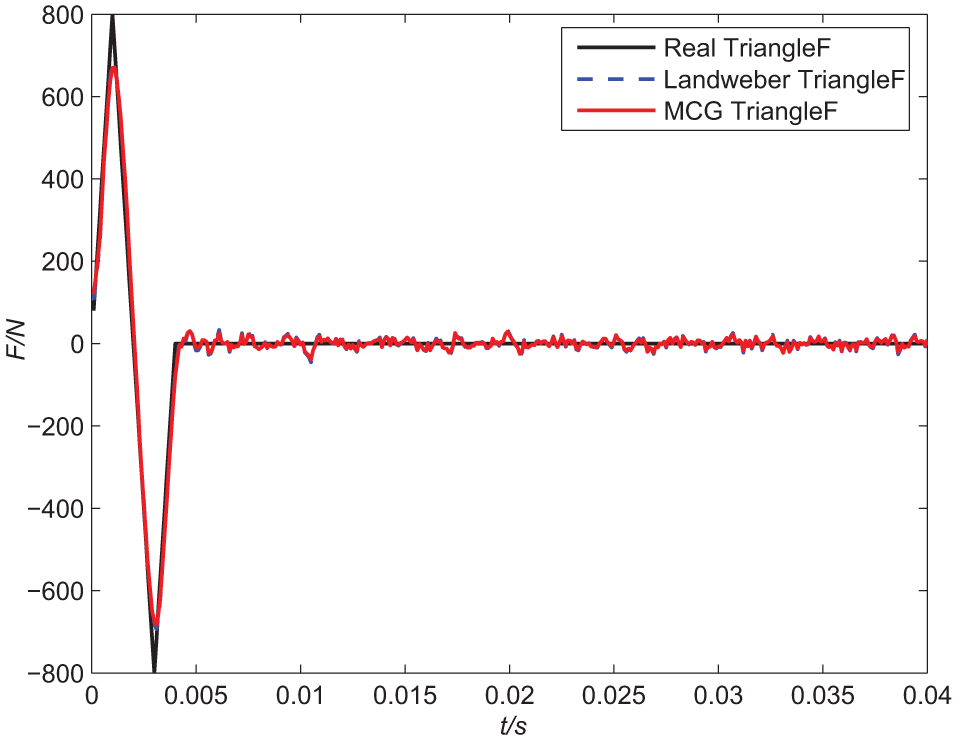
The identified triangle force by Landweber and MCG at noise level 5%; the number of iterations:

The relative deviations for the identified sine force by Landweber and MCG at noise level 5%.
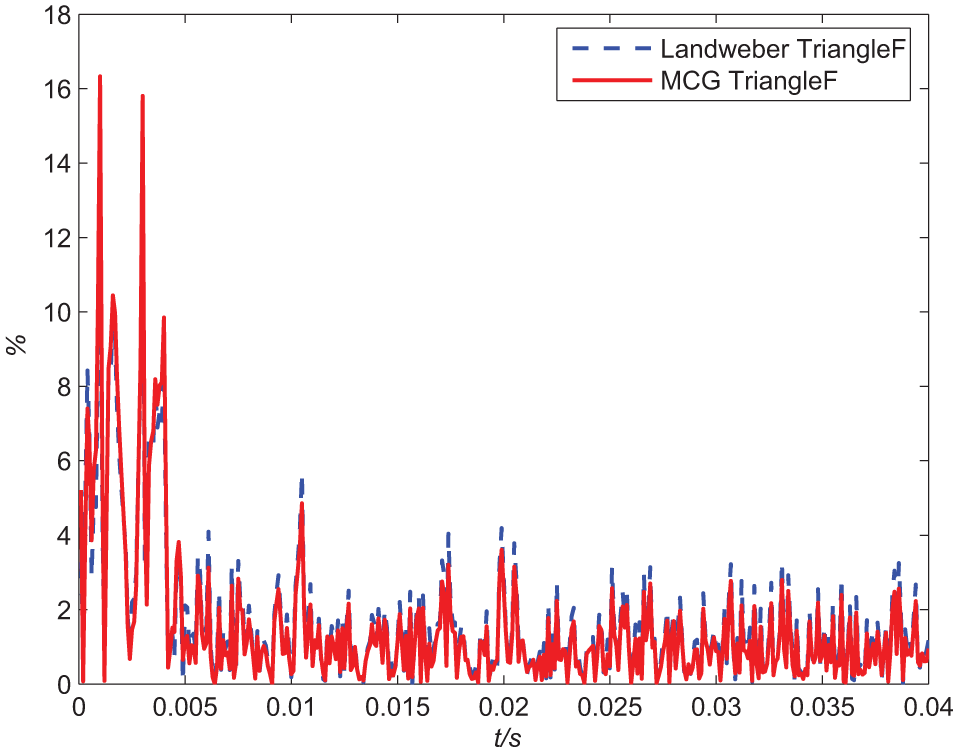
The relative deviations for the identified triangle force by Landweber and MCG at noise level 5%.
Moreover, the more detailed results of two regularization methods at five time points are listed in Table 6. What we have known from this article is that most deviations by the proposed method and Landweber iteration regularization method concentrate in the range of
The identified force at five time points at noise level 5% for 3 degree-of-freedom mass-spring system.

In addition, the number of iterations by the proposed method is 401, and the number of iterations by Landweber iterative regularization method is 11,934. This present method is far superior to the latter. All the above show that the proposed method has better performances than Landweber iterative regularization method, which is mainly due to its superiority in reconstructing expected dynamic loads. In summary, the proposed method has more advantages than the Landweber iterative regularization method in multi-source dynamic reconstruction of engineering structures.
Conclusion
This article proposes a new hybrid conjugate gradient method based on gradient operator, and this method is applied to the structural dynamic load identification problem. The stability and convergence of the proposed method is thoroughly proved by the mathematical theory. The accuracy of MCG has been demonstrated by the numerical examples. Compared with Landweber iteration regularization method, the proposed MCG has better precision and anti-noisy ability. Therefore, MCG is a stable and robust identification method for engineering applications and can solve dynamic load identification problems in practical engineering structure effectively.
Footnotes
Handling Editor: Jia-Jang Wu
Declaration of conflicting interests
The author(s) declared no potential conflicts of interest with respect to the research, authorship, and/or publication of this article.
Funding
The author(s) disclosed receipt of the following financial support for the research, authorship, and/or publication of this article: This work was supported by the National Natural Science Foundation of China (51775308), the Open Fund of Hubei Key Laboratory of Hydroelectric Machinery Design and Maintenance (2018KJX01), Hubei Chenguang Talented Youth Development Foundation and Research Fund for Excellent Dissertation of China Three Gorges University (2019SSPY046).
