




Abstract
Since the disaster point of road traffic emergency and the emergency demand were uncertain, the demand weighting model and the hierarchical location model are suitable for the characteristics of road traffic emergency. According to the requirements for coverage area of the macroscopic-location of the large area of disaster relief material repository, the demand weighting model and the hierarchical location model were established in this article. Among them, the demand weight model was solved by modeling, and the demand weight of each disaster point was obtained; the location model was combined with immune algorithm and ant colony algorithm to get the hierarchical location scheme. Finally, Jing-jin-ji that represented China’s “capital circle” was taken as an example, the model was solved using MATLAB, the mathematical software, and provided scientific and reasonable decision-making support for location selection. Moreover, it also provided a basis for the classification of the road traffic disaster relief material repository.
Keywords
Introduction
In past ten years, natural disasters occurred frequently all over the world, especially earthquakes, snow disasters, hurricanes etc, which often cause a series of serious consequences. With the improvement of road network and the expansion of the transportation scale in China, the consequences of road infrastructure damage and traffic interruption caused by natural disasters, traffic accidents, and social security incidents are becoming increasingly serious, which has attracted the attention of domestic and foreign theorists on the effective allocation of emergency relief supplies, and has made the location problem become a research hotspot. These random disasters or events cannot be accurately predicted or completely controlled at present. Therefore, the research on road traffic disaster relief material repository is the key to solve the problem of road traffic emergency management under major emergencies.
Recently, scholars have conducted a lot of research on the location of emergency facilities. Taking the time, cost, and coverage area as the objective,1–7 Doerner et al. 8 discussed the multi-target location of emergency facilities in coastal area by Non-dominated Sorting Genetic Algorithm II (NSGA-II) algorithm under the precondition of tsunami, and good results had been obtained. M Oral et al. 9 applied data envelopment analysis (DEA) for the location problem. Three basic models were comprehensively analyzed by DEA. Compared with the previous formal model, the basic models had better decision-making effects. Therefore, the method had a good enlightenment on the location of emergency materials repository. Grigoroudis et al. 10 analyzed the optimal design of supply chain network based on different economic standards, and even taking time and cost as the standard. In this study, under the condition of DEA algorithm recursion, a different way was introduced to design a supply chain network and mixed integer linear programming (MILP) model was built. Chai et al.11,12 built basic mechanism of coordinative management of expressway traffic emergency rescue based on the emergency rescue organization system. After designing linkage process corresponding to basic mechanism of coordinated management, the resource dispatch decision model was established for solving the problem of resource dispatch of emergency rescue system. YM Guo et al. 13 applied the thought of reliability for the location of emergency logistics facilities. Based on the facility reliability factors, a dual-target location model was established by taking the minimum total system cost and maximum customer demand coverage as the objective functions. Finally, multi-objective optimization function based on NSGA-II was used to solve the two-objective mixed integer programming model by MATLAB software.
According to above analysis, the existing research focuses on solving the optimization model by a single intelligent algorithm such as genetic algorithm. Besides, most research follows the traditional “point to cover surface” theories such as set covering, P-median, and linear programming. These theories were not suitable for the “point to cover line” location problems such as road traffic disaster relief material repository. However, the optimal path and coverage were precisely the two key factors for the “point to cover line” location problems. In previous research, single algorithm inclined to solve one of the two factors. Based on the optimal path and coverage area constraints, the global convergence of immune algorithm was used to solve the coverage requirement of the model. Besides, the optimal path of model was solved by the positive feedback of ant colony optimization (ACO) and the characteristics of heuristic search to seek the optimal solution of macroscopic-location of regional road traffic disaster relief material repository. This study meets the theoretical needs of China’s road traffic emergency management situation and the construction needs of China’s emergency system.14–18
Model establishment
Figure 1 shows the modeling idea and framework in the paper.

Model framework.
There were several factors involved in the location of disaster relief material repository. In resource allocation and optimization process, it was impossible to fully consider the influencing factors of repository location. The location model established in the paper mainly combined the basic requirements of location with characteristics of emergency management to make the following assumptions:
In this model, the location of alternative repository was considered at first. In the initial location selection, the model was established by taking the rescue time and demand for rescue resources at disaster points as the factors.
The running speed of vehicle was known. In other words, the rescue time was proportional to rescue distance.
Emergency repository was established by selecting a points from m alternative emergency repositories, thus covering the rescue-demand points in a certain area. After the occurrence of emergency, the emergency resources were delivered to the demand point in time.
In the paper, variable parameters were defined as follows.
In road transportation, location selection of disaster relief material repository should ensure safety, emergency timeliness, economic and resource conservation, overall scale moderation, and synergistic effect. Besides, the location method accorded with the particularity of city road network.19–23 Therefore, the population size, economic status, and traffic accessibility of disaster point were selected as the key quantitative indexes of demand weight in the road traffic disaster relief material repository, among them, the traffic accessibility was expressed by the mileage of traffic development. Due to the differences in population size, economic indicators, and traffic development mileage among different regions, the importance of the demand weights of road traffic emergency material in different cities was also different. Therefore, the above indicators of the three impact factors were evaluated in this article through the expert scoring method and the results were obtained. The evaluation indexes of influencing factors were processed by SPSS which was based on principle component analysis. Then the initial eigenvalue and component matrix were obtained. Moreover, the weights of influencing factors could be expressed by the variance contribution rate of principal component. In the linear combination of principal components, the coefficients were treated properly, that is, be weighted mean and then be normalized. The final results of the above factors were 0.4, 0.3, and 0.3, respectively. The weight of alternative location of road traffic disaster relief material repository is expressed as equation (1)

where

and

respectively;
Because of the urgency of rescue time in emergency rescue work, the shortest time model from disaster relief material repository to rescue-demand point was established. At the same time, according to the requirement of dynamic material support in the overall scope, the model was established by the most effective way between the cities where the alternative disaster relief material repository was located, so as to achieve the primary location scheme. The purpose of upgrading the repository was determined. There were many factors affecting the location of disaster relief material repository. Considering the selection of primary and advanced repository in the region, the combination of local and global optimum should be considered. The minimum weighted distance was taken by the local optimum as the objective function to select the primary repository, and then the objective function was constructed from the global optimum level to solve the optimal path problem, namely the Traveling Salesman Problem (TSP). Among them, the primary reserve was responsible for the cities within the radiation area, and the advanced reserve was responsible for the emergency rescue work within the other cities of support area besides the cities within the radiation area.
The primary repository aimed at serving cities around the location. Relief supplies were delivered to affected areas in the shortest time. The initial impact of disaster was minimized to conduct real-time material linkage with advanced repository. In primary repository location model, one disaster point was supplied with materials by at least one repository. The model was established as follows

The constraints were expressed as




Among them,
Advanced repository location model aimed at realizing replenishment of emergency needs and minimization of transportation distance by synchronously supporting the primary repository. In the case of the determined primary repository, the optimal path was taken as the objective function of the problem in advanced repository. The model was established to solve the shortest path of tandem alternative point. The model was expressed as follows

The constraints were expressed as


Formula (9) meant that each point in the set had only one path in and out; formula (10) guaranteed that there was no subcircuit solution between the entire path, and that all points formed a Hamilton loop.
Model solution
As non-deterministic polynomial (NP)-hard problems, the location and optimization of emergency repository were often solved by heuristic algorithm.24–30 In the paper, the immune algorithm was used to solve the location problem of primary repository combined with constraint conditions such as rescue timeliness, dynamic interactive support of relief materials, and repository classification. The ant colony algorithm (ACA) was used to solve the problem of advanced repository location, and then the final location scheme could be determined.
Solution steps of immune algorithm
Generation of initial antibody population
Determine whether the memory bank was empty. If it was, the initial antibody population was randomly generated from the feasible solution space, realizing simple coding. Otherwise, the initial antibody population was generated from antibodies in the memory bank, meanwhile being simply encoded. In location scheme, there were the antibodies with the lengths of P. Each antibody represented the demand point sequence selected as repository.
Diversity of evaluation solutions
First, the affinity of antigen and antibody was evaluated. For antigen and antibody, the stronger affinity leads to stronger recognition ability to antigen of antibody. Otherwise, it showed weakness. Affinity function
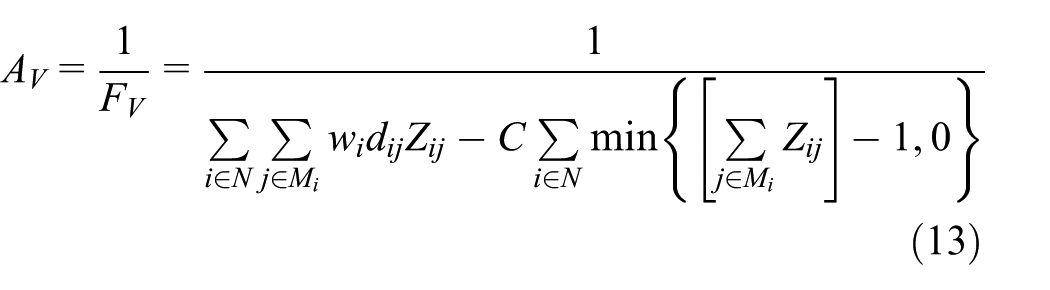
where
Second, the affinity among antibodies was the similarity. The most common solution was R-bit continuous method proposed by Forrest

where
Third, the antibody concentration was the ratio of similar antibodies in the entire population

where N is the total number of antibodies.

Finally, the expected reproduction probability was expressed as

where
Immune operation
Based on single-point crossover and common random selection mutation methods, Formula (17) was used to calculate the expected reproduction probability. After that, the location was completed according to roulette selection mechanism. 31
Solution steps of ACA
ACA was proposed by Italian scholars Marco Dorigo et al. It was initially used to solve the TSP and achieved satisfactory experimental results. In recent years, ACA had been widely used in chemical industry, communications, transportation, and other fields. It performed well in dealing with combinatorial optimization problems, such as assignment, scheduling, and location.
There was the basic idea of ACA: it was denoted that m was the number of ants in an entire ant colony; n the number of cities;
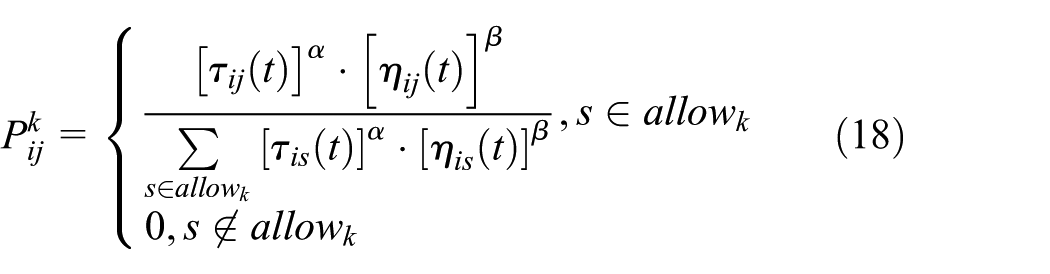
where
With the passage of time, the pheromone in each path constantly volatilized. The degree of volatility was expressed as parameter

where
For pheromone release problem by ant, ant cycle system model was selected 33

Solution procedure were as follows:
1. Parameter initialization
Parameters m, α, β, ρ, and Q were conducted with initial assignment. Iter-max was defined as the maximum iteration number. The initial value of iteration number
2. Establishment of solution space
Ants were randomly placed in different cities. For Ant
3. Update of pheromones
After traversal of all ants, the total length of the route
4. Judgment of termination
If iter<iter_max, then
Model verification
In the paper, Jing-jin-ji area was selected as the object of model verification. It was assumed that there were m alternative points for repository in the research area. Wherein, n locations were selected as the primary emergency repository. From n locations, q were selected as the advanced emergency repository to achieve supplement of emergency demand and minimization of transportation distance in the linkage support process of primary repository. Besides,
To facilitate calculation and enhance visibility, the latitudes and longitudes of selected 13 cities were conducted with coordinate system conversion by taking Kashi as the origin of horizontal coordinate and Haikou as the origin of ordinate. The converted horizontal and vertical coordinates were enlarged by 10 times. Meanwhile, the city’s demand

Location scheme of emergency repository.
In Figure 2, the box cities represent the location of emergency repository; the circle cities were the demand point of repository. The convergence curves of immune algorithm were obtained according to the iteration number, optimal and average fitness values (see Figure 3).

Convergence curve of immune algorithm.
According to the principle of ACA, the cities of Chengde, Zhangjiakou, Qinhuangdao, Beijing, Tangshan, Tianjin, Langfang, Baoding, Cangzhou, Shijiazhuang, Hengshui, Xingtai, and Handan were numbered as 1–13, respectively. In the initialization of parameters, the number of ants was defined as 100; the pheromone importance factor as 1; the maximum iteration number as 26. Finally, the paths were determined by randomly generating the starting cities of ants. The cities were accessed by the roulette method to calculate the path distances of ants. The shortest path distance was 172.38 km. Figure 4 shows the optimal path and Figure 5 shows the contrast of shortest and average distances of each generation.
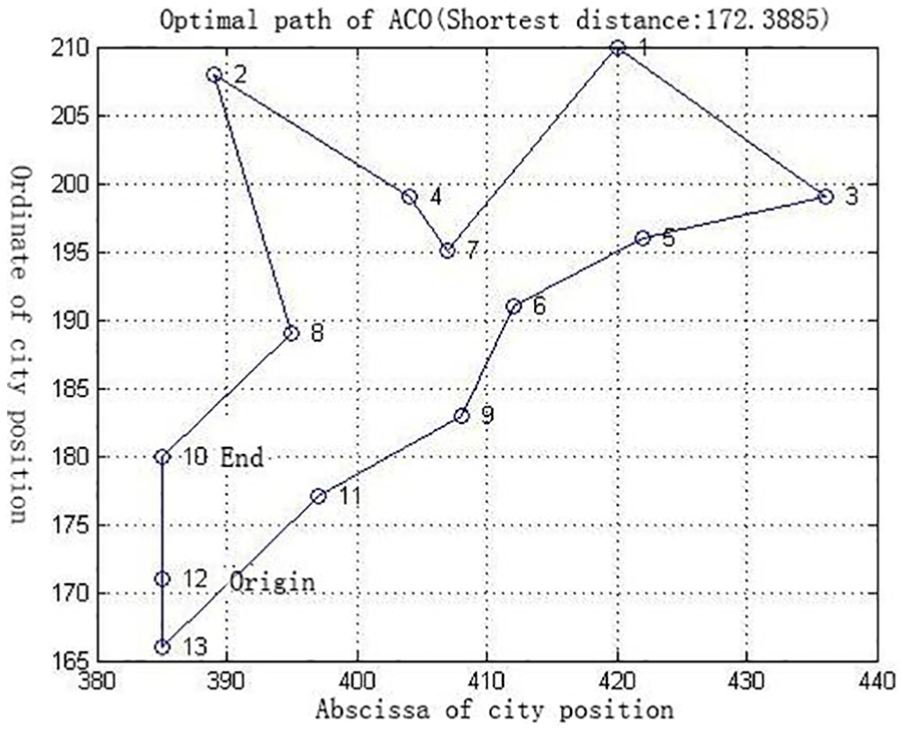
Optimal path diagram within research range.
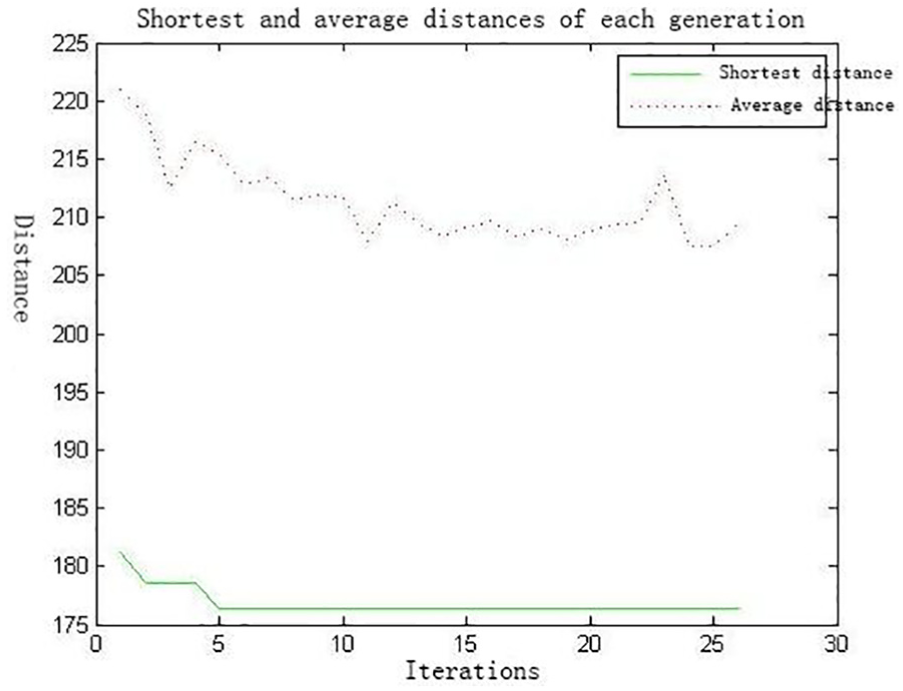
Shortest and average distances of each generation.
With the increase of the number of iterations, the shortest distance decreased. When the number of iterations was greater than 5, the shortest distance no longer changed. This indicated that the optimal path was obtained through the ant traversal path. The shortest path was 12-13-11-9-6-5-3-1-7-4-2-8-10-12.
The optimal path was obtained by the ACA combined with primary repository location scheme. The calculation was performed by taking Beijing, Tianjin, and Chengde as the centers and 150 km of rescue radiation range as the radius based on the optimal path as well as rescue radiation radius. The ratio of coverage area of three cities in the total area of research area was analyzed. Beijing and Tianjin were selected as the advanced disaster relief material repository; Chengde was selected as the primary disaster relief material repository (see Figures 6 and 7).
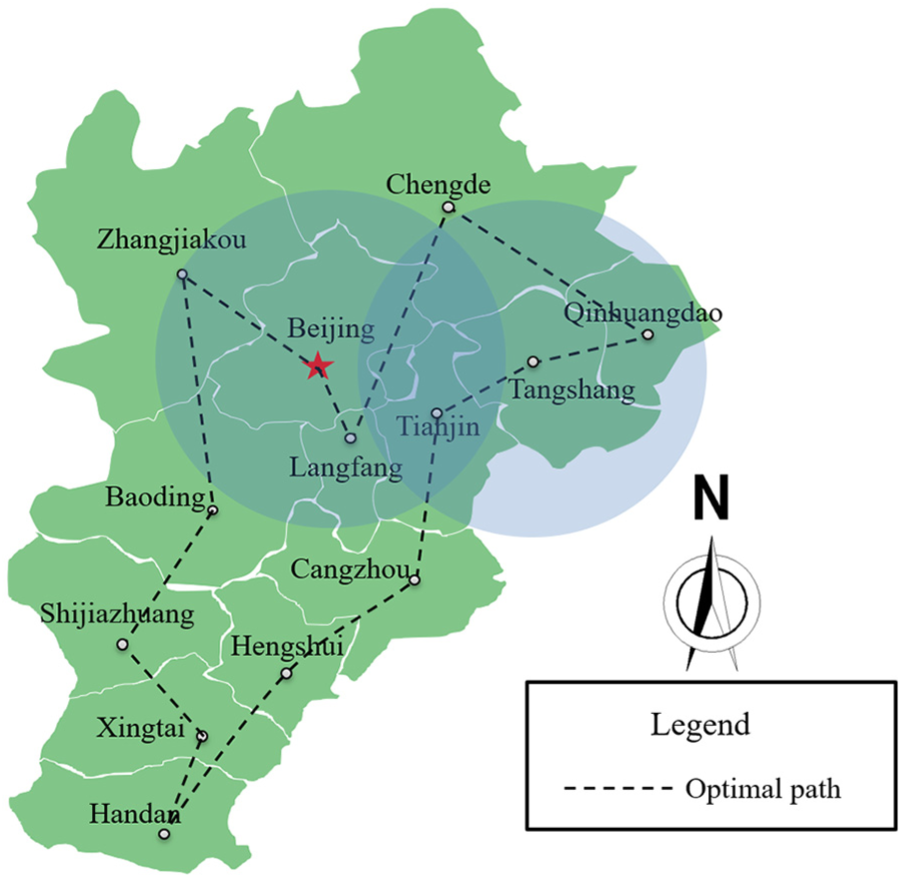
Coverage area of Beijing and Tianjin.

Repository location scheme.
Conclusion
In the paper, immune algorithm and ACO were applied to discuss the location optimization of road traffic disaster relief material repository based on the idea of hierarchical modeling. The specific conclusions were as follows.
The demand weight model of disaster points was proposed. The impact factors of demand were conducted with principal component analysis by SPSS. After that, the population size (0.4), economic level (0.3), and traffic accessibility (0.3) of the demand weight were obtained. This indicated that the population size was the main factor of demand weight for disaster points, thus satisfying people’s psychological expectations and realities. Thereby, the location model was scientific and reasonable in the paper.
Hierarchical location model of repository was constructed. According to the purpose of this research, the modeling conditions were conducted with basic assumption and variable definition. The minimum model based on demand distance was established. After initial location, the model was defined as primary repository. On the basis of the optimal path model, advanced repository was selected from primary repository. The immune algorithm and ACO were applied to solve the minimum demand distance and optimal path models.
Jing-jin-ji area was selected for model verification to obtain the final location scheme. Wherein, Chengde, Beijing, and Tianjin were taken as the primary repository; Beijing and Tianjin were taken as the advanced repository. The location scheme accorded with the actual situation, indicating the validity and practicability of this model.
There were still some shortcomings from the perspective of the application of repository location method. The location scheme of primary repository was first determined. After that, we only consider the optimal path and radiation range problems was only considered after path determination within the global field in the optimization model of hierarchical repository. It did not involve non-quantifiable factors such as road alignment, natural environment, and public service facilities. In addition, the applicability of model was subject to verification in more areas.
Footnotes
Handling Editor: Gang Chen
Declaration of conflicting interests
The author(s) declared no potential conflicts of interest with respect to the research, authorship, and/or publication of this article.
Funding
The author(s) received no financial support for the research, authorship, and/or publication of this article.