



Abstract
The cognitive characteristics of service designers in the design process were analyzed from the perspective of semantic linkages, and the visualization expression method of the cognitive characteristics of service designers was proposed to address the problem of absent references for constructing a high-efficiency service design team from a design cognition. The proposed method mainly determined the cognitive activity level of designers through link entropy, which was calculated on the basis of linkography. The proposed method also quantified the degrees of interaction and cooperation among designers from the cognitive activity relationship of the design team, which was constructed on the basis of linkography. An experiment based on design of transport service for thin-walled parts was conducted. Results showed that the proposed method can quantify a design cognition process, analyze cognitive features of designers effectively, and determine the compatibility among designers. The cognitive features of designers will provide scientific references for optimizing the design team.
Introduction
In the stage of service design concept generation, many cognitive processes, such as design analogy, reasoning, and association, promote the deviation of a design concept. The cognitive explicit expression of designers (e.g. language, draft, gestures, and diagrams) all reflects the characteristics of design cognitive activities. In the environment of information sharing, innovative design strengthens the communication and cooperation of the design team and stimulates the collective intelligence and creativity. Co-design in the field of service design refers to designers, customers, and users forming a design team in the process of design, service delivery, and usage; creating collective cooperation 1 ; and providing successful services from demand’s and supply’s perspectives of views. Complicated service design tasks assert high requirements on the knowledge structure and mode of thinking of the design team. On one hand, identifying and filtering the leading users can accurately predict the design trends, grasp the potential benefits of service innovation, and improve the effectiveness and quality of service design results;2,3 on the other hand, according to the designer’s design cognitive characteristics of the team, customers’ and users’ co-design can maintain team’s cognitive thinking heterogeneity, avoid design thinking dilemma. 4
Badke-Schaub et al. 5 proposed five different types of psychological models, from tasks, processes, teams, abilities, and backgrounds, to study the design process of a common design team. Ozkan and Dogan 6 analyzed the analogical reasoning design cognitive differences between the novice designer and expert designers from the level of knowledge and evaluation of the ability. Based on the combination of visual representation of mental model and in-depth interview, McNeil 7 studied designer’s mental model during the design process of designing a user-involved multimedia software. Bowen et al., 8 using experience-based design (EBD), studied the elderly outpatient service and clarified the problem of cognitive conflict among different stakeholders in participatory designs. In studies of design cognitive analysis, symbolic information processing theory of Simon 9 is the most representative. Design behaviors, such as information stimuli, mental responses, and conceptual expression, can be considered a component of information processing. Botta and Woodbury 10 proposed to design the transformational relationship of communication from the data analysis of oral cognition and introduced the method of recognizing a design conceptual switching position by sub-linkography. Dong et al. 11 believed that language is the preliminary evidence of cognition and investigated the mental model of the design team through semantic analysis method. Sosa et al. 12 proposed the divergent visualization inference pattern for concept generation stage. Zgraggen et al. 13 analyzed the design behavior and knowledge discovery ability of designers on the basis of the interaction log and thinking aloud. Fekete 14 developed a toolbox that assisted designers in progressive cognitive analysis. A great number of experts have conducted numerous studies of design problem solutions and cognitive mechanisms. However, there are less researches on the perspective of the cognitive state of the designer’s cognitive features, visual representation, and analysis service design team collaboration mechanism. In this study, the relationships among nonstructured language data were expressed in linkography. The cognitive concept in the design process was encoded to characterize the design evolution process and cognitive characteristics of designers in the conceptual generation stage.
Expression of design cognitive activity
Research on design cognitive activities has mainly expressed and analyzed cognitive behaviors (e.g. analogy, inference, and emergence) in the design process through nonstructured data (e.g. language, characters, and drafts). Among the design cognitive activities, extracting and analyzing design problems, meaning construction, and analytical reasoning are the key contents to understanding the design cognitive expression.
The theories of service design flow include Double Diamond theory, 15 tools communication capabilities map, 16 and human-centered design (HCD). 17 The two-diamond design methodology, compiled by the British Design Council in 2005, consists of four stages, namely, exploration, definition, development, and implementation. Exploration and definition is the concept of divergence and focus, cutting into the problem; development and implementation is the process of divergence and focus on the solution. Roberta Tassi, a researcher at the Milan Institute of Technology and the Darc Domus Academy, presented a map of tools communication capabilities. “Analysis,”“ideation,” and “development” in the “plan” section are consistent with the content of “exploration,”“definition,” and “development” in the Double Diamond theory, and “implementation” section corresponds to the “implementation” of the Double Diamond theory, and the final “maintenance/operation” section focuses on the user feedback mechanism, which is not part of the Double Diamond theory. HCD is the design method that the American Ideo design company induces. “Explore the service field” corresponds to the “exploration” of the Double Diamond theory, focusing on understanding all the people, events, time, place, and objects in the process of service experience, and carrying out “analysis and induction” after collecting the relevant information extensively. The “creation” phase combines the “definition” and “development” of the Double Diamond theory, forming the steps of “define the design problem” and “development the service concept,” and then “plan the service framework” and “design the service contact point” correspond to the “practice” in the Double Diamond theory. Based on the Double Diamond theory, this article divides the service design process into four stages: definition, search, concept, and evaluation. The iteration process of the four design cognitive activities can be divided into two cycles of activities, that is, information foraging and scheme display. The information foraging cycle mainly involves the design of the problem, information searching and filtering, and useful information screening and extraction. The scheme display cycle mainly covers the dynamic construction of the mental model in information iteration, explicit expression of design concepts, and correction of problem boundaries in the design scheme evaluation. A design cognitive activity cycle under the collaborative effect of the information foraging and scheme display cycles advances, and the scheme approaches the design goal in the iteration process.
Design of the cognitive activity category code
The complexity of design cognitive activity in the brains of designers is determined and is generally viewed in a black box form. The fusion of data and semantic domains provides methods for achieving cognitive visualization to support research on cognitive activities. 18 Oral analysis, as a common research method in the design cognitive field, examines the design thinking of designers by recording their nuncupation of short-term memory cognitive process and contents. Nuncupative information coding and decoding are utilized to understand the design cognitive behavior of designers. 19 In order to solve the problem of open design, Atman et al. 20 coded the design activities from different points of views, in which the design step is the code of entry point, which is divided into three categories as shown in Table 1: problem category, solution category, and project category. Valkenburg and Dorst 21 divided the team design activities into naming, framing, moving, and reflecting, dividing the spoken data into design activity episodes, and the design activities are encoded based on episode content. Based on designers’ cognitive activities in the design process, “category problem” is divided into definition and searching subcategories, and “category solution” is divided into concept and evaluation subcategories. This research focuses on the early service design process, so “category project” is not involved. Subcategories are set by spoken data of service design (Figure 1). The cognitive category encoding system of oral analysis is summarized in Table 2.
Atman’s coding standard. 20


Iteration cycle of service design cognitive activities.
Design cognitive activity category encoding.

Visualization expression of complicated cognitive activity based on semantics
Glodschmidt 22 proposed a linkography, which is mainly used to evaluate the design thinking ability of a team and individuals. Linkography describes a time sequence structure of a design cognitive inference based on oral data and constructs the causality index of different design concepts in the evolution of a time sequence. The design concept is called “move.” The label to evaluate the causality among “moves” is “link.” The “moves” in causality are recognized as “linkable moves.” The connection line between the “link” and “linkable moves” can be used to construct the linkography. “Backlink” represents the connection between moves and preorder moves, and “forelink” reflects the connection between moves and postorder moves. “Critical move (CM)” is the move that contains numerous backlinks and forelinks. 23 In Figure 2, Move 2 has four forelinks, and move n has four backlinks called CMs. 4 The time sequence directions of the number of links are expressed by the left and right arrows.

Linkography.
Methodology
Design cognitive activity category encoding
According to the information theory of Shannon,
24
the move set in linkography is
At two states (i.e.
The calculation formula of entropy is expressed as follows:


Thus,
In this experiment,

Consequently,
Entropy plays an important role in analyzing a design cognitive complexity. 11 A large entropy fluctuation reflects the production or transition of concepts and symbolizes the conceptual evolution into a new stage. A small entropy fluctuation reflects the staged concept concentration or new potential concepts.25,26 Therefore, entropy fluctuation can represent the transition, new, or isolated concept during a design cognition process.
Analysis of design cognitive characteristics
The interdisciplinary characteristics of service design require the design team to be composed of designers with different knowledge structures. Different designers may adopt various design strategies. If designers adopt a problem-driven strategy, then they will invest further efforts to recognize the design requirements and emphasize the explicit specific design goal. However, the design scheme generates only a few outputs. If designers adopt a knowledge-driven strategy, then they will use their prior knowledge and design experiences in existing design problems. This design strategy also belongs to a branch of scheme-driven strategy. 27
If many designers adopt the same type of design-driven strategy in the team, then design blinds or misunderstanding regions easily occur. The activity degrees of different designers in the design, search, concept, and evaluation stages can be analyzed in accordance with the relationship between links. This analysis is conducive to examining the cognitive strategy category and cognitive characteristics of designers. The CMs in linkography are important turning points in the design process and provide important insights into the overall design cognitive style of the design team. Moreover, interactions and stimuli among members of the design team are beneficial in determining their cooperation. The design team based on the cognitive characteristics of designers can optimize personnel allocation and highlight knowledge structure and heterogeneous advantages of cognitive thinking. 28
Experiment and discussion
Experimental design and data processing
For thin-walled aerospace industry products, in order to meet the specific design requirements, they are brittle, complex, and with strictly high requirements of orientation and position during transporting and assembly in case of deformation and breakage. 29 In the past, thin-walled parts transportation considered solely about fixture, but during the transport, how to handle and position these parts and cooperate them with each other increased the complexity of the transportation. 30 The study considers thin-walled parts transporting services, and conducts experiments with a co-design team. For solving the design problem, service design thinking is needed. The research focuses on early phase of service design, that is, the creation of a service concept design phase that can be further implemented, focusing on the cognitive activities of the co-design team in the design process.
In order to identify the interaction between the designers’ cognitive features and team design activities, to provide a basis for team optimization, the experiment is divided into two parts: quantitative research and qualitative research. The quantitative research is based on linked table data, analyzing designers’ cognitive features in design process and collaborative relationship between design teams. The qualitative research uses questionnaires and interviews to explore the relationship between team members’ design activities and the generation of collective creativity and design concepts. The experimental team has six people, four designers with service design experiment (three industrial designers, one mechanical designer), one machine operator, and one transport project executive. The backgrounds of team members are in Table 3.
Background of design team members.

ID: industrial designer; MD: mechanical designer.
The experiment lasted for 40 min and expressed the design thinking process through face-to-face language communication and draft drawing. The experiment required the designers to express their opinions as much as possible and search possibilities for a design scheme. In the experiment, a voice recorder was utilized, and the recorded audio was transformed into text data. A total of 50 texts, which were denoted as the moves, were related to the design and were acquired after data cleaning, punctuation, and encoding of oral analysis. Simultaneously, draft data of the design process were recorded using a video recorder, and the time sequence of the corresponding moves was used as a data supplement. After the design is completed, questionnaires are used to obtain design team members’ views about how to co-design, resolve conflicts, and inspire the design in the design process. The cognitive activity codes of moves are listed in Table 4. Linkography could be drawn in accordance with the causality of language text data (Figure 3).
Language text data of the design teams.


Linkography designed in the experiment.
Analysis of the design cognitive process
Link entropy of moves
The backlink and forelink entropies of each move are calculated using equation (3) (Table 5). The images are illustrated in Figure 4(a) and (b).
Backlink and forelink entropies of moves.


Entropy diagrams. (a) Backlink entropy of moves. (b) Forelink entropy of moves.
Entropies of moves represent the complexity of design cognition. A high entropy indicates a high occurrence possibility of innovation concepts. The backlink entropy reflects the convergence of moves, and the forelink entropy reflects the creation of moves.
The backlink entropy reflects the correspondence between the move and the concept of a preorder move. In Figure 4(a), the numerical value of the backlink entropy generally fluctuates. Within the development of the design process, the entropies of moves are constantly fluctuating, indicating that defining problems and searching information are more frequent in the early stage of design, more new concept is intensely produced, and the design cognition presents a disordered characteristic. At the end stage of the design, there is more evaluation of the existing concept, less new concepts; hence, the entropy change tends to be stable. Therefore, it indicates that the design activities are active in the whole design process, and there are many concept mutations. Moves 1 and 2 with the lowest entropies are about definition design problems, proposing “forms of protection in different transport service stages.” Moves 1 and 2 are characterized by continuity and convergence, thereby have low entropy values. Move 3, which has the highest entropy, has a high convergence of the preorder move, and its design problem generates an important protection direction. If the conceptual innovation of a move is relatively high, then it has few backlinks and low entropy. Thus, Move 30 denotes the protection form for the network structure. Move 3, proposed by the user, has the largest entropy value, which is the key node for defining the design problem in the whole design process. It defined the design goal, with high convergence of the previous node. However, if the concept of a move is more innovative, there are less backlinks and its entropy value is relatively low. Move 9 has no forelink indicating that it is a new concept node. It is the first time to propose the human factors problem while connecting the transport links, which triggers the subsequent discussion on the transport control visualization. It also inspires for the follow-up concept, and evolves local innovation. Move 5 presents a modular design case for fixtures, but fails to further develop. It is a node with no link, so that the entropy value is also the lowest.
The forelink entropy implies the possibility of heuristic design creativity. If the conceptual innovation of a move is high, then it has additional forelinks and a high entropy. Thus, the long-ago link of Move 3 reflects its inspiration and relevance to the concept of follow-up, and determines the basic thinking of design from three aspects of safety, economy, and efficiency. Move 16 presents the flexible structure of the protective device, which is strongly discussed by the design team members considering the radian and elasticity.
CM cognition
The service scenarios, cooperation of service elements, and service process should be considered when determining the service design goal. The determination of constraints and design problems is a correlation process and involves the important ability of designers to generate creative solutions. 31 Therefore, understanding the complexity of a design task from multiple levels of abstraction was beneficial to a follow-up evaluation of the reasonability and effectiveness of solutions. Move 3 denoted a cognitive activity of “determining the design goal” in the definition stage. The proposed design goal provided important guidance to subsequent discussions and motivated the design team to discuss materials, structures, and procedure.
Move 8 has a lot of forelinks, continues and inherits the concept divergence phase, and promotes the concept convergence, which is the key node of the cognitive inference process. It is found that the idea of the mechanical arm is determined at Move 8, leading toward the further evolution of the concept, showing its importance.
An iteration of the design scheme is the reflection of designers on design conflicts and design problems. 32 Move 16 denoted a cognitive activity of “evaluating the alternatives.” Different design thoughts and design keys were elucidated in previous discussions. In Move 16, designers iterated and integrated alternative schemes. The forelink of Move 16 caused frequent evaluations on Moves 17, 23, 30, 35, and 38. For instance, Move 17 goes over the user demands; after evaluating the design, new alternatives are selected and the design moves forward. Move 30 redefines the design criteria and evaluates the relationship between the scheme and design issues from a systemic perspective. Move 38 considers the cooperation between departments in the transport chain to evaluate the efficiency of the design. These evaluation behaviors could be viewed as reflections of the cognitive features of designers in a scheme iteration.
Move 47 evaluates whether the design scheme matches the design problem definition; then, the two backlinks define the design objectives and problem boundary: Move 24 concludes a new design scheme and interprets the meaning of the design; after Move 25 recollects information, a new design boundary is determined. Move 40 selects and iterates over the schemes. These cognitive activities prompted the designer to review their understanding of requirements and solutions after combing the information related to design issues, and conducted a whole evaluation of the design at Move 46.
Cognitive characteristics of designers
Cognitive activity level of designers
In Table 6, the number of moves and the entropy of links represent the cognitive activity level of the designer. The total entropy value of D1 designers is the highest, but the average value of the backlink’s entropy is the lowest. According to the open questionnaire survey, this is because D1 designers are the most experienced designer; in the design process, he is the one to control the direction of design; other designers said that D1 designers are prestigious, are able to accurately understand users’ opinions, providing more design ideas and necessary information to inspire other members. The analysis of D1 designer’s questionnaire shows that he explains the existing schemes at all stages of design, increases communication with users, reflects on whether the design scheme matches the design problem, and tries to avoid his personal prestige which may cause problems in team cooperation. This is the main reason leading to the lowest average entropy of D1 designers.
Analysis of the entropy of the cognitive activities of designers.

The average entropy value of D2 designers is moderate, and it is more average in design induction and design inspiration. D3 and D4 designers’ average backlink entropies are higher, while the average forelink entropies are lower, indicating that the designers are better at generalizing concepts, but worse in inspiring design opportunities.
U2 user’s average backlink entropy and U1 user’s average forelink entropy are the highest, indicating that the views from users in the co-design team are more inspiring to the development of design. Questionnaire analysis found that users can timely evaluate the concept proposed by the designer, and constantly emphasize the design issues, which enhanced the innovation and value of service design.
Cognitive characteristics of designers
Defining the boundaries of design problems is to clarify the nature of design problems, determine the starting point of design, and guide the search for important information of design problems. This is important to show designer’s professionalism in the design activities, and it is also a key factor to determine the quality of the design scheme. From the cognitive activity of the designers shown in Figure 5, we can see that the design team members D1, D3, and U2 are outstanding in definition. The complexity of design task makes the iteration of problem scope run through the whole design process. Information search behavior promotes the iteration, and helps designers understand the boundary of the problem, prompts them to find a solution to the problem, reconstructs the boundary of the problem in the process of evaluating the design scheme, and enters the next iteration—a more perfect solution. 33 D1 designer’s design activity is at a high level in the search, concept, and evaluation stages, and is outstanding in team interaction, which is related to the experience of D1 designer. Compared with other stimulus activities, the design team members are weak in defining the boundary of design problems. In understanding the cross-regional transformation between design problems and generation solutions, the transformation between D1 and D4 is relatively easy, and the corresponding relationship between D1 and D4 is more symmetrical, while the activity of U2 is the lowest, which is related to the user’s background—less experience in design has a certain relationship, but its performance in the search phase is outstanding. In searching phase, because of D1 designer’s experience and more abundant knowledge reserve, his search range is larger and more flexible. Due to his mechanical design background, D4 designer can search for more structural design cases. D2 designer searches less information, so that less attention is paid to other factors in the design process. The reason is that the consciousness of searching information is not strong and lacking the ability to extract information from existing clues. In conceptual iteration and evaluation, although D4 is good at information search, but due to the lack of information into the design solution of the abstract ability and design behavior backtracking ability, and so eager to solve, he did not consider the diversification of iterative design schemes to be close to the design goals, hence, less active in the design scheme iteration and evaluation. The design strategies of D1 and D3 designers are problem-driven, while those of D2 and D4 designers are solution-driven.
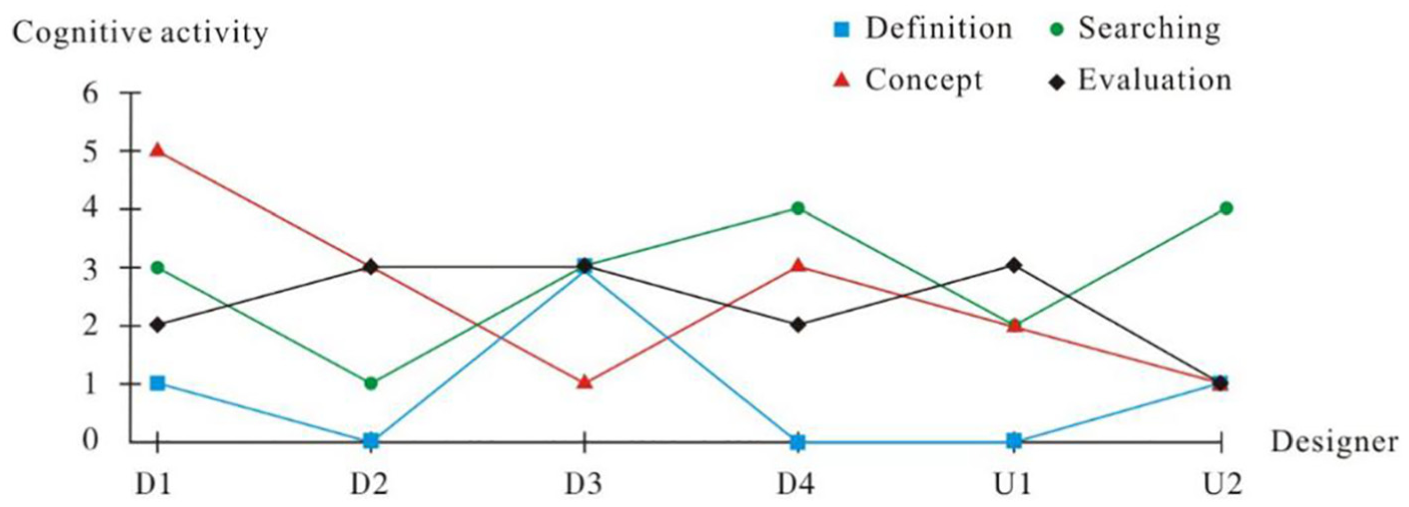
Cognitive activity levels of designers.
Interaction of designers
According to the linkage of CMs, the relationship induced by design interactions of different cognitive subjects was analyzed. D1 designer with the highest contribution rate among all CMs was used as an example. The interaction between D1 designer and other designers is depicted in Figure 6. The size of the circle reflected the occurrence frequency of this cognitive activity. Large circles represented high frequencies of occurrences. The arrow reflected the causality of cognitive activities. The number on and the thickness of the arrow reflected the times that the interaction was triggered.

Interaction among designers. (a) Design activities of other designers stimulated by D1. (b) Design activities of other designers stimulated by U2. (c) Design activity of D1 stimulated by other designers.
Nigel Cross 34 reported that a successful designer can switch over different design activities rapidly. The interaction stimulus among various members of the service design team could be regarded as an explicit form of a design concept. The interaction of cognitive activities among different designers was further analyzed to interpret the ability of designers in switching over different cognitive activities.
The relation scheme that D1 stimulates other designers in design activities is demonstrated in Figure 6(a). In the definition stage, D1 designer’s design cognitive activities can actively stimulate other stages with relatively high intensity; in search and concept generation stages, activities cross-interact and mutually stimulate frequently. D1 is in the passive state in the stages of information searching and design evaluation, thus resulting in the low frequency of trans-regional stimuli. In numerous trans-regional design activities, high-frequency cognitive activities include searching replaced information (E), interpreting the design scheme (O), and synthesizing the concepts into a new scheme (C). These cognitive activities are conducive to boundary definition for design problems and in-depth promotion of concepts.
Figure 6(b) is a member’s cognitive activity diagram triggered by U2. U2 proposes design problems, raising extensive reflection of other members in search and evaluation activities. Views from users greatly stimulate team members to search for all kinds of information, which is reflected in the high frequency of search activities. In the evaluation activities, the matching degree (Q) activities between the scheme and the definition of design problem show a high frequency, indicating that members are constantly comparing the matching degrees between the scheme and the design problem and iterating the scheme.
The relation scheme that other designers stimulate D1 in cognitive activities is exhibited in Figure 6(c). Several cognitive activities, including determining the design goal (I), searching the relevant cases (S), and developing fresh new schemes (M), frequently occur after D1 is stimulated by other designers. Especially in evaluation activities, other designers will facilitate D1 to design schemes and constraints (R) and define matching degrees of design problems (Q) in the evaluation stage. Such evaluation expands the information-searching scope and extends the integrated design scheme of D1, thus urging D1 to determine the spatial boundaries of the problem multiple times, generate and redefine constraints, and feedback the ideas to other designers.
In the co-design team, an important task of designers is to coordinate conflicts and realize the service value proposed by the user. 3 This study focuses on analyzing designers’ interaction from different designers. Figure 7 shows the number of interactive stimuli initiated by designer D1 and other designers. The average entropy values of D2, D3, and D4 induced by D1 are 0.215, 0.213, and 0.2, respectively, which are higher than the average entropy values of these designers. D1’s design activities stimulated D2’s design cognition in explaining design scheme (O) and synthesizing concept into new scheme (C), but did not stimulate D2’s design cognition in defining and searching stages. D4 has obvious feedback in the design cognitive activities such as searching un-provided information (G), searching existing cases (A), and evaluating the matching degree of scheme and user requirements (F), but does not generate design activities in the definition stage. On the contrary, D3, stimulated by D1, performed well in defining constraints (P) and searching alternative information (E) up to 9 times. According to the results of the questionnaire, D2 and D4 relied more on the information provided by D1. In most cases, the design is based on the existing information. D3 has participated in the design of logistics services before, hence has some experience in the design of relevant, and activities on searching alternative information are more frequent. This is in line with the problem-driven strategies of D1 and D3, and the scheme-driven strategy of D2 and D4.
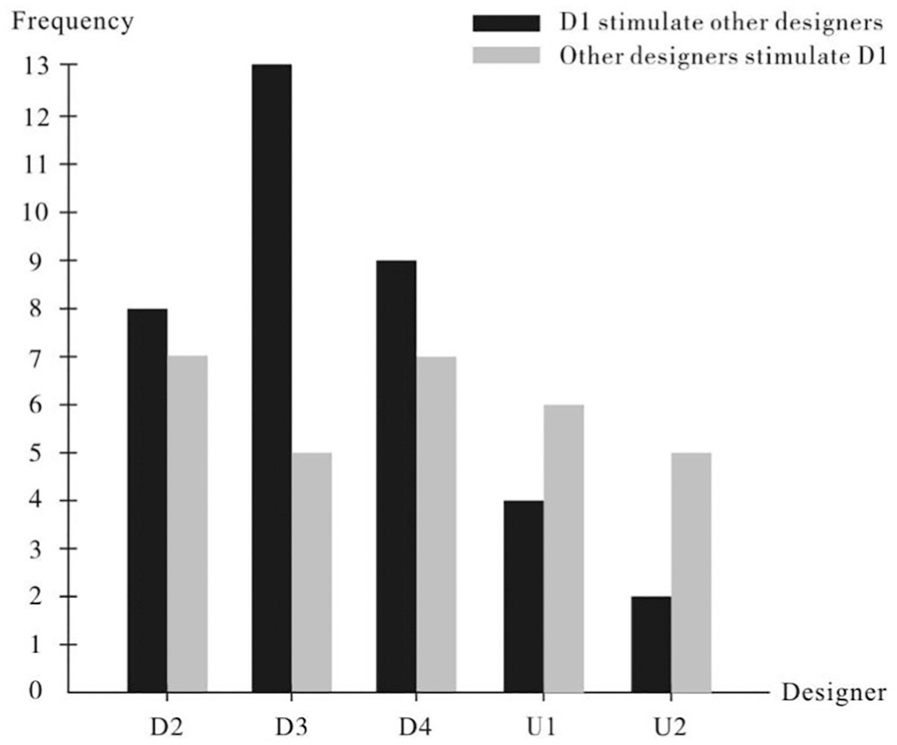
Frequency of stimulated design activities of D1 and other members.
The average entropy values of D1 stimulated by D2, D3, and D4 are 0.175, 0.212, and 0.192, respectively. The average entropy values of D1 stimulated by U1 and U2 are 0.187 and 0.207, respectively. Although D1 was stimulated more frequently by D2 and D4 than other members, the design activities of D3 and U2 stimulated more innovative design of D1. In the interactive process of design activities, different members share knowledge and experience, and provide necessary information to inspire together. D1 and D3 have longer service experience than other members in designing communication. The questionnaire reflects that D1 and D3 pay more attention to the information provided by users, and their schemes are easier for users to understand. It can be concluded that the D1 and D3 designers of the problem-driven strategy cooperate well with each other, and their cooperation stimulates the designers of the scheme-driven strategy to design and evaluate multiple schemes, which plays an important role in promoting D2 designers to propose Moves 28 and 36.
Discussion
This study seeks to identify the cognitive characteristics and interaction patterns among team members in the early stages of service design, and how design practices can contribute to team composition. As a component feature of service design team, user participation in design team is an important part of innovation and value realization of design project. Users and stakeholders can not only provide the input of service requirements, but also make them participate more actively in the innovation of service design to maximize the value of service. On the contrary, the important designers of the co-design team should have different knowledge background and cognitive characteristics, promote team cooperation, and break the stereotype of thinking. In the design process, the designer of problem-driven strategy should focus on defining the design objectives and providing the necessary information to resolve the conflicts caused by cognitive characteristics in the team. The designer of solution-driven strategy should measure the innovation, feasibility, and consistency with the design goal in the aspect of design evaluation and reflection. Designers of problem-driven strategy and solution-driven strategy should show their own advantages, avoid premature convergence or deadlock in design, and ensure that the team’s task orientation is consistent with the set goals of innovation.
In order to understand the operation mode of co-design more comprehensively, future research work should expand the scope of research, analysis of different characteristics of designers and users of the co-design team, the law of collaboration/interaction and communicating differences.
Conclusion
Solving service design problem is based on knowledge, including information stimulation, concept expression, and evaluation of reflection of the information processing. From qualitatively understanding the design problem to quantitative parametric representation, the designer need to clarify the problem, define the requirement, analyze the data, and iterate design scheme. Co-designing, communicating, discussing, and interacting are important design cognitive behaviors that inspire design creativity.
This article aims at the fuzzy early service design process, integrates link table and qualitative in-depth analysis of the complex structural characteristics of the design cognitive process, proposes a method to support key concepts and cognitive features, realizes the nonstructural language data visualization, and analyzes the designers’ cognitive characteristics and interaction between designers. This article also visualizes design cognition process based on semantic link and provides a general method for realizing team design process from spoken language. The cognitive characteristics of designers and the interaction characteristics of design team members can be used as a basis for the formation of a joint design team.
Footnotes
Acknowledgements
The authors sincerely thank Dr. P. Zhao for his valuable advice on data analysis.
Handling Editor: Tek-Jin Nam
Declaration of conflicting interests
The author(s) declared no potential conflicts of interest with respect to the research, authorship, and/or publication of this article.
Funding
The author(s) disclosed receipt of the following financial support for the research, authorship, and/or publication of this article: This work was supported by the National Key Technology R&D Program of China (Grant No. 2015BAH21F01).
