




Abstract
The vibration modes of an elastic plate are usually divided into propagating and non-propagating (evanescent) kinds. Non-propagating wave modes are very important for guided wave inspection of defect size and shape. But it is difficult to obtain the complex solutions of the transcendental dispersion equation, corresponding to the non-propagating wave. In this article, we present an improved Legendre polynomial method to calculate the complex-valued dispersion and study properties of the non-propagating wave in a piezoelectric spherical plate. Comparisons with other related studies are conducted to validate the correctness of the presented method. The complete dispersion and attenuation curves are plotted in three-dimensional frequency-complex wave number space. The influences of material piezoelectricity and radius–thickness ratio on non-propagating waves in piezoelectric spherical plates are investigated. The amplitude distributions of the electric potential and displacement are also discussed in detail. All the results presented in this work can provide theoretical guidance for ultrasonic nondestructive evaluation and are promising to be applied to improve the resolution of piezoelectric transducers.
Keywords
Introduction
Due to the unique properties of coupling between mechanical and electrical properties, piezoelectric materials are widely used in several industry fields, such as vibration control devices, electromechanical transducers, measuring instruments, actuators, and filters. 1 The research of waves propagating in piezoelectric materials has been a topic of particular importance and interest. Complete dispersion relations and wave mode shapes are essential for in-depth understanding the dynamic behaviors of piezoelectric structures, which is useful to design and optimize the high-precision transducers and sensors. 2
Many computational models and methods have been developed to investigate wave propagation in various piezoelectric structures in the past few decades. By the transfer matrix method, Stewart and Yong 3 investigated the propagating wave characteristics in anisotropic piezoelectric multilayer plates. Using the reverberation-ray matrix approach, Guo et al. 4 studied the guided wave propagation in multilayered piezoelectric plates. Based on the three-dimensional (3D) piezoelectric theory, Syngellakis and Lee 5 analyzed wave propagation in an infinite piezoelectric plate. Many curved structures, such as cylindrical and spherical structures, are extensively used in all sorts of engineering fields. Wave propagations in such structures have got much attention, although their treatment is more complex, difficult, and challenging than that of the plane structures. Using the Fourier transform, Paul and Venkatesan 6 determined the axial wave solutions in a piezoelectric hollow cylinder. Using the wave potentials method, Puzyrev and Storozhev 7 investigated the problem of wave propagation in piezoelectric hollow cylinders of sector cross section and presented the dispersion spectra. Yu et al. 8 investigated the guided propagating wave in piezoelectric spherical plates using polynomial approach. Dai and Wang 9 presented an analytical method to investigate the wave propagating in piezoelectric laminated spherical plates based on the Laplace transforms and the finite Hankel transforms. As is reviewed above, many research concerns are paid on propagating waves, but research on non-propagating waves is relatively limited so far.
Recently, research on pseudo surface acoustic waves (PSAW) in piezoelectric half-spaces reveals that the PSAW modes have higher velocities and lower attenuations than the classical surface acoustic waves.10,11 Such modes make the piezoelectric device possess higher resolution. Similarly, non-propagating waves also have these features. According to classification method of the wave mode by Auld, 12 the complete guided wave includes propagating wave modes and non-propagating wave modes at a certain frequency. The wave number of propagating wave mode is purely real. Propagating wave is very useful for location or for detection of defects in the structure. Non-propagating wave modes are fundamentally different from propagating wave modes, because they decay with the propagation distance. The non-propagating wave with purely imaginary wave number exponentially decays with the propagation distance and exists only near the edges, loads, and defects. The non-propagating wave with complex wave number is another kind of non-propagating wave, a damped sinusoidal attenuation rather than an exponential attenuation, which is very important for guided wave inspection of defect size and shape. 13 In the field of theory and application of guided waves, many problems, such as structural analysis of acoustic sensors and resonant devices, will involve the solution of the dispersion equation in the complex-valued wave number domain. However, there is one more unknown variable for solving complex roots than for solving purely real roots and solving purely imaginary roots, which makes the computational difficulty increase sharply. In large number of papers involving non-propagating wave, only the purely imaginary solutions are given. An 14 studied the evanescent Lamb waves in the plates and revealed the advantages of identification and location of cracks by the evanescent waves. Using the spectral collocation method, Quintanilla et al. 15 studied the propagation and evanescent waves in plates and cylinders and gave a full 3D dispersion curve. Chen et al. 16 theoretically studied the shear horizontal (SH) waves in a piezoelectric plate of cubic crystals and presented the full spectrum. Based on a semi-analytical approach, Bai et al. 17 presented the full spectra for a homogeneous piezoelectric cylinder. Yan and Yuan18,19 presented a quantitative study of conversion of evanescent Lamb waves into propagating in isotropic plates, and they also investigated the conversion of evanescent SH waves into propagating using a semi-analytical approach. Recently, Cheng et al. 20 investigated the complex dispersion relations and the evanescent wave modes in periodic beams using the extended differential quadrature element method. Dubuc et al. 21 presented a numerical approach based on spectral methods for the computation of complete wave modes in nonuniformly stressed plates. The existing research on non-propagating wave is limited to the simple materials or simple structures such as elastic materials and flat structures, but the study on piezoelectric materials and spherical curved structures is very rare.
In this article, we improved the Legendre polynomial method to compute the complex dispersion relation and investigate the properties of non-propagating guided waves in a piezoelectric spherical plate. The presented method can obtain the complete solutions by transforming the complicated wave equations into a simple eigenvalue problem. One known case is given to validate the method. Properties of non-propagating guided waves in various piezoelectric spherical plates are investigated, and the complete 3D dispersion and attenuation curves are plotted to gain a more in-depth insight into the nature of the non-propagating waves. The influences of material piezoelectricity and radius–thickness ratio on the non-propagating waves are investigated. Moreover, the amplitude distributions of the physical quantities including the electric potential and displacement are illustrated.
Mathematics and formulation of the problem
Based on the theory of 3D piezoelectric elasticity, a piezoelectric spherical curved plate with free surfaces inside and outside is considered in spherical coordinate system Oθφr. And a is the inner radius, b the outer radius, h the plate thickness, and η = b/h denotes the radius–thickness ratio.
The system of governing equations involves the motion equations, the electrical displacement equilibrium equations and the constitutive equations
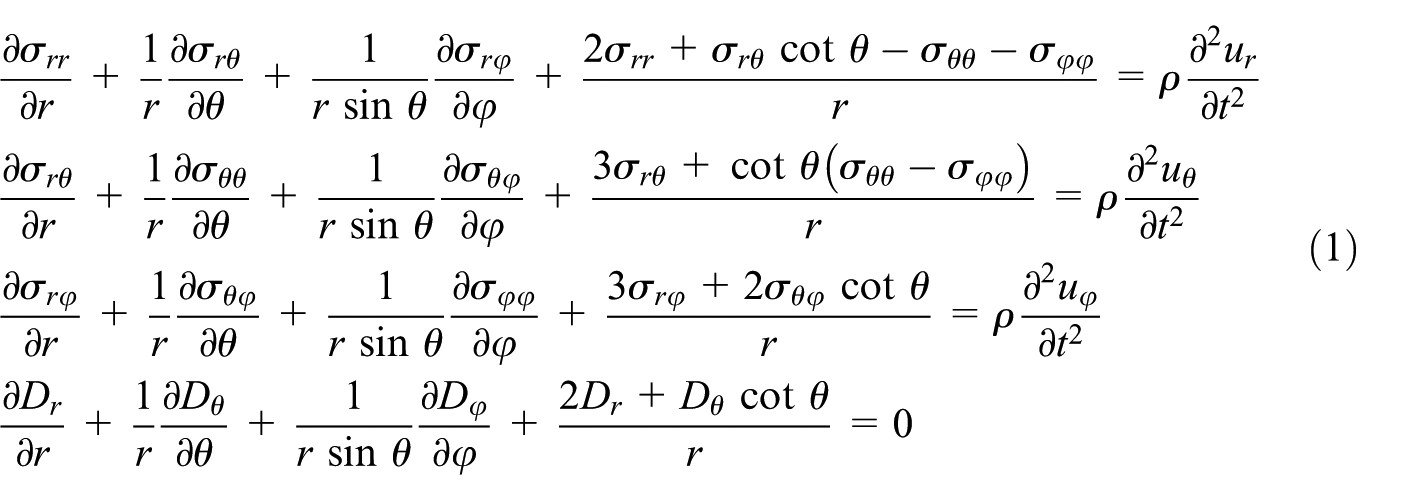


where σij, εij, Di, and Ei denote the stress, strain, electrical displacement and electrical intensity components, respectively. ui denotes the mechanical displacement component in the ith (i = r, θ, φ) direction. Cijkl, ekij,
The relationship between the mechanical displacement and strain, and the relationship between the electrical intensity and electric potential on the basis of the quasi-static Maxwell’s equation are, respectively

where Φ is the electric potential.
The traction-free and electricity open-circuit boundary conditions require that

where f(r) is a rectangular window function, and its derivative is
For the wave propagating in the circumferential direction of a piezoelectric spherical waveguide, the electric potential and the mechanical displacement can be written as

where Ui and X represent the vibration amplitude in the ith (i = r, θ, φ) direction and the amplitude of electric potential, respectively. k and
We substitute equations (3)–(5) into equation (2) with following substitution into equation (1). Consequently, the governing differential equations about the electric potential and displacement components can be obtained. Here, the case of an orthotropic, piezoelectric spherical plate with radial polarization is given




where U, V, and W respectively represent the vibration amplitude in the radial and two tangential (θ and φ) directions. The subscript comma indicates the partial derivative with respect to the radius r.
Obviously, equations (6a), (6c), and (6d) are mutually coupled. They are associated with Lamb-like wave. Equation (6b) is independent since the material is orthotropic, which represents SH wave and can be solved analytically. Because equation (6b) is easily solved, we here just give the solving process of Lamb-like wave as below.
We expand the field quantities into the Legendre polynomial form as23,24
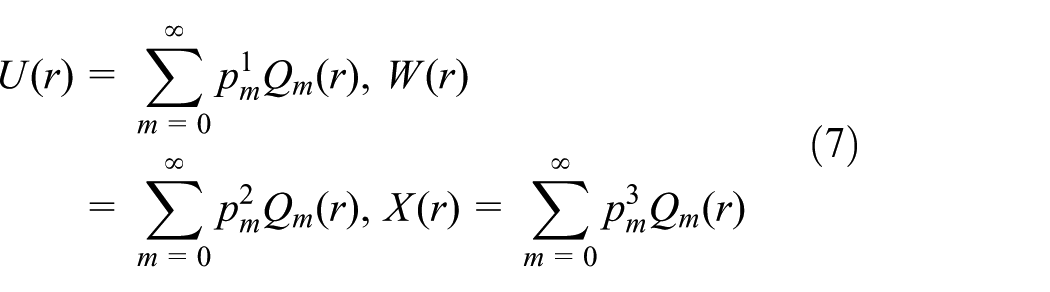
where
Substituting equation (7) into equations (6a), (6c), and (6d), then multiplying both sides of the modified equations (6a), (6c), and (6d) by a complex conjugate
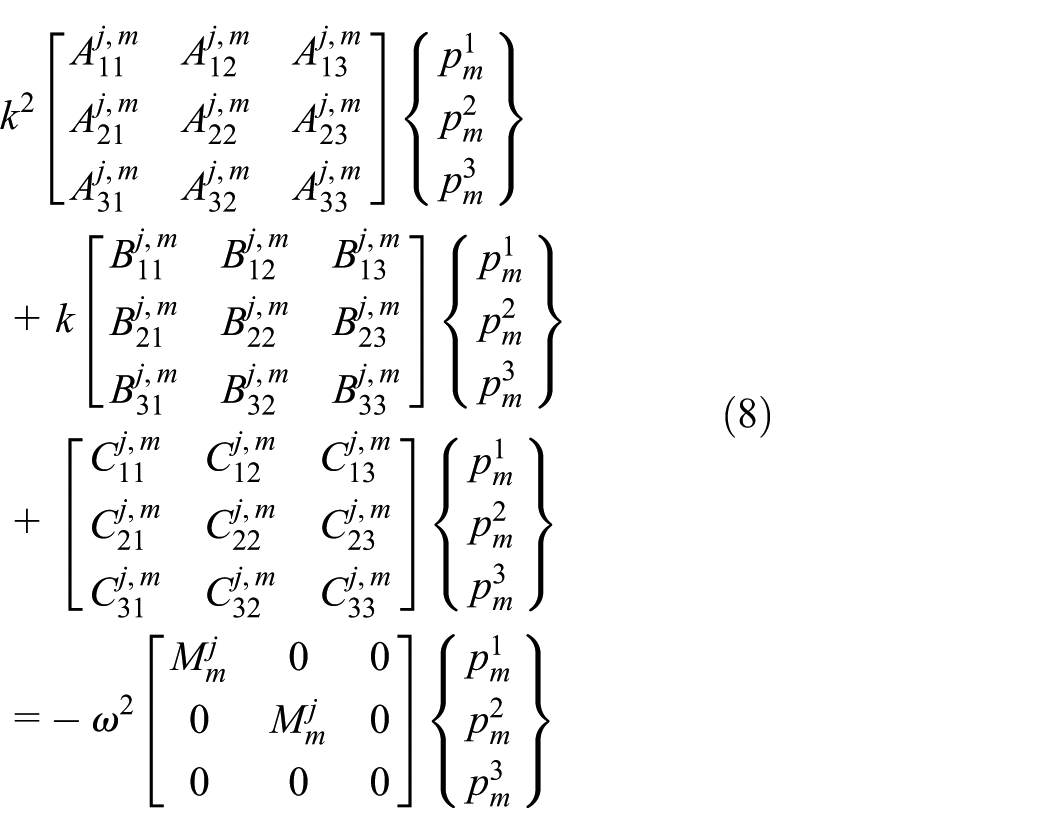
where
Equation (8) can be abbreviated as

where
Equation (9) is a positive-definite eigenvalue problem with real roots ω2. If our interest is in the propagating wave, as the previous research work, 8 it is very efficient to specify real k and then solve for ω. But for the non-propagating wave, the simple approach is not useful because wave number k is complex, thus leading to a multivariable search. In order to overcome this difficulty, we develop a new solution procedure as shown below.
Introducing a new column vector

That is,
Then, equation (9) can be written as

Multiplying the two sides of equation (11) by the inverse matrix

Combining equations (10) and (16) and defining

where
Up to this stage, the problem is transformed into a generalized eigenvalue solving problem. Equation (13) is easily solved to use the Mathematica function “Eigenvalues” for the problem of the type AX = λX, which can yield the complex wave number eigenvalues k(ω).
Numerical results
Approach and computer program validation
To the best of our knowledge, non-propagating wave in a piezoelectric spherical plate has not been presented before. In order to validate the presented approach and the computer program, we compute a piezoelectric spherical plate of large radius–thickness ratio, which may be equal to a plate. We compare our results with the existing ones of a piezoelectric plate from the reverberation-ray matrix method. The material is PZT-4 and the corresponding parameters are given in Table 1. The non-dimensional frequency
Material parameters of PZT-4.

Units: Cij (×1010 N/m2), eij (C/m), ϵ ij (×10−11 F/m2), ρ (×103 kg/m3).
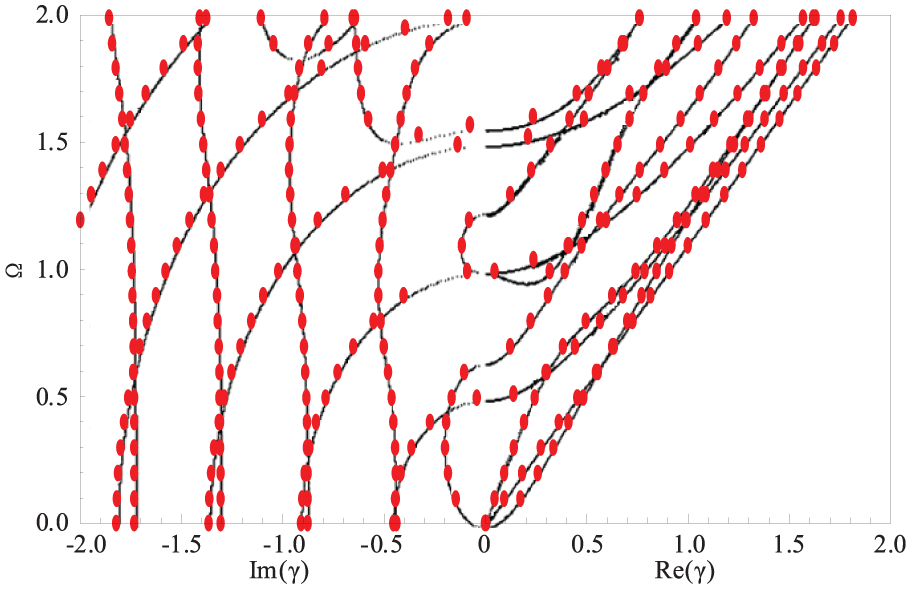
Dispersion curves: black dotted lines from the reverberation-ray matrix method and red dotted lines from the present method.
3D dispersion curves
Propagating guided wave has got a lot of attention, and here we put the emphasis on non-propagating guided waves in piezoelectric spherical structures. To have a better understanding of the nature of the non-propagating wave, a full 3D dispersion curve is plotted. The material is Ba2NaNb5O15 and the corresponding parameters are given in Table 2.
Material parameters of Ba2NaNb5O15.

Units: Cij (×1010 N/m2), eij (C/m), ϵ ij (×10−11 F/m2), ρ (×103 kg/m3).
The 3D complete dispersion curves of SH wave propagation in the piezoelectric spherical plate with η = 10 are given in Figure 2. For clarity, different colored dotted lines represent different modes. The dark blue ones are purely real solutions and green ones purely imaginary solutions. Since all of wave numbers corresponding to a given frequency is calculated at each time, the dispersion curves consist of a series of continuous Re(γ)–Im(γ)–Ω levels “slices.” The points that make up the dispersion curve become sparse when become close to the cutoff frequencies on the Ω-axis. We can see from Figure 2 that SH non-propagating wave has only the purely imaginary mode. These solutions including the real and imaginary always come out in pairs of opposite signs, which means that different wave fields are propagated in positive and negative directions. These non-propagating wave modes begin at the ω = 0 plane and terminate at a certain cutoff with increasing frequency. But SH propagating wave modes infinitely increase from the cutoff with increasing wave number. Interestingly, a purely imaginary mode transforms into a propagating wave mode at cutoff.

3D full spectrum of SH wave: dark blue dotted lines—purely real solutions; green dotted lines—purely imaginary solutions.
The 3D full spectrum of Lamb-like wave is given in Figure 3. Dark blue and green lines represent the same meaning with the above description, and red ones represent complex solutions. Figure 3 shows that Lamb-like non-propagating wave has purely imaginary modes and complex modes. For purely imaginary branches, some modes with small imaginary wave numbers usually begin at a certain cutoff and terminate the adjacent one, and form many arcs. Most modes with large imaginary wave numbers (greater than 0.2) usually begin at ω = 0 plane and terminate at cutoffs of the higher-order propagation modes, and their dispersion curves become approximately vertical lines at low frequency. Also with the increase of frequency, the value of the imaginary wave number gradually decreases and the curves become approximately horizontal lines. For complex modes, most modes begin at ω = 0 plane and collapse onto the local extremes of the real branches. This means that the complex branches convert into the propagating. With increasing frequency, some complex branches connecting two adjacent purely imaginary branches at high frequency appear, as pointed out in Quintanilla et al. 15 These complex branches start from the local maximum of one purely imaginary branch to the local minimum of another one. These curves indicate effectively the function of local extremes as potential wells that trap the complex branches. The properties of local extremes are not very clear at present. It was shown by Onoe et al. 25 that the location of local extremes is very sensitive to Poisson’s ratio and structural geometry. Some of the special complex branches mentioned above will have different characteristics with different Poisson’s ratios or structures of cross-section geometries, and some non-propagating wave modes will not even appear for different structures. Moreover, the spectra of Lamb-like wave are also symmetrical, and the conjugate of the complex wave number is also the solution of the equation.

Dispersion of Lamb-like wave: dark blue dotted lines—purely real solutions; green dotted lines—purely imaginary solutions; red dotted lines—complex solutions.
The phase velocity dispersion and attenuation curves of the first several propagating and complex modes of Lamb-like wave are shown in Figure 4. Dimensionless phase velocity and attenuation and frequency are respectively adopted as

Phase velocity dispersion and attenuation curves of Lamb-like wave, (a) and (b) are from different viewpoints; propagating wave in blue; non-propagating wave in red.
Influences of radius–thickness ratios and material piezoelectricity on dispersion
Considering the symmetry of the spectrum, only one quadrant is presented for clarity and comparison. Figure 5 shows the 3D spectrum for the piezoelectric spherical plate with a small radius–thickness ratio η = 2. Comparing Figures 2 and 3 with Figure 5, we can find that the wave number of SH non-propagating wave decreases with the decrease of the radius–thickness ratio, which means SH non-propagating wave decays more slowly for a piezoelectric spherical plate with a small radius–thickness ratio. For Lamb-like non-propagating waves, the real wave number of the complex branch is usually small and also becomes smaller with the decrease of the radius–thickness ratio. That means the propagation velocity of the non-propagating wave is decreased with the increase of the radius–thickness ratio. In contrast to the case of the large radius–thickness ratio, for the plate with a small radius–thickness ratio, the first inflection point of the purely real branch appears in the second-order mode.

3D spectrum for the piezoelectric spherical plate with η = 2: (a) Lamb-like wave and (b) SH wave.
Next, we investigate the influences of the material piezoelectricity on the dispersion. Assuming that piezoelectric and dielectric coefficients are zero and elastic parameters and mass density keep unchanged. The corresponding 3D spectrum for the spherical plate with η = 10 is shown in Figure 6, with the same color scheme as shown in Figure 3. Comparing with Figure 3, we can notice that the piezoelectricity has an evident influence on the propagating and non-propagating wave. Those purely imaginary branches beginning at 0 frequency and ending at the cutoff and those complex branches interconnecting two imaginary branches disappear (in the given range).

3D spectrum of Lamb-like wave for the elastic spherical plate.
Displacement and electric potential distributions
To reveal the characteristics of non-propagating waves, we calculate the distributions of the displacement and electric potential for a piezoelectric spherical plate with η = 10, which can be obtained by equations (5) and (7). Here we consider a special position (marked with a circle in Figure 3) where the complex branch first terminates at the minimal value of the fourth propagating mode, Ω, is about 0.7. The corresponding imaginary part of the complex wave number is very small. Figures 7 and 8 present the amplitude distributions of the displacement and electric potential in thickness direction and wave propagation direction, when Ω = 0.73248 and the corresponding complex wave number γ = 0.25894–0.04301i, and when Ω = 0.74045 and the corresponding real wave number γ = 0.23807, and when Ω = 0.73248 and the corresponding imaginary wave number γ = –0.28879i, respectively. We can note that the distributions are nearly symmetrical. Figures 7(a) and 8(a) indicate that the complex-valued modes can propagate a quite far distance (a few tens of the plate thickness) and show a damped sinusoid attenuation. Comparing Figure 7(a) with Figure 7(b), and Figure 8(a) with Figure 8(b), we can find that the corresponding displacement uφ and electric potential distribution are almost identical, which indicates the non-propagating mode becomes propagating with increasing frequency. Figures 7(c) and 8(c) show that the non-propagating wave mode with purely imaginary wave number exponentially decays and does not propagate with propagation distance.

Displacement distributions: (a) complex wave number mode, (b) purely real wave number mode, and (c) purely imaginary wave number mode.
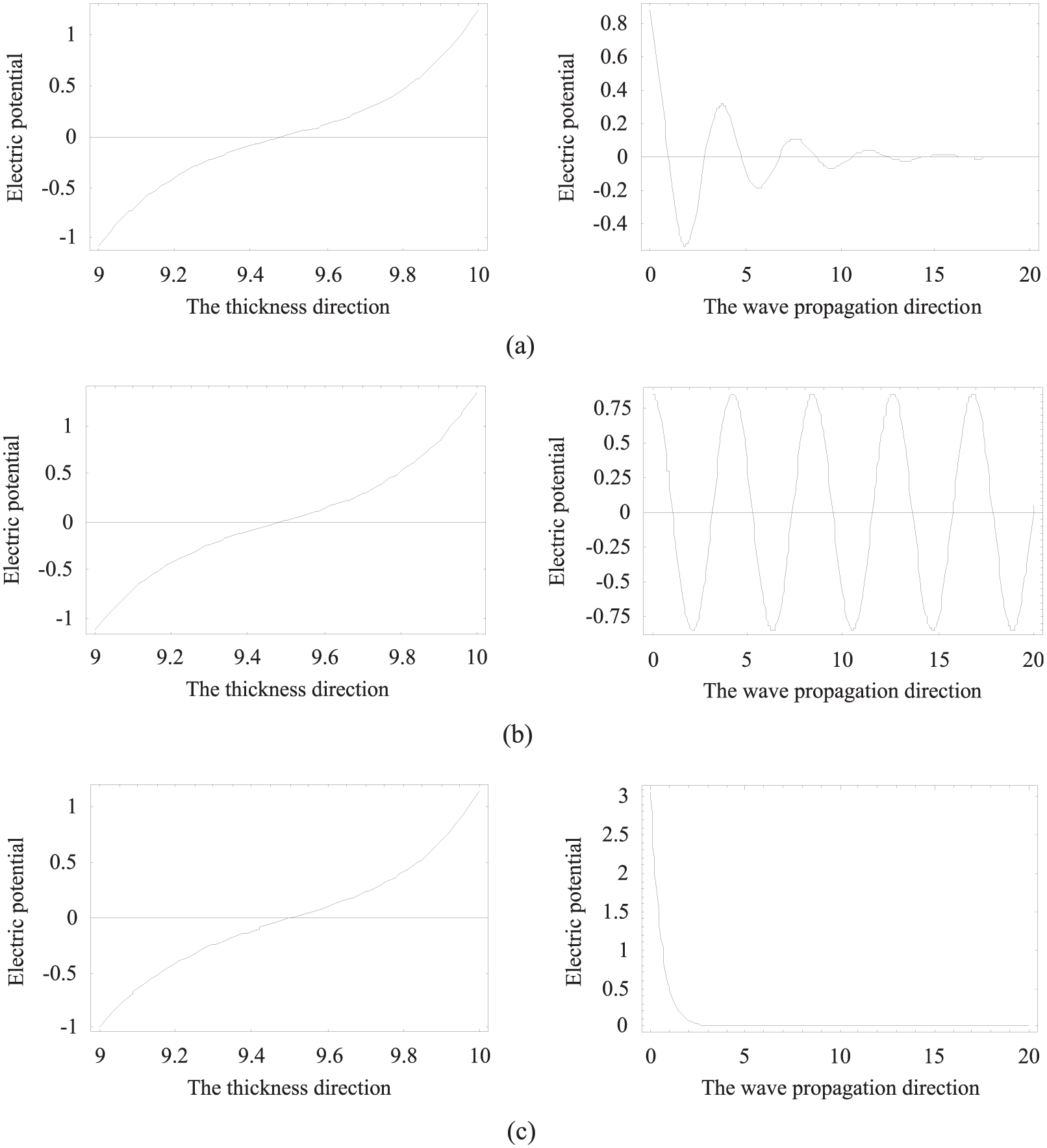
Electric potential distributions: (a) complex wave number mode, (b) purely real wave number mode, and (c) purely imaginary wave number mode.
Conclusion
An improved Legendre polynomial approach is successfully developed to investigate the non-propagating waves in a piezoelectric spherical plate. This approach enables one to determine the complex dispersion relations and to obtain the full spectrum. The correctness of this approach is verified by numerical results. Properties of non-propagating waves in various piezoelectric spherical plates are investigated. From the numerical results, some conclusions can be drawn as follows:
The presented approach can transform the coupled differential wave equations into an eigenvalue problem and can find all eigenvalues without iteration, including the real, imaginary, and complex root of the transcendental dispersion equation.
SH non-propagating wave has only the purely imaginary modes, and Lamb-like non-propagating wave has purely imaginary and complex modes. For complex modes, local inflection points occasionally occur on high-order real branches, and they turn into the propagating mode with increasing frequency.
The phase velocity of non-propagating (complex wave number) mode is much bigger than that of the propagating mode at high frequency, and the wave dispersion is very weak for the complex mode in some frequency ranges.
The influence of radius–thickness ratio and material piezoelectricity on the non-propagating wave is evident. The decay of the non-propagating wave becomes slower with reducing the radius–thickness ratio.
The purely imaginary-valued mode decays exponentially and does not propagate with propagation distance. But the complex-valued modes can propagate a quite far distance and show a damped sinusoid attenuation.
Footnotes
Appendix 1
where
Handling Editor: Muhammad Akhtar
Declaration of conflicting interests
The author(s) declared no potential conflicts of interest with respect to the research, authorship, and/or publication of this article.
Funding
The author(s) disclosed receipt of the following financial support for the research, authorship, and/or publication of this article: The work was supported by the National Natural Science Foundation of China (no. U1504106), the fundamental research funds for the national outstanding youth project of Henan Polytechnic University (no. NSFRF140301), and the Program for Innovative Research Team of Henan Polytechnic University (T2017-3).
