




Abstract
Grouting engineering is widely used in water plugging for geotechnical engineering. However, grout is usually treated as a Newton fluid and the viscosity is considered unchangeable over time during the grouting design process. This study proposes a grout diffusion model for porous media that considers the variation in viscosity with time. The flow equation is derived for a single smooth tubule. Then, the microequation of Bingham grout flowing in porous media is obtained. Finally, an assembled diffusion model of spheres and cylinders for grouting using a perforated pipe is proposed. A numerical simulation method is used to verify the grout diffusion mode. The research results can guide grouting design and practical grouting engineering in water plugging and reinforcement.
Introduction
During the construction process of tunnels and underground engineering, many disasters of water inrush have occurred in China, for example, in the Yesanguan tunnel,1,2 the Yuanliangshan tunnel, 3 and the Qiyueshan tunnel.4–7 These disasters induce underground water and a crisis in the living environment near the project. Due to increasing viscosity with time, grouting has been widely used in water plugging and the reinforcement of tunnels.8–10 Through grouting, the permeability of rock and soil can be dramatically decreased, and the physical and mechanical behaviors can be significantly improved. This technique has been widely applied in geotechnical engineering to prevent underground water inflow and protect the environment.
New technologies and materials for grouting have been developed to a large extent. However, the growth in grouting mechanisms has been very slow, and the related theory substantially lags behind the requirements of grouting design and construction. There are four reasons for the slow development of grouting theory. First, the injected medium is complicated; second, grouts behave with various characteristics and changeable viscosity over time. Some non-Newtonian fluids show a time-dependent change in viscosity and nonlinear stress–strain behavior, in which the longer the fluid undergoes shear stress, the lower its viscosity. Third, the interaction among grouts, injected media, and underground water has not been clearly understood. Finally, grouting engineering is a concealed project that is difficult to detect.
There are many kinds of grouting from different aspects, such as the aim, target, and grout material. According to the theory of grout diffusion, grouting can be divided into many types: seepage grouting, 11 split grouting, 12 filling grouting, 13 jet grouting, 14 and so on. 15 Comparatively, the theory of seepage grouting is relatively mature and is represented by Maag’s spherical, Raffle’s cylindrical diffusion theory, Baker’s formula, Wallner’s formula, and G. Lombardi’s formula from which some grout diffusion formulas have been developed.16–23 Cement materials and grout injection models are two critical parts in grout diffusion study. Some studies discussed different cement materials, such as Portland cement and silica fume, and compared the performances of various grout injection models.24,25
Due to its low price and maturity, cement slurry has been widely applied. During practical cement grouting, perforated pipes and cement-based slurries with water-to-cement ratios between 0.8 and 1.0 have been extensively employed. In these studies, the time features and the corresponding control methods have been considered.26–36 A starting pressure is required to initiate flow without considering the underground water pressure. Therefore, the cement-based slurry belongs to a Bingham fluid instead of a Newton fluid. Therefore, the cement slurry should be treated as a Bingham fluid during the grouting design and construction process. However, currently, we regard cement grouts as Newton fluids.
With the exception of grout properties, the diffusion rule should also be implemented. As it is known, in grouting design, spherical and cylindrical grout diffusion formulas have been used. However, based on the practical pre-grouting of tunnel faces and the results of indoor tests, the shape of cement paste is not exactly a sphere or a cylinder. We also need to study the grout diffusion model to improve the theory of grouting.
Based on the above discussion, an assembled diffusion model with Bingham grout jetted into a porous medium and a variable viscosity in time is proposed in this article. A porous medium is a medium that contains pores, and the pores are typically filled with a fluid. In addition, a skeletal medium is usually a solid with a foam-like structure. During this study, the injected medium is simplified to an isotropic and homogeneous medium, and underground water is treated as a source of pressure. The dilution and mixing of the water and grout are not considered in this study. The diffusion distance of cement grout under different grouting pressures and void ratios is analyzed. The detailed derivation process and the simulated results are described. The spherical and cylindrical diffusion equation is used to certify the results, which show that the spherical and cylindrical formula is a special example. Finally, the results of the numerical computational method also agree with the diffusion mode.
Diffusion mechanism of Bingham grouts
The diffusion mechanism of Bingham grouts is based on the rheology equation. The flow equation has been derived for a single smooth tubule. The rheological equation of Bingham fluids is represented by

where
The law for the variation in viscosity with time is expressed as

where
From equations (1) and (2), the rheological equation of a Bingham fluid considering the time-dependent viscosity is obtained at a given time t, which is as follows

At a given time t, selecting a representative elementary volume (REV; Figure 1) and using the mechanical equilibrium analysis method, equation (4) can be established

where p, l, and r represent the pressure, the grouting radius at a given time, and the radius, respectively. Equation (4) can be simplified as follows

Substituting equation (5) into equation (3), the following equation can be obtained

At the same time, considering


Flow diagram of the Bingham fluid.
A non-slip boundary condition is used at the pipe’s inner surface, namely,

Based on the flow pattern of the Bingham fluid in the thin pipe, as shown in Figure 1, the velocity of the Bingham fluid with slow migration (while considering the variation in viscosity with time) can be described as follows

The quantity of flow passing through the pipe’s given section per unit time is the sum of the flow in the piston section and the shear slippage section. The flow quantity per unit time can be represented as follows

Substituting equation (9) into equation (10), the flow quantity Q per unit time can be expressed as equation (11)

Substituting equation (7) into equation (11), the flow quantity Q per unit time can be reached as follows

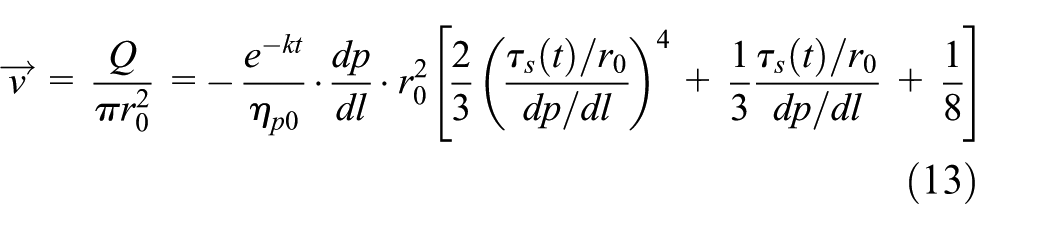
Therefore, the average velocity at a given time t in the pipe can be expressed as
If the Bingham fluid can flow in the pipe, then the primary shear stress

Equation (14) can also be expressed as

Defining

where
Assuming that the grouted media is a porous isotropic media, and its porosity is

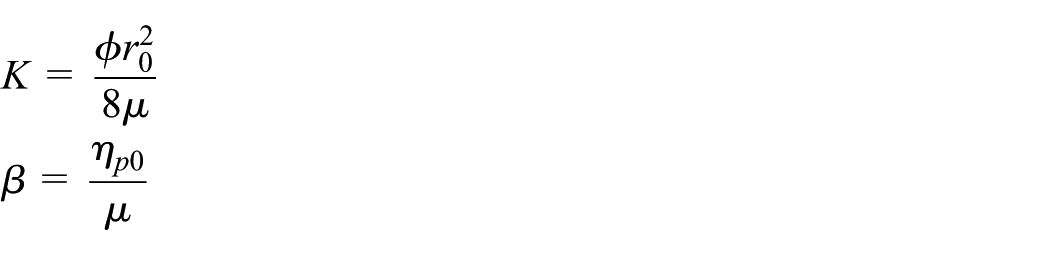
To facilitate usage, two variables, K and
Thus, equation (16) can be transformed to the following format

Equation (17) is the equation of Bingham grouts considering the viscosity variation with time in isotropic porous media.
Combined diffusion model of cement slurry flowing in porous media
For grouting in tunnels or other underground engineering, a perforated pipe is widely applied to avoid the collapse of a grouting hole and to reinforce the surrounding rock. During the whole grouting process, the driven force of grout flow is unbalanced. The grout flow is in the same direction as the driven force, so the cement slurry should fill the pipe first and then diffuse into the voids or fractures of the injected media. Therefore, there are two stages for the whole grouting process. In the first stage, the grout fills the pipe. The diameter of the pipe is approximately 42 mm, and its volume is small. The pipe also has a small resistance because of its hollow structure. Therefore, the first stage of the grouting process is very short. In the second stage, the grout is injected from the pipe into the surround media. Compared to the second stage, the first stage is very short in time and its influences are relatively small, so the first stage is not discussed in this article.
By investigating the injecting cement paste of the grouting practice and indoor tests, when using a perforated pipe, grout diffusion occurs along the cylindrical part of the pipe and in the spherical part of the pipe at the end point. The diffusion scheme is shown in Figures 2 and 3. The blue and black arrows represent the grouting pressure and underground water pressure, respectively.
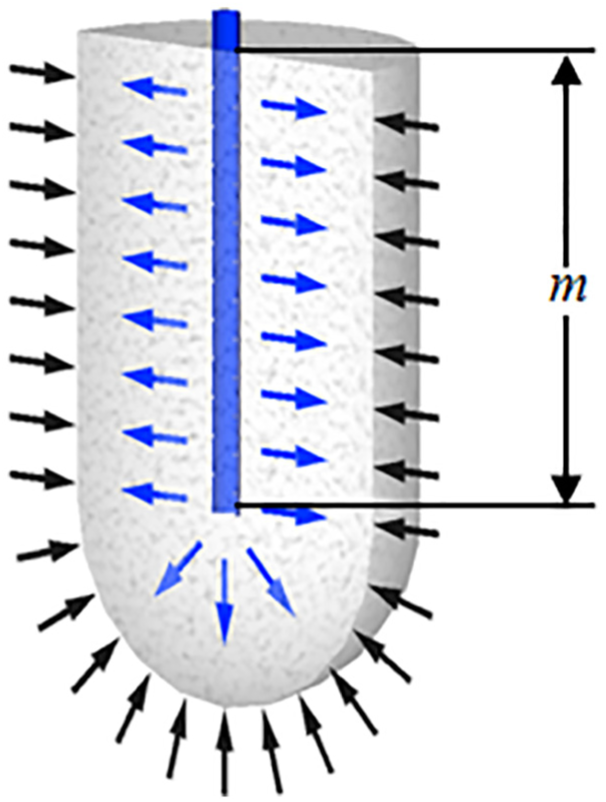
Profile of the plugging.
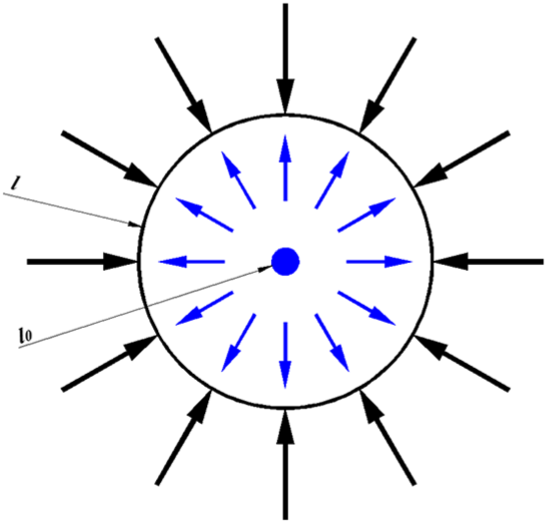
Top view of the plugging.
In this research, several assumptions are adopted. First, the grouted medium is treated as an isotropic medium; second, the grout is assumed to be an isotropic media with a variable viscosity in time; third, slurry permeates into the grouted medium after filling the pipe; fourth, the migration of slurry in the injected medium belongs to laminar conditions, which conforms to Darcy law; and finally, the effect of gravity is ignored. The theoretical permeation model is shown in Figures 2 and 3, where

Combining equations (17) and (18), equation (19) can be obtained by integration

From equations (17)–(19), we can obtain the relationship between the grouting pressure p, the grouting volume Q, and the radius of grouting l
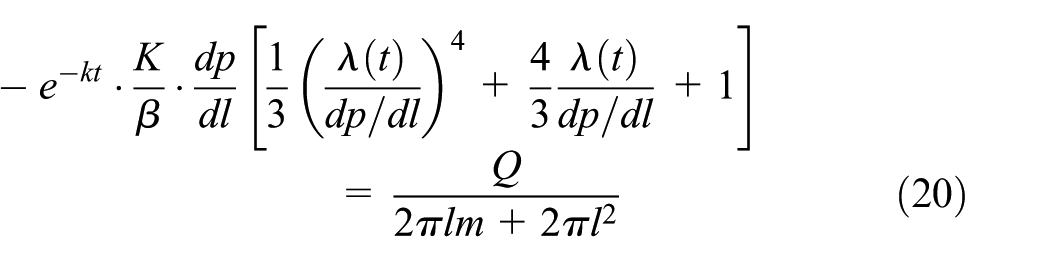
In the beginning of the grouting period, the injection pressure is much higher than the yield pressure of the Bingham fluid. This parameter is shown as

From equation (21), we can obtain the grout diffusion governing equation as follows. Equation (21) includes several variables, such as the injection pressure, the diffusion radius, and the grout property

For the kind of slurry that does not consider time-dependent viscosity, equation (22) can be simplified as follows

Considering the boundary and initial conditions, at the beginning of grouting, the time is
Considering the boundary and initial conditions, the integration of equation (23) yields
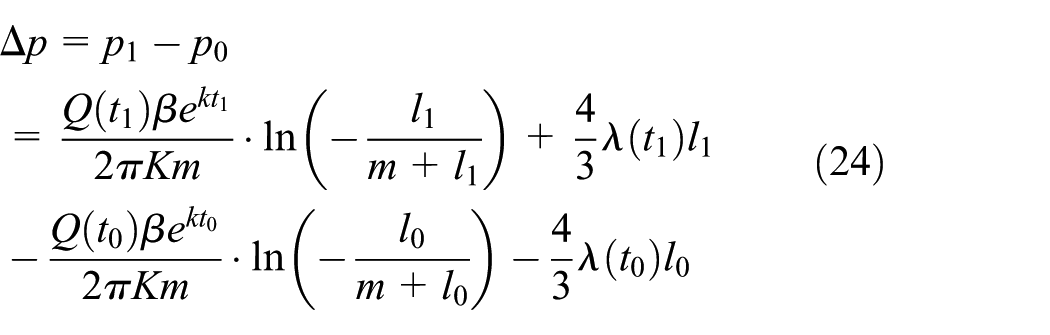
where
During the whole grouting process and based on this diffusion pattern, the total grout quantity injected into the isotropic medium can be expressed as follows
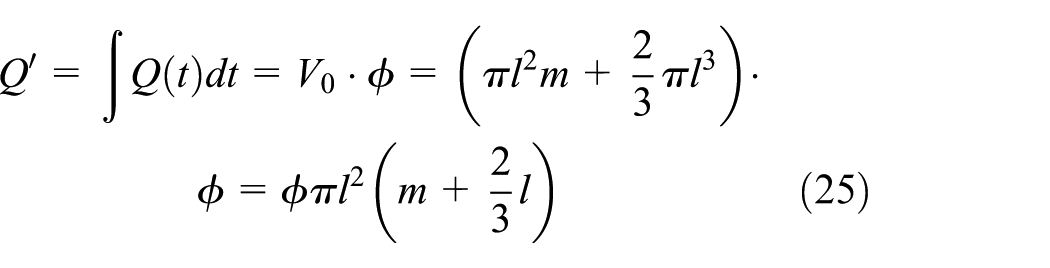
By simplification, at time t, equation (25) can be transformed as follows

For the Bingham grouts without considering the viscosity time variation, equation (24) can be simplified as follows
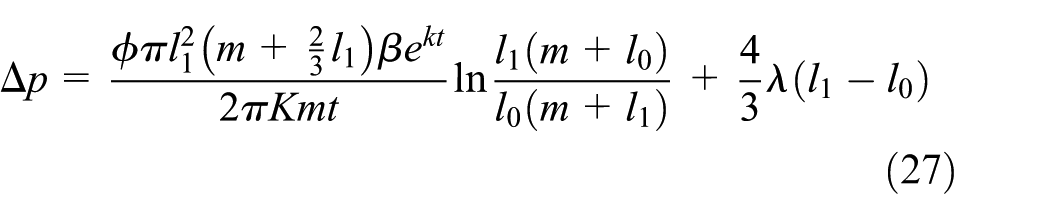
For Newtonian grouts without considering the viscosity time variation, equation (24) can be simplified as follows

Verification of the grout diffusion model
Based on classical theory, the grout diffusion model proposed in this article is verified by a numerical simulation method.
Classical theory
1. When m tends to infinity, equation (28) can be simplified as equation (29)

The classical theory of grout column diffusion is as follows

where
2. When m tends to

For the reason of

This equation is Maag’s formula 37 of a Newtonian fluid that seeps into the porous media. Therefore, Maag’s formula is also a special example of this study’s results.
Verification by numerical simulation
Geometric model
The various parameters in the geometric model are selected by repeated experiments. The length of the injected model square is 10 m. The injected pipe is located at the center. The depth and diameter of the pipe are 3 m and 10 cm, respectively, as shown in Figure 4.

The geometric model.
Introduction of the simulation
Taking the coarse sand of the yellow river as the injected medium, the porosity is 39% and the bulk density is 1480 kg/m3. The pressure of the surrounding underground water is 0.2 MPa. The cement grout with a water cement ratio of 0.8 belongs to the Bingham fluid, and the density and dynamic viscosity are 1350 kg/m3 and 20 MPa·s, respectively. The environment temperature is 20°C.
The flow rate of the grout poured into the injected media by the pipe is 1 m3/s, and the grouting time is 2700 s. The entire outer boundary is treated as a continual boundary, and the grout gravity is neglected.
Computational results
To obtain the diffusion model of Bingham fluid flow in porous media, computational fluid dynamics (CFD) software is used, and some results are obtained. CFD software is a tool with amazing flexibility, accuracy, and breadth of application.
The diffusion mode is generally fit to a cylindrical–spherical shape. The three-dimensional results are shown in Figure 5. The vertical and longitudinal views are shown in Figures 6 and 7, respectively. The diffusion range of the grout changes with time, as shown in Figure 8. At the beginning, the grout radius increases quickly, and then the velocity decreases with time, but the shape of the region remains as cylindrical–semispherical. This effect is because the grout quickly extends with a small radius at the beginning. With continuous injection of the grout, the grout slowly extends. Thus, the grout radius quickly increases. Due to the same pressure on the grout from all directions, the region still maintains the same shape.

3D form of grout diffusion.

Vertical view of the grout pressure.

Longitudinal view of the grout pressure.

Grout region enlarged with time.
By analyzing the results of the numerical simulation, the velocity of grouting can be obtained. Using the integration method, the volume flow rate is reached, as shown in Figure 9. The results of the numerical simulation and theoretical formula are very similar, that is, the largest difference is 4.87%, the smallest difference is 0.56%, and the average difference is 2.03%. In addition, 93.3% of the result points exhibit a difference of less than 4%. As time develops, the variance decreases. The difference may be caused during the determination of the values of m and l from Figures 8 and 3. The correctness of the combined transport pattern of the slurry and the diffusion theoretical formula is verified, as shown in Figure 9. The numerical simulation method is used to verify the model validity, and the simulation result of the diffusion shape is similar to the cylindrical–semispherical mode proposed by this work.
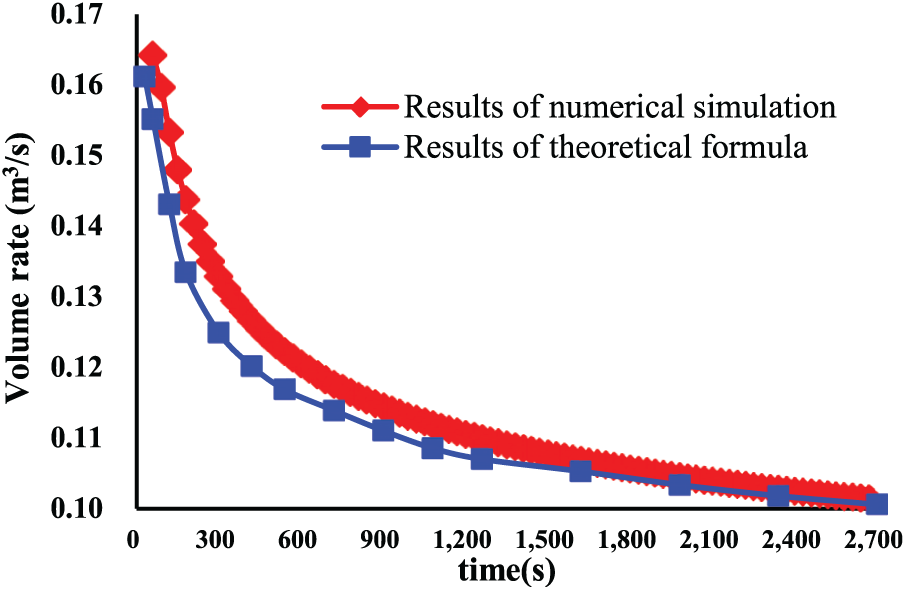
Change in mean volume flow rate with time.
Conclusion
This study is based on the rheology equation and considers the variation in viscosity with time. The flow equation is derived for a single smooth tubule. Then, the microequation of Bingham grouts flowing in the porous media is obtained. The main conclusions are listed as follows:
By field investigation and survey, the grout diffusion mode of cylindrical–semispherical is proposed, which fits grouting using a pipe with a many-hole uniform layout.
Based on the diffusion mode, the formula of Bingham grouts considering the viscosity changing with time has been derived. The relationship among the grouting pressure, diffusion radius, grouting time, and grouting parameters is determined.
Classical theory is used to verify the mode validity, and the results show that the classical formula of the cylinder and sphere mode is one of the special cases for this study.
The numerical simulation method is used to verify the mode validity, and the simulation result of the diffusion shape is similar to the cylindrical–semispherical mode proposed by this work.
The evaluation indicators of the results are minimal in this article. More evaluation indicators will be introduced to scientifically explain the results in the future. Further studies will provide additional contributions to grout diffusion in composite structures. Furthermore, the grout fills the pipe during the first stage of the grouting process. However, the first stage is not discussed in this article. Further investigations will consider the first stage of the grouting process.
Footnotes
Handling Editor: Gang Chen
Declaration of conflicting interests
The author(s) declared no potential conflicts of interest with respect to the research, authorship, and/or publication of this article.
Funding
The author(s) disclosed receipt of the following financial support for the research, authorship, and/or publication of this article: This study was supported by the National Natural Science Foundation of China (nos 51108387, 51678495, and 51578463).
