



Abstract
The voting system is a kind of redundant system, and the k-out-of-n system and consecutive k-out-of-n system have been widely used in engineering practice. In this article, the marginal reliability importance and joint reliability importance in k-out-of-n: F systems and consecutive k-out-of-n: F systems are studied for some situations. Then, some properties and relevant remarks of the marginal reliability importance and joint reliability importance in two kinds of system models are analyzed for parameters p, k, and n. Finally, an oil pump transportation system is used to demonstrate the proposed method and illustrate the feasibility and practicality of the model.
Introduction
A (consecutive) k-out-of-n: F system consists of an ordered sequence of n components such that the system fails only when at least k (consecutive) components fail. 1 In redundant systems, the (consecutive) k-out-of-n systems have a wide range of applications in reliability engineering, such as oil pipeline, long-distance telecommunication systems, multi-engine system in an airplane, relay stations, and the multi-pump system in a hydraulic control system.1,2 Importance measures can be used to identify the key components and improve the system reliability. Different kinds of importance measures have been proposed and studied in redundant systems.3–8 Based on the differences in reliability evaluation,9–13 the corresponding importance measures have been used to evaluate the effect of components on the reliability of the voting system. Dui et al.14,15 introduced the increase potential importance in consecutive k-out-of-n: F system based on the system performance level and repairable k-out-of-n: G systems. Si et al. 16 and Dui et al. 17 analyzed the component reliability importance indices with respect to the changes of the optimal component sequencing in linear consecutive k-out-of-n: F and G systems. Cai et al. 18 analyzed the optimization of consecutive k-out-of-n system using the Birnbaum importance. Yao et al.19,20 and Zhu et al. 21 analyzed the component assignment problems in consecutive k-out-of-n systems using the Birnbaum importance.
The marginal reliability importance measures the change in reliability of the system with respect to the change in the reliability of a certain component in the system.22,23 It can be used to find the component which has the largest effect on the reliability of voting system. Let R(p,k,n) represent the reliability of a system with n components that are statistically independent and identically distributed and p represent the probability of component functions, then the marginal reliability of component i in the system is defined as

However, the joint reliability importance (JRI) analyzes how much effect the interaction among components have on the reliability of the voting system.24,25 On the promise that components are statistically independent and identically distributed, the JRI of component pair (i, j) is defined as

for i ≠ j, and i, j = 1, 2, …, n.
Hong et al. 26 studied JRI of components in a k-out-of-n: G system. They presented a closed-form equation for the JRI of two components and examined its properties with respect to component reliabilities, and system parameters k and n. Gao et al. 27 extend the concepts of JRI and JFI (joint failure importance) of two components to multi-components and establish some relationships between JRI and JRI, JFI and JFI, and JFI and JRI. Rani et al. 28 studied conditional marginal and conditional JRI in series-parallel systems. Eryilmaz 29 studied JRI in a linear m-consecutive-k-out-of-n: F system. Considering the Markov-dependent components, Zhu et al. 30 analyzed the JRI in a m-consecutive-k-out-of-n: F system.
However, there is no attempt to derive exact formula of marginal reliability importance and JRI in the two kinds of voting systems above. In this article, we obtain general formula of marginal reliability importance and JRI in k-out-of-n: F systems and consecutive k-out-of-n: F systems. Furthermore, we perform the derivation of marginal reliability importance and JRI in k-out-of-n: F systems and consecutive k-out-of-n: F systems in detail. Besides, we propose some remarks about parameters p, k, and n and analyze the effects of the importance values of the change of the system reliability with respect to the parameters. Then, we use oil pump transportation system (a consecutive k-out-of-n: F system) to illustrate the practicality of the model and propose some suggestions on the improvement of the system reliability.
The rest of the article is as follows. Section “Importance analysis in k-out-of-n: F systems” analyzes corresponding remarks about marginal reliability importance and JRI in k-out-of-n: F systems. The corresponding remarks of marginal reliability importance and JRI are analyzed for linear consecutive k-out-of-n: F systems and circular consecutive k-out-of-n: F systems in section “Importance analysis in consecutive k-out-of-n: F systems.” Also, section “Importance analysis in consecutive k-out-of-n: F systems” derives exact formula of marginal reliability importance in linear consecutive k-out-of-n: F systems and circular consecutive k-out-of-n: F systems and JRI in linear consecutive k-out-of-n: F systems. An application is presented to illustrate the proposed remarks in section “Case study: pump transportation system.” Section “Conclusion and future work” gives the conclusion of this article.
Importance analysis in k-out-of-n: F systems
The calculation and analysis of marginal reliability importance in k-out-of-n: F systems
The calculation of the marginal reliability importance in k-out-of-n: F systems
The marginal reliability importance measures the change in reliability of the system with respect to the change in the reliability of a certain component in the system. The improvement of the component with the largest magnetic resonance imaging (MRI) value in the system can lead to the maximum increase in system reliability, which can be used to determine which component should be improved first to maximize the system reliability, such as the reliability design and the system optimization. Therefore, the marginal reliability importance is the most fundamental importance analysis of k-out-of-n: F system.
First, we know that the reliability of k-out-of-n: F system is

where
According to the definition of the marginal reliability importance, we know that

Substituting equation (1) into equation (2), we can obtain

And when the components of the system are independently and identically distributed, the reliability equation for the k-out-of-n: F system is

Substituting equation (4) into equation (3), the marginal reliability importance of the component i in k-out-of-n: F system MRI(i) is

Analysis of the relevant remarks of the marginal reliability importance in k-out-of-n: F systems
In (consecutive) k-out-of-n systems, Cai et al. 18 considered three different types of components, as low, high, and arbitrary reliable components with different scale. When n ≥ 20, (consecutive) k-out-of-n systems are the large systems, and the changes in importance values are good and advantageous. 18 When the n, k, and p take different values, the importance values may vary much. Thus, in the following discussions of Remarks, we will consider the large systems with component reliabilities of different scale.
Remark 1
The value of MRI(i) in k-out-of-n: F system first increases rapidly and then decreases rapidly with the increase in the value of p. After that, it decreases slowly and approaches 0 infinitely.
Here, we take i = 8, k = 4, and n = 20 as an example. When values of p are different, different MRI(i) values can be obtained. The results are as follows.
According to Figure 1, the value of MRI(i) in k-out-of-n: F system first increases rapidly and then decreases rapidly with the increase in the value of p. When the value of p is within (0, 0.2), the value of MRI(i) increases rapidly. When the value of p is within (0.2, 0.35), the value of MRI(i) decreases rapidly. When the value of p is within (0.35, 0.5), the decreasing rate of the value of MRI(i) decreases. When the value of p is within (0.5, 1), the value of MRI(i) remains unchanged generally and approaches 0 infinitely.

The MRI(i) with the change of p in k-out-of-n: F systems.
Remark 2
The value of MRI(i) in k-out-of-n: F system first increases slowly and then decreases rapidly with the increase in the value of k. After that, it decreases rapidly and approaches 0 infinitely.
Here, we take i = 8, p = 0.8, and n = 30 as an example. When values of k are different, different MRI(i) values can be obtained. The results are as follows.
According to Figure 2, the value of MRI(i) in k-out-of-n: F system increases first and then decreases with the increase in the value of k. When the value of k is within (0, 15), the value of MRI(i) increases slowly and the value is low. When the value of k is within (16, 24), the value of MRI(i) increases rapidly. When the value of k is within (25, 30), the value of MRI(i) decreases rapidly and decreases to 0 when k = 30.
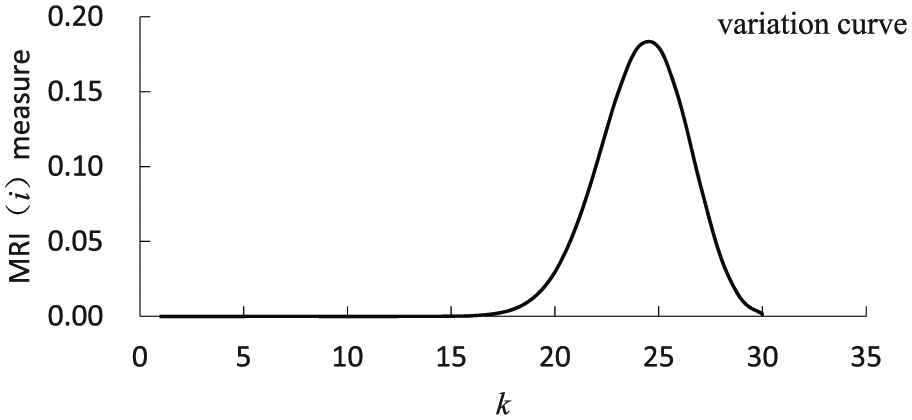
The MRI(i) with the change of k in k-out-of-n: F systems.
Remark 3
The value of MRI(i) in k-out-of-n: F system reduces monotonically with the increase in the value of n and approaches 0 infinitely.
Here, we take i = 8, p = 0.8, and k = 4 as an example. When the values of n are different, different MRI(i) values can be obtained. The results are as follows.
From Figure 3, the MRI(i) value in the k-out-of-n: F system decreases monotonically with the increase in the value of n. The value of n is not smaller than k, so there is no MRI(i) value in [0, 4]. When the value of n is within (4, 5), the value of MRI(i) increases rapidly. When the value of n is within (5, 10), the value of MRI(i) decreases rapidly. When the value of n is within (10, 30), the value of MRI(i) is very small and approaches 0 infinitely.

The MRI(i) with the change of n in k-out-of-n: F systems.
The calculation and analysis of JRI in k-out-of-n: F systems
The marginal reliability importance of components is the most fundamental importance analysis. However, the marginal reliability importance can only reflect how much influence the reliability of a certain component has on the reliability of the whole system. It cannot be ignored that the interaction among components in the system also has a non-negligible effect on the reliability of the system. The JRI analyzes how much influence the interaction among components have on the reliability of the k-out-of-n: F system.
The calculation of JRI in k-out-of-n: F systems
In the following, we will take the JRI of component pair (i, j) as an example to derive, thereby we will get a more general conclusion.
The JRI in k-out-of-n: F system is

When the components in the system are independently and identically distributed

It can be seen from equation (4) that when the component i and component j are both in working states, the reliability of system R(p, k, n – 2) is

In the same way, when the component i and component j are both in failing states, the reliability of system R(p, k, n – 2) is

When the component i is in a failing state while component j is in a working state, the reliability of system R(p, k, n – 2) is

Substituting equations (8)–(10) into equation (7), we can obtain

By further simplification, we get

Analysis for the relevant properties of the JRI in k-out-of-n: F systems
The parameters of k-out-of-n: F system will affect the calculation results of the JRI. Here, we will analyze the main parameters p, k, and n that affect the result.
Remark 4
There always exists a certain value of p, which makes the value of JRI(i, j) in k-out-of-n: F system be 0, and p = k – 1/n – 1.
Next, we will conduct relevant analysis and derivation of Remark 4 based on equation (12):
When p = k – 1/n – 1, JRI(i,j) = 0. Under this circumstance, component i has the same effect on the reliability of the system R(p,k,n) whether component j is in working state or failing state.
When 0 < p < k – 1/n – 1, JRI(i,j) > 0. Under this circumstance, component i has larger effect on the reliability of system when component j is in working state than in failing state.
When k – 1/n – 1 < p < 1, JRI(i,j) < 0. Under this circumstance, component i has larger effect on the reliability of system when component j is in failing state than in working state.
Remark 5
The value of JRI(i,j) in k-out-of-n: F system first increases rapidly to the maximum and then decreases to the minimum rapidly. Next, it increases quickly once again and approaches 0 infinitely. After that, the value of JRI(i,j) remains unchanged.
Here, we take k = 4 and n = 20 as an example. When values of p are different, different JRI(i,j) values can be obtained. The results are as follows.
From Figure 4, we know that the value of JRI(i,j) in k-out-of-n system first increases rapidly and then decreases rapidly with the increase in the value of p. After that, it increases quickly to 0. When the value of p is within (0, 0.1), the value of JRI(i,j) increases rapidly. When the value of p is within (0.1, 0.25), the value of JRI(i,j) decreases rapidly. When the value of p is within (0.25, 0.50), the value of JRI(i,j) increases at an increasing rate which is slightly smaller than the increasing rate in (0, 0.1) and approaches 0. When the value of p is within (0.5, 1), the value of JRI(i,j) remains unchanged generally.

The JRI(i,j) with the change of p in k-out-of-n: F systems.
Remark 6
The value of JRI(i,j) in k-out-of-n: F system decreases with the increase in the value of k monotonically.
Here, we take p = 0.8 and n = 20 as an example. When values of k are different, different JRI(i,j) values can be obtained. The results are as follows.
From Figure 5, we know that the value of JRI(i,j) in k-out-of-n system first decreases slowly and then decreases rapidly to the negative value with the increase in the value of k. When the value of k is within (0, 15), the value of JRI(i,j) decreases rapidly and stays around 0. When the value of k is within (15, 20), the value of JRI(i,j) is negative and decreases rapidly.
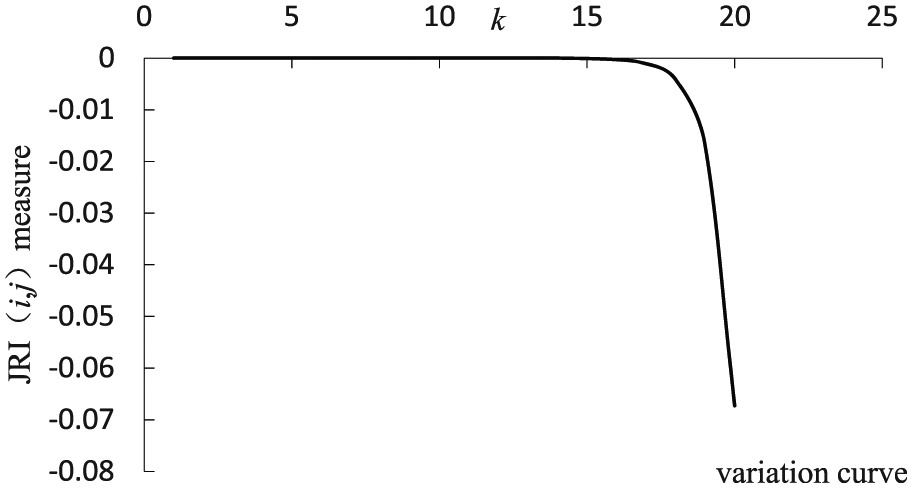
The JRI(i,j) with the change of k in k-out-of-n: F systems.
Remark 7
The value of JRI(i,j) in k-out-of-n: F system increases to the maximum rapidly and then decreases rapidly to the minimum with the increase in the value of n. Next, it increases rapidly once again and approaches 0 infinitely. After that, it remained unchanged generally.
Here, we take p = 0.8 and k = 4 as an example. When values of n are different, different JRI(i,j) values can be obtained. The results are as follows.
According to Figure 6, the value of JRI(i,j) in k-out-of-n system first decreases rapidly and then increases rapidly with the increase in the value of n. After that, it increases gradually to 0 and remains unchanged generally. When the value of n is within (0, 3), the value of JRI(i,j) makes no sense. When the value of n is within (4, 5), the value of JRI(i,j) decreases rapidly. When the value of n is within (5, 6), the value of JRI(i,j) decreases to the minimum at a decreasing rate which is slightly smaller than the decreasing rate in (4, 5). When the value of n is within (6, 12), the value of JRI(i,j) increases slowly. When the value of n is within (12, 30), the value of JRI(i,j) remains unchanged generally and approaches 0 infinitely.

The JRI(i,j) with the change of n in k-out-of-n: F systems.
Importance analysis in consecutive k-out-of-n: F systems
The consecutive k-out-of-n: F system is a system which contains n ordered components (in linear or circular form), and the system fails if and only if there are at least consecutive k components fails. There are two types of consecutive k-out-of-n: F systems: linear consecutive k-out-of-n: F systems and circular consecutive k-out-of-n: F systems. The difference between the two types of systems is whether there are definite beginning and ending components.
The consecutive k-out-of-n: F system model
Assuming that the components in the system are statistically independent and identically distributed, the reliability recurrence formula for the consecutive k-out-of-n: F system is

The exact formula for the reliability of linear consecutive k-out-of-n: F system is

The exact formula for the reliability of circular consecutive k-out-of-n: F system is

The calculation and analysis of marginal reliability importance in consecutive k-out-of-n: F systems
The calculation of marginal reliability importance in consecutive k-out-of-n: F systems
There are two types of consecutive k-out-of-n: F systems, and the different structures of systems will inevitably lead to different calculation results of marginal reliability importance. Next, we will perform the derivation of marginal reliability importance calculations of linear consecutive k-out-of-n: F system and circular consecutive k-out-of-n: F system.
The general formula of marginal reliability importance in consecutive k-out-of-n: F system is

When component i is in a failing state

It can be derived from the definition of marginal reliability importance as

Substituting what we obtain from equations (16) and (17) into equation (18), we can get
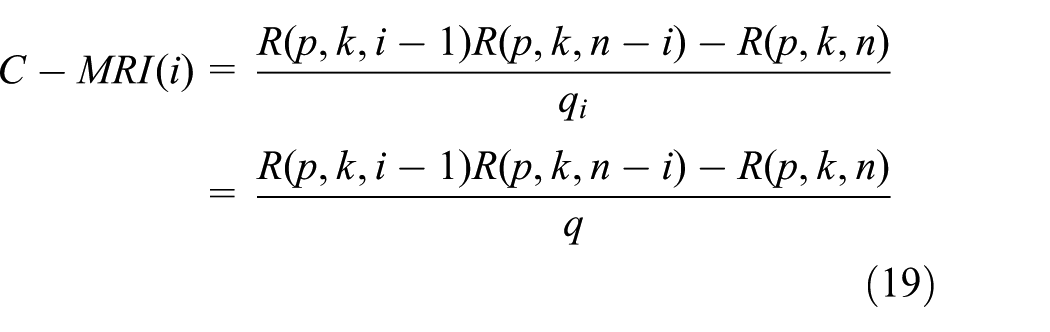
Equation (19) is the relationship between the marginal reliability importance and reliability of the consecutive k-out-of-n: F system. Then, substituting equations (14) and (15) into equation (19), we can get the marginal reliability importance of linear consecutive k-out-of-n: F system and circular consecutive k-out-of-n: F system as follows


Analysis of the relevant properties of the marginal reliability importance in linear consecutive k-out-of-n: F systems
Because there are two kinds of structures of consecutive k-out-of-n: F system, we will analyze them respectively. The parameters of the k-out-of-n: F system will affect the calculation result of marginal reliability importance. Next, we will analyze the relevant remarks of the marginal reliability importance in linear consecutive k-out-of-n: F systems.
Remark 8
The value of C-MRIL(i) in linear consecutive k-out-of-n: F systems first decreases slowly and then increases rapidly with the increase in the value of p. After that, it decreases quickly and approaches 0 infinitely.
Here, we take i = 8, k = 4, and n = 20 as an example. When values of p are different, different C-MRIL(i) values can be obtained. The results are as follows.
According to Figure 7, the value of C-MRIL(i) in linear consecutive k-out-of-n: F system first decreases and then increases with the increase in the value of p. After that, it decreases once again. When the value of p is within (0, 0.1), the value of C-MRIL(i) decreases slowly. When the value of p is within (0.2, 0.48), the value of C-MRIL(i) increases rapidly. When the value of p is within (0.48, 0.9), the value of C-MRIL(i) decreases rapidly. When the value of p is within (0.9, 1), the value of C-MRIL(i) decreases slowly and approaches 0 infinitely.

The C-MRIL(i) with the change of p in linear consecutive k-out-of-n: F systems.
Remark 9
The value of C-MRIL(i) in linear consecutive k-out-of-n: F system first increases rapidly and then decreases rapidly with the increase in the value of k. After that, it decreases slowly and approaches 0 infinitely.
Here, we take i = 8, p = 0.8, and n = 20 as an example. When the values of k are different, different C-MRIL(i) values can be obtained. The results are as follows.
From Figure 8, we know that the value of C-MRIL(i) in linear consecutive k-out-of-n: F system first increases and then decreases with the increase in the value of k. When the value of k is within (1, 2), the value of C-MRIL(i) increases rapidly. When the value of k is within (2, 3), the increasing rate of the value of C-MRIL(i) decreases. When the value of k is within (3, 4), the value of C-MRIL(i) decreases rapidly. When the value of k is within (4, 6), the value of C-MRIL(i) decreases slowly and approaches 0 infinitely.

The C-MRIL(i) with the change of k in linear consecutive k-out-of-n: F systems.
Remark 10
The value of C-MRIL(i) in linear consecutive k-out-of-n: F system first increases rapidly and then decreases rapidly with the increase in the value of n. After that, it decreases slowly.
Here, we take i = 8, p = 0.8, and k = 4 as an example. When values of n are different, different C-MRIL(i) values can be obtained. The results are as follows.
From Figure 9, we know that the value of C-MRIL(i) in linear consecutive k-out-of-n: F system first increases and then decreases with the increase in the value of n. When the value of n is within (0, 12), there is no value of C-MRIL(i). When the value of n is within (13, 16), the value of C-MRIL(i) increases rapidly. When the value of n is within (16, 18), the value of C-MRIL(i) decreases rapidly. When the value of n is within (18, 70), the value of C-MRIL(i) decreases slowly.

The C-MRIL(i) with the change of n in linear consecutive k-out-of-n: F systems.
Analysis of the relevant properties of the marginal reliability importance in circular consecutive k-out-of-n: F system
Remark 11
The value of C-MRIc(i) in circular consecutive k-out-of-n: F system first decreases rapidly and then increases slowly with the increase in the value of p. After that, it decreases slowly and approaches 0 infinitely.
Here, we take i = 8, k = 4, and n = 20 as an example. When values of p are different, different C-MRIc(i) values can be obtained. The results are as follows.
According to Figure 10, the value of C-MRIc(i) in circular consecutive k-out-of-n: F system first decreases and then increases with the increase in the value of p. When the value of p is within (0, 0.2), the value of C-MRIc(i) decreases rapidly. When the value of p is within (0.2, 0.5), the value of C-MRIc(i) increases slowly. When the value of p is within (0.5, 0.9), the value of C-MRIc(i) decreases slowly. When the value of p is within (0.9, 1), the value of C-MRIc(i) remains unchanged generally and approaches 0 infinitely.

The C-MRIc(i) with the change of p of circular consecutive k-out-of-n: F systems.
Remark 12
The value of C-MRIc(i) in circular consecutive k-out-of-n: F system first increases rapidly and then decreases rapidly with the increase in the value of k. After that, it decreases slowly and approaches 0 infinitely.
Here, we take i = 8, p = 0.8, n = 20 as an example. When the values of k are different, different C-MRIc(i) values can be obtained. The results are as follows.
From Figure 11, we know that the value of C-MRIc(i) in linear consecutive k-out-of-n: F system first increases and then decreases with the increase in the value of k. When the value of k is within (1, 2), the value of C-MRIc(i) increases rapidly. When the value of k is within (2, 3), the increasing rate of the value of C-MRIc(i) increases. When the value of k is within (3, 4), the value of C-MRIc(i) decreases rapidly. When the value of k is within (4, 6), the value of C-MRIc(i) decreases slowly and approaches 0 infinitely.

The C-MRIc(i) with the change of k in circular consecutive k-out-of-n: F systems.
Remark 13
The value of C-MRIc(i) in circular consecutive k-out-of-n: F system first increases rapidly and then decreases rapidly with the increase in the value of n. After that, it decreases slowly.
Here, we take i = 8, p = 0.8, and k = 4 as an example. When values of n are different, different C-MRIc(i) values can be obtained. The results are as follows.
From Figure 12, we know that the value of C-MRIc(i) in circular consecutive k-out-of-n: F system first increases and then decreases with the increase in the value of n. When the value of n is within (0, 12), there is no value of C-MRIc(i). When the value of n is within (13, 16), the value of C-MRIc(i) increases rapidly. When the value of n is within (16, 18), the value of C-MRIc(i) decreases rapidly. When the value of n is within (18, 70), the value of C-MRIc(i) decreases slowly.

The C-MRIc(i) with the change of n in circular consecutive k-out-of-n: F systems.
The calculation and analysis of JRI in consecutive k-out-of-n: F system
Similar to marginal reliability importance in consecutive k-out-of-n: F system, JRI also needs to be discussed according to different system structures. Therefore, we need to perform the derivation and analysis of the JRI in linear and circular consecutive k-out-of-n: F system, respectively. However, the derivation of JRI in circular consecutive k-out-of-n: F system is too tedious. In this article, we only perform the derivation of joint importance in linear consecutive k-out-of-n: F system.
In the following, we will take the JRI of component pair (i, j) in a linear consecutive k-out-of-n: F system as an example to derive.
From equation (6), we can know the basic expression of the joint importance in k-out-of-n: F system. On the premise that components in the system are statistically independent and identically distributed, we further derive the basic expression of the JRI in consecutive k-out-of-n: F system

Thus, for the computation of JRI of component pair (i, j), we need to evaluate the following two probabilities: P{W, Yi = 0} and P{W, Yi = 0, Yj = 0}.
For a consecutive k-out-of-n: F system consisting of n independent components with common working probability P{Yi = 0}= p

where

and
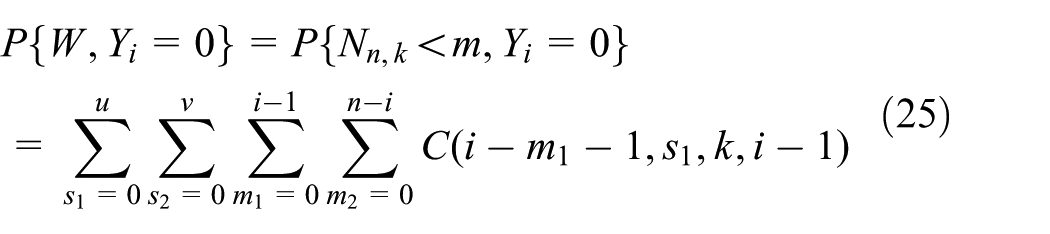
Thus, we can get

By conditioning on the number of working components, equation (26) can be rewritten as

The components are independent, so
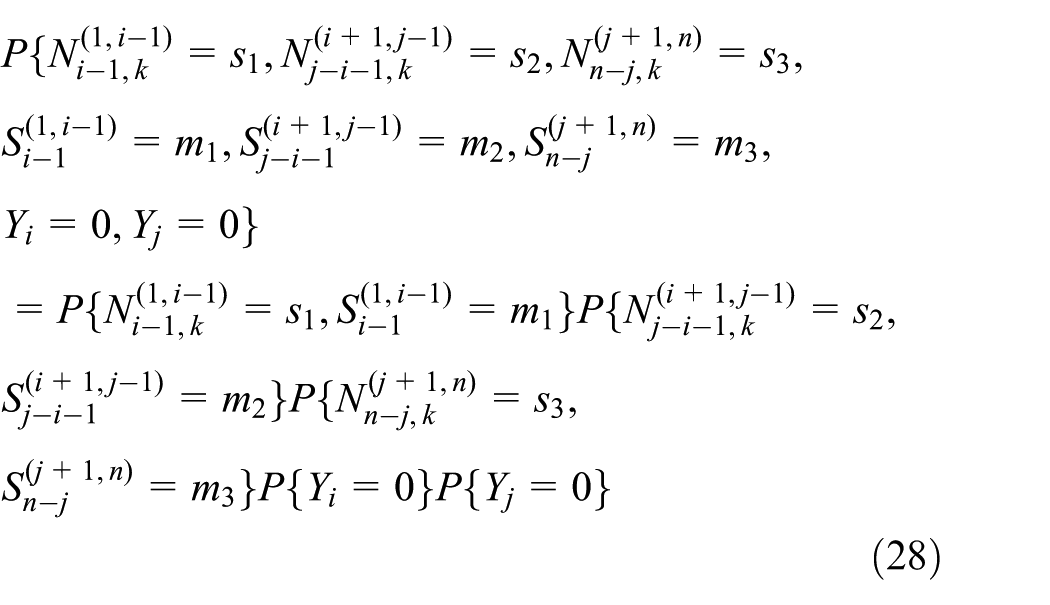
The number of ways for having s1 no overlapping failure runs of length k in a binary sequence of length i – 1 with m1 successes (working components) is given by C(i – m1 – 1, s1, k, i – 1).
Thus, we get


Substituting equation (30) into equation (27), we can obtain
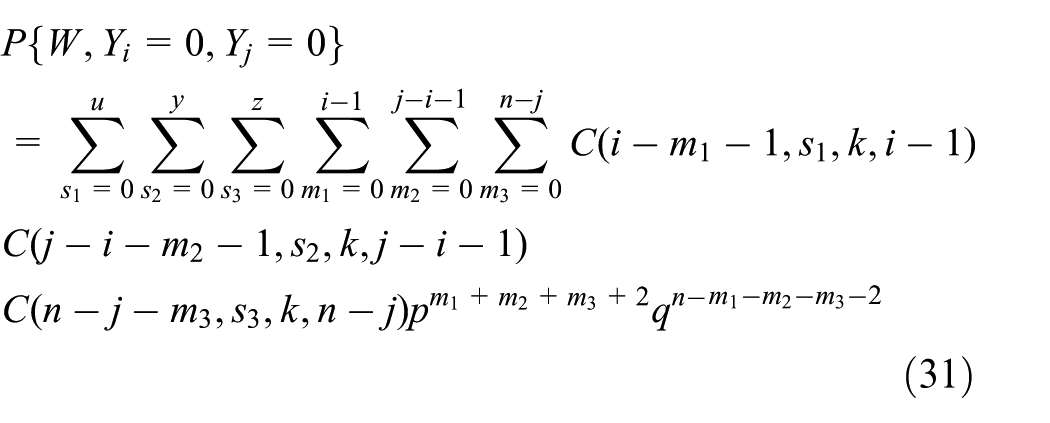
where

Substituting equations (25) and (31) into equation (22), we can obtain the expression of the JRI in linear consecutive k-out-of-n: F system as

Case study: pump transportation system
Oil is one of the indispensable sources of energy for today’s social development and it is an important condition for the economic development of a country. The transportation of crude oil and its products plays an important role in their production, transportation, and distribution links, and pipeline transportation is the most important link. In the pipeline transportation, the crude oil needs to be pressurized and heated by a pump station so that the transportation can be completed successfully. Once there are problems existing in this link, it will greatly affect the economic activities. Therefore, the reliability of pipeline transportation is particularly important. The reliability-based importance analysis of oil pump transportation systems is finding the weak links of the system to make corresponding improvements.
Every pump station has the same functions and can exchange positions arbitrarily, so the pipeline transportation system can be abstracted as a linear consecutive k-out-of-n: F system. The pumping stations in the system are the same components. However, due to various uncertainties such as the operating environment, we divide the reliability of the oil pump into the following 10 intervals: (0, 0.1), [0.1, 0.2), [0.2, 0.3), [0.3, 0.4), [0.4, 0.5), [0.5, 0.6), [0.6, 0.7), [0.7, 0.8), [0.8, 0.9), and [0.9, 1.0) and represent the reliability of pump station with the mean value of every interval. Table 1 shows the marginal reliability change of the oil pump transportation system with the change of p (take i = 8, k = 4, n = 30, for instance).
Marginal reliability importance with the change of p in oil pump transportation system.
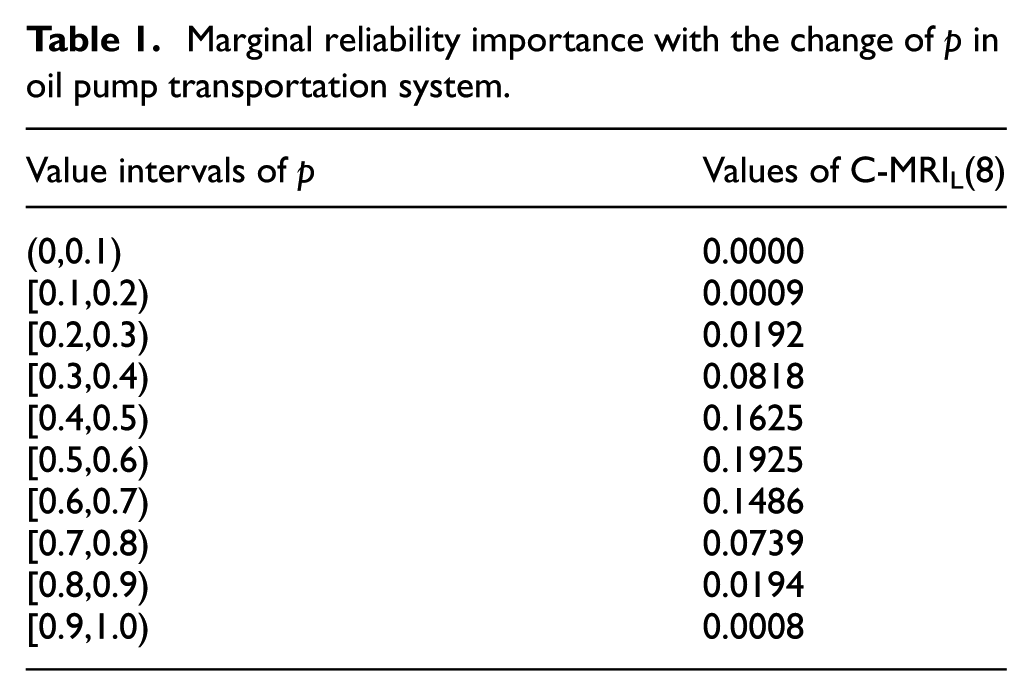
From Table 1, when the value of p is within (0.5, 0.6), the value of C-MRI reaches the maximum. At this time, the reliability of the eighth oil pump has the largest effect on the reliability of the system. The failure of the eighth oil pump will result in the failure of the entire oil pump transportation system in high possibility.
Next, we will analyze the reliability change of the oil pump transportation with the change of k (take i = 8, p = 0.9291, n = 30, for instance) as shown in Figure 13.

The C-MRIL(8) with the change of k in oil pump transportation system.
From Figure 13, when the value of k is small, the reliability of the eighth oil pump has the greatest effect on the reliability of the system. When the value of k increases, the effect decreases rapidly. It just proves the necessity of the existence of redundant components in the system.
In the following, we will analyze the reliability change of the oil pump transportation system with the change of n (take i = 8, p = 0.9291, k = 4, for instance) as shown in Table 2.
Marginal reliability importance with the change of n in oil pump transportation system.

From Table 2, if there are few oil pumps in the system, the reliability of the eighth oil pump has little effect on the reliability of the system. When the number of oil pumps reaches 17, the effect reaches the maximum. Then, the value of C-MRI(8) reduces and maintains at a relatively low level. It provides a way for optimizing the oil pump transportation system.
Conclusion and future work
This article analyzed the importance measures in two kinds of redundant systems: k-out-of-n and consecutive k-out-of-n: F systems. The main contributions can be summarized as follows:
The marginal reliability importance measures the change in reliability of the system with respect to the change in the reliability of a certain component in the system. The JRI analyzes how much effect the interaction among components have on the reliability of the voting system.
The changes of the importance values based on different parameters can be different. With the changes of p, k, and n, the importance values of different components have different effects on the system reliability. From the point of view of the improvement and stability of the system reliability, the change of p has the most effect on the system reliability.
In this article, in order to distinctly characterize the change of importance measures, we select parameters p, k, and n for a special case. Thus, this work can be extended to the general case of parameters p, k, and n to analyze the change of the system reliability. Moreover, it can also be extended to some systems with dependent components with maintenance policies. We can use the importance to identify the most influential components when considering maintenance policies adopted in the system life cycle.
Footnotes
Appendix 1
Acknowledgements
H.D. and L.C. conceived and designed the experiments. H.D. and L.C. proposed the idea of this paper. J.L. performed the experiments and analyzed the data. All authors have contributed to the editing and proofreading of this paper.
Handling Editor: Xihui Liang
Declaration of conflicting interests
The author(s) declared no potential conflicts of interest with respect to the research, authorship, and/or publication of this article.
Funding
The author(s) disclosed receipt of the following financial support for the research, authorship, and/or publication of this article: This research was supported by the National Natural Science Foundation of China (Nos 61807031, 61401403, and 71501173) and Scientific and Technological Research Project of Henan Province, China (No. 132102210560).
