



Abstract
Recently, the environmental issue caused by logistics of agricultural products has attracted a great deal of attention. In order to solve the problem, much of work focuses on green logistics to decrease environmental pollution. However, the green logistics evaluation system of agricultural products is insufficient. Therefore, establishing a reasonable green logistics evaluation system for agricultural products plays a key role in the development of green agricultural products. In this work, domestic and international environmental factors which affect the development of the green logistics of agricultural products are analyzed based on reduction, reuse, and recycling principle of circular economy. In addition, a series of evaluation indicators for green logistics of agricultural products are developed. A fuzzy analytic hierarchy process method is proposed to make a comprehensive evaluation for green logistics of agricultural products based on evaluation indicators. The method combined analytic hierarchy process and fuzzy theory, where a fuzzy transformation operator is introduced. The proposed method is applied for decision-maker in view of knowledge management. In order to verify the applicability of approach, the approach is applied to green logistics of Shandong agricultural products.
Introduction
With the improvement of living standards in China, there are great changes in many aspects, for instances, material food and consumption structure. Consumer demands for fresh produce, aquatic products, fruits, and vegetables are increasing strongly, which increases the vigor to develop logistics industry of agricultural products. Nowadays, the growth momentum of consumer demand is strong, and the development space for logistics of agricultural products is great in China. But there are still problems, such as late starting, relatively backward technology, and imperfect industry standard system, which lead to high cost and environmental pollution. Aiming at environmental pollution problem, much of work focuses on green logistics to decrease the environmental pollution of agricultural products. Many studies are performed on green logistics of agricultural products (APGL). Rostamzadeh and colleagues1–3 thought that green logistics evaluation indexes should include green purchasing, green transportation, and green storage. Ubeda and colleagues4,5 pointed out that the green logistics system is a friendly and efficient logistics system coordinated with the environment. Sarkis and colleagues6,7 argued that green marketing is a business to determine the target market demand, more cost effective than competitors to provide customers to meet the needs of goods. Aldakhil et al. 8 put forward that, in order to achieve the green development of logistics, great efforts need to be taken in four aspects. The four aspects are the freight strength, different modes of carbon consumption, vehicle utilization, and energy consumption of carbon. Bajdor and colleagues9–11 presented that green logistics is an extension of the concept of sustainable development and summarized the characteristics of green logistics. Georgiana and colleagues12,13 described the logistics activities and the resulting environmental impact based on the green logistics and green supply chain management theory. Pishvaee and colleagues14,15 analyzed the uncertain factors of green logistics network and established the fuzzy mathematical model. Bosona and colleagues16–18 put forward to establish the manufacturer cluster belt, which can reduce the waste of resources in transportation and improve the efficiency of green logistics operation. Sun and colleagues18,19 thought that enterprises, consumers, and other participants should be put into action to develop green logistics. Rezaei and colleagues20–22 established the evaluation index system of logistics distribution performance. The fuzzy comprehensive evaluation method was used to evaluate the performance of fresh agricultural products. Wu et al.23,24 analyzed the difference of combing ecological economy, circular economy, green economy, and the development of low-carbon economy. Tian 25 pointed out that green logistics can greatly reduce the cost of logistics operations and proposed a highly efficient low-cost logistics model.
By analyzing the existing investigations, there are fewer evaluation researches of APGL, especially for the evaluation of logistics system in agricultural products area.26–29 In this study, we analyzed the domestic and international environmental factors that affect the development of APGL according to the reduction, reuse, and recycling (3R) principle of circular economy and developed a series of evaluation indicators for APGL. A fuzzy analytic hierarchy process (FAHP) method is proposed to make a comprehensive evaluation for APGL based on evaluation indicators. The method combined analytic hierarchy process (AHP) and fuzzy theory, in which a fuzzy transformation operator is introduced. In order to verify the applicability of the evaluation system, the approach is applied to green logistics of Shandong agricultural products. The result reflected the actual situation of green logistics of Shandong agricultural products. In view of the result, some relevant policy suggestions are presented according to the obtained analysis results.
Evaluation index system
The evaluation index, which is used for assessing, evaluating, and comparing system quality, is a class of statistical index. While selecting the evaluation index of APGL, the frequency analysis method and expert consultation method are chosen to construct index set.30–32 The index set, including 27 elements, can be summarized as internal factor set and external factor set. Figure 1 shows the relationship between the internal factor set and the external factor set. The detailed descriptions of indexes are shown in Figures 2 and 3.

Relationship between internal factor set and external factor set.

Internal factor set.

External factor set.
The above indexes highlight the characteristics of APGL, but not all of them are concise and clear, and some of them lack objectivity and operability. Therefore, it is necessary to optimize index system to make the index more precise, scientific, reasonable, and easy to operate. To do so, three steps are adopted to determine final indexes: (1) analyzing indexes by cluster analysis and determining the layer of indexes; (2) analyzing each layer indexes by principal component analysis method and removing the index with lower contribution rate; and (3) regrouping the final index by factor analysis method.
Finally, an index system is constructed, which includes three layers, that is, target layer, criteria layer, and index layer. The meaning of the target layer is the evaluation result of evaluation object. In this study, the goal is to make an evaluation of APGL about Shandong province. The criterion layer is a set of judgment criteria, which reflects the evaluation object including political factors, economic factors, social factors, technical factors, internal management factors, and environmental protection.30,33–35 The index layer is a series of specific factors based on the criterion layer. The index hierarchical structure is shown in Figure 4.

Evaluation index system of APGL.
FAHP
The AHP, which is proposed by Saaty in the early 1970s, is a hierarchical weight decision analysis method.36–38 Based on AHP, we can decompose the elements associated with decisions into goals, criteria, plans, and so on and develop qualitative and quantitative analyses. AHP is applied to calculate index weights for APGL. The application process of AHP is divided into four steps, which are constructing index hierarchy, establishing judgment matrix, single-level sorting, and consistency checking. More detailed descriptions are provided in next steps.
In order to make a better evaluation, the index hierarchy is constructed. The highest target level is the perfection degree of the evaluation index system; the middle is the standard layer, that is to say, five aspects of APGL is evaluated; and the last layer is the index layer, which is the specific evaluation index.
By establishing the hierarchical model, the elements of each layer can be compared (pairwise), and then, a comparison judgment matrix can be obtained. Generally speaking, the form of judgment matrix is as follows

where BK is the upper target and Cij is the specific evaluation index: Cij > 0, Cij = 1/Cji (i ≠ j), Cii = 1 (i, j = 1,2, …, n).
The decision matrix is usually transformed to numerical judgment matrix so that it can be calculated easily. In general, the nine-point scale is adopted for comparison standard of proportion scale, which is shown in Table 1.
Evaluation of classification table.

In fact, the ranking problem of AHP is equivalent to solve feature vector of the judgment matrix. The steps are summarized as follows:
Calculating the product of each row element of the judgment matrix: Mi

Calculating the N root mean square of Mi:

Normalization of vector:

where
Calculating the maximum eigenvalue of the judgment matrix: λmax

Judgment matrices may not necessarily be consistent. Thus, making a consistency checking for each judgment matrix is needed. 39 The consistency index and consistency ratio are calculated by the following formulas, respectively

where n is the number of dimensional matrix and RI is the average random consistency index; for the matrix n = 1–9, the reference values are shown in Table 2.
Average random consistency index.

The consistency of the judgment matrix is depended on the value of RI. Generally, when CR is less than 0.1, the judgment matrix meets satisfactory consistency standards, and the result of single-level sorting is acceptable. Otherwise, the judgment matrix will be adjusted to achieve satisfactory consistency.
Comprehensive evaluation method
The fuzzy comprehensive evaluation method was established to handle fuzzy information that existed in the evaluation process of APGL. The comprehensive evaluation method integrates the advantages of fuzzy evaluation and AHP.39,40
In this article, the comment set and factor set can be written as

where U is the factor set that is used to describe the object to be evaluated (i.e. evaluation index) and V is the comment set that is used to describe the state of each factor (i.e. evaluation grade); the comment set is V = {good, better, general, poor, bad}, and the corresponding scoring set is {1.0, 0.8, 0.6, 0.4, 0.2}

where Rk is the judgment matrix and
Using the synthesis of fuzzy matrix, we get the comprehensive evaluation model B, that is

Finally, the maximum membership method is adopted to get the final evaluation level. Where, “*” is the fuzzy transformation, and the operator “*” has many types. The commonly used composition operators have the following four kinds
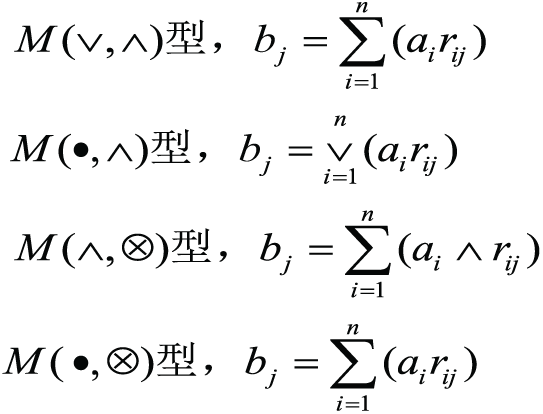
In this article, we select the fourth operator,M (•,⊗), as the calculation operator of fuzzy evaluation model.
Case study
In recent years, logistics enterprises have been committed to the low-carbon development and achieved certain results. Currently, the APGL are getting more attention. In order to better analyze the status of APGL, the evaluation index system is presented. Shandong province, as a large agricultural province, has a large population, where consumers’ demands for agricultural products are higher. Thus, we performed our approach for Shandong agricultural logistics.
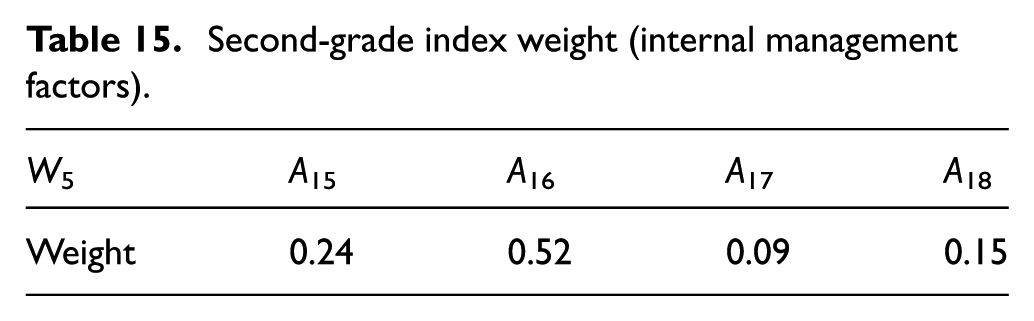
In this case, the evaluation system is divided into three layers: the target layer, T; the criterion layer, S; and the index layer, A. In addition, set S1 as the political factor, S1 = {A1, A2, A3, A4, A5} = {Perfection of relevant laws and regulations, Industry standard degree, Government support, Green channel for agricultural products, Overall planning and construction of agricultural products logistics}; S2 as an economic factor, S2 = {A6, A7, A8} = {Consumption of agricultural products, Demand for agricultural products, Marketization of agricultural products logistics}; S3 as a social factor, S3 = {A9, A10} = {Consumer attitudes toward green agricultural products, Quality of agricultural products logistics practitioners}; S4 as the technical factor, S4 = {A11, A12, A13, A14} = {Processing rate of agricultural products, Preservation rate of agricultural products, Utilization degree of green logistics technology, Traceability of information}; S5 as the internal management factor, S5 = {A15, A16, A17, A18} = {Transportation efficiency of agricultural logistics, Logistics cost of agricultural products, Total value of agricultural products logistics, Circulation rate of agricultural products}; and S6 as the environmental protection of agricultural products logistics, S6 = {A19, A20} = {Vehicle exhaust emissions, Waste recovery rate}.
Consistency check
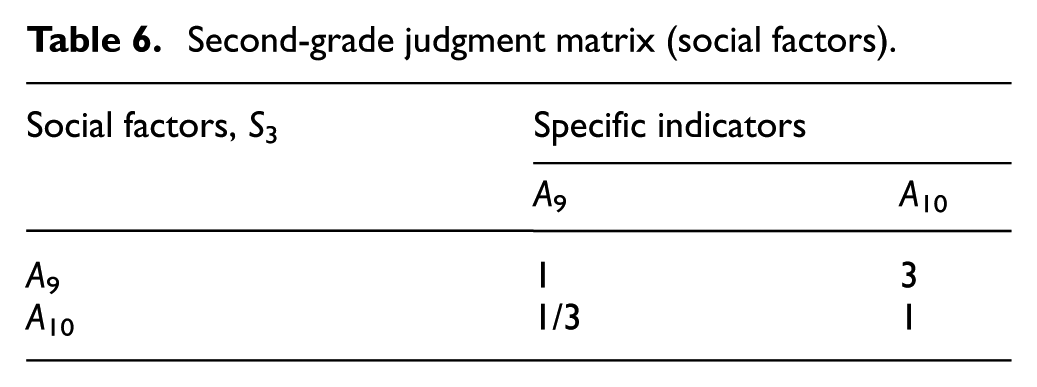
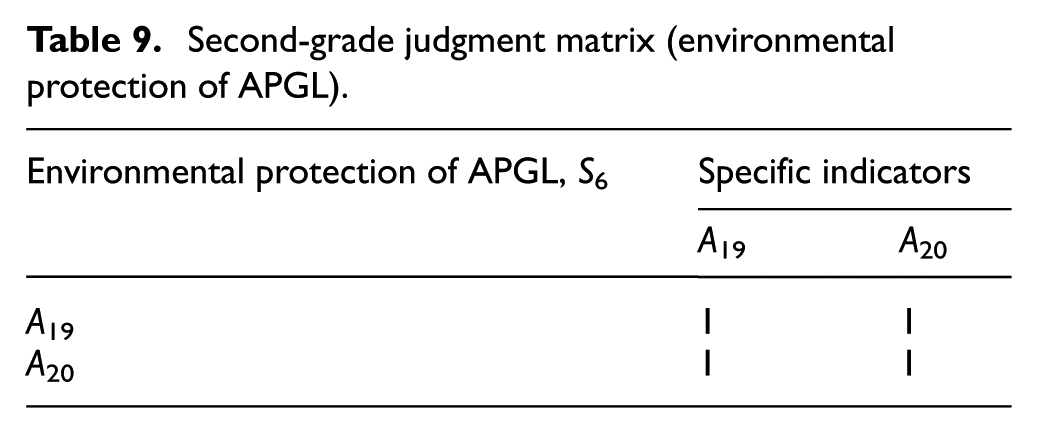
Judgment matrixes were obtained based on expert consultation and field investigation. The final results are shown in Tables 3–9.
First-grade judgment matrix.

Second-grade judgment matrix (political factors).

Second-grade judgment matrix (economic factors).

Second-grade judgment matrix (social factors).
Second-grade judgment matrix (technical factors).

Second-grade judgment matrix (internal management factors).

Second-grade judgment matrix (environmental protection of APGL).
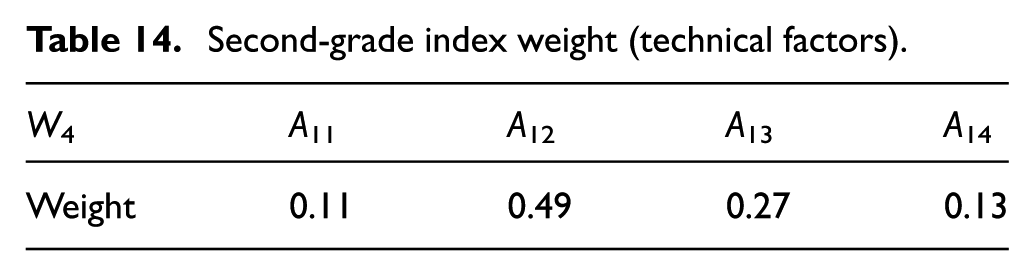
The index weight calculated by the square root method is shown in Tables 10–16. In addition, the consistency test results are shown in Table 17.
First-grade index weight.

Second-grade index weight (political factors).

Second-grade index weight (economic factors).

Second-grade index weight (social factors).

Second-grade index weight (technical factors).
Second-grade index weight (internal management factors).
Second-grade index weight (environmental protection of APGL).

Consistency check result.

Comprehensive evaluation
Some indices are difficult to get a specific value, that is, A1 and A14. Thus, an expert investigation method is adopted for this. In contrast, other indices are easily described by a definite value, that is, A6 and A16. Therefore, field investigation and questionnaire survey are applied to get this. Each evaluation factor including political factors (R1), economic factors (R2), social factor (R3), technical factor (R4), internal management factor (R5), and environmental protection of agricultural products logistics (R6) can be written as follows
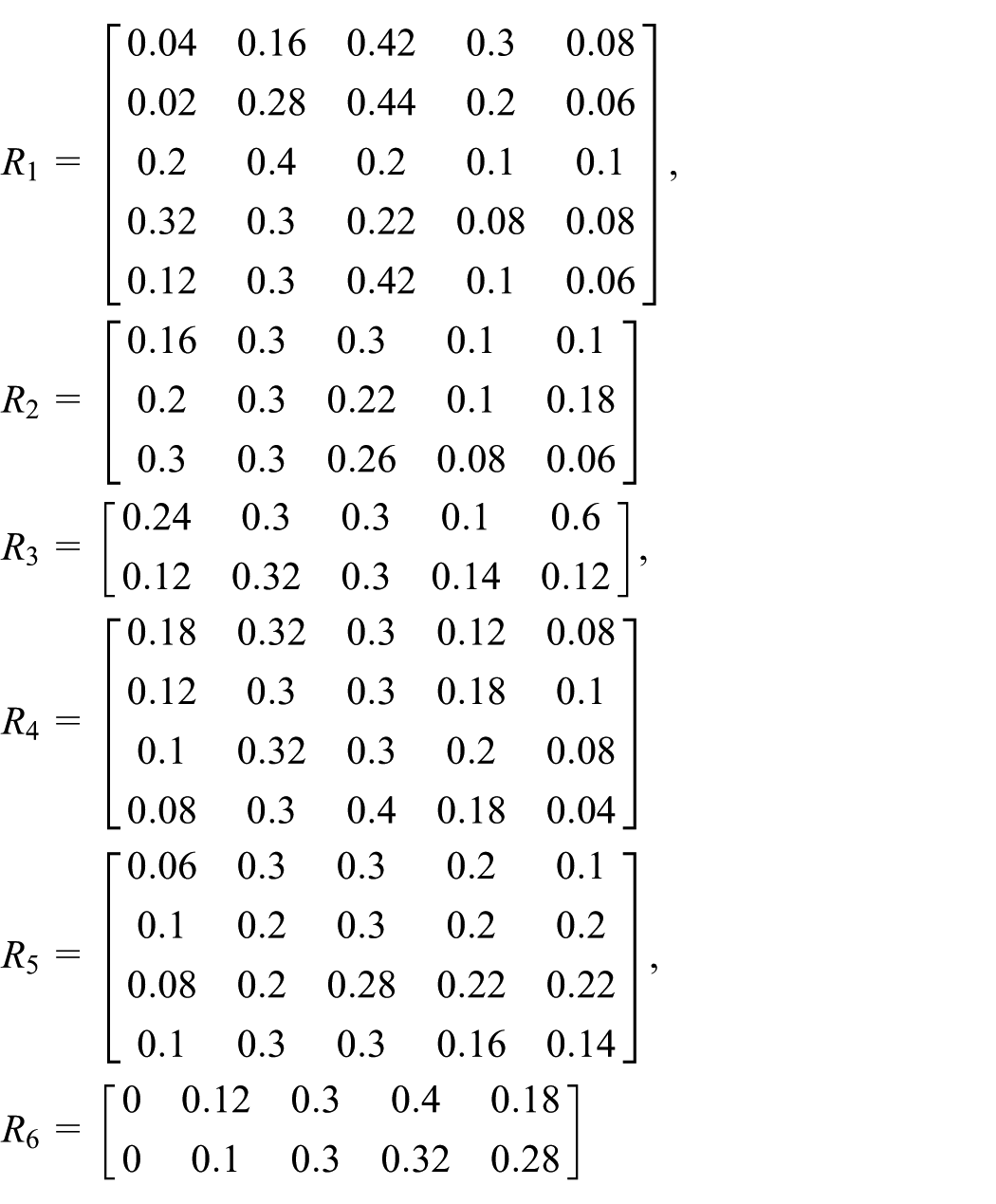
Based on the weight set Wi and fuzzy evaluation matrix Ri, we can easily get the fuzzy evaluation vector by comprehensive evaluation formula Bi, which can be written as

The other evaluation vectors are shown in Table 18.
Result of evaluation vector.

Let the fuzzy evaluation matrix R = (B1, B2, B3, B4, B5, B6)T, and we can get the final evaluation result B as

In this article, we know that the comment set is V = {good, better, general, poor, bad}, and the corresponding scoring set is {1.0, 0.8, 0.6, 0.4, 0.2}, so the final result of fuzzy comprehensive evaluation is shown as follows

The values of others are shown in Table 19.
Result of fuzzy comprehensive evaluation.

Based on the above analysis, we concluded that the overall development level of APGL in Shandong is not well. Among them, the political factor, the internal management factor, and the environmental protection of APGL are still very deficient. The improvement in economic, social, and technological progress is still a general level. Therefore, some measures should be taken to accelerate the development of APGL in Shandong. For instance, (1) making the overall planning of green logistics system for agricultural products and establishing a multi-lateral cooperation mechanism; (2) strengthening the construction of logistics facilities for agricultural products and accelerating the promotion of green logistics technology; (3) improving the efficiency and intensity of processing agricultural products, and promoting the circular logistics of agricultural products and packaging wastes; and (4) accelerating the cultivation of logistics professionals and advocating green consumption.
Conclusion
In view of the current resources, environment, and food safety issues, the agricultural products industry badly needs to introduce green logistics. It is very important to evaluate the performance of APGL. This article constructs the evaluation index system of APGL and proposes a fuzzy comprehensive evaluation method based on AHP. AHP is applied to determine the weights of evaluation indexes, which helps to avoid deviations caused by subjective factors. The fuzzy evaluation method is adopted to evaluate APGL based on the evaluation index. Besides, the presented approach makes a detailed analysis of the logistics of Shandong agricultural products. The results show that the development level of APGL in Shandong is not well, which is consistent with the reality. To some extent, the results can serve as a reference for APGL to make the best talent decisions and achieve long-term development strategies. In a word, this study provides an effective evaluation method for APGL.
Footnotes
Handling Editor: ZhiWu Li
Declaration of conflicting interests
The author(s) declared no potential conflicts of interest with respect to the research, authorship, and/or publication of this article.
Funding
The author(s) disclosed receipt of the following financial support for the research, authorship, and/or publication of this article: This work was supported by the Fundamental Research Funds for the Central Universities under grant no. 2572014BB02 and the Heilong Jiang Postdoctoral Funds for Scientific Research Initiation under grant no. LBH-Q16009.
