




Abstract
Industrial design is a complex process that contains multifarious product knowledge systems which play different roles at different stages of product development. Based on the research of different theories and methods of knowledge classification, the article proposes a new method which divides industrial design knowledge into knowledge in the field, near-field knowledge, and far-field knowledge, and established a corresponding frame of the design knowledge. In order to differentiate the near-field knowledge which is more innovative in design from considerable knowledge to facilitate an efficient design process, mechanisms of similarity searching are used. If 0.3 <
Keywords
Introduction
The function, technology, structure, and appearance of products not only are complementary but also illuminate each other. 1 In the design of products, its own internal structure, function, technology (e.g. intelligent technology), and other characteristics will generally determine the volume (product appearance design according to its volume, for example, kitchenware, furniture, and cutlery design), as well as its shape, linearity (e.g. molding line and solid line), direction, spatial arrangements, and even color plan. 2
To truly achieve innovative product styling, designers need to consider not only appearance factors but also other relevant factors such as structure, function, and so on. From the aspect of modeling drive, the reference is not necessarily limited to the same type of products. As long as two products have a certain similarity in the aspects of structure, function, technology, or manufacture process, then it is possible to use one product as a reference for the other. 3 Such products may have differences from the target product, but the internal structure and use of technology are highly similar, with several overlaps in many features. These commonalities and similarities disrupted the limitations in the way references are typically chosen, therefore, the research in this area may show great value in styling reference. 4 Refrigerators and lockers, for example, are different products which have the same main function that is to store items. Therefore, the internal space layout and external shape design of these two products can be driven by each other.
There have been many scholars begun to study about knowledge management and design drive. In the research, Mascitelli 5 proposed that some breakthrough innovations result from the tacit knowledge of individuals and project teams, rational management, and utilization of tacit knowledge, and establishment of a generative atmosphere for breakthrough innovation is of great significance in product development. Forty-two companies which were actively engaged in technology and design reuse in new offerings were surveyed, and the researchers analyzed the influence of design reuse percentage on design novelty and indicate the possible tipping point of negative impact, which provided basis for further development of design reuse strategy. 6 Park 7 devoted to the next generation information appliance by user-centered design, and developed a knowledge management system to acquire and save knowledge used in the design process for users’ own product design. Based on ontology, Yang et al. 8 proposed building design knowledge map to extract relevant design knowledge to help designers reconstruct specific design cases, and promote design innovation. Li et al. 9 divided design knowledge domain into creative knowledge domain and engineering knowledge domain according to the product design process, and proposed a double push strategy of knowledge for product design based on complex network theory to provide effective support for designers. The previous research in the field of innovative modeling is mainly concentrated on how to drive, that is, how to promote design innovation through design knowledge reuse. This article tries to focus on early-stage knowledge preparation to help design knowledge management. Relevant research shows that the knowledge base can make information and knowledge orderly and flowing, and meet designers’ requirements on knowledge retrieval, extraction, sharing, and communication in the design process. Sufficient design knowledge is conducive to enhancing the innovation of design and improving the feasibility of design, which is of great significance for efficient design work. The definition and classification of design knowledge is the core of building knowledge base. Design knowledge in the field of industrial product modeling are generally considered from the perspective of former design education or work experience. 10 In contrast, this article mainly explores the mechanism of identification and management of such knowledge, and puts forward the method of near-field knowledge identification on the basis of the constructed knowledge system framework to assist the designer in product design. In the research of inventive analogical transfers in the product design process, Kalogerakis et al. 11 indicated that analogical distance was found to be positively associated with solution novelty and negatively associated with the project duration. Therefore, the viewpoint is proposed that compared with referring to similar products, learning from near-field knowledge will provide designers more innovative ideas and also can reduce time and energy waste produced by choosing inappropriate reference that the design intention is overly different from the target product. The overall framework of this article is shown in Figure 1.

Overall framework of this article.
Definition and classification of knowledge within the field of industrial design
Knowledge classification divides knowledge into different types of systems according to its own attributes based on the specific needs and standards to indicate the knowledge’s appropriate place and relationships in overall knowledge systems. Knowledge classification is an extremely complex scientific activity. Different knowledge commentators have their own classification theory and methods. 12
Depending on the product categories, product functions, and other features, the products within the field of industrial design can be conceptually divided into three categories: in-field knowledge (in-field products), near-field knowledge (near-field products), and far-field knowledge (far-field products). Here, the “field” can be a subject area, a combination of a few areas, and one small area inside another. 13 For example, if we use mobile phones as an example to demonstrate the three different categories and the design target is to design a mobile phone for Samsung, then the in-field products are different types of mobile phones; the near-field products can be other digital products, such as PCs or MP3 players; and the far-field products will be other industrial products, such as automobiles, electric cookers, and furniture.
According to the classification method below (Figure 2), in-field products are products with the same properties as the target products, and the information and design knowledge on associated products is the knowledge in the field. Near-field products are products with similar properties as the target products 14 (same product category attributes and different categories), and their knowledge is relevant as near-field knowledge. Far-field products are other industrial products with less similar properties as the target products, and their associated product information and design knowledge are far-field knowledge. 15

Classification of Industrial Design Products.
Framework of knowledge within the field of industrial design
By building the knowledge framework and classifying cases, we can construct the necessary knowledge database to ensure the reuse and sharing of knowledge. 16
This article selected factors related to product function and appearance as the determining factors of product modeling, which help build the corresponding product knowledge framework.1,17 In addition, shape factors and factor values are selected as two dimensions to describe and define the near-field knowledge. Moreover, plug-in attributes are arranged, assigned, and then marked on each product case to establish the necessary knowledge database in the field of industrial design. 18 A detailed description of the framework is provided in Table 1.
Knowledge framework of industrial design products.

Considering the assignment accuracy of the descriptive factor, this article established a select set of descriptive vocabulary for each factor assignment, where one word in each attribute can be selected to describe the respective state when assigning each factor.
Identification of near-field knowledge
Conceptualization of cases
This stage is mainly based on the knowledge framework constructed above. By formalizing product innovative design cases, a formal knowledge database is established for product creative design in the field of industrial design. 19 In this article, the construction of the knowledge database is mainly for storing product modeling cases.
The KF consists of several KSs: if e represents the value of the KS and m represents the number of KSs, then the KF can be represented as follows

Identification of near-field products
Although near-field products have certain differences with the target products, they have certain similarities in main technologies, functions, materials, and internal structures; therefore, they have some reference value and portability for design innovation and style inspirations. Furthermore, the designers’ different way to conceive new product may affect triggering imaginations because there exist some differences between individuals. 22 And referring to near-field knowledge will be more conducive to avoid deviating from the design intent of the target product. For example, if we use the line, shape, or process manufacturing information of the near-field products, then we can integrate those attributes into the new development of the laptop innovation design to increase the volume of existing laptop design. This approach not only avoids the limitations of product modeling references (avoiding miscellaneous information) but also expands the design process of designers. In addition, the ambiguity between near-field products and target products will encourage the designer to find a more diverse solution to the problem, leading to innovation in the product conceptual design process. 23
Each product design cases are formalized by the KF; the KS values are entered into a database. By defining the similarity parameters and using a similarity search 24 to determine the product modeling cases in accordance with the rules of qualitative retrieval, 25 we define the product cases as the near-field products and the associated product features and design information as driven knowledge such that the new modeling must be based on functionalism and differ from past experience products.
When comparing KFs, the near-field product modeling cases should qualitatively match the target product cases; the specific algorithm steps are as follows:
If Q represents the number of cases, then
Then, formula
The above algorithm is the matching algorithm of the KSs of both
Set
Set
Next, use the algorithm above to define the similarity

When matching the cases in the knowledge database with target products, if 0.3 <
Designers can refer to recent near-field design cases to better conduct product innovation activities and can also transplant or extract certain features of near-field product cases integrated with the existing features of the target products to create a new design. After the new product modeling and life-cycle knowledge formalization, the knowledge is stored in the database for future expansion and updating of the knowledge database. 8
Method verification
Constituents of the knowledge management system
A laptop is used as the target product to identify the near-field products by the similarity identification mechanism to drive the target product modeling. The near-field product design cases can be identified via the establishment of the product creative design knowledge management system. The Protege 2000 ontology editing tool was used to define classes, class hierarchies, attribute relationships, and labels using the XML format outputs to build the product creative design knowledge management system. 26
The system is based on web technology, consisting of the network server database, user interface, and search rules and achieves dynamic design information input and design knowledge retrieval by networks. 27 The system is shown in Figure 3.

Innovative design knowledge management system flow diagram.
The database stores various product design cases, product innovation knowledge framework settings, and user feedback data. Users are divided into general users and manager users: general users are also the product designers, who have the rights to search and browse cases; manager users are mainly responsible for the management and maintenance of the system. Manager users also have the responsibility of setting the case, conceptualization, and formalization tasks to adapt the design characteristic of an object; in addition, they must manage not only the information input resources of product design cases but also the general users. The user interface provides functions, such as user login, search, retrieval history, comments, and feedback correction.
Knowledge acquisition from the management system
A laptop is used as the target product to identify the near-field products by the similarity identification mechanism to drive the target.
In the knowledge management system, each of the case features is recorded in the knowledge database detailed in a certain format through the design KF to obtain, compare, and retrieve the following: Design_object_knowledge_frame_of_table_of_contraling_room Product type, Main product function, Auxiliary product functions, Spatial arrangement, Geometric shape, Size, Surface material.
Identify and obtain near-field knowledge
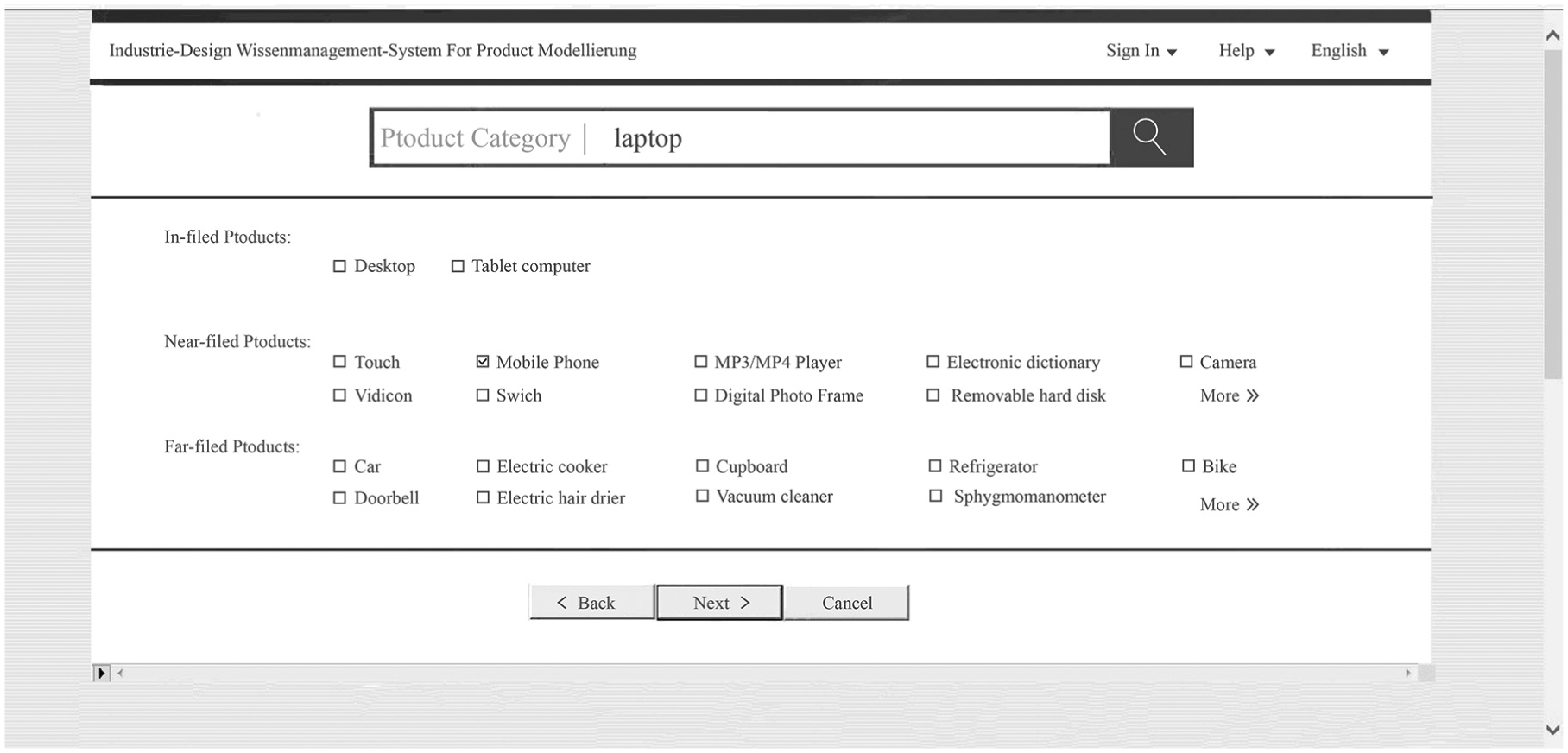
As shown in Figure 4, first, enter the target product information in the web input interface (Figure 5); then, the system will automatically recognize the product knowledge of the case classification in accordance with the above criteria through a search. The sorted similarity coefficients will provide references for the near-field product sequencing. In this article, mobile phones were selected as the target innovation-driven product styling products. Figure 6 shows the near-field mobile phone products stored in the knowledge database.

Identification Progress of Near-field Products.
Overall framework of this article.

Near-field mobile phone case interface.
Designers can select any style and have full access to its product design information for reference and further study. This article selected Motorola A1890 as the selected near-field case; when one clicks it open, detailed product information becomes available from the database for designers to use as a reference, as shown in Figure 7.
Innovative laptop design renderings.
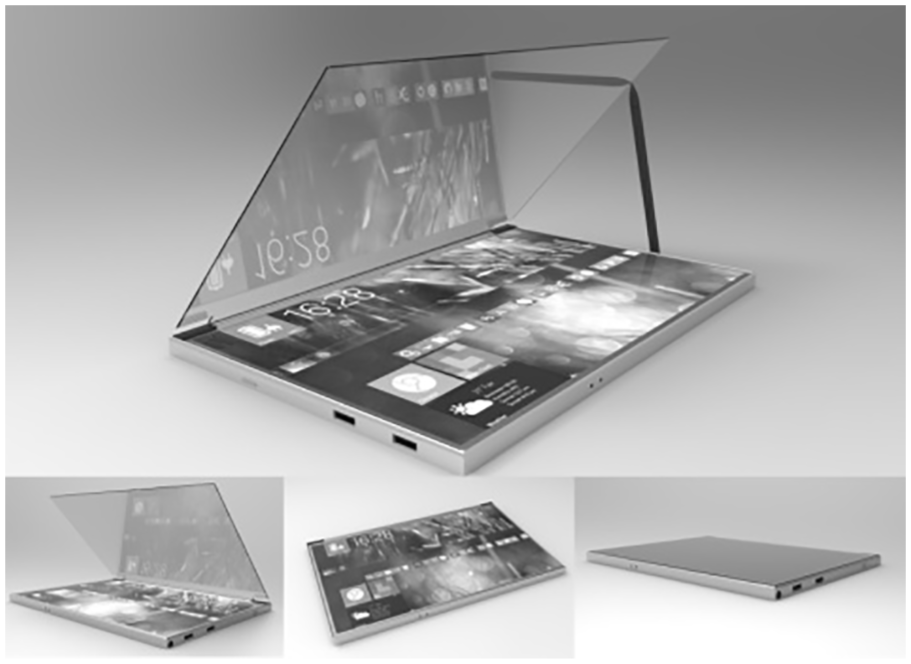
Figure 8 shows the laptop modeling case using the near-field product styling driven method. Through style transplantation, the laptop adopted the spatial arrangements of the Motorola A1890 and adopted a transparent plastic clamshell, stylus, and touch screen. Although a mobile phone and laptop are two products from different areas, they still have similarities in function, spatial structure, and even the material requirements of the internal structure. Therefore, the near-field product styling driven method is feasible in this situation.
The example above only selected a field of product as the reference sample, in actual design process, the designer can choose a variety of products, from which to extract its form genes, through the reorganization and optimization to achieve the purpose of product innovation design. 28
The system identified the near-field product cases of target products from a wide range of products, avoiding complex additional information, it provided design cases which have more reference values for designers to choose from, thereby saving energy and improving design efficiency.
Conclusion
This article studied the method of identification and management of the near-field knowledge of industrial design for producing innovative product shapes. The article started with the perspective of knowledge management and then defined and classified the knowledge within the field of industrial design according to the product and product functions and other features. Moreover, the article built an industrial design domain knowledge database to ensure knowledge reuse and sharing. All product model cases were marked by the related binary group theory, and KS assignment was conducted. In addition, by defining the similarity parameters and using a similarity search to determine the product modeling cases in accordance with the rules of qualitative retrieval, the product cases are defined as near-field products, and the associated product features and design information are defined as the driven knowledge. Through case-based identification and management of the near-field knowledge, this article aimed to support designers by identifying the search and providing inspirations on product styling innovation and finally achieve innovative design and knowledge reuse purposes through the knowledge management system. Finally, the practical application proves that the proposed product shape innovation method is simple, efficient, and highly feasible.
This article mainly explored the use of near-field knowledge in the application of innovative product modeling design during the knowledge preparation stage. However, in-depth consideration of the characteristics of near-field and far-field knowledge requires further study, and the other factors that affect a product, such as color, qualitative factors, and craft, should also be in consideration. We can devote to the research of interaction and integration of formal and tacit design knowledge and implementation of design innovation. 29 Furthermore, how to use artificial intelligence, fuzzy reasoning, and other more advanced technical methods to transport design knowledge into the design platform directly and achieve knowledge push initiatively to improve design efficiency is also an important direction for future research.
Footnotes
Handling Editor: Shengfeng Qin
Declaration of conflicting interests
The author(s) declared no potential conflicts of interest with respect to the research, authorship, and/or publication of this article.
Funding
The author(s) disclosed receipt of the following financial support for the research, authorship, and/or publication of this article: This research has been partially supported by National Key Technology R&D Program, China (Grant No. 2015BAH21F01), and National 111 Project, China (Grant No. B13044).