




Abstract
This article is on the purpose of developing an isolated tram signal priority control strategy based on logic rule for modern tram system. The designed method is presented with features that can ensure the intersection operates in a proper manner on the premise of tram priority and avoid vehicle queue overflow when the tram passes. In this study, the new method description consists of two parts: (1) the detector locations are determined, which include the upstream detector, the upstream trigger detector, the downstream detector, and the queuing detector upon entry approach to the intersection; (2) the corresponding priority logical algorithm for signal control is designed. The proposed method is experimentally examined in a tram intersection in Huaian city, China. In the process of the experiment, the detector layout scheme and optimal priority control model are simulated and verified using the VisVAP module of the Vissim simulation software. In the experimental results, the designed scheme significantly decreases average delay than the fixed timing signal control method, while it also can prevent the vehicle queue from overflowing compared to the absolute priority actuated control scheme.
Introduction
A modern tram is a form of public transportation based on the traditional tram. This updated transportation mode offers more transportation capability and improved effects in terms of environmental protection and energy saving. With these merits, the tram has become a popular public traffic mode in China. As of 2017, trams are fully operated in 16 cities, such as Beijing, Shanghai, Suzhou, and Huaian, with 243.4 km in total length in China. 1 By 2020, the number of tram lines is expected to exceed 150, with a total distance exceeding 2500 km, at a cost of 300 billion yuan (RMB). As a form of ground public transportation, measures to ensure its efficiency and service level, in particular, the priority passing strategy at an intersection, have come into focus recently.
The tram priority strategy includes passive signal priority and active signal priority.2,3 The passive signal priority has been widely used all over the world in 20th century, and its main control strategy includes reduced cycle time, priority movement repetition in the cycle, extra green time for the priority movement, phasing design, linking of signals for tram progressing, and priority access for trams. 3 The passive signal priority is based on the statistical average behavior between tram and other traffic. However, as the ground public bus system, the modern tram does not have independent right-of-way, especially it is generally disturbed by other traffic. Active signal priority is generally designed by combining with information perception of detectors; the main methods include extension, early start, special phase, priority phase sequences, and compensation. In recent years, the active signal priority is selected because it has actuated obvious advantages, which provide greater benefits to buses or tram than passive systems.
In practice, signal priority systems are implemented using a variety of signal control systems, which are grouped into two categories: isolated systems and coordinated systems. 4 The isolated systems are used in isolated signal-controlled junctions where traffic is directed using a fixed time or vehicle actuation. The vehicle actuated system depends on vehicle detectors and the allocated green time, so it belongs to the active signal priority. The coordinated systems are suitable for the signal control junctions that are more closely spaced, which also include fixed time control and traffic responsive systems. Examples include SCATS5,6 and SCOOT (Split Cycle Offset Optimization Technique) 7 traffic signal control systems, which were developed in Australia and the United Kingdom, respectively. These techniques are widely used in both bus and tram systems; especially the newest edition of SCOOT, which focused on public traffic development. 8 In Germany, as a rule, the signal lights of a tram are separated from those for general vehicles. This “separation” includes two types: one type is in the form of a distinct signal lamp that aims to reduce the number of traffic accidents caused by reading incorrect signals, and the other type is the use of various built-in parameters of signal lights, such as the green time. 9 Furthermore, some cities provide a green wave for the public transport modes, such as Portland in America.
Series of studies are carried out on control schemes under different control strategies in order to improve the efficiency of tram on junction approaches and increase reliability and reduce travel times. The absolute priority signal control programs with green time early start and compensate time are verified in China, it showed that the control program had a prominent effect on improving the traffic efficiency of trams, but it did not consider the effects on the non-tram vehicles at the crossroads.10,11 Gatenby and Fedzin 12 introduced all aspects of the tram priority system to be introduced for the Nottingham Express Transit (NET) scheme, including the overall tram and highway control system, the tram detector system, the complex traffic signal controller logic, and the remedial measures. German tested a traffic control measure for public transport prioritization developed by Gevas Humberg & Partne, the system operates following the principles of Signal program formation with acyclic phase sequence and fixed cycle time. 13 In the aspect of transportation efficiency evaluation, K Pavkova et al. 14 presented a new approach that adopts the economic concept of the Lorenz curve to compare the link performance in terms of transit operations and the weighted passenger volume of travel to determine the priority grade of a tram. Lehtonen and Kulmala 15 proposed a priority method for a tram, vehicles, and pedestrians in a complex intersection and provided several public transport telematics functions, such as real-time passenger information, bus and tram priorities at traffic signals, and schedule monitoring.
On the basis of the literature survey, we conclude that increasing attention and achievements have been given to active and passive priority control strategies to improve the service level of tram. The modern tram line is generally set along an arterial road or corridor, but it is unavoidable that the tram line is distributed on the crossroad sometimes, especially when the intersection exhibits high traffic levels and multiple traffic modes. Compared with other junction approaches, giving the tram priority in passing causes the vehicle queue to be excessive and can even cause overflow, particularly for approaches with a small space for waiting vehicles.
Focusing on the above problem, this article develops a new isolated tram signal priority control strategy based on logic rule orientation to prevent vehicle queue from overflowing in order to improve the applicability of modern tram priority control strategy and extend its usability. The method first introduces a detector layout scheme in order to present and establish the corresponding real-time control program for modern priority passing. To evaluate the performance of the program, the VisVAP module of Vissim simulation software is used together with the field data from an intersection in the city of Huaian.
Strategy and methods
A priority control system includes collecting real-time data pertaining to traffic operation and control, setting detectors, and optimizing the signal timing scheme. To balance the right of way and prevent the queue from extending to the upstream intersection in the arterial, the queuing detector and downstream detector are designed to ensure that the tram can go through the intersection safely. Thus, the priority control system includes real-time data from traffic operation, control parameter collection, detector layout, phase switching event detection, and priority signal control scheme adjustment.
Optimize the signal parameters based on the actuated signal control
At a single-point intersection, the timing signal control scheme is unable to address the priority of tram crossings. Therefore, in this study, an active signal control scheme that adopts a real-time priority control strategy is introduced. It includes three actions: shorten the red time, lengthen the green time, and use the minimum signal cycle. The action of shortening the red time is suitable for the current red light phase and the tram need to pass the intersection directly. The action of lengthening the green time is suitable for the green phase that applies at the latter portion of the first phase when a tram is approaching the intersection. Minimum signal cycle is suitable for the current green phase over the remainder of the phase when a tram is approaching the intersection. Thus, whether the green light length is reasonable is the key point of actuated control, especially the minimum green time.
The minimum green time
To ensure the safe passage of vehicles, each signal phase must be limited by the minimum green light time. For the minimum green time of the direct phase, the time required for safe vehicle passing should be considered; it is also necessary to ensure that pedestrians can pass through the intersection safely. Therefore, the minimum green time of a straight line is related to the pedestrian delay, the pedestrian crossing time, and the yellow light time. 16 The minimum left-turn green time includes the vehicle delay, vehicle crossing time, and yellow light time, as described by equation (1)

where i = 1, 2, 3, 4;
The minimum signal period
To reduce the waiting time of the tram at the intersection, the minimum signal cycle is determined using the following calculation method: the sum of the minimum green time of the four phases and the intervals between the green lights, denoted by

Designing the detector layout
To improve the accuracy of the tram priority control scheme and the real-time detection of vehicles queuing on the main road, the detector layout scheme includes an upstream detector, an upstream trigger detector, a downstream detector, and a queuing detector.
The position of the upstream detector
To reduce the waiting red light time when the tram passes through an intersection, the upstream detector is first set to a position no further than the location of the upstream intersection. The location of the upstream detector is first determined by the distance that the tram travels during the minimum signal cycle length (minus the station dwell time); next, one must determine whether an adjustment to the current intersection signal phase is required to allow the tram to pass through the intersection. The distance of the detector upstream from the stop line is L1 and is given as follows

where
The position of the upstream trigger detector
Considering that the tram speed is unstable and that the stop time is random, the upstream trigger detector is set away from the intersection upstream close to the position at which the detector detects the tram. With a small signal phase adjustment, the position of the upstream trigger detector is given by equation (4)

where
The position of the downstream detector
To determine whether the tram leaves the intersection, a detector is set downstream of the intersection at the position given by equation (5)

where
The position of the queue detector
The average vehicle delay will increase at an intersection if only the priority of the tram is taken into account and the delay of other vehicles is not considered when the direction of the tram conflicts with the main line of the intersection. When giving priority to the tram, it is easy to cause the idling of intersections at certain times; thus, the queue of vehicles in the main direction cannot be dissipated, which is detrimental to the entire intersection. Therefore, it is necessary to configure a queue detector in the direction of the main line at the intersection to check the queue length and determine whether the priority given to the tram is reasonable. The position of the queue detector is calculated as shown in equation (6). Note that the distance is less than the distance to the next intersection

where
The schematic placement of the detectors is shown in Figure 1.

The intersection detector placement.
Designing the logical signal control scheme algorithm
The signal priority control strategy is suitable for intersections where traffic volume varies greatly and irregularly and where it is difficult to use the fixed-time control scheme, especially if main road intersection interference must be reduced. In the phase structure of this article, a phase transmission process of first going straight and then turning left is adopted both for the left and right rings. The tram line is two-way, and the arterial has heavy traffic. There are four unique phases in this control strategy, and by adopting a new expression form using phase 1 to phase 4, the phase transition process is shown in Figure 2.
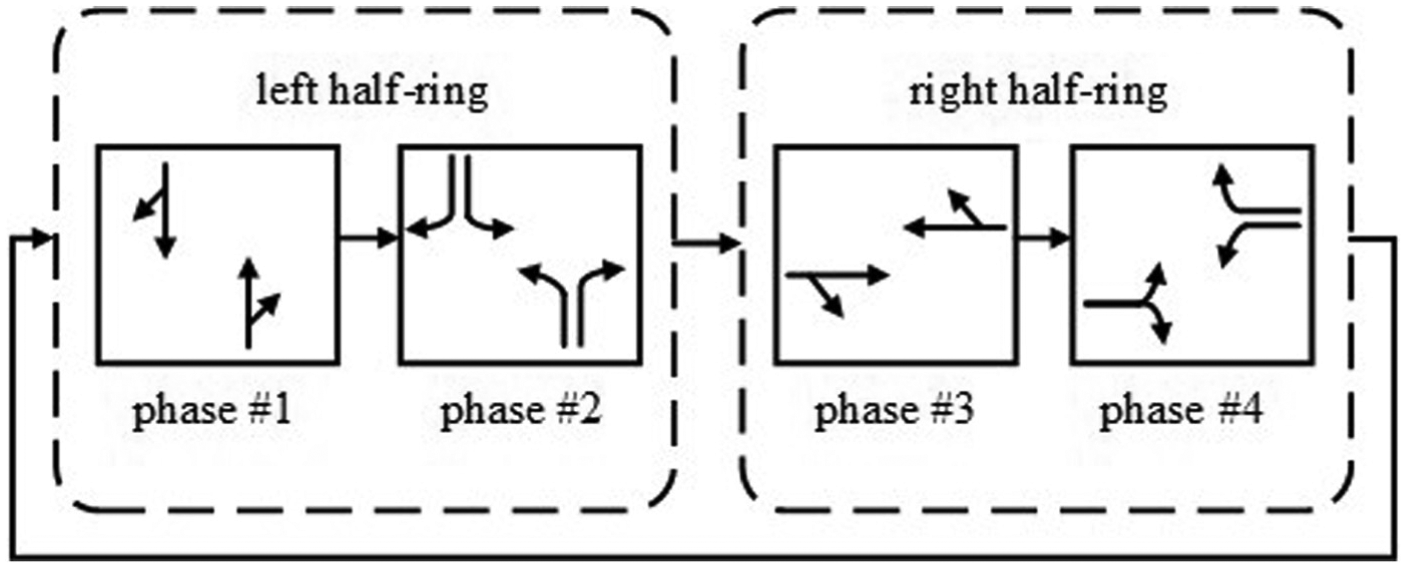
Phase transition process.
The tram intersection priority control scheme aims to achieve real-time control of the intersection priority to improve the intersection traffic efficiency and service level under the premise of tram priority. In the phase transition decision scheme, if the detector does not detect the tram, the original signal cycle will be maintained. The upstream detector is a certain distance from the intersection, and the tram stations are located nearby the entrance approach to the intersection, so the time of queue evacuation for vehicles on the arterial is considered. When the upstream detector determines that the tram has passed, the phase of the signal is determined according to whether the queue detector has detected queuing vehicles. Finally, the green light time and the phase transition are adjusted according to the different conditions. The time interval for the priority request generation and the control strategy response system execution is 1 s. The decision process of the upstream detector is shown in Figure 3.
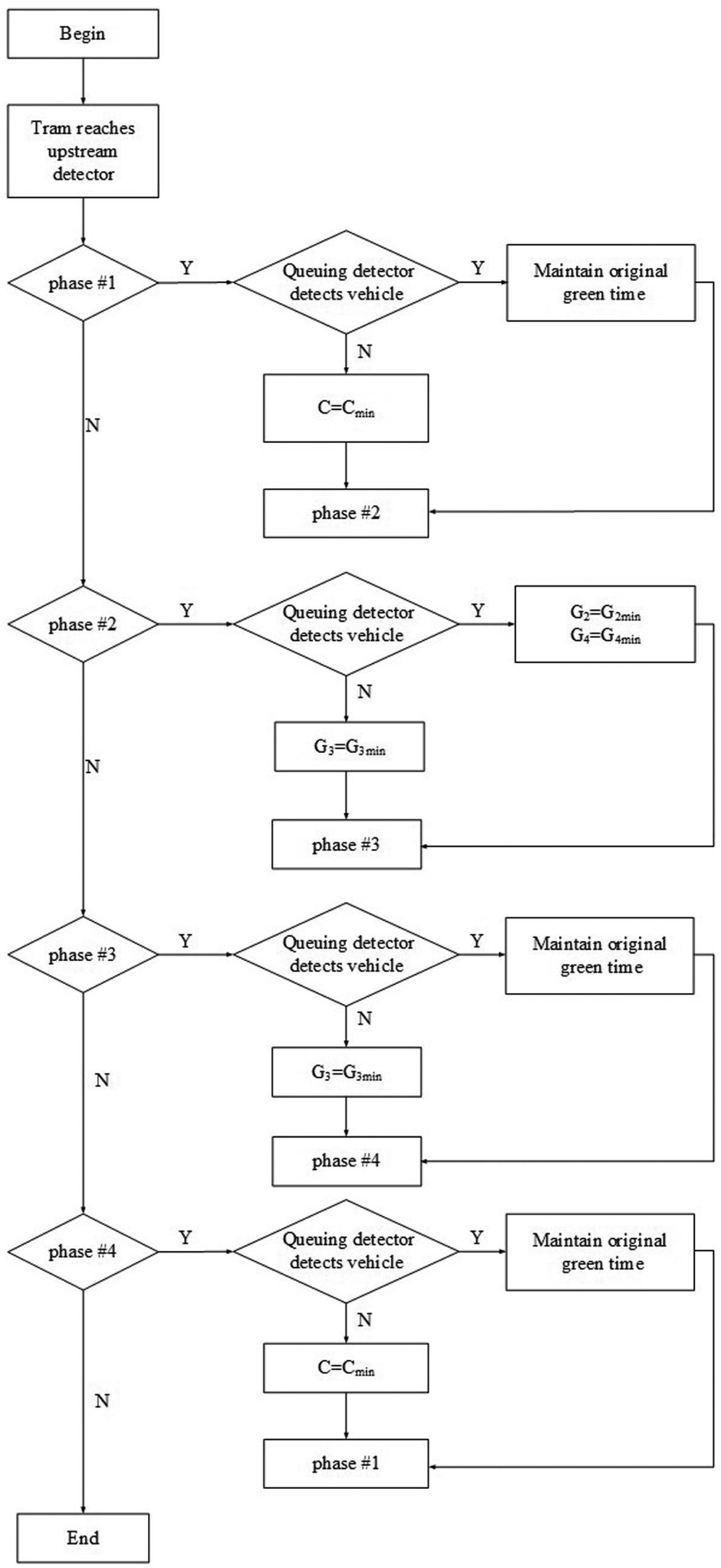
The logic structure of the upstream detector signal priority control strategy.
If the upstream detector detects the tram, the detector evaluates the phase of the current signal. If phase 1 or phase 4 is the current phase, and the queue detector detects a vehicle, the original green time is maintained and adjusted based on when the tram reaches the upstream trigger detector; otherwise, the system directly implements the shortest signal cycle when the main road is in a saturated flow state in order to return to the tram phase as soon as possible. When phase 2 is the current phase and the queue has reached the queue detector, the green time of left turn phase is shortened to the minimum green time. When phase 3 is the current phase, which is when the vehicles in the straight lane are passing through the arterial, if the queue detector detects vehicles, the original green time is maintained; otherwise, the green time is shortened to the minimum green time.
The upstream trigger detector is located close to the intersection approach to accurately determine the phase adjustment. The decision process of the upstream trigger detector is shown in Figure 4.

The logic structure of the upstream trigger detector signal priority control strategy.
When the upstream trigger detector detects that the tram is passing, the phase of the current signal is evaluated again. If the signal is in the first phase, then the signal is evaluated more precisely. In the first T seconds of the first phase, the tram can smoothly cross the intersection without changing the signal; otherwise, the green time of the first phase must be extended until the tram crosses the intersection safely. When the downstream detector detects the passing of the tram, then the signal proceeds to the next phase. Accordingly, T is the value of the first phase length minus the length required for the tram to cross the intersection. If the signal is in the second or third phase, the system must further determine whether the main road is in a saturated flow state; if so, then the original signal cycle remains unchanged, and the tram is allowed to pass through the intersection until the next cycle; otherwise, the signal cycle is set to the shortest time to provide the tram with sufficient priority to pass through the intersection. If the signal is in the fourth phase, the shortest green light time is selected, and the signal proceeds to the next cycle.
Data-related procedures
Site description
The Huaian modern tram line is the longest contactless network line in the world, with a length of 20.3 km. This study uses the example of the Huaihai East Road-Jiaotong Road intersection, which lies in the CBD (center business district) of Huaian. The Huaihai East Road is the main road, running along the east-west directions at the intersection, and Jiaotong Road is a branch road, running along the north-south directions at the intersection. The tram lane is located on Jiaotong Road, and the pathway is located in the center.
Data collection
Traffic volume at the intersection
According to a survey of late peak hours (17:00–18:00) on the Huaihai East Road–Jiaotong Road intersection over 4 weeks, the statistical traffic volume is collected at the peak hour.
Traffic characteristics of the tram and the non-tram vehicles
To make the simulation and optimization processes more closely resemble the actual conditions, we set key locations to the vehicles and tram, which are located from the entrance and exit approaches and are 50, 100, and 200 m for vehicles and 10, 20, 50, 100, and 200 m for tram. The vehicles and tram speed in the approach roads were investigated. In addition, according to our field data, the arrival rate of trams is 12 trams per hour.
Signal phase at the intersection
There are four phases in the original phase, its shift rules are shown in Figure 2, and the green time of the signal timing status are 24, 20, 56, and 18 s, and the yellow time is 3 s.
Case study
Determine the detector position
According to the statistics, the braking deceleration is approximately 2 m/s2 near the Huaihai Road–Jiaotong Road intersection; the stations are located only upstream of the intersection and 20 m beyond the stopping point. The station in Huaian is 30 m long. According to the field investigation, the parking time of the tram at the station is approximately 16 s, and the time for the tram to travel from the site to the downstream detector through the intersection is 15 s.
Upstream detector
The location of the upstream detector plays the most significant role in the priority of modern rail vehicle intersections. According to the actual investigation, the tram stopping time is 16 s, the running speed is approximately 19 km/h, and the distance between the north and south approach stopping points is 23 m and that between the east and west approach stopping points is 25 m. A left-turning vehicle must travel 28 m to pass through the intersection. The value of L1 is 285 m based on a calculation using equations (1)–(3), that is, the upstream detector is 285 m from the approach stopping point.
Upstream trigger detector
The function of the upstream trigger detector is to readjust the phase of the signal to ensure that the tram can pass through the intersection first. The value of L2 is calculated using equation (4). The other relevant parameters are
Downstream detector
The purpose of the downstream detector is to determine whether the tram has passed the intersection. L3 is equal to 30 m, according to equation (5).
Queue detector on major roads
The queue detector on the major roads is used to determine whether the no tram vehicles are in a saturated condition. The approach lane has four lanes, including one left turn lane, two straight lanes, and one straight right turn lane. According to the investigation,

Designing the logic algorithm for optimizing the real-time sensing signal control scheme
During the implementation of the control process, if the detector does not detect a tram, the original signal cycle is maintained, that is, the signal timing adopted is calculated using the Webster signal timing method to have a cycle length of 124 s. When the upstream detector detects the passage of the tram, the detector evaluates the phase of the current signal. If the signal is in the second phase, the detector continues to evaluate whether the volume of vehicles on the Huaihai East Road is saturated based on whether the queue detector detects a vehicle. If the queue detector does not detect a vehicle, the volume of vehicles is not in the saturated flow state, and the system reduces the green light time of the third phase to ω, which is 29 s according to the appropriate calculation. If the queue detector detects a vehicle, the green light time of the second and fourth phases is shortened to the shortest green time. If the signal is in the first phase or the fourth phase, the system must further determine whether Huaihai East Road is in a saturated flow state. The system directly implements the shortest signal cycle when Huaihai East Road is in a saturated flow state; otherwise, the original signal cycle is maintained and is adjusted based on when the tram reaches the upstream trigger detector. If the signal is in the third phase, the original signal cycle remains unchanged, and the tram will undergo adjustment when it reaches the upstream trigger detector.
When the upstream trigger detector detects that the tram is passing, the phase of the current signal is evaluated again. If the signal is in the first phase, the signal must be evaluated more precisely. In the first T seconds of the first phase, the tram can smoothly cross the intersection without changing the signal. If the signal is not in the first T seconds of the first phase, then the system must extend the green time of the first phase until the tram crosses the intersection safely, that is, the downstream detector detects the passing of the tram and then the signal moves to the next phase. Accordingly, T is the value of the first phase length minus the length required for the tram to cross the intersection; thus, it is equal to 9 s. If the signal is in the fourth phase, then the shortest green light time is adopted and the signal goes to the next cycle. If the signal is in the second or the third phase, the system must further determine whether Huaihai East Road is in a saturated flow state; if so, then the original signal cycle remains unchanged, and the tram is allowed to pass through the intersection until the next cycle; otherwise, the signal cycle is set to the shortest time to provide the tram with sufficient priority to pass through the intersection. On the premise of not increasing the vehicle delay, the above control logic is established to achieve the priority of tram crossing.
Discussion effect validation results of designed system
As a means of mass transit, a typical operation strategy is to give the tram absolute priority rights in an intersection, and this type of real-time control method is regarded as the absolute priority control strategy of an active priority scheme. The strategy does not consider the other traffic mode volume and the main traffic distribution direction, such as buses and private cars, and the current phase of signal. To evaluate the designed real-time actuated control system in this article, we choose the delay and the maximum queue length as indicators to compare the level of service at the entrances and the entire intersection for three control schemes: fixed timing signal control, absolute priority actuated control, and designed priority control (developed in this article).
The micro-simulation method is selected to validate the effect of the designed system. Vissim software is a fine-grained traffic simulation system based on time intervals and driving behavior developed by the PTV Corporation in Germany, 17 it also has a secondary development module that can be used to analyze each element of the road network separately. In the simulation process, the network is established, the traffic flow parameters are input, and the driving behavior is demarcated in sequence. Next, the VisVAP modules of the Vissim software are adopted to realize the real-time priority control algorithm.
Comparison of delay in each direction
The average vehicle delay reflects an intersection’s efficiency in dissipating traffic. Because vehicles are mainly distributed in the through lane, we statistically analyzed the average delay per vehicle for the through lanes in different directions using VISSIM software. After the traffic flow has reached a steady state, the statistics begin to operate for 1 h, and the statistical time interval is 300 s. The results are shown in Figure 5. Schemes 1–3 in the figure represent the designed real-time actuated control scheme in this article, the absolute priority actuated control scheme, and the fixed timing signal control scheme, respectively.

The average delay per vehicle for the through lanes in different directions.
For the eastbound and westbound through directions, the ranked order of schemes from excellent to inferior is scheme 1, scheme 2, and scheme 3. Because the fixed timing signal control scheme (scheme 3) does not consider the priority rights of the tram, the delay time of corresponding phase does not decrease. Overall, the average delay from schemes 1 and 2 are similar for the four directions of the intersection, but for the eastbound and westbound through directions, the average delay of scheme 1 is lower than that of scheme 2, especially eastbound through. When the queue length exceeds the queue detector, the green time will last the original length whether or not the tram arrives at the intersection in scheme 1. Conversely, the average delays from scheme 3 are maximum in the northbound and southbound through directions, and most points overlap in schemes 1 and 2 when the queue detectors do not detect vehicles.
In order to evaluate the influences of the three schemes on tram, we choose the average delay per tram to compare, and the results are shown in Figure 6. Tram priority is not considered in scheme 3, so the average delay is much higher than with other two schemes. For scheme 1 and scheme 2, most points overlap except the time period of 2100–2400 s and 2700–3000 s because the queue length exceeds the queue detector, so the phase time of the north and southbound through directions is shortened, and the vehicle stop time increased.

The average delay for per tram.
In order to illustrate the logic applied procession of the designed priority actuated control scheme for individual trams, the detail information of signal situation when tram arrived, logic applied situation, stop delay, and total delay are listed for 1 h in Table 1. The tram has absolute priority when the queue length does not exceed the queue detector, while the tram needs to stop in the opposite case in order to prevent vehicle queues from overflowing.
Comparison of the qualities of the three schemes in detail.

According to Figure 7, the average delay of scheme 3 is lower than those of the two actuated control schemes for the east and west entrance approaches but obviously much higher for the north and south entrance approaches. The average delays of scheme 1 and scheme 2 are similar for each approach.

The average delay of each approach.
The maximum length comparison of entrance approaches
The maximum queue length reflects the worst queue conditions in each simulation environment and the fault-tolerance and evacuation capability of the simulation environment in the secondary queue and intersection congestion. The results of each approach are shown in Figure 8, for the east and west entrance approaches, the maximum queue length is shortest, and scheme 1 performs better than scheme 2. Therefore, the designed scheme can prevent long lines under the actuated signal control condition.
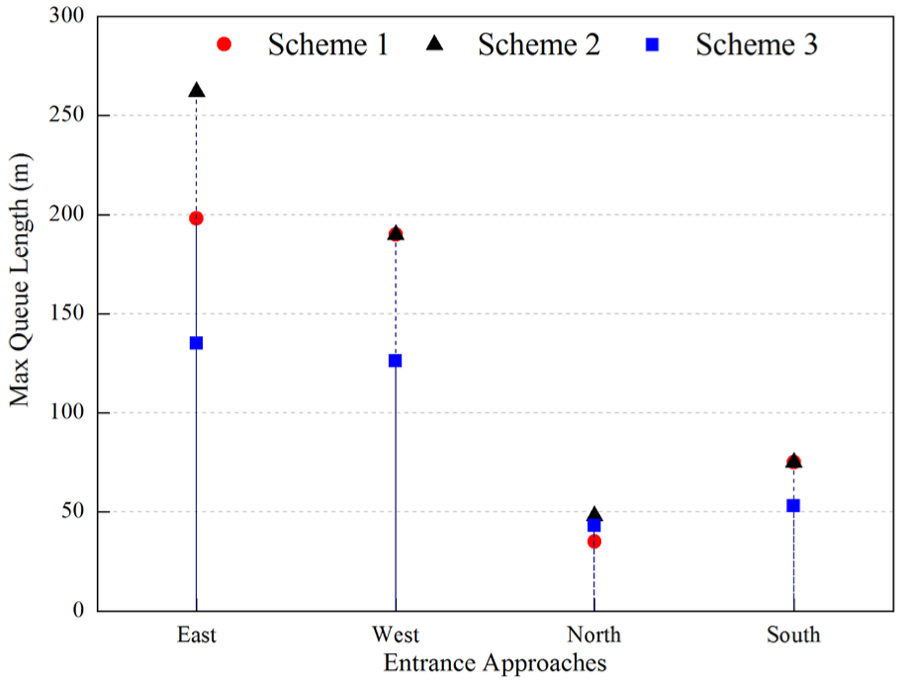
The maximum queue length at each entrance.
The average delay for the entire intersection and the level of service
According to the simulation results, the average delay of scheme 1 is less than those of the others with a value of 27.3 s, and scheme 3 is much less than scheme 2. However, as the fixed timing signal control scheme, scheme 3 does not consider the priority rights of the modern tram.
From the above simulation results and discussion, the characteristics and qualities of the three schemes are compared in Table 2.
Comparison of the qualities of the three schemes from whole intersection view.

Conclusion and application prospects
The tram priority signal control system should be implemented according to local conditions, especially concerning intersections with limited road resources. We studied the situation in which the main line direction of an intersection is different from the direction of a modern tram. Therefore, before supplying priority signals to the tram crossing, the saturation state of the vehicles traveling in different directions is considered. As a result, the detector layout scheme and corresponding priority logical algorithm are developed. The control algorithm presented here is simple in structure and straightforward to implement in practice and meets the demands of the tram priority in the signal cycle at any time, thereby improving the level of service at the intersection.
In this manner, two conclusions are drawn with the designed scheme. First, the experimental results of average delay show that the priority of the tram intersection is guaranteed in the designed priority actuated control scheme, so the designed schemes provide effective priority for modern tram. Furthermore, it offers a good solution in decreasing the negative impacts of modern tram progression on the vehicular traffic, especially in avoiding the vehicle queue overflow caused by tram priority. According to the experimental results, the average delay of the designed scheme is similar to that of absolute signal priority scheme, but the maximum queue length is shorter than it. Therefore, relative to the absolute signal priority approach, the designed actuated control scheme of this study focuses on the passing rights of all passengers.
Also, we only considered the influence of the tram priority only on vehicles moving straight; the influence of the left-turn delay and the passing of non-motorized vehicles and pedestrians was not considered. In addition, the designed approach applies to isolated signal intersections only; as a result, the priority of the full system of intersections of the modern tram requires further study.
Supplemental Material
ADESupplement_Materials – Supplemental material for Design of real-time actuated control system for modern tram at arterial intersections based on logic rules
Supplemental material, ADESupplement_Materials for Design of real-time actuated control system for modern tram at arterial intersections based on logic rules by Yun Li, Qiyan Cai, Yujie Xu, Weihua Shi and Yibao Chen in Advances in Mechanical Engineering
Footnotes
Acknowledgements
Y.L. and Q.C. designed the priority algorithms, participated in the investigation, and wrote the paper; Y.C. and Y.X. established the simulation model and participated in the investigation; and W.S. designed the detector location scheme and data processing methods.
Handling Editor: Salvatore Strano
Declaration of conflicting interests
The author(s) declared no potential conflicts of interest with respect to the research, authorship, and/or publication of this article.
Funding
The author(s) disclosed receipt of the following financial support for the research, authorship, and/or publication of this article: This study was supported by the National Natural Science Foundation of China (No. 51608221), the Science and Technology Key Research and Development Project of Huaian City (No. HAS2015015), and the Prospective Industry-University-Research Cooperation Research Project in Jiangsu Province of China (No. BY2016061-01).

Supplemental material
Supplemental material for this article is available online.
References
Supplementary Material
Please find the following supplemental material available below.
For Open Access articles published under a Creative Commons License, all supplemental material carries the same license as the article it is associated with.
For non-Open Access articles published, all supplemental material carries a non-exclusive license, and permission requests for re-use of supplemental material or any part of supplemental material shall be sent directly to the copyright owner as specified in the copyright notice associated with the article.
