



Abstract
In this study, an investigation of “the free vibrations of hollow circular plates’’ is reported. The study is based on elastic foundation and the results depicted are further extended to study the special case of “graphene sheets.’’ The first-order shear deformation theory is applied to study the elastic properties of the material. A hollow circular sheet is modeled and the vibrations are simulated with the aid of finite element method. The results obtained are in good agreement with the theoretical findings. After the validation, a model of graphene is presented. Graphene contains a layer of honeycomb carbon atoms. Inside a layer, each carbon atom C is attached to three other carbon atoms and produces a sheet of hexagonal array. A 25 nm × 25 nm graphene sheet is modeled and simulated using the validated technique, that is, via the first-order shear deformation theory. The key findings of this study are the vibrational frequencies and vibrational mode shapes.
Introduction
The importance of the graphene, which is a sheet of a single layer (monolayer) of carbon atoms, cannot be denied due to its novel applications, not only in the field of engineering but also in the field of biology. For example, it is expected that graphene can be used in the near future to transform brain–computer interfaces. The role of sheets in the field of structural mechanics cannot be denied. Therefore, theoretical understanding of the mechanical properties of sheets is highly desired. In this study, free vibrations of thick hollow circular plates based on elastic substrates are investigated. In order to bring the structural model closer to real geometry and completing previous research, first-order shear deformation theory 1 is used in this research. This theory of sheets has the advantages of the classical theory of sheets due to the consideration of shear deformities and inertia of structural components (which are not considered in classical theory), a more accurate estimate of the behavior of the structure is obtained, especially for thick sheets. Extensive research has been conducted on free vibration and dynamic response of structures to animate mass or load. Eastep and Hemmig 2 analyzed the vibrations of solid circular plates using finite element method. They obtained the frequencies and vibrational mode shapes considering some outer parts of the sheet clamped and some inner parts free. They also verified their finite element method results with experimental data. Hutchinson 3 modeled circular plate based on the first-order shear deformation theory by exact solution and approximate solution and compared the results of these two solutions.
Using the three-dimensional elasticity theory, Zhou et al. 4 studied the free vibrations of Pasternak-based circular three-dimensional plate. They obtained free vibrations of plate using Chebyshev polynomials and Ritz method. Furthermore, they investigated the effect of radius ratio and bed coefficients on free vibrations of circular plate.
Yalcin et al. 5 presented a semi-analytic solution for vibrations of circular plates with free, simple, and clamped boundary conditions, using the differential transform method (DTM). Using this iterative method, they obtained the natural frequencies and the vibrational mode shapes. They examined the accuracy of their analysis by comparing the results with the exact solution presented on the basis of the Bessel functions.
Senjanovic et al. 6 presented a thorough and comprehensive solution to analyze the free vibrations of solid circular plates. They obtained the natural frequencies of the sheet and the vibrational mode shapes for different boundary conditions.
Using the first-order shear deformation theory, Vaseghi Amiri et al. 7 studied the dynamic response of a thick plate to a moving mass on a random path.
Schiffer et al. 8 obtained a precise solution for the transient response of a circular plate with clamped edges under impact load. They measured the accuracy of their response by comparing the results with the numerical analysis presented in the finite element method.
Using Fourier series expansion functions, Guoyong et al. 9 studied three-dimensional analysis of free vibration of functional graded plate with arbitrary boundary conditions. They considered non-homogeneous material both in radial and in thickness direction and examined the effect of it on the natural frequencies of the plate. Different numerical and semi-analytic techniques are available in the literature for analysis of mechanical problems10,11,12
The force vibration response of beams with simple supports, under heavy and low moving loads, was presented by Kumar et al. 13 They examined the damping effect on the dynamic response of the beam. Keeping in view the importance of the subject, we have simulated the important dynamics of the model and have developed the model to good accuracy.
Since the discovery of graphene, it has remained a topic of research due to its unique properties, such as high thermal conductivity, large surface area, and high elastic modulus. The mechanical properties of graphene have been discussed by researchers such as Arani and Jalaei 14 studied the dynamic response of viscoelastic graphene sheet affected by magnetic field. In another work, Jalaei and Arani 15 studied double-layered graphene sheets on viscoelastic foundation affected by magnetic field.
In the following study, free vibrations of hollow circular plates based on elastic foundation are investigated and the results are extended to graphene sheets.
Extracting equations and solving equations in free vibration mode
In this section, we will first describe the geometry of the problem (Figure 1), then the equations and boundary conditions will be extracted using the Hamilton principle and the work-energy concept. We have used the appropriate dimensionless variables and have considered the non-dimensional form of the equations. According to this figure, a circular sheet with internal radius b outer radius a and the thickness h is considered.
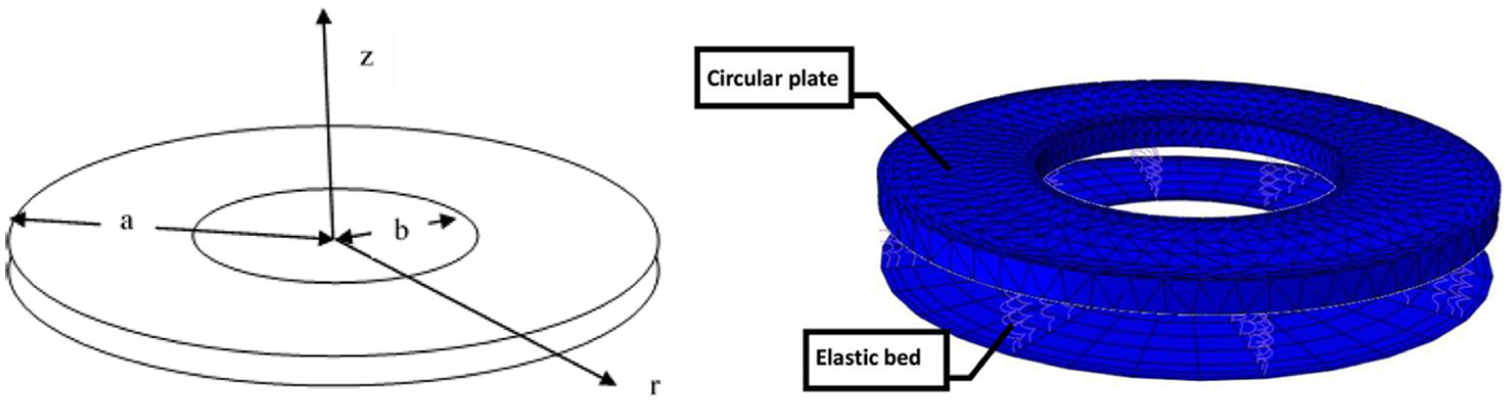
Hollow circular plate on elastic foundation.
According to the first-order shear deformation theory, the displacement field in a circular plate is as follows

where

The strain–displacement relations in polar coordinates are as follows 16

where ε and γ represent the axial and shear strains, respectively. The components of stress can be expressed in terms of displacement components as follows
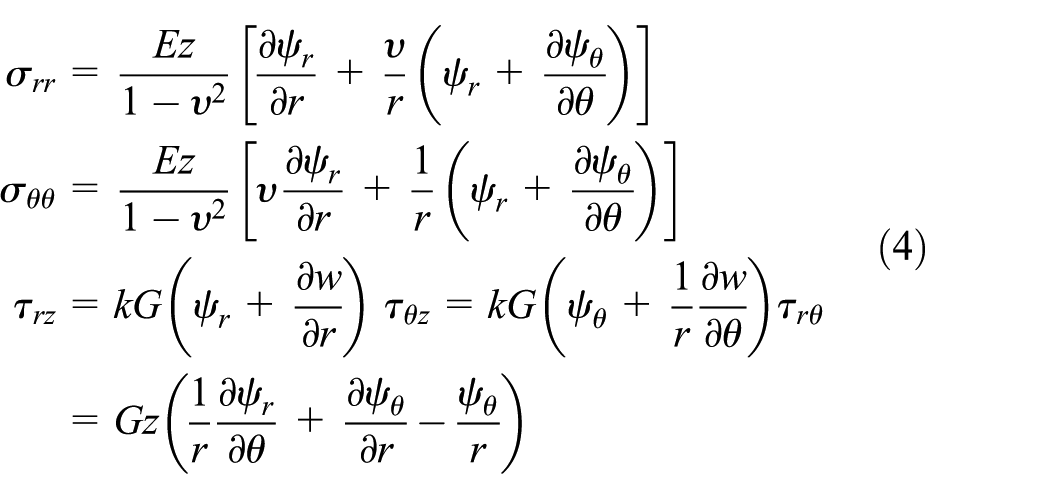
where

In this study, Hamilton’s principle is used to derive equations and boundary conditions. Based on the Hamilton principle, taking U as a strain energy, T as kinetic energy, and W as the work of external forces, the governing equations can be derived from the following relation 18

where

where V represents the volume of the sheet. Differential variations of the strain energy can be calculated as follows

Using the equation (3) we have

Due to the following relation (S is the middle layer area of the sheet
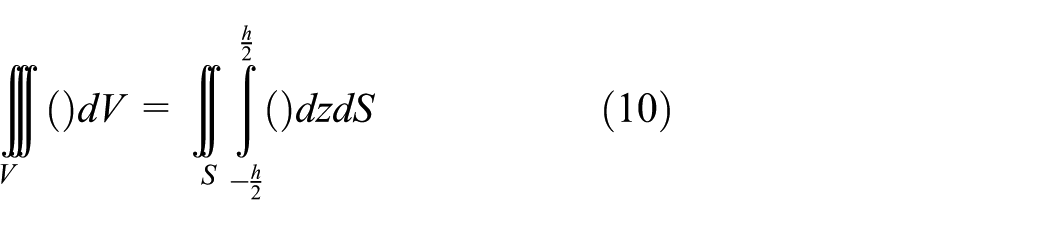
The equation (9) can be expressed as follows

where in this relation

Using equation (4), we can express the equation (12) as follows


where in this relation

In fact, D is the flexural rigidity of the sheet.
Using equation (10), we can now describe kinetic energy as follows

where

where

The differential variations of external work can also be expressed as follows

In this relation, f represents the external force per sheet area unit.
By replacing the equations (11), (15), and (18) in equation (6), we can find the following equation

In terms of the relation
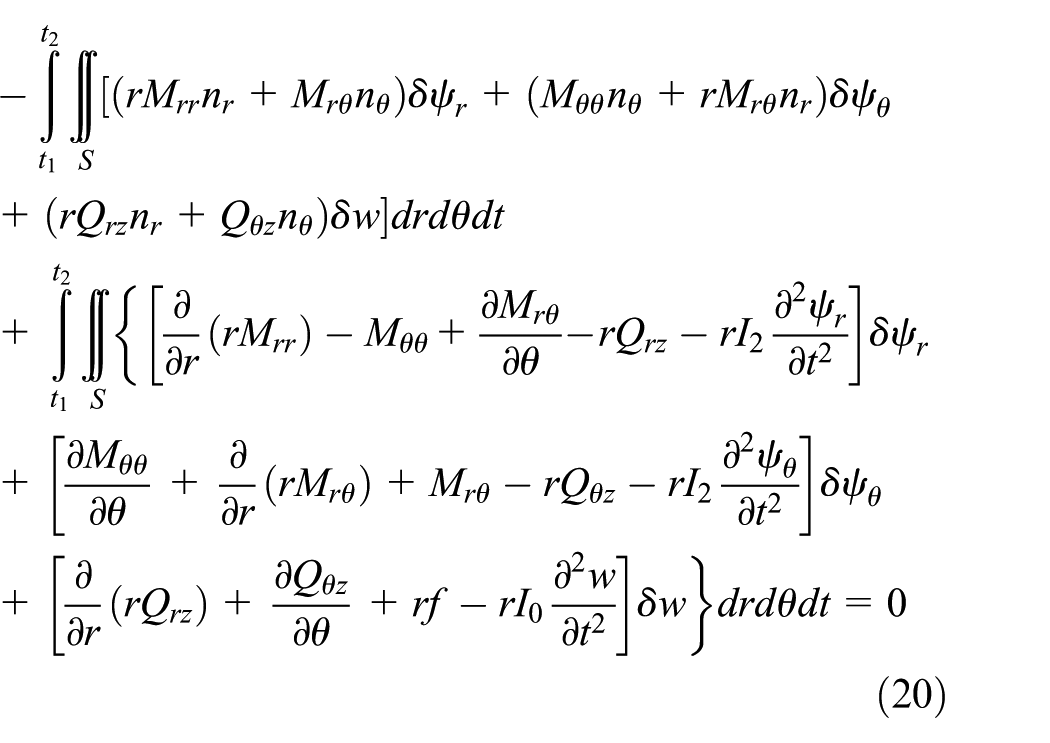
In this relation,
Therefore, the equations for the sheet vibrations will be extracted as follows

And the boundary conditions are also expressed as

Accordingly, three modes can be considered at each boundary:
Clamped (C)

Simple (S)

Free (F)

Utilizing equation (13), we can define simple and free boundary conditions as follows
Simple (S)

Free (F)

The boundary conditions on a simple edge can be expressed in simpler form as follows

The force exerted on the plate, caused by the reaction force of the foundation

where

With the definition of the dimensionless form of location, time and transverse displacement in the form below

And use the following mathematical relation for the Delta function

The equation (21) can be expressed as follows

where in this relation
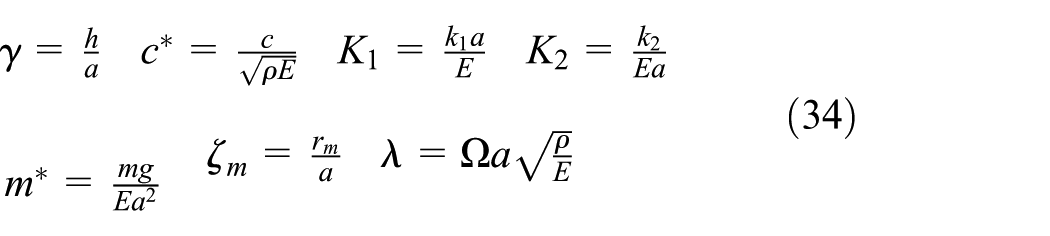
In fact, in the above relation,
Clamped (C)

Simple (S)

Free (F)

Numerical simulations
Investigating the effect of elastic coefficient of foundation on natural frequencies of sheet
A sheet with the following specifications is considered to examine the effect of the elastic coefficient of the foundation on its natural frequencies

The effect of the foundation elastic coefficients on the first three frequencies of the sheet for different boundary conditions is shown in Figure 2. These figures show that increasing the elastic coefficient of the foundation results in increased frequencies. The reason is that by increasing the elastic coefficient of the foundation, the stiffness of the structure increases, and as a result, the relative frequency increased. In limit state, a rigid foundation causes the sheet to be rigid and without oscillation.
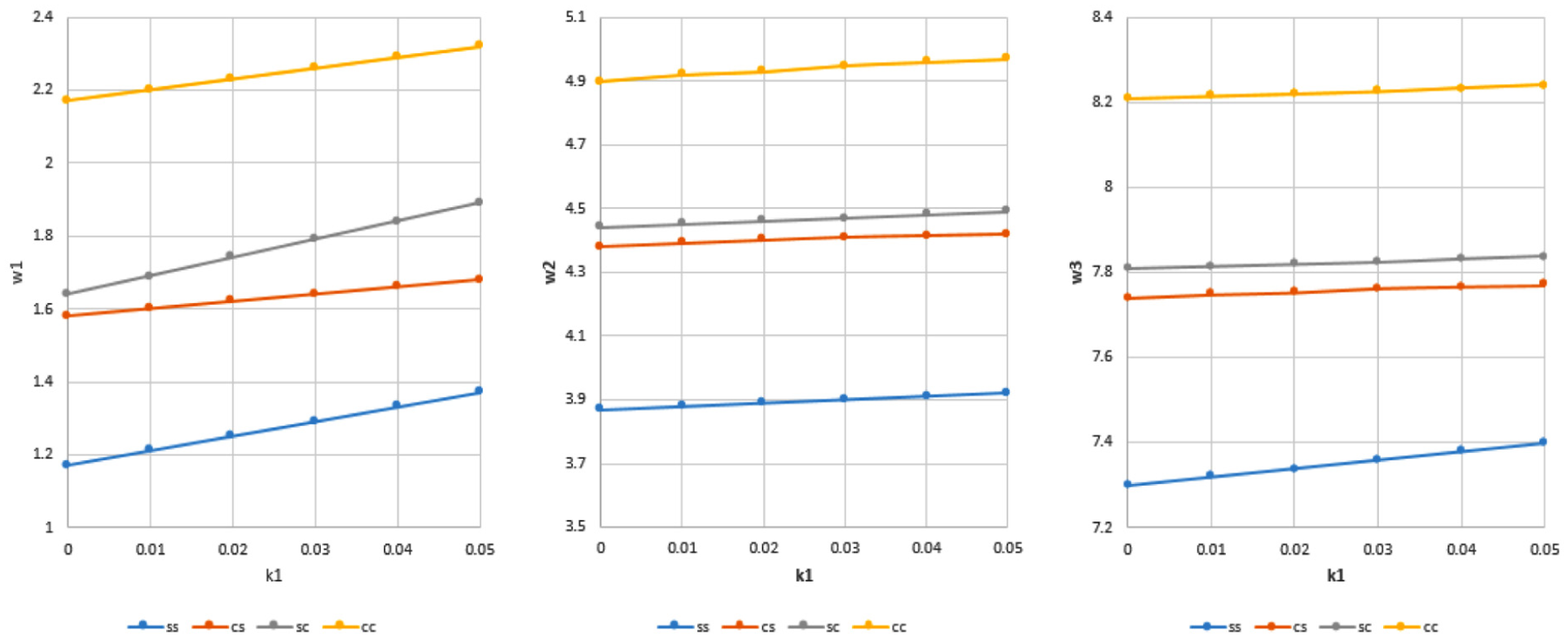
The effect of the elastic coefficient of the foundation on the natural frequencies of the sheet with the specifications of
The effect of the foundation elastic coefficient on the first three frequencies of the sheet with the specification given by numerical method is investigated by finite element method, the slopes of the analytical and numerical results were in close agreement (Figure 3).

The effect of foundation elastic coefficient on the natural frequencies of the sheet with the specified specifications by the finite element method.
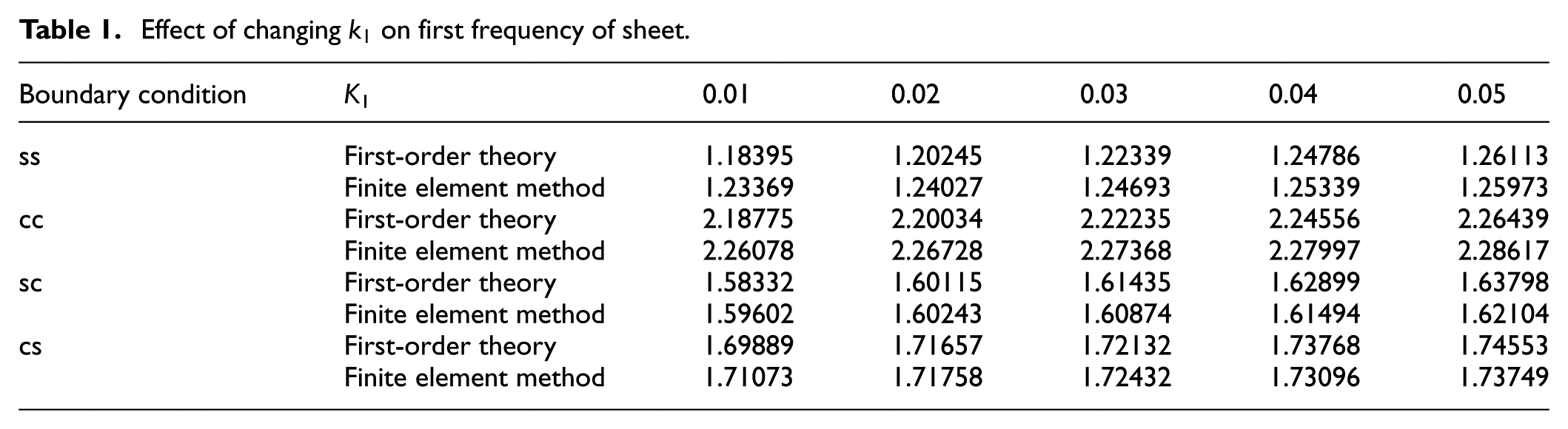
Table 1 shows effect of changing
Effect of changing

Mode shapes of the circular plate.
Graphene sheets
Effect of elastic coefficient of foundation on natural frequencies of graphene sheet
Graphene is a layer of carbon atoms; each carbon atom is connected to three other carbon atoms. It forms a flat sheet of hexagons. Graphene has good electrical, mechanical, and thermal properties. Electric conductivity of graphene is
A circular graphene sheet was considered as shown in Figure 5.

Converting graphene sheet to circular sheet.
Latter, a circular graphene sheet was considered as a plate with following specifications

The effect of the elastic coefficient of foundation on the first three frequencies was extracted and can be seen in Figure 6. These figures show that increasing the elastic coefficient of the foundation, increasing frequencies. The reason is by increasing the elastic coefficient of the foundation, the stiffness of the structure increases, and as a result, the frequencies increase.

The effect of foundation elastic coefficient on the natural frequencies of the graphene sheet.
Table 2 shows effect of changing
Effect of changing k1 on first frequency of Graphene.


Shape modes for graphene sheet.
Conclusion
Numerical analysis of macro-, micro-, and nanoscale materials has always remained a challenge for researchers due to the geometrical and structural complexities. In this study, free vibrations of hollow circular plates based on elastic foundation are investigated and the formulation is then implemented to graphene sheets. Initially, the first-order shear deformation theory is used to study effect of the elastic coefficient of foundation on sheet vibrations. Then, using a finite element method, a hollow circular sheet is modeled. The results depicted are in good agreement with the theory. The results show that increasing
Footnotes
Handling Editor: Ka-Veng Yuen
Declaration of conflicting interests
The author(s) declared no potential conflicts of interest with respect to the research, authorship, and/or publication of this article.
Funding
The author(s) disclosed receipt of the following financial support for the research, authorship, and/or publication of this article: This work was supported in part by the Science Technology Development Fund, MSAR, under Grants 078/2015/A3 and 122/2017/A3.
