



Abstract
This article is concerned with topology optimization of transmission gearbox under multiple working loads by taking dynamic performance as research object. First, the dynamic excitation model and finite element model are established, the vibration responses of the key points on gearbox are obtained by applying dynamic excitation on finite element model based on modal dynamic method, and the simulation responses are compared with testing results to validate finite element model. Finally, the gearbox structure is optimized by utilizing topology optimization method, and the lightweight model of transmission gearbox structure is redesigned. The dynamic performance indexes such as natural frequency are improved obviously, which indicates that the topology optimization method is very effective in optimizing dynamic performance of complex gearbox structure. The research has an important theoretical significance and reference value for lightweight design of transmission gearbox structure.
Keywords
Introduction
With rapid development of automobile industry and increasingly prominent energy issues, the research on energy saving and emission reduction in automobile industry has been more and more worthy of attention.1,2 Lightweight design of vehicles is one of the most important ways to realize energy saving, which has an important research value and practical significance. On one hand, traditional design approach will improve fuel consumption and increase cost of vehicles by increasing structure size indirectly. On the other hand, the material reduction will reduce strength and stiffness, which will affect noise, vibration, and harshness (NVH) performance greatly. Therefore, how to optimize complicated structure of transmission gearbox becomes more and more important.
Structural topology optimization is an effective optimization method to find optimal distribution of structural materials by considering constraints, loads, and optimization objectives.3,4 In recent decades, topology optimization theory has been widely studied in the area of conceptual design of industrial products, and some general practical topology optimization methods have been presented. In automobile industry and aircraft industry, topology optimization techniques are used for saving material to improve dynamic behavior of structure.5,6 With the development of computer-aided engineering (CAE), the optimization method can take the design requirements into account to find the optimal design under certain constraints combined with numerical methods. An ordered multi-material SIMP (solid isotropic material with penalization) interpolation was proposed to solve multi-material topology optimization problems without introducing any new variables; for its conceptual simplicity, the proposed ordered multi-material SIMP interpolation can be easily embedded into any existing single material SIMP topology optimization. 7 There are a lot of literatures about the research of topology optimization in the initial design stage of product, but the research of structural topology optimization under multiple working loads is rare. A novel method for nonlinear dynamic response topology optimization is proposed using the equivalent static load (ESL) method, and the transformation variables are introduced for a new update method for the incorporating process of the topology results into nonlinear dynamic analysis. 8 The topology optimization related to harmonic responses for large-scale problems was studied by Liu et al. and Duddeck et al. They found that the mode displacement method (MDM) results in the unsatisfactory convergence due to the low accuracy of harmonic responses, while mode acceleration method (MAM) and full method (FM) have a good accuracy and evidently favor the optimization convergence.9,10 Therefore, the studies of structural topology optimization of complex gearbox under multiple working loads are of great significance for improving the dynamics and lightweight design of a transmission gearbox system.
In this article, the structure of a transmission gearbox is optimized in order to improve dynamic performance. According to the multiple working load conditions of gear transmission system, the dynamic excitation models of gear transmission were established, and the dynamic excitations were applied to finite element (FE) model of gearbox. The dynamic responses of key points of the gearbox were obtained based on modal dynamic analysis procedure. The vibration responses of the gearbox under multiple working loads were tested using test bed of the transmission gearbox to verify the rationality of FE modeling. Finally, the gearbox structure under multiple working loads was optimized based on the variable density method of topology optimization, the three-dimensional (3D) model of lightweight design gearbox was re-established, and the dynamic performance of the optimized transmission gearbox was improved obviously.
Dynamic excitation of transmission gearbox
The internal dynamic excitation of gear transmission can be composed of three parts: the meshing stiffness excitation, the error excitation, and the meshing impact excitation. According to the principle of gear meshing dynamics, the nonlinear dynamic equations of a pair of gears can be expressed as 11

where
By introducing total equivalent excitation error and omitting small amount, the equation can be transformed as

where

where
In this article, the transmission gearbox is composed of the upper gearbox and the lower gearbox, and the dynamic excitation forces are applied on the gearbox through the bearing bores. The initial 3D geometric models of the gearbox are built in the SolidWorks Software. The FE models of the gearbox are established using ABAQUS based on the 3D geometric model, and there are 134,191 tetrahedron elements and 390,829 nodes in the FE model. The gearbox is made of aluminum alloy, and the density is 2700 kg/m3, the elastic modulus is 72 GPa, and Poisson’s ratio is 0.3. The initial model is shown in Figure 1.

Initial model of the transmission gearbox.
The vibration response can be obtained by applying the dynamic excitation forces on the gearbox based on the modal dynamic analysis procedure, where a reference point is set up at the center of the bearing bore of the FE model of the gearbox, the reference point is coupled with the bearing bore, and the dynamic excitation force is applied on the reference point. The upper gearbox and lower gearbox are tied together by the connection elements; the 6-degrees of freedom (DOFs) of the connecting part between the gearbox and the automobile frame are restrained. The dynamic responses of the key points under the fourth gear speed are shown in Figure 2. The meshing frequency of the fourth gear is 370 Hz in the automobile transmission system; it means that the fundamental frequency X of the vibration response of the transmission gearbox is 370 Hz. It can be seen from the frequency spectrum that the vibration frequency of the gearbox mainly concentrated within 1500 Hz under the fourth gear speed, and the vibration frequencies of the gearbox are mainly composed of the fundamental frequency X and the high multiple frequencies, such as the frequencies of 2X (740 Hz), 3X (1110 Hz), and 4X (1480 Hz).

Dynamic responses: (a) time-domain waveform and (b) frequency spectrum.
Vibration response testing
The vibration test of the gearbox is carried out under the fourth gear speed condition of the transmission system based on the transmission testing platform, and the gear transmission gearbox and the testing platform are shown in Figure 3, where the acceleration sensor is used to collect the vibration acceleration response of the key points on the surface of the gearbox. The input torque load is 50 Nm, the input speed is 600 r/min, the sampling frequency of the acceleration sensor is 5000 Hz, and the test time is 10 s.

Testing platform of transmission gearbox.
The test results of the vibration responses and the frequency spectrum of the test points are shown in Figure 4, where it can be found that the main characteristic vibration frequencies of the gearbox are the fundamental frequency of 370.1 Hz and the high multiple frequencies and harmonic frequencies.

Dynamic responses: (a) time-domain waveform and (b) frequency spectrum.
By comparing the simulation responses and the testing responses, it can be seen that the main vibration frequency of gearbox is composed of meshing frequency of 370 Hz and the high multiple frequencies and harmonic frequencies. Due to the influence of interference factors of the testing platform, the testing frequency spectrums are more noisier than that obtained by FE simulation. Since the simulation frequencies coincide well with testing frequencies of the gearbox vibration response, the FE model of the gearbox can be used for the structural strength analysis and the topology optimization.
Topology optimization under multiple loads
The structure of the transmission gearbox is affected by multiple working loads, and the material distribution of the gearbox will affect the dynamic performance of the gearbox, such as the stiffness and strength. In this article, the transmission gearbox structure is optimized based on the established FE model of the gearbox mentioned above by utilizing topology optimization methods to improve the dynamic performances. The basic idea of topology optimization of the structure is to transform the problem of searching the optimal topology of the structure into the problem of solving the optimal material distribution in a given design area. In this article, the variable density methods are used to optimize the structure of the transmission gearbox for its computational efficiency. The basic idea is to introduce a kind of variable density material so that the density value changes in the range of 0–1. The problem of topological optimization of the structure is transformed into the problem of searching the optimal distribution of element materials by taking the density of each element as the design variables, based on the discrete FE model of the continuous structure.
The minimum of deformation energy is taken as optimal target, and the material volume of the continuous structure is taken as the constraint (the total mass constraint). The mathematical model of topological optimization can be expressed as 12
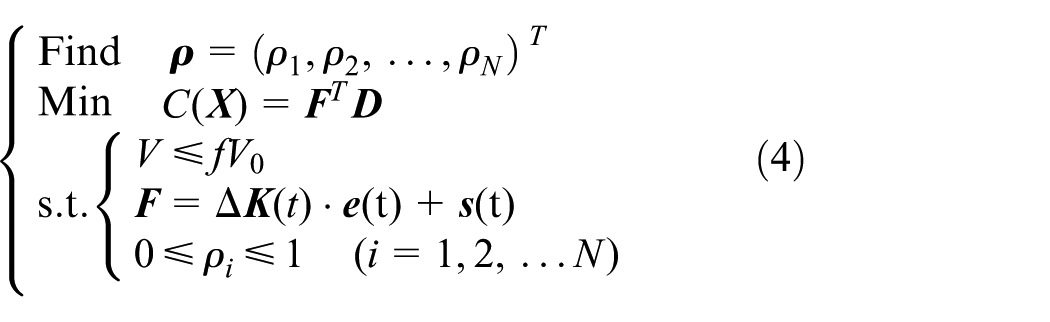
where

where Wj is the weighting coefficient of the jth working condition, and Cj is the structural deformation energy of the jth working condition. In fact, the FE optimization software can be better used to solve static stiffness optimization, dynamic response optimization, and combinatorial optimization of above problems. In this article, the topology optimization module in general FE software ABAQUS is used to optimize gearbox structure.
Analysis of topological optimization results
The topology optimization model of the transmission gearbox structure is built based on the FE model by considering the multiple working load conditions. According to the actual connection relationship between the upper and the lower gearboxes, eight linear spring elements with a stiffness of 6.1 × 10⁵ N/mm in the connecting surface of the two gearboxes are established, where the damping ratio of each spring element is 0.75. The bearing reaction forces are applied on each bearing bore in the gearbox in the vertical direction, horizontal direction, and axis direction. The maximum displacement at the top of the upper gearbox is 0.93 mm, which can be calculated by the static analysis procedure in ABAQUS, and the maximum stress in gearbox structure is 158 MPa, which is located at the output front bearing bore. Since the maximum stress is far less than the allowable stress of 220 MPa, there is sufficient strength margin in the gearbox; thus, the stiffness constraints are the main considerations in the optimization process. Considering the constraint of the manufacturing process of the gearbox, the connecting surface of the upper and the lower gearboxes is not optimized in this article, and the optimized area of the whole gearbox structure is shown in Figure 5.

Optimized area of the transmission gearbox.
The topology optimization is carried out by utilizing the topology optimization procedure in ABAQUS. First, the 3D geometric model of gearbox was imported into the FE software, the displacements of the nodes in the FE model of the gearbox are taken as the design responses, and the element density distribution of the optimized area in the gearbox is used as the design variables. The optimization process is executed by taking lightweight as the design goal and the maximum displacement at the top as the constraint by considering the multiple working load conditions. The criterion for convergence is the relative error of the largest component of the design variable for two iterations

As a convergence criterion,

Flow chart of topology optimization.
The iterative convergence curves of the topology optimization process obtained by the variable density method are shown in Figure 7. Since the material reduction of the structure based on the variable density method is realized by reducing the densities of elements, in this process, the remaining volume of the gearbox structure increases gradually, which will converge to a constant value. The variation curve of the remaining volume of gearbox is shown in Figure 7(a).

Convergence curves: variation of (a) remaining volume and (b) strain energy.
According to the variable density algorithm of the topology optimization process, due to the reduction in the element density and the structural volume in the optimized area, the optimization algorithm searches for the optimal material distribution to minimize the deformation energy of the gearbox structure. Therefore, in the process of structure optimization, the deformation energy will increase first, and then decrease gradually along with the reduction in the gearbox material, and finally, it will converge to a constant value to ensure the maximum stiffness of the gearbox structure; the variation curve of the deformation energy is shown in Figure 7(b). The relative density clouds of the elements in the optimized area are calculated through 25 iterations, which are shown in Figure 8(a).

Density cloud of the gearbox: (a) element density clouds and (b) optimized model.
In Figure 8(a), the structural material of the optimized area in which the element density value is close to 1 can be removed a little, and the material of the optimized area in which the element density value is close to 0.01 can be removed a lot. According to the density clouds of the elements, the supporting plate is excised 90 mm and the mesh stiffener is excised 10 mm. Finally, the optimized model of the gearbox can be obtained, which is shown in Figure 8(b). According to the optimization results, the initial design model of the upper gearbox is rebuilt by considering the manufacturing process constraints of the optimized area in the gearbox, and the specific optimized geometric models are shown in Figure 9.
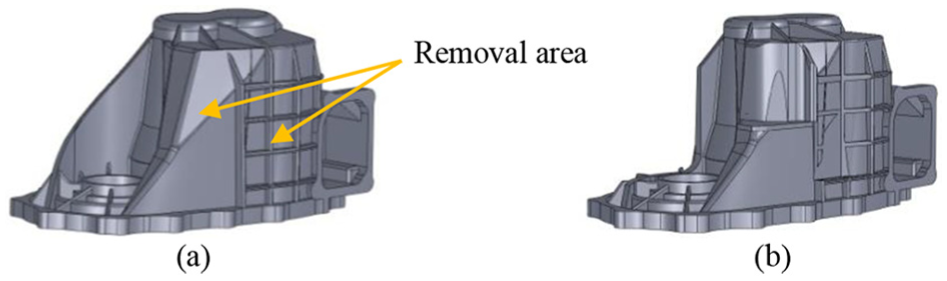
Comparison of optimized model: (a) initial model and (b) optimized model.
The mass of the optimized model of the gearbox is 9.1 kg, which is reduced by 7.6% compared with that of the initial model. In order to verify the accuracy of the topology optimization method, the dynamic performance of the optimized transmission gearbox is recalculated under multiple working loads in ABAQUS, and the comparisons of the dynamic performance indexes of the optimized model and the initial model of the transmission gearbox are listed in Table 1.
Comparison of dynamic performance indexes.

It can be seen from Table 1 that the mass of optimized gearbox decreases obviously, which means the lightweight design of the transmission gearbox is realized. The maximum stress of the optimized gearbox is 158 MPa, and the stress distribution of the optimized gearbox is basically consistent with that of the initial gearbox structure. After optimization, the material in the maximum stress area of the structure is not reduced, so the maximum stress of the structure before and after optimization has not changed. The maximum displacement of the optimized gearbox is 0.89 mm, which decreased about 5.3% compared with that of the initial gearbox. The changes of the aforementioned dynamic performance indexes show that although the mass of the optimized gearbox has been reduced, the strength and stiffness of the optimized box are not decreased. The first- and second-order natural frequencies of the optimized gearbox are 900.3 and 1008.7 Hz, respectively, which increased about 4.1% and 5.0%, respectively, and the vibration modes of the first two orders of the optimized model coincide well with that of the initial model, which means that the total stiffness and the overall strength of the optimized transmission gearbox improved. Therefore, the optimization design of the transmission gearbox is reasonably practicable in the basis of the topology optimization method, and the optimization method can be applied to the lightweight design of the transmission gearbox structure in the vehicle system.
Conclusion
This article has demonstrated how the topology optimization method can be applied to dynamic improvement and lightweight design of transmission gearbox under multiple load conditions in vehicle system. The dynamic excitation model and FE model of the gearbox were established, and the frequency responses obtained by modal dynamic analysis procedure were compared with the test results to validate the FE model of the gearbox. The bearing’s reaction forces applied on the bearing bore were calculated under multiple working loads. By considering the multiple working loads, the FE model of the gearbox structure was optimized based on variable density method, and the lightweight design model was redesigned based on distribution clouds of element density. Although the mass of optimized gearbox was reduced by 7.6% compared with the initial model, the strength and stiffness were not weakened, and the first- and second-order natural frequencies increased about 4.1 % and 5.0 %, respectively. The aforementioned indexes show that the dynamic performances of the whole transmission gearbox structure improved observably. This study can not only provide theoretical basis for dynamic optimizations but also has practical value for upgrading the transmission gearbox products.
Footnotes
Handling Editor: Elsa de Sa Caetano
Declaration of conflicting interests
The author(s) declared no potential conflicts of interest with respect to the research, authorship, and/or publication of this article.
Funding
The author(s) disclosed receipt of the following financial support for the research, authorship, and/or publication of this article: This work was supported by the Natural Science Foundation of China (nos 51705494 and 51605462) and the Natural Science Foundation of Zhejiang Province, China (grant no. LQ17E050005).
