



Abstract
A reconfigurable manufacturing system is one designed for rapid change in its structure, to quickly adjust its production capacity and functionality within a part family. Aiming at the diversity, cost and complexity of reconfiguration design, a method for evaluating the design scheme of a reconfigurable machine tool based on VIKOR is proposed. The module similarity between a reconfigurable machine tool and a prototype machine tool is defined, and on this basis, three quantitative evaluation indicators are established as follows: the module chain similarity determines the difficulty, effort, time and efficiency of machine tool reconstruction; the module interface complexity determines the feasibility and complexity of the disassembly and assembly of the reconfiguration module; and the reconfiguration cost determines the economic advantages of reconfigurable machines relative to fixed-structure equipment. According to three indicators, a multi-attribute decision-making method based on VIKOR is used to evaluate, calculate and sort the design scheme set of the reconfigurable machine tool, and the optimal feasible solution is obtained. An example of the reconfiguration design of a machine tool is analysed to verify the validity and feasibility of the proposed method compared with the methods of simple average weighting and technique for order preference by similarity to an ideal solution.
Keywords
Introduction
A reconfigurable manufacturing system (RMS) is a new type of variable manufacturing system that can rapidly adjust the processes, functions and capabilities of manufacturing according to changes in market demand and system planning by rearranging, reusing and innovating components. 1 RMS integrates the advantages of flexible manufacturing systems and dedicated manufacturing systems. 2 It can realize the dynamic and flexible response of manufacturing systems to the market and also achieve lower production costs when taking into account production efficiency and product quality.3,4
The RMS consists of one or more reconfigurable machine tools (RMTs), which are an important part of the RMS. 5 The main goal of an RMT is to handle various changes in the product or parts to be machined. The use of mechanical, control, hydraulic/pneumatic and electrical modules can achieve rapid adaptability of the RMT. Therefore, the efficiency of a machine tool can be enhanced by the development of machine modules, which can be quickly assembled and disassembled. 6
Some research on RMS has been carried out. Kurniadi and Ryu 7 presented the importance of the integration of Internet of things (IoT) into RMS and the development of mathematical model to solve reconfiguration planning (RP) problems in order to save reconfiguration time, cost and effort. Abdi and Labib 8 contributed an overall approach of grouping products into families based on operational similarities, when machines are still not identified. Scholz-Reiter et al. 9 presented a novel approach of capacity control considering the potential of RMTs and substantiate the often disregarded potential of RMTs with simulation results. Shneor 10 presented the design and implementation of modular machine subsystems that enables various machining processes on the same computer numerical control (CNC) vertical milling machine. Aguilar et al. 11 documented the design, refinement and implementation of an RMT that provides a flexible platform for turning and milling and demonstrates satisfactorily the reconfiguration characteristics of modularity, integrability and convertibility. Padayachee and Bright 12 focused on aspects of the mechanical design and the development of a control system that supported the modularity and reconfigurability of the mechanical platform and presented a modular electronic system that is characterized by a plug-and-play approach to control scalability. Son et al. 13 described the development of a 3-degree-of-freedom (3-DOF) desktop RMT, and presented the conceptual design of a desktop RMT, which is capable of controlling the 3-DOF orientation of a spindle. Dhupia et al. 14 considered an arch-type RMT that has been built to demonstrate the basic concepts of RMT design. Adamietz et al. 15 presented the concept and the prototype realization of a novel reconfigurable small-footprint manufacturing system in a transportable container.
Modular design was studied as the main method for RMS reconstruction. Mpofu 16 proposed a hierarchical classification mechanism for machine structures, these structures derive from module combinations where symbology is utilized to represent the machines and these symbols can be used in the configuration process. Bruzzone and D’Addona 17 proposed a new modular, reconfigurable and scalable machining centre that is characterized by the possibility of modifying the machining capacity. Sibanda et al. 18 presented a structured framework that will optimize the development process of a new reconfigurable guillotine shear and bending press machine to be used in sheet metal work. The framework provides a guide for designers and manufactures of sheet metal machines in developing the new machine. Xia et al. 19 developed a solution framework for reconfigurable machining process planning and extend the concept of reconfigurable process planning to a concept of reconfigurable machining process planning which targets the process plan generation for a part family. Mpofu and Tlale 20 presented an effective method that uses multi-level fuzzy decisions to create dynamic optimal configurations of machine structures with respect to a given part geometry. Gadalla and Xue 21 introduced an optimization approach for the design of an RMT based on evaluations to both the different machine configurations and the reconfiguration processes to change between machine configurations. Strasser et al. 22 proposed an approach for an engineering support for RMS, especially for RMTs based on the holonic paradigm. Ashraf and Hasan 23 proposed a framework for configuration selection for a manufacturing flow line and demonstrated using non-dominated sorting genetic algorithm-II (NSGA-II). Huang et al. 24 proposed a dynamic complexity-based RMS reconfiguration point decision method to address the problem of how to identify the best time to implement reconfiguration for the RMS. Jiang et al. 25 introduced a Petri Net model-driven methodology for the development, validation and operation of a radio-frequency identification-enabled decentralized flexible manufacturing system.
Different methods of analysing, evaluating and optimizing RMS have also been proposed. Eguía et al. 26 proposed a novel data envelopment analysis approach to assess the technical efficiency of RMS by benchmarking the observed time allocation of the different system configurations and the inputs consumed and output produced in each of them. Mittal and Jain 27 focused on the performance measures and the way to find the best configuration for RMS among various performance measures like ramp-up time, cost, reliability, availability, lead time and reconfiguration time that affect the performance of the RMS. Liao and Lee 28 introduced a methodology for designing a reconfigurable prognostics platform which can be easily and effectively used to assess and predict the performance of machine tools. Lorenzer et al. 29 presented a software tool that allows the evaluation of the performance and conformance to requirements of machine structure variants at an early stage. Goyal et al. 30 presented a novel methodology to assess the responsiveness of an RMT through developing the operational capability and machine reconfigurability metrics. Youssef et al. 31 provided a model for optimizing the capital cost of RMS configurations with multiple aspects using genetic algorithms. Yu et al. 32 proposed an RMS formal model from the perspective of multi-agent systems, in order to describe, analyse and verify the reconfiguration of RMS.
The design schemes of the RMS need to be evaluated to obtain the best results. The evaluation involves the following two aspects: evaluation indicators and evaluation algorithms. Due to the criteria multiplicity and information uncertainty evaluations, the evaluation of machine tool design schemes has been examined to quantify the indicators and address the uncertainties in the evaluation process; furthermore, schemes have been evaluated, calculated, sorted and optimized. For this reason, a multi-attribute decision-making (MADM) method based on VIKOR for evaluating the reconfiguration schemes of a machine tool is proposed, and the best design proposal is obtained through the quantitative evaluation of three evaluation indicators including the module chain (MC) similarity, module interface complexity and reconfiguration cost.
Similarity between the reconfiguration module and the prototype module
According to the structural features and processing requirements of the parts to be processed, a variety of different process routes are planned to constitute a process plan set
The similarity between reconfiguration module (RM) and prototype module (PM) shows the module utilization in the process of machine tool reconfiguration, including the similarities in layout, function, quantity and physics of the module. Layout similarity means that the layouts of RM and PM, such as the positional relationship, the connection mode and the arrangement mode, are similar. Functional similarity means that the functional properties of RM and PM, such as the machining speed and the acceleration, load and torque, are similar. The quantity similarity relationship refers to the similar relationship between the number of components in the RM and the PM, such as adding or deleting components in the module when modifying the module. Quantity similarity means that the number of internal parts of RM and PM is similar. Physical similarity means that the transfer mode of internal energy, information or material flows between RM and PM is similar.
The similarity features of RM and PM are denoted as a set
where
Evaluation indicators of the RMT design scheme
The following three aspects in the reconfiguration evaluation should be considered: the degree of similarity between RMT and PMT, the complexity of the module interface and the cost of the reconfiguration.
MC similarity
The chain structure of machine tool modules to accomplish a certain function is defined as an MC. Assuming that

where
The following three kinds of values exist for
When
When
When
Module interface complexity
Module interface complexity is an important indicator that affects the assembly and disassembly characteristics of RMT. Non-destructive methods should be adopted as far as possible for module disassembly in the reconfiguration process to increase the module reloading efficiency and reuse probability.
Entropy, as an effective concept for expressing the amount of information, can be used to measure the interface complexity between modules. In the assembly and disassembly process, the smaller the information entropy of the module interface complexity, the less the difficulty of the assembly and disassembly.
According to the assembly and disassembly characteristics of the module, an interface number relation matrix

According to the concept of information entropy, the module interface complexity relationship is defined as shown in equation (4)

where
Reconfiguration cost
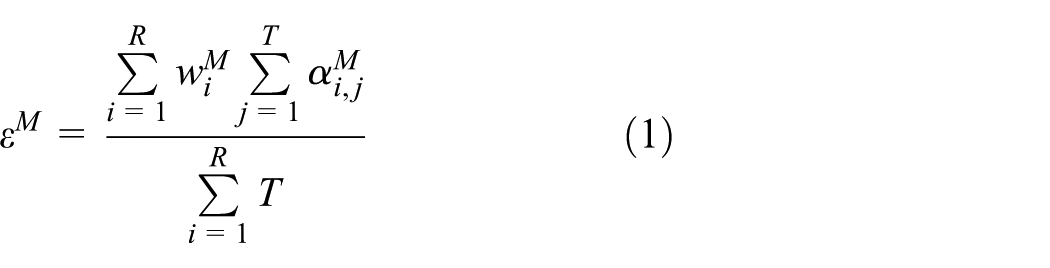
The reconfiguration costs of a machine tool mainly include auxiliary costs, demand costs and module reconfiguration losses. Auxiliary costs include labour costs and resource costs, of which labour costs are used to disassemble and assemble modules in the process of machine reconfiguration, and resource costs are used for the purchase, rental and energy consumption of auxiliary tools needed for reconfiguration. Demand costs are used for module purchases, leases and other expenses resulting from production changes. Module reconfiguration losses refer to the value loss caused by damage to the module structure, performance and so on during the reconfiguration process.
The cost of the reconfiguration from

where

where K is the number of modules that need to be recovered when the module is damaged in the reconfiguration process corresponding to the process

where
MADM evaluation of the RMT design scheme based on VIKOR
The evaluation of the RMT design scheme is a typical MADM problem. For the benefit of group evaluation, the VIKOR is used for evaluation, which provides the optimal ranking of alternatives with the characteristics of maximizing ‘group benefits’ and minimizing ‘individual regrets’ and performs evaluation optimization to obtain the optimal feasible solutions.34,35
The decision-making algorithm of the RMT design scheme based on VIKOR is as follows:
Step 1. For decision alternatives

where
Step 2. Determine positive ideal solution


where J is a profitable attribute set, and
Profitable attributes are the MC similarity, and cost attributes are the interface complexity and reconfiguration cost.
Step 3. Calculate group benefit


Equation (11) shows that when p is small (e.g.
Step 4. Calculate the comprehensive index

where
Step 5. Sort the alternatives in ascending order of
C1 is an acceptable advantage

where
C2 is acceptable reliability.
After sorting according to R values, the value of S or Q of the first scheme must be better than that of the second scheme, and the schemes are compared in turn when there are multiple schemes.
If C1 and C2 cannot be satisfied at the same time, a compromise set is obtained. If the relationship between the first scheme and the second scheme only satisfies C2, both schemes are considered to be optimal schemes. If C1 is not satisfied between the first scheme and other schemes, and only C2 is satisfied, then these schemes are considered to be the optimal schemes close to the ideal scheme.
Case analysis
The PMT model is shown in Figure 1, and the part model is shown in Figure 2.

PMT model.

Part model.
Based on the module composition of the PMT and the machining feature of the part to be machined, five process plans are obtained for the part. The RM of each programme is shown in Table 1.
Modules for process plan.

The MC similarity and interface complexity of the RMT are determined by the structure position and the connection mode of the modules. The risk-free interest rate of the reconfiguration cost is calculated using the 1-year fixed deposit interest rate of 3.5%, the risk factor is set to 1.5 according to the market prospect and the market return rate is expected to be 10%. The expected discount rate is

The above five process schemes are evaluated according to the three evaluation criteria including the MC similarity, interface complexity and reconfiguration cost, and the obtained values are standardized as shown in Table 2.
Decision indicator attribute value after normalization.

The MC similarity is an efficiency index, and the interface complexity and the reconfiguration cost are cost indicators, which can be obtained according to Table 2.
The positive ideal solution
Sorting algorithm-based VIKOR,

According to Table 3,
To compare the effectiveness of the proposed method, simple average weighting (SAW) and technique for order preference by similarity to an ideal solution (TOPSIS) are used to evaluate the alternatives. SAW is a weighted linear combination or scoring technique, which is based on the weighted average and an evaluation score is measured by multiplying the normalized value of each criteria for the objectives with the importance of the criteria. The objectives could be ranked and objective with the highest score is selected as the preferred one. 36 TOPSIS is a method of compensatory aggregation that compares a set of alternatives by identifying weights for each criterion, normalizing scores for each criterion and calculating the geometric distance between each alternative and the ideal alternative, which is the best score in each criterion. 37 The details of the two methods mentioned above are not listed due to space limitations.
MC similarity, module interface complexity and reconfiguration cost are used as evaluation indicators in SAW, TOPSIS and the proposed method, and the same index weight vector
Comparison results of the proposed method, SAW and TOPSIS.

SAW: simple average weighting; TOPSIS: technique for order preference by similarity to an ideal solution.
From Table 4, it can be seen that the ranking results obtained by the three methods are basically the same. Therefore, the proposed method is reasonable and feasible for evaluating the performance of the RMT reconstruction scheme. In addition, the decision value obtained by the proposed method is more distinct than the value obtained by SAW and TOPSIS, which can provide more accurate evaluation information for decision makers. This result is also consistent with the research conclusions of Opricovic and Tzeng.38,39
However, it is also noteworthy that the coefficient of decision-making mechanism v in the proposed method plays an important role in the alternative ranking. Different values of v have a big impact on the results. There are other shortcomings in the article: (1) the main research object in this article is a serial machine tool, and the case of parallel and hybrid machine tools is not considered; (2) only a few key indicators are used for evaluation in this article, but in practice, a comprehensive and complete evaluation indicator system and a complete weight determination and evaluation algorithm are needed.
Conclusion
Aiming at the diversity of RMT design schemes, this article proposes a new method for the evaluation and optimization of reconfiguration schemes based on MADM. The method has the following characteristics:
The module similarity is defined and calculated according to the similarities in layout, function, quantity and physics of the module, to describe the module utilization in the process of machine tool reconfiguration.
The following three indicators are constructed for the reconfiguration evaluation of RMT design scheme: the MC similarity, the module interface complexity and the reconfiguration cost, and the quantitative calculation methods are also proposed.
The reconfiguration design schemes are evaluated using the multiple-attribute decision-making algorithm based on VIKOR that maximizes ‘group benefits’ and minimizes ‘individual regrets’ to obtain the best design scheme for RMT.
An example of the reconfiguration design of a machine tool is analysed to verify the validity and feasibility of the proposed method compared with the methods of SAW and TOPSIS.
Footnotes
Handling Editor: Michal Kuciej
Declaration of conflicting interests
The author(s) declared no potential conflicts of interest with respect to the research, authorship and/or publication of this article.
Funding
The author(s) disclosed receipt of the following financial support for the research, authorship and/or publication of this article: The authors would like to thank the National Natural Science Foundation of China (Grant No. 51875515) for the support given to this research.
