




Abstract
To study the applicability of diffusion approximation method, the influence of the optical thickness, scattering albedo, and wall emissivity of the examined medium on the accuracy of the diffusion approximation is analyzed. The accuracy is determined by comparison with results obtained by using the Monte Carlo method. By calculating the dimensionless radiation heat flux distributions at the bottom of the medium for various parameter combinations, the influence of each optical parameter is analyzed. In addition, the adaptability of the diffusion approximation method to the case of a gradient-index medium is examined. The results show that in the homogeneous-refractive-index medium and the gradient-index medium, the accuracy of diffusion approximation method is improved by an increase in the optical thickness or the scattering albedo and by a decrease in the wall emissivity. Moreover, the maximum relative errors are primarily distributed at the medium boundary and center. In the case of increased optical thickness or decreased wall emissivity, the error of the diffusion approximation method becomes stable and remains at a small value.
Introduction
Radiation transfer, as a basic transfer mode, occupies an important position in the field of industrial applications. The research is not only limited to the field of solar radiation transmission 1 and high-temperature gas radiation 2 but also the micro-scale radiative heat transfer, 3 spacecraft thermal control design, 4 and radiation inverse problem method to identify the temperature field of target 5 and so on. Obviously, the study of radiative transfer is still of great significance.
At present, the calculation of the radiative transfer equation mainly depends on different numerical methods, such as Monte Carlo method (MCM), 6 discrete transfer method, 7 discontinuous finite element method, 8 natural element method, 9 and so on. However, these methods have different applicable conditions. For instances, the MCM can deal with all kinds of complex problems, the complexity of the simulation calculation increases proportionately with the complexity of the problem and the amount of calculation increases greatly when dealing with the radiation of non-uniform medium. The discrete transfer method is considered to be very convenient for dealing with homogeneous and inhomogeneous medium radiation, but it is not easy to converge when solving the energy equation. The discontinuous finite element method has strong adaptive ability and high accuracy, but the computation is still slightly larger.
The P1 diffusion approximation (DA) method, which is based on spherical harmonics, eliminates the angle coordinates and also reduces the dimension processing, which greatly simplifies this problem. In recent years, the DA method is mainly applied to the field of medical imaging because of its fast computation. Ruan 10 used diffusion equation to solve the forward problem in the shape diffusion optical tomography technology. Furthermore, Xu et al. 11 investigated total time-resolve diffusion reflectance from a semi-infinite turbid media based on the DA method. For the research on the gradient-index medium, to our knowledge, Liu and colleagues12,13 have derived the DA equation of steady-state radiative transfer in multidimensional gradient-index medium, and the application conditions of the DA method are briefly described, so that the degree of influence of each optical parameter has not been further revealed.
In this work, the impact of τL, ε, and ω on the accuracy of the DA method, for media having a homogeneous refractive index and a gradient index distribution, is analyzed and compared. By calculating the distribution of the radiation heat flux at the bottom of the medium, the degree of influence of each optical parameter is determined. Note that, in order to simplify this work, the two-dimensional (2D) steady-state radiative transfer equation is considered.
Method
The radiative transfer equation for participating media can be expressed as
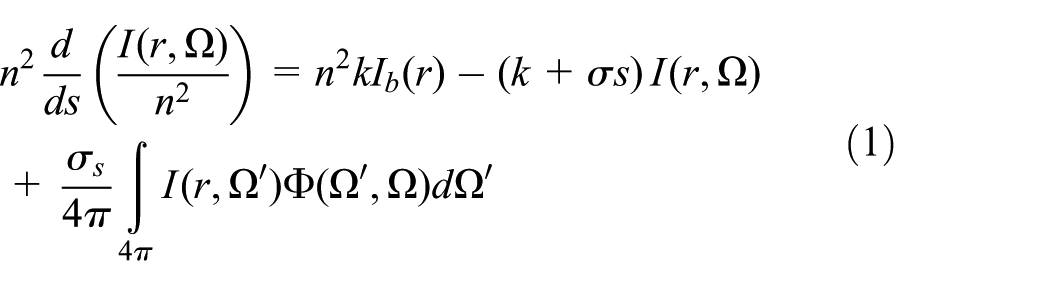
where
Based on P1 DA method, I can be rewritten in terms of the incident radiation G, and radiation heat flux q can be written as

Combined with formulas (1) and (2), the steady-state radiative transfer equation can be obtained
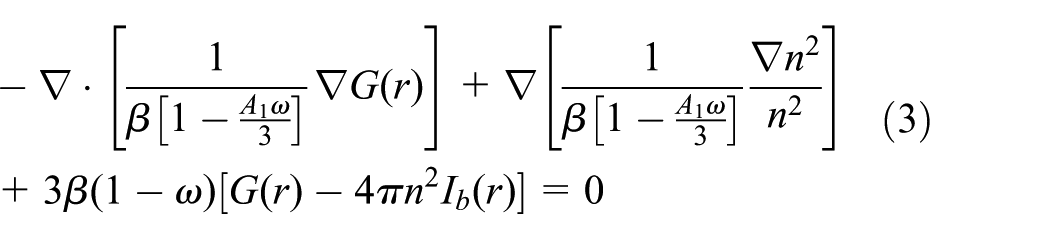
The boundary condition are expressed as

where
Using the conventional Galerkin finite element method, finally we can obtain

where
The discrete formula (5) can be written in a matrix form

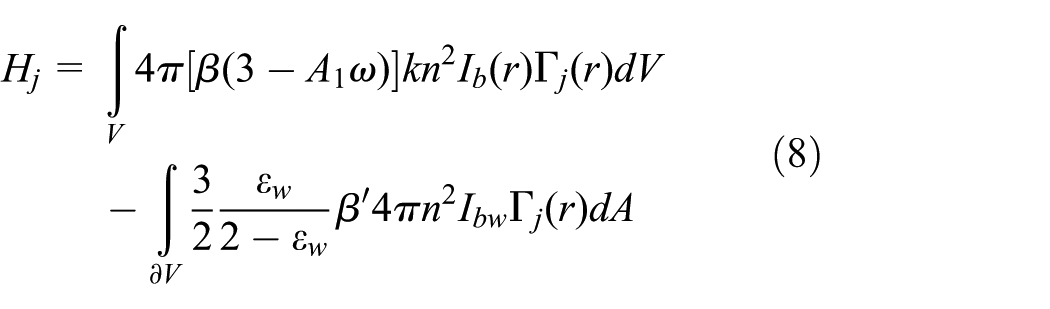
Each matrix element is defined as

Results and discussion
To determine the performance and accuracy of the presented DA method, we examine radiative heat transfer problems in a rectangle with opaque and diffuse surfaces. The boundaries are cold (0°K), and the medium temperature is maintained at 1000°K. For the following numerical study, the medium is uniformly divided into 200 × 200 units. Depending on the τL, ε, ω, and n of the material, different results can be obtained.
Several sample problems are tested to explore the accuracy and computation efficiency of P1 DA for different τL, ε, and ω. In subsection “Square enclosure filled with homogeneous-refractive-index medium,” three examples regarding homogeneous-refractive-index media are presented. In subsection “Square enclosure filled with graded-index medium,” examples concerning gradient-index medium are considered.
Square enclosure filled with homogeneous-refractive-index medium
The DA algorithm is tested through comparison with the MCM. The examined medium has a fixed

Dimensionless radiation heat flux distributions along the bottom wall for
For

Dimensionless radiation heat flux distributions along the bottom wall for
In Figure 3, the distributions of the dimensionless heat flux as obtained using both the DA method and the MCM are plotted for the case of
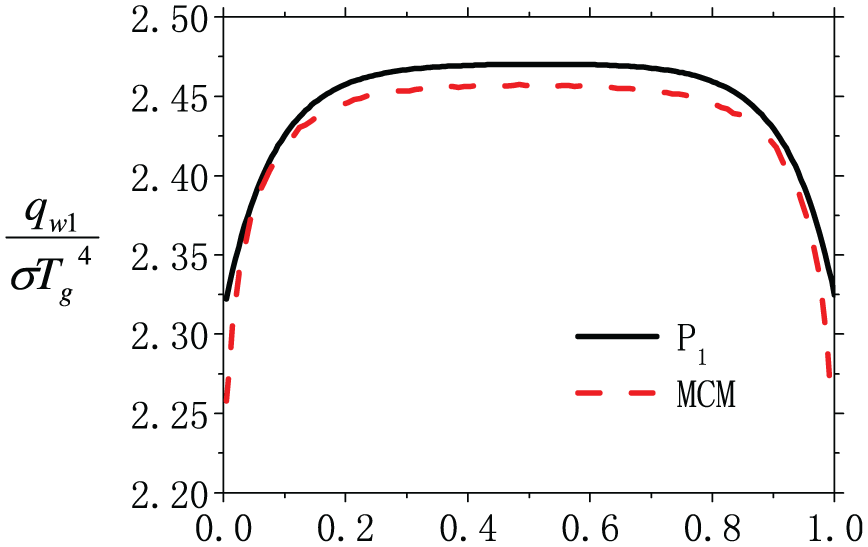
Dimensionless radiation heat flux distribution on homogeneous-refractive-index medium bottom for
Square enclosure filled with graded-index medium
Next, we consider a special layered graded-index medium, where the refractive index is modeled by

Thus, this medium has a variable refractive index n(x). We set

Dimensionless radiation heat flux distribution on graded-index medium bottom for
Figure 5(a) and (b) shows the dimensionless heat flux distributions for

Dimensionless radiation heat flux distributions along the bottom wall for
In Figure 6, the dimensionless heat flux distributions are plotted for
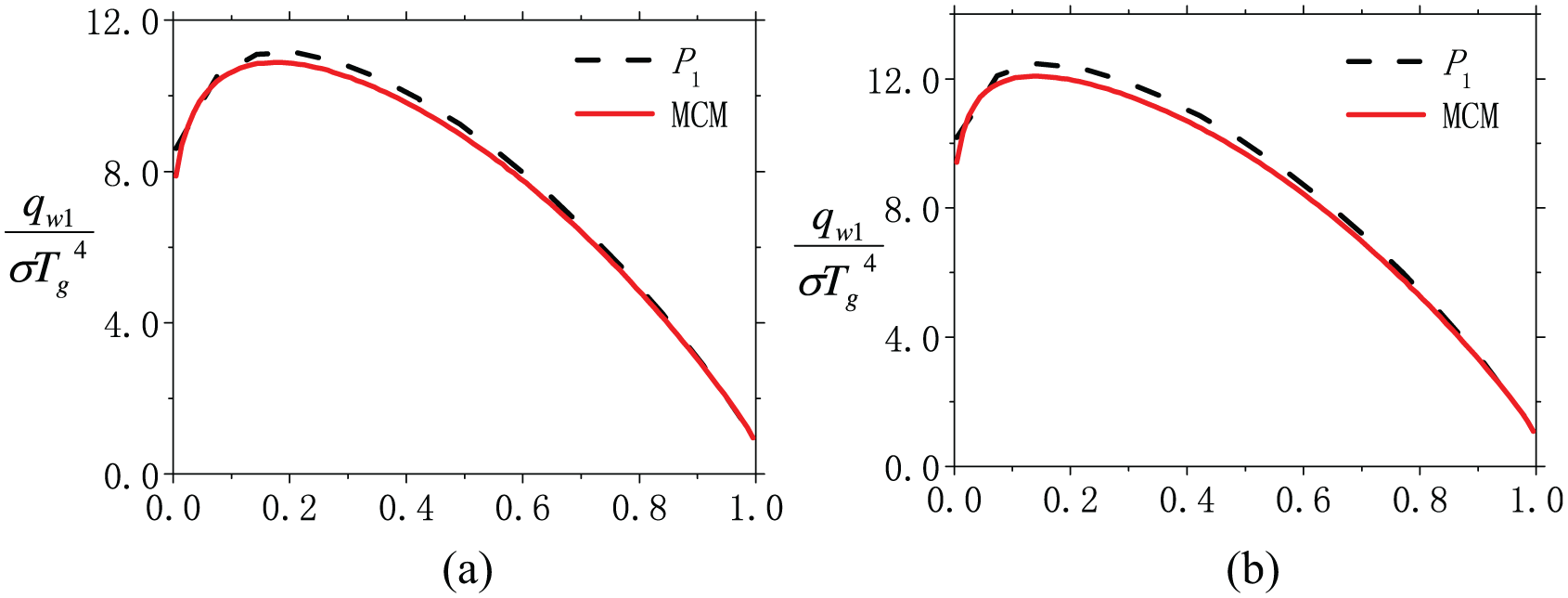
Dimensionless radiation heat flux distributions along the bottom wall for
Figure 7 shows the distributions of dimensionless heat flux under the conditions of

Dimensionless radiation heat flux distributions on graded-index medium bottom for
Conclusion
The DA method, which is a rapid algorithm, was extended to solve radiative transfer problems in a 2D rectangle containing a participating medium. Then, the applicability and precision of this method for a variety of optical parameters were examined. Under appropriate boundary conditions, the DA method was found to be consistent with the MCM, and the errors were primarily distributed at the boundaries and the medium center. Comparison of the influence of the optical parameters on the DA method in case of a homogeneous-medium-refractive-index and a graded-index medium indicated the accuracy of the DA. That is, the accuracy of the DA method increase with increased optical thickness or scattering albedo and with decreased wall emissivity. When the optical thickness increases or the wall emissivity decreases to a certain value, the error of the DA method becomes stable and keeps a small value.
Footnotes
Handling Editor: Oronzio Manca
Declaration of conflicting interests
The author(s) declared no potential conflicts of interest with respect to the research, authorship, and/or publication of this article.
Funding
The author(s) received no financial support for the research, authorship, and/or publication of this article.
