




Abstract
The effects of high-pressure and low-pressure exhaust gas recirculation on engine and turbocharger performance were investigated in a turbocharged gasoline direct injection engine. Some performances, such as engine combustion, fuel consumption, intake and exhaust, and turbocharger operating conditions, were compared at wide open throttle and partial load with the high-pressure and low-pressure exhaust gas recirculation systems. The reasons for these changes are analyzed. The results showed EGR system of gasoline engine could optimize the cylinder combustion, reduce pumping mean effective pressure and lower fuel consumption. Low-pressure exhaust gas recirculation system has higher thermal efficiency than high-pressure exhaust gas recirculation, especially on partial load condition. The main reasons are as follows: more exhaust energy is used by the turbocharger with low-pressure exhaust gas recirculation system, and the lower exhaust gas temperature of engine would optimize the combustion in cylinder.
Keywords
Introduction
With the energy crisis and environmental problems becoming increasingly serious, engines with lower fuel consumption and lower exhaust emissions have become a trend.1,2 Small-displacement and small-size turbocharged gasoline direct injection (GDI) engine3–7 has attracted wide attention in lowering engine fuel consumption, improving thermal efficiency and reducing emissions.1,8,9
However, engine miniaturization and high turbocharged pressure lead to the high load, which will increase the knocking tendency of the engine.10,11 The conventional solutions, such as delaying the ignition advance angle or decreasing the compression ratio, will sacrifice the thermal efficiency of the engine.12,13
In recent years, with the fuel consumption and emission regulations becoming more stringent, exhaust gas recirculation (EGR) technology has been used in the gasoline engine to reduce NOx and particulate emissions.14,15 It is also found that EGR can reduce the fuel consumption of gasoline engine.16,17
The research on EGR system of gasoline engine started earlier, mainly in universities and research institutions. Z Liu and D Cleary 18 have discovered earlier that layered EGR is more beneficial to combustion and emission performance of gasoline engine than conventional EGR on many conditions. J Su et al. 10 has theoretically analyzed the principle of improving gasoline engine efficiency by EGR system, and the performance improvement of high-compression-ratio gasoline engine using EGR system is analyzed by experiments. J Fu et al. 19 analyzed the energy conversion changes of gasoline engines after using EGR. These studies provide guidance for the application of EGR on gasoline engines, but pay less attention on the turbocharger performance changes after the EGR introduction. In fact, there are some effects on engine and turbocharger performance through intake and exhaust.
In this article, the change of turbocharger operation and the influence on engine performance are studied by experiments, and the reasons of these changes are analyzed after the introduction of low-pressure (LP) or high-pressure (HP) EGR to the turbocharged gasoline engine.
Test system and method
The test object is a 1.5-L inline four-cylinder turbocharged GDI gasoline engine, and its basic parameters are shown in Table 1. Test fuel is Beijing standard gasoline 92#. The EGR lifting valve and butterfly valve, which are driven by the DC motor, respectively, are adopted in the HP and LP EGR systems. They are all installed at cold end.
The main parameters of the test engine.

GDI: gasoline direct injection.
The EGR rate could be controlled accurately, and the calculation method of EGR rate is shown in equation (1). Therefore, the test system needs to collect the concentration of carbon dioxide in the intake pipe after the intercooling and the exhaust gas after the turbine

Among them,
The CD represents the duration of combustion, defined as the difference between the crank angle of the cumulative release rate reaching 90% and the crank angle of the heat release rate reaching 10%, shown in equation (2)

Figure 1 is a schematic diagram of HP and LP EGR engine test systems. The LP circulating exhaust gas is taken after the three-way catalyst and introduced through the EGR valve and the EGR cooler to the front of the compressor. Then, it is mixed with the fresh air and compressed by the compressor to enter the manifold through the intercooler. The HP circulating exhaust gas is taken in front of the turbine and introduced directly into the intake manifold through the EGR cooler and the EGR valve.

HP and LP EGR engine test systems.
To study the influences of HP and LP EGR systems on turbocharger, the operating parameters of engine and turbocharger under the action of HP or LP EGR alone are studied at wide open throttle (WOT) and partial load conditions. Due to the high speed and high load, the coefficient of variation (COV) for indicated mean effective pressure (IMEP) will become too large with LP EGR system. At low speed and high load, the HP EGR cannot be stably introduced, owing to the too small pressure difference between the intake and exhaust. Therefore, the test condition of LP EGR is 2000, 2500, and 3000 r/min, and the test condition of HP EGR is 3000, 4000, and 5000 r/min.
In addition, to exclude the interference of other systems, in the experiment, under the same working conditions of the engine, the angle of the variable valve timing (VVT) is kept unchanged, the opening of the booster air bleed valve is kept unchanged with the increase in the EGR rate, and the ignition advance angle is adjusted until the fuel consumption rate is minimum. The 200-cycle COV is guaranteed to be within 4%. At the same time, ensuring that the intake temperature after intercooling is consistent, the cooling water temperature is kept at 85°C ± 2°C, and the oil temperature is controlled at 90°C ± 2°C.
Test results and discussion
Performance change of engine andsupercharger at WOT
Because the engine is prone to knocking at low speed and high load, the original engine calibration will delay the ignition. With the introduction of EGR, the suppression and heat capacity effects of exhaust gas become more and more obvious, which reduce the knocking sensitivity. Therefore, the ignition angle can be properly advanced, as shown in Figure 2. At the same time, the function of EGR also significantly prolonged the duration of combustion, as shown in Figure 3, while the location of CA50, except 2000 r/min, has been postponed to varying degrees, as shown in Figure 4, which is consistent with the conclusions of many studies.10,12,14 Meanwhile, the brake mean effective pressure (BMEP) at 2000 r/min and WOT lowered by 12.2% with LP EGR rate from 0% to 13.5%.

Ignition advance angle of different LP and HP EGR rates at WOT.

Effects of LP and HP EGR on combustion duration at WOT.
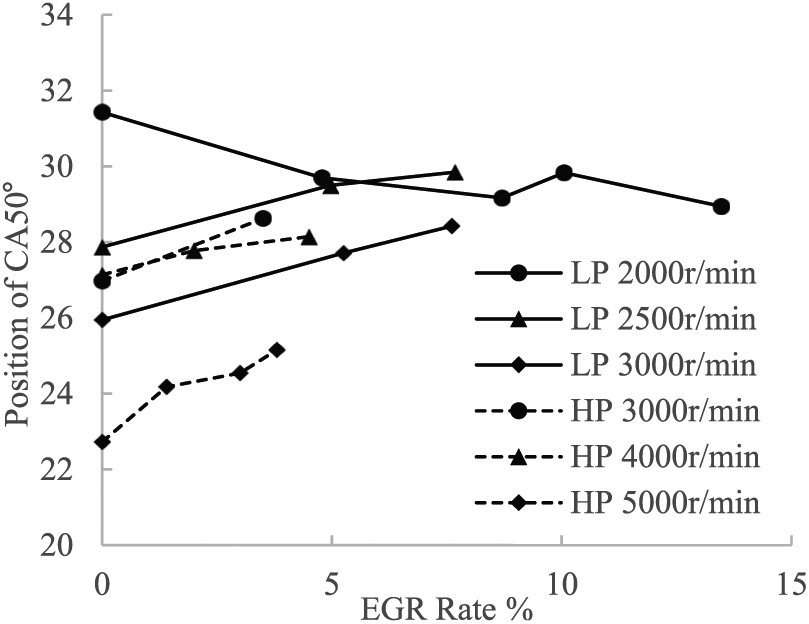
Effects of LP and HP EGR on CA50 at WOT.
In Figures 2 and 3, HP EGR rates are limited when high speed and high loads are imposed. The main limiting factor is the excessive introduction of exhaust gas, which makes the COV worse and COV is unable to sustain the engine power. As shown in Figure 5, in addition to WOT at 2000 r/min, whether it is LP or HP EGR system, the turbine speed increases with the increase in the EGR rate. This is because the introduction of exhaust gas will affect the flow of fresh air. To maintain the power of this condition, it is necessary to increase the intake pressure to maintain air flow, as shown in Figure 6. The booster is required to increase the pressure ratio and speed to provide more air into the intake system. The increasing speed of the turbocharger is achieved mainly through the increase in the exhaust pressure, as shown in Figure 6.

Turbine speeds of different LP and HP EGR rates at WOT.

Exhaust pressure (relative) of different LP and HP EGR rates at WOT.
However, with LP EGR, at 2000 r/min and WOT, intake and exhaust pressures first rise and then decrease, which is not the same as other operating conditions, as shown in Figures 4, 5 and 7. This is mainly because the engine is prone to knocking at low speed and high load. Therefore, the ignition time of the original engine is delayed later at 2000 r/min and WOT, as shown in Figure 2. But meanwhile, to maintain the power of this condition, it is necessary to increase the mass of intake gas and fuel injection. So, the intake pressure is higher, as shown in Figure 8. With the increasing EGR rate, the knocking sensitivity of cylinder is greatly reduced. Therefore, the ignition advance angle can be adjusted continuously (as shown in Figures 2 and 3). Meanwhile, the combustion phase can be continuously optimized. The advantage is that the amount of air needed for combustion is reduced. According to the control strategy of excess air factor of 1, the fuel injection quantity will be reduced.

Exhaust temperature before turbine of different LP and HP EGR rates at WOT.

Intake pressure (relative) of different LP and HP EGR rates at WOT.
As can be seen from Figure 9, the increase in the LP EGR rate at low speed is less obvious than HP EGR rate at high speed for reducing fuel consumption. However, this is not because HP EGR has an advantage over LP EGR. At high speed and high load, to maintain the engine power and lower the exhaust temperature, the excess air coefficient is generally 0.8–0.9, which is also the control strategy for most gasoline engines, as shown in Figure 10.

Fuel consumption rate of different LP and HP EGR rates at WOT.
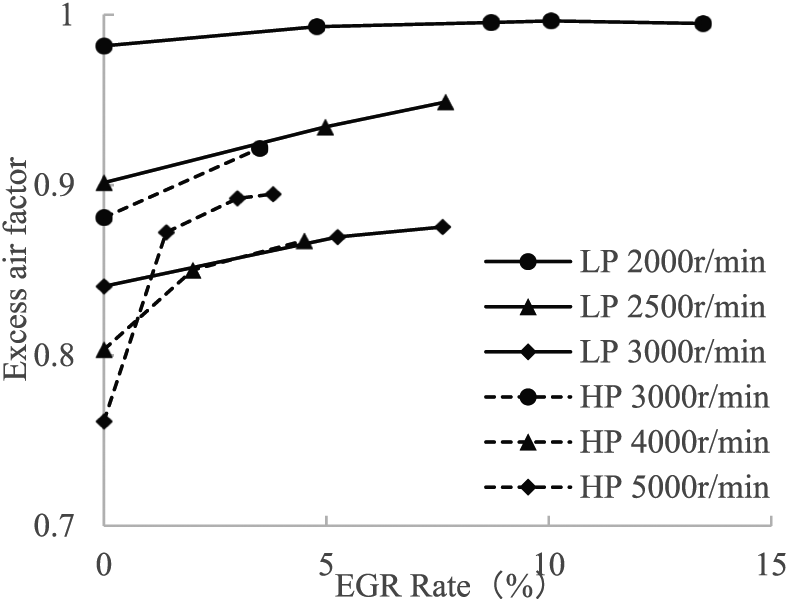
Excess air factor of different LP and HP EGR rates at WOT.
After the introduction of EGR, the problem of knocking and high exhaust temperature is controlled because of the combustion suppression and the heat capacity of diatomic molecular gas. It allows combustion to be close to stoichiometric air–fuel ratio at high speed and high load. This will lead to the increase in the combustion temperature, which is counteracted by the dilution of EGR and the decrease in the temperature with heat capacity. However, stoichiometric air–fuel ratio combustion will also reduce fuel consumption.
Many studies have suggested that the main reason for EGR to decrease gasoline consumption is the decrease in the pumping loss. However, from the impact of EGR rate on pumping loss under WOT, as Figure 11, the degree of reduction is very limited and at LP EGR low-speed conditions, the pumping loss even increases.

Average pumping loss of different LP and HP EGR rates at WOT.
Therefore, an important aspect of EGR on the fuel consumption of engines at WOT is the optimization of ignition advance angle and combustion phase. At low speed and high load, EGR can reduce knocking sensitivity, which can adjust the ignition angle and reduce the intake and fuel injection. At high speed and high load, besides reducing the knock tendency, the combustion temperature and the exhaust temperature in the cylinder are lowered. And, the combustion conditions are closer to stoichiometric air–fuel ratio, so the fuel consumption can be further reduced.
Performance changes of engine and supercharger at partial load
Automotive engines generally do not work at high load for a long time, so the fuel consumption and performance under partial load are more practical. Therefore, it is necessary to test the common operating conditions with partial load at middle and low speed. In this article, 2000 r/min and 8 bar are selected as the research conditions of partial load. Unlike the full load, the HP and LP EGR can be introduced into the engine under this operating condition with higher proportion, as shown in Figure 12.
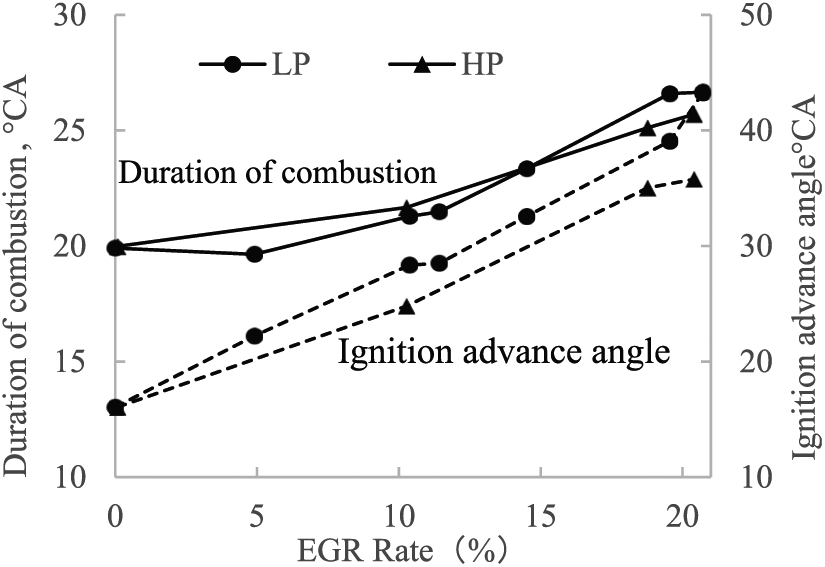
Ignition advance angle and combustion duration of different LP and HP EGR rates under partial load.
The combustion duration also increases with the increasing EGR rate at partial loads as WOT. The ignition angle can be advanced unceasingly and the maximum ignition angle can be advanced to about 40°CA, as shown in Figure 12. Meanwhile, the AI50 positions with different LP and HP EGR rates also are advanced, as Figure 13. This is because the original engine has less knocking tendency at 2000 r/min of partial load. When exhaust gas is not introduced, the ignition advance angle is about 15°CA before top dead center (TDC). After the introduction of the exhaust gas, the combustion suppression and the heat capacity effect of EGR reduce the combustion temperature and prolong the combustion duration, and the knock is further suppressed, as Figure 14. Therefore, the ignition angle can be greatly advanced.
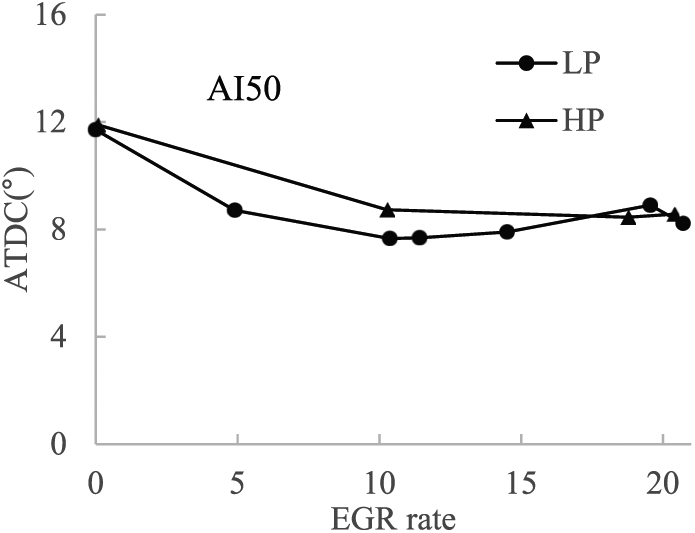
AI50 position of different LP and HP EGR rates under partial load.

Exhaust temperature before turbine and exhaust temperature of different LP and HP EGR rates under partial load.
As can be seen from Figure 12, with the same EGR rate, the ignition angle of LP EGR can be more advanced than HP EGR. This is because the gas of LP EGR is taken after the three-way catalyst, introduced in front of the compressor, while the gas of HP EGR is taken in front of the turbine and introduced in front of the intake manifold, as shown in Figure 1. In addition to the cooling of the EGR cooler, the LP exhaust gas also passes through the turbine, reducing enthalpy, and finally cooling with the compressed fresh air in the intercooler. Therefore, the intake temperature of the LP EGR system is lower than that of the HP EGR, and the ignition angle can be more advanced, as Figure 14. But at the same time, the cooling capacity requirement of the booster intercooler will be higher.
The application of EGR will reduce the pumping loss of gasoline engines, which is reflected in the results of partial load test, as shown in Figure 15. However, the working mechanism of LP EGR and HP EGR system in reducing the pumping loss is not the same.

Turbine speed and average pumping loss of different LP and HP EGR rates under partial load.
Same as WOT, the LP EGR system improves the intake pressure by increasing the speed and pressure ratio of the supercharger, as shown in Figure 15. As the exhaust gas mixes with fresh air, more gas passes through the compressor. To maintain the same speed and torque, the intake of fresh air will not be affected much. And the turbine speed and the compression ratio need to be increased through raising the exhaust pressure, as shown in Figure 16.

Intake (relative) and exhaust pressure (relative) of different LP and HP EGR rates under partial load.
For the HP EGR system, the exhaust gas is taken away in front of the turbine, which directly results in the decrease in the exhaust pressure and then causes the decrease in the turbine speed, as shown in Figure 15. However, the introduction of exhaust gas into the intake manifold also increases the intake pressure, as shown in Figure 16.
Figure 15 shows the decrease in the engine pumping loss after the use of the EGR. The HP EGR is achieved by reducing the exhaust pressure and increasing the intake pressure, while the main method of LP EGR is to increase the intake pressure. From the effect of pumping loss reduction, there is not much difference between HP and LP EGR systems.
However, in Figure 17, the fuel consumption with LP EGR system is lower than with HP EGR system under the same EGR rate. Through the analysis above, at partial load, there are some reasons for better fuel consumption better with LP EGR: (1) compared with the HP EGR system, the exhaust gas passes through the turbine and the booster intercooler, which makes the intake temperature lower. The ignition angle can be more advanced, and the combustion phase can be optimized. (2) LP EGR reduces the combustion temperature and reduces the loss of combustion heat transfer. (3) The exhaust gas of LP EGR is introduced into the turbine to make use of the exhaust energy, which can be seen from the increase in the turbine speed.

Fuel consumption rate of different LP and HP EGR rates under partial load.
Conclusion
The effects of the HP and LP EGR systems on the performance of the engine and the supercharger at WOT and partial load were investigated by experiments. The causes of these changes were analyzed and discussed, and the main conclusions were as follows:
At 2000 r/min and WOT, the EGR system can reduce the knock tendency through the heat capacity of the exhaust gas and the suppression effect of combustion, so that the ignition advance angle can be adjusted and the combustion phase can be optimized to reduce the fuel consumption. At the other speeds and WOT, the mechanism for brake-specific fuel consumption (BSFC) improvement is different and is mainly related to the exhaust temperature reduction. Meanwhile, to maintain the intake and power of the engine, the speed of the turbine will be increased.
At WOT, the main working mechanisms of EGR system for the improvement on fuel consumption at low speed and high speed are different. At low speeds, the EGR system mainly optimizes ignition angle and combustion phase by suppressing the knock; while at high speed, the EGR system mainly reduces the combustion temperature through the heat capacity of exhaust gas to optimize the air–fuel ratio and reduce fuel consumption.
At partial load, EGR system can achieve greater ignition advance angle and combustion optimization, and LP EGR has more advantages than HP EGR.
Footnotes
Appendix 1
Handling Editor: Mustafa Canakci
Declaration of conflicting interests
The author(s) declared no potential conflicts of interest with respect to the research, authorship, and/or publication of this article.
Funding
The author(s) disclosed receipt of the following financial support for the research, authorship, and/or publication of this article: Key projects of Natural Science Research of Anhui Provincial Department of Education (Project number: KJ2018A0824) and National Natural Science Foundation of China (Grant number: 51806143).