This article studies the Darcy–Forchheimer flow of three-dimensional micropolar nanofluid between parallel and horizontal plates in a rotating system. The micropolar nanofluid in permeable media is described by assuming the Darcy–Forchheimer model, where drenching the permeable space obeys the Darcy–Forchheimer expression. The significant influence of Brownian motion and thermophoresis has been taken in the nanofluids model. The thermal radiation impact is taken to be varying in terms of non-uniform absorption/generation for the purpose to see the concentration as well as the temperature modifications between the nanofluid and the surfaces. The leading equations are converted into a system of differential nonlinear equations and then homotopic method is used for solving the modeled equations. The other physical impacts, that is, skin friction, heat flux, and mass flux, have been studied through tables. The impacts of the porosity, rotation, and inertia coefficient analysis have been mainly focused in this research. It is observed that the higher value of Fr decay the velocity profile, while it increases the transverse velocity, and the increase in the porosity parameter increases the porous space, which creates resistance in the flow path and reduces the flow motion. Skin friction coefficient is observed to be larger for the strong concentration , as compared to the case of weak concentration . Impact of strong and weak concentrations on Nusselt and Sherwood numbers seems to be similar in a quantitative sense.
The fluids with microstructure are called micropolar fluids. Micropolar fluids belong to a class of fluids with non-symmetric stress tensor, named polar fluids. The theory of micropolar fluid has been a field of very active research because it takes into consideration the microscopic influences arising from the local structure and micromotions of the fluid elements. The theory is expected to provide a mathematical model, which can be utilized to describe the behavior of non-Newtonian fluids such as liquid crystals, polymeric fluids, paints, animal blood, ferroliquids, and colloidal fluids. Eringen1,2 was the pioneer of the basic idea regarding micropolar fluid. Also, he has found applications in physiological and engineering problems. Keeping in view the depth and wide range of uses, Lukaszewicz3 has briefly studied the micropolar fluids. Generally, these fluids indicate fluids covering unpredictably oriented liquids suspended in a viscid medium. A micropolar fluid by the influence of magnetic induction on a flat plate was primarily deliberated by Mohammeadein and Gorla.4 Kasivishwanathan and Gandhi.5 have examined magnetohydrodynamic (MHD) micropolar fluid with exact solutions. Agarwal and Dhanapal6 have inspected micropolar fluid with convective conditions in parallel absorbent vertical plates. Bhargava et al.7 have scrutinized varied convective micropolar fluid. The stagnation point micropolar fluid with stretched sheet has been examined in Nazar and colleagues.8,9 The other relevant studies with micropolar fluid can be seen in the literature.10–13 Recently, Shah and colleagues14,15 have studied micropolar nanofluid flow with Hall effect in rotating parallel plates with impacts of thermal radiation.
Many environmental and industrial systems like system of geothermal energy and system of heat exchanger design include the convection flow subject to permeable medium. The adapted form of classical Darcian model is the non-Darcian porous medium, which contains the inertia and boundary topographies. The standard Darcy’s law is effective under constrained range of small permeability and little velocity. Forchheimer16 has predicted the inertia and boundary features by including a square velocity term to the countenance of Darcian velocity. Muskat17 has entitled this term as “Forchheimer term,” which is permanently operative for large Reynolds number. Flow through a porous medium has numerous practical applications and usage especially in geophysical fluid dynamics. Some common examples of natural porous media are sandstone, beach sand, the human lung, limestone, bile duct, and gall bladder with stones in small blood vessels. The detail of porous media with application can be seen in the literature.18,19
Pal and Mondal20 have investigated the MHD flow of inconstant viscosity liquid in a permeable medium by employing the Darcy–Forchheimer theory. Hayat and colleagues21,22 have explored the Darcy–Forchheimer flow considering Maxwell fluid with variable heated surface. The idea of liquid motion and heat transmission analysis with rotating situation shows a very leading role in the petrochemical industry, geophysics, meteorology, aeronautics, and oceanography. A Dawar et al.23 have investigated Eyring–Powell fluid flow over an unsteady oscillatory porous stretching surface with impact of thermal radiation and heat source/sink. Recently, Ishaq et al.24 have studied nanofluid thin film flow with thermal radiation effect on an unsteady porous stretching sheet with entropy generation.
With the advent of nanoscience, nanofluids have become a focus of attention in the study of fluid flow in the presence of nanoparticles. Nanofluids are the fluids that are arranged by scattering-nanometer-sized (10−9) substances such as nanoparticles, nanotubes, nanofibers, and droplets in fluids. Actually, nanofluids are nanoscale-shattered suspensions involving concise nanometer-sized materials. These are two period systems: the first one is solid phase and the second one is liquid phase. Nanofluids can be used to increase the thermal conductivity of the fluids and are more stable fluids having better writing, spreading, and dispersion properties on solid surfaces.25,26 Nanoscience can be offered applicable working fluid to improve thermal behavior and convective heat transfer enhancement.27–31 The most current investigational and theoretical research was given by Sheikholeslami32–34 on nanofluids using dissimilar phenomena, with modern application, possessions, and properties with usages of diverse approaches. Sheikholeslami and colleagues35,36 have shown importance of nanofluid in nanotechnology. Yadav and colleagues37–48 have studied the onset of MHD nanofluid using different phenomena and further studied the numerical simulation, heat transfer enhancement, linear and nonlinear, stability and instability of nanofluid.
The study of nanofluid flow in rotating parallel plates have gigantic applications in aerospace technology, rotation of machinery, chemical industries and engineering, generating systems of thermal power, rotor–stator systems, medical apparatus, electronic and computer storing appliances, crystal growing phenomena, machines of air cleaning, food processing technologies, turbo machinery, and many others. Greenspan and Howard49 have studied the rotating flow behavior of viscous fluid filled in the axisymmetric closed container. Nazar et al.50 have derived the analytical results for unsteady flow problem of rotating fluid. The impact of rotational scheme on nanoliquid flow was studied by Mustafa et al.,51 and they have analyzed that the influence of rotational variable decreases the heat transfer coefficient. Recently, Shah and colleagues52,53 have investigated rotating nanofluid flow between parallel plates. The recent investigation of nanofluid in rotating system can be studied in the literature.54–56 Qayyum and colleagues57–62 have studied nanofluid flow under the influence of chemical reaction and thermal radiation using different phenomena. Hayat and colleagues63,64 investigated the nanofluid flow under the influence of nonlinear thermal radiation through a stretching sheet.
The purpose of this research is to examine the Darcy–Forchheimer flow of three-dimensional micropolar nanofluid between parallel and horizontal plates in a rotating system. Homotopy analysis method (HAM) is used in this work for solving the modeled equations which are nonlinear and coupled. The effect of all embedding parameters has been studied graphically.
Problem formulation
Consider three-dimensional thermally conducting micropolar nanofluid flows between two plates which are horizontal as well as parallel. The distance between them is taken as h. The coordinate system for the flow of micropolar Casson nanofluid is nominated that both plate and fluid rotate about the with angular velocity . Here, two forces are assumed having equal magnitude, but opposite in direction to stretch the lower plate along , which keep the origin constant. The upper plate is subject to a uniform wall suction/injection velocity . The micropolar nanofluid saturates the porous space characterizing Darcy–Forchheimer model. The hot base nanofluid is also retained at lower surface of the lower plate such that and , where are temperature and volume friction of micropolar nanofluid at lower plate and are temperature and volume friction upper plate, respectively. Moreover, the thermal radiation is taken to be non-uniform in absorption/generation. Using all the above discussed assumptions, the governing equations of micropolar nanofluid are reduces as10–21
In equations (1)–(4), and characterize the kinematic and dynamic viscosities coefficient, respectively; represents the nanofluid density; N represents microrotation velocity; means angular velocity; is vertex viscosity; represents the permeability of medium; and F signifies the variable inertia coefficient of permeable medium where , is used for drag coefficients10–15
In equation (5), T symbolizes temperature; signifies thermal diffusivity; and are the coefficients of Brownian diffusion and the coefficient of thermophoretic diffusion, respectively; represents specific heat; C is fluid concentration of the fluids particles; is ratio between nanoparticles and heat capacity; indicates the radioactive heat flux, which is given by Rosseland approximation as , where is known as Stefan–Boltzmann constant and denoted the coefficient of mean absorption. By Taylor series, expanding and sampling it, we get
The term is the non-uniform heat source/sink and is defined as55–58
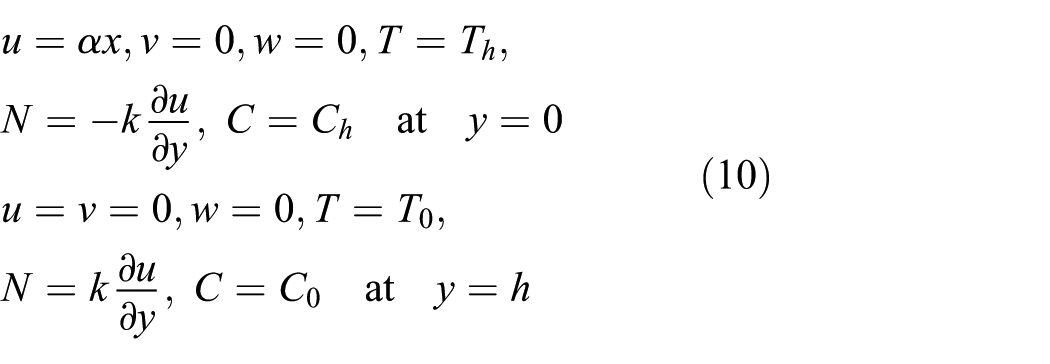
Here, A and B represent the coefficients of temperature- and space-dependent heat source and sink term, respectively. When , links to inner heat source, and when , links the inner heat sink. The subjected boundary conditions are
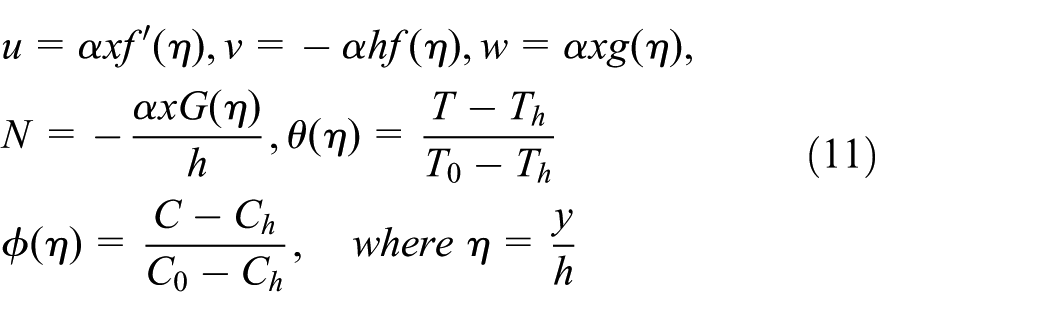
Here, k specifies the boundary parameter. The non-dimensional variables are given as
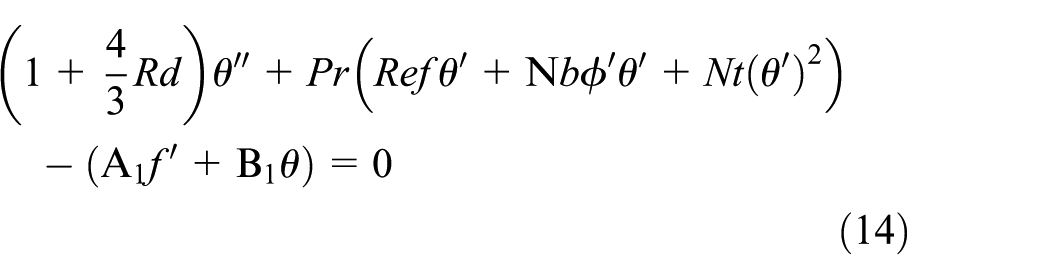
Substituting equation (11) into equations (1)–(7) and (10), equation on satisfied identically and the other equations are converted to the following form
where represents rotation parameter, is porosity parameter, is the coefficient of inertia, denotes the coupling parameter, signifies transpiration parameter, signifies viscosity gradient parameter, is the Reynolds number, denotes constant of micropolar fluid, is the Prandtl number, represents radiation parameter, signifies the parameter of the Brownian movement of the fluid molecules, is Schmidt number, and denotes thermophoretic parameter.
Physical quantities of interest
The physical quantities of interest such as skin friction, heat flux, and mass flux have abundant applications in the field of engineering. For micropolar nanofluid flow problem, skin friction is defined as
And here
The Nusselt number is defined as , where is the heat flux and . The Sherwood number is defined as , where is the mass flux and . The dimensionless form of , Nu, and Sh are obtained as
where is called local Reynolds number and defined as .
Solution by HAM
HAM is one of the substitute methods and mostly used to solve the nonlinear differential equations without discretization and linearization. Liao65,66 is the pioneer to derive it using the basic concept of topology called homotopy, for the derivation of this HAM. For this purpose, he used two homotopic functions.
For the basic idea, let and are two functions which are continuous, and and are two topological spaces where and map from to then is said to be homotopic to if there produce a continuous function
Such that
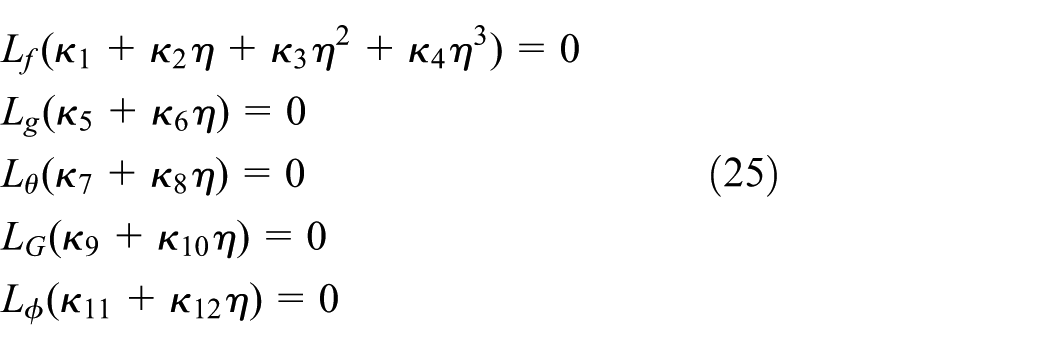
Then, this mapping is called homotopic. This technique has several advantages, some of them are as follows: (1) it is free from the values of the parameters which may be small or large. (2) It guarantees the convergence of the solution. (3) It is self-determining for an assortment of base function and linear operator. The solutions of equations (12)–(16) with the dependable boundary conditions equation (17) are obtained by HAM. The initial guesses for equations (12)–(16) are calculated as
where the linear operator for the equations
The initial solution form is
Here, , where are arbitrary constants. Zeroth-order deformation to the following form with boundary conditions is
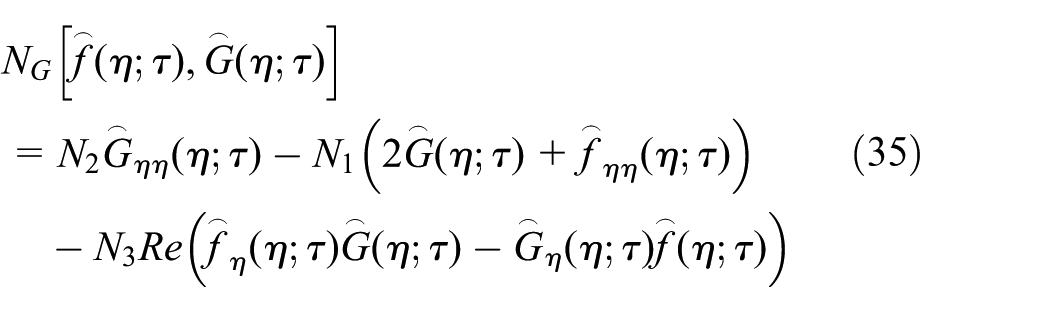
The substantial nonlinear operators , and are planned as
when changes from then expanding with boundary conditions
At , we obtain
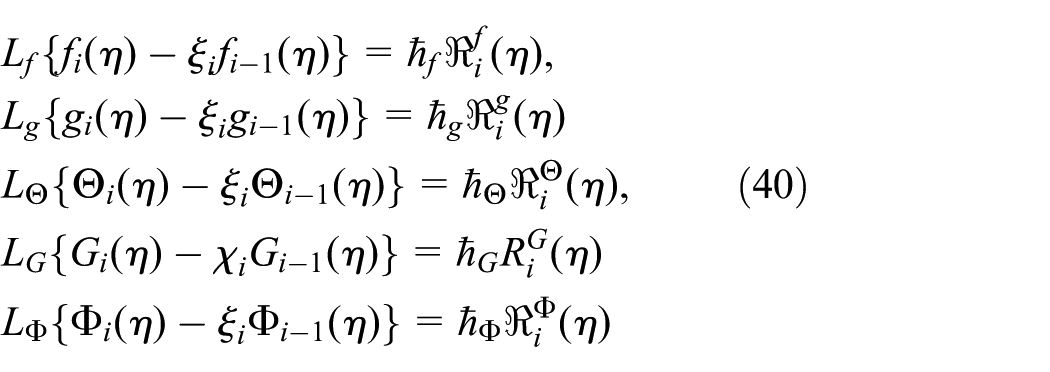
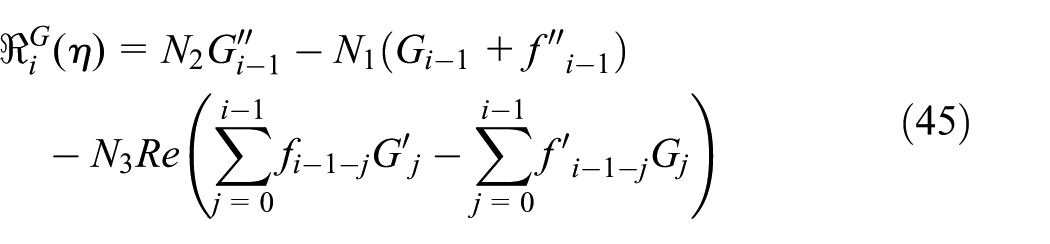
Differentiating zeroth-order equations, the ith-order deformation equations with boundary conditions can be reduced as
where
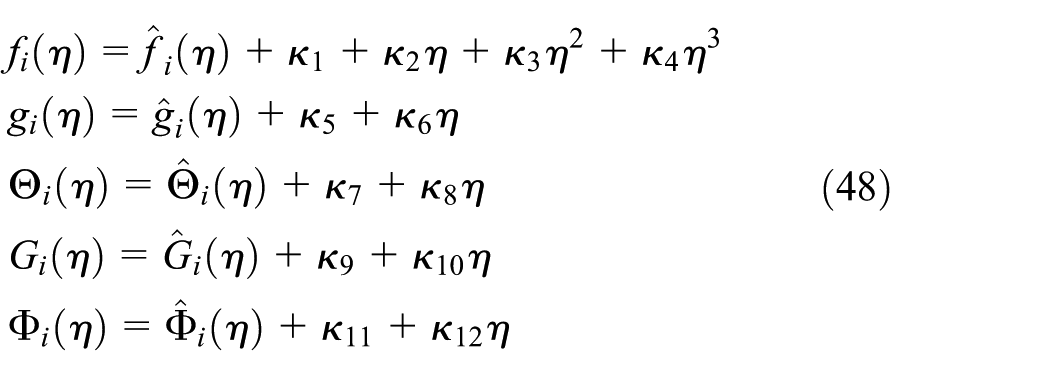
The overall homotopic solutions in general form are specified as
Here, are the particular solutions of the equations.
Analysis
Here, our interest is to analyze the analytical solution of obtaining system of ordinary differential equations by HAM. When the solutions of equations (12)–(16) with the dependable boundary conditions (equation (17)) are computed in series form using HAM, the embedding parameters , and appeared, which are responsible for adjusting of convergence of solutions. The convergence of HAM solutions for the model equations at different approximation using dissimilar values of parameters is shown in Table 1, showing that homotopy analysis technique is a fast convergent technique. The velocity profiles and , microrotation velocity profiles , temperature profiles , and concentration profile are concentrated by dissimilar micropolar nanofluid flow parameters. Attention is explicitly given to upshot coefficient of inertia porosity parameter Fr, porosity parameter , rotation parameter Kr, coupling parameter , Reynolds number Re, viscosity gradient parameter , coefficients of temperature source/sink term , space-dependent heat source/sink term , Brownian motion parameter Nb, thermophoretic parameter Nt, Prandtl number Pr, radiation parameter Rd, and Schmidt number
The convergence of HAM up to 15th-order approximations when .
Order of approximation
1
3.41575
−0.01393
−0.99782
−0.68008
−1.00331
3
3.42436
−0.02152
−0.99687
−0.68023
−1.00783
5
3.42570
−0.02268
−0.99722
−0.68036
−1.00961
7
3.42598
−0.02286
−0.99717
−0.68048
1.01013
9
3.42598
−0.02288
−0.99314
−0.68059
−1.01032
11
3.42598
−0.02289
−0.99314
−0.68053
−1.01032
13
3.42598
−0.02289
−0.99314
−0.68053
−1.01032
15
3.42598
−0.02289
−0.99314
−0.68053
−1.01032
Results and discussion
In this segment, we discuss the physical assets of different embedding parameters of the modeled problems and their influence on velocity, temperature, microrotation, and concentration profile which are showed in Figures 2–25. The graphical view of problem is presented in Figure 1.
Sketch of the micropolar nanofluid between parallel plates.
Velocity profile and
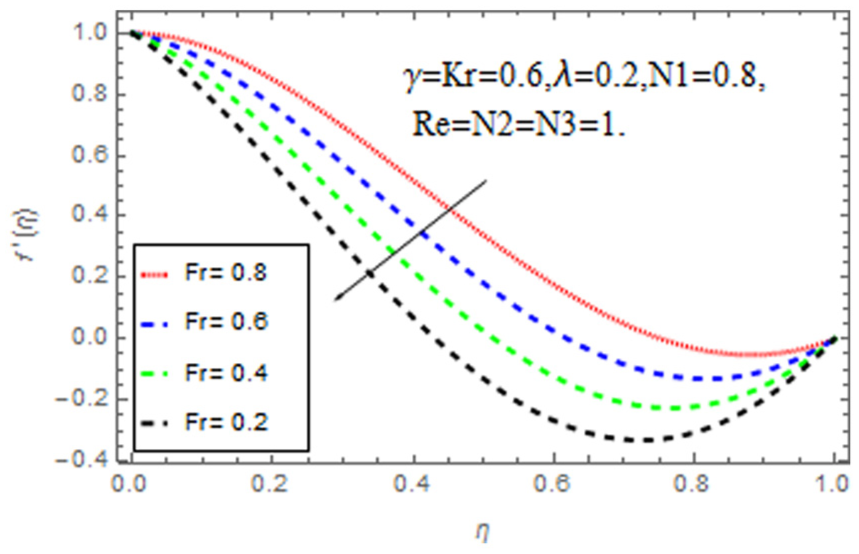
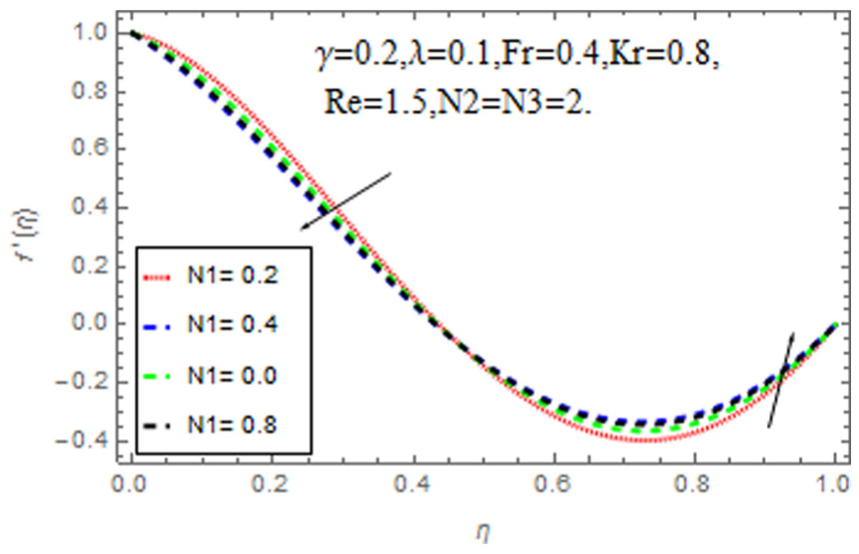
The impact of physical parameters Fr, , Kr, and Re on velocity profiles and are presented in Figures 2–11. The effect of Fr on and are shown in Figures 2 and 3. It is observed that the greater value of Fr decay the velocity profile . Actually, the higher value of inertial coefficient produces resistance in the flow path, which in turn, eases the nanofluid motion. In case of z-direction, the result is found opposite, that is, the large value of inertial coefficient increases the velocity (Figure 3). The impact of on and is shown in Figures 4 and 5, respectively. Increasing increases the porous space, which creates resistance in the flow path and reduces the flow motion of nanoparticles. It is perceived that an increment in porosity variable leads to improvement in the velocity field . Physically, it is due to the fact that the porous surface influence on the boundary layers progress is important owing to rise in the viscosity of the thermal boundary layers. So, it is predictable that an increment in the porosity of surface leads to accelerate the motion of the liquid on it. Basically, when the dumps of the permeable surface become large, the opposition of the porous surface may be ignored. The opposite trend is found in case of z-direction, that is, the enormous value of decreases Figures 6 and 7 present the impact of rotational parameter Kr on x-component of and , respectively. Here, inspection of graphs validate that with the enhancement of rotational parameter Kr, the velocity distribution shows a decreasing trend for micropolar nanofluids. Physically, the rotation parameter Kr drops its linear velocity; as a result, the liquid is flowing and rotating, and its velocity reduced the rotational friction force made by flow. In case of large magnitude of rotation parameter Kr, frequency of rotation becomes leading as compared to stretching frequency and it provides resistance to the fluid flow, so velocity is a decreasing function of Kr. The impact of on is displayed in Figures 8 and 9, respectively. It is observed that the coupling parameter drops velocity profile when it is close to the lower plate and increases it from the center toward the upper plate (Figure 8). The impact of Re on and is shown in Figures 10 and 11, respectively. It is noticed that the accelerating value of the Re drops the (Figure 10). The conflicting consequence is seen in Figure 11, that is, greater values of Re surges the .
The impact of Fr on velocity profile .
The impact of Fr on velocity profile .
The impact of on velocity profile .
The impact of on velocity profile .
The impact of Kr on velocity profile .
The impact of Kr on velocity profile .
The impact of on velocity profile .
The impact of on velocity profile .
The impact of Re on velocity profile .
The impact of Re on velocity profile .
Microrotation velocity profile
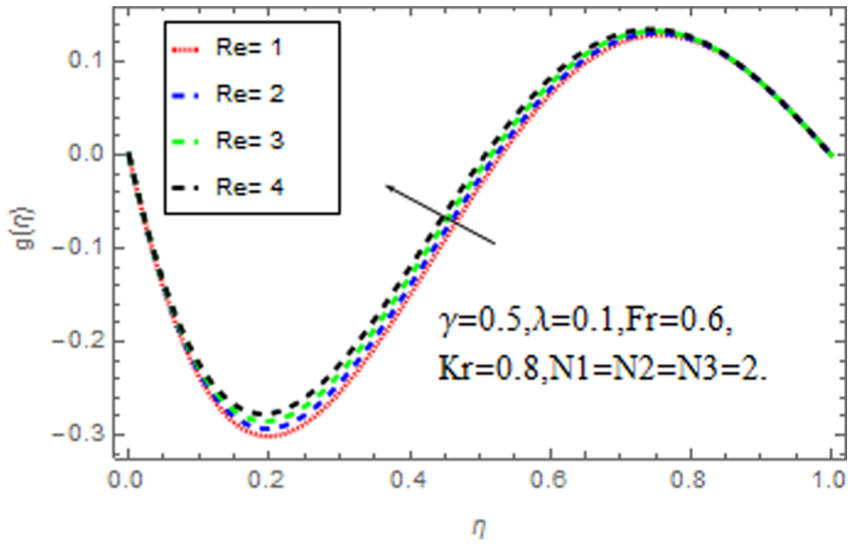
The impact of physical parameters and Re on microrotation velocity profiles is presented in Figures 12–14. The impact of on is displayed in Figure 12. The opposite conduct is perceived in Figure 12 from Figure 8, that is, the higher value of the coupling parameter rises the microrotation profile . The effect of on is shown in Figure 13. Same effect is seen for , while the opposite tend is found for spin gradient viscosity on the profile . The higher value of drops . The influence of Re on is displayed in Figure 14. It is perceived that augmented value of Re improves between parallel plates.
The impact of on microrotation .
The impact of on microrotation .
The impact of Re on microrotation .
Temperature profile
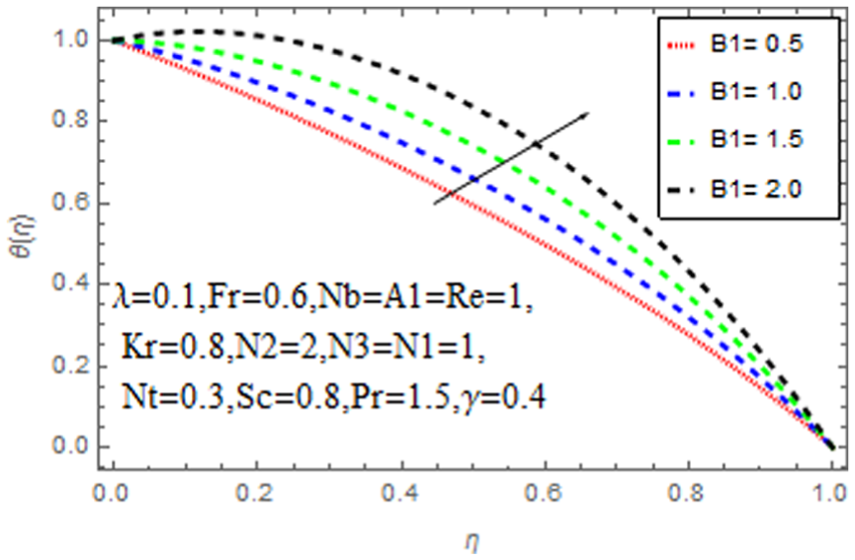
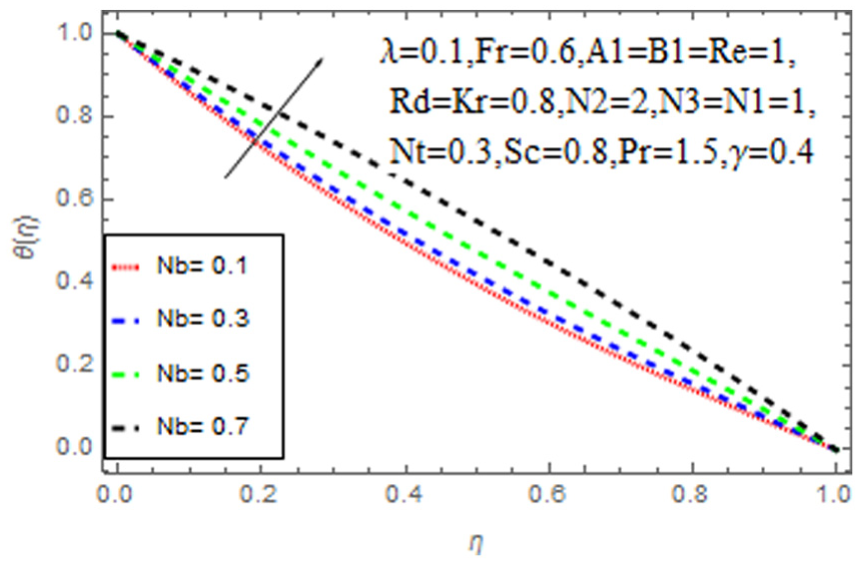
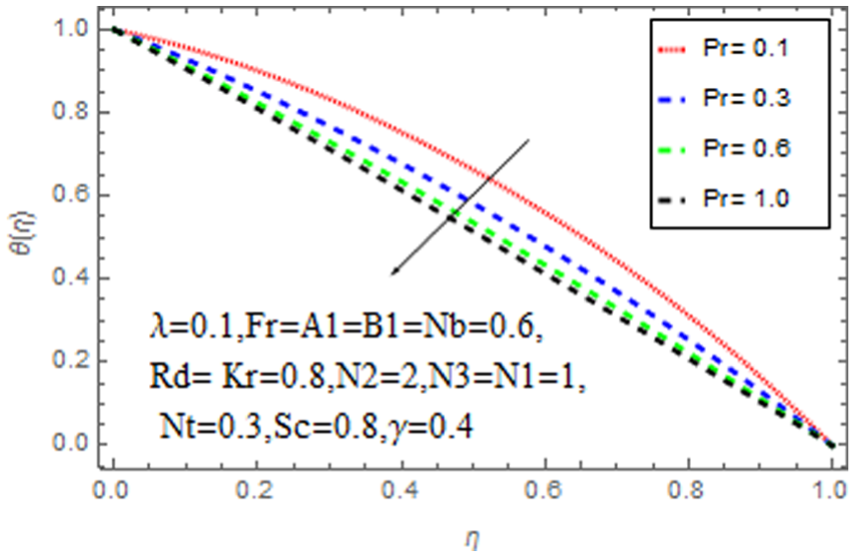
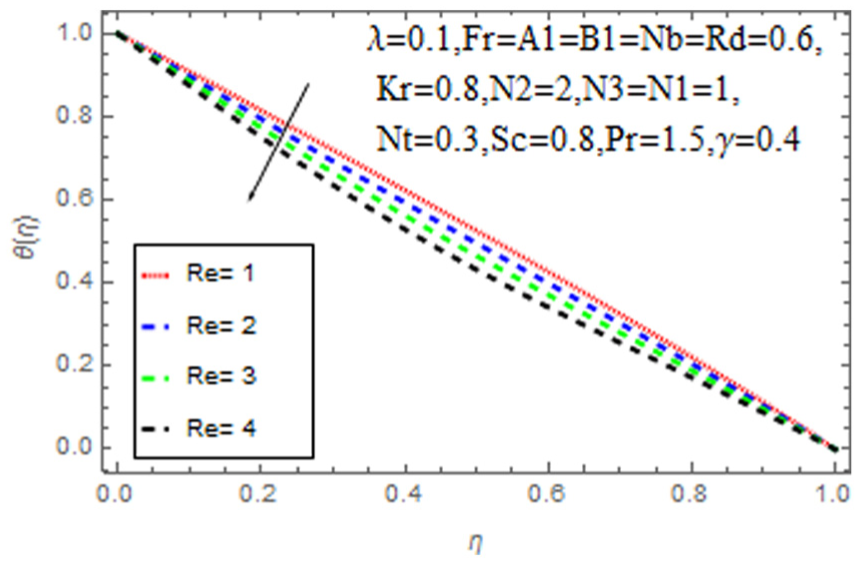
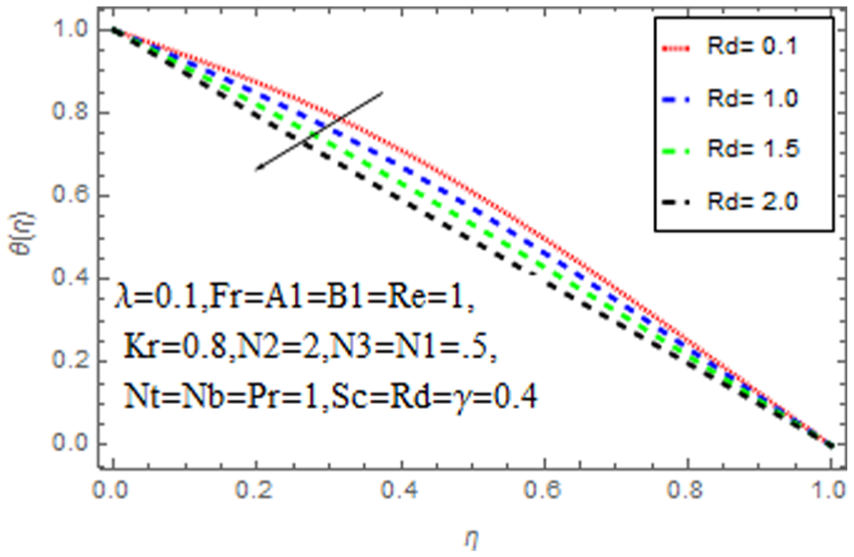
The impact of physical parameters , , Nb, Nt, Pr, Rd, and Re on temperature profiles is presented in Figures 15–21. Figure 15 displays the effect of space-dependent parameter on nanofluid flow field of temperature . It is observed that increasing rises the temperature of the nanofluid between parallel plates. Figure 16 displays the influence of temperature-dependent coefficient . Same effect is observed for on temperature field . Actually, the increase in and increase the thermal layer of the boundary produces internal energy which gives rise in temperature profile while, in turn the small value it drop the temperature. The impact of Nb on is shown in Figure 17. It is detected from Figure 17 that augmented value of Nb rises . In fact, increasing Nb increases the kinetic energy of the nanofluid inside the fluid with which the rate of internal heat transmission, microrotation velocity, and boundary layer thickness rise leading to increase in the temperature profile. The consequence of thermophoresis parameter Nt on is demonstrated in Figure 18. From Figure 18, it is clear that Nt increases when it is augmented. Actually, Nt depends on the temperature gradient in the surrounding nanofluid molecules. Increasing Nt increases the random motion of the nanoparticles, which in turn increases the internal energy, hence the temperature profile increases. The influence of Pr on is given in Figure 19. It is vibrant that declines with bulky value of Pr and rises for lesser values. Actually, nanofluids with lesser value of Pr have large thermal diffusivity and this consequence is conflicting for greater Pr. Therefore, high value of Pr causes the thermal boundary layer to drop. Figure 20 shows the influence of Re on ; the higher values of Re strengthens the inertial forces and tends to decrease the temperature field. Opposite effect is observed of Re on the The impact of Rd on is presented in Figure 21. When we increase Rd, then it is perceived that Rd augments the temperature in the boundary layer area in the nanofluid layer. This increase leads to drop in the rate of cooling of micropolar nanofluid flow.
The impact of on temperature .
The impact of on temperature .
The impact of Nb on temperature .
The impact of Nt on temperature .
The impact of Pr on temperature .
The impact of Re on temperature .
The impact of Rd on temperature .
Concentration profile
The impact of physical parameters Nb, Nt, Sc, and Re on concentration profile are presented in Figures 22–25.
The impact of Re on temperature .
The impact of Nb on temperature .
The impact of Nt on temperature .
The impact of Sc on temperature .
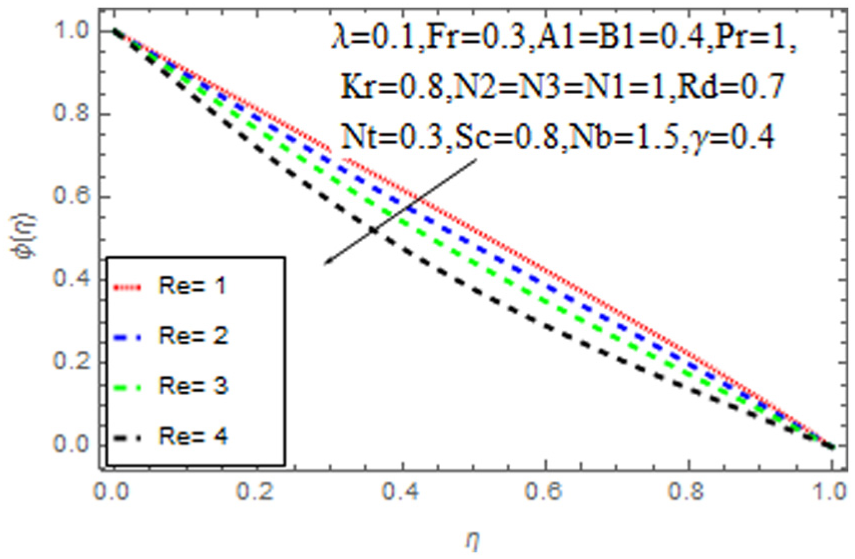
Figure 22 shows the influence of Re on . It is observed that higher value Re increases . Actually, higher values of Re reinforce the inertial forces of nanofluids, resulting the concentration field to increase. The impact of Nb on is shown in Figure 23. The opposite trend has been found for concentration distribution as from temperature field, that is, increasing Nb reduces the concentration profile. This is because of the rises of Brownian motion diminish the boundary layer thicknesses, which leads to decrease in the concentrations. The characteristics of Nt on is shown in Figure 24. Increasing Nt increases . This is due to that Nt depends on the temperature gradient of the nanofluids molecules. Due to increase of Nt kinetic energy of the nanofluids increase, which resulting in the increase in the concentration profile. Figure 25 labels the effect of Schmidt number Sc. The Schmidt number is a dimensionless number, defined as the ratio of momentum diffusivity to mass diffusivity. It is apparent that increasing Schmidt number decreases the concentration profile, which results to reduce the boundary layer thickness.
Skin friction, Nusselt number, and Sherwood number
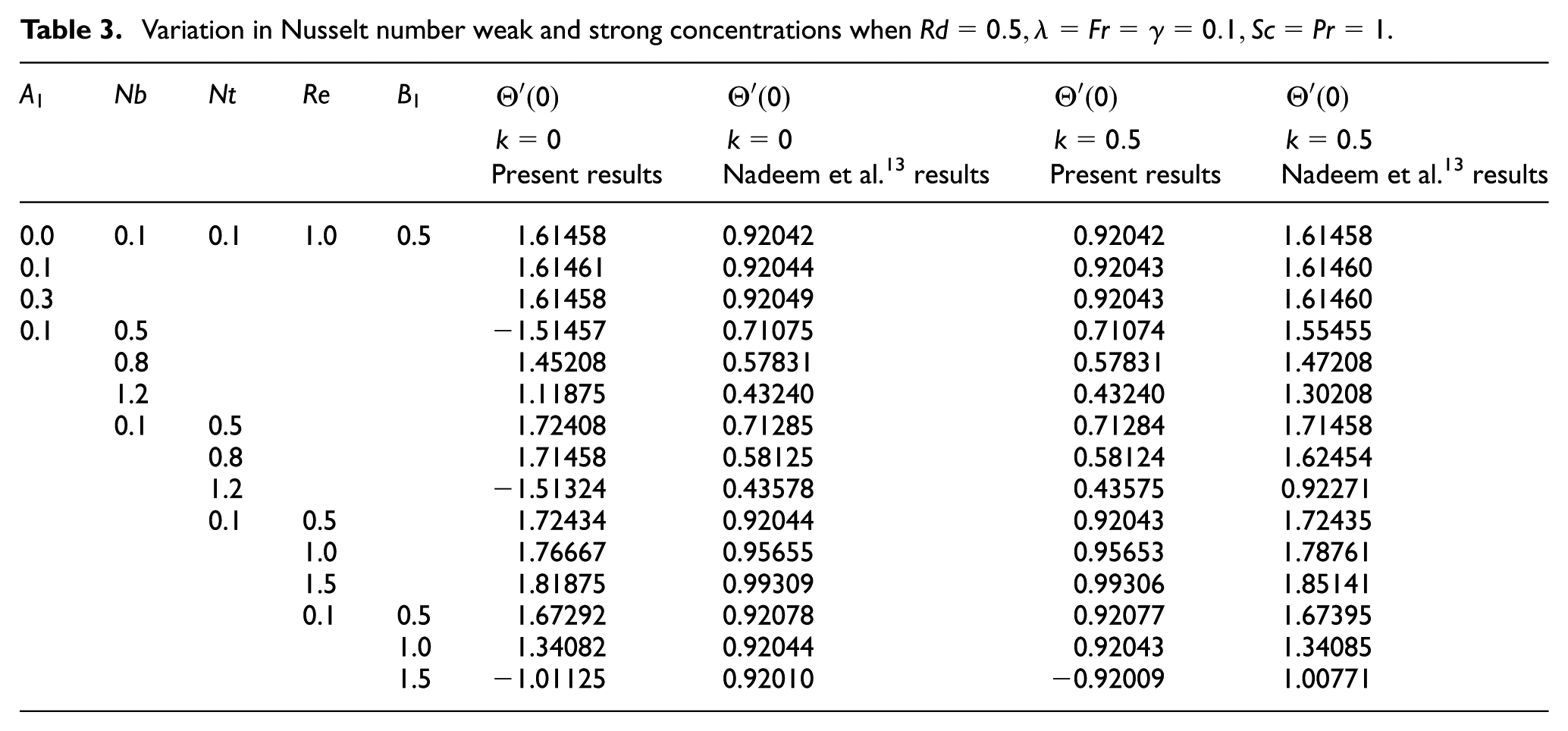
The numerical values of coefficient of skin friction , Nusselt number Nu, and Sherwood number Sh are calculated in Tables 2–4 for large concentration and small concentration. Table 3 observes the effect of and Re on . It seems that , and Re has positive impact on at the lower plate. It is also seen that the higher performance is more projecting in case of . Table 3 studies the stimuli of , and Rd on Nu. It is alleged that greater values of and Re rise, while the greater values of , and Rd decline the heat flux Nu. Table 4 scrutinizes the impacts of and Sc on Sh. Increasing Nb reduces the mass flux, while Nt increases the mass flux. The higher value of Re reduces the Sh, while it increases with increase in the value of Sc. The present results are compared with the previous results of Nadeem et al.,13 and an excellent agreement is found between both current and previous results.
Variation in skin friction coefficient for weak and strong concentrations when .
In this article, the Darcy–Forchheimer flow of three-dimensional micropolar nanofluid between two parallel plates in a rotating system has been investigated. The micropolar nanofluid flow in permeable media is described by taking the Darcy–Forchheimer model, where drenching permeable space obeys Darcy–Forchheimer expression. The thermal radiation impact is taken to be varying in absorption/generation for the purpose to see the concentration as well as the temperature modifications between the nanofluid and the surfaces. The central concluded points given as follows:
It is observed that the higher value of Fr decay the velocity profile, while it increases the transverse velocity.
It is observed that increasing the porosity parameter increases the porous space, which creates resistance in the flow path and reduces the flow motion.
The higher value of Re reduces and increases .
The coupling parameter and spin gradient viscosity parameter having the key rule to change the microrotation profile . Moreover, it is observed that rises in the coupling parameter increases while reduces it.
Increasing Nt and Nb consequences in a conflicting behavior on .
It is observed the temperature field enhances with larger values of Nb and Nt for and .
The greater values of and Re increase the heat flux, while the higher values of reduces the heat flux for and .
Thermal boundary layer thickness reduces with rise of Rd and Nusselt number Nu increases with large value of radiation parameter Rd.
It is detected that and fall with higher value of Pr and rise for lesser values of Pr.
The convergence of the HAM method with the variation of physical parameters has been observed numerically and best result is obtained.
Footnotes
Appendix 1
Handling Editor: Jiin-Yuh Jang
Declaration of conflicting interests
The author(s) declared no potential conflicts of interest with respect to the research, authorship, and/or publication of this article.
Funding
The author(s) received no financial support for the research, authorship, and/or publication of this article.
ORCID iDs
Zahir Shah
Waris Khan
References
1.
EringenAC.Simple micropolar fluids. Int J Eng Sci1964; 2: 205–217.
2.
EringenAC.Theory of micropolar fluid. J Math Mech1966; 16: 1–18.
3.
LukaszewiczG.Micropolar fluids: theory and applications. Basel: Brikhäuser, 1999.
4.
MohammeadeinAAGorlaRSR. Effects of transverse magnetic field on mixed convection in a micropolar fluid on a horizontal plate with vectored mass transfer. Acta Mech1966; 118: 1–12.
5.
KasivishwanathanSRGandhiMV.A class of exact solutions for the magnetohydrodynamic flow of a micropolar fluid. Int J Eng Sci1992; 30: 409–417.
6.
AgarwalRSDhanapalC.Numerical solution of free convection micropolar fluid flow between two parallel porous vertical plates. Int J Eng Sci1988; 26: 1247–1255.
7.
BhargavaRKumarLTakharHS.Finite element solution of mixed convection micropolar flow driven by a porous stretching sheet. Int J Eng Sci2003; 41: 2161–2178.
8.
NazarRAminNFilipDet al. Stagnation point flow of a micropolar fluid towards a stretching sheet. Int J Nonlinear Mech2004; 39: 1227–1235.
9.
IshakANazarRPopI.Magnetohydrodynamic (MHD) flow of a micropolar fluid towards a stagnation point on a vertical surface. Comput Math Appl2008; 58: 3188–3194.
10.
ZiabakhshZDomairryG.Homotopy analysis solution of micropolar flow in a porous channel with high mass transfer. Adv Theor Appl Mech2008; 2: 79–94.
11.
SrinivasacharyaDRamana murthyJVVenugopalamD.Unsteady stokes flow of micropolar fluid between two parallel porous plates. Int J Eng Sci2001; 39: 1557–1563.
12.
NadeemSSadafMRashidMet al. Optimal and numerical solutions for an MHD micropolar nanofluid between rotating horizontal parallel plates. PLoS ONE2016; 6: 0124016.
13.
NadeemSMehmoodRMasoodS.Effects of transverse magnetic field on a rotating micropolar fluid between parallel plates with heat transfer. J Magn Magn Mater2016; 401: 1006–1014.
14.
ShahZIslamSAyazHet al. Radiative heat and mass transfer analysis of micropolar nanofluid flow of casson fluid between two rotating parallel plates with effects of hall current. J Heat Trans: T ASME2018; DOI: 10.1115/1.4040415
15.
ShahZIslamSGulTet al. The electrical MHD and hall current impact on micropolar nanofluid flow between rotating parallel plates. Results Phys2018; 9: 1201–1214.
16.
ForchheimerP.Wasserbewegung durch boden. Zeitschrift Ver D Ing1901; 45: 1782–1788.
17.
MuskatM.The flow of homogeneous fluids through porous media. Ann Arbor, MI: J. W. Edwards, Inc., 1946.
18.
VafaiK.Porous media: applications in biological systems and biotechnology. Boca Raton, FL: CRC Press, 2010, p.632.
19.
NieldDABejanA.Convection in porous media. 4th ed.New York: Springer, 2013, p.1268.
20.
PalDMondalH.Hydromagnetic convective diffusion of species in Darcy-Forchheimer porous medium with non-uniform heat source/sink and variable viscosity. Int Commun Heat Mass2012; 39: 913–917.
21.
SadiqMAHayatT.Darcy-Forchheimer flow of magneto Maxwell liquid bounded by convectively heated sheet. Results Phys2016; 6: 884–890.
22.
HayatTMuhammadTAl-MezalSet al. Darcy-Forchheimer flow with variable thermal conductivity and Cattaneo-Christov heat flux. Int J Numer Method H2016; 26: 2355–2369.
23.
DawarAShahZIdressMet al. Impact of thermal radiation and heat source/sink on Eyring–Powell fluid flow over an unsteady oscillatory porous stretching surface. Math Comput Appl2018; 23: 20.
24.
IshaqMAliGShahZet al. Entropy generation on nanofluid thin film flow of Eyring–Powell fluid with thermal radiation and MHD effect on an unsteady porous stretching sheet. Entropy2018; 20: 412.
WongKFVLeonOD. Applications of nanofluids: current and future. Adv Mech Eng2010; 2: 1–11.
27.
KakaçSPramuanjaroenkijA.Review of convective heat transfer enhancement with nanofluids. Int J Heat Mass2009; 52: 3187–3196.
28.
MichaelidesEE.Nanofluidics: thermodynamic and transport properties. Cham: Springer, 2014.
29.
ShenoyASheremetMPopM.Convective flow and heat transfer from wavy surfaces: viscous fluids, porous media, and nanofluids. New York: CRC Press, 2016, p.306.
30.
MancaOJaluriaYPoulikakosD.Heat transfer in nanofluids. Adv Mech Eng2010; 2010: 380826.
31.
MyersTGRiberaHCreganV.Does mathematics contribute to the nanofluid debate. Int J Heat Mass2017; 111: 279–288.
32.
SheikholeslamiM.Influence of magnetic field on nanofluid free convection in an open porous cavity by means of Lattice Boltzmann method. J Mol Liq2017; 234: 364–374.
33.
SheikholeslamiM.Numerical simulation of magnetic nanofluid natural convection in porous media. Phys Lett A2017; 381: 494–503.
34.
SheikholeslamiM.Numerical study of heat transfer enhancement in a pipe filled with porous media by axisymmetric TLB model based on GPU. Eur Phys J Plus2014; 129: 248.
35.
SheikholeslamiMRokniHB.Simulation of nanofluid heat transfer in presence of magnetic field: a review. Int J Heat Mass2017; 115: 1203–1233.
36.
SheikholeslamiMGanjiDD.Nanofluid convective heat transfer using semi analytical and numerical approaches: a review. J Taiwan Inst Chem Eng2016; 65: 43–77.
37.
YadavDLeeDChoHHet al. The onset of double-diffusive nanofluid convection in a rotating porous medium layer with thermal conductivity and viscosity variation: a revised model. J Porous Media2016; 19: 31–46.
38.
YadavDNamDLeeJ.The onset of transient Soret-driven MHD convection confined within a Hele-Shaw cell with nanoparticles suspension. J Taiwan Inst Chem Eng2016; 58: 235–244.
39.
YadavDLeeJ.The onset of MHD nanofluid convection with Hall current effect. Eur Phys J Plus2015; 130: 162–184.
40.
YadavDLeeJ.Onset of convection in a nanofluid layer confined within a Hele-Shaw cell. J Appl Fluid Mech2016; 9: 519–527.
41.
YadavDWangJLeeJ.Onset of Darcy-Brinkman convection in a rotating porous layer induced by purely internal heating. J Porous Media2017; 20: 691–706.
42.
YadavD.Electrohydrodynamic instability in a heat generating porous layer saturated by a dielectric nanofluid. J Appl Fluid Mech2017; 10: 763–776.
43.
YadavDWangJBhargavaRet al. Numerical investigation of the effect of magnetic field on the onset of nanofluid convection. Appl Therm Eng2016; 103: 1441–1449.
44.
YadavDBhargavaRAgrawalGS.Numerical solution of a thermal instability problem in a rotating nanofluid layer. Int J Heat Mass2013; 63: 313–322.
45.
YadavDAgrawalGSBhargavaR.Thermal instability in rotating nanofluid. Int J Eng Sci2011; 49: 1171–1184.
46.
YadavDKimMC.Linear and non-linear analyses of Soret-driven buoyancy convection in a vertically orientated Hele-Shaw cell with nanoparticles suspension. Comput Fluids2015; 117: 139–148.
47.
YadavDLeeJChoHH.Brinkman convection induced by purely internal heating in a rotating porous medium layer saturated by a nanofluid. Powder Technol2015; 286: 592–601.
48.
YadavDAgrawalGSLeeJ.Thermal instability in a rotating nanofluid layer: a revised model. Ain Shams Eng J2016; 7: 431–440.
49.
GreenspanHPHowardLN.On a time-dependent motion of a rotating fluid. J Fluid Mech1963; 17: 385–404.
50.
NazarRAminNPopI.Unsteady boundary layer flow due to a stretching surface in a rotating fluid. Mech Res Commun2004; 31: 121–128.
51.
MustafaMWasimMHayatTet al. A revised model to study the rotating flow of nanofluid over an exponentially deforming sheet: numerical solutions. J Mol Liq2017; 225: 320–327.
52.
ShahZIslamSGulTet al. Three dimensional third grade nanofluid flow in a rotating system between parallel plates with Brownian motion and thermophoresis effects. Results Phys2018; 10: 36–45.
53.
ShahZGulTKhanAMet al. Effects of hall current on steady three dimensional non-Newtonian nanofluid in a rotating frame with Brownian motion and thermophoresis effects. J Eng Technol2017; 6: 280–296.
54.
NasirSIslamSGulTet al. Three-dimensional rotating flow of MHD single wall carbon nanotubes over a stretching sheet in presence of thermal radiation. Appl Nanosci2018; 8: 1361–1378.
55.
HammedHHaneefMShahZet al. The combined magneto hydrodynamic and electric field effect on an unsteady Maxwell nanofluid flow over a stretching surface under the influence of variable heat and thermal radiation. Appl Sci2018; 8: 160.
56.
MuhammadSAliGShahZet al. The rotating flow of magneto hydrodynamic carbon nanotubes over a stretching sheet with the impact of non-linear thermal radiation and heat generation/absorption. Appl Sci2018; 8: 482.
57.
QayyumSHayatTShehzadASet al. Nonlinear convective flow of Powell-Erying magneto nanofluid with Newtonian heating. Results Phys2017; 7: 2933–2940.
58.
QayyumSHayatTAlsaediAet al. MHD nonlinear convective flow of thixotropic nanofluid with chemical reaction and Newtonian heat and mass conditions. Results Phys2017; 7: 2124–2133.
59.
QayyumSHayatTShehzadASet al. Effect of a chemical reaction on magnetohydrodynamic (MHD) stagnation point flow of Walters-B nanofluid with Newtonian heat and mass conditions. Nucl Eng Technol2017; 49: 1636–1644.
60.
QayyumSHayatTAlsaediA.Chemical reaction and heat generation/absorption aspects in MHD nonlinear convective flow of third grade nanofluid over a nonlinear stretching sheet with variable thickness. Results Phys2017; 7: 2752–2761.
61.
QayyumSHayatTAlsaediA.Thermal radiation and heat generation/absorption aspects in third grade magneto-nanofluid over a slendering stretching sheet with Newtonian conditions. Physica B2018; 537: 139–149.
62.
HayatTQayyumSAlsaediAet al. Nonlinear convective flow with variable thermal conductivity and Cattaneo-Christov heat flux. Neural Comput Appl. Epub ahead of print 18 April 2017. DOI: 10.1007/s00521-017-3001-0
63.
HayatTQayyumSAlsaediAet al. Inclined magnetic field and heat source/sink aspects in flow of nanofluid with nonlinear thermal radiation. Int J Heat Mass2016; 103: 99–107.
64.
HayatTQayyumSAlsaediAet al. Magnetohydrodynamic (MHD) nonlinear convective flow of Walters-B nanofluid over a nonlinear stretching sheet with variable thickness. Int J Heat Mass2017; 110: 506–514.
65.
LiaoSJ.The proposed homotopy analysis method for the solution of nonlinear problems. PhD Thesis, Shanghai Jiao Tong University, Shanghai, China, 1992.
66.
LiaoSJ.An explicit, totally analytic approximate solution for Blasius’ viscous flow problems. Int J Nonlinear Mech1999; 34: 759–778.