



Abstract
A simplified methodology is rigorously studied in this article to analyze the modal properties of base-isolated high-rise structures with dynamic soil–structure interaction being considered. The proposed methodology is developed based on a more reasonable 2-degree-of-freedom model and the existing simplified methodology which is only applicable for non-isolated structures. The base-isolated structure model with 2 degrees of freedom is supported by swaying and rocking springs and by the corresponding dashpots. Rigorous mathematical derivation is performed, and closed-form formulas of natural periods, modes, and modal damping ratios are derived. Furthermore, the overall accuracy of the proposed methodology was checked against the results of the rigorously derived complex eigenvalue approach proposed by Constantinou and Kneifati. A parametric study is also conducted on the soil–structure interaction effects of base-isolated structures, which indicates that tall and slender structures with stiff isolation systems are more affected by soil–structure interaction effects in comparison to flexible superstructures. The proposed method provides a feasible way to evaluate the soil–structure interaction effects of base-isolated structures efficiently during the schematic design phase.
Introduction
As a new kind of anti-seismic approach, a base isolation system has been widely adopted in different structures, and numerous engineering applications have recently verified that this system is effective for protecting structures from earthquake motions. 1 Meanwhile, it has also been verified by various researchers that soil–structure interaction (SSI) exerts considerable effects on the seismic behavior of structures. 2 In the case of non-isolated structures, these effects are well recognized and the related results are presented in NEHRP document 3 and ATC document. 4 However, the foundations of isolated structures are assumed to be rigid (i.e. embedded on solid rocks) in common practice and thus the SSI effect is usually ignored. Therefore, it is requisite to understand and quantify the influence of the SSI effect on the seismic response of structures with base isolation systems.
During an earthquake, translation and rotation of the foundation lead to the kinematic interaction between the foundation and the soil, which changes the input motion of the foundation in turn. Meanwhile, the energy dissipation of the foundation–soil substructure results in inertial interaction, which alters the dynamic property of superstructures and therefore makes the rigid foundation assumption no longer applicable. Although a rigorous solution of such an SSI problem should involve an advanced numerical analysis which can account for the non-linear response of the coupled system,
5
the results obtained from the analysis considering non-linear behavior will vary dramatically if the parameters in the soil constitutive model fluctuate, rather demanding with regard to computational effort and expertise. The current prevailing procedures investigating SSI effects in the case of non-isolated structures (e.g. Building Seismic Safety Council (BSSC)
3
) are based upon the original research completed by Veletsos et al.6,7 and Bielak,
8
in which the effects caused by inertial SSI on the dynamic response of structures are evaluated by a formula consisting of two terms: the ratio of the first-order periods of the flexible to fixed-base model,
It is widely accepted that SSI effects may either amplify or reduce the structural seismic response according to the comparative observations from the response spectra with and without interaction intersect. 11 In the design of non-isolated structures, SSI effect is considered by a wave parameter σ, 6 which is computed by the formulation σ = TsVs/h, where Vs denotes the shear wave velocity in soil, Ts is the natural period of fixed-base structures, and h is the height of structures. Hence, the SSI can be found to have important effects on very rigid structures, like nuclear plants. Besides, significant effects of SSI on structures with medium and long periods have also been revealed by Avilés and Pérez-Rocha. 12 It is found that structures can benefit from SSI effects if their fundamental period is longer than the site period, while negative effects will be caused if the structures possess a fundamental period lower than the prevailing site period.
Several researches have been carried out on the SSI effects of base-isolated structures. Kelly 13 conducted an experimental study on nuclear facilities located on soft soil sites and came to the conclusion that the benefits that base isolation can bring to the design of equipment and piping still hold when the concept is applied to a facility at a soft site. Constantinou and Kneifati 14 investigated the steady-state response of base-isolated structures supported on a visco-elastic half space. The accuracy of an energy-based method to predict the damping of the interaction system has also been examined. A time-domain-based procedure has been developed by Tsai et al. 15 to research the SSI effects on friction pendulum system (FPS)-isolated structures, which indicated that the influences of soil compliance and damping are not negligible. Since these methodologies require complex procedures and great expertise, the use of these methodologies is limited for practical purposes. Spyrakos et al. 16 developed an equivalent 2-degree-of-freedom (DOF) model with fixed foundations to represent a base-isolated structure system supported on soil half space. Utilizing this model, they investigated the SSI effects by modal properties of base-isolated structures. Li et al. 17 proposed a more dedicated model in which the interaction system is considered to be fully described by the height of the layer. It should be noted that, for slender isolated structures, a very low damping factor was observed by Constantinou and Kneifati 14 when the value of wave parameter σ is low; however, such phenomenon is not observed by the equivalent methodology. 15 It is shown that the equivalent principles may introduce some undesired limitations, for example, the damping ratio formulated is dependent on how the modes are normalized (e.g. Eq. 29 in Tsai et al. 15 ).
Current research generally focuses on the SSI effects on the dynamic characteristic and the seismic behavior of non-isolated structures and low-rise or multi-story base-isolated structures, and the base-isolated high-rise structures have rarely been involved. Nevertheless, the SSI effect could have a different impact on the base-isolated high-rise structures because the high-rise structures possess high-order vibration modes. This study presents a simplified reasonable 2-DOF model for the base-isolated high-rise structures by characterizing the seismic property and considering the SSI effects. The calculation formulas are then derived for the dynamic characteristic parameters of the base-isolated high-rise structure. The comparative verification is conducted based on the results from the literature and, thereafter, the effects of SSI on various modal properties are investigated.
Analytical model
Modeling of the structural system
A typical base-isolated structure with a large aspect ratio is demonstrated schematically in Figure 1. In order to reduce the dynamic DOFs in analysis, the superstructure of the base-isolated structure, defined as the structure upper than the isolation layer, is modeled as an equivalent 2-DOF system.1,18 This methodology of the 2-DOF system is adopted herein, in which, however, the structure is divided into the upper and lower structures in the superstructure rather than between the isolation layer and the superstructure. The upper part of the superstructure concludes certain stories of structures, which can be centered to a single particle with general mass ms, stiffness ks, and viscous damping coefficient cs as shown in Figure 1, while the lower part of the superstructure consists of the rest stories of the structure and the isolation layer, which is considered as another particle with mass m0, the total horizontal equivalent stiffness k0, and equivalent viscous damping coefficient c0 of the isolators. As a result, the whole isolated structure with a large aspect ratio can be modeled as a simple 2-DOF system supported by swaying and rocking springs of ku and kθ, and by the corresponding dashpots of cu and cθ, assuming that the foundation is massless. 19 The parameters h and h0 refer to the equivalent heights of ms and m0, respectively, which can be calculated by balancing the moment at the foundation. It should be noted that dividing the upper and lower parts of the structure depends on the aspect ratio of the superstructure. 18

Simplified analytical model.
Equation of motion
Based on the method mentioned above, the interaction system demonstrated in Figure 1 is considered as a simple linear system with 2 DOFs. The equations of motion of the system in the matrix form are given by
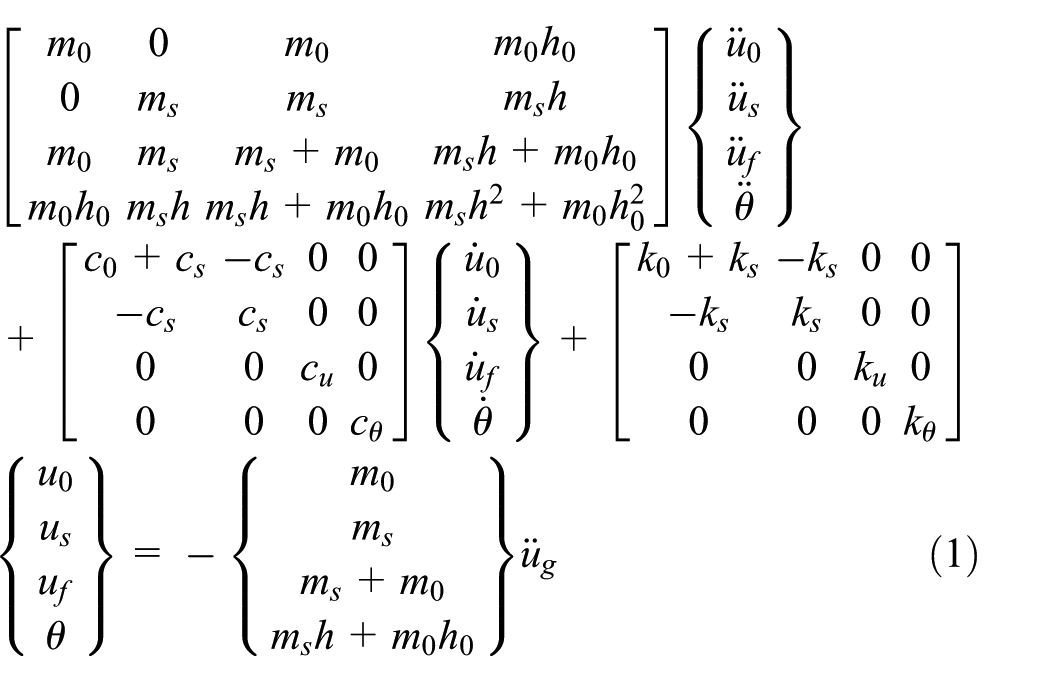
By performing Fourier transformation on both sides of equation (1), the above equation can be represented in the frequency domain as

where Us, U0, Uf, and Θ are the Fourier transform of us, u0, uf, and θ, respectively; us and u0 are the relative horizontal displacements of ms and m0, respectively; uf is the relative displacement between the foundation and the ground in the horizontal direction; θ is the angular displacement of the foundation; Ug is the frequency domain description of the input excitation ug; and ω is the natural frequency of the input motion ug(ω).
If the variables are defined as follows


then equation (2) can be rewritten as

where

Modal property
Owing to the assumption of massless foundation, the isolated structure with a large aspect ratio is simplified to a model consisting of only two particles: the structural system, Us, and the isolation system, U0. Based on equation (2) with all the terms of damping being neglected, Uf and hΘ can then be described by Us and U0 as follows


Substituting equations (5a) and (5b) into the last two equations in equation (4), with the terms of high-order damping ratio being neglected, we obtain

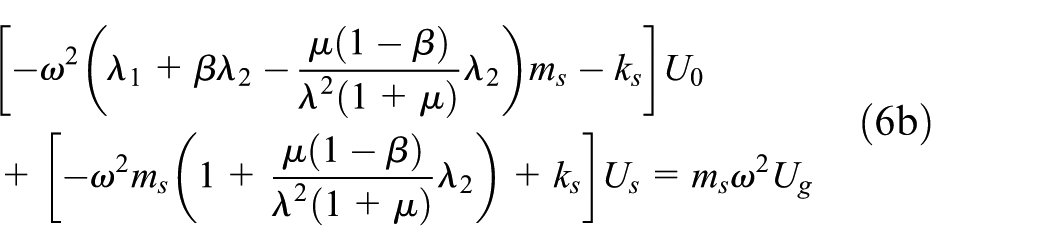
Equations (5a) and (5b) can be considered as an equivalent 2-DOF model with base fixed to the ground, namely, Us and U0. Substituting equations (6a) and (6b) into the eigenvalue equation and equating the value of the determinant to zero, we have

Hence, the modal frequency of the equivalent system demonstrated in Figure 1 can then be obtained by solving the eigenvalue problem in equation (7)

where


Thus, the natural period can be readily calculated from the eigenfrequencies obtained using equation (8)
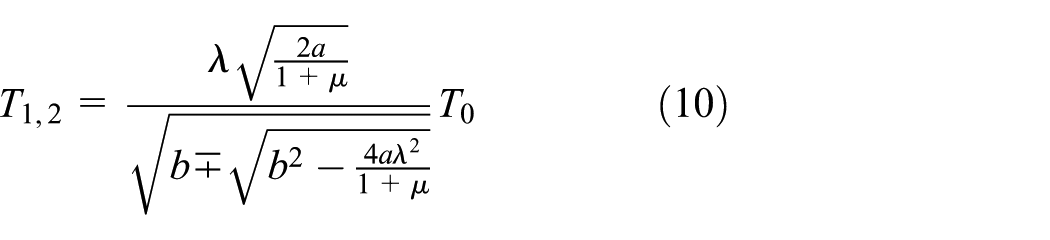
It is to be noted that equation (10) becomes the formula of natural period of the fixed-base isolated structure system1,18 when the relative stiffness ratio of the interaction system
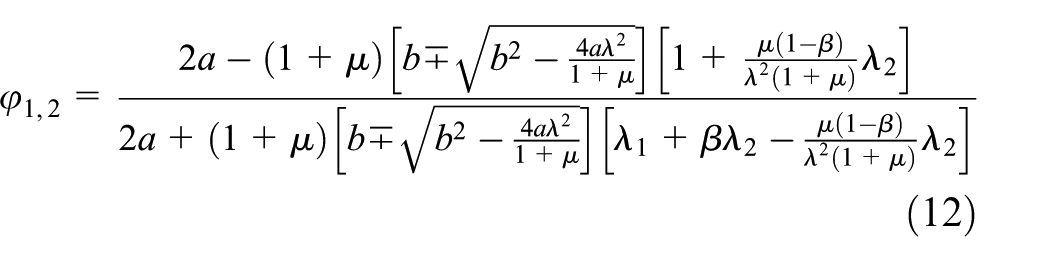
Finally, the mode shape vectors of the 4-DOF system can be determined using equations (4)–(6) and (8), which is given by

where i = 1, 2 with
The modal participation factors are obtained by

where


Damping property
The diagonalization transform performed on the stiffness matrix is considered to be also applicable to the damping matrix in the approximate procedure proposed by Veletsos and Ventura.
20
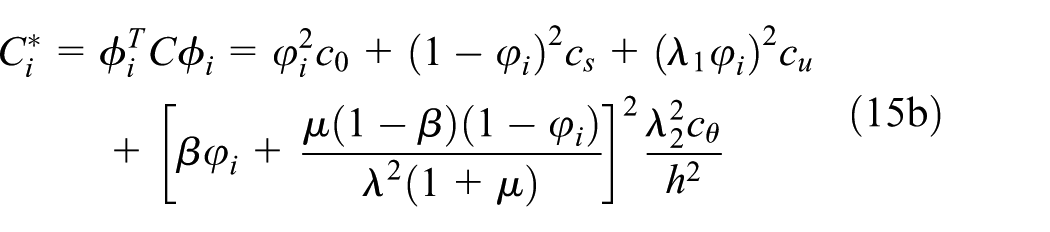
Namely, the terms of

where
The modal damping ratios can then be expressed by generalized mass and damping coefficients as

Modal characteristic parameters
The coefficients of sway and rocking motions for springs and dashpots can be evaluated from the following formulas, respectively 20


where Vs is the shear wave velocity, ν is the Poisson ratio, ρ is the mass density of soil, and r is the radius of the equivalent circular foundation.
The effects of SSI on the base-isolated structures are investigated conveniently by the parameters below

What should be mentioned is that the three parameters in equation (18) are defined exactly in the same way as non-isolated conventional structures, 6 making the ranges of these parameters identical for both types of structures.
Based on equations (3a), (3b), (17), and (18), the following expressions can be derived


Verification of the analytical model
The relatively rigorous complex eigenvalue approach proposed by Constantinou and Kneifati 14 is adopted to validate the simplified analysis methodology employed herein, for the case of interaction systems for various values of σ (1, 3, and 10) and Ts (1.05, 0.52, and 0.1 s), while T0 = 2.0 s, η = 5, ξs = 0.02, and ξ0 = 0.05. The parameters μ = ms/m0 and β = h0/h were determined according to the value of Ts, supposing that Ts is inversely proportional to h. The published analytical results by Constantinou and Kneifati 14 and those obtained by means of the simplified analysis proposed here are demonstrated in Table 1, in terms of the fundamental modal parameters of the system T1 and ξ1.
Comparison of the fundamental modal parameters of the system.
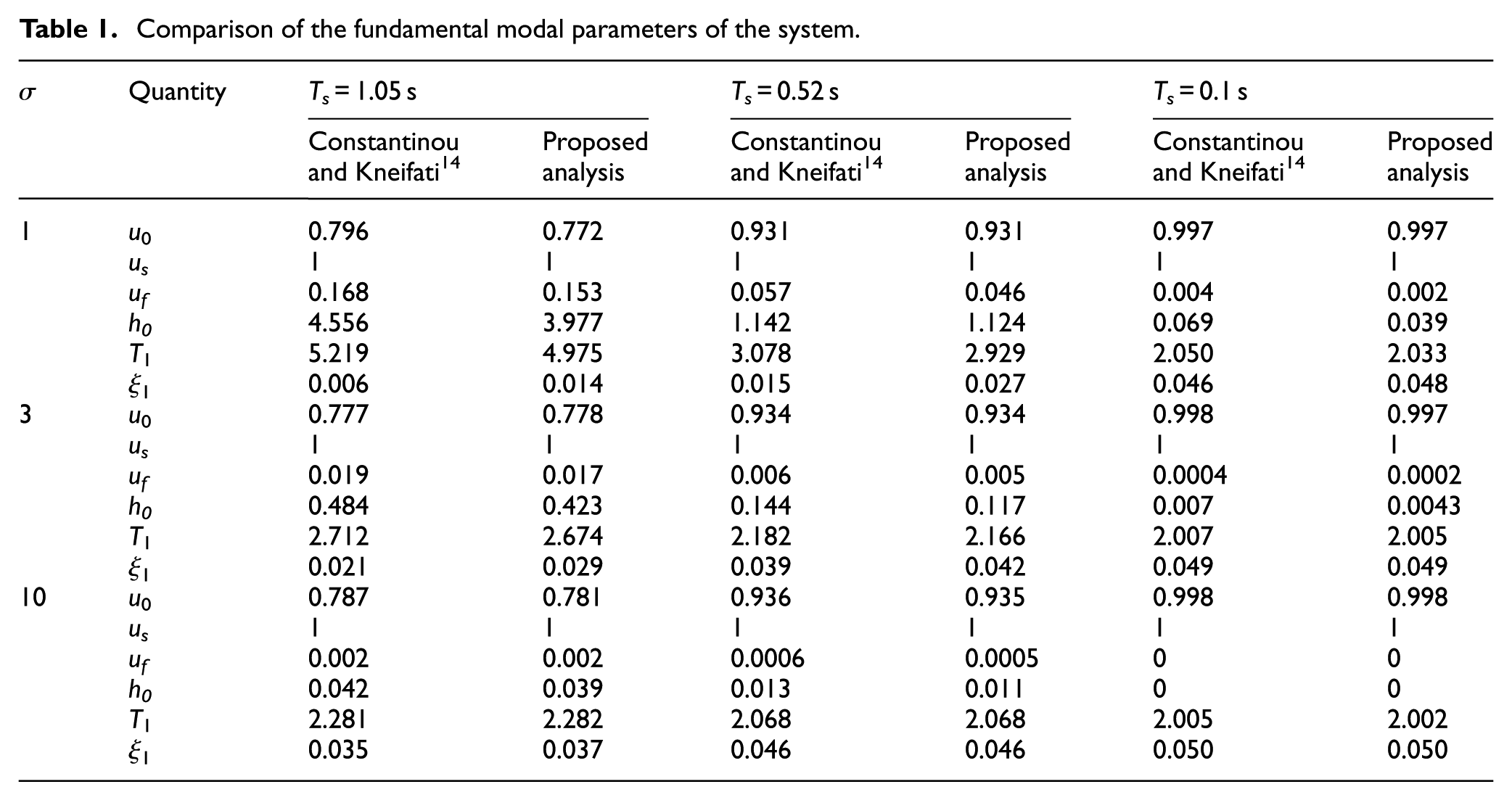
The results show that the fundamental mode shapes and periods predicted by the simplified method proposed are in good agreement with the counterparts from the complex eigenvalue approach. However, the damping factors of the fundamental mode calculated by the simplified method were slightly larger than those obtained using the complex eigenvalue approach for a low wave parameter σ and a long superstructure period Ts. Nevertheless, as can be observed, even for a value of σ = 3 corresponding to Vs = 91.5 m/s assuming that h equals 3.05 m, the results of the two methods show high consistency, which indicates that the proposed simplified analytical model is applicable for most engineering site conditions. It should be noted that the simplified method presented does not focus on the accurate prediction of SSI effects but rather on a concise way to evaluate SSI effects generalized on base-isolated structures.
Parametric study
Effects on mode participation
The change regulation of the model participation factor with regard to the structure-to-soil stiffness 1/σ for a value of η = 5 are shown in Figure 2. It is shown that the participation function of the first model is far more than that of the second model for the isolated structure period ratio λ = 0.1 and 0.3, while the value of 1/σ ranging from 0 to about 0.3 corresponds to Vs ranging from ∞ to about 100 m/s. However, the participation function of the second model increases with increases in the structure-to-soil stiffness 1/σ while λ = 0.5. In practice, a larger value of the period ratio (λ = Ts/T0) often occurs in higher structures, for example, for a base-isolated structure with 15–20 stories, λ may be larger than 0.5. Therefore, it can be deduced that SSI can increase the contribution of higher modes for high-rise isolated structures which is necessary to pay attention to and study. Nevertheless, for most isolated structures λ is lower than 0.3 and the soil shear wave velocity Vs is larger than 100 m/s, and therefore it seems reasonable to neglect the contribution of the higher modes, but further investigations are needed to verify this conjecture.

Model participation functions of (a) the first degree of freedom (U0) and (b) the second degree of freedom (Us) of the soil-base-isolated-structure systems.
Effects on fundamental period
Figures 3–5 demonstrate the law of the period lengthening ratio T1/T1fixed with respect to the structure-to-soil stiffness 1/σ. As can be observed in these figures, the period lengthening ratio (T1/T1fixed) increases with the increase in the structure-to-soil stiffness 1/σ. This increase is also used as a means of assessing the SSI effects of conventional structures.

Period lengthening ratios versus 1/σ for representative λ.
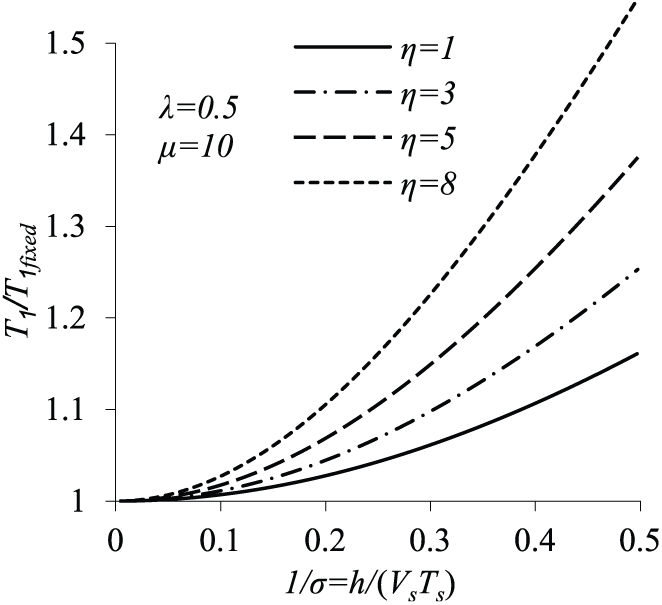
Period lengthening ratios versus 1/σ for representative η.
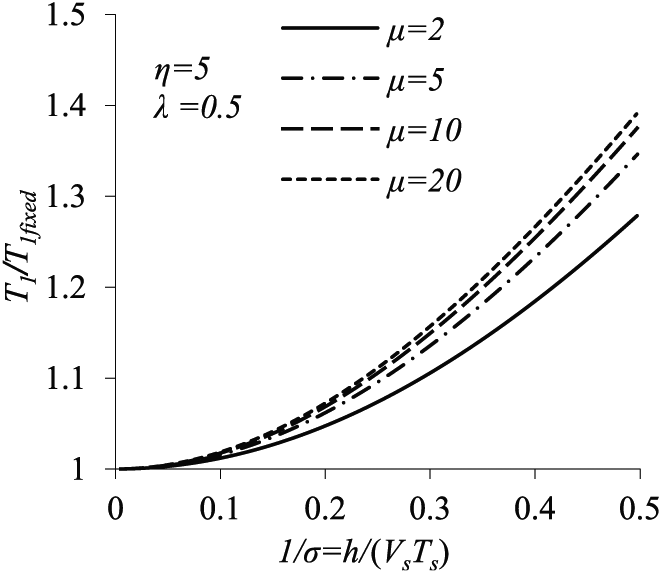
Period lengthening ratios versus 1/σ for representative μ.
Further proof for the importance of the period ratio (λ = Ts/T0) is shown in Figure 3, in which the period lengthening ratio (T1/T1fixed) increases significantly with the increase of λ. Note that the period lengthening becomes negligible for the values of λ less than 0.1. As mentioned previously, larger values of λ correspond to taller structures. Thus, it can be interpreted that high-rise isolated structures are more affected by SSI than low-rise structures. Based on this fact, when designing high-rise isolated structures, it is recommended to increase the stiffness of superstructure relative to that of the isolation layer by either installing shear wall elements or using isolators with low horizontal stiffness. The reason for this phenomenon can be explained by the fact that the presence of the isolation layer causes the structure system more flexible, which makes the structure less affected by SSI.
As depicted in Figure 4, the period lengthening ratio (T1/T1fixed) increases with the aspect ratio (η = h/r), which indicated the significant effects of SSI on slender structures with more overturning moment. It can be observed from Figure 5 that the period lengthening ratio is significantly influenced by the variation of the mass ratio (μ = ms/m0). The mass ratio μ is described by the ratio of mass of the upper part to that of the lower part of the structure shown in Figure 1. It is shown that the influence of μ on T1/T1fixed is smaller than that of the period ratio (λ = Ts/T0) and aspect ratio (η = h/r), independent of the relative stiffness properties between the structure and soil.
Effects on fundamental damping factor
It can be observed from Table 1 that, for low values of σ, the damping factor of the fundamental mode ξ1 is rather low. This phenomenon is caused by the rocking of foundation, which makes the inertial force on the superstructures larger for their slenderness (η = 5). Figure 6 shows the influence of SSI on the damping coefficient of the principle mode ξ1 with respect to the structure-to-soil stiffness 1/σ for representative η. It can be observed that, in the case of aspect ratios of η = 3, 5, and 8, ξ1 decreases with increases in the parameter 1/σ, while for η = 1 corresponding to squatty structures the opposite phenomenon is observed, in which the supporting medium absorbed a significant amount of energy radiated from the foundation.

Damping factor of the fundamental mode versus 1/σ for representative η.
The variation of the fundamental mode ξ1 with respect to 1/σ for various λ (Ts/T0) is shown in Figure 7. The period ratio λ defined in equation (3) reflects the relative stiffness relationship between the structure and the isolation system. As shown in Figure 7, increasing the stiffness of the isolation system while keeping the stiffness of the superstructure unchanged leads to a reduction in the fundamental mode ξ1, which resulted from an increase in the first-mode superstructure response of the isolation–superstructure system. For the case of λ = 0.7 corresponding to a slender superstructure (η = 5) with stiffness similar to the isolation system, the damping factor ξ1 is reduced by about 50%. Figure 8 shows the influence of the variation of mass ratio (μ = ms/m0) on ξ1. Just the same as the influence on the period lengthening ratio (T1/T1fixed), the influence of μ on the fundamental mode ξ1 is also very small.

Damping factor of the fundamental mode versus 1/σ for representative λ.

Damping factor of the fundamental mode versus 1/σ for representative μ.
Conclusion
The SSI effects are significant to the base-isolated structure’s seismic response, especially for structures with a large aspect ratio. In order to investigate the SSI effects of a base-isolated high-rise structure, a more rational model was adopted and then a new simplified method has been developed for the evaluation of dynamic characteristic parameters. Since the procedure is conducted in the frequency domain, this method is both concise and effective when applied during the schematic design phase:
Based on the 2-DOF model of a base-isolated high-rise structure, rigorous and closed-form formulas of natural periods, modes, and modal damping ratios are derived, which were verified by the relatively rigorous complex eigenvalue approach. It is shown that the proposed methodology is applicable for most of the engineering site conditions.
The participation function of the first model is far more than that of the second model for the isolated structure with a large aspect ratio. However, the participation function of the second model increases with increases in the structure-to-soil stiffness 1/σ while λ = 0.5. In practice, a larger value of the period ratio often occurs in higher structures. Therefore, it can be deduced that SSI can increase the contribution of higher modes for high-rise isolated structures.
SSI effects are more pronounced in high and slender structures with a stiff isolation system in comparison to low-rise or squatty structures. It is recommended to increase the stiffness of the superstructure by installing shear wall elements or using isolators with sliding isolation bearing or friction pendulum.
In this article, a simplified formula was developed for the calculation of dynamic characteristic parameters of a base-isolated structure with a large aspect ratio, which provides the basis for further research on the seismic response and its design method.
Footnotes
Handling Editor: MA Hariri-Ardebili
Declaration of conflicting interests
The author(s) declared no potential conflicts of interest with respect to the research, authorship, and/or publication of this article.
Funding
The author(s) disclosed receipt of the following financial support for the research, authorship, and/or publication of this article: This research was funded by the National Natural Science Foundation of China (Grant Nos 51678301 and 51678302), which is sincerely appreciated.
