




Abstract
The number of thermal power plants is growing due to the industry development and the growth of energy consumption. This leads to an increase in harmful emissions in the atmosphere. There is a necessity to control the emission concentration level in the areas of power plants location. The aim of this work was to study the level of pollution concentration at different distances from the source. The mathematical model and the numerical algorithm were verified by solving test problems and comparing them with the experimental data and numerical results of other authors. Furthermore, the pollution distribution in three-dimensional case was investigated in a real physical scale. CO2 was considered as polluting gas. As a real example, the Ekibastuz SDPP-1 coal-fired thermal power plant was simulated. The remarkable feature of this thermal power plant is that the pollution emits from two chimneys of different heights (330 and 300 m). The results showed that due to the difference between chimney heights (30 m), the pollution concentration from the higher chimney dropped far away from source, than from the lower one (2160 and 1970 m, respectively). Obviously, building higher chimneys helps to reduce the harmful impact of emissions on the environment. Also, it can be used to control the emissions level at already existing power plants.
Introduction
Industry is developing all over the world: the number of chemical plants, thermal power plants (TPP) and nuclear power plants (NPP) is growing. They produce a large amount of pollutants. Emissions lead to various ecological problems that are harmful to human health and the environment.
TPPs generate 63% of all electricity. 1 Fuel is burned during the TPP operation and various polluting substances are dispersed in the atmosphere. About 50% of the pollution is sulphur dioxide, 30% – nitrogen oxide and 25% – fly ash.2,3 Gaseous emissions spread through the air, chemically react and fall in the form of dry or liquid sediments on the surrounding surfaces. Depending on various factors like physical, chemical and meteorological, pollutants from power plant can settle at 500–1000 km from the source. This distance increases in proportion to the source capacity.4–12
The study of this process in Kazakhstan is especially important. About 87% of Kazakhstan energy uses coal as fuel. According to statistics, the share of coal in the emissions production will be 66% of the total pollution by 2020. Thus, in the Republic of Kazakhstan, the energy sector is the main polluter of air.
The Gaussian model and Briggs plume rise equations are often used for pollution spread modelling.13–22 However, they do not allow making sufficiently accurate determination of the pollution movement nature. Two-dimensional model of pollution dispersion at the earth’s boundary layer was considered by Škraba et al. 14 In the previous works, Mrša and Čavrak, 23 Oliver et al., 10 and Sanín and Montero 24 constructed the ‘box model’ taking into account the terrain relief and wind direction. They considered SO2 as a pollutant and used the k–ε turbulence model. Fatehifar et al. 25 applied the multiple cell models. Yang et al. 12 examined the capabilities of numerical simulation to describe the transport and chemical transformation of pollutants from the power plant. The simulation area is divided into two parts, based on the turbulence characteristics: JDR (jets-dominated region), which is characterized by high-pulsed jet flue gas flow, and ADR (an area with a predominance of the environment) due to the atmospheric boundary layer turbulence. Then, they tested the Reynolds-averaged Navier–Stokes equations (RANS) and large eddy simulation (LES) approaches. The results showed that LES gives more accurate results, but in comparison with RANS, it does not justify high computational costs. Toja-Silva et al. 11 simulated the CO2 dispersion and compared results with the experimental measurements. They considered the TPP in the centre of the city. The TPP pollution dispersion was modelled taking into account the nearby architectural buildings and the wind direction. In this work, different values of the Schmidt number were investigated. The emission and particles distributions were investigated by Meroney. 26 A comparative analysis of the distribution was carried out for two cases: when buildings were located around source and when they were absent. Ghermandi et al. 8 assessed the impact of NOx emissions on the environment from the TPP. In this paper, variable wind directions and topography relief were taken into account. Ebrahimi and Jahangirian 27 obtained new formulas for the Gaussian model of pollution distribution. Their results proved were closer to experimental data than the numerical results of previously known models. Barbero et al. 28 modelled dispersion of particles near a NPP in emergency case. Particle dispersion and deposition on buildings in urban environments were investigated by Gousseau et al. 29 and Kumar et al. 30 Olaguer et al. 31 simulated various scenarios for the energy facilities’ operation (different capacities and regimes). They also investigated the distribution of particles and various gases.
Before simulating of such large-scale processes, it is necessary to verify the correctness of the chosen mathematical model and numerical solution method using test configurations. Later, it can be used for simulation of more complicated turbulent models. For this purpose, in this article, two-dimensional (2D) and three-dimensional (3D) test problems of the substance motion coming out of the pipe were investigated. Moreover, there are perpendicular to the main flow in the channel. Obtained results were verified and compared with the experimental data. The obtained numerical results showed closest agreement with the experimental data than the computational results of other authors.32;–34
Then, the 3D model of the pollution distribution in real scales was considered. The obtained results were also compared with the data of other authors. 5 CO2 was considered as a pollution substance. Then, simulation of atmospheric pollution by the Ekibastuz SDPP-1 (Ekibastuz State District Power Plant-1) was carried out. Ekibastuz SDPP-1 is the largest TPP in the Republic of Kazakhstan, which is located on the northern side of Zhyngyldy lake shore, at 16 km north from the Ekibastuz city, Pavlodar region (see Figure 1). Operation capacity of Ekibastuz SDPP-1 is about 3500 MW. Dimensions of the main building: length – 500 m, width – 132 m and height – 64 m. Height of chimneys: 300 m (built in 1980) and 330 m (built in 1982). The difference between chimneys made it possible to study the source height influence on the pollution dispersion. According to the obtained numerical results, increase in chimney height reduces the emission concentration.

Ekibastuz SDPP-1, Pavlodar region, Kazakhstan.
Mathematical model
Margason 35 gave a detailed description of the latest works devoted to the study of the jet distribution in the crossflow. Authors numerically simulated the velocity field in previous papers.36–42 The passive scalar mass fraction was considered in previous works.43–45 Numerical algorithms are often used to solve these problems. In many previous works,46–50 RANS were used and the numerical results were compared with the experimental data. The good correspondence between numerical solutions (direct numerical simulation [DNS] method) and experiments was obtained by Chochua et al. 51 , Acharya et al. 52 and Camussi et al. 53 These problems were also investigated in previous works.54–57 However, the DNS method requires large computational costs, which is unacceptable for solving large-scale problems in real scales.58–60 As a result, in this article, the k–ε turbulence model was used.
The CFD simulations of such processes are based on the Navier–Stokes equations (momentum and continuity equations)61–64


where

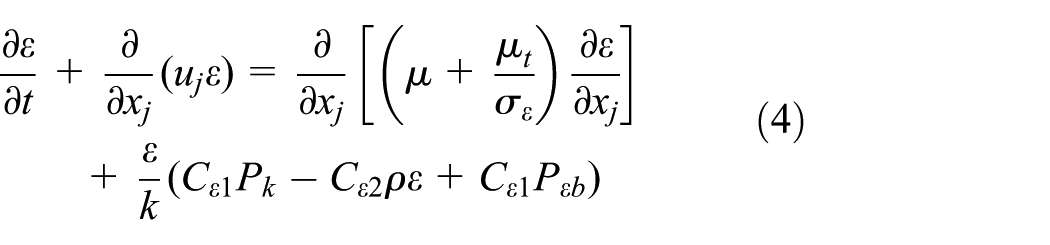
The term

Species transport equations
Transport equations were used to solve chemical species transport conservation. ANSYS Fluent simulates the local mass fraction of each species

where
Energy equation looks like

where

where
For the arbitrary scalars

where
For the steady case (stationary), ANSYS can solve one of the three equations, depending on the numerical method which is used to compute the convective flux term:
If it is possible to neglect convective flux term, ANSYS Fluent will solve the following equation

If convective flux term will be taken into account, the following equation will be like that

It is also possible to specify a user-defined function (UDF), which will use convective flux term in the simulation. In this case, it will looks like in this form

where
2D test problem
The present test problem was computed before by Falconi et al. 32 and Schonauer et al. 33 Here, a laminar jet inlet from a pipe, to the main crossflow, is located perpendicular to the jet (see Figure 2). The chemical component B enters perpendicular to the flow (input 2), component A – by the side of main channel (input 1). The components of species A and B are reacting and produce species C.

The dimensions of the computational domain (m).
Computational domain and grid
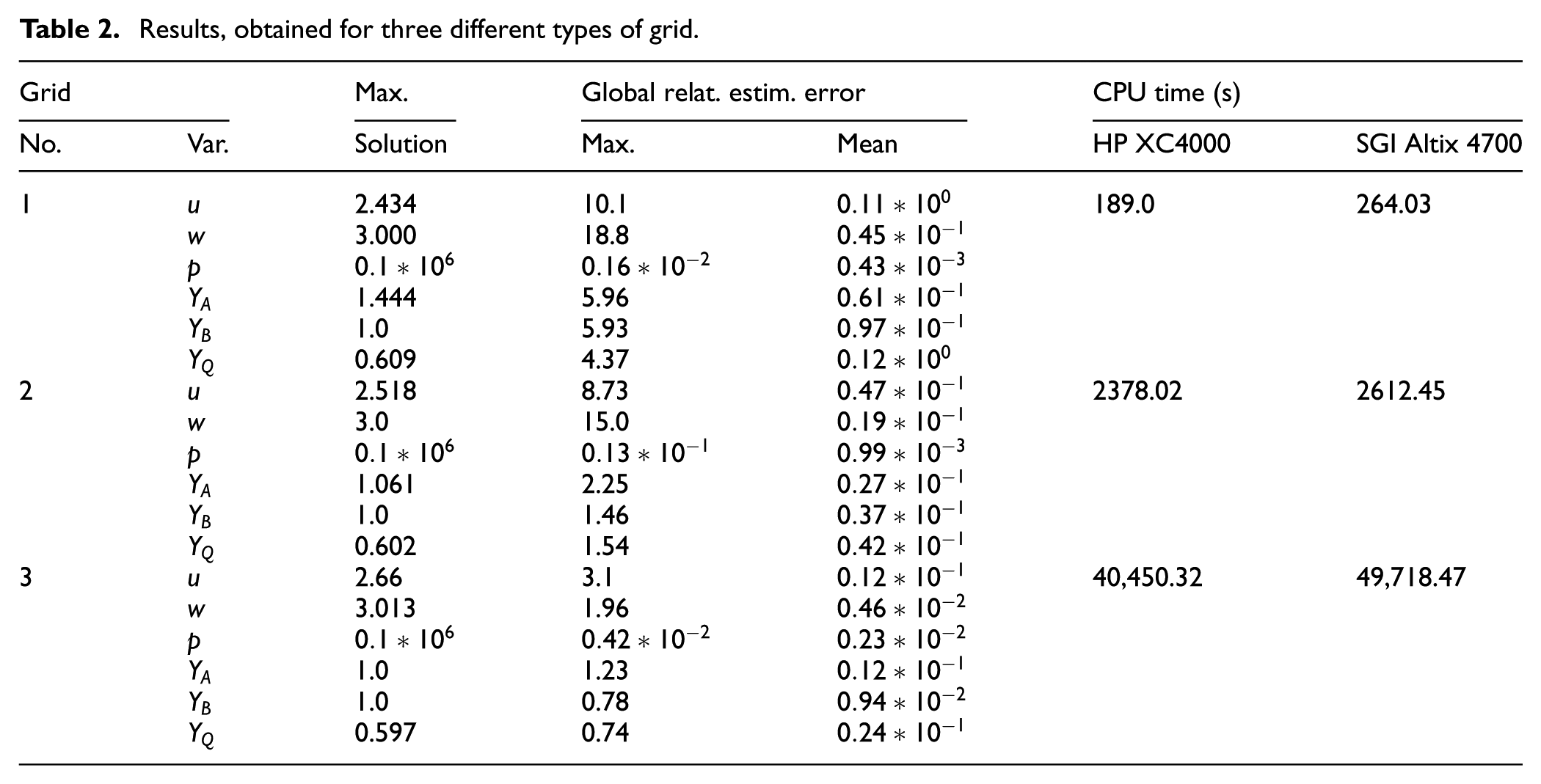
Figure 2 shows the dimensions of computational domain. It is assumed an incompressible fluid with Reynolds number 25.32,33 The computational grid in the main part of channel consists of 2561 × 641 dimensions, the dimensions of the pipe: 161 × 321. As a result, the number of nodes are 1,693,121 (see Table 1, line 3). The choice of these parameters for the grid construction is based on the simulation results. 33 In this article, the sensitivity of the numerical results to the computational grid with various nodes amount is investigated to obtain an optimal grid arrangement. It is obviously that the computational grid described in Table 1, line 3, has a good arrangement between the CPU time and the accuracy prescribed in the test problem (see Table 2). Increasing the number of grid elements allow to reduce the global maximum relative error.
Three various variants of simulation grids.

Results, obtained for three different types of grid.
Boundary conditions and flow characteristics
The simulations were carried out using ANSYS Fluent, where all simulations are made in physical sizes. That is why in this article, the physical parameters have been specified, not dimensionless parameters.
The species transport equations have been applied for calculating the mass fraction distribution. The SIMPLE algorithm with finite volume method was chosen for the numerical solution. Convergence condition was set as
Boundary conditions in ANSYS were set as follows: for the inlet 1 and inlet 2 –‘Velocity inlet’, for the outlet –‘Pressure-outlet’, for the walls –‘Wall’. It means that for the main channel outlet boundary is applied gradient for all quantities equal to zero. For top and bottom walls, there is no slip for the velocities and wall-normal gradient for the scalar components.
Different types of the u velocity profile (where u– horizontal velocity component,
Various velocity profiles.

Thus, the influence of various pre-exponential coefficients on the flow nature was investigated.
Other parameters for crossflow inlet were set as constants:
For the entry of pipe (inlet 2),

The hydraulic diameter was
Comparison of numerical results
The numerical results and the comparative analysis for the velocity field and mass fraction are presented below. The results were compared with the computational solutions of Schonauer et al. 33 and showed good coincidence. Figure 3 illustrates the comparison of velocity streamlines for the flow through the computational domain (initial velocity profile u3, see Table 3). The length of the vortex after the pipe in both cases is approximately l = 5.9D.

Comparison of streamlines, from top to bottom: the results of Schonauer et al. 33 and the results of this article.
Figure 4 presents a comparative analysis of the species transport, where C1, C2 and C3 – the mass fraction of A, B and C substances, respectively. Species mass fraction can be defined as the species mass per unit the mixture mass (kg of species in 1 kg of the mixture), that is, dimensionless quantity. The results also showed a good coincidence.

Comparison of contour plots for mass fractions, from top to bottom: the results of Schonauer et al. 33 and the results of this article: (a) product A, (b) product B and (c) reaction product C.
Figure 5 shows product concentration profiles. Data were taken at various sections (x/D = 0.0 and x/D = 3.0). Difference between the

Various mass fraction profiles for the reaction product C at different distances: (a) x/D = 0.0 and (b) x/D = 3.0 (m).
3D test problem
An experimental study for 3D test problem was conducted in a low-speed wind tunnel on a row of six rectangular jets injected at the perpendicular to the crossflow.34,65 Using a three-component Doppler velocimeter laser, which is operating in coincidence mode were measured mean velocity component and six flow stresses. Seeding of jet and crossflow air was achieved with the smoke generator. For the detailed measurements of the flow, accomplished visualization was used by transmitting the laser beam through a cylindrical lens, which is generates an intense sheet of light.
Computational domain and grid
The computational domain included the jet and the flat plate which is located above the jet. For simulation, the square jet was used and jet diameter was D, which was used as the length unit (Figure 6). The origin of the coordinate system was located at the jet exit centre. The calculation area of the test problem is a 3D channel with the pipe entering into it. The height of the crossflow channel is 20D, jet channel length is 5D, the length of the crossflow channel is 45D, the width is 3D and the centre of the pipe located at 5D from the inlet (see Figure 6). Number of grid points was as follows: main channel 230 × 100 × 21 and jet channel 7 × 30 × 7 nodes. Grid was unstructured, and the total number of nodes was 533,697.

Configuration of computational domain.
Boundary conditions and flow characteristics
The ratio of the jet velocity to the crossflow velocity is denoted by R and is expressed as follows

In the paper by Keimasi and Taeibi-Rahni, 65 various ration of the jet R (0.5, 1.0 and 1.5) was considered. In this article, R = 0.5 was considered, that is why the jet velocity was 5.5 m/s, crossflow velocity was 11 m/s. Water was chosen as the material of the crossflow and jet fluid. The jet diameter was D = 12.7 mm. Based on the above data, the Reynolds number is defined as follows

Five types of boundary conditions were used: inlet, outlet, no flux, wall and periodic. According to the experimental data, the boundary layer thickness is 2D. To describe the initial crossflow velocity profile in the boundary layer, 1/7 power law wind profile was used

Here, u is the wind velocity at height z and
Comparison of numerical results
Figure 7 shows a comparison of the numerical results for the horizontal velocity component at jet centre plane (z/D = 0) with experimental data and computational solutions of other authors (R = 0.5). The red solid line marks the results of this article, round-shaped marks represent the results of experimental data, 34 and the rest of the lines illustrate computational solutions of other authors. 65 The results for the shear stress transport (SST) model are shown by blue squares.

Comparative analysis showed that the k–ε model and the SIMPLE algorithm with finite volume method yield closest results to the experimental data (see Figure 7(b)). The solutions obtained in this article turned out to be more accurate than those computational solutions obtained by other authors. 65 Values of the red line (u/Vjet) at y/D = 0 close to zero, when other results close to ∼0.5–0.7. This is more accurate from a physical point of view, since it is a near-wall field. Moreover, in the interval y/D∼0.5–1.5, it is noticeable that the current simulation results are much closer to the experimental data than the others authors. One of the reasons is the quality of the grid: in this article, unstructured grid was used, the number of nodes was 533,697, while in the paper by Keimasi and Taeibi-Rahni, 65 structured grid was used and the number of nodes was 265,000.
3D problem in real physical scale
In this section, a 3D problem in real physical scale is presented. The comparative analysis with paper by Zavila 5 was carried out. The results of the work by Zavila 5 had been verified by an experiment performed in a low-speed wind tunnel.
Computational domain and grid
The 3D box with a chimney was chosen as the computational domain. Emissions are released from the chimney hole. Figure 8 shows the geometry and grid of computational domain. The dimensions are described in Table 4. For accurate simulation, the grid was nonuniform and was clustered near the wall, around the chimney exit and along the trajectory of pollution motion. The total number of 3D cells is 568,486. The test problems were solved using the standard k–ε model, but in present investigation, it was used RNG k–ε to compare the results with paper by Zavila. 5 According to Chang et al. 66 and Saeed et al., 67 standard k–ε and Re-Normalisation Group (RNG) k–ε turbulent models give almost the same results.

3D problem in real physical scale: (a) the geometry of simulating field and (b) the computational unstructured mesh.
Geometry parameters.

Boundary conditions and flow characteristics, comparison of numerical results
Boundary conditions for wind inlet were set as the ‘Velocity inlet’ and ‘Wall’ for chimney walls, the chimney hole and the ground; ‘Pressure Outlet’ for the outlet of channel; and ‘Symmetry’ boundary conditions were used for the front, back and top walls.
Zavila
5
considered the helium dispersion for different wind velocities: 1, 3 and 5 m/s. For comparison, the third case was chosen (vair = 5 m/s; see Figure 9). As in the test problem, species transport model was applied for pollution movement simulation. It was assumed that discharge substances do not react with air. The influence of gravity was taken into account. The temperature and convergence criterion were set as 300 K

The helium distribution numerical results. From left to right: results of Zavila 5 and present results (wind velocity is 5 m/s).
Ekibastuz State District Power Plant-1 (Ekibastuz SDPP-1)
Next, the real physical model of the pollution distribution from Ekibastuz SDPP-1 (Ekibastuz city) was considered. At this TPP, pollution emits from two chimneys (300 and 330 m). The distance between the chimneys is about 250 m (see Figure 10). Diameters of chimney holes are 10 m. Two cases with different wind velocities were tested: 1.0 and 1.5 m/s (Figure 11). Velocity of pollutants from chimneys: 5 m/s. To describe the boundary layer, the following initial wind velocity profile was applied

Satellite image of Ekibastuz SDPP-1 thermal power plant. Distance between the chimneys is 250 m.

CO2 motion analysis (Ekibastuz SDPP-1) for various wind velocities: (a) 1.0 m/s and (b) 1.5 m/s.
CO2 was considered as a pollutant in this case (see Figure 11). In the figure, it is obvious that at higher wind velocity, pollution settles on the ground much farther from the source than at low wind velocities. Also, the distances for different chimney heights from the pollution source were determined. For this purpose, mass fraction profiles from two chimneys were compared at different distances from the source (wind velocity 1.5 m/s): 1750 and 2150 m (see Figure 12).
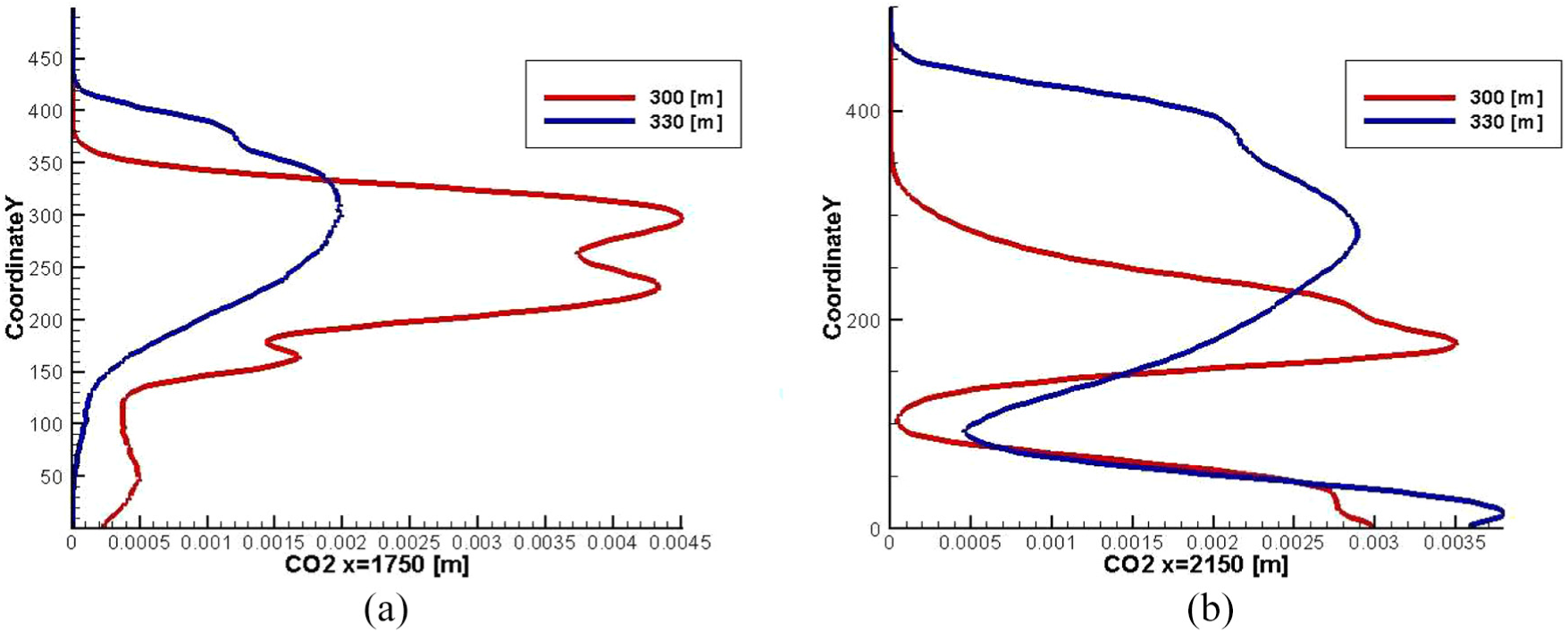
Comparison of CO2 mass fraction profiles at various distances for two different height chimneys (300 and 330 m): (a) 1750 m, (b) 2150 m and wind velocity: 1.5 m/s.
Figure 12 clearly shows that contamination from a smaller pipe (300 m) settles closer to the source. At the distance of 1750 m from the chimney with source, a small amount of CO2 concentration is already observed on the ground surface. On the contrary, pollution from a higher chimney at this distance still does not reach the ground in large quantities and is practically zero. At an altitude of 150–350 m, large emission concentrations are observed for a chimney with height 300 m, compared to a chimney with height 330 m. This is due to the fact that in this interval, contaminants from a smaller chimney are added with contaminants from the high chimney, since the distance between the two chimneys is only 250 m and the emissions can dissipate well. At a distance of 2150 m, the concentration of contaminants from both chimneys is already settling. Generally, pollution concentration (CO2) tend to be higher at ground level than at chimney height (∼300 m), where the diffusion effect is smoother. This effect is associated with turbulent eddy dissipation. Toja-Silva et al. 11 showed that the pollution concentrations change trajectory and drop below towards the ground at a distance of about 500 m from the chimney. At a distance of about 700 m from the power plant, high concentrations are observed at ground level. However, this phenomenon is also observed in this work, but there are differences in pollution dropping distances because of the various chimney heights: in the paper by Toja-Silva et al., 11 the TPP has the chimney height about 90 m, but Ekibastuz SDPP-1 TPP has the chimney height 300 m for the first one and 330 m for the second one.
Conclusion
The aim of this work was to identify the distance from the chimney with source at which the contamination settles and the factors affecting it. For this purpose, a numerical simulation of gaseous pollutant plume motion and dispersion was conducted in real atmospheric conditions. Moreover, in this work, additional dispersion model did not apply. The influence of various wind velocities and chimney dimensions was investigated.
In the beginning, numerical methods were tested using 2D and 3D test problems. The jet, entering from the channel, perpendicular to the main flow, was considered in sections ‘2D test problem’ and ‘3D test problem’. A comparative analysis of obtained numerical results with the numerical data of other authors32,33,65 showed that the results are in good agreement with each other. It should be noted that these computational results have been found to be much closer to the experimental data than the computational results obtained by other authors 65 due to the improved grid. As a result, it was revealed that the initial velocity profile has a significant influence on the further character of impurity distribution. 65
Next, a 3D simulation of pollution distribution in real physical scale was conducted in section ‘3D problem in real physical scale’. The distribution of He was considered. The fine grid was constructed near the ground, around the chimney exit and along the pollution motion trajectory. It allowed to minimize simulations cost and focus on areas of interest.
In section ‘Ekibastuz State District Power Plant-1 (Ekibastuz SDPP-1)’, the real physical model of the pollution distribution from Ekibastuz SDPP-1 was considered. From the results it is obvious that the height of the chimneys significantly influences the pollution distribution. Building of higher chimneys is more appropriate for the ecology safety. Safe distances (1750 m for the first chimney (300 m) and 2150 m for the second chimney (330 m)) were also determined from the falling concentration of the two chimneys of the TPP.
Future research should continue to examine knowledge in describing distribution of species in the air at various distances. It will help to determine optimal location of TPPs with respect to human settlements in advance. This will help to minimize the damage to flora and fauna caused by emissions from the chimneys of TPP.
Footnotes
Handling Editor: Bo Yu
Author note
Alibek Issakhov is also affiliated with Kazakh-British Technical University, Almaty, Kazakhstan.
Declaration of conflicting interests
The author(s) declared no potential conflicts of interest with respect to the research, authorship and/or publication of this article.
Funding
The author(s) received no financial support for the research, authorship and/or publication of this article.
