




Abstract
Circular and square steel tubes are two of the most commonly used members in the construction industry in China. Material damage and its accumulation cannot be neglected when structures undergo obvious deformation and material plasticity during severe earthquakes. In another published paper, a material damage constitutive model for Q235 steel was derived, and some of its parameters were defined based on a cyclic test. This article focuses on developing a normalized constitutive model at the material level and a damage model at the component level for square steel tubes based on experimentally derived results. First, the material damage behavior of 10 square steel tubes under five cyclic load schemes was investigated. The material damage and its accumulation at the material level were defined using a user-defined material sub-routine (UMAT) in the finite element software Abaqus. Next, the parameters in the constitutive model were calibrated by the fitting degree between the test result and numerical result. Furthermore, based on the experimental and numerical data, a damage model combined with deformation and energy was developed at the component level to evaluate the overall damage behavior of the specimens. Finally, the parameters in the damage model were calibrated based on the responses of the specimens at the time of collapse. The effect of material damage behavior and the accumulation of damage were found to significantly reduce the collapse load of specimens, which must be considered in the theoretical analysis and design process. The constitutive model and damage model developed in this article can be used to quantify the degree of damage of the material and components of structures under earthquake loads.
Keywords
Introduction
A space structure, especially a large-span space structure (e.g. an airport terminal or a waiting hall in a train station), is commonly the basis of large-scale public facilities and is widely used in locations in China where earthquakes occur frequently; as a result, the damage or collapse of space structures due to earthquakes can result in large-scale casualties and property losses. Determining how to guarantee peoples’ safety and reduce the damage to property under severe seismic events is attracting increasing attention from scholars. This type of structure usually presents serious states of destruction including obvious member buckling and fracture under severe earthquakes, indicating that the damage behavior exhibited by the materials in the structure is serious. These failure patterns were universally observed in the space structures that experienced the Lushan earthquake, 1 which occurred in 2013 in China. It is necessary to develop a constitutive model to consider the damage behavior and its accumulation at the material level and a damage model to evaluate the damage degree at the component level when a structure is subjected to earthquake loads. Hearn and Testa 2 thought it was practical to use the reduction of the cross section of members as an essential element to calculate the damage evolution process. Powell and Allchabadi 3 used the deformation of the component to describe the damage. Material damage is usually caused by excessive energy and deformation; thus, Park and colleagues4,5 presented a model composed of a linear combination of the above two factors for quantifying damage. Based on this concept, Kumar and Usami6,7 proposed a damage model to calculate the damage degree of hollow steel box columns based on experimental data. Sreekala et al. 8 selected two damage models, one was defined by Park and colleagues4,5 and the other by Rao et al., 9 to give a simple and realistic measure of structural damage. The performance of the low-cycle bending fatigue of A36 steel bars was studied through a series of experiments by Liu et al.10,11 Subsequently, a damage index was defined to evaluate the damage magnitude of structural members and design principles for low-cycle bending fatigue strength. With the increase in the structural span, lightweight and high-strength materials become more promising. The metallic-based structures will be constantly replaced by lightweight fiber-reinforced structures, as mentioned by Almeida Jr et al.12,13
The response behavior in the material and individual component, as well as at structural level, is more complex when the steel space structure is subjected to three-direction dynamic loads; thus, a theoretical analysis and numerical simulation should consider the above factors. Taking these complex factors into account, the combination of experiment and finite element analysis is thought to be an effective method to investigate the material damage behavior and develop a constitutive model for the evaluation of damage and its accumulation. In the aforementioned research, 14 a series of tests were completed to study the cyclic damage behavior of circular steel tubes, which are widely used members in steel structures. Based on the experimental results, Nie et al. 14 derived a constitutive model to take into account the material damage behavior at the material level. Subsequently, the accuracy of the model was verified, and the damage degree of the experimental specimen was evaluated. Furthermore, the damage mechanism and failure pattern of a single-layer reticulated dome, which is one of the main forms used in space structures, was investigated by Nie and colleagues15,16 based on incremental dynamic analysis. The results showed that the failure of the structure under a strong seismic load was dynamic strength failure resulting from excessive damage to the material. However, although material constitutive models have focused on the damage behavior of circular steel tubes, few constitutive models have been developed for a square steel tube, which is another universal member used for space steel structures.
This article describes part of an effort to implement performance-based design practices considering the material damage behavior in the construction of steel space structures subjected to earthquake loads. Although the essential mechanical characteristics have been investigated through a series of tests for circular steel tube, a normalized constitutive model for square steel tubes has not yet been developed. A proper constitutive model is crucial for the accurate evaluation of structural damage behavior when performing finite element analysis (FEA) simulations. In this article, 10 square steel tubes with different diameters and heights were experimentally tested under five loading schemes to investigate their hysteretic behavior. Next, a constitutive model applicable for square steel tubes at the material level was defined to calculate the material damage and damage accumulation using the fitting method and both the numerical and experimental results. Furthermore, a damage model at the component level was developed to quantify the degree of damage of the components based on experimental responses at the time of collapse. Finally, based on the constitutive model developed for the material level and another damage model implemented at the component level, the effects of the material damage behavior and damage accumulation on the performance of the specimen under dynamic loads can be accurately evaluated.
Outline of test
Details of test
To understand how the damage behavior of the specimens varied with various parameters that could potentially be utilized for further study, such as cross section and slenderness ratio, two series of experiments composed of hollow square steel tubes with the same samples and different loading criteria were carried out. Square steel tubes with a height of 1200 mm and a cross section of 80 mm × 5 mm and 100 mm × 5 mm were chosen to cover different slenderness ratios that are applicable in steel space structures. The restraint condition of the specimen adopted was a cantilevered column, that is, one end of the specimen was fixed and the other end was free. The specific description of the specimen is shown in Table 1. The experimental setup and connections applicable for square steel tubes were the same as that of the circular steel tubes presented in the study conducted by Nie et al., 14 as shown in Figure 1. For this reason, the above-mentioned considerations are not further described here.
Description of the specimen.

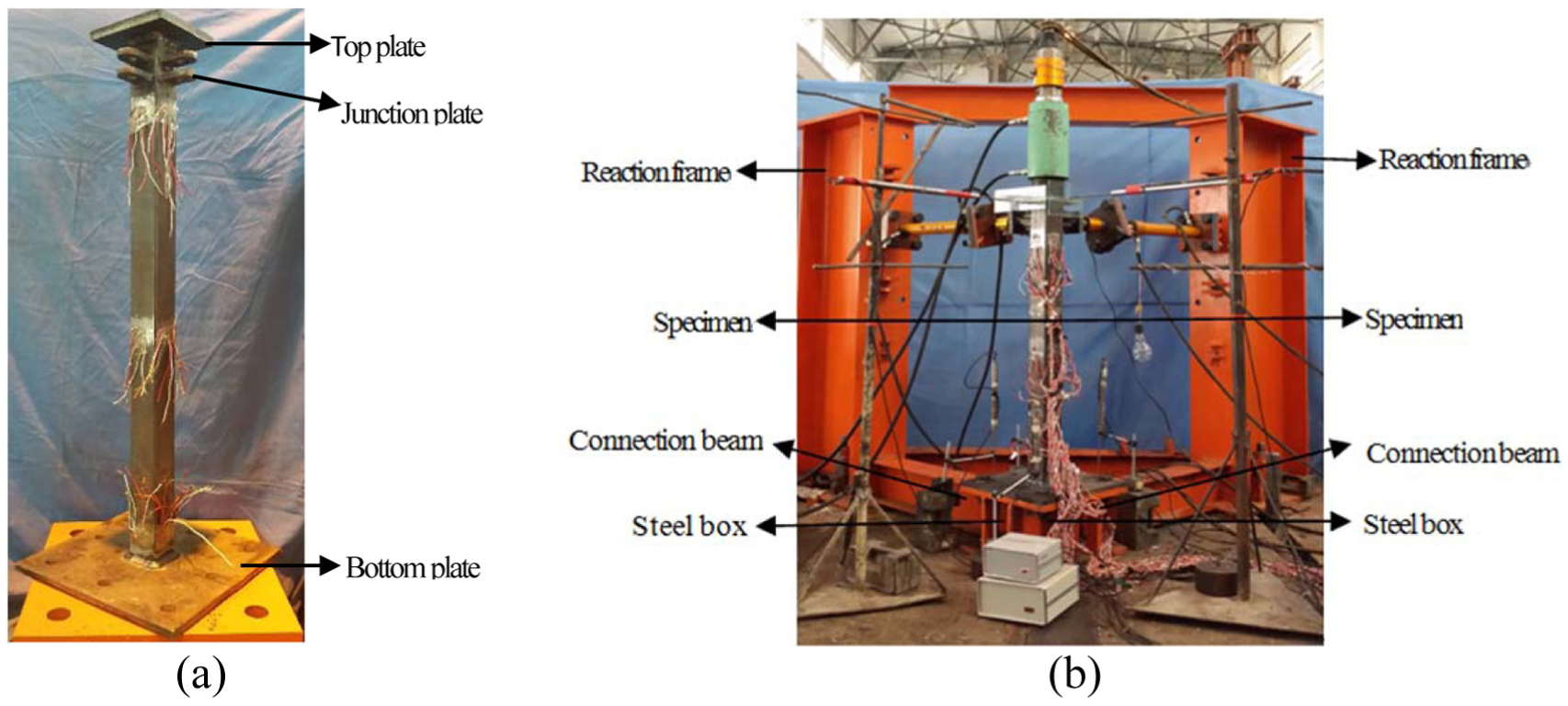
The specimen and the corresponding experimental setup: (a) a specimen and (b) details of the experimental setup.
The experimental specimens were fabricated from a low-alloy steel Q235B, which is a standard steel grade in China;17,18 The modulus of elasticity of low-alloy steel Q235B in the test is 2,06,000 MPa, and the yield strength is 235 MPa. The corresponding chemical composition is shown in Table 2. To accurately simulate the responses of the tubes under cyclic loads and provide effective material property data, eight groups of members—four with cross sections of 80 mm × 5 mm and another four with cross sections of 100 mm × 5 mm—were studied in the material test. The mean value of the specimen is shown in Table 1. The material property data and geometrical measurements will be used in the numerical simulation.
Chemical composition of Q235B steel in China (values are in atomic %).

Test observations
The five load schemes described by Nie et al. 14 were performed quasi-statically. Because the load schemes were similar to those used in the previous study, 14 the details are not given here. In each half-loading cycle, the load was increased gradually using a hydraulic jack until the defined maximum displacement was obtained. However, the same load amplitude was applied with three cycles when the loading displacement was greater than 40 mm. Before providing a detailed description of the experimental results, the definition of collapse of the specimens is here clarified. In this article, the specimen is considered to have collapsed when the bearing load of the specimen decreases to 80% of its maximum value. The mechanical property of the member in the structure is largely dependent on its interior material responses under exterior loads, which follows a close relationship with the loading history. In this article, a subset of the experimental results is shown in the load displacement form to understand the effects of loading history on damage behavior. Taking specimens SA-01, SA-04, SB-01, and SB-04 as examples, the load–displacement curves and the corresponding failure patterns of the specimens are shown in Figure 2.

Hysteretic curves and the failure of specimens SA-01, SA-04, SB-01, and SB-04: (a) SA-01 in the x and y directions, (b) SA-04 in the x and y directions, (c) SB-01 in the x and y directions, (d) SB-04 in the x and y directions, (e) failure of SA-01, (f) failure of SA-04, (g) failure of SB-01, and (h) failure of SB-04.
The material remains elastic when the specimen is tested before the 6th half-cycle with the absolute value of loading displacement less than 6 mm. At the same time, the specimen has no residual deformation and energy dissipation because the coverage area is nearly zero and the slope of the curve remains unchanged, as shown in Figure 2(a). The residual deformation of the curve is first visible at the 7th half-cycle. The residual deformation of the specimen grows increasingly obvious with the increase in the load. The slope of the curves and the coverage area of the hysteretic curves vary significantly at the 13th half-cycle, that is, the stiffness of the specimens has a notable deterioration. Buckling at the fixed end of the specimen is visible at the 15th half-cycle, and then, the corresponding bearing capacity of the specimen begins to decline with the load displacement of 50 mm, demonstrating the good deformation ability and energy dissipation capacity of the square steel tube. However, the strength decreases faster when the value of the load displacement reaches 50 mm for the third time, that is, the specimen’s damage behavior and its accumulation grow increasingly pronounced under the constant repetition of large deformation. The buckling at the fixed end of the specimen becomes considerable when the value of the load displacement reaches 56.5 mm at the 21st half-cycle, as shown in Figure 1(e). The sound caused by the continuous development of an initial microscopic crack at the point of buckling is heard when the value of the load displacement reaches 60 mm at the 22nd half-cycle. However, the slight difference in the strength between the 21st and 23rd half-cycles is due to the closing of the cracks on the compressed side of the specimen. At the 23rd half-cycle, a crack becomes visible at the edge between the specimen and the bottom plate. The specimen is considered to have collapsed at the 21st half-cycle after the load has decreased to 78% relative to its maximum value. To study the effect of load schemes on the mechanical behavior of the specimen, specimen SA-04 is selected for comparison with SA-01, as shown in Figure 2(c) and (d). The maximum strength and energy dissipation capacity is quite different between these two specimens. Furthermore, both the maximum strength and energy dissipation capacity increase with increasing specimen cross section, as shown in Figure 2(c) and (d). The failure pattern of the square steel tube is similar across different load schemes, which is consistent with the observations for the circular steel tube discussed by Nie et al., 14 where the failure mode of all specimens involved is local buckling at the fixed end of the specimen.
Experimental results
Before simulating the experimental results, the experimental errors should be calibrated. In this study, the experimental errors included three parts: the initial rigid body rotation at the bottom steel box caused by the horizontal displacement of the specimen, (2) the difference in height between the force sensor connected with hydraulic jack and displacement sensor at the top plate of the specimen, and (3) the geometric nonlinearity due to two-directional horizontal loading, as presented by Nie et al. 14 Herein, it should be emphasized that the specimens in the test conducted by Nie et al. 14 are made of circular steel tubes. However, the experimental errors in this article are the same as the above-mentioned errors because both the circular and square steel tubes in the two experiments used the same experimental setup. Therefore, the experimental data and its error processing are not discussed in this article.
Damage index at the material level
The design of steel structures requires a ductile material to resist obvious plastic development at the material level and significant deformation at the component level under a severe earthquake event. Steel structural ductility and damage behavior depend on the type of structure and the material used in the structure. In the previous study, 14 the authors presented a constitutive model including three equations for describing the nonlinear material behaviors of Q235B steel based on the fitting method between cyclic experimental and numerical results; however, the specimens used in that test were circular steel components, which are different from the specimens used in this article. The hysteretic behavior of the material may be affected by the specimen’s cross section. Therefore, this study is a continuation of the authors’ work toward developing a rational constitutive model that considers material damage accumulation for Q235B steel used in circular and square tubes. Herein, a user-defined sub-routine UMAT encoded with Abaqus is developed to include the material constitutive model used in this article. The material damage degree and its accumulation are defined using the damage index, 14 expressed as shown in equation (1)

where


where
The above three equations can be used as constitutive relations to calculate the material damage and its accumulation. Moreover, this set of equations can also be used to quantify the mechanical behavior of materials. Therefore, the finite element software Abaqus and its user-defined sub-routine (UMAT) were used to carry out a numerical simulation for the experiment. The user-defined sub-routine (UMAT), including the material constitutive model expressed in equations (1)–(3), was compiled with the finite element software Fortran to exchange data with Abaqus. Using this approach, the material parameters, such as


Curves fixed through the trial and error method: (a) S-11 in the x direction and (b) S-11 in the y direction.
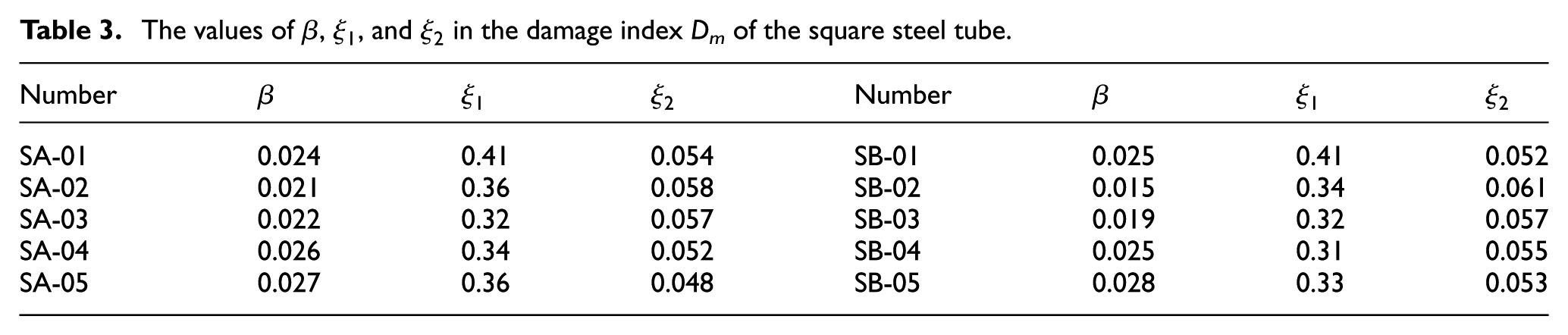
The values of
Damage model at the component level
As previously stated, the damage index Dm is used to evaluate quantitatively the material damage behavior and provide a better understanding of the deteriorating relationship between the Dm and the elastic modulus and yield stress of the material. The material mentioned in this article will fail when the value of Dm in the integral point of the finite element model reaches 1. In this section, to determine the degree of damage and ultimate collapse point of the specimens under cyclic load, another damage index Ds is introduced. Next, the collapse of the specimen is defined at the time when the bearing load of the specimen reduces to 80% of the maximum value in the numerical and experimental curves. The damage at the component level includes local and global buckling in the specimens. The damage degree at the component level can also be expressed by the damage index Ds, as expressed by equation (7). The characteristics of Ds are similar to the damage index Dm for the material

where



where
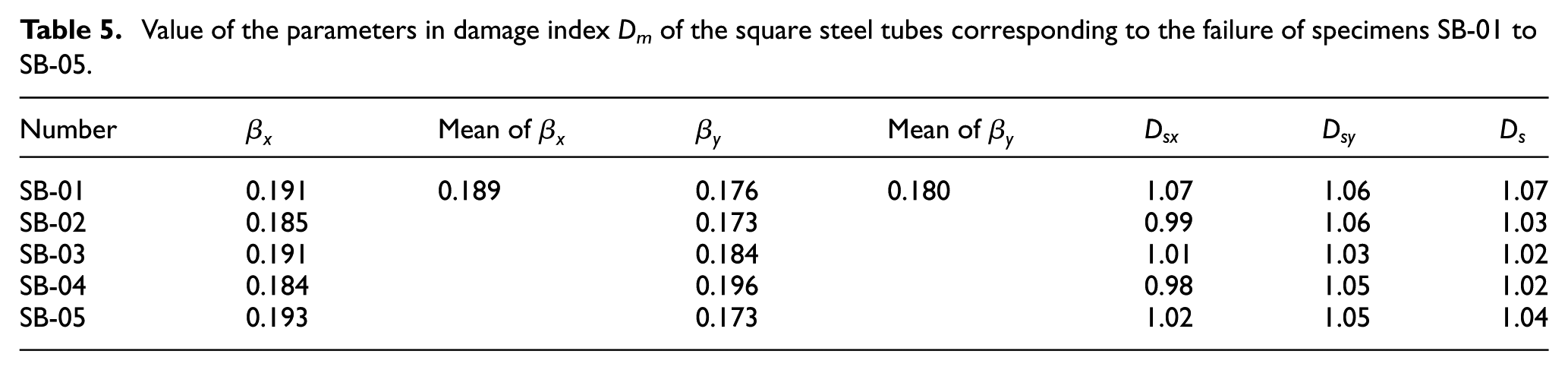
As mentioned above, a specimen is considered to have collapsed when the bearing load of the specimen decreases to 80% relative to the maximum value. The values of
Values of the parameters in damage index Dm of the square steel tube corresponding to the failure of the specimens.

Value of the parameters in damage index Dm of the square steel tubes corresponding to the failure of specimens SB-01 to SB-05.

Precision of Dsx, Dsy, and Ds for specimens (a) SA and (b) SB.
Conclusion
In this study, a spatial hysteretic experiment was conducted on square steel tubes, and then, two damage models were defined to quantify the damage behavior in the material and at the component level. The following conclusions were drawn based on the study results.
The development of plasticity and buckling were described in this study. The experimental results showed that the damage and its effect on the behavior of the damage mechanism are largely dependent on the loading history. The failure pattern of the square steel tube was local buckling at the fixed end of the specimen.
To quantify the damage degree and the damage accumulation, a material damage constitutive model that included the damage index Dm was defined in this article, and then, a user-defined sub-routine UMAT encoded with Abaqus was developed to include the model. Furthermore, the parameters in the model for each specimen were evaluated through the least squares method based on the experimental data. Finally, a normalized material constitutive model containing the material damage behavior and the damage accumulation was eventually determined. This constitutive model is used to re-simulate the experiment result, which proves that the constitutive model has good accuracy.
The specimen-level damage indices were defined using the maximum displacement and cyclic cumulative displacements. Their values at the failure of the specimens were discussed, and the corresponding precision was calibrated. The results showed that the precision of damage index in specimen level was very good; as a result, these indices can be used to quantify the degree of damage of specimens under cyclic loads. Therefore, the structural mechanism behavior can be accurately quantified using the damage model in the material level and damage index in specimen level.
Footnotes
Handling Editor: Seung-Bok Choi
Declaration of conflicting interests
The author(s) declared no potential conflicts of interest with respect to the research, authorship, and/or publication of this article.
Funding
The author(s) disclosed receipt of the following financial support for the research, authorship, and/or publication of this article: This study was jointly sponsored by the China Earthquake Administration Fundamental Research Program (2018B12) and the National Natural Science Foundation of Heilongjiang Province, China (E2016071) and supported by Program for Innovative Research Team in China Earthquake Administration.
