



Abstract
In the multi-agent system of personalized product supply chain, negotiation can effectively solve conflict and realize cooperation. In this article, personalized index is defined and the calculation method of personalized index is presented. Then, the multi-agent negotiation model is constructed based on personalized index and the negotiation procedure is discussed. Finally, the validity of the model is demonstrated by an example. That will be provided theoretical and operational methods for personalized product supply chain management, is helpful to coordinate and control personalized product supply chain, and realize the efficient, flexible, and quick operation of personalized product supply chain.
Keywords
Introduction
With the continuous improvement of living standards, customer demands have changed gradually. The change shows that customers are not satisfied with standardized product and prefer to meet the personalized product.1,2 The ability of meeting the personalized needs of customers has become an indispensable ability for manufacturing enterprises. Only by designing, producing, and serving different customers, the core competitiveness of manufacturing enterprise can be improved. In the demand-driven market, it is the key point for manufacturing enterprise to understand the customer’s individual demand accurately and adopt the appropriate supply chain model to respond quickly to the personalized requirements of customers.3–5
The research of manufacturing enterprise personalized product focuses on personalized product requirements and personalized product customization.6–9 Personalized product requirement research mainly includes the characteristics of personalized demand and concepts, demand forecasting, and product classification.10–15 Personalized product customization research mainly includes the concept and implementation methods of personalized customization.12–18 The personalized product supply chain refers to a customer-oriented supply chain mode. This mode takes customer’s personalized demand as the starting point, integrates customer, production integrators, suppliers, logistics service providers, and other service providers by utilizing artificial intelligence, big data, cloud computing, Internet, and Internet of things technology; this mode integrates supply chain resources to provide personalized product for customer by means of the analysis of demand forecasting and collaborative operation, and focuses on customer’s personalized experience and maximum satisfaction. These entities can be abstracted to the independent agent, and personalized product supply chain can be considered as a multi-agent system composed of agent, which is divided into separate enterprises or departments. In the operation of personalized product supply chain, negotiation can effectively solve the conflict between partners, and it is also an important way to improve the operational efficiency of personalized product supply chain. At present, research on personalized product supply chain and negotiation of personalized product supply chain is rare.
Research on agent and multi-agent systems has originated from distributed artificial intelligence, which is the inevitable result of the development of distributed artificial intelligence, modern computer technology, and communication technology.19–21 Agent and multi-agent systems are frequently used to solve the problems of decision-making and collaboration in supply chain management. Shoham 22 believes that if the state of an entity contains the mental states of belief, commitment, knowledge, and ability, then the entity is an agent. Wooldridge and Jennings suggest that the agent is a computer system to meet the needs of specific design, and it has superior flexibility and autonomy.23,24 Franklin and Graesser 25 believe that the agent is a software entity that can represent the user, has certain independence and autonomy, and automatically realizes the original design of a set of targets in the calculation of complex dynamic system environment. A multi-agent system is composed of multiple agents that coordinate with each other to accomplish their goals. In view of the limited ability of a single agent to solve complex problems, it is possible to form a multi-agent system by coordinating multiple independent agent behaviors to compensate for the lack of a single agent function. In a multi-agent system, each agent coordinates each other’s goals and completes a specific task or achieves goals through cooperation.
Research on multi-agent systems is concentrated on multi-agent model, architecture, consistency and coordination, multi-agent planning, and conflict processing. 26 The negotiation process can be seen as a process in which agents coordinate their respective actions through communications to take joint action. Multi-agent communication technology is a fundamental foundation and service guarantee for negotiation. KQML is an officer communication language based on speech act theory, which has become the fact standard of agent communication language. 27 Implementing agent negotiation in addition to agreeing on communication languages, there is a need for a negotiation mechanism to regulate the collaboration process. Contract net protocol (CNP) is part of the most well-known and widely used consultative mechanisms.28,29
Negotiation is the exchange of relevant structured information by both parties, forming planning and consensus of views. 30 Neumann and Morgenstern 31 divide the negotiation into single-objective and multi-objective negotiation. Faratin et al. 32 believe that negotiation can be divided into time-, resource-, and behavior-dependent negotiation from the perspective of negotiation strategy, and point out that the main factors affecting the negotiation process convergence include time, resources, and behavior and also that the deliberative bodies can produce a variety of negotiation tactics based on these factors. Jennings et al. 33 studied the division method of negotiation research category and considered that the scope of negotiation research mainly includes negotiation language category, decision-making category, and process category. Kraus 34 believes that negotiation is an important link in deciding whether an electronic transaction is successful. He proposes a general model of multi-agent negotiation framework and discusses multi-agent negotiation under incomplete information. The model mainly discusses the single-objective negotiation between the two sides.34,35 Faratin et al. 32 put forward the computational function of fuzzy values based on agent negotiation problem. The validity of the calculation function is verified by experiment and simulation. Jennings et al. 33 developed a method of calculating the price utility function by fuzzy mathematics, and the price negotiation model and tactics based on multi-agent system are discussed. Fatima studied the negotiation of price and utility based on web between the two negotiating parties. A multi-agent negotiation model and tactics for two commodity prices under incomplete information are proposed.36,37 Park and Yang 38 propose a multi-objective negotiation model for e-commerce environment and discussed the ways to make the negotiation agent reach the satisfactory or optimal solution. Li and Sheng 39 discuss the multi-agent negotiation model under uncertainty information. Huang and Liao 40 propose a B2C e-commerce negotiation model including information collection, search, negotiation, and evaluation. Adhau proposes a distributed multi-agent system by means of auction based on negotiation method for solving multi-project schedule problem. Computational experiments showed the impact of resource transfer time for project delay and can minimize the project duration. 41 Chen and Weiss 42 presented an automated negotiation tactics that can adjust utility based on adaptive concession-making mechanism by acquiring an opponent model and provided an empirical analysis based on game theory that showed the robustness of the automated negotiating strategy. Hernández et al. 43 discuss the supply chain negotiation mechanism and the supply chain coordination planning based on multi-agent system. Khaled and Besoa 44 discuss the supply chain performance based on agent simulation. The application of agent will increase the efficiency of supply chain operation. Mansour considered a one-to-many negotiation approach of the buyer agent, addressed the bidding tactics in the negotiation process, and proposed novel dynamic negotiating tactics. The experimental results approved the effectiveness of dynamic negotiating tactics in different negotiating environments. 45 Manupati et al. 46 describe a negotiation approach–based mobile agent and presented the functions and the fundamental framework of the method, and an illustrative example was presented to validate the feasibility of the approach. Ilany and Gal 47 discussed how to select algorithm in bilateral negotiation and designed a meta-agent for predicting the performance of different negotiating tactics; the simulation results showed the effectiveness of the method.
The above works provide lots of methods for solving the negotiation problem and application of agent and multi-agent systems in supply chain negotiation. For example, Neumann and Morgenstern, 31 Faratin et al., 32 and Jennings et al. 32 studied the multi-agent negotiation categories and influencing factors. Kraus and colleagues34,35 explore the multi-agent negotiation model of a single objective under incomplete information conditions. And in some previous works,32,33,36–39 the agent negotiation problem was explored using fuzzy mathematics method and also the calculation method of negotiation utility function and the offer tactics of negotiation parties were explored. Although these works reported the negotiation problems from a different aspect, the influence of different risk preferences on the negotiation process is not taken into account, and the negotiation in personalized product supply chain is also worth studying. However, in the actual negotiation process, different risk preferences will affect the negotiation number, price, and utility, and the purpose of this study is to explore the impact of different risk preferences on the negotiation process in personalized product supply chain. Based on the above research, we will analyze the personalized index and then build the bidding tactics model of both parties, which take into account the impact of different risk preferences and discuss how different risk preferences affect the negotiation number, price, and utility by experiment. We discuss the personalized index in section “Discussion of personalized index.” We present the bidding tactics model and analyze the negotiation procedure in section “Negotiation model and tactics.” In section “Negotiation illustrations,” a concrete example will be given for analyzing the influence of different risk preferences on the negotiation process, which can provide the method for solving agent negotiation in personalized product supply chain and demonstrate the validity and correctness of the models. Finally, we present the conclusion and future work.
Discussion of personalized index
Personalized index
In the multi-agent negotiation model of personalized product supply chain based on personalized index, the personalized demand of consumer has an important impact on the negotiation process. In order to reflect this influence, this article proposes a measure of personalized degree, that is, personalized index. Therefore, this article assumes that the personalized degree in the negotiation model can be measured by personalized index, where g is used to represent the personalized index. The personalized index g is a relative concept and is relative to the standardized product. Here we define the standardized product; for any product, it meets the basic functions of customer need. There are lots of products in the market, and have no difference among the same product from materials, quality, functional process, structure, and other aspects. And if g = 1, it means the standardized product. There are three kinds of values of g which are shown as follows

The first value is that, compared with the standardized product, when a product removes certain characteristics or a feature for the general user to become worse, such as function, materials, quality, and some product characteristics without additional features, the personalized index is in the interval (0,1). For example, some customers do not want to choose the best supplier to provide parts for their personalized products, but choose suppliers with low price.
The second value is when the product is a standardized product, that is, all the same products in the market are exactly the same, and the personalized index is 1.
The third value is that, compared with the standardized product, when product characteristic for the general user becomes better, such as more attractive appearance and more diverse function, and the best suppliers for providing parts for their personalized products, the interval of the personalized index is (1,+∞).
Impact of personalized index
The influence of the personalized index on the buyer’s offer can be represented by the following function.
The offer of the buyer is as follows

where x is the offer of the buyer, g is the personalized index, and

(a) Buyer’s quotation and (b) seller’s quotation.
The impact of the personalized index on the seller’s offer can be represented by the following function, and the function graph is shown in Figure 1(b).
The offer of the seller is as follows

where y is the offer of the seller, g is the personalized index, and
Hence, the offer of the seller consists of three kinds

When the product’s personalized index is in the range (0,1), the product characteristics will be reduced compared with the standardized product. The cost of the enterprise is reduced, so the offer of the seller can be lower than the standardized product, that is, less than
When the value of a product’s personalized index is 1, the product is a standardized product and the offer of the seller is
When the value of a product’s personalized index is greater than 1, it indicates that the characteristics of a product have improved compared with the standardized product, which may be an increase in function or improvement of the material. The offer of the seller is greater than
It can be seen from Figure 1(b) that the offer of the seller is an increasing function of the personalized index g and is a convex function. When a product’s personalized index g is in the range from 0 to 1, the cost of the product is reduced compared to a standardized product; as the product characteristics decrease, the cost reduction will be greater and greater, and each unit characteristic decreases, which is determined by the product integrator’s self-learning. As the personalized needs are still to be met, product integrators for the production of personalized product become more and more sophisticated and the cost reduction ratio is also growing.
When a product’s personalized index g is more than 1. Compared with the standardized product, the cost of the product will increase for each additional feature. Moreover, with the increase in product characteristics, the increase in the cost per unit of product characteristics caused by the increase will be less important and smaller. This is because when the product is compared with a standardized product, one unit of property is added, the producer is required to make a drastic adjustment from the scale of production, and therefore the added cost is large. Relatively speaking, with the characteristics of the increase, production adjustment of producers is not just beginning so significant, so the increase in cost is smaller.
Negotiation model and tactics
Negotiation model
The multi-agent single-objective negotiation of the personalized product supply chain based on personalized index is the negotiation between the product integrator and the consumer. The negotiation of the personalized product supply chain based on personalized index can be price, quality, delivery, personalization, and so on. In order to reflect the characteristics of the personalized product supply chain, we converted to the price of the negotiation through the impact of personalized index on the price. Therefore, the single-objective negotiation in this article is the negotiation between product integrator agent and consumer agent about the price.
Both the product integrator agent and the consumer agent in the personalized product supply chain have their own offer tactics. The offer tactics of the consumer agent in personalized product supply chain are as follows

where
The offer tactics of the product integrator agent in the personalized product supply chain are as follows

where
The utility function of the consumer agent is monotonously decreasing, and the utility function of the product integrator agent is monotonously increasing. Here we use the linear utility function; the utility functions of the consumer agent and product integrator agent are as follows.
The price utility function of the consumer agent is as follows

The price utility function of the product integrator agent is as follows

where
The joint utility function is as follows

The negotiation loss is as follows


Negotiation tactics
We analyze the offer tactics of the product integrator agent and the consumer agent in the personalized product supply chain based on the multi-agent concept. The negotiation steps are as follows and the negotiation process is as shown in Figure 2.
Step 1. Begin to negotiate and give the initial offer
In the personalized product supply chain, the product integrator agent and the consumer agent negotiate the price of a certain personalized product, and each party has an initial quotation, namely,
Step 2 Negotiation, offer, and counteroffer
If
Step 3. Repeating offer and counteroffer
If
Step 4. Signing the contract and accepting the task
The negotiation mission is successful. The consumer agent will endorse the contract with the product integrator agent.
Step 5. The negotiation is to end.

Flowchart of the negotiation process.
Negotiation illustrations
The negotiation example is to understand more clearly about the multi-agent single-objective negotiation model of personalized product supply chain based on personalized index, and the relationship between the two sides’ risk preference degree, product personalized degree, negotiation frequency, and joint utility. In this article, we assume that a consumer agent in a personalized product supply chain needs to purchase a personalized product that can be provided by a reliable product integrator agent. The product integrator agent and the consumer agent in the personalized product supply chain negotiate the price of the personalized product. Their bidding strategy is affected by the personalized index and is also affected by their respective risk preference, that is,
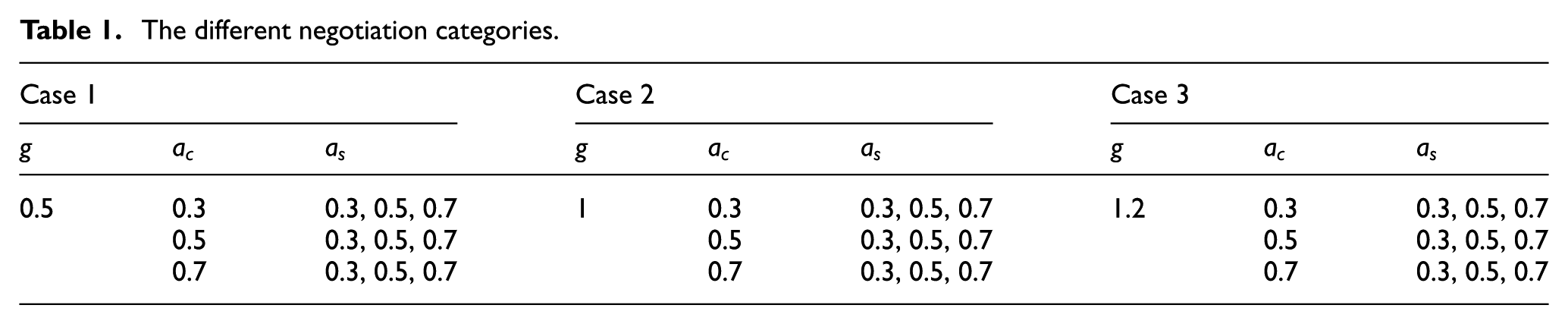
According to the value of the personalized index, the influence of the personalized index on the negotiation can be divided into three categories and the exact circumstances are shown in Table 1; for ease of explanation and calculation, we set g = 0.5, 1, and 1.2, and in each case a situation is selected for detailed analysis and discussion. The initial conditions for their negotiation are as follows:
The different negotiation categories.
The first negotiation case
In this case, the personalized index g = 0.5,

The case of g = 0.5,
Negotiation results for different risk preferences.

When g = 0.5,
The second negotiation case
In this case, the personalized index g = 1,

The case of g = 1,
Negotiation results for different risk preferences.

When g = 1,
The third negotiation case
In this case, the personalized index g = 1.2,

The case of g = 1.2,
Negotiation results for different risk preferences.

When g = 1.2,
Analysis and discussion
In Table 5, we summarize the three cases where the individuation index is 0.5, 1, and 1.2, and the values in brackets in the table are the transaction price, number of consultations, and the negotiation cost.
Negotiation results of different risk preferences and personalized index.

Different from related works, we mainly discuss the influence of different risk preferences of agent and personalized index on the negotiation process:
In this article, the offer of the seller is an increasing function of the personalized index g and is a convex function. When the other conditions are constant, the final price is increasing with the increase of g. On the basis of the basic functions of any product, adding some functions, or choosing the best supplier, will increase the cost of the personalized product, and of course the price of the personalized product will also increase. The change of the personalized index g has no obvious effect on the number of negotiations. The greater the g, the greater the negotiation loss of the customer and the more the final price deviating from the customer’s initial offer, which means that the customer will pay the higher price to buy the personalized product. The greater the g, the smaller the negotiation loss of the product integrator, which means that the final price is closer to the initial offer of the product integrator.
It can be seen from the table that the change of the risk preference has an obvious effect on the final price, negotiation number, and negotiation loss. When the parties are not preferred to risk, the two sides are very cautious to offer and the price change is very small, which can reach agreement for more rounds of negotiation. The more the risk preference, the greater the negotiation loss and the less the negotiation numbers. The final price is more conducive to the party who does not prefer the risk.
Conclusion
The effective operation of personalized product supply chain will increase the customer satisfaction. Negotiation will increase the operational efficiency of personalized product supply chain management. In this article, we expatiate the personalized index and present the calculation method. We set the multi-agent negotiation model and tactics based on personalized index. And finally the illustration is given for verifying the validity of the model. This will help to more clearly understand and learn the multi-agent negotiation essence of personalized product supply chain and to improve the operational efficiency of personalized product supply chain.
We mainly consider the negotiation of two parties in this article. And in the future research we will conduct negotiation among the three parties on a single objective or multiple objectives. In the actual operation of personalized product supply chain, the negotiation about three parties is widespread. With the improvement of consumption level and application of Internet technology, manufacturing enterprise personalized product supply chain has become a trend, the negotiation is not the same between the personalized product supply chain multi-agent system and traditional manufacturing enterprise supply chain multi-agent system, and this problem is worth studying. We would like to cooperate with researchers in this field to carry out such research together.
Footnotes
Handling Editor: Peter Nielsen
Declaration of conflicting interests
The author(s) declared no potential conflicts of interest with respect to the research, authorship, and/or publication of this article.
Funding
The author(s) disclosed receipt of the following financial support for the research, authorship, and/or publication of this article: This work was supported by the National Natural Science Foundation of China (Nos 71702174 and U1404704). And this work was supported by the Soft Science Program Research Project of Henan (No. 182400410281).
