




Abstract
Intercooled cycle gas turbine has great potential in improving the output power because of the low energy consumption of high-pressure compressor. In order to more efficiently recovery and utilize the waste heat of the intercooled system, an organic Rankine cycle power generation system is developed to replace the traditional intercooled system in this study. Considering the effects of different kinds of organic working fluids, the thermodynamic performance of organic Rankine cycle power generation system is investigated in detail. On this basis, the sensitivity analyses of some key parameters are conducted to study the operating improvements of organic Rankine cycle power generation system. The results indicate that the integration of organic Rankine cycle and intercooled cycle gas turbine not only can be used for waste heat power generation but also increases the output power and efficiency of intercooled cycle gas turbine by selecting the organic working fluids of n-butane (R600), n-pentane (R601), toluene, and n-heptane. And compared to the others, organic Rankine cycle power generation system with toluene exhibits the best performance. The maximum enhancements of output power and thermal efficiency are 6.08% and 2.14%, respectively. Moreover, it is also concluded that both ambient temperatures and intercooled cycle gas turbine operating conditions are very important factors affecting the operating performances of organic Rankine cycle power generation system.
Introduction
Nowadays, gas turbine is playing a very important role in the fields of power generation and machinery propulsion. As a kind of effective approach to sharply improve the overall performance of gas turbine, intercooled (IC) cycle or intercooled regenerated (ICR) cycle attracts more and more attentions due to their great potentials in decreasing the power consumption of high-pressure compressor.1,2 In recent years, the successful application or experiment of IC industrial gas turbine (LMS100) 3 and ICR marine gas turbine (WR-21) 4 has verified the feasibility and effectiveness of the above two cycle technologies.
Intercooled system, which locates in between low-pressure and high-pressure compressors, is an important part of IC or ICR gas turbine. The main function of intercooled system is to decrease the temperature of compressed air from low-pressure compressor and then improve the performance of high-pressure compressor. Referencing to the design features of intercooled system for LMS100 (Figure 1) and WR-21 (Figure 2), a large number of investigations have been carried out in the past decades to study the operating characteristics of intercooled system and its effect on gas turbine.5–8 All of the available results indicated that the heat exchange condition of intercooled system can directly affect the stable and dynamic performances of gas turbine. Besides, a careful inspection of Figures 1 and 2 reveals that although the intercooled systems used in LMS100 and WR-21 are significantly different, the corresponding heat exchange between compressed air and coolant is usually wasted directly. Therefore, how to effectively recover and reasonably utilize the waste heat of intercooled system is a very meaningful study to realize the energy conservation and emission reduction of IC gas turbine.
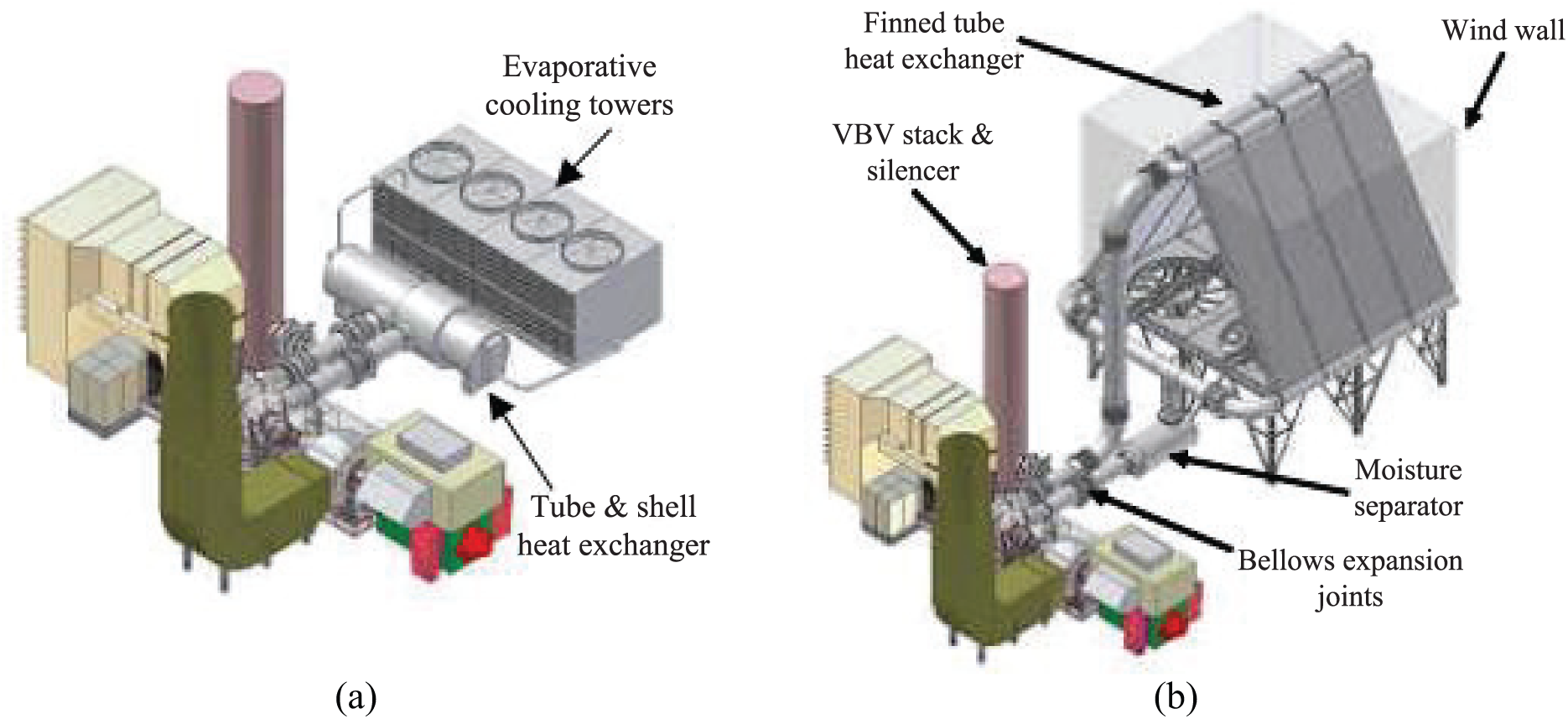
Intercooler systems of LMS100 gas turbine 3 with (a) air-to-water heat exchanger and (b) air-to-air heat exchanger.

Schematic diagram of WR-21 gas turbine. 4
In general, the temperature of air from low-pressure compressor is about 100°C–200°C. 7 For this kind of low-grade heat source, it is usually difficult to be recovered using the traditional steam bottoming cycles because of low thermal efficiency.9–11 As one of the attractive technologies, organic Rankine cycle (ORC) power plant can effectively realize the recovery and utilization of low-grade heat due to its advantages of safety, stability, flexibility, wider applicable ranges (generally <350°C), and installed capacity.12–15 According to the incomplete statistics of Colonna et al., 16 the cumulative global capacity of ORC power systems for the conversion of renewable and waste thermal energy was undergoing a rapid growth and was estimated to be about 2000 M. We considering only installations that went into operation after 1995. In view of the potential advantages of ORC, many researchers analyzed its application in gas turbine. Saavedra et al. 17 performed a thermodynamic optimization of ORC using different working fluids to recover the exhaust gas waste heat from gas turbine which was applied to drive a natural gas compressor station. They found that the highest ORC turbine output powers were obtained with aromatic hydrocarbons. Then, Tveitaskog and Haglind 18 analyzed the supercritical ORC performance for recovering the exhaust gas waste heat of a LM2500 gas turbine with toluene as working fluid. As shown in their study, the combined thermal efficiency was determined with 51% for full load of turbine and 45.6% for 47.7 % turbine load. Similarly, investigating the biomass combined cycles based on externally fired gas turbines and ORC plant, Invernizzi et al. 19 highlighted that a maximum efficiency of 23% was obtained with toluene as working fluid. Muñoz de Escalona et al. 20 discussed the rated and part-load performance of the combined cycles formed by ORC and five commercial gas turbines with waste heat temperature of 300°C–450°C. In addition, Pierobon et al. 21 designed and optimized an ORC to efficiently recover the medium temperature (350°C–400°C) waste heat from SGT-500 gas turbine exhaust gas. They found that the combined cycle thermal efficiency could be increased up to 44.3%, which was significantly higher than that of SGT-500 without ORC. Recently, to further increase the electrical power efficiency and the power output of the ICR industrial gas turbine, a combined operation with an ORC was presented by Kusterer et al. 22 The waste heat from the compressor intercooled system and exhaust gas after the recuperator were coupled as the heat source of ORC. Based on a parametric optimization considering the effects of ORC working fluids and ambient condition, the enhancement of efficiency and output power were 4% and 10%, respectively, for the combined cycle. Wang et al. 23 presented a contrastive study of an ORC and a Kalina cycle for the waste heat recovery of compressor intercooling. They demonstrated that ORC was an effective technology to realize energy saving even if its performance was lower than that of Kalina cycle system.
To the best of author’s knowledge, although many investigations have been performed to study the waste heat recovery of gas turbine using ORC, most of them mainly focused on the exhaust gas from turbine and few were on compressor intercooled system of IC gas turbine. For this cause, this study develops an ORC power generation system to effectively recover the low-grade heat of IC gas turbine intercooled system. Then, the following main contents will be addressed in detail: (1) what is the basic characteristic of intercooled cycle gas turbine (ICGT) with ORC for recovering the low-grade heat source of intercooled system? (2) which kinds of organic working fluid are effective for ORC used in ICGT? and (3) how can ORC affect the performance of ICGT under different ambient temperatures and gas turbine operating conditions?
System description and thermodynamic models
Combined cycle configuration
Figure 3 shows the schematic diagram of a three-shaft IC gas turbine without or with the ORC system for recovering the waste heat from compressor intercooling. For both of the above two types of IC gas turbine, air is first compressed to some certain intermediate pressure in the low-pressure compressor and then enters the intercooler to be cooled by coolants. After that, the air continues to be compressed to the final pressure in the high-pressure compressor. However, in terms of the intercooled system, there are obvious difference between the above two IC gas turbines. As shown in Figure 3(a), the traditional intercooled system is usually composed of two parts which are, respectively, named on-engine intercooler (plate-fin heat exchanger) and off-engine intercooler (plate heat exchanger). The on-engine intercooler is designed to decrease the temperature of air from low-pressure compressor using water or ethylene glycol–water as coolant. The off-engine intercooler is used to transfer heat from coolant to the external environment. Differently, for the ORC intercooled system shown in Figure 3(b), the high-temperature air from low-pressure compressor is cooled by organic working fluids in the intercooler. And the organic working fluids which are heated to evaporation temperature and evaporation pressure state go through a turbine to drive a generator for yielding the electricity. The exhaust from the ORC turbine is condensed to the liquid state in the condenser and then is pumped to the high pressure before entering the intercooler once more.

Schematic diagram of IC gas turbine (a) without and (b) with ORC power generation system.
Thermodynamic model
In this study, a three-shaft gas turbine for industrial power generation is selected as the basic of IC gas turbine. In general, this kind of gas turbine usually operates under several stable conditions. Considering the modeling of gas turbine is not the focus of this study, and the detailed modeling process of IC gas turbine can be found in the study of Nada. 2 For the ORC power generation system, the main equipment consists of pump, intercooler, turbine, condenser, and generator. Figure 4 illustrates the T–s diagram of ORC system for recovering the waste heat of compressor intercooling.

T–s diagrams of the ORC power generation system.
In order to simplify the calculation process of ORC system and still keep the calculation results close to the reality, the following assumptions will be used in the present analysis:
Gas turbine only operates at the stable design conditions.
The ORC system works in a steady-state condition.
The heat dissipation through walls of intercooler, pipelines, and condenser to ambient air is ignored.
The pressure loss of ORC working fluid in the intercooler, condenser, and pipelines is ignored.
The isentropic efficiencies of pump and turbine are
The degree of superheating is 10°C for the working fluids discharging from the intercooler.
The outlet temperature of air in intercooler is fixed.
The degree of condensation is 5°C for the working fluids discharging from the condenser.
Based on the conservation of mass and energy principles and the assumptions mentioned above, the expressions of each part can be obtained as follows.
The mass flow rate of organic working fluid is calculated using the following equation

where

where
In the process of state (

In the intercooler, the process (

For the turbine, a non-isentropic expansion process (

In the condenser, the process (

Then, the net power output and thermal efficiency of ORC system can be, respectively, expressed as


The work ratio of ORC system is calculated by

Performance criteria
Due to the coupling of ORC power generation system with IC gas turbine, the operational characteristics of ORC system will directly affect the performance of IC gas turbine. When the system parameters of ORC vary, the inlet temperature of air in high-pressure compressor will change as well, which leads to the variations of the power consumptions of compressor and the whole gas turbine. Therefore, it is not incomplete to focus on the performances of the ORC system only. In this article, the increment percentages of thermal efficiency (PC1) and output power (PC2) are selected as the system performance criteria


where
Result analysis and discussion
For the present calculation and analysis, the software named REFPROP 9.0 (developed by National Institute of Standards and Technology 24 ) and MATLAB R2017a (developed by Mathworks 25 ) are used to calculate the thermodynamic properties of organic working fluids and simulate the performance characteristics of ORC power generation system with different operating conditions.
Table 1 shows the preliminary parameters of IC gas turbine in ISO condition which is used to combine with the ORC power generation system. Besides, considering the operating characteristics of the original IC gas turbine without ORC, Figure 5 presents the variations of air outlet temperature of low-pressure compressor and the corresponding intercooler efficiency at four typical ISO stable operating conditions of IC gas turbine. It can be seen from Figure 5 that the heat source temperature range of ORC is about 148°C–171°C which belongs to the typical low-grade heat.
Main parameters of IC gas turbine in ISO condition.


Variations of air outlet temperature of low-pressure compressor and intercooler efficiency at different ISO operating conditions.
Selection of organic working fluids
In order to achieve a maximum waste heat recovery rate, the selection of suitable organic working fluids is very important. Over the past decades, a large number of researches have been reported to study the selection of organic working fluids for different heat sources.26–30 In this section, considering the heat level recovered from the compressor intercooling, n-butane (R600), n-pentane (R601), toluene, and n-heptane are selected as the working fluid candidates of ORC system due to their relatively high thermal efficiencies and vast working regions. Their basic physical parameters are listed in Table 2. Besides, it is assumed that IC gas turbine operates at the ISO condition of No.4 shown in Figure 5. The corresponding heat load of intercooler is about 12,232 kW.
Basic properties of the selected organic working fluids.
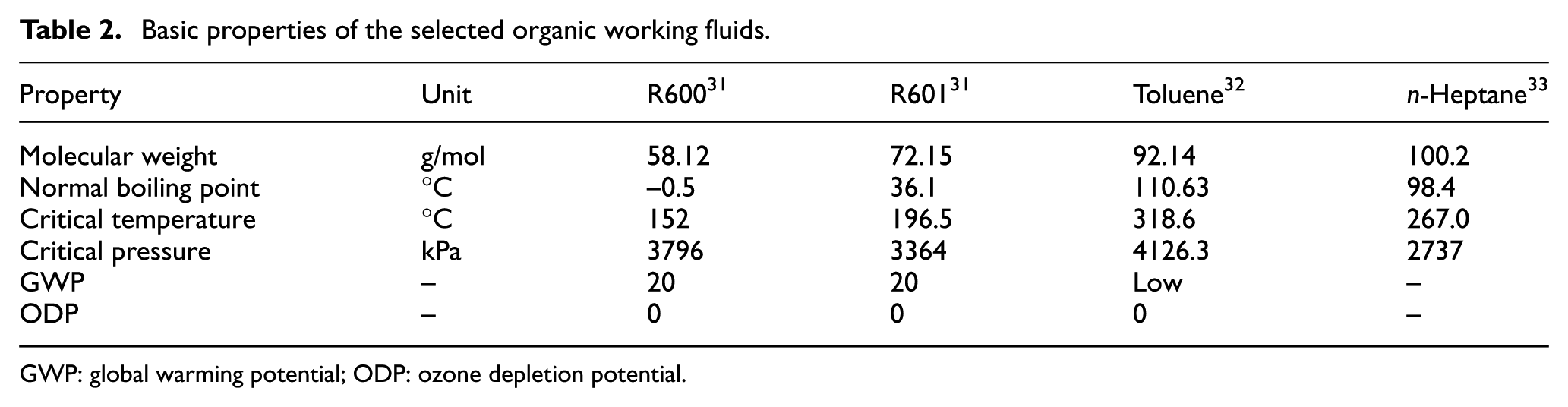
GWP: global warming potential; ODP: ozone depletion potential.
Evaporation pressure which can be affected by evaporation temperature is one of the most important factors affecting the design of ORC system and the selections of various components. Figure 6 compares the evaporation pressure of the above four organic working fluids as a function of evaporation temperature varying from 80°C to 150°C. As shown in Figure 6, compared to R601 and n-heptane, R600 and toluene, respectively, have the maximum and minimum evaporation pressure at the constant evaporation temperature. For example, at evaporation temperature of 80°C, the evaporation pressures of R600, toluene, n-heptane, and R601 are 809.1, 27.19, 40.51, and 283.5, respectively. When the evaporation temperature is increased up to 150°C, the corresponding evaporation pressures are 3127, 218.1, 298.6, and 1331 kPa. Besides, it should be worth noting that at low evaporation temperature, the corresponding evaporation pressure of n-heptane and toluene will be lower than ambient pressure. This means that the reasonable design and selection of intercooler is a very important issue worthy of careful consideration in practice.

Effect of evaporation temperature on evaporation pressure of various organic working fluids.
Figure 7 shows the effects of evaporation temperature on the mass flow rates of the above four organic working fluids. From Figure 7, it is found that the increase in evaporation temperature decreases the mass flow rate of organic working fluids in this study. The main reason is because the superheat temperatures of organic working fluids can increase with the increase in evaporation temperature when both the intercooler heat load and the degree of superheating remain constant. Besides, a careful inspection of Figure 7 also reveals that affected by the thermophysical properties, the mass flow rate of R600 is highest in the whole range of evaporation temperature, and that of toluene is lowest only when the evaporation temperature is lower than 110°C. However, with the increase in evaporation temperature, the mass flow rate of n-heptane decreases greatly, which leads to the fact that it is lower than those of the other three organic working fluids in high evaporation temperature.

Effect of evaporation temperature on mass flow rate of various organic working fluids at constant heat source.
Since the variations of the evaporation pressure and the mass flow rate of the working fluid are opposite, it is difficult to directly determine how the power output of ORC turbine changes. By analyzing the results illustrated in Figure 8, it can be seen that the power output of ORC turbine is improved significantly as the evaporation temperature increases, which indicates that the increase in evaporation pressure dominates. Meanwhile, it is also found from Figure 8 that the power outputs of toluene are significantly higher than those of R600, R601, and n-heptane. For instance, at the evaporation temperature of 150°C, ORC turbine can, respectively, provide 1853, 2092, 1828, and 1829 kW using R600, toluene, n-heptane, and R601.

Effect of evaporation temperature on the power output of ORC turbine using different organic working fluids at constant heat source.
Due to the fact that the power consumption of pump in ORC is little and even can be neglected (see Figure 9), the net power output of ORC system is also improved with the increase in evaporation temperature, which is shown in Figure 10. When selecting toluene as the working fluid, the maximum net power output of ORC system can reach about 2084.8 kW at the evaporation temperature of 150°C. On this basis, Figure 11 illustrates the variation of ORC system thermal efficiency as a function of evaporation temperature, which is similar to the result of Figure 10.

Effect of evaporation temperature on the work ratio of ORC system using different organic working fluids at constant heat source.

Effect of evaporation temperature on the net power output of ORC system using different organic working fluids at constant heat source.
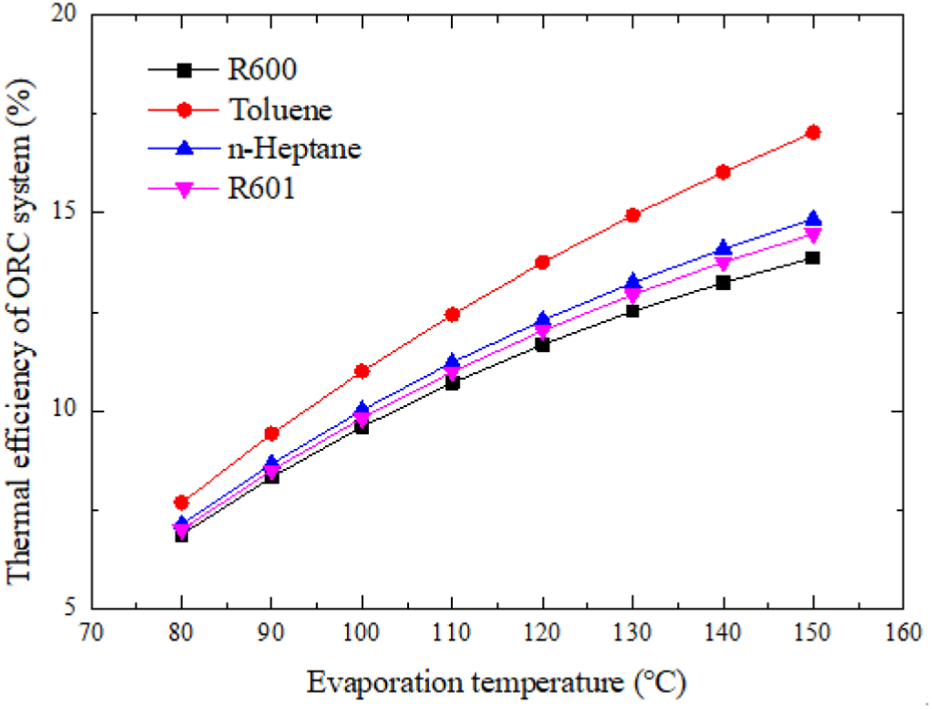
Effect of evaporation temperature on the thermal efficiency of ORC system using different organic working fluids at constant heat source.
To further study the potential value of ORC system for recovering the waste heat of compressor intercooling, Figure 12 presents the comprehensive performance of different organic working fluids at their maximum evaporation temperature using the evaluation criteria named the increment percentages of thermal efficiency (PC1) and output power (PC2). As shown in Figure 12, using the organic working fluids selected in this study, ORC system can effectively recover the waste heat of compressor intercooling and improve the performance of IC gas turbine. For the ORC system with R600, the thermal efficiency enhancement of 1.84% and output power enhancement of 4.85% are obtained, respectively, even if it provides the lowest energy saving in comparison with the others.
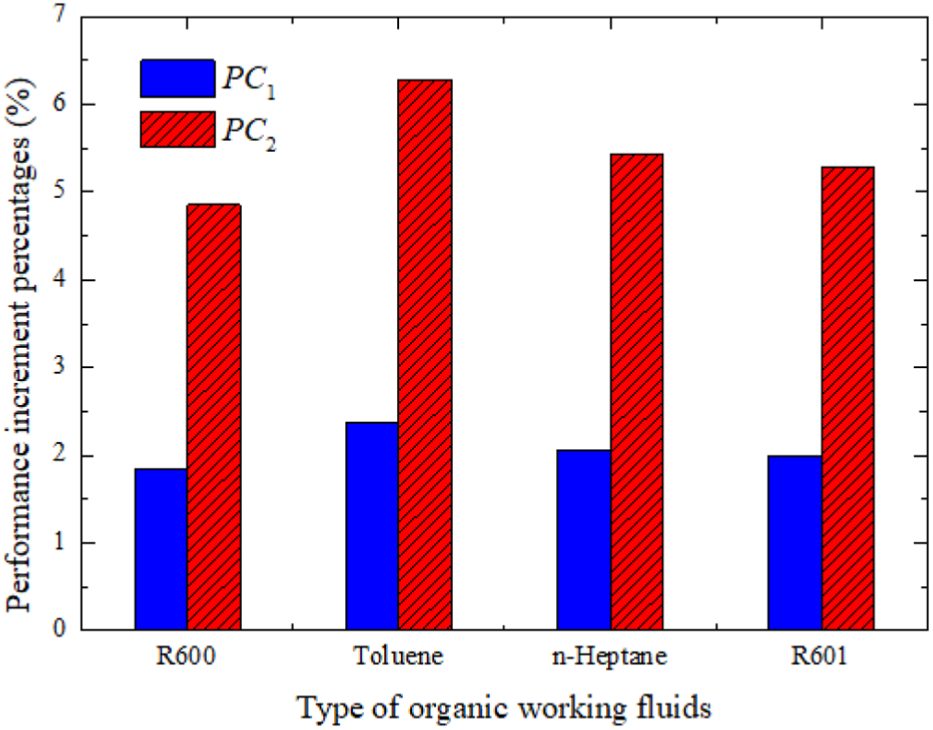
Performance evaluation of ORC system combined with IC gas turbine using different organic working fluids.
Effect of ambient temperature
In the practical application, ambient temperature is a very important factor that affects the power consumption of compressor and the comprehensive performance of gas turbine, which further affects the intercooler efficiency and heat load absorbed by the ORC system. This section will discuss the effects of ambient temperature (from 15°C to 32°C) on the performances of ORC system in detail. Considering the comprehensive analysis above, toluene is selected as the working fluid of ORC system. Besides, it is assumed that all the power outputs of IC gas turbine at different ambient temperatures are constant with that obtained at the ISO condition of No.4 shown in Figure 5.
Figure 13 shows the variations of intercooler heat load with ambient temperatures. It is found that with the increase in ambient temperature from 15°C to 32°C, the intercooler heat load which can be absorbed by the ORC system increases from 12,232 to 13,116 kW. On this basis, Figure 14 shows the effect of ambient temperature on the net power outputs of ORC system at various evaporation temperatures of toluene. As shown in Figure 14, with the increase in ambient temperature, the net power output of ORC system decreases in the ambient temperature ranges of 15°C–32°C. For example, at the evaporation temperature of 100°C and the ambient temperature of 15°C, the net power output and thermal efficiency of ORC system are 1346.13 kW and 11%, respectively. However, the corresponding values decreased to 1014.16 kW and 7.73% when the ambient temperature is 32°C.

Effect of ambient temperature on the intercooler heat load.
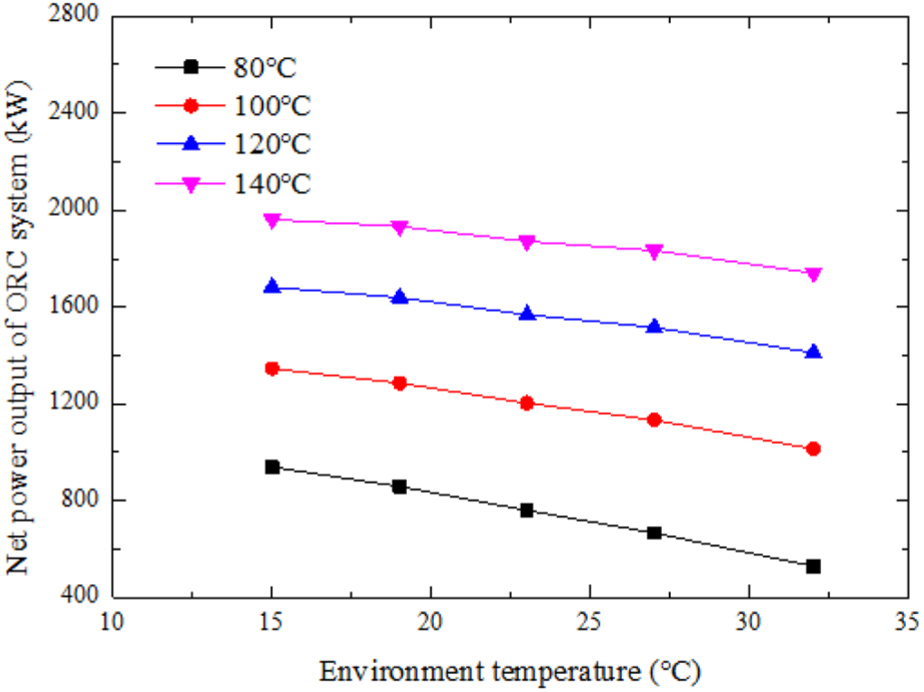
Effect of ambient temperature on the net power output of ORC system at various evaporation temperatures.
Moreover, Figure 15 presents the variations of the comprehensive performance criteria named PC1 and PC2 with ambient temperature. According to the results shown in Figure 14, it is clearly observed that for the present investigation conditions, the maximum and minimum of PC1 are 2.12% and 0.56%, and the corresponding values of PC2 are 5.61% and 1.51%, respectively.

Effect of ambient temperature on the performance criteria (a) PC1 and (b) PC2 at various evaporation temperatures.
Effect of IC gas turbine operating conditions
With the variation of IC gas turbine operating conditions, the intercooler heat load will also be correspondingly changed, which can directly affect the performance of ORC system. Therefore, it is very necessary to evaluate the performance of ORC system under different operating conditions of IC gas turbine. In this section, toluene is selected as the working fluid of ORC system and the related parameters of IC gas turbine are obtained from Table 1 and Figure 5.
A comparison of the net power outputs of ORC system at different operating conditions of IC gas turbine and various evaporation temperatures is shown in Figure 16. The results indicate that affected by the intercooler heat load, the net power outputs of ORC system change with the variation of the operating conditions of IC gas turbine.

Effect of operating conditions of IC gas turbine on the net output power of ORC system at various evaporation temperatures.
Moreover, Figure 17 shows the comprehensive performance of ORC system with toluene at different operating conditions of IC gas turbine. It is found that within the scope of this study, both PC1 and PC2 do not change significantly when the operating condition of IC gas turbine changes. This may mean that the ORC power generation system with toluene can exhibit the effective performance for recovering the waste heat of compressor intercooling in a wide operating range. According to the present analysis, the lowest and highest increment percentages of PC1 are 0.87% and 2.14% and the corresponding values of PC2 are 2.29% and 6.08%, respectively.
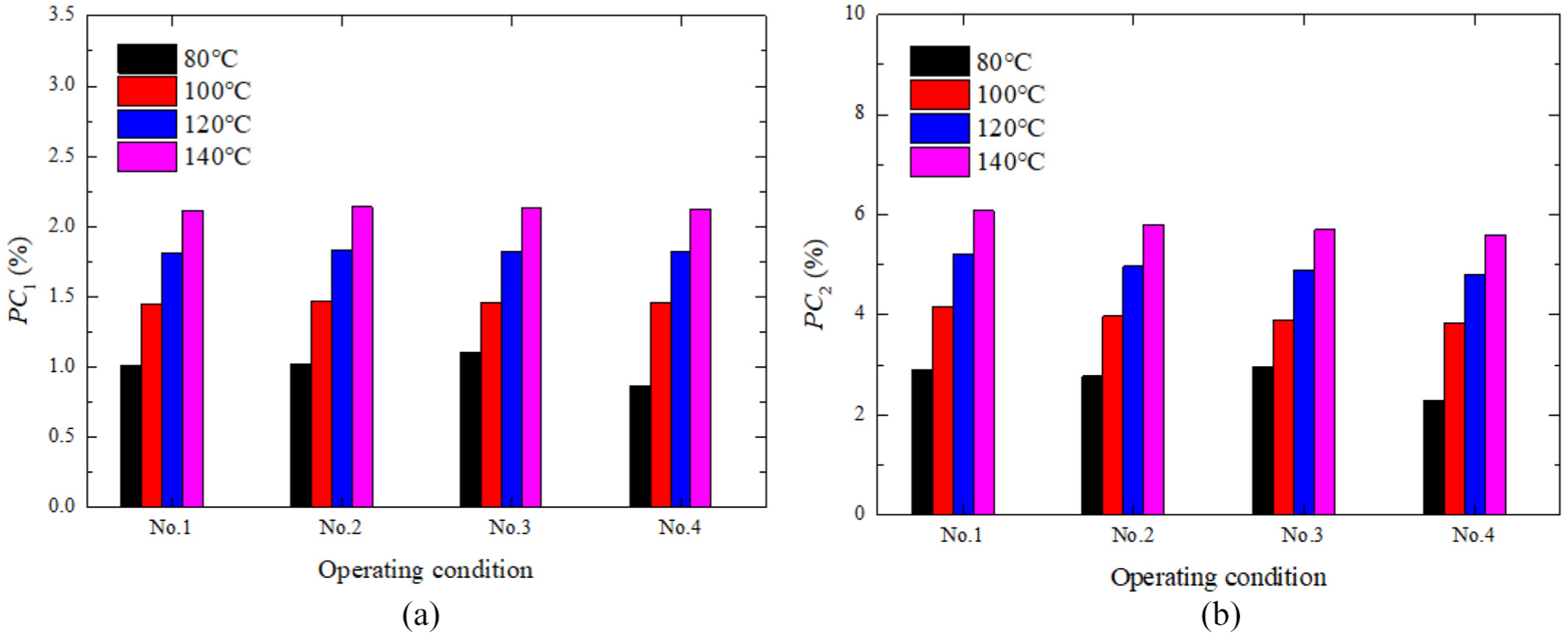
Performance evaluation: (a) PC1 and (b) PC2 of ORC system combined with IC gas turbine with different operating conditions.
Conclusion
This article investigates the application of an ORC power generation system for recovering the waste heat of compressor intercooling for IC gas turbine and discusses the influences of several key thermodynamic parameters on the system performance in detail. On the basis of work presented in this study, the main conclusions drawn are summarized as follows:
With the waste heat recovery of compressor intercooling using ORC power generation system, both the output power and the thermal efficiency of IC gas turbine can be effectively improved. As far as this study is concerned, the maximum increment percentages of output power and thermal efficiency are about 6% and 2%, respectively.
Compared to n-butane (R600), n-pentane (R601), and n-heptane, toluene has better ability for recovering and making full use of the low-grade waste heat of compressor intercooling. However, its special physical properties should be paid great attention during the design and selection of intercooler in practice.
Ambient temperature is a very important factor affecting the enhancement of ORC power generation system on IC gas turbine performance. With the decrease in ambient temperature, the enhancement will be increased.
When selecting toluene as coolant, ORC power generation system exhibits a good waste heat recovery performance in the wide operating conditions of IC gas turbine.
This study is only a pre-feasibility analysis and thermodynamic assessment of IC gas turbine integrating an ORC system. In the future, the effects and optimization of ORC system on the operation of IC gas turbine including operation stability and off-design conditions need to be investigated in detail.
Footnotes
Appendix 1
Handling Editor: Oronzio Manca
Declaration of conflicting interests
The author(s) declared no potential conflicts of interest with respect to the research, authorship, and/or publication of this article.
Funding
The author(s) disclosed receipt of the following financial support for the research, authorship, and/or publication of this article: This work was supported by the National Nature Science Foundation of China (no. 51709059), the Province Nature Science Foundation of Heilongjiang (no. QC2017045), and the Fundamental Research Funds for the Central Universities (nos HEUCFJ170304, HEUCFP201719, and HEUCFM180302).
