




Abstract
Rubber-tracked transporters are becoming increasingly popular in agriculture, forestry and military transportation. Rubber track systems are typically fitted instead of using tyres on the transporter to decrease soil stress and increase trafficability. Therefore, the accurate failure analysis of a rubber track is important. A model for predicting stress distribution along a rubber track is presented in this study. In the model, the stress along a rubber track consists of the vertical stress below the rubber track, tensile stress, bending stress and centrifugal tensile stress. Moreover, fourth strength theory was used to change a complicated stress state to a simple stress state. An experiment was performed at the test site of Harbin First Machinery Building Group Ltd, with a total weight of 61.789 kN. The experiment was conducted to verify and approve the theoretical model. The Miner rule was used to predict the cycle index and working hour of the rubber track, thereby providing a method for predicting the fatigue life of a rubber track.
Introduction
Rubber track systems that replace tyres on transporters have become increasingly popular in recent years. Rubber track systems are fitted mainly on transporters used in the fields of agriculture, forestry and the military. However, a small number of differences exist in the structure of these systems (Figure 1).1–3

Two types of rubber track structure: (a) holistic structure and (b) separated structure.
Many researchers have investigated rubber tracks. MA Rabbani et al. built a model to predict the vertical dynamic forces acting on the track rollers. What’s more, the tension of the rubber crawler on the idle roller was obtained through tests. 4 Peng et al. designed a set of reasonable experimental devices and methods to analyse the structure and principle of a rubber-tracked vehicle walking system. The relationship between force and shear deformation of the rubber track was obtained by tests. 5 G Fedorko et al. 6 researched the tension force, deformation and failure life of a rubber conveyor belt by experiments. W Molnar et al. 7 calculated the von Mises stress distribution of a rubber-conveyor belt using smoothed particle applied mechanics (SPAM). F Hakami et al. 8 investigated the wear mechanisms of a rubber conveyor belt which affect the failure life.
Hub and Cho 9 provided a method for calculating the track tension around the guiding wheel. X Huang et al.10,11 researched the track tension around the track system through theoretical calculation and dynamic simulation. T Keller et al., 12 Arvidsson et al., 13 Keller and Arvidsson, 14 Molari et al. 15 and Grisso et al. 16 researched models for predicting vertical and lateral stress distributions under a rubber-tracked tractor during ploughing through numerical calculation and experiments. HLM Du Plessis et al. 17 researched the distribution of the contact pressure for a flexible track based on numerical calculation and experiments.
From the above, the researches about rubber track were focused on the following fields. First, the stress distribution along a rubber track was obtained by experiments, but the concrete relationship with the external loads was not built. Then, the numerical calculation and experiments were carried on the rubber conveyor belt, and some stress distribution models were built, but the rubber track is very different from the rubber conveyor belt, whether structure or external loads. What’s more, the research about the track tension around the track system and stress distribution under a rubber track is popular, but those are parts to the stress distribution along the rubber track, especially the stress distribution under a rubber track is only a small part. The objectives of this study are as follows:
To build a new stress distribution of a rubber track including the vertical stress below the rubber track, tensile stress, bending stress and centrifugal tensile stress according to the readily available input parameters, namely, weight of tracked transporter, numbers of wheels and the geometric dimensioning of rubber track and wheels (Figure 1(b));
To conduct an experiment that will verify and validate the theoretical model;
To predict the fatigue failure of a rubber track using the Miner rule.
Stress distribution on the rubber track
Stress distribution below the rubber track
The vertical stress distribution in the longitudinal direction (i.e. the driving direction) was described via harmonic oscillation, and the peak values of stress in the longitudinal direction occurred at the bottom of the road wheels

where q(x) is the vertical stress in the longitudinal direction, x is the distance from the axle of the first road wheel to the simulated part, N is the weight of the tracked transporter, A is the ground contact area, n is the number of road wheels and L is the ground contact length.
Tensile stress distribution of the rubber track
Before the tracked transporter operates, the rubber track is strained at the driving and guiding wheels, such that an initial tension F0 occurs at the rubber track (Figure 2(a)). The tension F0 can be confirmed by equation (2)10,18


Tension on the rubber track: (a) before operation and (b) during operation.
While the transporter is operating, one side of the rubber track is pulled, whereas the other side is relaxed due to the action of static friction force. These forces are labelled F1 and F2. In addition, the ground also acts on the pulled side as ground adhesive force F3 and rolling resistance F4 (Figure 2(b)) (equation (3))

where f is the rolling resistance coefficient of the ground, T1 is the driving torque acting on the driving wheel, p is the distance from the centre of the diving wheel to the ground and dd1 is the diameter of the driving wheel.
Therefore, the tensile stress distribution of the rubber track can be obtained using equations (2)–(4). Moreover, we assume that the strain stress is transferred uniformly from the pulled side to the relaxed side

where σI and σΠ denote the tensile stresses of pulled and relaxed sides, respectively. B is the cross-sectional area of the rubber track.
Bending stress distribution of the rubber track
When the rubber track wraps around the driving wheel, road wheels and guiding wheel, bending stresses occur at these places on the rubber track, as shown in equation (5)

where σb1, σb2 and σb3 are the bending stresses at the driving wheel, road wheels and guiding wheel, respectively; E is the elasticity modulus of the rubber track; h is the height of the rubber track; and dd1, dd2 and dd3 are the diameters of driving wheel, road wheels and guiding wheel, respectively.
Centrifugal tensile stress of the rubber track
When the rubber track goes around the circle that follows the driving and guiding wheels, centrifugal tensile stress occurs on the rubber track, as shown in equation (6)

where σc is the centrifugal tensile stress, q is the mass of the rubber track per unit length and v is the linear velocity of the rubber track.
Among the aforementioned stresses, tensile, bending and centrifugal tensile are considered tensile stresses, whereas the vertical stress below the rubber track is considered shear stress. An example is an element from the bottom of the rubber track (Figure 3).

Tensile and shear stresses of the element from the bottom of the rubber track.
Finally, the tensile stresses and shear stress distribution of the rubber track can be obtained as shown in Figure 4.
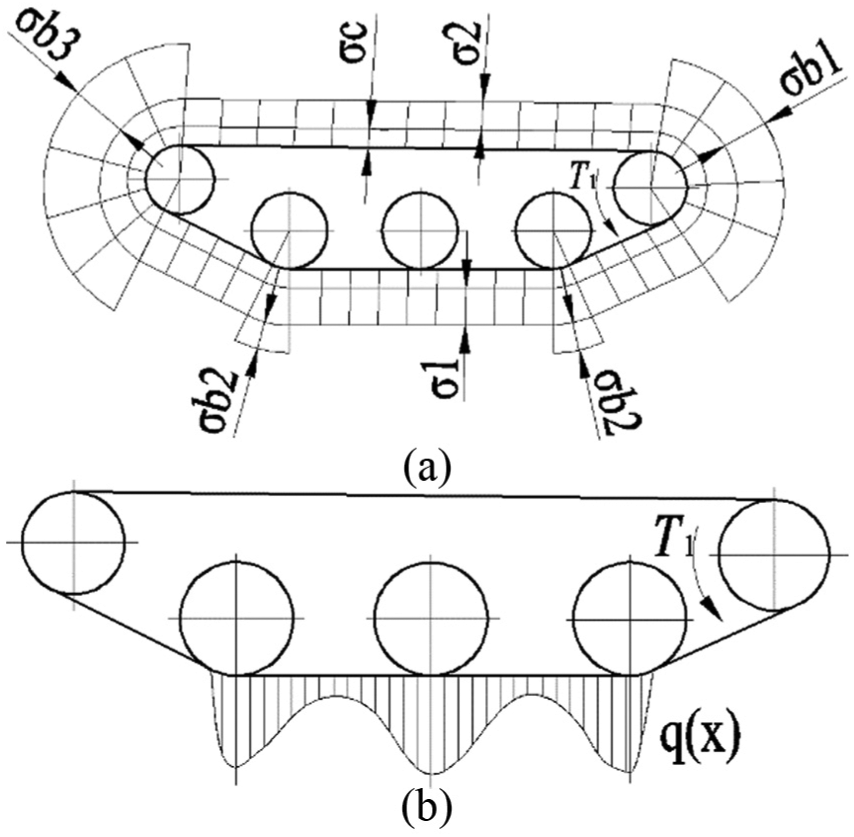
Stress distribution on the rubber track: (a) tensile stress distribution and (b) shear stress distribution.
The rubber track is a plastic material with a two-dimensional (2D) stress state; thus, fourth strength theory is used to change the complicated stress state to a simple stress state as shown in equation (7)

where σca is the equivalent stress, σ is the tensile stress and τ is the shear stress.
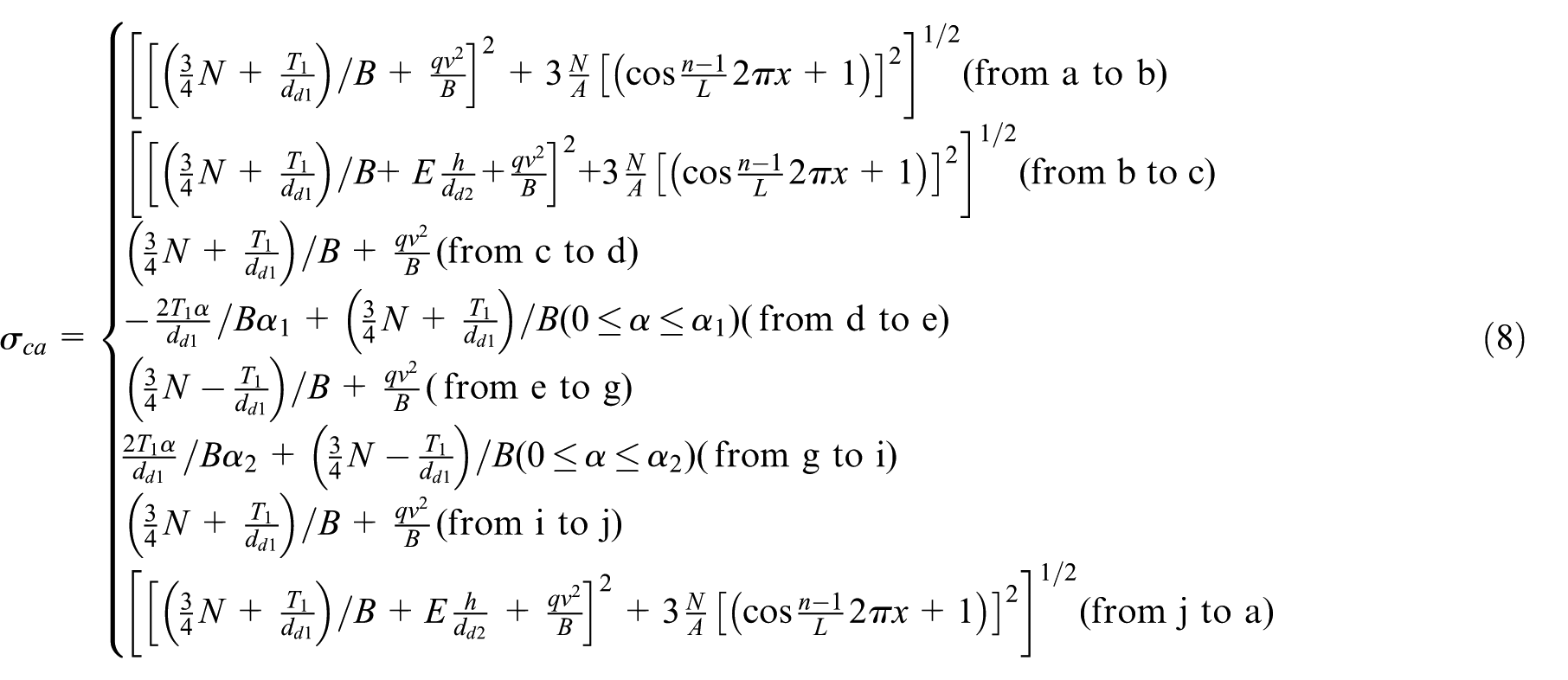
Stress distribution along the rubber track can be obtained according to equations (1), (4), (6) and (7), as shown in equation (8) and Figure 5. This stress distribution is not constant but varies cyclically as time passes (Figure 6).

Marks along the rubber track.

Cyclical variation of stress distribution.
The bending stresses on the driving, road and guiding wheels comprise a considerable proportion of σca, with a numerical value that is more than 100 times higher than the other stresses. Therefore, the stresses along b–c, d–e and g–i are higher than those along the other segments. Moreover, bending stress is inversely proportional to wheel diameter. As shown in Table 1, the diameter of the guiding wheel is the smallest, and thus, the bending stress of the guiding wheel σb3 is the largest. In addition, the stress on the pulled side is larger than that on the relaxed side (i.e. σ1 > σ2). Finally, the equivalent stress on location i is the largest
Model parameters.

Measurements of stresses on the rubber track
Experimental site and machine properties
The experiment was conducted at the test site of Harbin First Machinery Building Group Ltd (Figure 7). The ground for the test was flat, and the parameters of the soil are provided in Table 2. The rubber-tracked transporter used for the experiment was an MSM rubber-tracked transporter (Figure 8), and the parameters are listed in Table 1. To measure tensile stresses along the rubber track, four strain rosettes (Figure 9) were attached on the internal surface of the rubber track. Among the three sensitive grids, No. 2 was placed along the longitudinal direction. In addition, the four strain rosettes were arranged in order along the lateral direction (Figure 10).

Test site.
Mechanical properties of soil at the experiment site.


MSM rubber-tracked transporter.

Strain rosettes.

Diagram of measure points.
The signal system for the test consisted of the strain rosettes, a dynamic signal acquisition instrument and a computer (Figure 11). The dynamic signal acquisition instrument was DH5902, with a frequency range of 1–100 kHz.

Signal system for the test.
Measurements of strain on the internal surface of the rubber track
The driving speed of the rubber track transporter was typically 20 km/h. During the experiments, the strain on the internal surface of the rubber track was measured using the strain rosettes. Among the three sensitive grids, No. 2 was used in this study, whereas the other two could be applied in other study. The results of the four measure points were obtained.
Calculations of stress
The test data were a type of micro-strain. The tensile stress distribution is presented in Figure 12 (the black curve) according to Hooke’s law (equation (9))

where σ is the measured stress and ε is the strain.

Measured (black) and simulated (red) stress distributions at Measure point 1.
Comparison of model prediction with measurements
The equivalent stress of model prediction can be obtained according to equation (8) and Table 1, as shown in Figure 12 (red curve). The measured stress agrees considerably with the simulated result from model prediction (Figure 12). Measure points 1 and 2 were located along the lateral direction (Figure 10); thus, most of the stress distributions were the same, except at the ground part (Figure 13). In accordance with equation (8), the stress at the ground part consists of tensile, bending, centrifugal tensile and vertical stresses in the longitudinal direction. Vertical stress in the lateral direction was modelled as a linear function with the maximum stress at the centre line of the track and the minimum at the edge of the track. Therefore, the stress obtained by Measure point 1 was mostly larger than that obtained by Measure point 2 (Figure 13).

Stress distribution of Measure points 1 (black) and 2 (red) at the ground part.
However, slight differences existed between the measured and simulated results, which might have severe consequences:
At the ground part (distance: 0–1643 mm), the simulated result was larger than the measured result because the former assumed that the road was flat, but the measured road was not completely flat. The measured road can cause bending stress on the rubber track, and thus, the simulated result was larger than the measured result.
At a distance of 4500–6500 mm along the rubber track, the measured result differed from the simulated result because this part was the relaxed side, and thus, the vibration at this part was more serious. Therefore, the simulated result was larger than the measured result.
The simulated result disregarded the dampness, accelerated speed, vibration, and thickness of the rubber track, what’s more, the track-trail, and thus, differences existed between the measured and simulated results.
Fatigue failure analysis of rubber track
The stress variation of the rubber track was regarded for the unsteady stress of unidirectional regularity (equation (8)). The failure strength of the rubber track can be obtained using the Miner rule (equation (10))

where σi is the stress amplitude of the equivalent symmetric circulating variable stress, N0 is the circular base, σ−1 is the fatigue limit for N0, i is the number of stresses and N is the cycle index.
The stress amplitudes of the equivalent symmetric circulating variable stress (σi) can be obtained according to equation (8), as shown in Table 3. The stresses σ1, σ3, σ5 and σ7 are smaller than the fatigue limit σ−1; hence, these stresses have no function on the fatigue. Moreover, the difference among the stress amplitudes is small, and thus, the Miner rule is suitable for failure strength simulation.
Parameters of failure strength simulation.

The cycle index N can be obtained as N = 34,593,928 according to equation (8) and Table 3. The working hour T can be obtained according to the cycle index N, driving speed v and length of the rubber track (8870 mm).
If the tracked transporter works 8 h every day, then rubber track fatigue failure occurs after 750 days. Moreover, fatigue failure appeared on zones g–i along the rubber track (Figure 3) because the stress for these zones was the largest along the rubber track. Consequently, the probability that this place can cause an initial crack is greater than those of other places.
Discussion
As indicated in section ‘Stress distribution on the rubber track’, the stress distribution of the rubber track is composed of vertical, tensile, bending and centrifugal tensile stresses. The aforementioned stress simulation differs from that of the traditional conveyor rubber belt, as reflected in the following points:
Vertical stress occurs below the rubber track unlike in the traditional conveyor rubber belt.
The simulation of tensile stresses, including the tensile stresses of the pulled and relaxed sides of the rubber track, differs from that of the traditional conveyor rubber belt. As shown in equation (4), the forces on the rubber track differ from those on the traditional rubber belt due to the existence of adhesive force F3 and rolling resistance F4 (Figure 1(b)).
While the weight of the tracked transporter N, the cross-sectional area B and the diameter of the driving wheel dd1 are constant, the tensile stress of the pulled side realises the maximum value, whereas the tensile stress of the relaxed side obtains the minimum value (equation (4)). This result is attributed to adhesive force F3 being in proportion with the weight of the tracked transporter and the adhesion coefficient on the road surface. Therefore, adhesive force F3 achieves the maximum value when the road is certain. When
As indicated in section ‘Fatigue failure analysis of rubber track’, stresses σ1, σ3, σ5 and σ7 are smaller than the fatigue limit σ−1, and thus, these stresses have no function on fatigue. The following conclusions can be drawn according to the simulation of σi (equation (8)):
The linear velocity of the rubber track v exhibits no relation with stresses, except for centrifugal tensile stress. Moreover, it is considerably smaller than the fatigue limit σ−1 (65 MPa) (when v = 20 km/h, σc = 0.32 MPa). Therefore, the fatigue failure of the rubber track has no relation with the linear velocity v of the tracked transporter.
The vertical stress below the rubber track is typically smaller than 1 MPa, which is also significantly smaller than the fatigue limit σ−1 (65 MPa). Therefore, the fatigue failure of the rubber track exhibits no relation with the vertical stress below the rubber track of the tracked transporter.
The bending stresses comprise a large proportion of the stress distribution of the rubber track, and they exhibit significant relations with the fatigue failure of the rubber track. Bending stresses decrease with the increasing diameter of the driving wheel, guiding wheel or road wheel according to equation (5).
Conclusion
A model that predicts stress distribution along a rubber track was developed. The stress distribution of the rubber track comprises vertical, tensile, bending and centrifugal tensile stresses. Fourth strength theory was used to change the complicated stress state to a simple stress state. The stress distribution is not constant but varies cyclically as time passes. The bending stresses comprise a considerable proportion of the stress distribution, and the stress on location i is the largest.
The experiment of stresses on the rubber track demonstrates that the theoretical model is valid. The Miner rule was used to predict the cycle index and working hour of the rubber track. The cycle index N = 34,593,928, and if the tracked transporter works 8 h every day, then rubber track fatigue failure occurs after 750 days. Moreover, fatigue failure appeared on zones g–i along the rubber track.
The bending stresses exhibit significant relations with the fatigue failure of the rubber track. The fatigue failure of the rubber track exhibits no relation with linear velocity v and the vertical stress below the rubber track of the tracked transporter. The cycle index and working hour of the rubber track decrease with the increasing diameter of the driving, guiding or road wheels.
A method to calculate the fatigue life of a rubber track is provided, and the new stress distribution along a rubber track model provides realistic estimates according to the readily available input parameters, namely, weight of tracked transporter, numbers of wheels and the geometric dimensioning of rubber track, wheels and so on.
Footnotes
Handling Editor: Hiroshi Noguchi
Declaration of conflicting interests
The author(s) declared no potential conflicts of interest with respect to the research, authorship and/or publication of this article.
Funding
The author(s) disclosed receipt of the following financial support for the research, authorship and/or publication of this article: This research was financially supported by the National Key Research and Development Program of China (No. 2016YFC0802703).
