



Abstract
By considering the description of phase volume fractions, a micromechanics model is presented for predicting the elastic mechanical properties of isotropic two-phase functionally graded materials. The particle size dependence of the overall elasticity of functionally graded materials is not generally considered by classical continuum micromechanics; however, being based on micropolar theory, the presented micromechanics model is able to study such size effects. As the effective material properties vary gradually along the gradation direction, a functionally graded material can be divided into two distinct zones: the particle–matrix zone and the transition zone. In the particle–matrix zone, the matrix material is idealized as a micropolar continuum and Mori–Tanaka’s method is extended to the micropolar medium to evaluate the effective elastic properties. The effective properties across the gradation forms are further derived and the effects of particle size on the effective properties of a functionally graded materials are also studied. The validity and effectiveness of the present model is demonstrated by comparing the model results with other model outputs and experimental data.
Introduction
Functionally graded materials (FGMs) are composite materials that are microscopically inhomogeneous, and their overall properties vary continuously in one (or more) direction(s) to eliminate singular stresses, relax residual stresses, and enhance bonding strength. Therefore, aerospace, automotive, marine, and biological industries are taking advantage of the special characteristics of FGMs. 1 However, the extent to which FGMs can be tailored to produce a target performance, that is, the design of FGMs, strongly depends on the resultant effective properties and, more importantly, on how these properties relate to microstructure. Therefore, an important aspect of the design of FGMs is prediction of the mechanical, thermal, and other properties based on the given microstructure and its spatial distribution.
Many models and approaches have been proposed in the literature for the evaluation of the various effective properties. Classical micromechanic approaches such as the Mori–Tanaka method, 2 the self-consistent method, 3 and a variety of other models have been directly applied to estimate the effective elastic properties of FGMs.4–8 Aboudi et al. 9 developed a higher order theory for FGM application; this theory can explicitly couple the local microstructure and global response. Yin et al.10,11 employed an elastic model that included the pairwise particle interaction and gradient effects of phase volume fraction to investigate the mechanical and thermal-elastic behavior of FGMs. The effective properties of FGMs have also been determined by the micromechanical finite element method.12,13 In order to determine the effects of the stochastic behavior of FGMs, Rahman and Chakraborty14,15 presented a stochastic micromechanical model for predicting the probabilistic characteristics of the elastic mechanical properties of isotropic FGMs; they also developed a concurrent multiscale model for the fracture behavior of FGMs. Guo et al. 16 studied the fracture problem of FGMs by combining the stochastic micromechanics model with the extended piecewise-exponential method.
FGMs are essentially heterogeneous in nature; homogenization of the material depends on length scales. The above-mentioned FGM model based on classical elasticity did not directly include size effects owing to the lack of a material length scale parameter. This motivated the development of microstructure-dependent models using higher order continuum theories that are able to describe such size effects. 17 In recent years, the micropolar elasticity theory has gained great importance due to the large-scale development and utilization of composite, reinforced, and coarse-grained materials. Forrest and Sab 18 proposed a micro–macro transition method by examining periodic boundary conditions on a representative volume element (RVE). Cheng and He19,20 derived the analytical solutions for a homogeneous micropolar material in which a cylindrical or a spherical region is subjected to both a uniform eigenstrain and uniform eigentorsion. Ma et al. 21 proposed a microstructure-dependent Timoshenko beam model based on the modified couple stress theory. Reddy 22 used the modified couple stress theory to develop a model for the FGM beam that considered the size effect. Ostoja-Starzewski et al. 23 studied the effective properties and size effect of a two-phase composite material based on couple stress theory. Hu and Colleagues24–26 presented an analytical homogenization method to derive the higher order material parameters of micropolar theory and explain the observed particle size dependence in composite materials.
Although there is much work devoted to micromechanics models for FGMs, there is at present no analytical continuum micromechanical method in the framework of micropolar theory that enables one to determine the microstructure parameters for FGMs.
This article presents a simple analytical micromechanical method based on micropolar theory. In this method, an average equivalent inclusion method is advanced and the Mori–Tanaka method is extended to a micropolar medium to evaluate the effective elastic properties. The studied FGM consists of two constituents and its microstructure is assumed to be solid spherical particles that are spatially distributed in a homogeneous matrix. Numerical results are presented to show the effects of both gradient form and particles size upon the effective properties of the FGM. The predictive capability of the proposed model is illustrated by comparison with experimental results and other theoretical results.
Micromechanics for the micropolar medium
Basic relations of micropolar theory
In this section, we present the basic equations of the micropolar elasticity theory. The classical Cauchy continuum mechanics is based on the assumption that the interaction between any two continuum particles across an elementary area lying within the body occurs solely through the force vector. 27 While in micropolar theory, it allows the points in the continuum to rotate as well as translate, and the continuum supports couple per unit area as well as force per unit area. In micropolar theory, it is assumed that not only forces but also moments can be transmitted across the surface element of a body. In addition to the displacements, three extra degrees of freedom are introduced, characterizing the microrotation of each material point. In the absence of body force and body moment, the governing equations of in-plane micropolar theory are as follows (with proper boundary conditions) 26




where

These constants relate the symmetric components of stress and strain, as in a Cauchy medium. 26
In two-dimensional Cartesian coordinates, the above equations for the plane strain condition considered in this article become28–30


where the subscript i, j varies from 1 to 2 and the repeated indices denote summation over the range (k = 1,2). In this case, the plane bulk modulus is defined as

The following conditions must be defined on the boundary in order to establish a well-posed problem


where pj and zj are surface force and moment vectors, respectively, and ni is the exterior unit normal.
It should be noted that

Micro–macro transition principle for a micropolar composite
In a classical Cauchy medium, the local elastic field for a single ellipsoidal inclusion in an infinite medium under a far-field strain is obtained by the Eshelby inclusion through the so-called equivalent inclusion method.
27
The essence of this model is that the particle–matrix heterogeneous domain is replaced by a homogeneous domain that has the same matrix material but with an eigenstrain acting on the particle phase to represent heterogeneity. For a micropolar medium, Cheng and He19,20 obtained the exact closed-form solutions for the cases of spherical and long cylindrical inclusions, respectively. Based on their method, there is one particle with radius a embedded in the infinite matrix at a certain

where

where 〈·〉 and
If a stress boundary condition is applied on the boundary of the RVE, then

Through a similar process as presented in Equation (15), the energy equivalence can be expressed as

with
Thus, the classical effective modulus tensor

where the superscript “s” denotes a symmetric tensor.
It is assumed that the eigenstrain


where
It should be noted that for a micropolar medium, the resulting strain and torsion in the inclusion domain are not uniform, even for a circular inclusion. Similar to the work of Hu and Colleagues,24–26 only for the average stress and couple stress in a heterogeneity will the considered to determine the effective property in an elastic case, the equivalent inclusion method could be used in an average sense for a micropolar composite. Based on the average equivalent inclusion method, the following equations of a spherical particle embedded into a micropolar matrix under a remote loading


where


It should be noted that the volume averages of the Eshelby-like tensors

This implies that on average, the eigenstrain and the eigentorsion are uncoupled, that is, on average, an eigenstrain produces only strain and an eigentorsion leads only to an average torsion deformation.
Micromechanics analysis of the FGM
Consider a particulate isotropic FGM (Figure 1) containing two phases A and B with elastic stiffnesses

where the subscripts “A” and “B” refer to the phases A and B, respectively.

Schematic of the microstructure of a two-phase FGM.
According to Rahman and Chakraborty
14
and Guo et al.,
16
an RVE at one point of an FGM characterizes the material heterogeneity in the microscopic length scale. As shown in Figure 1, the particle and the matrix zones could be well defined when
As mentioned above, when only a remote uniform symmetric stress (without couple stress) is applied, the effect of the eigenstrain and eigentorsion is uncoupled. Then, to calculate the effective FGM elastic stiffnesses

where the subscripts


Equations (21) and (22) can be written as


With the solution of a single inclusion in a micropolar matrix, Equation (18) can be used to determine the effective modulus tensor. For the plane problem, Equation (30) can be written separately for the symmetric and anti-symmetric components. For a spherical inclusion in an isotropic micropolar matrix, the Eshelby-like tensor is an isotropic fourth-order tensor with the following form

where

and the subscripts

where
This approach uses Equations (29)–(31) and (33), and at the same time decomposes Equation (31) into the symmetric and an anti-symmetric components. Thus, the effective modular

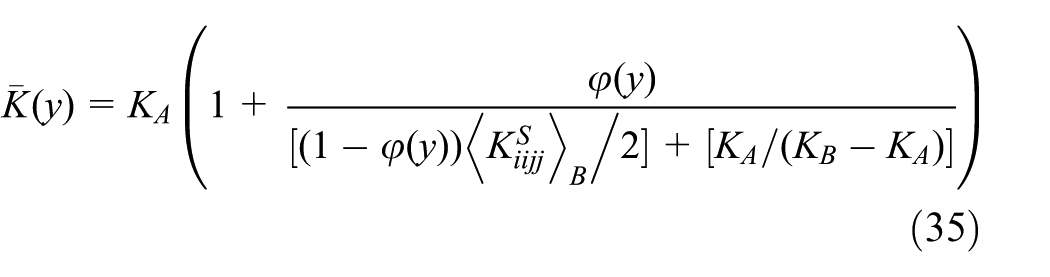


where
The averaged strain field in Region III can also be calculated through a similar process by switching the matrix and particle phases because the particle and matrix zones in this region can be well defined.
In the transition zone (Region II), it is not easy to identify the particle and matrix phases when (1) both the volume fractions of the two phases are in the vicinity of 0.5 and (2) the two phases have interpenetrated to form a connected network. In this case, because the transition zone (Region II) for a practical FGM lies between Regions I and III and is also much smaller than these regions, the averaged elastic fields cannot explicitly be determined through the micromechanics framework. Following Reitor and Dvorak 8 and Yin et al., 10 a phenomenological transition function is introduced as

Then, the averaged strain of each phase (A or B) in transition Region II can be estimated as a cubic Hermite function appropriately contributed by the averaged strain of the same phase (A or B) from two particle–matrix zones (Regions I and III) as

Using Equations (29), (30), (38), and (39), the overall averaged strain tensor at each point in the transition zone can be calculated.
If a uniform far-field loading
Numerical applications and discussion
In this section, the effectiveness of the proposed micromechanical FGM model will be illustrated using numerical examples. The geometry of the problem being examined is shown in Figure 1. The microstructure of the FGM includes two distinct material phases. The macro properties vary along the y direction. As in Yin et al., 10 the lower and upper bounds d1 and d2 are conveniently selected where the corresponding volume fractions are 40% and 60%.
Before performing the parametric study, the above solution was verified with an existing solution similar to the proposed problem. As mentioned above, when the micropolar effect is neglected, the estimates of the effective properties


Effect of phase volume fraction distribution on elastic properties of the FGM: (a) Young’s modulus and (b) Poisson’s ratio.
To demonstrate the validity of the present model, a further example case was conducted by comparing the present model with experimental results and the Mori–Tanaka method. As in Yin et al.,
10
we compared the results from the present model with the experimental data in Eshelby.
32
Both the effective Young’s modulus and Poisson’s ratio of the TiC/Ni3Al FGM with phase material properties of

Comparison of the effective properties of the FGM with a linear volume fraction between simulation models and experimental data: (a) Young’s modulus and (b) Poisson’s ratio.
The next example demonstrates the particular usefulness of the method in analyzing the size effect in relation to the effective properties of the FGM. The conventional micromechanical model for FGMs based on a Cauchy medium do not take into account the effect of particle size in the FGM; however, the model presented in this article is based on micropolar theory and the size effect is directly considered. We consider a SiC particle reinforced metal matrix FGM (SiC/Al); the material constants of the two phases are listed in Table 1. The SiC particle reinforced metal matrix composite (not the FGM) was analyzed by Liu and Hu
25
and Lloyd,
33
respectively. For simplicity, we assumed the elastic characteristic lengths of Phase A to be
Material constants of each constituent used in the FGM.


Effects of particle size on the effective Young’s modulus of the FGM linear volume fraction distribution: (a)
The influence of the volume fraction distribution form of Phase B is also examined. Figure 5 displays the variation in the effective Young’s modulus of the FGM with particle radius for the case

Effects of particle size on the effective Young’s modulus of the FGM with volume fraction distribution
Conclusion
In this article, a micromechanics-based elastic model set in a framework of micropolar theory is presented for two-phase FGMs to investigate size effects on the effective properties of the FGM. The method is based on the average equivalent inclusion method for a micropolar material, and Mori–Tanaka’s method is extended to a micropolar FGM to evaluate the effective elastic stiffness tensor. The effects of volume fraction distribution forms, together with the size and properties of the particle, on effective properties of the FGM are examined. The size dependence is more pronounced for the case where the particle size approaches the matrix characteristic length and where the stiffness of the particle is large. When the particle size is much larger than the matrix characteristic length, the prediction based on micropolar theory is similar to the classical results and the size effects can be neglected. Comparisons are conducted between the present model and the available simulation and experimental data to validate the proposed micromechanics model.
Footnotes
Handling Editor: Farzad Ebrahimi
Declaration of conflicting interests
The author(s) declared no potential conflicts of interest with respect to the research, authorship, and/or publication of this article.
Funding
The author(s) disclosed receipt of the following financial support for the research, authorship, and/or publication of this article: This work was supported by the National Natural Science Foundation of China (No. 11472248), the Natural Science Foundation of Henan Province (No. 182300410221), and a grant from the Natural Science Research Project of Jiangsu Colleges and Universities (No. 17KJB460014).
