



Abstract
The soil and vegetation on the ground surface are affected when the zinc content in the soil is excessively high. It is of great importance to choose suitable additives for the solidification/stabilization treatment of zinc-contaminated silt soil. Research focus on the stress–strain, shear strength, and durability of dry–wet cycle for solidified soil contaminated with different contents of zinc is scarce. In this study, the strength, microscopic, and stability of solidified silt are examined and analyzed, and the solidification agent with the best effect is identified. The silt near the mouth of the Pearl River in China is collected, the different contents of zinc are added, and then 15% cement and 15% cement + 5% slag or 15% cement + 10% slag are added to the mixture for curing. The effects of solidification with different additives at the different zinc contents are determined through test, for example, unconfined compressive strength, leaching, scanning electron microscopy, triaxial undrained solidification, X-ray diffraction, and dry–wet cycling experiments. The results show that the admixture that contained 15% cement + 10% slag has a better effect on solidification/stabilization of zinc-contaminated silt. Thus, this study provides a reference for the treatment of zinc-contaminated soft soil.
Introduction
The current environmental problems caused by soil contaminated by heavy metals are gradually increasing.1,2 It is related to the content of the following elements: cadmium, chromium, lead, nickel, and zinc, which are the most common ones.3,4 Soil contaminated by heavy metals is relatively more stable, and it is less influenced by environmental changes; therefore, heavy metals may exist in the soil for a long period. Consequently, research on soil contaminated by heavy metals is becoming increasingly important. The traditional remediation methods used for soil examination are as follows: landfill treatment and biological, chemical, and physical remediation.1,5–7 However, there are certain restrictions and limitations for the scope of application. Solidification/stabilization (S/S) used in remediation of soil contaminated by heavy metals adds cement, lime, and other additives to the soil and transforms the harmful pollutants into compounds with low toxicity, solubility, and mobility. Moreover, the technology has significant advantages, for example, low cost, simple examination, wide processing scope, and good stability of treated soil and utilization of resources. Thus, this technique is especially suitable for the treatment of soil contaminated by heavy metals.
To date, many efforts are frequently conducted on S/S technology of soil contaminated by heavy metals. The leaching amount of lead and zinc is followed by the elements’ content and met the requirements of environmental standards using a composite additive based on cement to solidify and stabilize lead–zinc tailings. 8 The radioactive thorium-contaminated soil is treated, which not only improved the strength of the soil but also reduced thorium radiation. 9 The solidified tailings exhibited greater strength, and the leaching characteristics were located lower than the specified limit values through an additive based on cement to solidify and stabilize tailings contaminated by arsenic 10 on solidifying the heavy metal ions in soft soil at the mouth of Xiangjiang River. The cement stabilized most of the heavy metal ions, and the leaching concentration of the heavy metals after solidification was far below the prescribed limit. 11 In addition, S/S was not affected when the cement was replaced by certain fly ashes, which had a cost-saving benefit. 12 Furthermore, Su et al. 13 added potassium magnesium phosphate to fly ash to solidify soil contaminated by Cd and Pb, and Cerbo et al. 14 solidified heavy metal ions in soil and fly ashes. Therefore, the strength of the soil increased, and the leaching of heavy metal ions greatly improved. 14 Thus, after soil contaminated by heavy metals, the S/S technology is used and the strength and leaching characteristics can be influenced at selected requirements. The treated soil can be used as landfill cover or other building materials.
As the types and contents of heavy metals in contaminated soil will affect the solidification effect of the additives, some researchers have worked on the mechanism of solidification and its influence on microstructural features.15–18 Hekal et al. 15 conducted an X-ray diffraction (XRD) test and examined that Ni can affect the hydration reaction of cement. The unconfined compressive strength (UCS) of a solidified body decreases with an increase in the content of Ni ions. In an experiment where fly ash and quicklime were used to solidify and stabilize silty sand and soil contaminated by heavy metals, Dermatas and Meng 16 investigated that the stabilization mechanism of the heavy metal ions was different after S/S treatment, and the effect of additives on Pb2+ was stabilized by the adsorption of hydration products. Cr6+ was stabilized through hydroxide precipitation. Heavy metal ions can affect the hydration reaction of cement, and they will precipitate in an alkaline environment, which prevents the continuation of the hydration reaction. 18 When the pH value increases, the concentration of heavy metal ions in fly ash reduces significantly. 18
Although the S/S technology has many advantages, a lot of efforts are taken to focus on an additive based on a single type of cement to solidify zinc-contaminated soil, but the study of the effect of composite additives’ content is scarce. Moreover, the stress–strain characteristics and the durability of dry–wet cycle (DWC) for different soils contaminated by zinc are still insufficiently recognized. Therefore, in this study, silt soil contaminated by zinc in Nansha, Guangzhou, China (Pearl River estuary) was used as the research object for solidification by adopting S/S technology with cement and slag as additives. The main objectives of this study are as follows: (1) to determine and analyze the differences between the strength characteristics of the solidified silt, (2) to investigate the microscopic features of the solidified silt, and (3) to examine the stability of the solidified silt on the different zinc content. Following the solidification agent for the best effect is related to a reference for the treatment of zinc-contaminated soft soil. On the one hand, the strength of the cured zinc-contaminated soil greatly increased, and it also met the environmental protection requirements. The zinc-contaminated soil as a waste can be turned into as a soil providing a new manner for the utilization of slag.
Materials and methods
Specimens and elements
Soil
The silt was collected from the Pearl River estuary (Guangzhou, China), utilizing the soil depth from 3 to 6 m. The physical properties of the silt were very poor while the soil could be shaped by plastic deformation, and the soil is in plastic state. Parameters of the soil are listed in Table 1.
Physical properties of the soil.

Zinc nitrate
Cuisinier et al. 19 reported that Zn(NO3)2 6H2O is a colorless crystal that is soluble in water. The nitrate ion is stable, and it has little effect on the hydration of cement. Thus, in this experiment, Zn(NO3)2·6H2O (Zn(NO3)2 6H2O ≥ 99.0%) was adopted for analysis (Xilong Chemical Limited by Share Ltd, Shantou, China). Composing the sample, Zn(NO3)2·6H2O crystal, measured using an electronic balance with a precision of 0.01 g, was used as the backup sample.
Cement
The cement was called Shijing PO42.5R ordinary Portland cement (Shijing Cement Company, Guangzhou, China). The main chemical composition is shown in Table 2.
Chemical composition of cement.

Slag
Slag was a by-product of pig iron smelting. The slag was created using its powder (GBSS; Shaoguan Iron and Steel Group, Guangdong, China); the main chemical composition is presented in Table 3.
Chemical composition of GBSS.

Experimental program
When processing the specimens, the silt was first dried in an oven and then crushed and passed through a 2-mm sieve. Then, a certain amount of dried powder was collected and added to deionized water, that is, 70% of the weight of the dried soil, in a cylinder. A zinc crystal corresponding to the mass of Zn(NO3)2·6H2O was collected. The crystal was dissolved in the deionized water and mixed into solution. Finally, silt with different zinc contents was prepared for backup.
Cement and slag with corresponding masses and the prepared silt and the additives in powder form were placed in a mixing device for 120 times until evenly mixed. The mixed solution was for backup in the following experiment. The mixed solution was added to a three-valve model (height: 80 mm, diameter: 39.1 mm) coated with Vaseline on the upper and lower surfaces and covered by a glass plate. Finally, it was stored in a curing box (Figure 1).

The specimens and curing method, (a) Specimens, and (b) Curing of samples.
According to the research conducted by SH Liang et al. 20 on soil with a high water content in Nansha, if 5%−10% (the ratio relative to the mass of wet soil) slag is added based on 15% cement, the compressive strength of the solidified soil may increase. In this experiment, 0%, 5%, or 10% slag was added on the basis of the standardized cement solidification agent, and silt with different zinc contents was processed using S/S. The UCS after 28 days of curing was measured. The specific proportions of the specimens are shown in Table 4.
Proportions of solidified silt with cement and GBSS.

Tests for evaluation of the method
Tests were performed applying the following devices: testing machine and station for three-axis loading.
Testing machine
The testing machine manufactured by the Hengruijing Company was used for the experiment (Figure 2(a)).The silt specimens with different ratios of zinc cured for 28 days were tested. Three groups of specimens were prepared for each number according to their age periods, that is, 7, 14, and 28 days. For each test, three identical specimens were used to measure their UCS.

Devices for evaluating the performance of zinc-contaminated soil after solidification, (a) testing machine, (b) station for three-axis loading, (c) SEM scan, (d) XRD, (e) leaching, and (f) DWC test.
Three-axis test
This experiment was performed using the TSZ10-1.0 strain-controlled triaxial station that was calibrated applying strain signals, which is called the strain gauge technique (Taike Technology Co. Ltd., Nanjing, China). The results were represented by the stress–strain characteristics of the zinc-contaminated soil. The triaxial shear tests were carried out for K2Z0 (0 mg/kg Zn), K2Z1 (1000 mg/kg Zn), K2Z2 (3000 mg/kg Zn), and K2Z3 (30%) consolidated silt (28-d period) with different zinc contents. The pressure for consolidation was 100–300 kPa.
Scanning electron microscopy
An FEI Quanta 650 scanning electron microscope (SEM; FEI Company, Hillsboro, OR, USA) was used for examining the microstructure of the specimens (Figure 2(b)). The tests were carried out on solidified silt (28 days) for which the curing effect of the original soil and the cement and slag additive was of high quality. Then, the solidified silt sample cured for 28 days was dried; the silt used for testing was removed by breaking after drying, avoiding smooth surfaces. The experiments were conducted on representative soil specimens without disturbance. The specimens were fixed and covered by metal. Then, the soil and frame were placed into a vacuum chamber in the SEM and observed at a magnification of 2000 times.
XRD
The main parameters of the XRD instrument used in the experiment (Bruker Company, Karlsruhe, Germany) were as follows: scanning range of 5°–80° and scanning step size of 0.02. The XRD experiments were carried out on solidified silt cured for 28 days and with initial zinc contents of 0, 1000, 3000, or 5000 mg/kg. The fundamental mineral composition, the type of hydration product, and the compound type of zinc were analyzed and compared after K2 treatment. The characteristics of the zinc in the silt that affected the solidification effect of the K2 additives were also analyzed.
Leaching
In this study, the National Environmental Protection Standard of China was adopted. 21 The obtained results indicated that a large number of heavy metal ions were stabilized under the condition of deionized water leaching, and the hydration products of the heavy metal ions were absorbed and surrounded by C-H-S and other gel bodies. 22 Therefore, deionized water was selected as the extractant. The solidified silt with a curing duration of 28 days was selected, by drying and crushing, and then its moisture content was measured. Then, according to the moisture content, solidified silt with a dry weight of 100 g was selected. This silt was placed into a 2-L extraction flask, deionized water was added as an extracting agent, and horizontal shaking was performed for 8 h followed by stewing for 16 h. Then, the stewed solution was filtered to obtain the leaching solution. The Hitachi Z-2000 atomic absorption spectrophotometer (Hitachi, Tokyo, Japan) was used to measure the concentration of zinc ion in the leaching solution. A specimen for comparison of each batch was made. For every 10 specimens, a set of parallel double specimens was prepared.
DWC
In the DWC test, the mass loss of the specimens was measured using the ASTM method. 23 The specimens cured for 28 days at a constant temperature and humidity container were selected for the DWC test, which were divided into experimental group and control group (n = 2). The first group was cured under constant temperature and humidity conditions. The experimental groups were dried for 24 h at 60°C ± 3°C. After stewing for 1 h, distilled water (room temperature) was used to wash the sample until it was completely immersed in water where it was soaked under constant temperature and humidity conditions for 23 h. Afterwards, the distilled water was used to wash the sample and obtain the residue whose roughness, cracking, and breaking characteristics were observed. The specific mass of the dried residue was measured to compare with the initial mass. Finally, the mass loss in a DWC was obtained. The UCS of samples undergoing 1, 3, 5, 8, and 12 periods of DWCs was tested.
Results
UCS
The UCS of solidified silt cured for 7, 14, or 28 days with different ratios of the mixture and different zinc contents was measured. The strength of the solidified silt was the highest for the specimens of 28 days. The same effect was evidenced at the slag content of 10% (Figure 3). After solidification, if the zinc ions were higher, the strength of the solidified soil was lower. When the zinc content was of 5000 kg/m3, the strength of the soil was affected.

Variations of the UCS versus time (days) for the specimens with different compositions: (a) 15% cement, (b) 15% cement mixed with 5% slag, and (c) 15% cement mixed with 10% slag.
Three-axis test
The K2 (15% cement + 10% slag) solidified silt was selected for the three-axis test. The stress–strain relationship of the K2 solidified silt with different zinc contents at three values of pressure is shown in Figure 4. The photographs of the specimens after test are presented in Figure 5.

Stress-strain curves of solidified silt with different zinc contents, (a) 15% cement mixed with 10% slag without zinc, (b) 15% cement mixed with 10% slag with a zinc content of 1000 mg/kg, (c) 15% cement mixed with 10% slag with a zinc content of 3000 mg/kg and (d) 15% cement mixed with 10% slag with a zinc content of 5000 mg/kg.

The solidified silt specimens with different zinc contents during the three-axis test: (a) the state of the specimens in the linear increase stage, (b) the state of the specimens in the nonlinear increase stage, and (c) final stage of the test.
It can be observed that a character of the stress–strain characteristics of the K2Z0, K2Z1, and K2Z2 solidified silt at 100–300 kPa confining pressure was independent on the zinc content for its range of 0–3000 mg/kg. Looking at the compression curves, the role of pressure is easily evidenced, that is, an increase in this process parameter increased the UCS. The stress–strain curve can be divided into three stages: linear increase stage, nonlinear increase stage, and steep-decline stage (Figure 4). The fracture of the specimens was characterized by obvious brittle failure, which is the state of the damaged soil (Figure 5(c)). In the case of the stress–strain characteristics of the K2Z3 solidified silt (5000 mg/kg), very small reduction in stress was evidenced after UCS.
The SEM and XRD images of solidified silt are shown in Figure 6. The occlusal effect of the embedded soil particles decreased, and the higher the zinc content of the solidified silt, the smaller the internal friction angle as the products of hydration decreased (Figure 6). In the four groups of solidified silt under the pressure of 100–300 kPa, the shear strength envelope formed a straight line, and the shear strength envelope was not a polygonal line.

SEM and X-ray diffraction images of solidified silt, (a) Undisturbed soil, (b) the composition and content of compounds in undisturbed soil, (c) K2Z0 silt, (d) composition and content of compounds in the K2Z0 group, (e) K2Z1 silt, (f) composition and content of compounds in the K2Z1 group, (g) K2Z2 silt, (h) the composition and content of compounds in the K2Z2 group, (i) K2Z3 silt, (j) the composition and content of compounds in the K2Z3 group.
Leaching test
The leaching test was carried out for silt with different zinc concentration in the Z1, Z2, and Z3 groups. The silt that was solidified based on cement and contaminated by Zn2+, and the Zn2+ concentration in each extracted specimen was obtained (Table 5). The Zn2+ in each group of the solidified silt leaching solution was less than 1 mg/L, far less than the limit of 100 mg/L for Zn2+ concentration specified in the “Leaching Toxicity Identification Standard.” 24 With an increase in the zinc concentration in the silt, the concentration of Zn2+ in the silt of each group increased. When the zinc concentration in the silt was relatively low (1000 mg/kg), the Zn2+ concentration of the S1Z1 (1000 mg/kg Zn) solidified silt leaching solution was of 16 μg/L, and the Zn2+ concentration in the other groups was 0. When the zinc concentration in the silt increased up to 5000 mg/kg, free Zn2+ appeared in all of the silt leaching solutions.
Leaching test results.

Wet–dry cycle test
Wet–dry cycle (WDC) tests were carried out for K2 solidified silt with different zinc contents. Table 6 shows the corrected relative mass loss rate of the K2 solidified silt during 12 DWCs. The accumulated corrected relative mass loss rate of K2 in each group was less than 1%, which is far less than the standard value of 30% specified by the United States Materials and Testing Association. The K2 solidified silt with different zinc contents had good DWC durability. The corrected relative mass loss rate of the K2Z0 (0 mg/kg Zn) and K2Z1 (1000 mg/kg Zn) silt was 0 in the DWC. The mass loss rate of the K2Z2 (3000 mg/kg Zn) solidified silt increased slowly and steadily during the DWC, and the mass loss rate of the dry–wet group was slightly higher than that of the control group. The corrected relative mass loss rate of the K2Z3 (5000 mg/kg Zn) solidified silt increased rapidly at the beginning of the WDC and then gradually decreased.
Cumulative relative mass loss of specimens.

WDC: wet–dry cycle.
The morphology of solidified silt of the DWCs expressed that the corrected relative mass loss rate of the solidified silt K2Z3 (5000 mg/kg Zn) increased rapidly at the beginning of the WDC, followed by a slow decrease (Figure 7).

Morphology of solidified silt before and after the DWCs, (a) K2Z0 group (before the cycle), (b) K2Z1 group (before the cycle), (c) K2Z2 group (before the cycle), (d) K2Z3 group (before the cycle), (e) K2Z0 group (after the cycle), (f) K2Z1group (after the cycle), (g) K2Z2 group (after the cycle), and (h) K2Z3 (after the cycle).
Strength analysis
Moore’s circle and shear strength envelope of silt with different zinc contents are solidified by the K2 additive (Figure 8). Linear regression analysis was performed on the strength envelope of K2-solidified silt with different zinc contents, and the shear strength parameters in each group were obtained. Meanwhile, according to the UCS of the solidified silt in group K2 (Figure 3), the strength parameters of the K2-solidified silt with different zinc contents were obtained and are shown in Table 7.
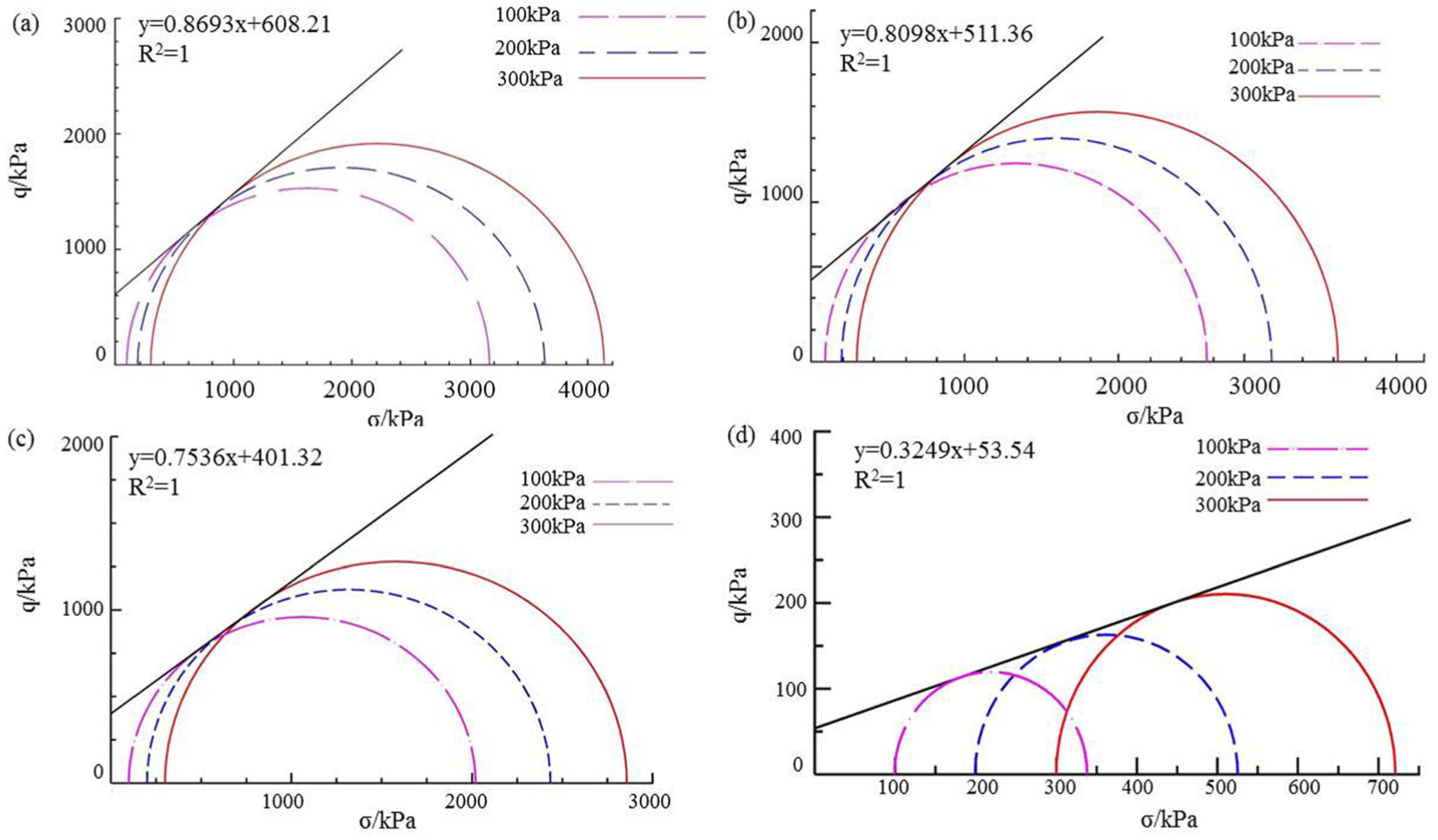
Moore circle and strength envelope for silt solidified by cement / slag, (a) K2Z0 group, (b) K2Z1 group, (c) K2Z2 group, and (d) K2Z3 group.
Strength parameters of K2 solidified silt.
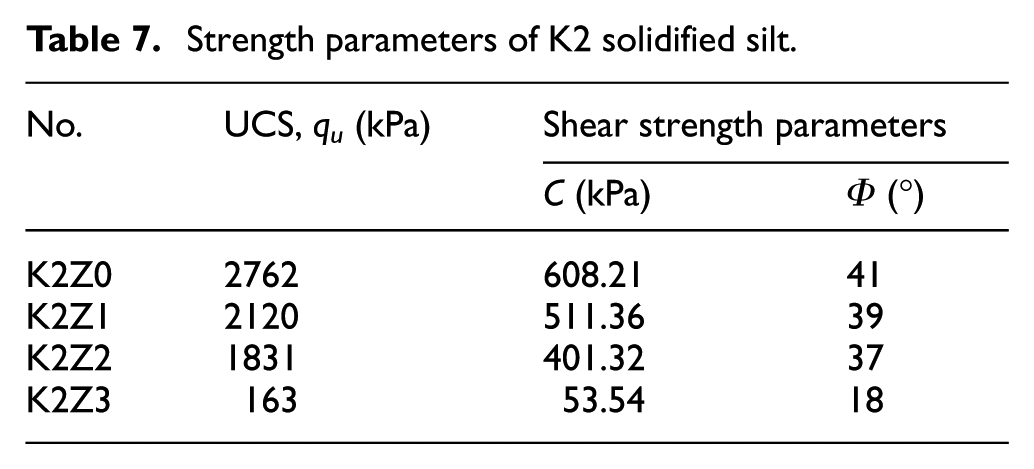
The cohesion of the solidified silt decreased with the increase in the zinc content, and the internal friction angle was reduced for increasing the zinc content of the silt (Table 7 and Figure 8). In the K2Z0 group, the cohesion of silt after solidification and the internal friction angle reached maximum values.
Stability analysis
In order to compare the stabilizing efficiency of different additives with respect to zinc ion in the soil contaminated by zinc, the stability ratio η was used

where η is the ion stability (%), C0 is the Zn2+ concentration of the leaching solution of silt before the S/S treatment, and Cs is the Zn2+ concentration of the leaching solution of silt after the S/S treatment.
The stability ratio of zinc ions in the silt with zinc contents of 3000 and 5000 mg/kg is presented in Figure 9. The high stability of K2 was observed for silt with a zinc content of 3000 mg/kg, and the stable efficiency reached 100%. The silt containing a zinc content of 3000 mg/kg with the worst stability was S1, and the stability ratio of zinc ions reached 99.63%. For silt with a zinc content of 5000 mg/kg, the K2 stability was also very high, and the ratio reached 99.98%; the worst results occurred in the S1 group, and the ratio reached 99.82% (Figure 9(b)).
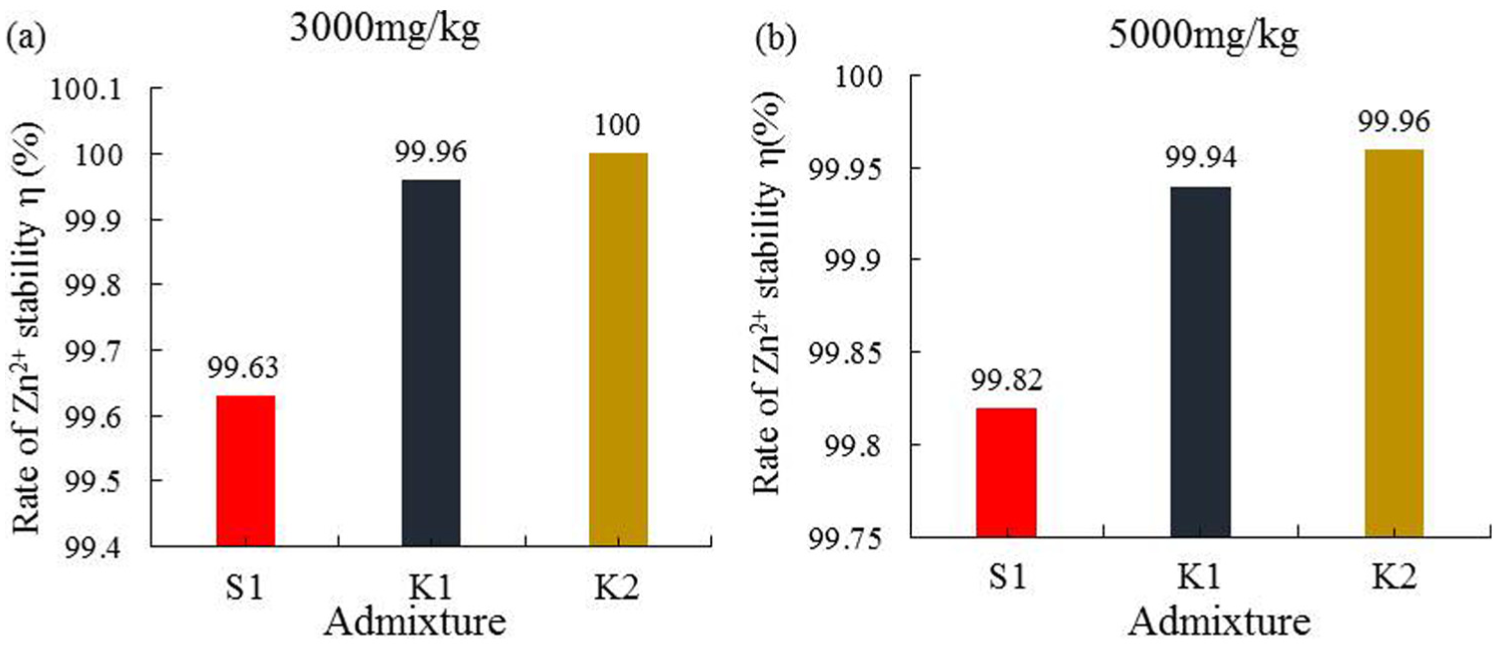
The stability ratio of different cement-based additives in Zn2+, (a) Silt with a zinc content of 3000 mg/kg in the presence of different solidification agents, and (b) Silt with a zinc content of 5000 mg/kg in the presence of different solidification agents.
The stability ratio of zinc ions in the silt-leaching solution of each group with a concentration of 1000 mg/kg was higher than 99.99%, and the effect of different additives was not significantly different (Table 5). Therefore, the stability of zinc ion in the silt with zinc content between 0 and 5000 mg/kg was greater than 99%, and the stability was good.
Discussion
Strength
The UCS value of the solidified K1 and K2 silt increased with increasing curing duration (Figure 2). A large amount of Ca(OH)2 can be produced when the hydration reaction of cement proceeds within a certain stage. At the same time, the slag vitreous body begins to dissolve, and the slag is activated. The active CaO, MgO, and other substances in the vitreous body can have secondary reactions with Ca(OH)2 produced by the cement clinker after hydration. Therefore, the slag increases the number of hydration products in the solidifying system; meanwhile, it also reduces the basicity of C-S-H and other hydration products, while the strength of the C-S-H with low basicity is higher than that of C-S-H with high basicity. Pesonen et al. 25 also reported that C-S-H is the main component that increases the strength of Portland cement-solidified soil, but the high alkaline environment will have a negative effect on the solidification effect of S/S. The UCS of silt solidified by K1 and K2 increases with an increase in the zinc content of the silt. The similar trend was observed for the strength of cement solidified with S1. When the zinc content in the silt is too high (5000 mg/kg), the solidification effect of the cement/slag additive is affected, which is the same as the work of Li et al. 26
In Table 7 and Figure 8, the cohesion of silt after solidification reached a maximum value, and the internal friction angle was also at the maximum value, which is consistent with the UCS test results. The zinc content in the silt had an adverse effect on the solidification effect of the additives in the K2 group, and the strength of the soil after solidification was affected. This probably occurred with respect to the presence of the yield stress of the solidified silt for the experiment. Under the consolidation pressure, the cementation of the solidified silt was not damaged because the stress–strain curve was not transformed, and the consolidation pressure was not sufficient.
Micro
The hydration products C-S-H and ettringite (AFt) of cement and slag in each solidified soil were affected by the cement, slag, and additive (Figure 6). Sanchez et al. 27 proposed that C-S-H is the cement material generated in the hydration reaction of cement and slag that is insoluble in water and has a virtual effect on strength. AFt is the needle stick hydration product generated by C-A-H and sulfate ion after being integrated.
When the zinc content in the silt was 3000 or 5000 mg/kg, the zinc transformed into CaZn2(OH)6 6H2O and Zn(OH) in the reaction system affected by the K2 additive, and these products will influence the continuation of the hydration reaction of cement and slag. Zn2+ will form a Zn(OH)2 sediment in an alkaline environment. 28 When there is a certain amount of C-S-H gel in the solidified system, Zn(OH)2 will react with Ca2+ attached to the surface of C-S-H. The product of the reaction is CaZn2(OH)6 6H2O, which is insoluble in water. The hydrate is attached to the surface of the cement material, such as C-S-H generated in the initial hydration reaction, and the hydration reaction is hindered.
Furthermore, zinc in an alkaline environment is transformed into Zn(OH) sediment, and Zn(OH)2 surrounds the cement particles, forming an isolation layer that further hinders the contact between the cement and water and the hydration reaction. 29 It can increase the embedding capacity of the hydration crystallization products of solidified soil and improve the strength of solidified soil. As the zinc content in the silt increases, the hydration products detected in the XRD spectra of the solidified silt decreases accordingly (Figure 6). For the K2Z0-solidified soil without zinc, the hydration reaction was normal throughout the curing period. In addition, the hydration products of the solidified silt group were present in the highest quantities, and their strength was also the greatest. With an increase in the zinc content of the silt, the hydration reaction was hindered by zinc, and the amount of water consumed by the silt solidified by K2 under the same curing duration decreased correspondingly. The moisture content of the corresponding solidified silt also increased. The zinc in the silt can hinder and delay the hydration reaction of cement and slag through the formation of insoluble hydrate or hydroxide precipitation, which affects the solidification effect of the K2 additive.
Stability
The Zn2+concentration of the solidified silt in the leaching solution increased with an increase in the zinc content in the silt (Table 5). Compared to the effect of cement solidification S1, the incorporation of slag can reduce the concentration of Zn2+ in the solidified silt. When other conditions were the same, the greater the amount of slag, the lower the Zn2+ concentration, which is the same finding as in the research of El-Eswed et al. 30 It was observed that the hydration reaction of slag can produce C-S-H, other gel products, and zeolite materials, which can be used to adsorb heavy metal ions. When the zinc content in the silt was relatively low (1000 mg/kg), the Zn2+ concentration of the leaching solution in S1Z1 (1000 mg/kg Zn) was 16 μg/L, and the Zn2+ concentration in the solidified soil of the other groups was 0. When the zinc content in the silt increased to 5000 mg/kg, free Zn2+ appeared in all leaching solutions of the solidified silt, which indicates that the ability of absorption, wrapping, sediment, and exchange of ions of the cement-base additive was limited, and above a certain value, the concentration of Zn2+ will increase.
The stability effect of the K2 group was very high, which is similar to the research results (the slag has good effect on soil) of Gougar et al. 31 The slag in K2 will produce more hydrated calcium silicate, calcium aluminate hydrate, and zeolite material in the secondary hydration reaction after the hydration reaction of cement. The hydration products and zeolite materials have good adsorption properties with respect to Zn2+, and the alkaline environment provided by the hydration reaction is beneficial for the stability of the zinc ions.
The relative mass loss rate of the silt with different K2 contents differed between the WDCs (Table 6 and Figure 7). This occurred because in the early period of the WDC, the connection between the K2Z3 solidified silt particles was relatively loose, the sample structure was relatively poor, and the soil particles on the surface could easily be lost in the WDC through expansion and contraction. The mass loss at the beginning of the dry–wet period was much higher than that of the control group. With the continuation of the WDC, the cement and slag in the K2Z3 group solidified silt, which had not engaged in the hydration reaction, would continue the hydration reaction at higher temperatures of the wet cycle and under sufficient moisture. The integrity of the specimen was stronger, and the destruction effect of the DWC on the material gradually weakened. The relative mass loss rate of the specimen gradually reduced.
Conclusion
From this study, we can conclude that zinc has an adverse effect on the solidification effect of cement-based additives. The stress–strain curve of the solidified silt was strongly influenced by the zinc ions. An increase in the element content up to 5000 mg/kg caused almost 10 times reduction in the unconfined stress comprising the curve of the specimen without zinc. However, the strength of the K2 (15% cement + 10% slag) group was better for zinc-contaminated silt, and there was a good fitting relationship between shear strength parameters and compressive strength parameters in the K2-solidified silt.
The microstructural characteristics of the solidified silt with different zinc contents were also verified, as was the microstructure of the solidified silt with the same zinc content and different categories of additives. The soil particles of the K2 (15% cement + 10% slag) solidified silt were more closely connected, and the pores between the soil particles were smaller. Zinc affects the solidification effect of the additives by delaying and hindering the hydration reaction of cement and slag. The higher zinc content in the silt leads to the obstruction of the hydration reaction of cement and slag.
The stability effect of the cement-based additives in each group with respect to Zn2+ in the zinc-contaminated silt was satisfied. The K2 (15% cement + 10% slag) with different zinc contents had a better effect on the stability of the zinc ions in the zinc-contaminated silt, and the solidified silt had good DWC durability. When the content of zinc in the silt was higher (5000 mg/kg), the K2-solidified silt slowly increased.
Footnotes
Handling Editor: Michal Kuciej
Author's note
Jun Dai is now affiliated to Guangzhou Water Supply Company, Guangzhou, China.
Declaration of conflicting interests
The author(s) declared no potential conflicts of interest with respect to the research, authorship, and/or publication of this article.
Funding
The author(s) disclosed receipt of the following financial support for the research, authorship, and/or publication of this article: This work was supported by the Natural Science Foundation of Guangdong (2016A030313692) and the National Natural Science Foundation of China (51508109).
