




Abstract
In order to study the influence of double arc oil groove parameters on oil film torque in hydro-viscous drive, the numerical simulation and parameterized analyzing platform were built. The flow field characteristics were carried out using CFX. The parameter analysis platform was integrated with parameterized design of grooves, numerical simulation, and design of experiment (DOE). The effects of groove parameters on output torque were analyzed. The results indicate that the output torque consists of shear torque and impact torque, and the oil film shear torque plays a more important role in total torque. The shear torque is mainly affected by coefficient of effective area and velocity distribution. The velocity distribution and dynamic pressure on sidewalls are the main influencing factors on impact torque. The effect of eccentricity and oil grooves depth on the output torque is positive, but others are negative. In addition, the eccentricity and inner diameter of eccentric circle are sensitive parameters. The effects of oil groove parameters on oil film torque are analyzed accurately using the parameterized analyzing platform that is integrated with CAD, CFX, and DOE. A new method and theoretical foundation are provided for design of complex oil grooves in hydro-viscous drive.
Introduction
The hydro-viscous drive (HVD) is a kind of torque transmission device making use of oil film shearing and friction. There are several advantages such as step-less speed regulating, soft starting, overload protection, little impact, high efficiency, and high reliability. The HVD which plays an important role in energy-saving is widely used in fan transmission in vehicles, fans, pumps, belt conveyors, and scraper conveyors. 1
The friction pairs in HVD consist of friction plate (FP) and separator disk (SD). The step-less speed regulating and soft starting are realized by changing the gap of friction pairs. In order to improve the cooling capacity and avoid large thermal deformation and thermal failure, a certain numbers and shape of cooling oil grooves are usually machined on the surface of FP. In addition, the oil grooves also have the effect on frictional performance and chip removal. 2 The double arc oil groove friction pairs are widely used in HVD. The flow capacity of oil has nothing to do with the direction of rotation, but the structure is very complex.
The parameters of double arc oil grooves mainly include width, number, eccentricity, inner diameter of eccentric circle, and depth of oil grooves. The structure and geometrical parameters of oil grooves have a great influence on flow field characteristics and output torque of oil film. However, it is difficult to solve the analytical solution of flow field and torque characteristics directly because of the complicated structure. In the design process, they are usually determined by the experience value. Therefore, the accurate analysis of flow field characteristics and oil groove parameters is the key step to predict torque characteristics, improve the speed regulation performance, and design oil groove parameters. 3
Most researches about the relation between shear torque and oil grooves focused on the wet clutch. For the consideration of grooves, Razzaque and Kato 4 studied the groove of FP during the engagement period and analyzed the torque characteristics. Aphale et al. 5 developed a two-dimensional (2D) lubrication model and a three-dimensional (3D) computational fluid dynamics (CFD) model with the consideration of grooved plates to evaluate the film torque. The drag torque between two rotating plates had been extensively studied both by theoretical models and experiments. 6 A small experimental rig was set up to test a grooved single-plate wet clutch and verify the effects of the clearance, rotating speed, groove depth and friction material.7,8 The numerical results of the air–oil two-phase flow inside the open radial grooved two-disk system calculated by the CFD code FLUENT were studied. 9 Miyagawa et al. 10 pointed out that the surface temperature of the friction pairs can be effectively reduced by the radial and circumferential grooves in wet clutch. The shape of oil grooves in wet clutch had been discussed to reduce the drag torque and save energy. 11
Meanwhile, many researches focused on the influence of oil grooves on oil film torque in HVD. The influence of surface roughness, working oil viscosity, and groove area on engagement process of HVD was studied.12,13 The influence of oil grooves on torque characteristic was researched by the hydrodynamic lubrication theory, and the flow field in the friction gap was analyzed using the “narrow groove” theory. 14 Meng and Hou 15 pointed out the oil torque will be reduced as the increase in the oil groove width in HVD for soft starting. The analytic solutions of pressure distribution, velocity field, and oil torque in radial oil grooves under the condition of variable viscosity were obtained. 16 The flow field and the influence of oil grooves on transmission performance were analyzed using the Fluent software. 17 The effects of radial grooves on the behavior of HVD were studied using CFD. The parameters related to the flow, such as velocity, pressure, temperature, axial force, and viscous torque, were obtained. 18 The effects of central angle of oil grooves zone, friction contact zone, oil film thickness and number of oil grooves on pressure, flow, load capacity, and torque were studied theoretically of hydro-viscous clutch based on viscosity–temperature property of oil film. 19
Besides, some relative research works with an emphasis on thermal effects were presented. 3D thermohydrodynamic model was developed to investigate the effect of radial grooves and waffle-shaped grooves on the performance of wet clutch. 20 Heat conduction theory model of hydro-viscous clutch was established, and the heat flux of different cross-sectional shapes and layout form of oil grooves on friction disk and SD was calculated. 21 The transient temperature models were derived with the aim of revealing the effect of engagement pressure, lubricant viscosity, viscosity–temperature correlation, surface roughness, and the ratio of inner and outer radius of disks on temperature distribution of multidisk friction pairs in HVD. 22 An extensive parametric analysis of the factors was performed that takes into account different groove patterns (waffle shape, radial, and spiral). The temperature field was predicted using a thermohydrodynamic analysis with the consideration of the asperity contact stress during engagement process. 23 A 3D thermohydrodynamic analysis of wet clutch was performed that covers the entire cycle of engagement from slip to lock to detachment. The performance of wet clutch was influenced by various groove effects. 24
In conclusion, from the above review of the previous work, although the structure of HVD has some similarity with wet clutch, there are essential differences in working conditions and operating performance. The effect of oil grooves on oil film torque is not the same. At the same time, the present studies on oil film torque of HVD mostly concentrate on circumferential grooves, radial grooves, and waffle oil grooves by qualitative analysis and experimental study. However, the double arc grooves are more common in the engineering. The structure of double arc oil grooves is very complex and the influence of oil groove parameters on oil film torque needs to be studied further.
Therefore, the numerical simulation of oil film torque of HVD in full film shear stage was built using the software CFX. The parameter analysis platform of oil grooves was integrated with the parameterized design of oil grooves, numerical simulation of flow field, and design of experiment (DOE). The effects of double arc oil groove parameters on shear torque, impact torque, and output torque of oil film in HVD were analyzed accurately. A new method and theoretical foundation were provided for design of complex oil grooves of friction pairs in HVD.
Numerical simulation of oil film torque
Structure of oil grooves
In HVD, the surface of FP is paper-based friction material. The shape of oil grooves on the surface of FP is double arc. The structure of oil grooves in HVD is shown in Figure 1.

Schematic sketch of oil grooves.
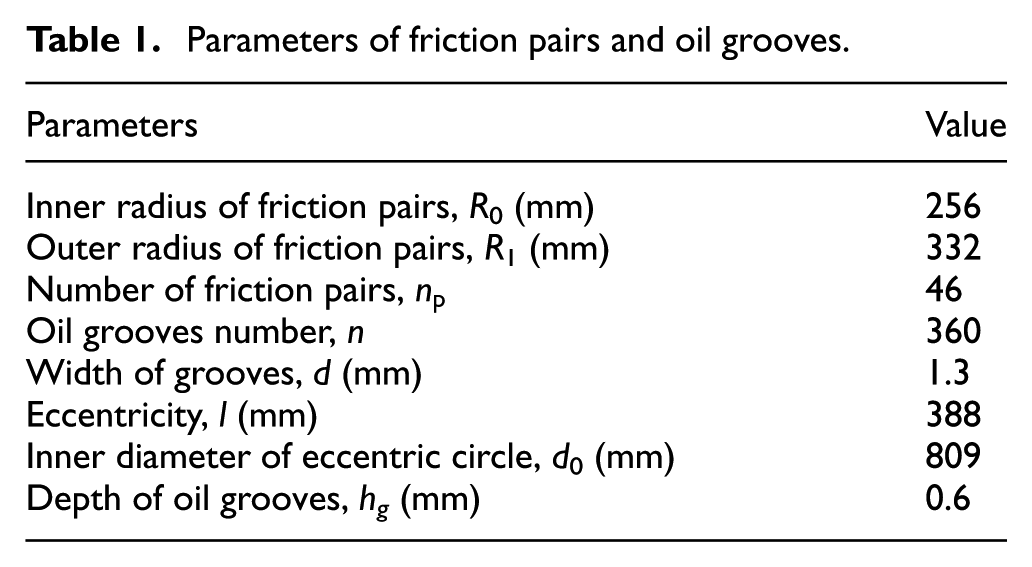
The double arc grooves can be realized by circular array of two eccentric circles around the center of FP. The number of arrays is the oil grooves number
Parameters of friction pairs and oil grooves.
Numerical simulation
The structure of the double arc grooves is very complex, so it is difficult to solve the analytical solution of flow field and torque characteristics. Meanwhile, some specific phenomena cannot be explained by the experimental method. With the rapid development of CFD, the numerical simulation is used to deal with the complex flow that cannot be solved by theoretical fluid mechanics.
In order to speed up the calculation, the 1/n single-cycle model of fluid flow field was established by considering the symmetrical structure of friction pairs, so the periodic boundary condition was used. The non-structural grid model of flow field was adopted using the ICEM CFD. The maximum size of the grid is 0.05 mm. The grid quality is guaranteed to be above 0.4 through the smooth mesh step, so it can meet the requirements of CFX calculation.
The internal flow of friction pairs is turbulent. In order to obtain the small vortex and boundary layer phenomena in the flow field and get more accurate calculation results, the shear stress transport (SST) turbulence model was selected for analysis. The SST turbulence model combines the advantages of k-ε model in calculation of outer region and k-ω model in near-wall simulation. In k-ε model, the values of k and ε come directly from the differential transport equations for the turbulence kinetic energy, and the turbulence dissipation rate is shown in equation (1)

where
The k-ω model solves two transport equations, one for the turbulent kinetic energy, k, and one for the turbulent frequency, ω. The stress tensor is computed from the eddy-viscosity concept. The k-ω equation is shown in equation (2)

where
SST model accounts for the transport of the turbulent shear stress and gives highly accurate predictions of the onset and the amount of flow separation under adverse pressure gradients. The k-ω model is thereby multiplied by a blending function

where

with

where

Therefore, an automatic wall function is obtained, by which the boundary layer phenomenon can be accurately simulated. Meanwhile, the transport of turbulent shear stress was considered in the calculation of turbulence viscosity, by which various fluid flows can be accurately predicted.
In the simulation, the incompressible viscous fluid is assumed. The density of oil is

where the term
The constant temperature boundary condition of wall surface is used. The inlet temperature of oil is

The flow boundary condition is used in inlet of friction pairs. In order to ensure that no oil film rupture occurs, the inlet flow of single cycle is
Results of numerical simulation
In the software of CFX, the control equations are discretized by finite volume method, and the shear flow is calculated using all-implicit multi-grid coupling algorithm. In CFX post-processing, the stream line, pressure distribution, and velocity distribution can be obtained, and the output torque can be extracted directly.
When the FP keeps stationary and the SD rotates at the rotational speed
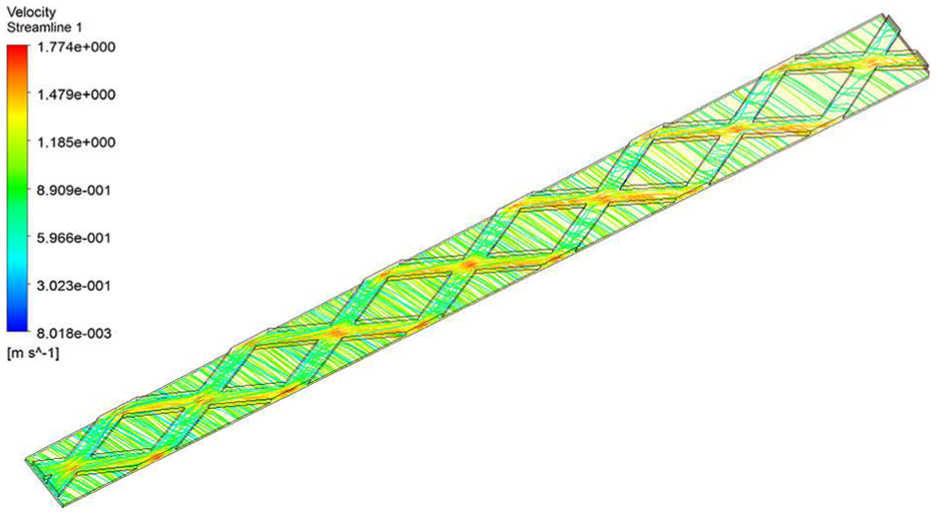
Stream lines of single period of oil film.
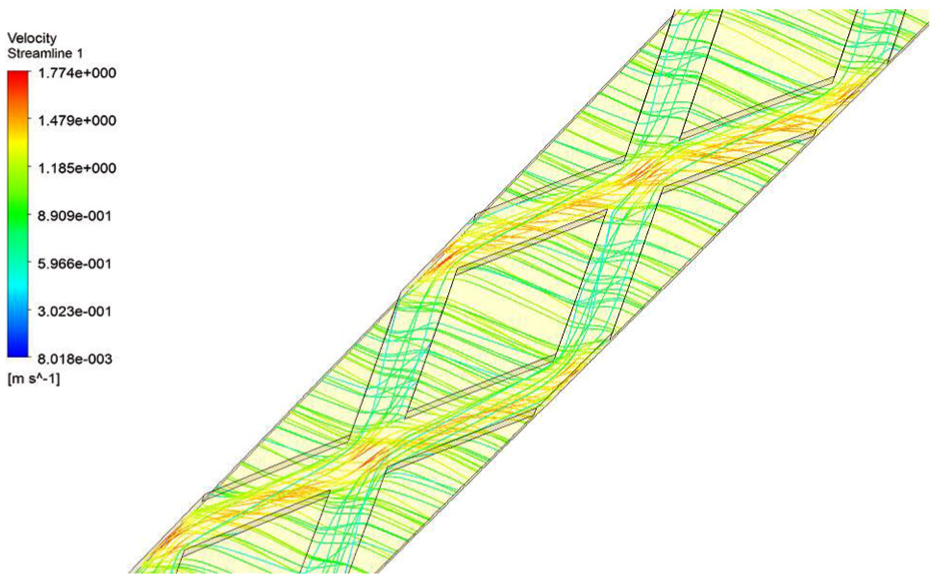
A partially enlarged view the stream lines of single period of oil film.
The geometrical model of flow field is shown in Figure 4. The non-grooved part of the surface is defined as
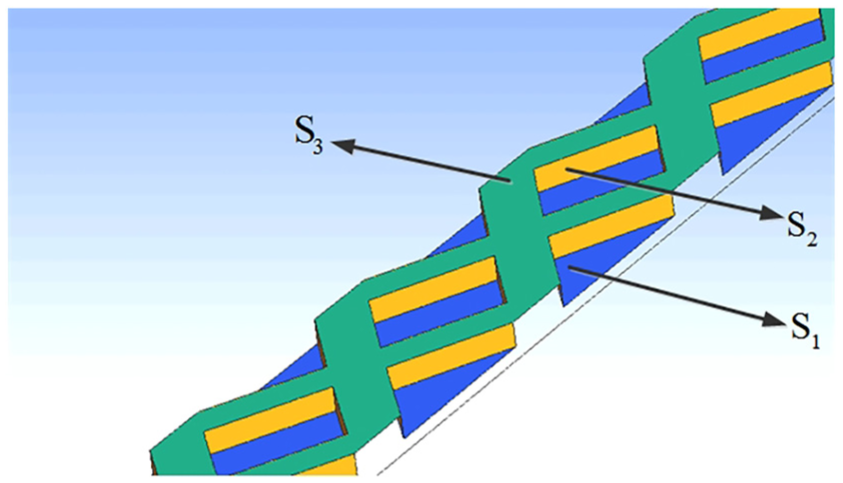
Geometrical model of flow field.
Parameterized analyzing platform
The previous researches about the influence of double arc groove parameters on output torque are not sufficient, because the simulations about groove parameters are ponderous and repetitious. Therefore, an iSIGHT platform utilizing the multidisciplinary optimization was built to analyze the influences of groove parameters including the width d, the number n, the eccentricity l, the inner diameter of eccentric circle d0, and the depth of oil grooves hg on torque characteristics.
As the analytical expression between oil film torque and oil grooves parameter was difficult to be determined, a number of simulation analysis modules were integrated to make one-to-one correspondence of input parameters and output parameters. Therefore, a platform was integrated Pro/E and CFX by geometric module and finite element module, and the effects of parameters on output torque of HVD were analyzed in the parameterized analyzing module. The platform is shown as Figure 5.

iSIGHT parameterized analyzing platform.
In the iSIGHT platform, a number of sample points were used for parameterized geometric modeling in the DOE. After meshing, the flow field of various parameterized models was analyzed using the CFX software. The database of torque performance was obtained through the data extraction. The sensitivity and main effect analysis of every parameter were carried out.
The trail files were used in the parametric modeling, and they reliably guaranteed the transition of oil groove parameters. Parametric modeling of geometric model was completed by Pro/E trail file, and the seamless connection between Pro/E and ICEM was achieved by interface module instead of using the intermediate format files. When the geometric parameters were altered, the family and its attachment were unchanged. By refreshing the geometric model, a new one was saved and exported as “.tin files.” The computational domain, boundary conditions, and initial conditions were set, and then, the parallel computing was carried out by calling the ANSYS solver. After the results were analyzed, the files were exported. All modules were controlled by DOE and carried out by utilizing the trail files, the script files, the batch commands, and the parameterized command stream automatically.
The effects of double arc oil groove parameters on output torque of HVD were studied. The oil groove parameters analysis platform was built by iSIGHT software, integrating oil grooves parameterized design, flow field numerical simulation, and DOE.
Results and discussion
The double arc groove parameters include the width of oil grooves d, the number of oil grooves n, the eccentricity l, the inner diameter of eccentric circle d0, and the depth of oil grooves hg. The multifactorial trial design was conducted using the Latin square test method. The test table of oil groove parameters is shown in Table 2.
Parameters test table of oil grooves.

The effects of oil groove parameters on shear torque
Because the oil film torque is affected by coefficient of effective area which changes with variation of the double arc groove parameters, the coefficient of effective area has also been studied.
Number of oil grooves
When other parameters of oil grooves are constant, the relation between shear torque of oil film, coefficient of effective area, and the number of oil grooves is shown in Figure 6. The increase in the number of oil grooves causes the decrease in the coefficient of effective area. With the increase in the number of oil grooves, the shear torque of oil film declines. The trends of the coefficient of effective area and shear torque of oil film are the same, when the number of oil grooves varies.

Relation between coefficient of effective area, shear torque, and number of oil grooves.
Width of oil grooves
The relation between the shear torque of oil film and the width of oil grooves and the relation between the coefficient of effective area and the width of oil grooves are shown in Figure 7. The figure shows the increase in the width of oil grooves causes the decrease in the coefficient of effective area. With the increase in the width of oil grooves, the shear torque of oil film declines.
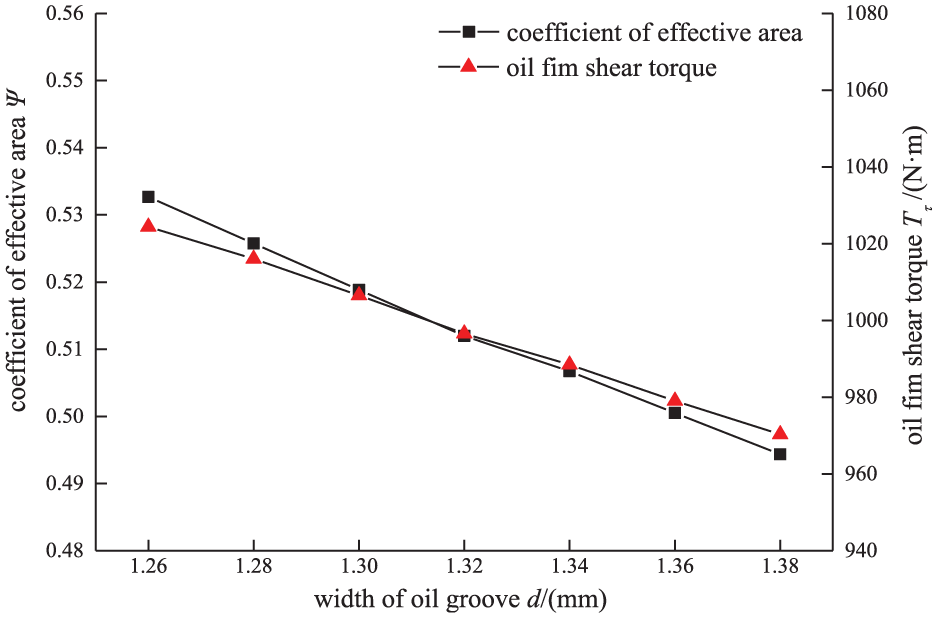
Relation between coefficient of effective area, shear torque, and width of oil grooves.
Eccentricity
The relation between the shear torque of oil film and the eccentricity and the relation between the coefficient of effective area and the eccentricity are shown in Figure 8.When the eccentricity increases from 385 to 391 mm, the coefficient of effective area increases with the eccentricity, whereas the shear torque of oil film decreases gradually. When the eccentricity increases from 391 to 403 mm, the coefficient of effective area curve and shear torque of oil film curve both increase first and then decrease. It is because of complex effects of eccentricity on the coefficient of effective area. Too large or too small eccentricity will cause the arrangement of grooves too narrow near the inner diameter of FP, even there will be no grooves any more. Therefore, the certain value of the eccentricity exists, and the coefficient of effective area will be maximum.
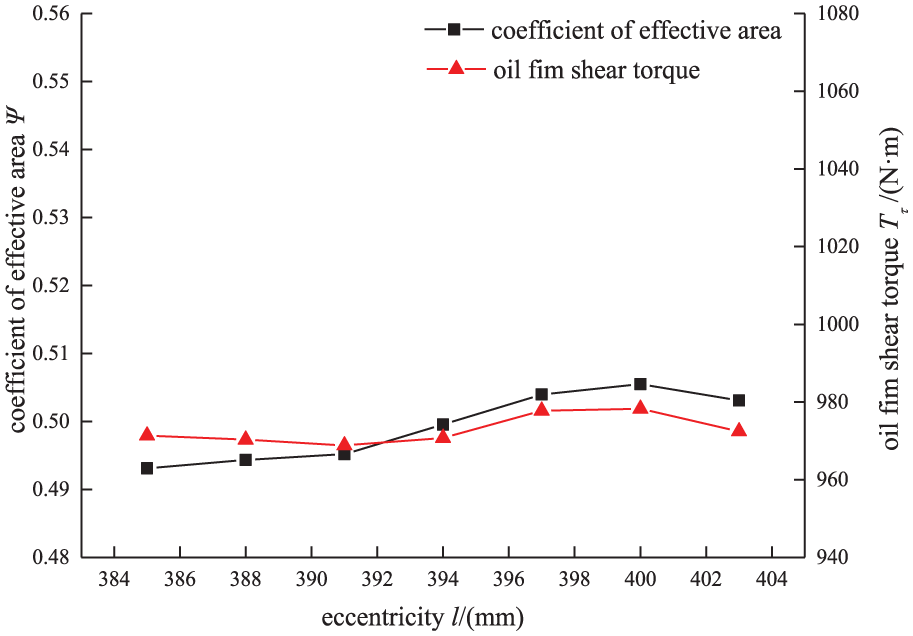
Relation between coefficient of effective area, shear torque, and eccentricity.
Inner diameter of eccentric circle
The relations between the shear torque of oil film, the coefficient of effective area, and the inner diameter of grooves are shown in Figure 9. The figure shows the increase in the inner diameter of eccentric circle causes the decrease in the coefficient of effective area. With the increase in the inner diameter of eccentric circle, the shear torque of oil film declines. However, the trends of the coefficient of effective area and shear torque of oil film are not very close, when the inner diameter of eccentric circle varies.

Relation between coefficient of effective area, shear torque, and inner diameter of eccentric circle.
Depth of oil grooves
The relation between the shear torque of oil film and oil grooves depth and the relation between the coefficient of effective area and oil grooves depth are shown in Figure 10. The figure shows that during the increase in oil groove depth, the coefficient of effective area keeps constant. While the depth of oil grooves increasing, the shear torque of oil film grows first and then declines. It is because when the effective area keeps constant, the depth of oil grooves is another direct reason causing the change of shear torque of oil film. When the depth is less than 0.57 mm, the increase in it causes the change of velocity distribution and then the shear torque of oil film grows. When the oil grooves depth grows from 0.57 to 0.63 mm, the effect of oil grooves depth on shear torque causing by bottom surface of the oil grooves is more significant than that of the velocity distribution, so the shear torque decreases.

Relation between coefficient of effective area, shear torque, and depth of oil grooves.
Therefore, as shown from Figures 6–10, when the parameters of oil grooves vary, the shear torque of oil film has a similar trend with the coefficient of effective area. The main reason is that the shear stress of oil film in oil grooves portion is smaller than that of in non-oil grooves portion because of larger thickness, so the shear torque of oil film is mainly affected by coefficient of effective area that is determined by every parameter of oil grooves. Meanwhile, the parameters of oil grooves have great effect not only on coefficient of effective area but also on velocity distribution. The shear stress and shear torque are affected by velocity of flow filed as well, so the changes of shear torque of oil film and the coefficient of effective area are not exactly the same. Besides, the number and width of oil grooves have a greater influence on shear torque than other parameters.
The effects of oil groove parameters on impact torque
Number of oil grooves
The relation between the impact torque of oil film and the number of oil grooves is shown in Figure 11. With the increase in the number of oil grooves, the impact torque of oil film grows. When the input of oil is constant and the number of oil grooves increases, the effect of oil impact on the sidewalls of oil grooves enhanced.
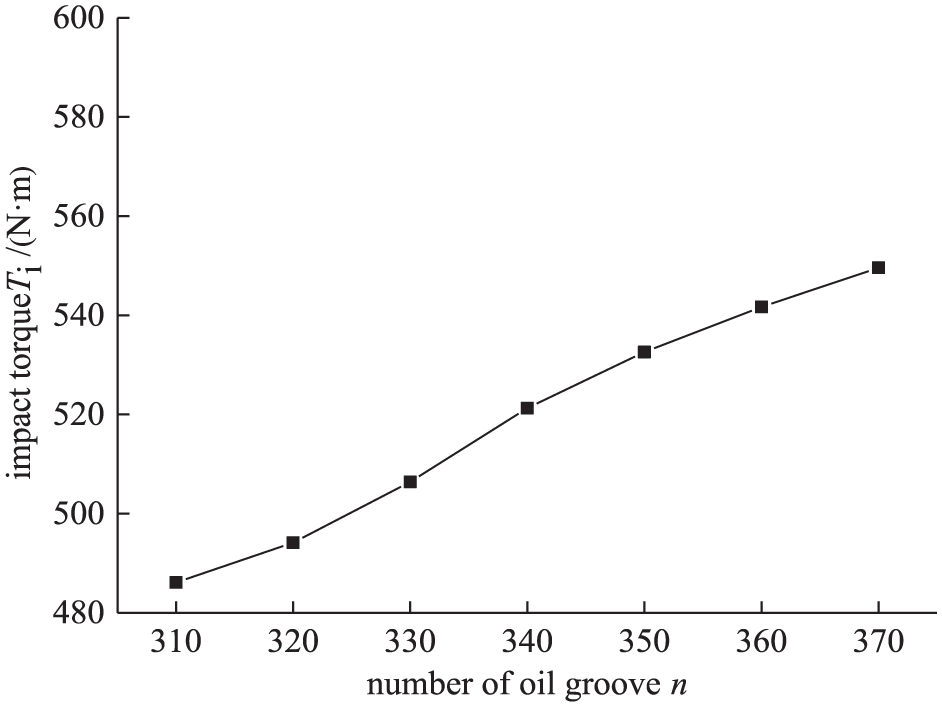
Relation between number of oil grooves and impact torque.
Width of oil grooves
The relation between the impact torque and the width of oil grooves is shown in Figure 12. The figure shows the impact torque increases with the increase in the width of oil grooves. It is because the velocity distribution changes with the oil grooves arrangement, and the effect of oil impact enhances.
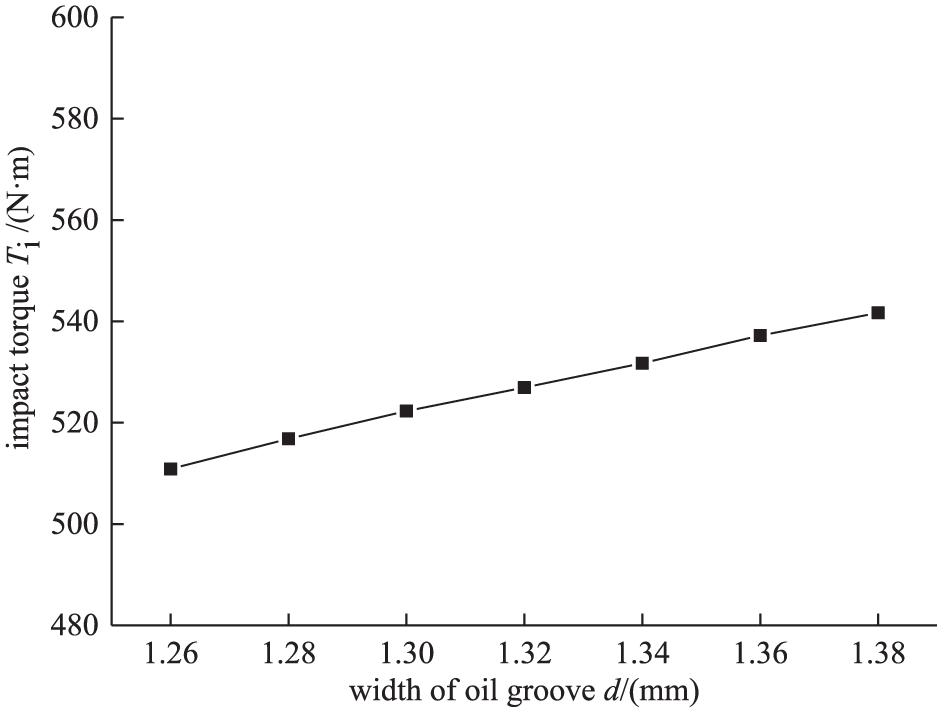
Relation between width of oil grooves and impact torque.
Eccentricity
The relation between the impact torque of oil film and the eccentricity is shown in Figure 13. When the eccentricity increases, the impact torque has an increasing trend but gets a small fluctuation when the eccentricity is between 391 and 401 mm. It is because the eccentricity has complex effect on velocity distribution, therefore the impact torque varies.

Relation between eccentricity and impact torque.
Inner diameter of eccentric circle
The relation between the impact torque of oil film and the inner diameter of eccentric circle is shown as Figure 14. With the increase in the inner diameter of eccentric circle, the shear torque of oil film has a decreasing trend. With the variance of velocity distribution of the oil film, the impact torque changes as the figure shows.

Relation between inner diameter of eccentric circle and impact torque.
Depth of oil grooves depth
The relation between the impact torque of oil film and the depth of oil grooves is shown in Figure 15. With the increase in the depth of oil grooves, the impact torque of oil film decreased. The velocity distribution of the oil film has a significant effect on the impact torque.

Relation between depth of oil grooves and impact torque.
Therefore, as shown from Figures 11–15, the impact torque is affected by the parameters of oil grooves. The main reason is that the velocity distribution and dynamic pressure of flow field on the sidewalls will change as the variety of the structure of oil grooves.
Meanwhile, the output torque of HVD in the oil film shearing stage consists of the shear torque and the impact torque. As shown from Figures 6–15, affected by dynamic pressure of flow field on the sidewalls of oil grooves, the impact torque of oil grooves accounts for nearly one-third of the output torque of HVD, and the shear torque accounts for nearly two-thirds, which is mainly decided by the shear stress. Therefore, the oil film shear torque plays a more important role in total torque.
The effects of oil groove parameters on output torque
The geometric module and finite element module were packaged by Simcode in iSIGHT. The effects of double arc oil groove parameters were analyzed by the DOE. The sensitivity of each parameter, main effects, and interaction effect were analyzed.
Pareto graph illustrates the effect of each oil groove parameter on the output torque. The blue bars represent the positive effects, they express that with the parameters grows, the response increases. While the red represent the negative effect, they express that with the parameters grows, the response decreases. As Figure 16 shows, the effect of eccentricity and oil grooves depth on the output torque is positive, but others are negative. The positive response of the eccentricity, 14.37%, is the most obvious, and the eccentricity and inner diameter of eccentric circle are sensitive parameters to output torque. The interaction between the inner diameter of eccentric circle and eccentricity, accounting for 8.81%, has a quite strong positive effect on output torque. However, the interaction between the inner diameter of eccentric circle and the number of oil grooves has the most significantly negative effect, −12.69%.

Pareto graph of the effects of oil groove parameters on output torque.
In Figure 17, the gradient of oil groove parameters is consistent with the effect in the Pareto graph. The bigger the gradient is, the more obvious the effect of parameter on the response is. As shown in figure, the effect of the eccentricity and the depth are nearly linear. With the effect of quadratic term, the effects of the inner diameter of eccentric circle, the number of oil grooves, and the width of oil grooves on output torque are parabolic.

Main effect graph of the effect of oil groove parameters on output torque.
Conclusion
An analysis platform, which was built to discover the influence of double arc oil groove parameters on oil film torque of friction pairs in HVD, was designed based on flow field parametric modeling, numerical stimulation, and DOE. The conclusions are as follows:
The shear torque of oil film decreases with the width of oil grooves, the number of grooves, and the diameter of the inner eccentric and gets fluctuated with the growth of eccentricity and oil grooves depth. Meanwhile, the number and width of oil grooves have a greater influence on shear torque. The oil film shear torque is mainly affected by coefficient of effective area which is determined by oil groove parameters. Besides, the shear stress and shear torque will be affected by velocity distribution of flow filed.
The impact torque increases with the width of oil grooves, the number of grooves, and the eccentricity and decreases with the inner diameter of eccentric circle and depth of oil grooves. The main reason is that the velocity distribution and dynamic pressure of flow field on sidewalls will change as the variety of the structure of oil grooves.
The output torque consists of shear torque and impact torque. The shear torque accounts for nearly two-thirds and the impact torque is one-third, so the oil film shear torque plays a more important role in total torque. The effect of eccentricity and oil grooves depth on the output torque is positive, but others are negative. In addition, the eccentricity and inner diameter of eccentric circle are sensitive parameters to output torque.
The platform is integrated with CAD, CFX, and DOE by utilizing trail files, script files, batch commands, and parameterized command flow to set up parameters automatically and improve simulation efficiency. Effects of double arc oil groove parameters on shear torque are analyzed accurately, and a new method and theoretical foundation are provided for design of complex oil grooves of friction pairs in HVD.
Footnotes
Handling Editor: Pietro Scandura
Declaration of conflicting interests
The author(s) declared no potential conflicts of interest with respect to the research, authorship, and/or publication of this article.
Funding
The author(s) disclosed receipt of the following financial support for the research, authorship, and/or publication of this article: This study was supported by the Young Science Research Foundation of Shanxi Province (No. 201601D021066) and the Key Project of Key Research Programs of Shanxi Province (No. 03012015002).
