




Abstract
A new simplified analysis is carried out to predict the dynamic response of clamped metal sandwich plates with various lattice cores subjected to impulsive loading. Based on the yield condition for sandwich plate cross-section, the interaction of bending moment and axial force for the section is decoupled. The simplified analytical solutions of the maximum midspan deflection and structural response time are obtained. Moreover, neglecting the effect of bending moment, a simplified plastic-string model is developed. Comparisons of the present theoretical predictions with previous analytical and numerical results are conducted and good agreement is achieved for a wide range of sandwich core topologies.
Introduction
Sandwich structures have been widely used because of their excellent mechanical performance compared with monolithic structures, such as lightweight, high specific strength, high specific stiffness.1–3 Usually, sandwich structures consist of two thin face sheets and a lightweight core and the excellent properties of such structures mainly depend on the innovative core topologies design. Thus, several kinds of core topologies for sandwich structures have emerged, such as metal foams, honeycombs, pyramidal lattice truss core.2,4–6
Over the last decade, the shock resistances of sandwich structures with various lightweight cores subjected to blast loading have been investigated extensively. Xue and Hutchinson7,8 have made a comparison between the monolithic solid plates and the metal sandwich plates with pyramidal truss core, square honeycomb core, and folded plate core under the same conditions and results indicated that the blast resistance of metal sandwich plates is superior. Also, numerous numerical simulations were carried out to study the dynamic response of metal sandwich structures with a variety of core topologies subjected to air blast loading and underwater blast loading.9–12 Meanwhile, many researchers13–16 experimentally studied the shock resistance of metal sandwich structures using the metal foam projectiles which can be adopted to simulate the shock loading. These experiments also demonstrated that the sandwich structures have better shock resistances than monolithic solid structures under the same conditions.
Much effort of establishing theoretical models to predict the blast response of metal sandwich structures has also been devoted. Fleck and Deshpande 17 proposed a theoretical model to analyze the structural response of clamped sandwich beams under uniform impulsive loading, in which the dynamic response was sequentially divided into three steps. Moreover, based on the classical yield locus of sandwich beam section, the approximate yield criterions were employed. Subsequently, Qiu et al.9,18 adopted this analytical method to research the structural response of a clamped sandwich beam under blast loading acting in the central region and conducted finite element (FE) simulation to validate this theoretical model. However, the yield criterion in the aforementioned analysis does not take into account the effect of core strength. In order to capture the structural response more accurately, a new yield criteria considering the effect of core strength for the symmetric and asymmetric sandwich cross-sections was proposed by Wang and co-authors,19–22 and a membrane factor method 23 was used to predict the large deflection impulsive response of clamped metal circular sandwich plates and sandwich beams based on this new yield criterion.24–26 Results showed that the solutions of impulsive response lie in the upper and lower bounds using this method and are accurate enough to capture the structural response. The plastic limit loci of interaction of bending moment and axial force result in several complications for analyses of dynamic response of the sandwich structure in above models. Therefore, it is necessary to establish a simplified prediction model for decoupling the bending moment and the axial force to capture the large deflection response for the sandwich structure with a wide range of core topologies.
The objective of the study is to establish a new simplified analysis method to capture the structural response of clamped metal sandwich plates with various lattice cores under impulsive loading. The organization of this article is as follows. First, the basic problem is described in section “Problem formulation.” Then, section “Analytical solutions for decoupling model” deals with the decoupling model of the structural response and section “Analytical solutions for plastic–string model” proposes a further simplified plastic-string model. Moreover, comparisons of the present theoretical predictions with the previous analytical and numerical results of the sandwich plates with a wide range of lattice core topologies are carried out in section “Results and discussion.” Finally, section “Concluding remarks” outlines concluding remarks.
Problem formulation
Herein, a metal sandwich plate with lattice core subjected to impulsive loading
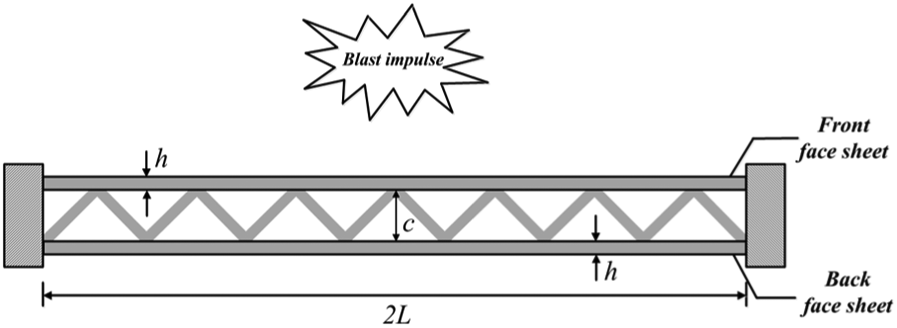
Sketch of a fully clamped sandwich plate subjected to impulsive loading.

Material properties of sandwich structure: (a) face sheets and (b) core.
For this problem, Fleck and Deshpande
17
assumed that the structural response can be sequentially divided into three steps: fluid–structure interaction, core compression, and beam bending/stretching. As the complexity of the fluid–structure interaction, this step is neglected and an impulse

For the core compression step, the plastic energy is dissipated by the core deformation and the average compressive strain

where
When the core compression step ends, the total sandwich plate attains the uniform common velocity

where

while the fully plastic axial force is assumed to be insensitive to the degree of the compression of the core 17 and it can be expressed as

where
Therefore, the structural response of sandwich plate under impulsive loading can be redivided into three stages in the following order: stage I is the stage of core compression; stage II is the stage of pure bending; stage III is the stage of plastic string. In addition, there exits two phases of the structural motion: in phase I, there are two stationary plastic hinges at the fixed ends and other two traveling plastic hinges toward the midspan; in phase II, two traveling plastic hinges merge and keep stationary at the midspan. Moreover, according to the magnitude of the impulse loading, the transition from stage II to stage III may occur in either phase of the structural motion. For the high impulse loading, the transition will occur in phase I of the motion, while for the low impulse loading, the transition will occur in phase II of the motion. Then, there exits two critical impulse loading values

and

where
According to the above analysis, we can get the following three cases. For the case of
Analytical solutions for decoupling model
The midspan deflection did not attain the critical value
,
Similar to Fleck’s analysis,
17
sketches of the velocity profile and the free-body diagram for the sandwich plate are given in Figures 3–5. When the motion keeps in phase I, there will be two stationary plastic hinges at the fixed ends and other two traveling plastic hinges toward the midspan, as sketched in Figure 3(a). The central portion between two traveling plastic hinges keeps the constant velocity

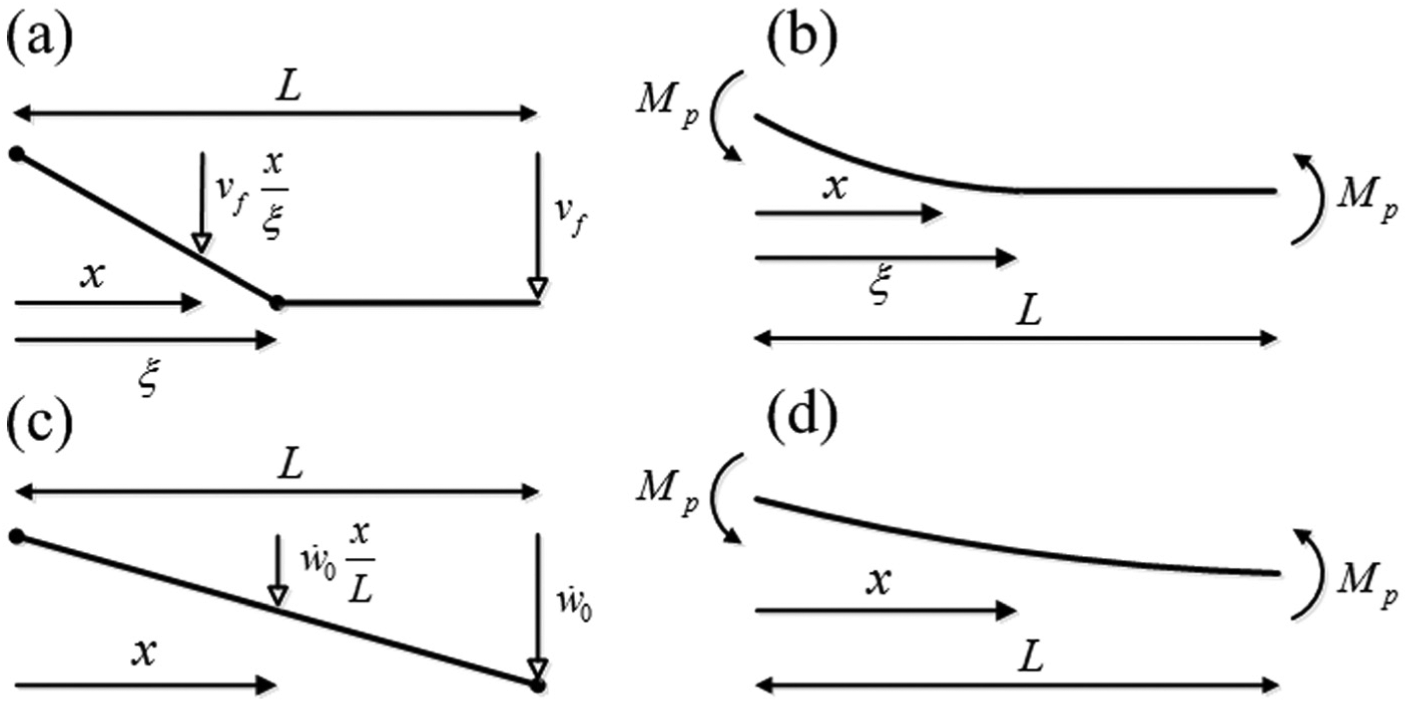
Sketch of the velocity profile and the free-body diagram for the case of
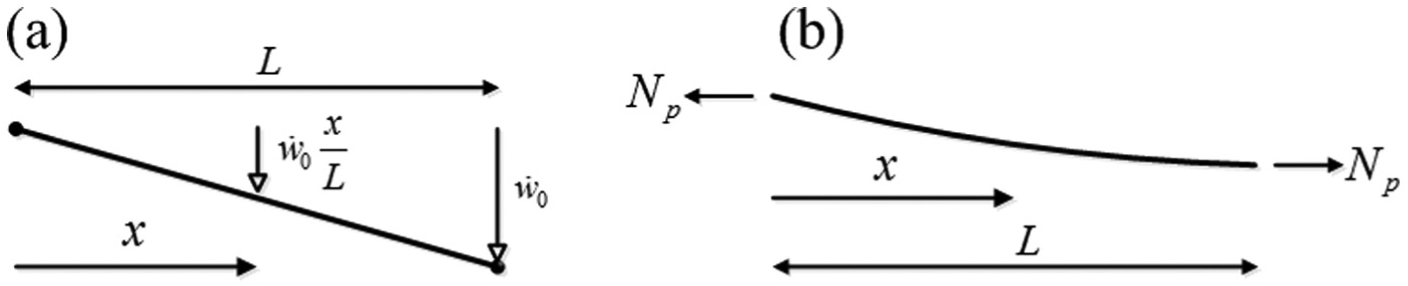
Sketch of the velocity profile and the free-body diagram for the case of

Sketch of the velocity profile and the free-body diagram for the case of
Thus, we obtain the relation of

Then, the two traveling plastic hinges will merge into one plastic hinge at midspan with the continuation of the motion, that is,

Correspondingly, the midspan deflection

Next, the motion will keep in phase II. For this case, two plastic hinges at the fixed ends and one plastic hinge at the midspan will all keep stationary, as sketched in Figure 3(c). Based on the conversation of moment of momentum for the half sandwich plate about a fixed end in Figure 3(d), we have the governing equation

Solving equation (12), we have

Using the initial condition

and
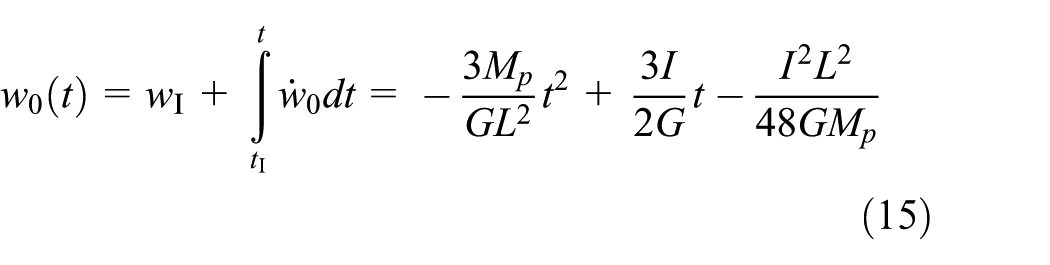
When


The midspan deflection attained the critical value
in the phase Π of the structural motion,
When the impulsive loading is moderate, the critical midspan deflection will attained in phase II of the motion. Before the midspan deflection attained the critical value

A good approximation solution of equation (18) can be expressed as29,30

Then, the final midspan deflection

with initial conditions at time

and

where
As the midspan deflection and the kinetic energy of the sandwich plate in the two stages should be equal, we can get the midspan velocity initial condition by equating the kinetic energies at

Combining equations (19) and (23) yields

Using the critical deflection

Then, the midspan velocity at the critical deflection is

Thus, the final response time is

and the final midspan deflection is

The midspan deflection attained the critical value
in phase I of the structural motion,
As the increase of the impulsive loading, the critical midspan deflection value

According to the critical time

Similarly, solving equation (23) yields

The midspan velocity at the critical deflection is

Thus, the final response time is

and the final midspan deflection is

For simplicity, we introduce the following dimensionless parameters


Then, the aforementioned formulations of the final response time and midspan deflection have the following dimensionless forms
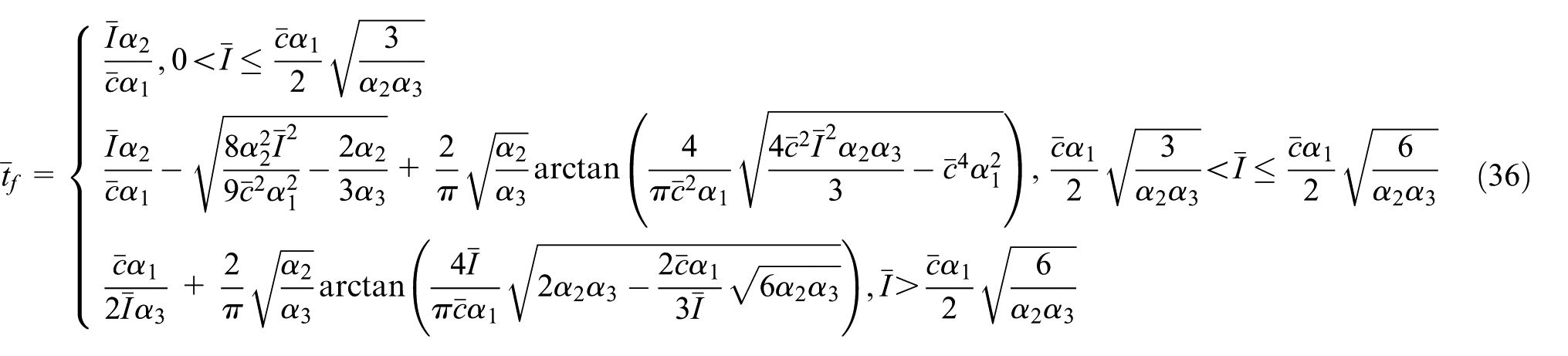
and

where
Analytical solutions for plastic–string model
For the dynamic response of the clamped metal sandwich plates under impulsive loading, as the deflection increases, the effect of the bending moment diminishes and the main effect of structural response is by the axial (membrane) force. Correspondingly, the effect of the bending moment can be ignored in analysis when the deflection of the sandwich plate is larger. Therefore, the impulsive response prediction of a clamped metal sandwich plate in Figure 1 can be obtained by a plastic-string model. The governing equation of plastic-string response can be given by equation (18). The form of the solution is

Using the initial condition

Therefore, the final response time is

and the final midspan deflection is

Correspondingly, the dimensionless forms are

and

Results and discussion
For the verification of the present theoretical models, comparisons between the present theoretical prediction results and the previous analytical and numerical results of the metal sandwich plates with various lattice cores are conducted.
Numerical studies on the impulsive response of sandwich plates with unfilled and metal foam-filled sinusoidal cores are carried out by Zhang et al.
31
and be adopted here. For the metal foam-filled sinusoidal core sandwich plates, the core web was filled by the metal foam. In the FE analysis, the commercial FE code ABAQUS/Explicit was employed. The whole model was established with eight-node linear brick element with reduced integration (C3D8R). Since the boundary of plate was constrained during blasting, all the displacements and rotations of the nodes at ends of the plate were set to zero. The friction was not considered and a general contact algorithm with a frictionless contact option was used in the numerical calculation. The dimensionless geometrical dimensions and material parameters are listed as
Figure 6 shows the comparisons for the relation of the normalized maximum midspan deflection

Analytical and numerical results for the normalized maximum midspan deflection of the sandwich plate versus the normalized impulsive loading: (a) the unfilled sinusoidal plate core and (b) foam-filled sinusoidal plate core.

Analytical and numerical results for the non-dimensional structural response time of the sandwich plate versus the normalized impulsive loading: (a) the unfilled sinusoidal plate core and (b) foam-filled sinusoidal plate core.
Numerical results of sandwich plates with the pyramidal truss core, square honeycomb core, and corrugated core under impulsive loading that carried out by Xue and Hutchinson 8 are adopted too. Comparisons of the present theoretical predictions and the previous theoretical predictions 25 as well as the FE results for the normalized maximum midspan deflection of sandwich plates with the pyramidal truss core, square honeycomb core, and corrugated core are shown in Figure 8. It is also observed that the present analytical model is in excellent agreement with FE results and has better accuracy than that of the previous membrane factor method at high impulsive loading. The good agreement between the analytical model and FE results may justify that the high initial peak, non-uniform collapsing, and fluctuating crushing behavior of the lattice cores using r-p-p-l model have small effect on the global deformation of the sandwich plates with various lattice cores subjected to impulsive loading and these can further prove the applicability of the present model.

Analytical and numerical results for the normalized maximum midspan deflection versus the normalized impulsive loading of sandwich plates: (a) pyramidal truss core, (b) square honeycomb core, and (c) corrugated plate core.
Concluding remarks
A new simplified analysis for the dynamic response of clamped metal sandwich plates with various lattice cores under impulsive loading is conducted. The simplified theoretical solutions for the maximum midspan deflection and structural response time are derived by decoupling the moment–axial force interaction. Comparisons of the present theoretical predictions with the previous analytical and numerical results are carried out and good agreement is achieved for a wide range of sandwich core topologies. It is shown that the present theoretical models are simple and efficient to predict the impulsive response of the metal sandwich plates with various lattice cores in engineering applications.
Footnotes
Appendix 1
Handling Editor: Wensu Chen
Declaration of conflicting interests
The author(s) declared no potential conflicts of interest with respect to the research, authorship, and/or publication of this article.
Funding
The author(s) disclosed receipt of the following financial support for the research, authorship, and/or publication of this article: The authors gratefully acknowledge the financial supports of NSFC (11372235, 11572234, and 11502189), China Postdoctoral Science Foundation funded project (2015M572546).
