




Abstract
Internet technologies bring methods to help bridge safety management, to collect data or monitor conditions in real time, and to comprehensively record or analyze the collected data of on-site conditions in real time. In this study, the wireless sensor networks and smart building technologies are adopted to help the bridge safety information transmission and management. The study proposed a bridge safety–monitoring system conceptual framework by applying the ZigBee wireless sensor and control technology. The conceptual framework demonstrated by a prototype includes four major subsystems: (1) monitoring units; (2) photovoltaic units; (3) wireless communication system; and (4) bridge safety–monitoring server system. This system can monitor and analyze in real time the conditions of a bridge and its environment, including the waters levels nearby, pipelines, air, and other safety conditions. The detected data and images are transmitted to the server and database for users to have real-time monitoring of the bridge conditions via mobile telecommunication devices.
Keywords
Introduction
Bridges play an important role in both rural and urban transportation in every country. For some island-type countries or countries located in volcanic zones, incidents of bridges or bridge piers severely damaged by typhoon, floods, and earthquakes are frequently reported each year. In addition to floods, typhoons and earthquakes may also cause disastrous accidents of fires, explosive gas leakage, and liquid chemical leakage. When disastrous accidents happen, different disasters and damaged sites require different professional disaster rescue knowledge and equipment in order to plan and achieve optimal rescue results. However, the rescue activities require related information for helping the decision-making process; lack of information about the damage site can impede information management at the rescue center and rescue operation, resulting in poor rescue efficiency or even preventable causalities.
The management of bridge safety have faced the following challenges: (1) failure to monitor on-site conditions in real time; (2) data collection requires large-size electronic equipment, often resulting in inaccurate monitoring results or higher costs and higher power consumption; and (3) failure to record and analyze the collected data and retrieve information from the data on-site conditions in order to represent the condition of bridge and report the information about the damage site.
Among the emerging trends of industrial development, Internet of things (IoT) and smart building are the international trends of technology development. Both of the IoT and smart building require communication technology to support data transformation between the sensors and management systems. The sensor and wireless communication technologies can help in the development of bridge health–monitoring system to help the abovementioned challenges.
The concept of wireless system was started in the late 20th century, M Weiser (1991, 1994)1,2 proposed the concept of ubiquitous computing, which shed light on the earlier concept of wireless communication and provided a blueprint for IoT. IoT interactions include three main dimensions: time, place, and thing. They can be man-to-man, man-to-thing, and thing-to-thing interactions through information transmission on the IoT. With the maturing IoT technology, an environment in which everything can communicate with one another can be created. There are three layers in the architecture of an IoT: (1) sensor layer: mainly responsible for sensing and collecting all kinds of physical, identification, audio, and video data from the physical world through the application of sensors, radio frequency identification (RFID), barcodes, and other data collection technologies; (2) network layer: mainly responsible for transmitting data reliably and safely through wider and faster networks connections currently available on the Internet, wireless communication networks, satellite communication networks, or cable TV networks; and (3) application layer: composed of an application support sublayer and an application service sublayer with the former applied to support information coordination, sharing, and interconnection across different industries and applications, while the latter applied in fields such as smart traffic, smart home, smart logistics, smart medicine, smart power, digital environmental protection, digital farming, and digital forestry.
A wireless sensor network (WSN) consists of three components respectively responsible for sensing, communication, and computing (hardware, software, and algorithms). In a WSN environment, each sensor (such as temperature sensor, sound sensor, or pressure sensor) distributed in the environment is a node that transmits signals through wireless communication to the base station of the network. Machine-to-machine communication can be made possible through the WSNs technology. The WSNs technology is an indispensable communication method for IoT. Each sensor has different communication requirements such as frequency, power consumption, and complexity. These requirements also have a direct influence on the design consideration of WSNs such as its power, storage, computing speed, and bandwidth. Currently, the WSNs technology has been applied in many civil fields such as environmental and ecological monitoring,3,4 healthcare monitoring,5–7 home automation,8,9 and traffic control.10,11
In this study, WSNs and smart building technologies are adopted to help the bridge safety information transmission and management. Previous research has applied the information and wireless communication technologies to develop computer-aided system for helping the task of bridge’s structure and health status monitoring.12–15
The smart bridge research attempts to enhance the quality of bridge health monitoring by different approaches. For example, in the research proposed by Zhou and Yi, 16 they conducted a systematic review of the current development of WSNs and the relevant technologies for supporting the bridge health–monitoring tasks. Their research has shed light on the understanding of both the advantage and disadvantage of using the emerging IoT technologies for bridge health monitoring. Based on the development of the WSN-based bridge health–monitoring system, other studies applied the WSN technologies to help the structure and health monitoring of different kind of bridges in the real world.17–19 Another approach focused on proposing theoretical framework or algorithm for optimizing the performance of wireless sensor placement (WSP).20–22
Although the previous works of bridge monitoring has shed light on using smart sensor to collect and analyze sensor data through one or a few sensors to help the evaluation about the state of the bridge; however, the development of smart sensor devices is ever-improving, the emerging smart sensors have multi-function and can help to make the management system more confident about understanding the situation of the bridge. Specifically, the study applies the ZigBee wireless sensor and control network to develop an IoT-based bridge safety–monitoring system that is capable of monitoring the environmental data of a bridge and transmitting the data to the mobile devices of bridge safety management staff for reference and documentation. 23 The ZigBee technology24,25 is a communication technology characterized by low power consumption, high safety, and support of a large number of network works. The proposed system’s framework can be used for helping in planning the bridge safety–management system.
Design of bridge safety–monitoring system framework
The study proposes a framework to help the development of bridge safety management by using smart sensor devices and wireless communication technologies. In addition, the system proposed in this study can monitor and analyze in real time the conditions of a bridge and its environment, including the waters levels nearby, pipelines, air, and other safety conditions. The detected data and images are transmitted to the server and database for users to have real-time monitoring of the bridge conditions via mobile telecommunication devices.
Specifically, the system is composed of four main subsystems: (1) monitoring units: monitoring the sensor and devices that installed in the bridge environment; (2) photovoltaic (PV) units: convert solar energy into electrical power through the PV panels installed on the bridge; (3) wireless communication system: communication devices connecting the bridge-monitoring devices and the cloud-based server; (4) data processing system: a cloud-based server with a dynamic database that stores bridge condition data and analyzes the data transmitted from the monitoring devices. The following is an introduction to the design of each subsystem.
Monitoring units
The monitoring units are the sensor layer of the IoT in the system developed in this study. There are three kinds of monitoring units for bridge safety monitoring in this system: (1) river water level–monitoring units: monitoring the river water levels and alerting anomalies in the water levels; (2) river water pressure monitoring units: monitoring the river water levels and alerting anomalies in the water pressure; (3) gas monitoring units: monitoring the conditions of several gases and alerting anomalies in the gases. The study applied Arduino development board to realize the design prototype of the bridge safety–monitoring system. According to the MIT Technology Readiness Level, the proposed framework and the prototype are in Level 3—development of limited functionality to validate properties and predictions critically using non-integrated software components. The sensors applied to realize each units of the bridge safety–monitoring system were introduced as following:
River water level–monitoring units: the study applied the RB-02S048 water-depth detection sensor (Figure 1) which is built by China Harbin Okumatsu Robot Technology Co to monitor the level of water depth. The water level exposed through a series of parallel wire circuit line mark to detect and measure the water droplets/size to determine water level. The sensor can help to convert water level to an analog signal and easy to communicate with the main monitor system through wire or wireless communication network. A sample code to retrieve water level value from the sensor can be design as follow.
River water pressure–monitoring units: the ZIYUN G3&4 water flow sensor (Figure 2) was applied to measure the water flow of the development prototype. The sensor consists of a plastic valve body, a water rotor, and a hall-effect sensor. When water flows through the rotor rolls, the sensor detect the speed changes of water flow and outputs a signal to report the speed of water flow. Due to the proposed design concept of a bridge-monitoring system in this study is at prototype level, the ability of the sensor only allows flow rate rage from 0 to 60 L/min and water pressure ≤2.0 MPa.
Gas-monitoring units: due to some gas pipeline was constructed and adhered to the bridge. To monitor the status of gas is helpful preventing fire when an accident occurs to a bridge. The study applied Grove—Multichannel Gas Sensor (Figure 3) to help detect many kinds of vital gases including carbon monoxide (CO), nitrogen dioxide (NO2), hydrogen (H2), ammonia (NH3), and methane (CH4).

Water level–monitoring sensor and sample code.
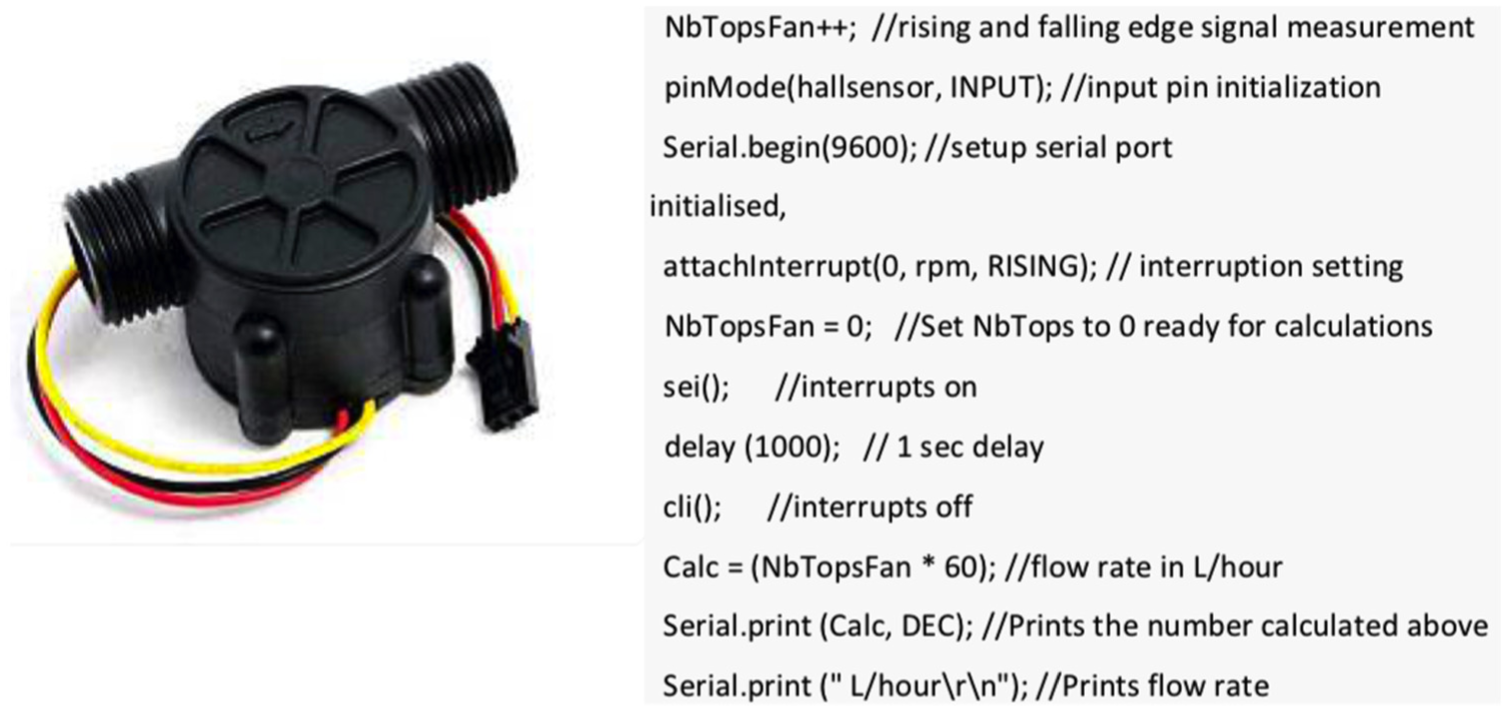
Water flow sensor and sample code.

Grove—Multichannel Gas Sensor and sample code.
The monitoring units are designed to be energy-efficient, low-cost, small-sized, and capable of sensing the environment. Each monitoring unit is like a microcomputer, equipped with a sensor, a computing device, and a wireless transmission device. The units can monitor and collect data of the conditions of three important factors in a bridge environment and the pipe: water level, water pressure, and gas and then process the data through simple computing before sending the processed data to the data storage server via wireless transmission (Figure 4).

Monitoring units and the sensors.
In addition, due to the sensor, wireless gateway are all electronic components. The framework should also consider the failure modes when the framework is realized as a smart system and applied to the real-world context. According to the Failure Modes and Effects Analysis (FEMA), the subsystem proposed in this should also contain the five dimensions for failure response and operation: (1) items/process/function, (2) potential failure model, (3) potential effects of failure, (4) detection methods and quality control, and (5) recommended actions.
PV units
Solar energy is used as a supplementary power source for the system to reduce its costs. The PV units convert solar energy into electrical power through the PV panels installed on the bridge (Figure 5(a)). The solar power is stored in the batteries and serves as a supplement to the power grid to power the bridge safety–monitoring system and the bridge lamps. In addition, there is a sun-tracking mechanism in the system that can automatically track the sun and adjust the tilt angles of the PV panels accordingly to ensure optimal solar energy collection (Figure 5(b)).

(a) PV unit panels on the bridge and (b) automatic sun-tracking mechanism.
Wireless communication system
The major function of the wireless communication system is to connect all the components in the bridge safety–monitoring system, including the sensors, computing system, and signal receptors. The wireless communication system is based on the ZigBee protocol, which is mainly characterized by low-speed transmission, low power consumption, high safety, and support of large quantities of network nodes and multiple network typologies. There are three ZigBee network typology structures: star network, cluster network, and mesh network. There are three kinds of devices in the ZigBee network layer protocol: coordinator, router, and end devices (Figure 6). The coordinator is the core of the network, responsible for the establishment and control of the network. The router is responsible for transferring communication and maintaining communication pathways in the network. The end devices are different kinds of devices connected through ZigBee. Compared with Bluetooth, ZigBee can support more network nodes with broader working bandwidths. In addition, ZigBee has lower development costs and longer transmission distances than Bluetooth. These are the reasons why ZigBee is adopted as the communication technology of the system developed in this study.

The ZigBee wireless communication system.
Data collection and computing module
The data collected by the abovementioned three types of monitoring units are transmitted using the ZigBee technology to the cloud server system for further computing and decision-making. The decisions made by the system, related data analysis and alert messages are all transmitted by the server system via the Internet to the management center and mobile devices of management staff for them to have a real-time and comprehensive understanding of the bridge’s surrounding environment and keep records of the data for appropriate responses when a disaster occurs (see Figure 7).

The informative structure of the proposed system.
Discussion
To help the management of bridge safety more efficiently is one of an important issue for the development of the smart city. Wireless network and sensor technology can help bridge safety management system to collect data and monitor the components of bridge conditions in real time. This study is intended to propose a conceptual framework of bridge safety–monitoring system that integrates the technologies of IoT, ZigBee, PV power generation, and monitoring sensors.
The proposed system framework and the suggested sensors were connected by using ZigBee WSN as the primary communication protocol. The system is expected to help the management of bridge safety tasks to become a dynamic and data-driven approach. This framework is unique in its ability to monitor the bridge environment, transmit the environmental data through wireless communication and send alerts to the bridge-management staff in real time for prompt reactions. All the collected sensor data sent to the server in the system can be used for big data analysis or follow-up research. In addition, not only the introduced four kinds of sensors but also other compatible sensors that are related to the bridge health structure monitoring can be added to the framework to help the system efficiency in real-world cases. For example, accelerations, displacement, strain, and temperatures are also important factors indicating bridge safety. In addition, solar power is used as a supplementary power source for the system and lamps on the bridge, which helps to conserve energy and reduce carbon emissions.
However, the system developed in this study is a preliminary exploration and the proposed bridge-management system that was at the conceptual framework level and not yet realized in real-world cases. Although the framework is contributing to shed light on the proposed WSN as well as the machine-to-machine communication protocol. However, there are some limitations in this study and could be improved by future research. First, the study focuses on proposing a conceptual framework for bridge health management. The framework was realized by a prototype and not yet evaluated with a simulation or experiment in the real-world scenario. Future research is suggested to apply the system to a realistic context of bridge safety management for evaluating the performance and reliability of the proposed framework. Second, the study acknowledges that the effect of some real-world factors may affect the service quality of the proposed system. The future study could apply the system to the real-world case to explore the other factors that may affect the quality of the system such as electromagnetic interference and the noise contamination.
In addition, to meet the goal of bridge safety management, the key technology will be the data communication method, data analyzing the model, and the algorithm of system status projection. Future research could also focus on collecting simulation or real-world data for developing more advanced computing models and operational practices for the system.
Footnotes
Acknowledgements
The authors would like to thank all reviewers who have contributed to the paper by generously offering their time and insightful comments.
Handling Editor: Stephen D Prior
Declaration of conflicting interests
The author(s) declared no potential conflicts of interest with respect to the research, authorship, and/or publication of this article.
Funding
The author(s) disclosed receipt of the following financial support for the research, authorship, and/or publication of this article: This research was funded by the Ministry of Science and Technology (MOST) of Taiwan under the grant MOST 106-2511-S-163-001.
