




Abstract
This study focuses on analytical solutions of the fracture grouting pressure. Based on the cavity expansion and fracture grouting mechanism, the small deformation in the elastic zone, large deformation in the plastic zone, and non-associated flow rules are assumed. The solutions of the fracture grouting pressure based on the Unified Strength failure criterion, spatial mobilized plane criterion, Mohr–Coulomb failure criterion, and modified Cambridge model (MMC) are proposed for the large-deformation and small-deformation assumptions, respectively. A parameter analysis was conducted to analyze the differences between large-deformation and small-deformation theories. A comparison of the local test data with theoretical results reveals that the Cambridge model is more suitable for weakly consolidated soil and that the Mohr–Coulomb theory is suitable for over-consolidated soil. For all yield criteria in the study, the analysis indicates that the large-deformation theory has more reliable results than the small-deformation theory. The results in this study can direct the design and operation of fracture grouting.
Introduction
Fracture grouting has been widely used in traffic and civil engineering fields. It is applied to projects such as the treatment of subgrade landslide of highways and reinforcement of pile foundations. Most studies on the mechanism of fracture grouting and fracture grouting pressures focused on cracked rock masses. Only few studies were related to the mechanism of fracture grouting and calculation of the fracture grouting pressure. For example, Brantberger et al. 1 derived the solution of the grouting pressure in the control of the grout diffusion range and vertical uplift based on field data and the Grouting Intensity Number (GIN) criterion. Weaver 2 elaborated on the method to determine the grouting pressure based on the grouting log and hydrological data. Cohen et al. 3 analyzed the cavity expansion pressure under the generalized yield criterion and obtained the limit expansion pressure. Zhao et al. 4 obtained the relationship between grouting pressure and radial stress by comparing field-measured data with numerical simulation results. Dai et al. 5 discussed the effect of the pore water pressure, permeability resistance, and initial grouting pressure on the grouting pressure dissipation with the theory of fluid mechanics and elastic mechanics. Zou and colleagues6–8 have done much work in this field. Zou and Li 6 developed the cavity expansion problem by considering hydraulic–mechanical coupling and proposed an improved numerical method and stepwise procedure to obtain the theoretical solution. Zou and Yu 7 deduced the theoretical solution of the cavity problem with the effect of the out-of-plane stress based on the generalized Hoek–Brown failure criterion. Zou and Zuo 8 proposed a similarity solution for the synchronous grouting of shield tunnels in the vertical non-axisymmetric displacement boundary condition. These studies effectively developed the research on fracture grouting, but other studies involved the qualitative analysis and numerical simulation, which could not provide the calculation formulas for the fracture grouting pressure.
The main objective of this study is to introduce the results for the fracture grouting pressure in the undrained condition based on the cavity expansion model. The calculation formulas of the fracture grouting pressure under the conditions of different yield and large- and small-deformation theories are obtained. In addition, the fracture grouting pressure in four types of soils is calculated using the engineering example and parameter analysis correspondingly.
Problem definition
Assumptions
According to the engineering practice, fracture grouting is first compression and subsequently a fracturing process. The initial fracture grouting pressure is the limit grouting pressure of the compaction stage. Thus, the fracture grouting in the initial stage is mainly extrusion deformation and yields to the final destruction. 9 Based on this result, the following suppositions are made.
The bubble consolidation stage of fracture grouting can be considered a cavity expansion model for the plane strain condition. To easily analyze problems, the stress distribution because of the cavity expansion in soil can be considered in two zones: an elastic zone and a plastic zone (as shown in Figure 1). Figure 1 shows a cavity with an initial radius

Show of analysis for cavity expansion.
Model of simplified stress–strain softening
To consider the softening characteristics and dilatancy of the soil mass, the stress-strain-softening model based on the conventional geotechnical test is often used to consider the strain softening characteristics of the soil mass. Figure 2 shows that the simplified tri-linear model in Zhang et al. 10 and Read and Hegemier 11 can be used to represent the relationship between stress and strain.

Simplified stress-strain-softening model: (a) (σ1–σ3)–ε1 simplification curve, (b) εv–ε1 simplification curve, and (c) ε1–ε3 simplification curve.
As shown in Figure 2, the soil mass is linearly elastic before the peak stress according to the simplified constitutive law. In Figure 2(a), point A satisfies the initial yield function and point B satisfies the subsequent yield function. When the stress is at the residual strength after dropping, the soil mass continues to deform and plastic dilatancy occurs.
Radial displacement in the plastic zone
The non-associated flow rule is used in the plastic zone

where
2. The radial distance of the plastic zone is determined using the small-strain theory.
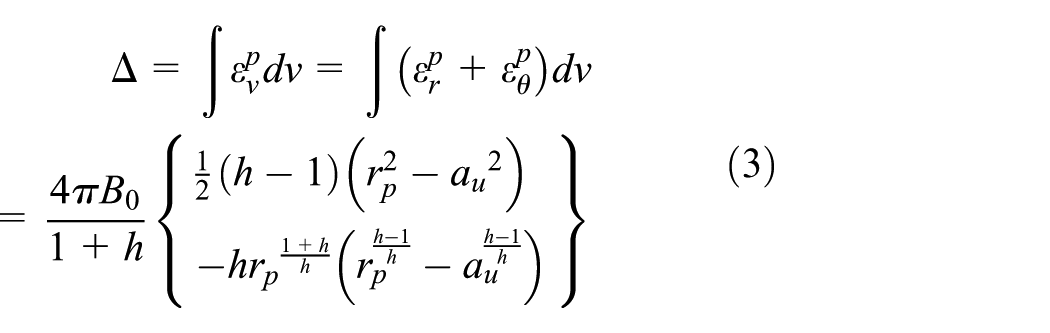
According to Ni and Cheng, 12 the volume variation of bore enlarging is equal to the elastic–plastic volume variation of the surrounding soil. There are

Hence

where
3. The radial distance of the plastic zone can be determined using the large-deformation theory.
According to Yang and Zou, 13 the deformation compatibility equation in the plastic zone of the large-determination theory is obtained by

Thus, the radial distance of the plastic zone in the large-strain condition is

where G is the shear modulus and can be defined as

Analytical solution of the elastic region
According to static equilibrium equations, the stress of the soil mass has the following relationship at any point

According to the axisymmetric solutions and boundary conditions (



where
Analytic solution of the fracture grouting pressure
Grouting pressure loss of the pipeline
When the inner diameter of the grouting tube is constant, and the inner surface smoothness slightly varies, the pipeline resistance is

where
Fracture grouting pressure based on Mohr–Coulomb failure criterion
Using the static equilibrium equations in the cavity expansion process based on the Mohr–Coulomb criterion (M-C criterion), we can obtain the plastic radius under large-strain and small-strain theories and the fracture grouting pressure. The limiting cavity expansion pressure according to the M-C criterion is

where


Fracture grouting pressure in the large-deformation theory.
Based on the M-C criterion and large-strain theory, the fracture grouting pressure can be obtained as

2. Fracture grouting pressure in the small-strain theory.
Based on the M-C criterion and small-strain theory, the fracture grouting pressure is

where
Stress of the plastic zone based on the spatial mobilized plane criterion
According to the literature, 14 in the plane strain condition, the radial and tangential stresses of the plastic zone based on the spatial mobilized plane (SMP) criterion are

where



When
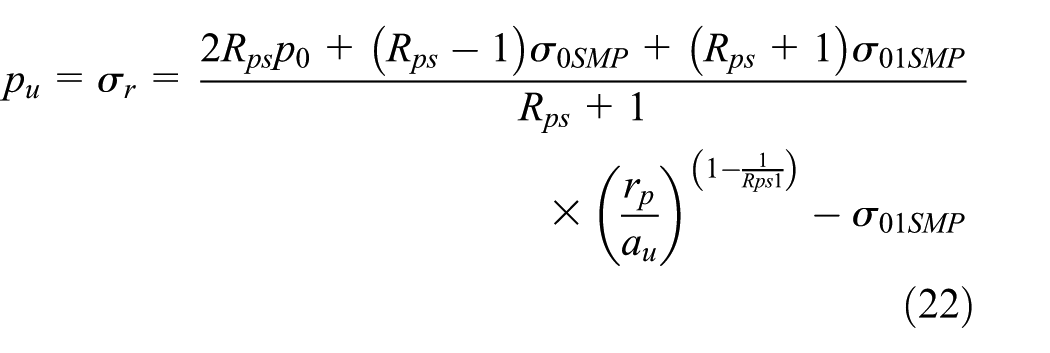
The deviatoric stress causes

Fracture grouting pressure in the large-deformation theory.
The fracture grouting pressure in the large deformation theory can be obtained by combining equations (6) and (22)

2. Fracture grouting pressure in the small-deformation theory.
The fracture grouting pressure in the small-deformation theory can be obtained by combining equations (4) and (22).
Fracture grouting pressure based on the Unified Strength criterion
According to the Unified Strength criterion (UN criterion), 15 the limiting cavity expansion pressure is

where


Fracture grouting pressure in the large-deformation theory.
Based on the UN criterion and large-strain theory, the fracture grouting pressure is obtained by

2. Fracture grouting pressure in the small-deformation theory.
Based on the UN criterion and small-strain theory, the fracture grouting pressure is

where
Fracture grouting pressure based on the Cam-Clay failure criterion
Based on the observation of Cao et al., 16 the expanding pressure in the Cam-Clay model (MMC criterion) is as follows

where


Fracture grouting pressure in the large-strain theory.
The fracture grouting pressure in the large-strain theory can be obtained by combining equations (6) and (30)

2. Fracture grouting pressure in the small-strain theory.
The fracture grouting pressure in the small-strain theory can be obtained by combining equations (4) and (30).
Results
To validate the proposed model, the predicted grouting pressures by the proposed model are compared with those from the real application of fracture grouting in Shaohuai highway K1302 section. To validate the proposed method in conformity with practical engineering, the measured data are compared with theoretical results under the SMP, M-C, MMC, and UN criteria. The basic parameters are as follows
Calculated data with actual data.
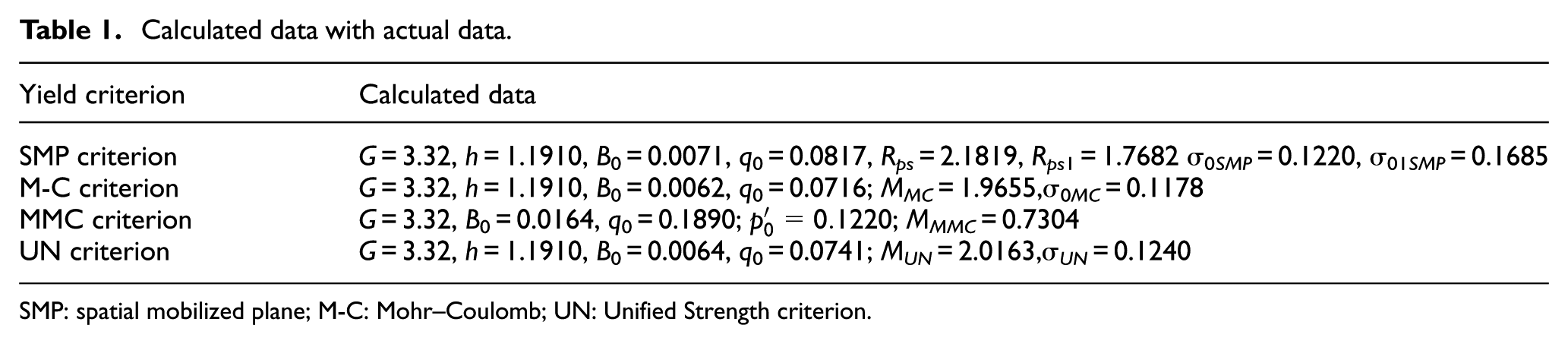
SMP: spatial mobilized plane; M-C: Mohr–Coulomb; UN: Unified Strength criterion.
Comparison with actual data (MPa).

SMP: spatial mobilized plane; M-C: Mohr–Coulomb; UN: Unified Strength criterion.
To further validate the proposed model, the predicted limiting pressures by the proposed model are compared with those from observation.
11
The basic parameters are shown as follows: the grouting pressure of the site measurement is 0.44–0.57 MPa;
Calculated data with the local test results.
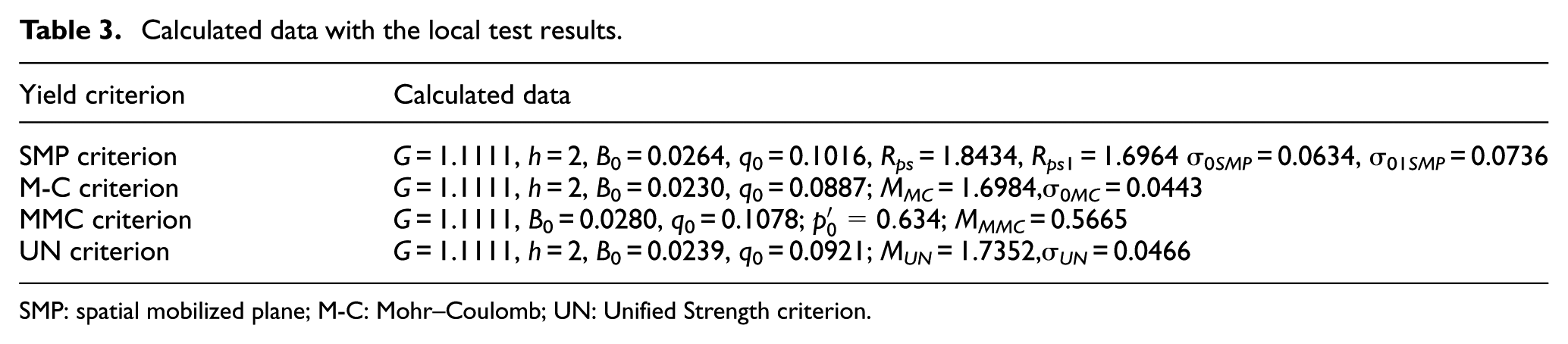
SMP: spatial mobilized plane; M-C: Mohr–Coulomb; UN: Unified Strength criterion.
Comparison with the local test results (MPa).
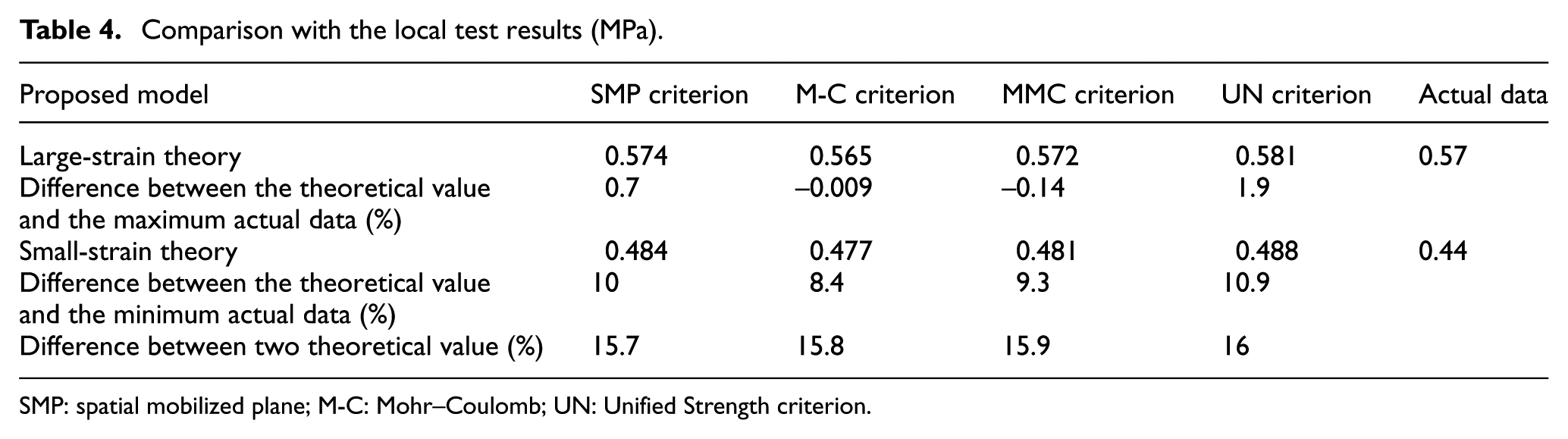
SMP: spatial mobilized plane; M-C: Mohr–Coulomb; UN: Unified Strength criterion.
As shown in Tables 1 and 2, the results based on the large-deformation theory are larger than those based on the small-deformation theory. In this article, the UN criterion has the maximum results, and the M-C criterion has the minimum results. Their difference is 2.8% for the effect of parameters m and b, which are considered in the M-C criterion.
The difference in the theoretical and measured results in large-deformation theory is less than 2% and that in small-deformation theory is approximately 10%. Thus, the theoretical results of the large-deformation theory are more reliable.
Discussion
To analyze the effect of dilation, deformation modulus, and Poisson’s ratio on fracture grouting pressures in different yield criteria and deformation conditions, the measured data of Shaohuai highway K1302 section were used to calculate and analyze as shown in Figures 3–5. The dilation coefficient in the M-C criterion is not considered because the M-C criterion is not suitable for dilation.
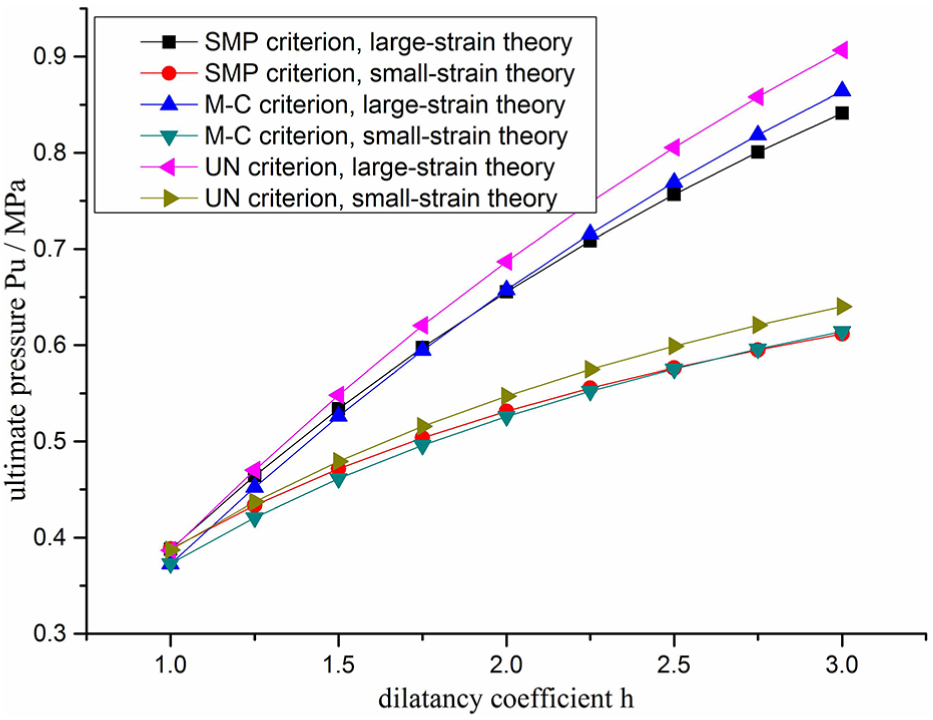
Relationship between the shearing dilation coefficient and the ultimate pressure of fracture grouting.

Relationship between the deformation modulus and ultimate pressure of fracture grouting.

Relationship between Poisson’s ratio and the ultimate pressure of fracture grouting.
In Figure 3, the increase in dilation results in a nonlinear increase in fracture grouting pressure, and the results are larger than that with the small-deformation theory. The difference is 32% when h = 3.0. When the soil has large deformation and displacement under the function of the grouting pressure, the soil is severely damaged. When the soil has small deformation, it is not seriously cracked and sheared; the soil only has plastic deformation. Therefore, the grouting pressure is less than that under large strain. In the dilation soil, the deformation theory is used. In non-dilation soil, similar results are observed for the fracture grouting pressure calculations of large- and small-deformation theories.
Figure 4 indicates that (1) the increase in deformation modulus results in a nonlinear increase in fracture grouting pressure, and the result with the large-deformation theory is approximately 6% larger than that with the small-strain theory; and (2) when the deformation modulus is small, similar results are observed for the calculated fracture grouting pressure with large- and small-deformation theories. Thus, the small-strain theory is used when the deformation modulus is small.
Figure 5 shows that the increase in Poisson’s ratio results in a nonlinear decrease in fracture grouting pressure, and the large-strain theory has a larger result than the small-deformation theory. Their difference is 25% when v = 0.45. When Poisson’s ratio is large, the large-deformation theory is used. When Poisson’s ratio is small, similar results are observed for the calculated fracture grouting pressure with the large- and small-deformation theories.
Figures 3–5 show that the fracture grouting pressure nonlinearly increases with the increase in dilation coefficients and deformation modulus but nonlinearly decreases with the increase in Poisson’s ratio. With the increase in deformation modulus and Poisson’s ratio, the MMC criterion has the maximum results, and the M-C criterion has the minimum results. The SMP criterion has similar results to the UN criterion, which are between MMC criterion and M-C criterion. The results of the fracturing grouting pressure calculation based on different strength criteria are similar. The calculation results considering the effect of the pipe resistance coincide with the measured results, which indicates that this method is reliable.
To analyze the effect of the cohesion c and friction angle on the fracture grouting pressure in different yield criteria and deformation conditions, the measured data of Shaohuai highway K1302 section are used to calculate and analyze as shown in Figures 6–13.

Relationship among the cohesion, friction angle, and ultimate fracture grouting pressure with the SMP criterion and large-strain theory.

Relationship among the cohesion, friction angle, and ultimate fracture grouting pressure with the SMP criterion and small-strain theory.

Relationship among the cohesion, friction angle, and ultimate fracture grouting pressure with the M-C criterion and large-strain theory.

Relationship among the cohesion, friction angle, and ultimate fracture grouting pressure with the M-C criterion and small-strain theory.

Relationship among the cohesion, friction angle, and ultimate fracture grouting pressure with the UN criterion and large-strain theory.
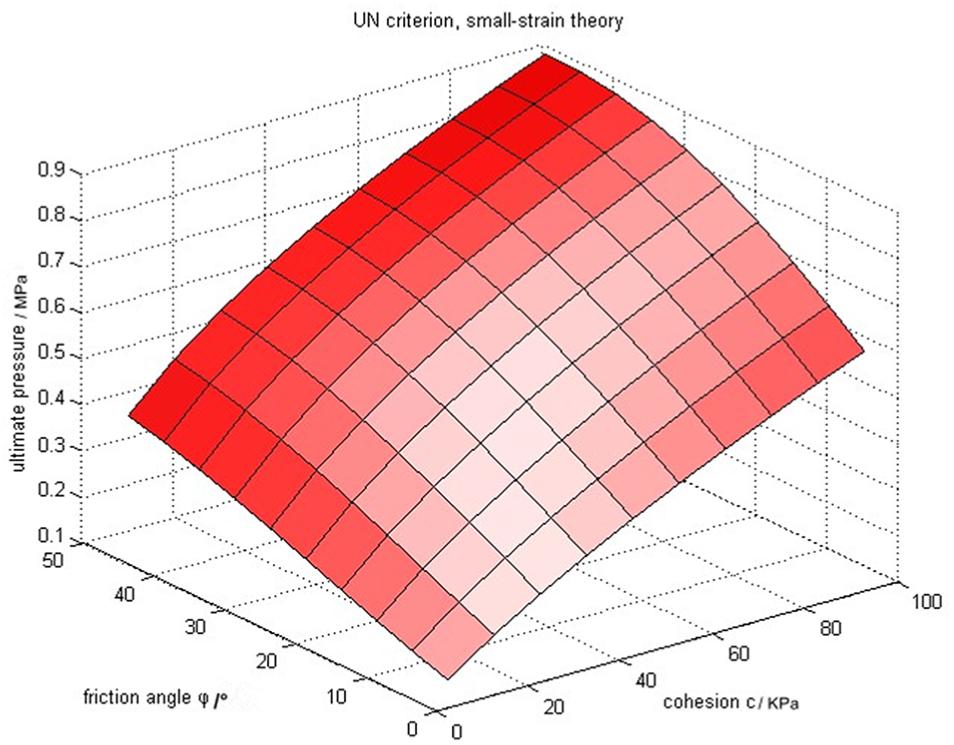
Relationship among the cohesion, friction angle, and ultimate fracture grouting pressure with the UN criterion and small-strain theory.

Relationship among the cohesion, friction angle, and ultimate fracture grouting pressure with the MMC criterion and large-strain theory.
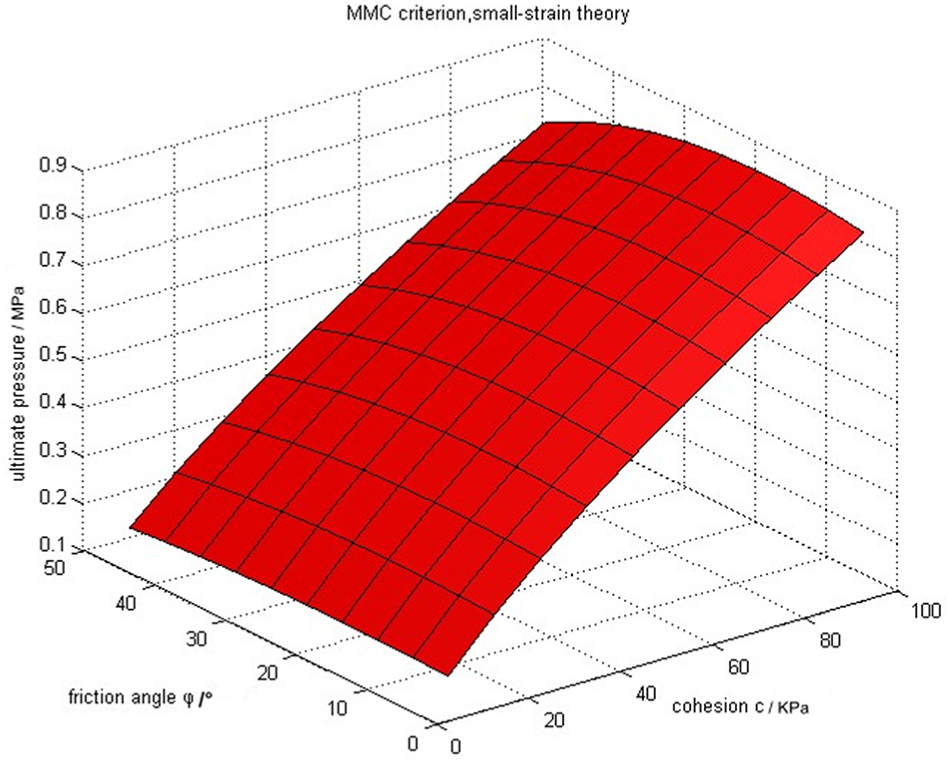
Relationship among the cohesion, friction angle, and ultimate fracture grouting pressure with the MMC criterion and small-strain theory.
Figures 6–13 show the relationships between the fracture grouting pressure and the soil strength parameters of cohesion and the friction angle. As shown in Figures 6–13, (1) the fracture grouting pressure increases with increasing cohesion but decreases with increasing friction angle except under the MMC criterion. Because the MMC criterion does not consider the effects of dilation, the dilation and MMC criterion make the solution different from the solution of the other three models. (2) The magnitudes of the fracturing grouting pressure with different yield criteria are almost identical; the difference in their minimum values is approximately 38%, and the difference in their maximum values is approximately 14%. (3) In the SMP criterion, the cohesion has a greater effect on the fracture grouting pressure than the friction angle. The cohesion and friction angle have identical effects on the fracture grouting pressure under the M-C criterion and UN criterion. (4) Under the MMC criterion, the cohesion has a greater effect on the fracture grouting pressure than the friction angle when the cohesion is small. The fracture grouting pressure increases with decreasing friction angle when the cohesion is over 80 kPa, which is different from other criteria because the MMC criterion is not suitable for over-consolidated soil. (5) The result with large-strain theory is approximately 7% larger than that with small-deformation theory in different yield criteria with the changes in the cohesion c and friction angle, and the change rules are identical.
In Figures 6–13, when the cohesion is less than 80 kPa or the friction angle is less than 40°, the fracture grouting pressures based on different yield criteria are similar. In other cases, the results significantly vary, although the cohesion and friction angle values almost never reach this value in engineering examples. To facilitate engineering applications, the proposed method of fracture grouting pressure based on the M-C criterion is recommended.
Conclusion
The solutions of the fracture grouting pressure and plastic radius are proposed based on the SMP, M-C, MMC, and UN criteria. The measured data show that the large-deformation theory has more reliable results than the small-deformation theory.
The increase in cohesion or friction angle results in a nonlinear increase in fracture grouting pressure under different criteria except the MMC criterion. The results are larger than those with the small-deformation theory.
With the changes in cohesion, deformation modulus, Poisson’s ratio, and friction angle, the theoretical solutions under different criteria are highly consistent with one another. The proposed theory can represent engineering practice, which illustrates its reliability.
Footnotes
Appendix 1
Handling Editor: Michal Kuciej
Declaration of conflicting interests
The author(s) declared no potential conflicts of interest with respect to the research, authorship, and/or publication of this article.
Funding
The author(s) received no financial support for the research, authorship, and/or publication of this article.
