



Abstract
The structural composition of the oil platform is very complicated, and its working environment is harsh, thus conducting a large number of reliability tests is not feasible, and the field tests are also hard to accomplish. So the reliability of the oil platform cannot be analyzed and calculated by the traditional reliability method which needs a lot of test data, and new methods should be studied. In recent years, imprecise probability theory has attracted more and more attention because when unified, it can quantify hybrid uncertainty. Structural reliability analysis on the basis of imprecise probability theory has made remarkable achievements in theoretical aspects, but it is scarcely used in practical engineering domains due to the complexity in the developed methods and the unavailability of suitable or specific modeling steps for applications. In this regard, we propose a unified quantification method for statistical data, fuzzy data, incomplete information, and the like, which can handle the issue of hybrid uncertainties, and then, we construct an improved imprecise structural reliability model aiming at the practical problems by introducing copula function. To verify the existing methodology, we also consider a cantilever beam widely applied in the oil platform here for the structural reliability analysis.
Keywords
Introduction
Oil platform is a large structure with lots of facilities for well drilling and can be used to extract and process oil and natural gas, to store product until it can be brought to shore for refining and marketing. The oil platform is made up of the hull, spud legs, pile-boots, cantilever beams, helicopter landing, and so on. As known to all, the structural composition of the oil platform is very complicated, and its working environment is harsh, thus conducting a large number of reliability tests is not feasible, and the field tests are also hard to accomplish. 1 In this case, traditional reliability method which needs a lot of test data cannot be used to analyze and calculate its reliability, thus new methods should be studied. Uncertainties influencing the reliability of engineering structures are not only one type of uncertainty, but hybrid uncertainties, and it is of great importance to find out rational methods to quantify these uncertainties. 2 As we know, a structural system throughout its life circle is faced with a variety of stresses, and it will degenerate, damage, or fail if the stress exceeds the limit, from the view point of different failure mechanisms.3,4 The boundary between a damage state and a failure one is referred to as a limit state, and the structural reliability analysis is to study the likelihood for the structure to reach its limit state under the uncertainties. 5 In practical engineering, the structural reliability is affected by hybrid uncertainties, which mainly derives from physical, model, and statistical uncertainty, and can be split into stochastic and epistemic uncertainty in accordance with their property. In the light of the theory relevant to mathematical statistics, structural reliability analysis methods can be divided into probabilistic and non-probabilistic methods. Probabilistic structural reliability analysis methods employ probability theory to quantify uncertain information. In particular, strength, stiffness, loading, geometric dimensioning as well as other characteristics related to structural reliability are characterized by a vector composed of a group of stochastic variables, 2 and then, a specific probability distribution is thought over for each variable. Probabilistic structural reliability analysis methods are highly efficient when statistical data of the structure is ample enough to determine an accurate probability distribution, and these methods have been widely applied in multifarious engineering applications.6–8 Nevertheless, an increasing number of experts and authors9–14 point out that the lack of data and information remains the prevailing problem in realistic projects, and it is not convincing to ponder over any specific probability distribution for the variable when statistical data are lacking. Hence, structural reliability analysis on the condition of lack of data has aroused the concern and research of many scholars and experts. Structural reliability analysis for the lack of data is studied mainly in two lines, one concentrates on studying the reliability modeling methods for particular types of data, such as partially relevant recurrence data, 9 and incomplete degradation data. 10 The other line concentrates on studying the mathematical theories as well as optimization algorithms 11 to make up for the lack of data, such as Bayesian theory,12,13 fuzzy set, 14 Dempster–Shafer theory, 15 interval analysis, 16 and other non-probabilistic theories; meanwhile, optimization algorithms relevant to the non-probabilistic theories are proposed. 17 All of those methods deem that the reliability measure may be decided in an indeterminant bound other than a deterministic value. Yet, either probabilistic or non-probabilistic structural reliability analysis methods, they principally consider solely one type of uncertainty, stochastic uncertainty or epistemic uncertainty, and no uniform hybrid uncertainty quantification means has been put forward. Therefore, one generalized non-probabilistic theory called imprecise probability theory has drawn more and more attention in recent years.
Imprecise probability theory can quantify information or data with any amount, and they can also effectually merge together the classical probability, fuzzy set, interval number as well as other data types in a spontaneous extension model. 18 For this reason, it supplies a feasibility to quantify hybrid uncertainties in a single model. Moreover, imprecise structural reliability analysis method can be comprehended with the help of probabilistic structural reliability theory which has comparatively integral and ripe theoretical system for engineers to apply. An imprecise structural reliability analysis method has accomplished a lot in theoretical aspects, 6 but it can hardly be utilized in practical engineering due to the complicacy of imprecise structural reliability modeling. Accordingly, based on a concise introduction of imprecise probability theory, we propose a unified hybrid uncertainties quantification method and construct a relatively reformative analysis model which turns out to be much more available for practical engineering in this article.
The remainder of this article is designed as follows. In section “Basic concepts of imprecise probability theory,” a brief introduction of certain fundamental concepts of imprecise probability theory is given. Then, the unified quantification method for hybrid uncertainties is raised, and the imprecise structural reliability model is given accordingly in section “Imprecise structural reliability analysis under the unified quantification of hybrid uncertainties.” In section “Improved imprecise structural reliability model by introducing copula function,” because of the problem statement of the extant imprecise structural reliability analysis methods, we propose a modified natural extension model by introducing copula function and show its concrete procedure for practical use. For the validation of the proposed method, we have solved an engineering example in section “The application of the proposed method on the cantilever beam.” Ultimately, conclusions are dawn in section “Conclusion.”
Basic concepts of imprecise probability theory
The mathematical theory of imprecise probability theory can be interpreted by behavioral interpretation. As is known to all, there exists an “event” in probability theory, and probability distributions and other mathematical models are established via the discussion of the “event.” Likewise, the notion of “gamble” in imprecise probability theory equals to the “event” in probability theory, and mathematical models can be constructed by the discussion of gambles as well. In this section, we give a few basic concepts frequently used in the field of reliability engineering. More details with respect to imprecise probability theory can be found in references.6,18
Definition 1
A “gamble” is a bounded and real-valued function defined on domain
Definition 2
Assume



and

Definition 2.3
Natural extension is a vital concept to construct reliability models for imprecise probability. In subsistent papers, natural extension models are embodied by different equivalent optimization models.
19
As we can see,


The set
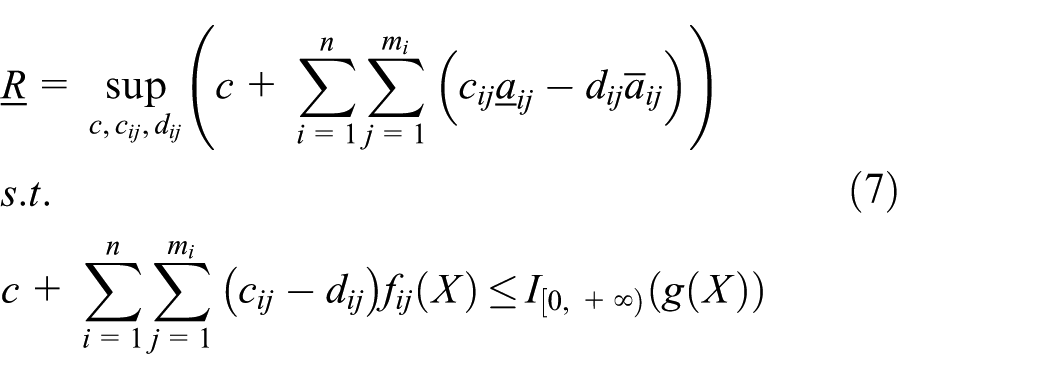
Distinctly, as the primal natural extension model is extremely intricate to calculate, Kuznetsov introduces duality theorem of linear programming into the above optimization model and transfers it into a linear optimization problem. 10 According to Utkin et al. 19 , Elishakoff 20 and Zhao, 21 the above optimization model can be rewritten as
and

where
The above-mentioned two natural extension models are the most wide-spread used models in imprecise structural reliability analysis, and other equivalent models are also raised based on this model for specific applications.
Imprecise structural reliability analysis under the unified quantification of hybrid uncertainties
Unified quantification of hybrid uncertainties
Hybrid uncertainties mainly considered in practical engineering include physical uncertainty, statistical uncertainty, modeling uncertainty, and so on, and the above uncertainties of different kinds can be qualitatively divided into stochastic uncertainty, fuzzy uncertainty, and incompleteness. According to the imprecise probability theory, stochastic and fuzzy uncertainty as well as incompleteness can be quantified into a unified form. Through it, reliability data of different types can be employed into one model. Here, we simply give the resulting mathematical expressions.
The quantification of statistical data
Assume the mean of a variable


When
The quantification of fuzzy data
Here, we take triangular fuzzy number as an example, and it can be defined as

The fuzzy variable

where
The quantification of incomplete information
The incomplete information can be directly quantified by upper and lower expectations. For instance, the mean time between failures of one system is in the interval


Imprecise structural reliability analysis under hybrid uncertainties
Presume

and the failure probability

Reliability data collected beforehand are quantified as follows

where
On the basis of the quantification of reliability data gathered for variables, the structural reliability model is able to be established as
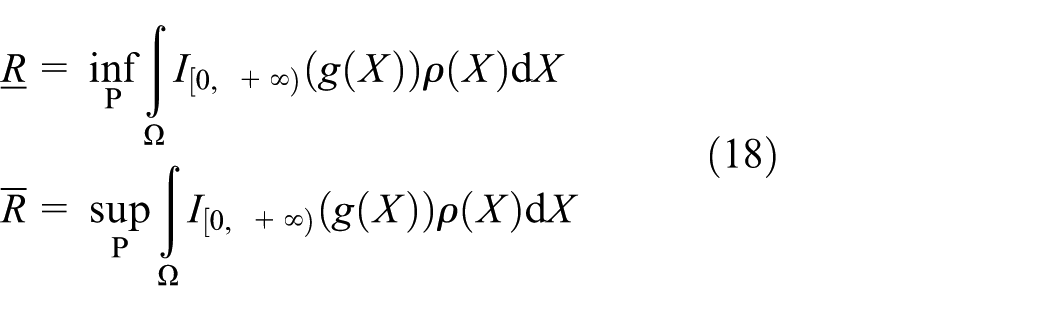

Hence, set P is made up of all possible probability density functions which satisfied the constraints (19), that is
Improved imprecise structural reliability model by introducing copula function
Problem statement
This study on imprecise structural reliability theory which are mostly restricted to artificial example but not in practice6,22 concentrates mainly on theoretical analysis. The main reasons are elucidated as follows:
The great mass of natural extension models requires reliability data to be characterized by upper and lower precisions, such as
The most imprecise structural reliability models use joint probability density function
The existing imprecise structural reliability analysis models are restricted to numerical examples but never in practice. That is to say, there exists no minute application process to be used for reference, so it seems out of the question for engineers to operate.
The problems discussed above restrict the wide application of imprecise structural reliability analysis in practical engineering to a large extent. By keeping this in mind, we introduce copula function to the analysis of natural extension model to improve the computation accuracy, for the copula function can effectively quantify the correlation of different parameters or failure modes. In this way, we can, on one hand, use single variable reliability data to augment the data amount and reduce the imprecision
An improved natural extension model by introducing copula function
The improvement of natural extension model by introducing copula function
As we know, a copula function links univariate margins to their joint probability distribution23,24 and allows us to study probability density functions and correlation of variables correspondingly.
Assume

where

If marginal probability distribution functions of

When all variables are fully independent and


In the above equations,
Consequently, the above optimization model can be rewritten as the Kuznetsov’s form

and

where
The parameter estimation of the copula density function
The modified natural extension models partly reduce the imprecision
A majority of common copula functions have been come up with in previous papers, such as multivariate Gaussian copula, Gumbel copula, and Frank copula. 19 Here, we solely introduce some common copula functions as follows:
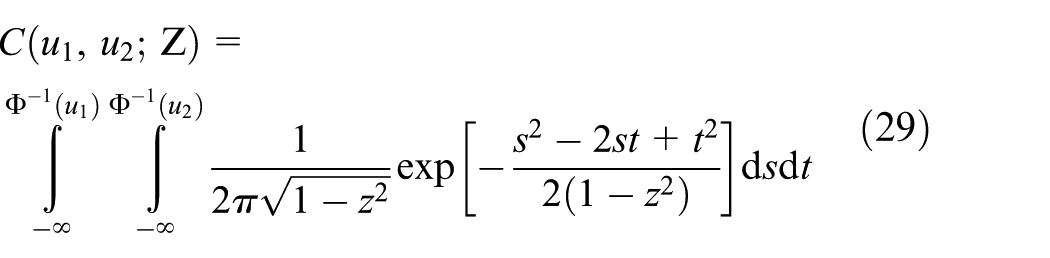
Multivariate Gaussian copula and its probability density function are defined as

and

where
When
2. Gumbel copula function is defined as

where
3. Frank copula function is defined as

where
In normal conditions, we may utilize parameter estimation methods to estimate the copula probability density function, such as maximum likelihood, the step-by-step, and the semi parametric estimation method. 26 Here, we apply the maximum likelihood estimation method to evaluate the parameter of copula probability density function.
Application of the improved structural reliability analysis model
The utilization of imprecise probability theory in the domain of reliability engineering has long been studied and has achieved a lot in theory. However, no details of application process are proposed for reference. So, in this section, we will give specific application process of the unified natural extension model for the analysis of structural reliability. The process can be operated as follows:
In light of the failure criteria, we should first determine the limit-state function of
Refer to the Table 1 and collect reliability data concerning the structure or structural parameters.
Choose one certain copula function
Construct a natural extension model with the help of collected reliability data. Assume, we want to measure the lower bound of structural reliability, the natural extension model can be established as follows:
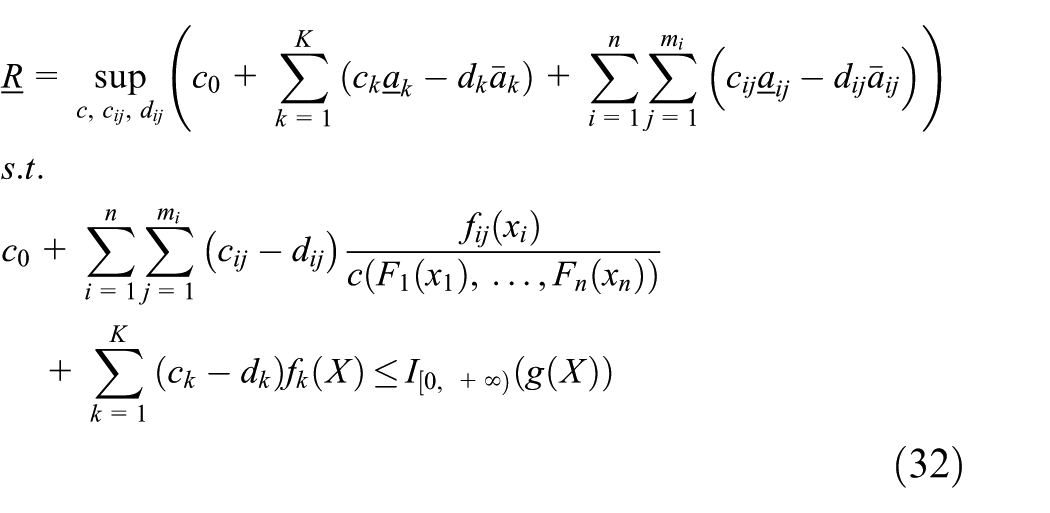
Reliability data collected for the very variable

In these equation,
The procedure of imprecise reliability analysis can be illustrated by Figure 1.
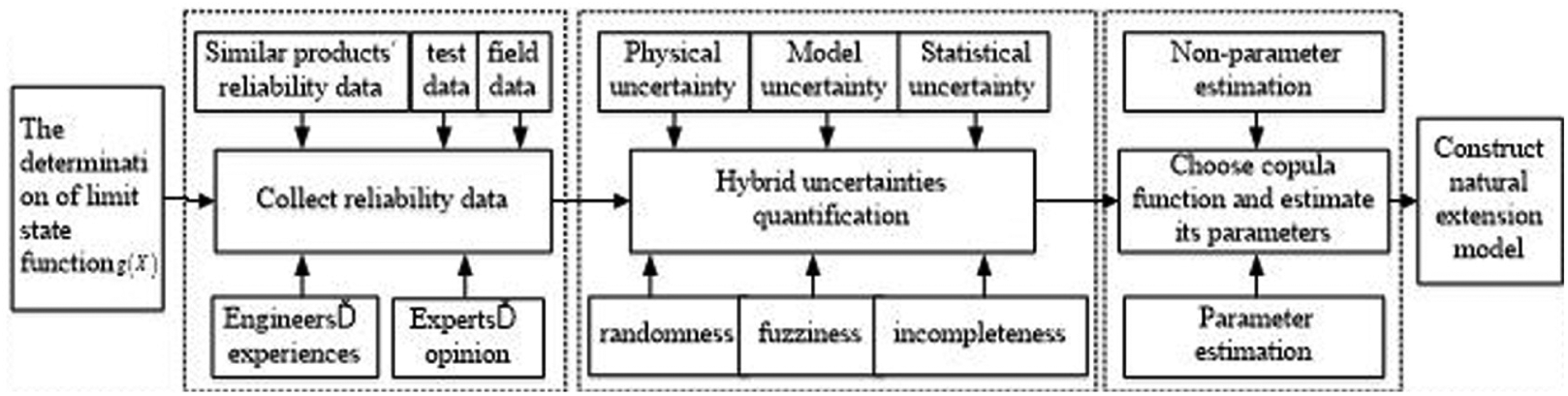
Procedure illustration of the proposed method.
The application of the proposed method on the cantilever beam
Structural reliability analysis for the cantilever beam based on imprecise probability theory
The cantilever beam is a significant component for the oil platform, and its reliability affects the reliability and safety of the whole system. Here, the reliability analysis of the cantilever beam is taken as the example to illustrate the counting process of the new proposed method. The cantilever beam along with force situation as are shown in Figure 2, where

A simplified structure of the cantilever beam.
Denote

Reliability data about
Reliability data collected for

As we all know, the flexion of a structure is affected by its length. In order to determine the correlation of
A set of sample data of variables

Suppose the relationship between

and

where
Let us presume

and

Thus, the structural reliability of this cantilever beam can be gained as
Result discussion
Here, a cantilever beam for the structural reliability analysis has been taken into account to verify the current methodology. By introducing copula function, we can use the proposed method to quantify variables correlation. It conforms much more to the real conditions of practical systems and will arrive at a much precise result.
If we do not consider variables relationship, natural extension model of a cantilever beam can be rewritten as

and

Thus, the structural reliability of a cantilever beam can be obtained as
In addition, interval analysis, fuzzy mathematics, and other non-probabilistic theories have been used for safety analysis as well when reliability data are in short. In line with samples data shown in Table 4,
Samples data of variables


So, means and variances of

and the mean and variance of
According to Wu et al.,
24
structural reliability measure
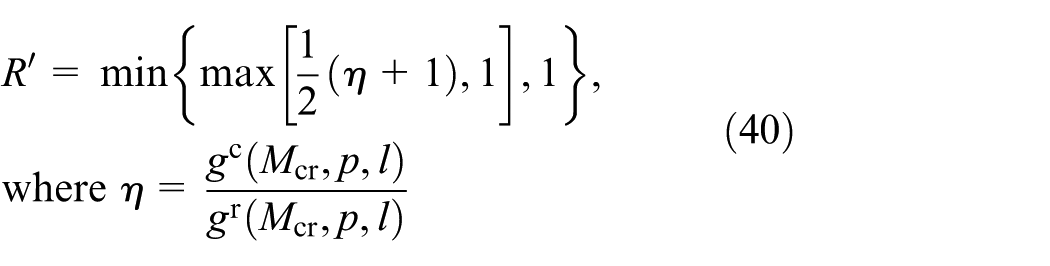
Where
By the above-mentioned comparisons, we can conclude that the proposed method is much more effective than original natural extension models, and it is more conservative than interval analysis methods. In this way, it is rational for general use of structural reliability analysis. Nevertheless, it should be noted that different choice of copula functions will lead to disparate precision, and so following works will focus on the determination of copula functions.
Conclusion
In practical engineering, reliability data concerning to the variables vector are rather tough to get, while the single variable’s information, on the contrary, is easy to get. This article proposes an improved imprecise structural reliability analysis method by the introduction of copula functions to the natural extension model, the big advantage is that each variable’s marginal probability density functions as well as the variable correlativity can be researched and characterized, respectively. Imprecise probability theory in reliability engineering has been studied for long, and it has made great achievements in theory, but no details about application process are proposed for reference. Thus, we give the detailed reliability modeling steps in this article for engineers to refer to; moreover, an engineering example of a cantilever beam which is widely applied in the oil platform has been taken into account to illustrate the effectiveness of the novel method proposed.
Footnotes
Handling Editor: José Correia
Declaration of conflicting interests
The author(s) declared no potential conflicts of interest with respect to the research, authorship, and/or publication of this article.
Funding
The author(s) disclosed receipt of the following financial support for the research, authorship, and/or publication of this article: This research is partially supported by the Innovative Academic Team Project of Guangzhou Education System (grant number: 1201610013).
