




Abstract
With the increasing number of domestic buildings, the importance of safety evacuation in case of fire in the buildings has been aware. Occupants in a building will crowd at exit(s) when they evacuate in disasters. The content of this study includes the following: (1) to conduct a literature review on severe stampedes in history, identifying the number of casualties, and to explore existing research on crowd evacuation; (2) to examine the applicability of software packages EXODUS and Unity for simulating occupant evacuation using them for simulations under identical conditions; and (3) to construct simulated evacuation environments using Unity and perform simulations with different combinations of occupant number, space size, exit size, and flow diverter size. The simulation results found that placing a flow diverter in front of the exit could reduce the evacuation time effectively. The best result was observed when the width of the door is close to the width of the flow diverter; it can reduce the evacuation time by about 25%. When more than 60 people were emptying through an exit below 120 cm width, the blocking happened regardless of whether a flow diverter was placed.
Introduction
When a disaster occurs inside a building, occupants inside begin to evacuate toward the exits. People must be able to successfully escape from a disaster site or enter an area of refuge. With the increasing number of domestic buildings, the importance of safety evacuation in case of fire in the buildings has been aware. 1 Evacuation walking distances are thus calculated according to technical specifications and construction methods at the beginning of a building’s design. Modern buildings have become increasingly large and featuring complicated functions. To ensure that all occupants of a building can successfully evacuate a disaster site, Taiwan’s current method of verifying evacuation safety not only involves calculating statutory requirements but also incorporates functional design verification using the method proposed in the Verification Guideline of Buildings Evacuation Safety Performance-based Design, which was published by the Architecture and Building Research Institute, an agency affiliated with the Ministry of the Interior. 2
However, neither listed nor functional design regulations can currently satisfy actual needs, a famous example of which is the evacuation calculation performed for the Taipei dome. Therefore, competent building authorities have adopted more professional verification methods such as the use of fire simulation or evacuation analysis software that is commonly acknowledged by the government and industry to perform appropriate verification. For example, EXODUS and Pathfinder have been employed to estimate crowd flow during evacuations. However, these software packages can produce varying results due to the different settings of their algorithm and parameters.
Stampede
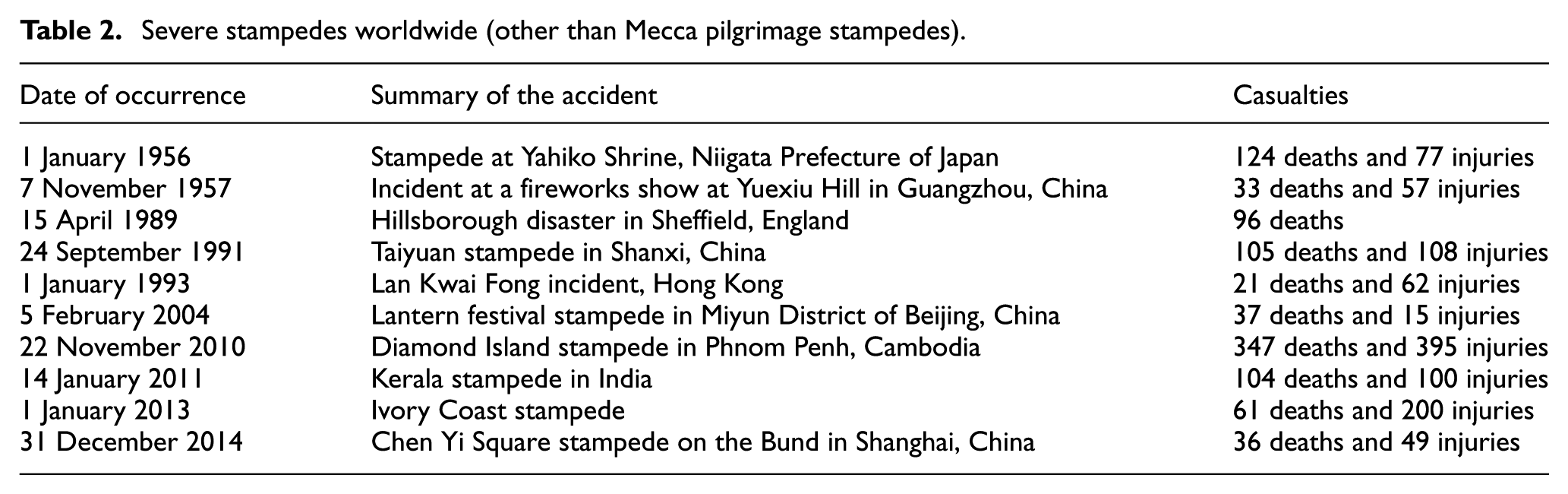
When a disaster occurs in a building, the evacuation speed will be slowed down or even blocked. This will result in a push phenomenon, which will result in a stampede. On 22 November 2010, a stampede occurred in Cambodia on the Diamond Bridge connecting Diamond Island to the capital Phnom Penh. 3 After the annual celebrations for the Water Festival were over, the narrow bridge connecting Diamond Island and the downtown of Phnom Penh began to shake and caused the crowd to panic, resulting in a stampede in which at least 347 people died and 395 were injured. At 23:35 on 31 December 2014, a stampede occurred on the steps at Chen Yi Square on the Bund in Shanghai, China, leading to 36 deaths and 49 injuries. 4 The most notorious stampedes have occurred in Saudi Arabia during the religious ritual of the Hajj, which occurs annually on the desert plain of Mina, a city near Mecca. The massive number of pilgrims who perform the Hajj (often millions) can easily result in stampedes. Over the recent 30 years, 11 accidents of various types have occurred during the pilgrimage to Mecca, 5 the most well-known of which are the stampedes detailed in Table 1. Table 2 lists relatively severe stampedes that occurred during events other than the Mecca pilgrimage. 6 These accidents suggest that research into how crowds can be safely evacuated is critical. During an evacuation, an indoor crowd tends to flock toward the exits. In addition to the crowd flow directly facing the exits, people join the crowd from both sides of the exit, causing simultaneous perpendicular flows. People facing the exit are thus blocked by those who cut in from each side, consequently slowing the evacuation process.
Mecca pilgrimage stampedes since 1990.

Severe stampedes worldwide (other than Mecca pilgrimage stampedes).
The occupants inside the fire site often only have a few minutes to evacuate, which is referred to as the golden evacuation time. 7 When the fire occurs, how to safely and rapidly evacuate people is a very important mission. In this study, the escape scene was simulated by Unity software to investigate the evacuation time for different condition, such as the setup of obstacle, obstacle size, exit width, and evacuation number. An optimized evacuation suggestion will be proposed by this study for disaster scene.
Research objectives
Li 8 has presented a model which could balance the influence of differentiated cognition of various pedestrians against the practical evacuating state and surroundings on multiple exit space. For a large area evacuation simulation, the risk-based stochastic evacuation routing strategy proposed by Huang et al. 9 can generate more actual flow if it is compared to single prospect-value-based risky strategy. This study will investigate the evacuation simulation for small-to-middle space. To determine how crowd congestion caused by panic or people cutting into flow at exits can be avoided, this study simulated evacuations using the Unity software. The space, dimensions, exit size, and flow diverter size were defined in the software, and the distances between the crowd and exit and between the flow diverter and exit were adjusted. This study had three objectives:
To conduct a literature review on severe stampedes in history, identifying the number of casualties, and to explore existing research on crowd evacuation.
To examine the applicability of software packages EXODUS and Unity for simulating occupant evacuation using them for simulations under identical conditions.
To construct simulated evacuation environments using Unity and perform simulations with different combinations of occupant number, space size, exit size, and flow diverter size, which can serve as a reference for concerned parties.
The remainder of this article is organized as follows: section “Crowd-diversion at exits” presents crowd-diversion at exits; section “Simulating evacuations using software” describes evacuation simulation using EXODUS and Unity; section “Simulating crowd-diversion using Unity” details simulating crowd-diversion using Unity; section “Discussion” discusses the simulation results; finally, section “Conclusion” makes the conclusion of this article.
Crowd-diversion at exits
Zhangang Han and his research team discovered that installing column obstacles at both sides of an exit reduced sideways queue jumping. 10 Moreover, guiding the crowd to proceed in the direction facing the exit increased evacuation speed effectively. They conducted a crowd evacuation experiment at the Qiu Stadium in Beijing Normal University. The venue was the second-floor lobby, which had an area of 100 m2 and an exit of width 1 m. Trash cans, approximately cylindrical, were employed as obstacles (flow diverters; diameter: 0.8 m; height: 1.2 m; filled with water to two-thirds of their height). A total of 80 people participated in the experiment, divided into three groups: no obstacle, one obstacle, and two obstacles. The results revealed that the average evacuation speed of the crowd was 2.48, 2.73, and 2.87 (people per second), respectively. The evacuation thus occurred 16% faster when two obstacles were installed at the door than when no obstacle was installed. Another team conducted a simulation with the same group of people, finding that the crowd’s evacuation speed was higher when one flow diverter was installed (the top half of the film on Figure 1) at the exit than when no flow diverter was installed. 11

Simulating an evacuation when flow diverters were installed at the exit: (a) on the beginning of the evacuation simulation and (b) near the end of the evacuation simulation.
Simulating evacuations using software
When a disaster occurs inside a building, occupants attempt to evacuate via the exit. If the number of occupants is high and the exit is relatively small, shoving and pushing can easily occur, which decrease the evacuation speed. The width of an exit and walking distance to the exit are mostly calculated item by item and in accordance with existing regulations; however, the variety of on-site spatial arrangements tend to be overlooked during this process. Therefore, competent building authorities also employ fire simulation software to verify their evacuation plans. The commonly used fire simulation software includes FDS, EXODUS, Pathfinder, Simulex, and so on. EXODUS is the fire simulation software that is generally recognized by the British and Japanese governments and industry. In order to verify that the evacuation of crowds can be accelerated by adding an obstacle in front of exit, EXODUS is used as control tool for this study.
EXODUS software
EXODUS is a software package developed by the fire safety engineering group of the University of Greenwich. 12 Wang et al. 1 have converted three-dimensional (3D) model into the Fire model and the Evacuation model and used Building EXODUS to conduct the analysis of safety evacuation. It has been used to conduct the simulation for mass evacuation in urban underground passages 13 and evacuation process. 14 Its evacuation calculation method is based on Article 76 of the fire prevention regulation issued by Tokyo Fire Department (Order No. 36 of Tokyo Fire Department, May 1986) and the discussion results of the Prevention Technology Review Committee. In addition, in accordance with Article 3, Paragraph 1, and Subparagraph (3) of the compendium for estimating the necessary evacuation time (announced by Minister of Relief on 19 March 2008), the Calculation Method Equivalent for Fire Evacuation Modeling was passed by the standards of the Tokyo Fire Department. 15
EXODUS models evacuation by employing the space an individual evacuee occupies as the center, with 0.5 m × 0.5 m squares referred to as nodes-defined in relation to this central square. The nodes are connected by arcs, along which the evacuees can move between nodes (Figure 2). In Figure 3, blue and green dots indicate occupant positions and spaces into which occupants can move, respectively. Door_1 indicates the exit, which has a width of three dots and thus 1.5 m (0.5 × 3 = 1.5 m).

Node and arc connections.

Simulating evacuations using EXODUS.
Unity software
EXODUS uses a 0.5 m × 0.5 m grid as the module for personnel mobility. This module limits the flexibility of the simulation and cannot be used for other dimensional adjustment. Therefore, Unity is selected as simulation tool in this study. Unity 16 is a game engine that adopts the PhysX physical engine of NVIDIA to simulate the real world. Navigation operations can be roughly divided into A-Star, WayPoint, and NavMesh operations. 17 Unity employs the convex polygon algorithm of NavMesh, which indicates that human positions use triangles instead of conventional squares. Route planning in the accessible area is performed using NavMesh, which simulates the occupants’ area of activity (blue area in Figure 4). The NavMeshAgent component is a core component of the Unity navigation system. All lines connecting the current position of an individual with the central point of another triangle are identified. Other lines intersecting this line, namely, the evacuation route, create nodes. All nodes are identified, and the longest indicates the optimal position of the node. The authors of this study have employed the Unity software to complete a series of fruitful research on topics such as landslide simulation,18,19 fire evacuation simulation, 20 evacuation simulation for older adults, 21 and house sales systems. 22
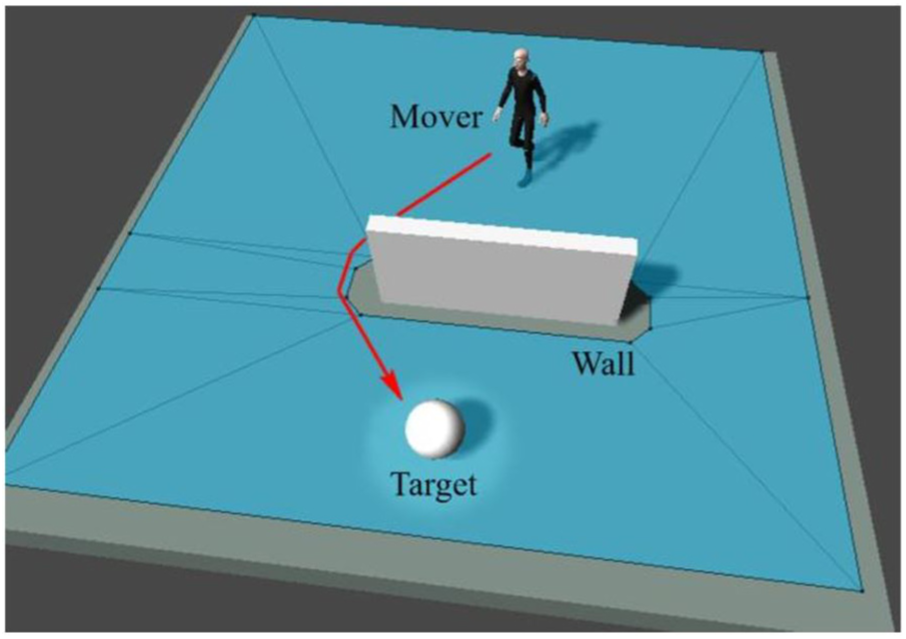
Unity routing algorithm.
Comparing the evacuation simulations performed by EXODUS and Unity
The evacuation simulations performed by EXODUS and Unity were compared. The exit widths used were 0.5, 1.0, and 1.5 m. Table 3 presents the simulation results of the time required to evacuate 1–100 occupants. For example, when the door width is 1 m, for 60 and 100 occupants, the evacuation times from EXODUS are 55.75 and 88.59 s, respectively. The simulation results from Unity are 62.91 and 102.37 s. An analysis of the test results indicated that Unity obtained results closer to those observed during physical on-site simulations. The evacuation time increased linearly with the number of occupants in the EXODUS simulations; however, in the physical simulations, crowd congestion was observed once the number of occupants had reached a critical value; this phenomenon was similar to the results obtained using Unity.
Evacuation times obtained using EXODUS and Unity (s).

Simulating crowd-diversion using Unity
This study employed Unity to simulate occupant evacuation and investigate the results obtained using different crowd-diversion devices. The simulation procedures were discussed as following (Figure 5):
The establishment of simulation system.
3ds Max was used to build a scene model, the C# syntax, navigation algorithm, and escape formula were used in Unity to create an evacuation simulation system.
Validation of simulation tools.
EXODUS was used to calculate the evacuation time using the above identical environment conditions. The simulation results were used as the comparison basis for Unity to validate the feasibility of Unity as simulation tool.
Using Unity to simulate evacuation time for different combinations.
Different exit widths, occupant numbers, diverter settings, and diverter sizes were used as variables to simulate evacuation times by Unity.

Evacuations simulation procedure of the study.
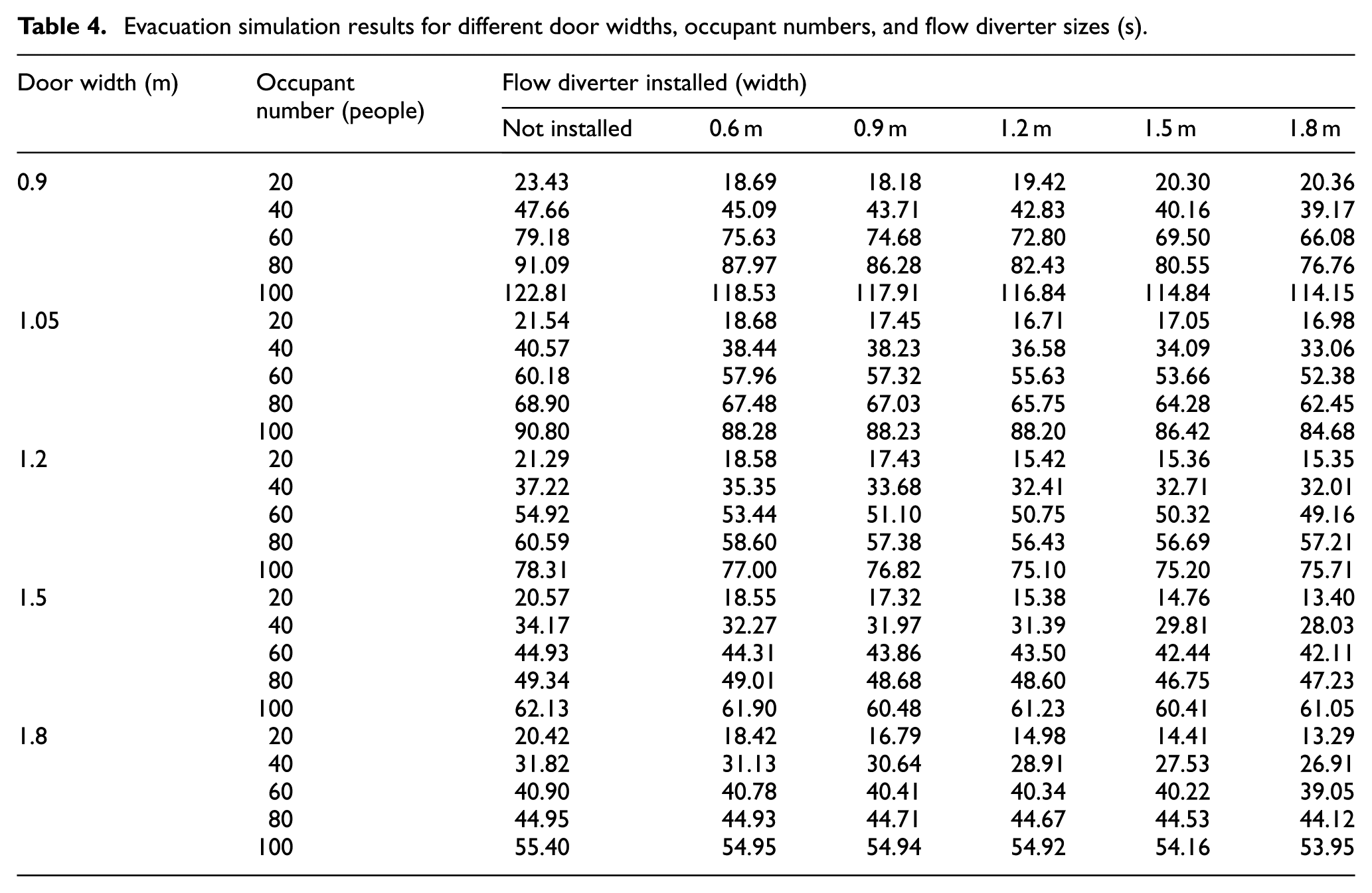
The variables of the simulated evacuation included the number of occupants evacuated, the width of the flow diverters, and the width of the exit (Figure 6). In this study, the door widths used were 0.9, 1.05, 1.2, 1.5, and 1.8 m; the flow diverter diameters employed were 0 (not installed), 0.6, 0.9, 1.2, 1.5, and 1.8 m; and the number of evacuating occupants was 20, 40, 60, 80, or 100 people. Table 4 presents the simulation results.

Variables of simulated evacuation in this study.
Evacuation simulation results for different door widths, occupant numbers, and flow diverter sizes (s).
Discussion
EXODUS can be used to calculate increases in evacuation time; however, it produces linear increases and the results obtained using this software does not reflect the actual conditions at the exit. In addition, the size of flow diverters installed at the exit, and the exit width could only be set as multiples of 0.5 m. Relative complicated evacuation simulations cannot be conducted using this software.
The evacuation simulation result obtained using Unity in this study was similar to those of an actual evacuation experiment. The Unity evacuation results indicated that installing flow diverters in front of the door could reduce the time needed for evacuation. In particular, crowd-diversion was most effective when the obstacle size was approximately equal to the door width; this reduced the evacuation time by nearly 25%.
When the exit was too small, congestion occurred at the exit regardless of whether flow diverters were installed. The crowd members that had been diverted by the flow diverters rejoined the flow in front of the exit and caused congestion, resulting in ineffective crowd-diversion. When the number of evacuating occupants was less than 20, no congestion occurred; therefore, the effect of crowd-diversion was non-significant.
This study found that to enable occupants to divert to different directions evenly, flow diverters should be installed in a central position in front of the exit. Installing one flow diverter had the largest effect, whereas installing two flow diverters caused congestion. When the flow diverters were overly small (<0.6 m), they did not divert the crowd properly; instead, they became obstacles that impeded evacuation.
When more than 60 occupants were evacuating and the width of the exit was less than 120 cm, congestion occurred regardless of whether flow diverters were installed. Therefore, exit size is more crucial in evacuations than the installation of flow diverters.
Conclusion
This study employed EXODUS and Unity to simulate the evacuation of building occupants at times of emergency. The contributions of the research are the following:
A literature review was conducted of severe historical stampedes to investigate their casualties and existing research on crowd-diversion-based evacuation.
The applicability of EXODUS and Unity for occupant evacuation was determined using them to simulate occupant evacuation under identical conditions.
Unity was employed to construct simulated evacuation environments and obtain simulations for combinations of different occupant numbers, space sizes, exit sizes, and flow diverter sizes, which can serve as a reference for the departments concerned.
Footnotes
Handling Editor: Stephen D Prior
Declaration of conflicting interests
The author(s) declared no potential conflicts of interest with respect to the research, authorship, and/or publication of this article.
Funding
The author(s) received no financial support for the research, authorship, and/or publication of this article.
