



Abstract
Sensitivity analysis plays a crucial role in identifying the structure important parameters. In this article, a new non-probabilistic parameter sensitivity analysis method is proposed according to the ellipsoidal model. Meanwhile, an analytical solution of non-probabilistic parameter sensitivity analysis method based on the ellipsoidal model is derived for linear performance function, as well as an approximately analytical solution is obtained for nonlinear performance function using the first-order Taylor expansion to linearize the functions in design point. Finally, the proposed method is illustrated by three examples, which shows that it is reasonable and applicable.
Keywords
Introduction
Parameter sensitivity analysis can be used to understand the importance of variables for structural reliability, which provides the reference for structural analysis and optimization design.1–3 In practical projects, probabilistic reliability analysis method has been fully applied in many fields, and accordingly, the corresponding probabilistic reliability sensitivity analysis gradually becomes more mature.4,5 Wu 6 and Wu and Mohanty 7 defined the parameter sensitivity in the probability model. Melchers and Ahammed, 8 Isabelle and Komlanvi, 9 Jensen et al., 10 Geraci et al., 11 Dubourg and Sudret, 12 Zhang et al., 13 and Yuan et al. 14 have developed the methods solving the parameter sensitivity in probability models. Depending on the study of probabilistic reliability sensitivity, the non-probabilistic reliability index has been widely used in engineering, and the study of non-probabilistic reliability sensitivity analysis has also developed smoothly.15–17 In the current research, however, the sensitivity of non-probabilistic parameters is confined to the interval model application, and the non-probabilistic parameter sensitivity analysis method under ellipsoidal model has not been constructed yet. We have to acknowledge that the variables in engineering problems are interrelated with each other, so the sensitivity of non-probabilistic parameter problems in the ellipsoid model has to be researched further in future studies.
In recent years, the non-probabilistic model has attracted wide attention by researchers. The main reason is it can effectively solve the reliability problems if there is fewer data as well as lack of probability density function situation.18–21 Ben-Haim22,23 proposed the concept of non-probabilistic reliability based on the convex model and put forward the idea that the reliability index can be measured by the maximum degree of uncertainty that systems can stand. Also, Elishakoff 24 applied the convex model to describe the uncertainty, from which the non-probabilistic index is considered as an interval rather than a specific value, and the boundary of the reliability index can be obtained by the interval calculation of the safety factor method. Generally, a non-probabilistic convex model can be divided into two models, such as interval model and ellipsoid model, respectively. Compared with the interval model, the ellipsoid model can describe the correlation in multiple uncertain variables. When the variables are irrelevant, the ellipsoidal model degrades into an interval model. Thus, interval model can be regarded as a special case of the ellipsoidal model.
Furthermore, many kinds of research have conducted research on the non-probabilistic reliability analysis under the ellipsoidal model in recent studies.25–29 Qiao et al. 25 studied the structural non-probabilistic reliability based on the ellipsoidal convex model. Luo and Kang 26 deduced the explicit iterative formula of an optimization problem and solved the ellipsoidal model. Liu et al. 27 proposed a general robust reliability index that can be applied to linear and nonlinear systems with basic variables contained a variety of uncertain convex sets. Zhou et al. 28 solved the convex aggregate comprehensive index, which combined the improved finite step-size iterative method with Monte-Carlo method. Cao and Duan 29 researched the structural non-probabilistic reliability problems under hyper-ellipsoid convex set description and promoted a reliability index, which is used to measure the safety degree of structures when hyper-ellipsoid convex set model coexists with interval variables.
In this article, the ellipsoid model is combined with structural parameter sensitivity, from which the sensitivity of non-probabilistic parameters is defined and its formula is deduced. Then, for the case, the non-probabilistic performance function is the linear combinations of ellipsoidal variables, and the exact analytical solutions of the non-probabilistic parameter sensitivity are given in ellipsoidal model. Next, the nonlinear performance function is linearized with Taylor expansion based on an approximate analytical method which is proposed for solving parameter sensitivity. Finally, the proposed method is verified by numerical examples in the following part.
Reliability indexes of the ellipsoidal model
The structural function is g(

where

From equation (2), it can be seen that the solution of reliability index η is a constrained optimization problem in real ellipsoidal model. The reliability index η and the optimal solution
If n = 2, ui = 0,

Diagram of reliability index based on two-dimensional ellipsoidal model.
In Wu,
6
the parameter sensitivity of random model is defined as the partial derivative of failure probability Pf to the basic parameter variable, that is,
Reliability sensitivity analysis of ellipsoid model
Reliability sensitivity analysis of linear function
When g(

the variable

According to the definition of non-probabilistic reliability index, we can get the reliability index of the linear function in ellipsoidal model

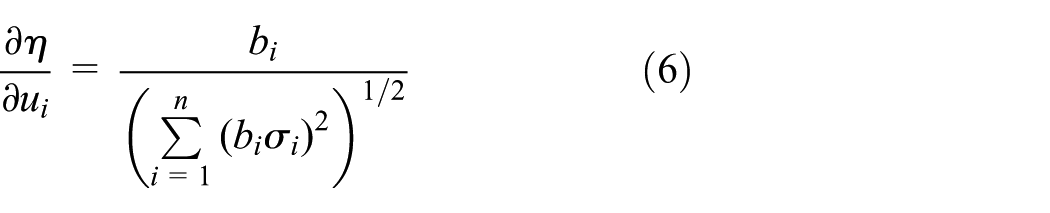
For the linear function g(

Reliability sensitivity analysis of nonlinear function
In fact, it can be difficult to put the above-described solving method into the application directly if the function is nonlinear. Therefore, from this consideration, we aim to present an approximate analytic method of non-probabilistic parameter sensitivity. Its basic idea of this method is to linearize the nonlinear function at its design point and then use the previous paragraph method to obtain the approximately analytic solution of nonlinear and non-probabilistic parameter sensitivity in the ellipsoidal model.
As for the design point

As the design point


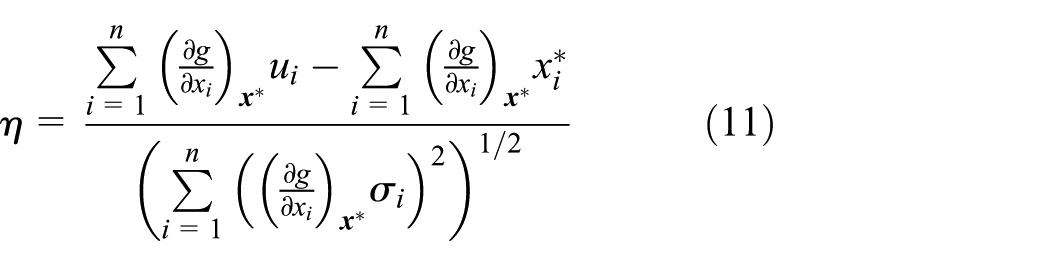
According to the definition of non-probabilistic reliability index and equation (10), the approximate analytic solution of nonlinear limit state equation is shown as follows
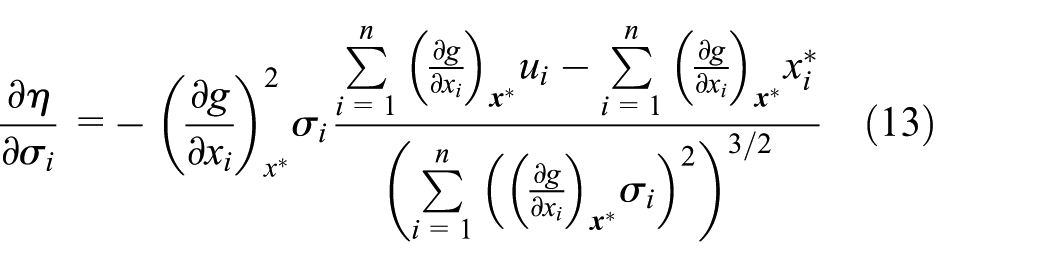
Through the definition of non-probabilistic reliability sensitivity, we can get the approximately analytical solution of reliability sensitivity in the case of nonlinear limit state equation as follows

Based on the analysis above, we get two expressions of the reliability sensitivity indices for the linear and nonlinear functions, respectively. In nonlinear case, an approximate solution is illustrated, which can solve the problem of selecting the step size in the case of weak nonlinearity using the method of difference. Eventually, the sensitivity indices will be more simply and conveniently.
Computational analysis of examples
There, three examples have been used to demonstrate the rationality of this method in this article.
Example 1
A function

when M > 0, it is safe, and when M < 0, it is failure. The variables r1, r2, s meet following equation (15)

The parameters of the variables are shown in Table 1.
Ellipsoidal parametric variable of Example 1.

The results of non-probabilistic parameter sensitivity analysis in ellipsoidal model are shown in Table 2.
Non-probabilistic parametric sensitivity analysis results of Example 1.

In algorithm case 1, the sensitivity of non-probabilistic parameters is analyzed in the case of linear function. As shown in Table 2 where the finite difference method is taken as the exact solution, the difference between the two methods is less than 1%. What is more, the results of the proposed method for the linear function are consistent with the finite difference theory, which shows the method proposed in this article is effective and feasible for solving linear problems.
Example 2
As shown in Figure 2, the distance from the point where the concentrated load p1 is applied to the fixed end of a cantilever beam is b1. The distance from the point where the concentrated load p2 is applied to the fixed end of a cantilever beam is b2. The function

when M > 0, it is safe; when M < 0, it is failure. The variables


Diagram of the cantilever beam.
The parameters of the variables are shown in Table 3.
Ellipsoidal parametric variable of Example 2.

The results of non-probabilistic parameter sensitivities in the ellipsoidal model are shown in Table 4.
Non-probabilistic reliability sensitivity analysis results.

Case 2 illustrated sensitivity analysis of the non-probabilistic parameters for nonlinear function. By comparing the approximate analytic solution with the result of the finite difference theory, it can be seen that the error results of the two kinds are less than 0.1%, which also certifies that the approximately analytical solution is effective to solve the non-probabilistic parameter sensitivity problem for nonlinear conditions.
Example 3
An aerofoil 9-box structure composed of 64-bar and 42-plate elements is shown in Figure 3. The material is aluminum alloy. The whole original data are taken from Song. 30 Both applied load and the strengths of every element are variables. The significant failure mode of structure system is enumerated by the optimum criterion method, which is

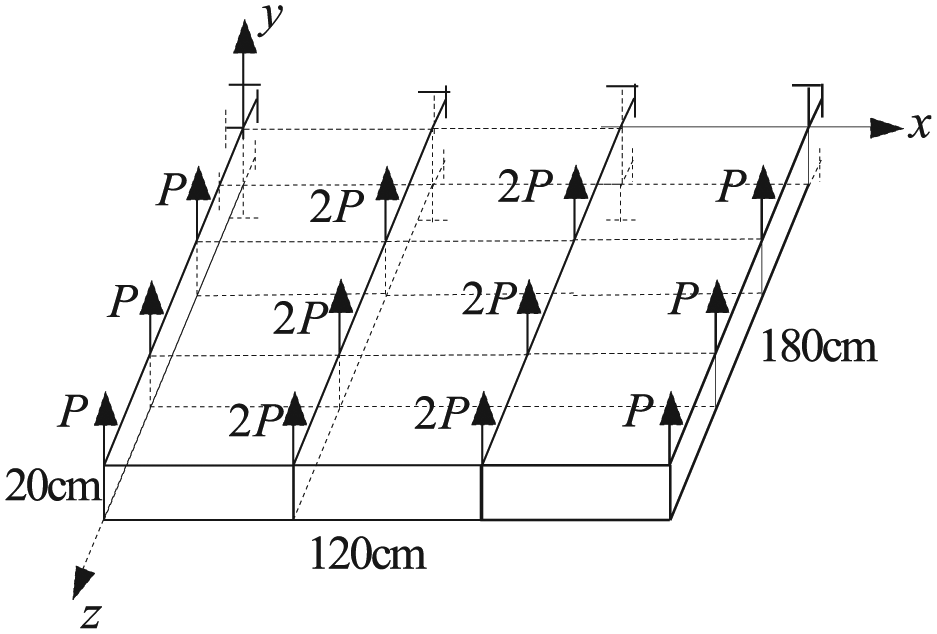
Diagram of aerofoil 9-box structure.
When M > 0, the structure is safe, and when M < 0, the structure is failed. The variables R68, R77, R78, P have to satisfy the following

The parameters of the variables are shown in Table 5.
Ellipsoidal parametric variable of Example 3.

The results of non-probabilistic parameter sensitivity calculation in ellipsoidal model are shown in Table 6.
Non-probabilistic parametric sensitivity analysis results of Example 3.

For the example mentioned above, the sensitivity of non-probabilistic parameters is analyzed by an aerofoil 9-box structure. As shown in Table 6 where the finite difference method is taken as the exact solution, the difference between the two methods is less than 1%, from which the linear function is consistent with the finite difference theory. The proposed method in this paper has demonstrated its effectiveness and feasibility meaning, which could effectively solve relate issues in this field.
Conclusion
In conclusion, non-probabilistic parameter sensitivity analysis based on the ellipsoidal model can be applied to quantitatively describe the importance of non-probabilistic reliability under bounded parameters. Therefore, it has important theoretical and practical meanings for research and engineering application. In this article, the non-probabilistic parameter sensitivity index in the ellipsoidal model is defined, and the analytic solution of the sensitivity of non-probabilistic parameters is deduced as well. At the same time, an exact analytical solution is deduced for the linear function. For this non-linear function case, an approximately analytic method for sensitivity analysis with non-probabilistic parameters under the ellipsoidal model is obtained through combined with the first-order Taylor expansion. Meanwhile, the correctness and effectiveness of the analytical method are illustrated by three numerical examples, which also show this method simplifies the calculation process compared with the finite difference method. And finally, the results of this article are of great significance for the optimization and exploration in non-probabilistic reliability models, which verifies the method proposed in this article benefits for the approximate linearization function. Rather, for high-nonlinear function problem, it is probably to explore further in the future.
Footnotes
Handling Editor: Shun-Peng Zhu
Declaration of conflicting interests
The author(s) declared no potential conflicts of interest with respect to the research, authorship, and/or publication of this article.
Funding
The author(s) disclosed receipt of the following financial support for the research, authorship, and/or publication of this article: Authors gratefully appreciate the support of China Scholarship Council, Top International University Visiting Program for Outstanding Young scholars of Northwestern Polytechnical University, the fundamental research fund for the central universities (NPU-FFR-3102015BJ(II)JL04), natural science foundation of Shaanxi province (2016JQ5109), and the 2017 National Undergraduate Training Programs for Innovation and Entrepreneurship.
