




Abstract
Split Hopkinson pressure bar technique has been widely used to measure the dynamic tensile strength of concrete materials. Most experimental results show that the tensile strength of concrete material increases with strain rates. However, the dynamic tensile strength derived from the split Hopkinson pressure bar test is affected by lateral inertia confinement, which may lead to the overestimation of dynamic mechanical properties of concrete materials. The true dynamic characteristics of concrete materials are not actually shown by experimental data. It is impossible to completely eliminate the influence of lateral inertia confinement in split Hopkinson pressure bar tests. In this study, a rate-insensitive material model is used in commercial finite element software to study how the lateral inertia confinement affects the dynamic tensile strength of concrete material at strain rates between 30/s and 150/s. Comparison of finite element results and split Hopkinson pressure bar test results shows that the dynamic tensile strength enhancement of concrete materials is strongly influenced by the inertial effect. The dynamic increase factor of concrete materials which remove the influence of lateral inertia confinement in split Hopkinson pressure bar tests can reflect the true dynamic characteristics of concrete materials. It is also found that the influence of lateral inertia confinement is related to the size of the specimen.
Keywords
Introduction
Concrete is widely used in both civil engineering and military facilities. During their service life, they might be subjected to shock loading such as blast and impact. It is important to study the dynamic properties of concrete material. The dynamic tensile strength of concrete material is usually measured by direct tension test1,2 and indirect tension tests such as Brazilian splitting test.3,4 It is commonly agreed that the dynamic increase factor (DIF), defined as the ratio of dynamic strength to static strength, of tensile strength of concrete material increases with the increase in strain rate. The enhancement of dynamic tensile strength of concrete material is widely considered as material property, called the strain rate effect. Like the compressive DIF of concrete, obvious scatters of tensile DIF from different tests can also be found.5,6 These scatters can be given the credit to variations in testing condition such as specimen material and specimen size. Besides these variations, it is known that lateral inertia confinement also has a significant effect on dynamic compressive strength7–12 and dynamic tensile strength13,14 of concrete material. Some researchers 15 found that the influence of lateral inertial confinement is trivial and could be neglected on Split Hopkinson pressure bar (SHPB) tests. But other researchers 16 pointed out that the lateral inertial confinement is the only reason for the increase in dynamic uniaxial strength, and the strength increment of concrete under impact loading cannot be used to describe the material property but the structural effect. It is impossible to remove the influence of lateral inertia confinement in SHPB tests. Taking the results from SHPB test as the material properties will lead to overestimation of the dynamic strength of concrete. Therefore, it is necessary to eliminate the influence of lateral inertia confinement in SHPB tests.
This study intends to investigate the influence of lateral inertia confinement on dynamic tensile strength of concrete in SHPB tests and to clarify the enhancement of dynamic tensile strength of concrete is a material property or a structural effect. Numerical simulation and SHPB tests are used to investigate the increase of tensile strength of concrete under dynamic loading. The strain rate effect of concrete material is neglected in the numerical simulation model; in other words, the tensile strength of concrete material is independent of strain rate, and therefore the dynamic tensile strength of concrete obtained from numerical simulation is only affected by lateral inertia confinement. But the dynamic tensile strength of concrete obtained from SHPB tests is affected by both lateral inertia confinement and strain rate effect. The true dynamic tensile strength of concrete can be obtained through the comparison of dynamic tensile strength obtained from numerical simulation and SHPB tests.
Numerical simulation
Principle of the Brazilian test
The SHPB test is widely used to determine the dynamic property of materials.17–22 The SHPB test system23,24 is shown in Figure 1. The disk specimen is sandwiched between the incident bar and transmission bar. The projectile impacts the incident bar to generate a longitudinal one-dimensional (1D) compressive stress wave; the compressive stress wave propagates along the incident bar and is recorded by the strain gauge attached on the incident bar. When the compressive stress wave reaches the interface between the incident bar and the disk specimen, it splits into two smaller waves, one of which travels through the specimen and into the transmitted bar that can be recorded by the strain gauge attached on the transmission bar and the other wave is reflected back to the incident bar as tensile stress wave.
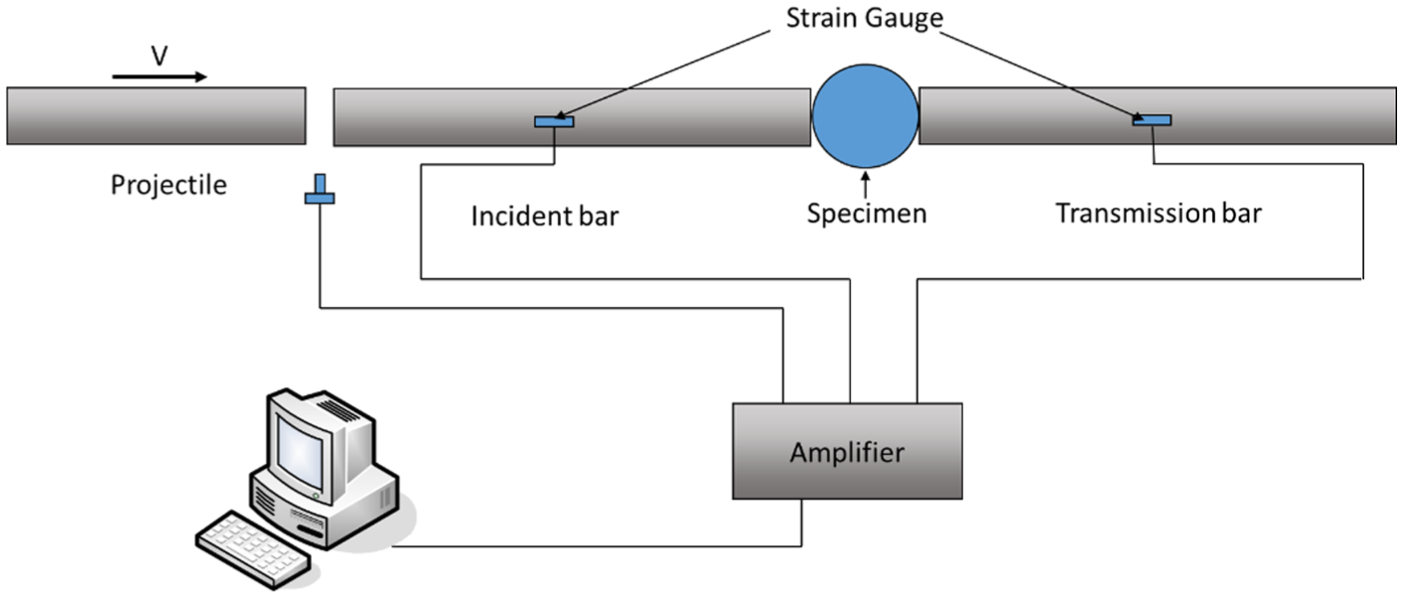
Schematic of the dynamic Brazilian test.
The recorded signals from the strain gauge are called incident strain


where
The dynamic stress equilibrium is achieved on the disk specimen

The dynamic tensile strength of concrete can be calculated by

where
Material model
The Holmquist–Johnson–Cook (HJC) constitutive model proposed by Holqmuist et al. 25 for the large deformation and high strain rate of concrete materials under dynamic impact was used in this study. The model can describe the mechanical behavior of concrete under high speed impact and penetration. The yield surface equation of the HJC model is

where
Since the compressive strength of concrete is much larger than its tensile strength, the tensile failure at the center of Brazilian disk always occurs before global failure. The HJC model has already been included in commercial finite element code. Material 111 MAT_JOHNSON_HOLMQUIST_CONCRETE was adopted in this study. Table 1 shows all the material parameters used in the simulation. The parameter C is the strain rate coefficient as before. FS represents the failure type. FS = 0 means that the material fails in the mode of tensile failure; meanwhile,
Material parameters of the HJC model used in simulation.

HJC: Holmquist–Johnson–Cook.
Simulation of lateral inertia confinement
In order to study the influence of lateral inertia confinement on dynamic tensile strength in dynamic Brazilian tests, numerical simulations are performed to simulate the dynamic Brazilian tests as shown in Figure 2. It should be mentioned that the finer meshes had been tested in several trial simulations and no obvious difference was observed between the results obtained from the current meshes and those of finer meshes. The lengths of the incident and transmission bars are 3.5 and 3.0 m, respectively, and the diameter of the bars is 74 mm. The disk specimens are 70 mm in diameter and 20, 30, 40, 50, and 60 mm, respectively, in thickness. The incident and transmission bars are linear elastic materials, the elastic modulus is 210 GPa, the density is 7800 kg/m3, and the Poisson ratio is 0.3. The compressive strength of concrete is 34 MPa and the tensile strength is 2.74 MPa. The friction between the bars and specimen is not considered due to its narrow contact strip and lubrication.

Part of the numerical model of SHPB test.
In order to save the calculation time, the impact wave is not generated by the projectile to impact the incident bar, and a pulse is applied on the end face of the incident bar instead, as shown in Figure 3. Multiplying velocity by time gives deformation. Strain is equal to deformation divided by size. Strain rate is calculated by substituting strains into equation (1). Hao et al.9,13 pointed out that this is an effective method to save the computation time.

Velocity–time curve.
The dynamic tensile strength calculated by equation (4) includes the effect of lateral inertia confinement on tensile strength, which will overestimate the dynamic material strength. Figure 4 illustrates the effect of inertial forces in the dynamic equilibrium of concrete. When the stress wave travels through the disk specimen, there is a force F to cause the disk to split in the vertical direction, and at the same time the inertial force Fi and the resistance force Ft will stop the disk to split.
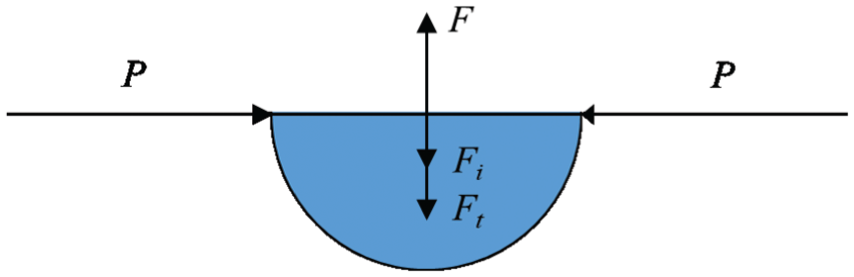
Equilibrium of forces of disk.
According to the equilibrium of forces in the vertical direction

When the inertial force is not considered, tensile strength is calculated by

In fact, the tensile strength given by formula (7) is not the true strength of the material at high strain rate; the true strength should be calculated by

The enhancement of dynamic tensile strength of concrete obtained from equation (8) is the true mechanical property, rather than a structural response.
SHPB experiments
Specimen preparation
In order to study the influence of specimen size on lateral inertia confinement, commercial cement C30 was adopted to fabricate the disk specimens of two different thicknesses, 30 mm × 70 mm and 50 mm × 70 mm (thickness × diameter), as shown in Figure 5. In order to avoid the non-homogeneity, the aggregate size of the disk specimen is not very large (maximum aggregate size is 7 mm). The mix proportion of water, cement, sand, and aggregate of the specimens is given in Table 2. All the specimens are demolded after around 24 h and are cured until an age of 28 days at the temperature of 20 ± 2°C and the humidity of ≥95%. The as-prepared specimens are thicker than what experiments need and will be polished to meet the requirements of size and parallelism. The quasi-static compressive strength is 34 MPa and the quasi-static tensile strength is 2.7 MPa.
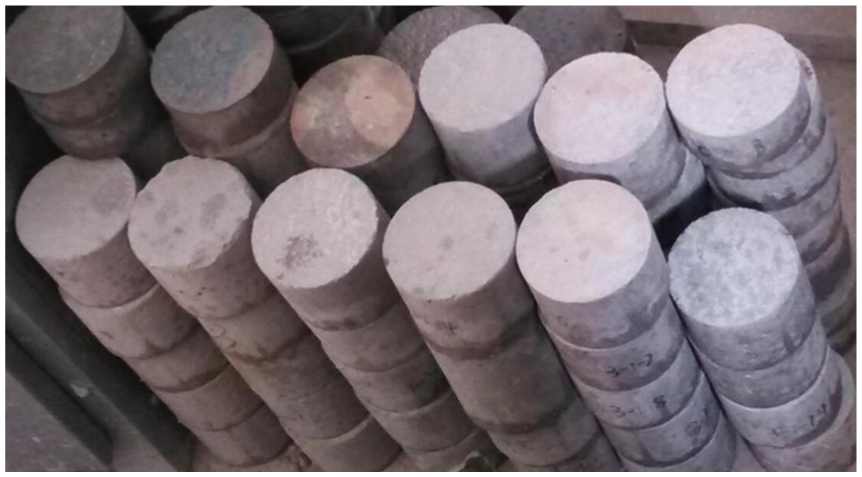
Brazilian disk specimens.
Mix proportion of specimens.

Dynamic Brazilian disk tests
The principle of dynamic Brazilian disk test is shown in Figure 1. The different impact velocities of the projectile will generate different incident stress pulses. Five disk specimen tests are carried out at each impact velocity. The typical reflected and transmitted strain–time curves from the test are shown in Figure 6. They are the fundamental to calculate the dynamic tensile strength of concrete. The dynamic tensile strength of concrete can be calculated through equation (4). Some dynamic Brazilian disk test images are shown in Figure 7.
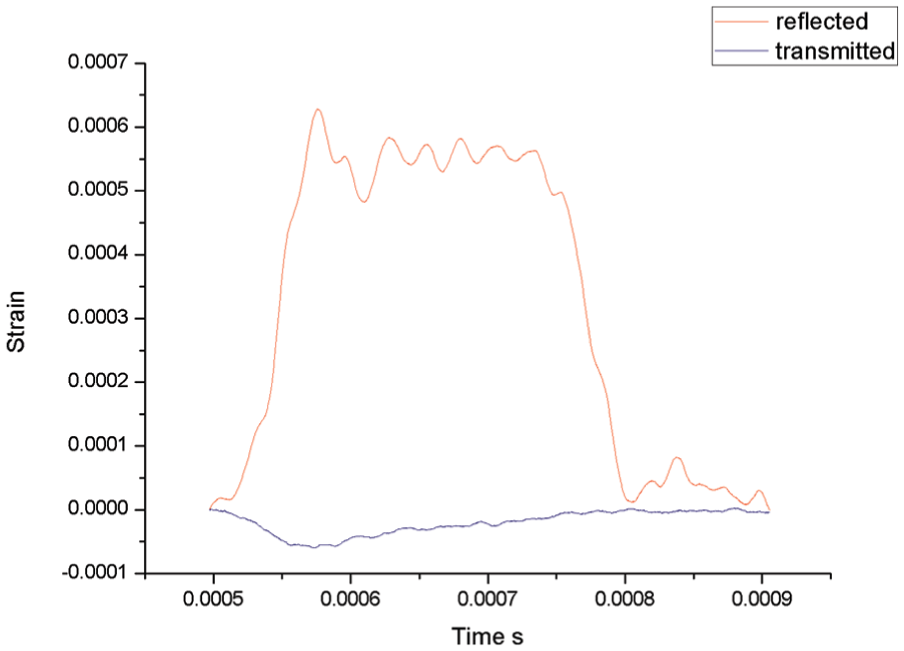
Typical reflected and transmitted strain pulses.

Dynamic Brazilian disk tests: (a) 30 mm and (b) 50 mm.
Results and discussion
Numerical simulation results
The dynamic tensile strength of concrete from numerical simulations is shown in Figure 8. It is found that the tensile strength of concrete increases with the increase in strain rate. When the strain rate reaches 120/s, the tensile strength is 10.9 MPa, which is four times the quasi-static tensile strength. This indicates the existence of lateral inertia confinement in dynamic Brazilian disk test with SHPB apparatus. In the case when the thickness of the disk specimen is less than 60 mm, the tensile strength of concrete increases with the increase in the thickness of the disk specimen. A conclusion can be drawn that the lateral inertia confinement is dependent on specimen size. When the disk specimen is 60 mm in thickness, the tensile strength is smaller than that of the disk specimen 20 mm in thickness. Equation (4) is based on plane stress hypothesis; obviously, when the disk specimen is 60 mm in thickness, the plane stress hypothesis is no longer valid.
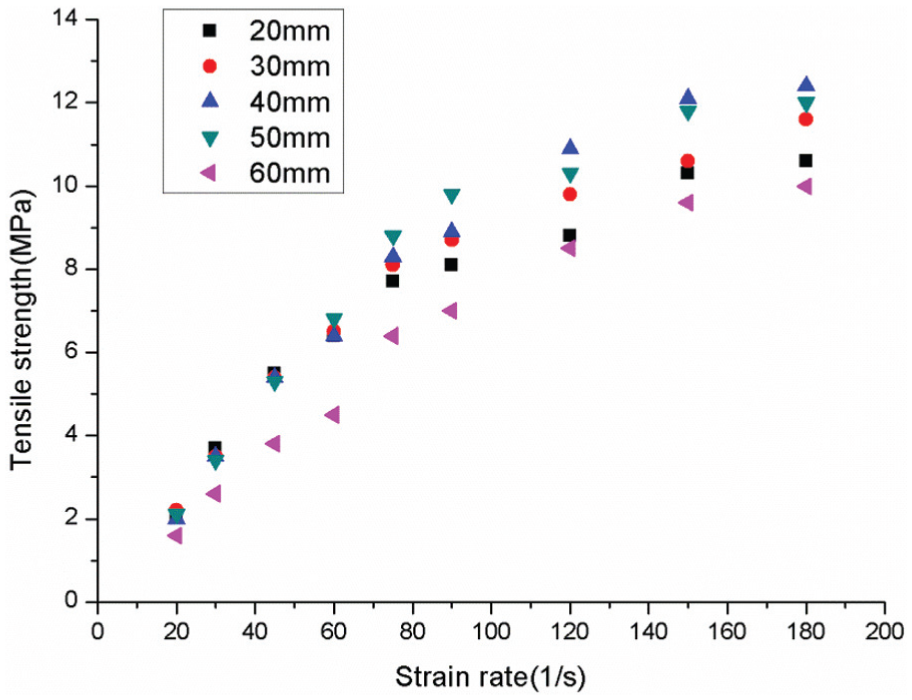
Relationship between tensile strength and strain rate.
Experimental results
Figure 9 shows the relationship between DIF and strain rate with different thicknesses. It is found that the DIF of concrete increases with the increase in strain rate for both sizes. The DIF obtained from the specimen of 50 mm thickness is smaller than that of the specimen with 30 mm thickness when the strain rate is less than 40/s, whereas the DIF of the 50-mm specimen is bigger than that of the 30-mm specimen when the strain rate goes beyond 40/s. Because the influence of lateral inertia confinement on the DIF increases with the increase in strain rate, the dynamic tensile enhancement is dependent on specimen size. Therefore, the DIF of the 50-mm disk specimen will grow more rapidly when the strain rate increases.

Relationship between DIF and strain rate.
Comparison of the experimental and numerical simulation results
Specimens with the thickness of 30 mm are taken as an example for comparison. Both the data and fitted curves of DIF obtained from experiments and simulations are shown in Figure 10. It can be seen that the DIF obtained from experiments is greater than that obtained from simulations. It indicates that the lateral inertia confinement has a great effect on the dynamic tensile strength. It is important to remove the influence of lateral inertia confinement on dynamic tensile strength. The true dynamic tensile strength of concrete can be derived from equation (8). The DIF, which reflects the true dynamic mechanical properties of concrete, is shown in Figure 11.
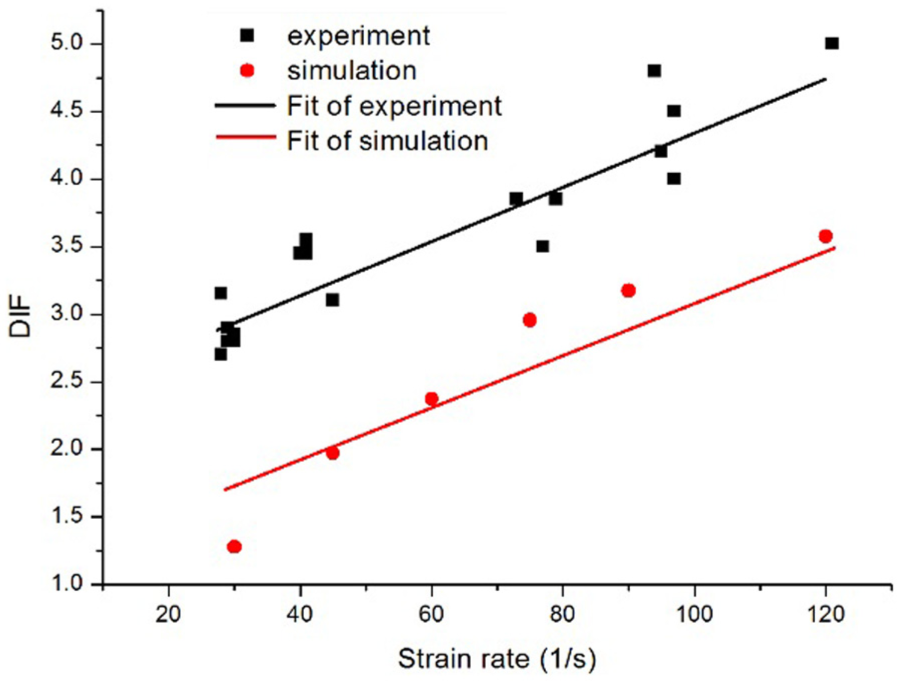
Comparison of DIF from simulation and experiments.

Fitted curve of DIF obtained from the true mechanical properties.
The DIF of tensile strength given by the Committee Euro-International du Beton (CEB) 6 is

where
In this study, the DIF was investigated when

Comparison of DIF from true mechanical properties and CEB.
Conclusion
The lateral inertia confinement has a great effect on the dynamic tensile strength, which depends on both specimen size and strain rate. The tensile strength of concrete determined by dynamic Brazilian test with SHPB apparatus cannot reflect the true dynamic properties of concrete and will overestimate the dynamic tensile strength of concrete. The DIF reflecting the true dynamic properties of concrete is obtained through the comparison of the results from numerical simulation and experiment. It is important to eliminate the influence of lateral inertia confinement on the tensile strength of concrete in structural design.
Footnotes
Handling Editor: Wensu Chen
Declaration of conflicting interests
The author(s) declared no potential conflicts of interest with respect to the research, authorship, and/or publication of this article.
Funding
The author(s) disclosed receipt of the following financial support for the research, authorship, and/or publication of this article: This work was financially supported by the National Natural Science Foundation of China (grant nos 11390361, 11390362, and 11772215).
