




Abstract
The deformable warhead is a common type of anti-missile warheads, and the geometric configuration of deformable warhead is close to D shape under the lateral blast loading of auxiliary charge. In this article, the spatial distribution of fragments is taken as the research object, and an empirical model for evaluating the spatial distribution of fragments is expected to be established. First, the empirical model was designed based on dimensional analysis and quadratic interpolation. Then, three different D-shaped structures (D-90°, D-120°, D-150°) were studied by the numerical simulations and experiments. In order to minimize the influence of the axial sparse waves at both ends, only the middlemost layer of fragments was researched. The relationships among d/r, sin α, and sin β were obtained (where d represents the initiation distance, α represents the initial position angle, and β represents the scattering angle). With the scattering angle β and target distance l, the spatial distribution of fragments can be deduced. Based on the fitting formula and the parameters of D-shaped structures, the relationships between d/r, sin α, and sin β of arbitrary D-shaped casing (D-θ) were obtained using quadratic interpolation. Finally, D-105° structure was verified by numerical simulation and empirical formula, both of which coincided well with each other. Therefore, the empirical model can be used to rapidly evaluate the spatial distribution of fragments, especially suitable for the D-shaped structure with a large length–diameter ratio.
Keywords
Introduction
For the conventional fragment warhead, only about 1/12th to 1/8th of the fragments fly to the target area and most of the fragments are considered as invalid fragments, which leads to the existence of conventional fragment warhead with low utilization efficiency and poor damage.1,2 In case the overall quality of the warhead is limited, how to improve the effectiveness of warhead damage is a key issue. As a result, the military powers carried out technical research on the directional warhead since 1960s. The basic principle of the directional warhead is through the special structural design to achieve the regional concentration of fragments toward the specified direction of the target, and the damage gain area is formed to improve the damage power and probability of fragments.3–6 The deformable warhead7–11 is a new type of intelligent warhead among the directional warheads, which achieves high efficiency damage by increasing the distribution density of fragments in the direction of targets. The prototype of deformable warhead was first proposed by Kempton 12 of the Navy Air Weapons Research Center in 1971. Konig and Mostert 13 improved the structure of deformable warhead on the basis of previous studies, and some regular knowledge was obtained through simulation analysis of projectile deformation and the scattering process of fragments. Lloyd 14 conducted a series of detailed studies on the process and mechanism of deformable warhead and the conclusions are significantly valuable. In the 1990s, Fairlie et al. 15 simulated the deformation of the deformable warhead and the scattering process of fragments by AUTODYN-3D finite element program, and the scattering rules of fragments and structural parameters of the deformable warhead were obtained. Lloyd 16 assumed that the geometric configuration of deformable warhead is D-shaped, which made the theoretical analysis of the deformable warhead easier. The spatial distribution and velocity of fragments are two most important parameters of deformable warhead, which determine the damage area and damage degree of the target, respectively. It has been reported in the literature17–22 the experimental and theoretical research on fragment dispersion and velocity distribution about the fragment generators. The theoretical velocity of fragments can be quickly estimated by Gurney formula. 23 Arnold and Rottenkolber 24 examined the fragmentation behavior of very light and heavier casings to obtain the mass distribution of the fragments produced after detonation of the explosive charge. The applied method of data collection was based on image processing, which was outlined and applied to the fragment mass distribution of four different shells. Grisaro and Dancygier 25 proposed a simplified model to depict the non-uniform spatial distribution over a protective wall. The spatial distribution was characterized by an ‘intense strip’, which was impacted by the heaviest fragments, and the model parameters were evaluated using the smoothed particle hydrodynamics (SPH) simulation technique. Gong et al. 26 and Wang et al. 27 reported an empirical formula and a new method to estimate the projection angles and fragment velocities of D-shaped cylindrical casing. Ding et al. 28 studied the spatial distribution and velocity of fragments about the concave-shaped and convex-shaped asymmetric structures.
It is seen that there is no empirical or semi-empirical model to rapidly evaluate the spatial distribution of fragments about the D-shaped structure at present. Therefore, this article aims to study the spatial distribution of fragments about the D-shaped structure and proposes an empirical model, by numerical simulations and experiments. The empirical model is able to rapidly evaluate the spatial distribution of fragments, which can greatly save the time and cost.
Design of the empirical model
Problem description
Deformable warhead, also known as explosion-oriented directional warhead, is generally made up of the main charge, auxiliary charge, casing, refabricated fragments, and initiation control system, and its typical structure is shown in Figure 1(a).

(a) Schematic diagram and (b) action process of deformable warhead.
The working principle of deformable warhead is that when the missile and target encounter, the relative orientation and motion state of the target are detected by the target location detection device and the fuze detection device on the missile. Then, the detonation network first chooses to initiate one or several adjacent auxiliary charges near the side of the target (as shown in Figure 1(b)-B), and the other auxiliary charges are not detonated under the protection of the flameproof structure. The casing of warhead deforms under the blast loading of the auxiliary charge, and the deformed casing outline is similar to D shape (as shown in Figure 1(b)-C). After a short delay, the main charge is eccentrically initiated on the undeformed side, and the detonation wave drives the fragment layer to fly toward the target more intensively (as shown in Figure 1(b)-D), to achieve efficient damage.
The spatial distribution of fragments and fragments’ velocities are the key indexes determining the power of deformable warhead. It is assumed that the deformable warhead profile is D-shaped in this article, to achieve the rapid assessment of the spatial distribution of fragments.
Dimensional analysis
If the value of β, which is defined as the angle between the scattering direction of the fragments and the plane of symmetry, is determined after the main charge exploded, then the spatial distribution of fragments is to be determined, as shown in Figure 2. The parameters that may affect the angle β are identified as follows: the geometric position relationship of the above parameters is shown in Figure 2. In addition, the points O1, O2, and O3 are the initiation points. The definitions of notations are as follows:
r—the charge radius of the main charge
d—the horizontal distance from the initiation point to the D-shaped plane
α—the angle between the direction of the detonation wave at the location of the fragment and the symmetric plane
l—the distance between the D-shaped structure and the target plate
θ—the central angle corresponding to the D-shaped surface
ψ—the distance from the fragment to the symmetric plane on the D-shaped surface

Geometric position relationship of the influence parameters.
According to the principle of dimensional analysis, the expression of spatial distribution of fragments can be obtained as follows

Based on the dimensional homogeneity, r is selected as the independent dimension and the other parameters can be written in the dimensionless form as follows

Then, the dimensionless form of formula (1) can be expressed as follows

In order to further simplify the problem, the parameters that are not independent dimensions need to be removed from the above six parameters. The parameters α, ψ, and d have the following relationship

The above formula indicates that ψ is not an independent dimension and Π4 can be discarded. It is assumed that the fragment is flying along a straight line, ignoring the influence of gravity on the fragment trajectory, and the distance between the device and the target plate l cannot be considered, namely, Π3 can be discarded. When the central angle θ of the D-shaped structure is also known, Π2 can also be discarded. Then, the expression of the spatial distribution of fragments can be expressed as

Quadratic interpolation algorithm
When the center angle of the D-shaped structure is determined, formula (5) can be fitted by numerical simulation and the specific expression can be obtained. However, it is obviously time consuming to determine the spatial distribution of fragments of the D-shaped structure at each specific central angle, by numerical simulations and experiments.
To solve this problem, this article proposes to quickly obtain the spatial distribution of fragments of D-shaped structures corresponding to different central angles through the quadratic interpolation algorithm, based on three sets of basic data, which can greatly reduce the assessment cycle.
The quadratic interpolation algorithm used in this article is roughly designed as follows. It is assumed that there are three known central angles θ1, θ2, and θ3, the corresponding spatial distribution expressions of fragments can be fitted according to the numerical simulations



Then, according to the quadratic interpolation, the spatial distribution expressions of fragments of the D-shaped structure corresponding to the given arbitrary central angle can be obtained as follows

Based on our previous studies,26,27 it is found that the comprehensive damage effect of the fragments is better when the central angle of the D-shaped structure is between 90° and 150°. Therefore, it can be assumed that the optimum range of the central angle θ is 90°–150°.
If the values of β at θ = 90°, 120°, and 150° are determined, namely, the spatial distributions of fragments corresponding to the three working conditions are known, then the spatial distribution of fragments of the D-shaped structure corresponding to arbitrary center angle within the range 90°–150° can be obtained, based on the following expression
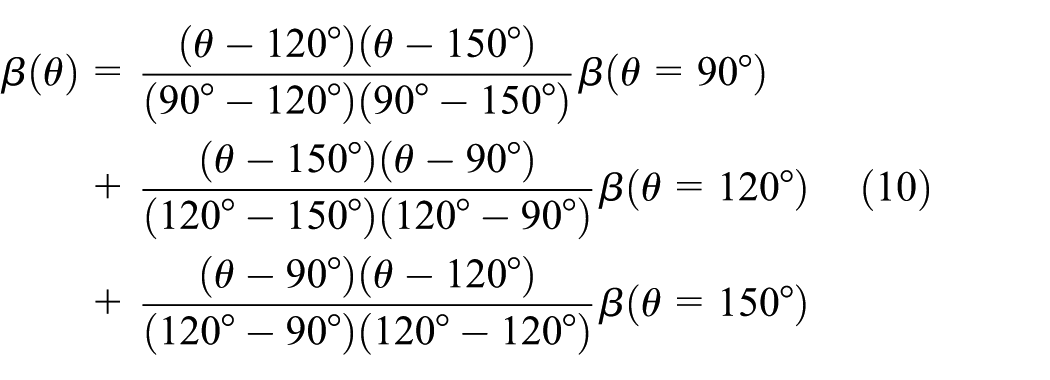
According to the above analysis, the empirical model of the spatial distribution of fragments corresponding to the D-shaped structure has been fully established.
Simulation and experiment
LS-DYNA is one of the most important dynamic finite element programs, which is widely used in aerospace, weapons, equipment, automobile, marine, and other important fields. It is mainly used to deal with explosion, large deformation, high-speed penetration, and other complex conditions. At present, the software includes three basic algorithms: Lagrange algorithm, Euler algorithm, and arbitrary Lagrange–Euler (ALE) algorithm. This article selects the ALE algorithm which combines the characteristics of Euler algorithm and Lagrange Algorithm. Therefore, it is very suitable to analyze the fluid–solid coupling problems, and it can avoid the serious distortion of the grid. In order to ensure that the simulation model can represent the experimental setup, the numerical simulations reported in this article were performed on the whole model.
FE model
Modeling geometry
In this section, three groups of D-shaped structures (D-90°, D-120°, D-150°) were numerically simulated, as shown in Figure 3. The entire model was composed of five parts, upper endplate, lower endplate, casing, fragments, and charge. Based on the requirements of the ALE algorithm, the whole model was divided into two parts, namely, the Euler part and the Lagrange part. The air and trinitrotoluene (TNT) charge were defined as Euler part, while the two endplates, casing and fragments were defined as Lagrange part. The thickness of the two endplates is 10 mm, the material of which is aluminum. The height of the casing and charge is 82 mm, the materials of which are steel and TNT, respectively. The fragment layer consists of steel cubes with a side length of 4.8 mm and the fragment type is square semi-prefabricated.
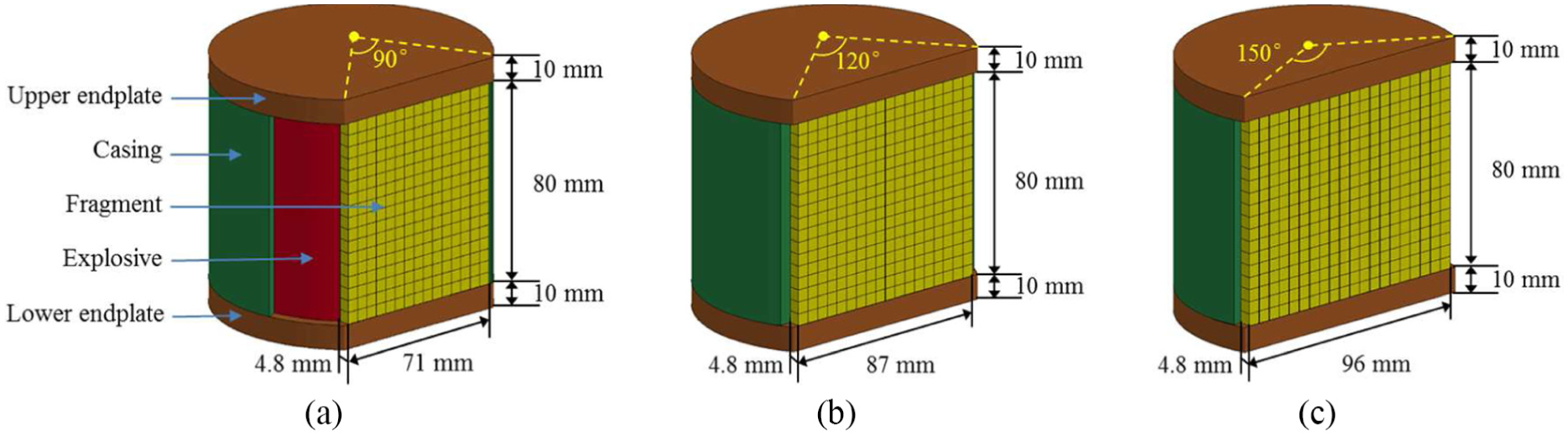
Schematic diagram and sizes of D-shaped devices: (a) D-90°, (b) D-120°, and (c) D-150°.
All of the meshes adopted the SOLID164 elements and the mesh sensitivity analyses were also undertaken. It is considered that the Lagrange mesh size is at least twice as large as the Euler mesh size. In this article, the Lagrange mesh size is 5 mm and the Euler mesh size is 2.5 mm, which has been well demonstrated in Ding et al., 28 because the simulation results coincide well with the experimental results.
Modeling material
In the numerical simulation, the material model and equation of state (EOS) have great influence on the simulation results. After repeated debugging, the material model and EOS are determined as follows.
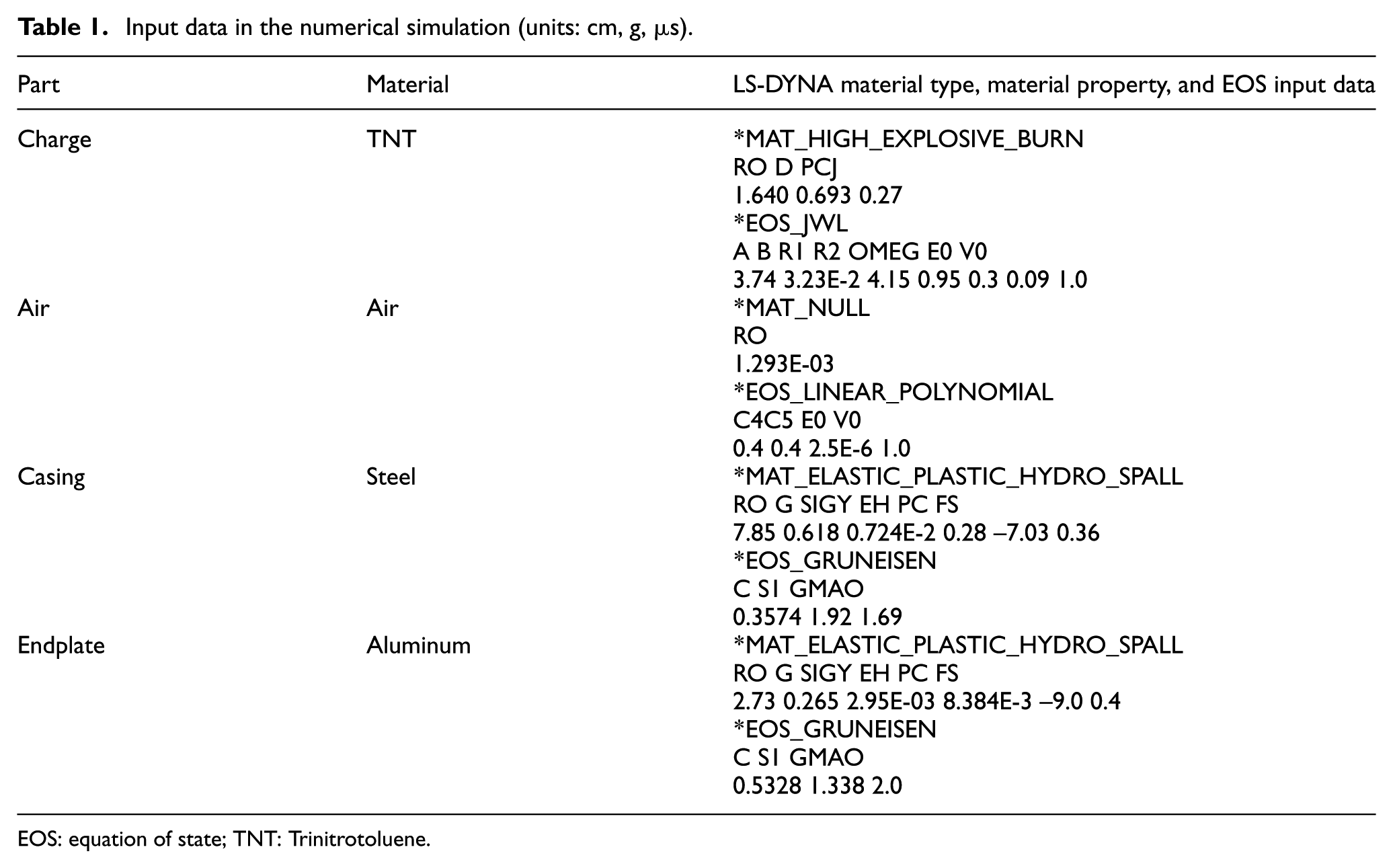
The high-explosive material model (*MAT_HIGH_EXPLOSIVE_BURN) and the Jones–Wilkins–Lee (JWL) EOS (EOS_JWL) are used to describe the material property of charge. The JWL EOS gives the relation between the pressure of detonation products and various parameters, which is expressed as

where A, B,
Input data in the numerical simulation (units: cm, g, μs).
EOS: equation of state; TNT: Trinitrotoluene.
The material type 9 (*MAT_NULL) in LS-DYNA incorporating the linear polynomial EOS (EOS_LINEAR_POLYNOMIAL) is used to describe the material property of air. The linear polynomial EOS is a linear function of internal energy, and the pressure is expressed as

If
Other components, including the casing, endplates, and fragments, are modeled by the material type 10 (*MAT_ELASTIC_PLASTIC_HYDRO_SPALL) and Gruneisen EOS (EOS_GRUNEISEN). Since we only care about the spatial dispersion of semi-prefabricated fragments, the strain rate effect was not considered in the selected material model. Failure strain was used to define the failure criterion, and its value is FS (failure strain for erosion) in the “*MAT_ELASTIC_PLASTIC _HYDRO_SPALL” material model, as shown in Table 1. In the explosion process, if the strain of the material grid is greater than FS, it means that the element will fail and be deleted in the subsequent calculation. Here, it is taken that FS = 0.36 (steel) and FS = 0.4 (aluminum). The mechanical parameters of the material model were not the default parameters in LS-DYNA, which were provided by the material supplier. These material parameters had been verified by numerical simulations and experiments, the detailed analysis of which can be found in Ding et al. 28
Experiment
Specimen
In order to verify the rationality and correctness of the numerical simulation, three sets of experimental devices with the same size and structure as the finite element model were designed, as shown in Figure 4. The material of each part is also the same as in the finite element model.

Assembly drawing of three different D-shaped devices: (a) D-90°, (b) D-120°, and (c) D-150°.
Experimental setup
The schematic diagram and physical map of the experimental setup are shown in Figure 5. In the experiment, the fragment velocity was measured by the high-speed photography and target mesh, respectively. The high-speed photography was placed behind a small shelter in order to protect it from the interference and destruction, and the fragment’s initial scattering moment and impacting moment can be directly given based on the video. Another method of velocity measurement is to use an oscilloscope and target meshes, the target meshes were stuck on the target plates, and the oscilloscope can also provide the fragment’s initial scattering moment and impacting moment. The D-shaped device was perpendicular to three target plates, and the target plates with a width of 1.0 m, a height of 2.5 m, and a thickness of 0.3 mm were used to record the spatial distribution of fragments. Each target plate was divided into several square regions (25 cm × 25 cm) by gridlines. The distance between the specimen and the target plates is 3.5 m, so the azimuth angle of each square region is 4.09°. The axis of the D-shaped device was vertical to the ground, and the semi-prefabricated fragments faced the center of the 2# target plate. For the following analysis, it is assumed that the direction from the center of the D-shaped device to the center of the 2# target plate is the 0° azimuth angle. To note, the azimuth angle is positive along the clockwise direction. Under the above conditions, the spatial distribution of fragments can be obtained theoretically.

Schematic diagram and physical map of the overall experimental arrangement: (a) schematic diagram of the target plate and D-shaped device; (b) schematic diagram of the high-speed photography; and (c) experimental physical map of the target plate and D-shaped device.
Construction and verification of the empirical model
For the D-shaped structure, its fragment scattering process after explosion cannot be obtained by the experiment. In addition, the cost and test period of the explosion experiment are also higher. Therefore, this article hopes to verify the rationality and reliability of numerical simulation, by comparing and analyzing the experimental and simulation results of the fragments’ spatial distribution. Then the empirical model is constructed based on the simulation results.
Simulation and experimental result analysis of the D-120° structure
Several different simulation conditions were constructed, to rapidly obtain the spatial distribution of fragments under different initiation conditions. For the D-120° structure, three different simulation conditions were designed and the corresponding d/r values of the points O1, O2, and O3 are 1.5, 1.0, and 0.5, respectively.
The results of the condition d/r = 0.5 are shown in Figure 6. Figure 6(a) shows the recovered target plates of the D-120° structure, which can be served as a visual comparison of the spatial distribution of fragments over the target from the experiment and numerical simulation. Since only the semi-prefabricated fragments face the target plates, the other parts of the D-shaped device are not facing the target plates, so the natural fragments created from the casing do not impact the target plates. Figure 6(b) indicates the fragment statistics corresponding to the experiment and numerical simulation, the experimental data were counted from the recovered target plates, and the simulation data obtained were based on the self-compiled program. There are four numbers of fragments on each target plate, which means that the four regions are related to the width of each target plate, namely, each number of fragments is the sum of the impacts over the height of the plate in that region. Figure 6(c) shows the spatial distribution of fragments on the target plate with l = 3.5 m, corresponding to the numerical simulation. In Figure 6(c), each point represents a fragment, the ordinate indicates the spatial coordinate, the abscissa indicates the azimuth angle of fragments, and the velocities of fragments are distinguished by different colors.

Fragment statistics and spatial distribution of the D-120° structure: (a) recovered target plates of the D-120° structure; (b) fragment statistics of the D-120° structure; and (c) spatial distribution and velocity of fragments about the D-120° structure (l = 3.5 m).
It can be seen from Figure 6 that the fragments are concentrated in the central area and the velocities are also larger, while the densities and velocities of fragments on both sides are relatively small. Through the analysis of the dispersion process of fragments, it can be seen that the fragments at the axis of symmetry fly along the horizontal direction, while the dispersion situation of fragments at the boundary is asymmetric under the action of sparse waves. Because the scattering process is very complicated, it needs to be simplified when studying the spatial distribution of fragments and the middlemost layer of fragments is taken as the research object, which can minimize the influence of the axial sparse waves at both ends of the device. The methods used to determine the spatial location of fragments are different for experiments and numerical simulations, which can ensure that the perforation hole and the specific fragment are in one-to-one correspondence. For the experiments, the specific perforation positions of the corresponding fragments are determined by comparing the high-speed photography and the recovered target plates. However, for the fragment generator device, the number of fragments is really much higher and the explosion of the explosive will be affected by the sparse waves at both ends. It is difficult to accurately obtain the spatial position of all fragments from the experimental point of view. For the numerical simulations, the spatial position and velocity of the selected fragments are accurately obtained based on the self-compiled program. Therefore, all the values of sin α and sin β in this article correspond to the middlemost layer of fragments and are based on the simulation results rather than experimental results.
According to the principle of symmetry, we only need to study one side of the fragments. For the middlemost layer of fragments, the values of α and β corresponding to each fragment can be obtained in a single simulation and the specific values are shown in Table 2.
Geometric relations under different initiation conditions of D-120°.
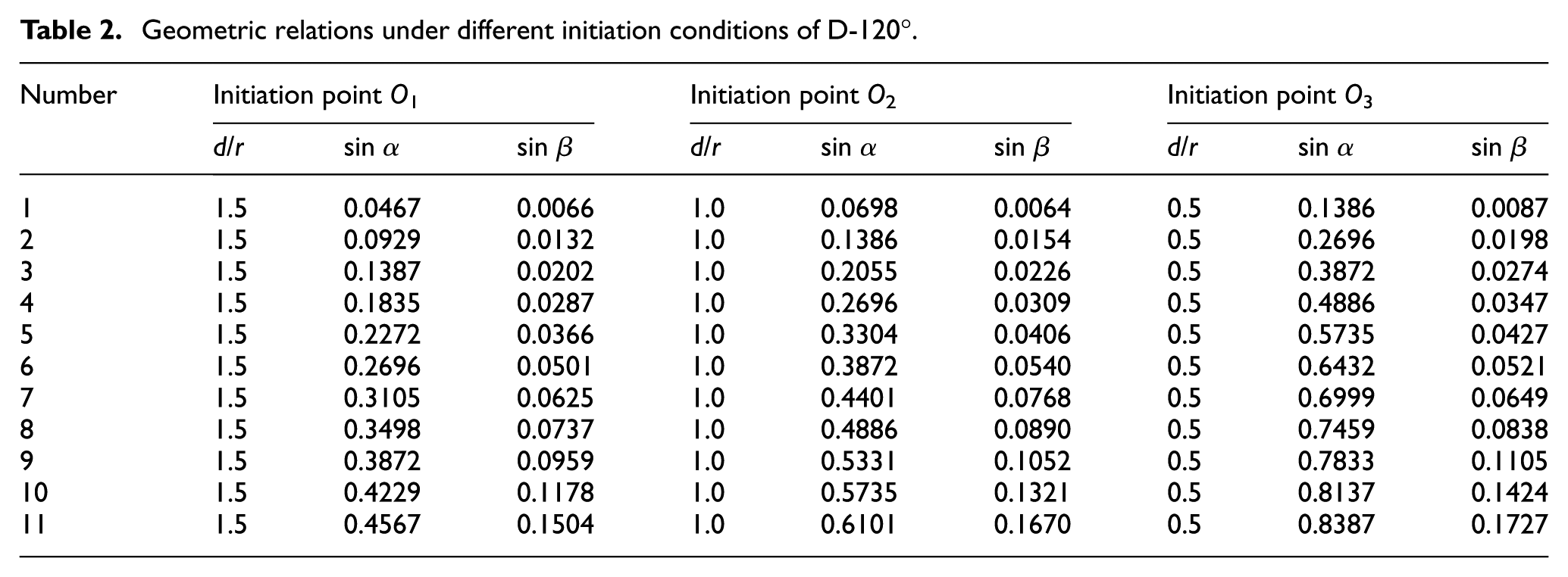
In order to rapidly predict the spatial distribution of fragments under different initiation distances d, three values of d/r, sin α, and sin β were fitted in the quadric surface, based on the data in Table 2. The fitting polynomial is expressed as

The values of A, B, C, D, E, F, and R2 (coefficient of determination) were obtained, as shown in Table 3.
Fitting parameter values of the D-120° structure.

The quadratic surface of D-120° was fitted as shown in Figure 7 and the points corresponding to different conditions in Table 2. Through comparison, the dispersion state of fragments under different conditions is consistent with the quadratic surface, so formula (13) can be used to rapidly analyze the fragment dispersion of the D-shaped structure.

Quadratic surface of the D-120° structure.
Verification of the fitting formula corresponding to the D-120° structure
To verify the accuracy of the fitting formula (13), the charge radius of the D-120° structure was adjusted to r = 5 cm. Moreover, the length of cubic fragments remained 0.48 cm and the distance between the adjacent fragments increased from 0.01 to 0.03 cm. Two simulation conditions were employed, corresponding to the initiation distances d = 6 and 7.5 cm. In addition to the symmetry axis position and the edge position, one side contains seven pieces of fragments. Based on formula (13), the different values of sin β were calculated and the simulation values of sin β were also obtained, as shown in Table 4.
Numerical simulation and calculated values of sin β.

Two groups of comparative results between the simulation and calculated values are shown in Figure 8. In order to more clearly compare the calculation results with the simulation results, the error parameter Δβ is defined as


Comparative results of different initiation distance: (a) d = 6 cm and (b) d = 7.5 cm.
It is seen from Figure 8 that the distribution of fragments obtained by formula (13) coincides well with the simulation result. Therefore, the research method of dimensional analysis and quadratic interpolation can be used as an effective method to rapidly evaluate the spatial distribution of fragments.
Simulation and experiment result analysis of the D-90° and D-150° structures
The D-shaped structures with different central angles have different spatial distributions of fragments, and the spatial distribution of fragments is the main research indicator of the D-shaped structure. Therefore, it is necessary to further explore the spatial distribution of the D-shaped structure and obtain a more universal fitting formula, to realize the rapid assessment of the spatial distribution of fragments.
According to the D-120° structure, the D-90° and D-150° structures were investigated on the basis of experiment and simulation analysis. The fragment statistics and spatial distribution of fragments corresponding to the D-90° and D-150° structures are shown in Figures 9 and 10, respectively. The simulation results are in good agreement with the experimental results, which indicates that the simulation results are reliable. The values of the angles α and β were also obtained and the sine values are listed in Tables 5 and 6, respectively.
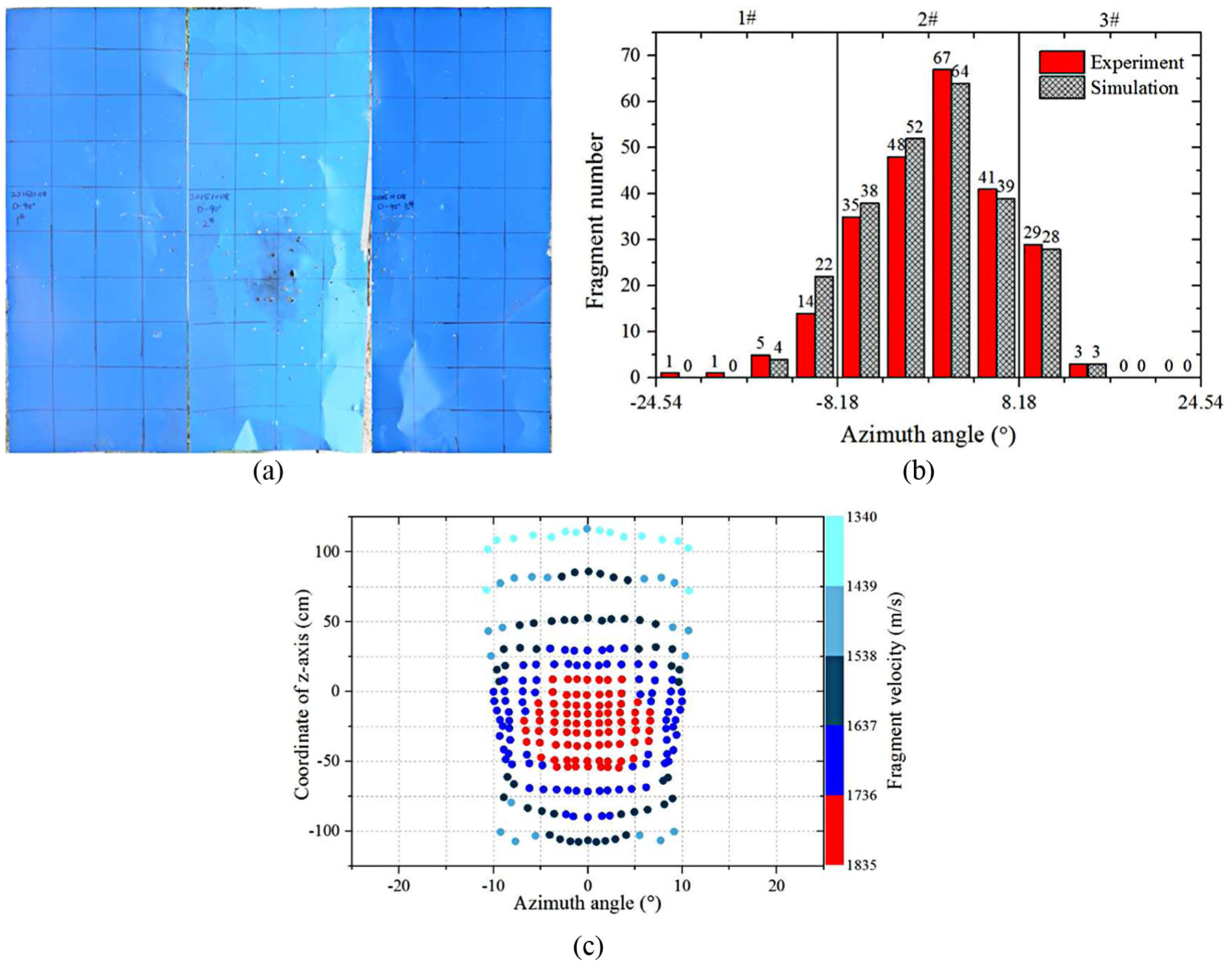
Fragment statistics and spatial distribution of the D-90° structure: (a) recovered target plates of the D-90° structure, (b) fragment statistics of the D-90° structure, and (c) spatial distribution and velocity of fragments about the D-90° structure (l = 3.5 m).

Fragment statistics and spatial distribution of the D-150° structure: (a) recovered target plates of the D-90° structure, (b) fragment statistics of the D-150° structure, and (c) spatial distribution and velocity of fragments about the D-150° structure (l = 3.5 m).
Geometric relations under different initiation conditions of D-90°.

Geometric relations under different initiation conditions of D-150°.

Based on the data in Tables 5 and 6, three values of d/r, sin α, and sin β in formula (13) were also fitted. The values of the constants A, B, C, D, E, F, and R2 were obtained by fitting, as shown in Table 7. Similarly, the quadratic surface of D-90° and D-150° were also obtained, as shown in Figures 11 and 12, respectively.
Fitting parameter values of the D-90° and D-150° structures.


Quadratic surface of the D-90° structure.
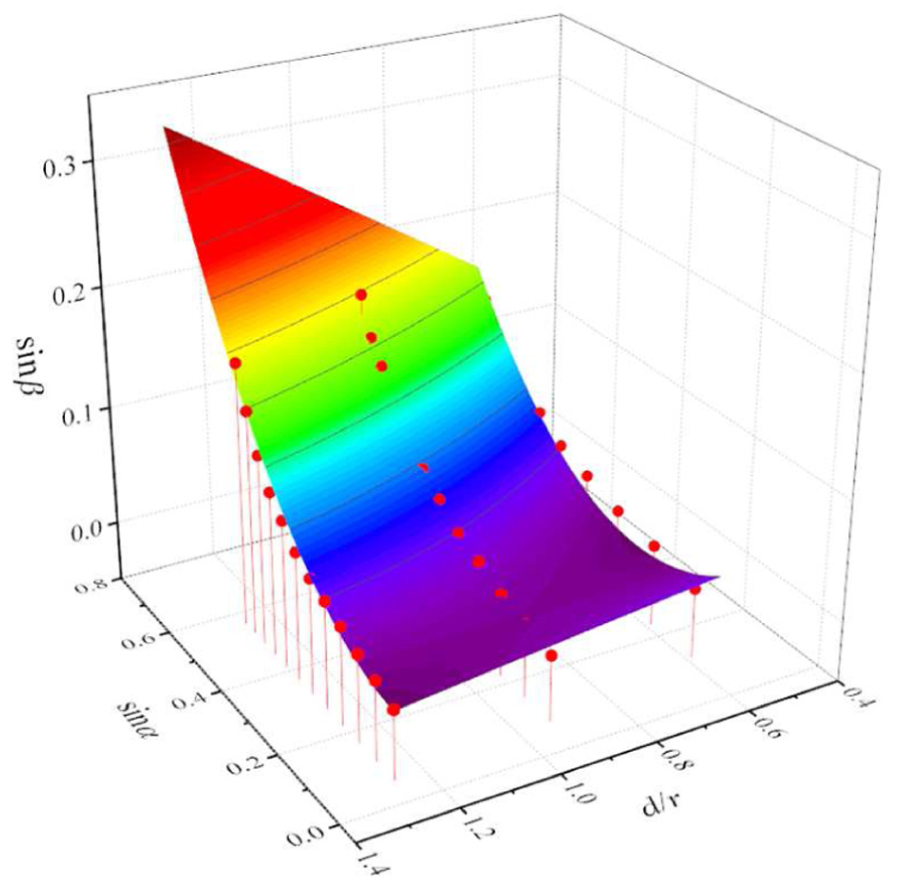
Quadratic surface of the D-150° structure.
Construction of the quadratic interpolation
For other D-shaped structures with different central angles, the structural geometry is determined, which means that the values of d/r and sin α are determined. According to the fitting formula (13) and the constants (A, B, C, D, E, F), the values of sin β corresponding to D-90°, D-120°, and D-150° can be calculated. Then the value of sin β, corresponding to the specified D-shaped structure, can also be calculated by constructing a quadratic interpolation function. Finally, the spatial distribution of the specified D-shaped structure based on the value of sin β can be deduced. It is assumed that the central angle of the D-shaped structure is θ, and the corresponding value of sin β can be calculated by the following formula

where
Verification of the quadratic interpolation function
In this part, a random selection of D-shaped structure (D-105°) with the central angle θ = 105° was made. The D-105° structural model with a radius of r = 5 cm and the side length of the fragment was adjusted to 4.7 mm. The dimensions of the other parts were the same as those of the above D-120° structure. Here, the scattering process of fragments at an initiation distance d = 7.5 cm was studied.
In the same way, the simulation model of D-105° was built based on the given geometric parameters. The scattering process and spatial distribution of fragments corresponding to D-105° are shown in Figure 13, and the values of sin β obtained from the simulation are listed in Table 8.
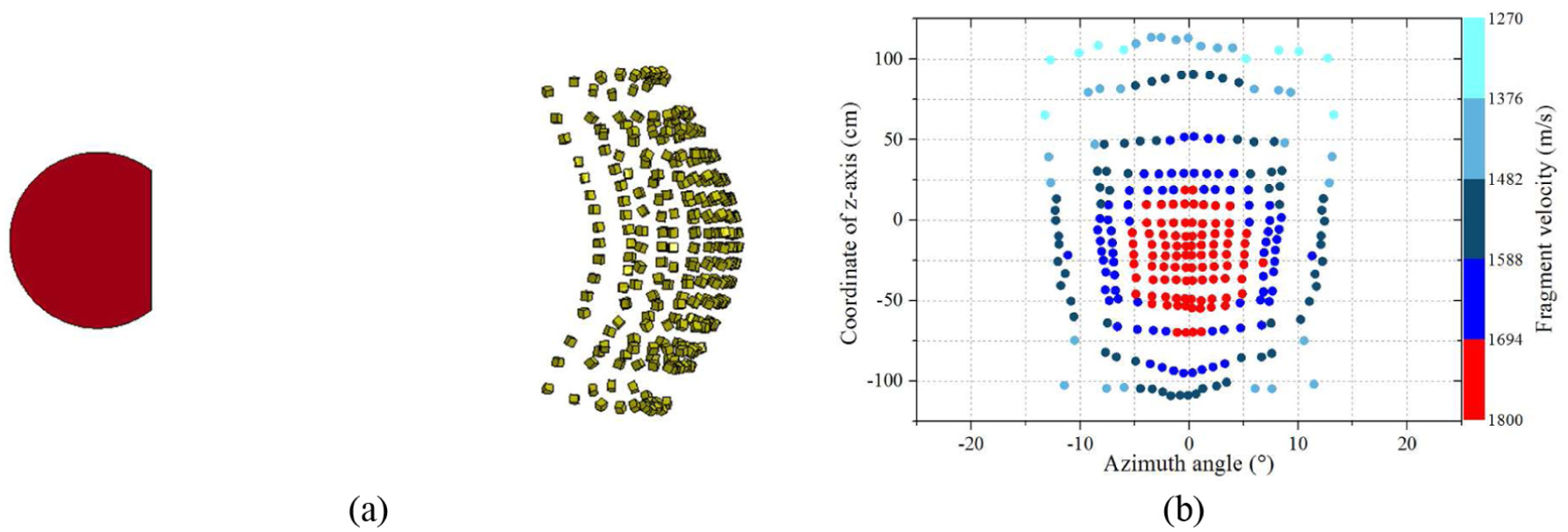
Scattering process and spatial distribution of the D-105° model: (a) scattering process of the D-105° model (t = 200 μs) and (b) spatial distribution and velocity of fragments about the D-105° structure (l = 3.5 m).
Values of sin β obtained from simulation and calculation.

Based on the determined values of d/r and
Calculated values of sin β corresponding to D-90°, D-120°, and D-150°.

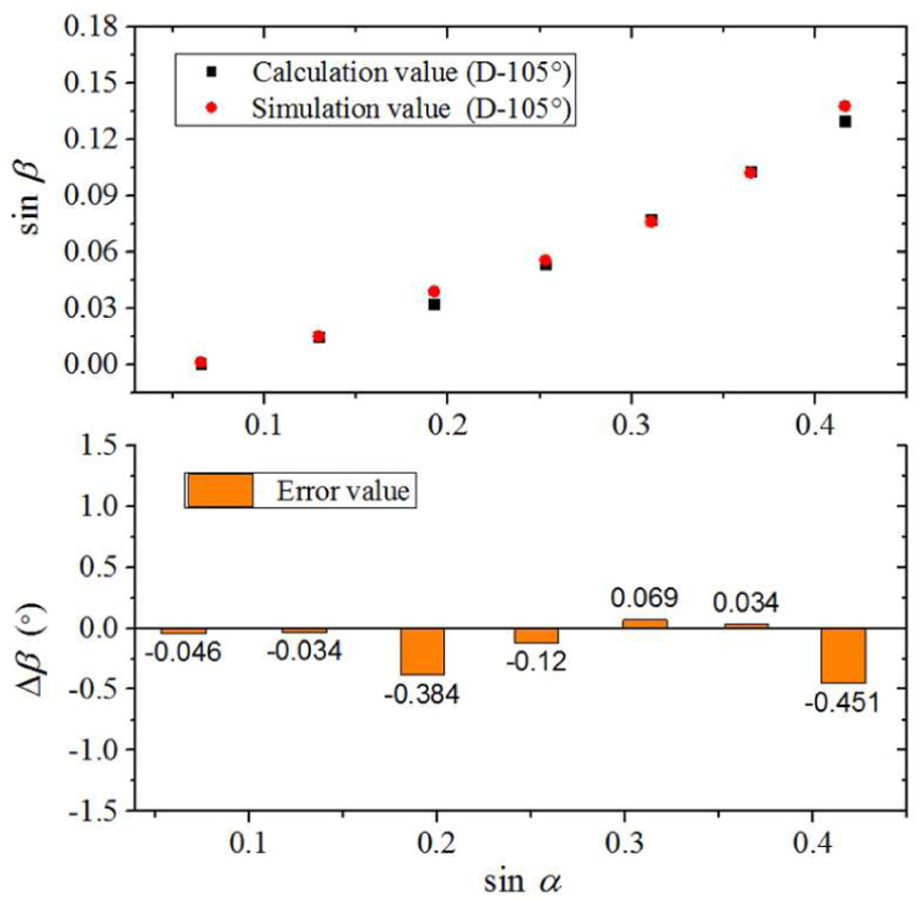
Comparison of sin β between the simulation and calculation.
Through the analysis of Figure 14, the values of sin β obtained from the quadratic interpolation formula and the numerical simulation coincide well with each other. In other words, it is feasible to study the fragment dispersion of other D-shaped structures by constructing the quadratic interpolation function, based on the three specified D-shaped structures (D-90°, D-120°, and D-150°). Therefore, this empirical model can be used to analyze and solve the spatial distribution of fragments about the D-shaped structures with various central angles.
To sum up, the fitting formula (16) and the corresponding constants (as listed in Table 10) were obtained, based on the analysis of numerical simulation results

Fitting parameter values of the D-90°, D-120°, and D-150° structures.

The quadratic interpolation method was applied, and the empirical model of any other D-shaped structure was realized based on the three basic data; namely, formula (17) was obtained

Conclusion
The spatial distribution of fragments is an important evaluation indicator of the D-shaped structure. However, it is generally relatively cumbersome and time consuming to obtain the spatial distribution of fragments of D-shaped structure in engineering applications. In this article, an empirical model based on the dimensional analysis and quadratic interpolation has been designed in order to quickly evaluate the spatial distribution of fragments of D-shaped structure. LS-DYNA is used to simulate the three different D-shaped structures (D-90°, D-120°, D-150°), and the simulation results have been verified by experiments. Then the spatial distribution of fragments about the specified D-shaped structure can be rapidly evaluated based on the simulation and experimental data. The results obtained from the numerical simulation have been compared with the computed results, which indicates that the method proposed in this article is scientific and feasible. In addition, a random D-shaped structure (D-105°) was selected to verify the accuracy of the fitting formula, which further validates the reliability of the empirical model.
It is worth noting that not all the fragments are studied. Instead, the middlemost layer of the fragment is taken as the research object when the empirical model is built, where the influence of axial sparse waves is ignored. Therefore, the obtained empirical model is especially suitable for the D-shaped structure with a large length–diameter ratio, and it can achieve rapid assessment of the spatial distribution of fragments.
Footnotes
Handling Editor: Jose Antonio Tenreiro Machado
Declaration of conflicting interests
The author(s) declared no potential conflicts of interest with respect to the research, authorship, and/or publication of this article.
Funding
The author(s) disclosed receipt of the following financial support for the research, authorship, and/or publication of this article: This study was financially supported by the National Natural Science Foundation of China (grant nos 11202237 and 11132012), which is gratefully acknowledged.
