




Abstract
In this article, a new method for fatigue reliability analysis of crack growth life based on the maximum entropy theory and a long crack propagation model is proposed. A modified generalized passivation-lancet model for long fatigue crack propagation rate is presented with explicit physical meaning. Experimental results for turbine disk alloy ZSGH4169 under different strain ratios and temperatures (at 650°C and room temperature) are used to verify the applicability of the new model. Results show that predictions by the proposed model are almost identical to the experimental data. The presented model is better than the other three models to reflect the rapid propagation characteristics of the crack. In order to perform fatigue reliability estimation, the probabilities of failure are calculated using the maximum entropy theory based on the fatigue crack growth life that derived from the proposed modified crack propagation model and the above existing three models. Results have shown that maximum entropy theory is very apt for fatigue reliability analysis of turbine disk under different loading conditions with a limited number of samples because it does not need any distribution assumptions for random variables. The effectiveness and accuracy of the combination of fatigue crack propagation models and maximum entropy method for fatigue reliability analysis are demonstrated with examples.
Keywords
Introduction
Fatigue fracture failure is one of the main failure modes for aero engine components under cyclic loadings.1–6 Fatigue life usually consists of crack initiation life and crack growth life, and as an important performance index, fatigue crack growth life must be taken into account in damage tolerance design for aero engine components.7,8 As the key parts of the aero engine, damage tolerance design for turbine disk plays an important role on improving the structural fatigue reliability and ensuring the safety during the service life. 9
Fatigue crack growth theory has become a considerable research subject for ensuring the aero engine integrity. Lots of researches have been devoted to fatigue crack growth modeling and lifing issues from material to component. Note from early publications, Paris, 10 Walker, 10 Forman, 11 generalized Forman, 12 and Elber 13 models or formulas have been developed for characterizing the process of crack growth rates; however, these models or formulas cannot correctly describe the effect of stress ratio R on fatigue crack growth or cannot describe the rules of the entire fatigue crack growth process from the cracking threshold to the critical fracturing point effectively, which may cause significant errors for life evaluation due to the inaccurate cracking threshold and fracturing point.
Note from the literature14–16 that the fatigue crack growth rate is closely related to the threshold value, fracture roughness, and cyclic stress ratio. Therefore, it is necessary for a model to describe the crack growth with stress ratio, threshold value, and critical fracturing point. Zhao et al.
17
proposed an empirical model for long crack growth with stress ratio, threshold value, and critical fracturing point to accurately reflect the entire long fatigue crack growth process. However, the models not only have no explicit physical meaning but also ignore the influence of material characteristics on crack propagation rate. Zhang et al.
18
presented another model for crack growth rate based on the linear elastic fracture mechanics theory and passivation-lancet model for crack propagation, which has explicit physical meaning, since it introduced a linear function to model the growth rate curve when describing crack growth rate near cracking threshold, the effect of approximation is slow and inconsistent with test results. By considering the fatigue crack closure effect and the passivation-lancet theory, Liu
19
developed a generalized passivation-lancet model (GPLM) for long fatigue crack propagation rates model. The prediction results of GPLM are more consistent with experimental data and have the explicit physical meaning of fatigue crack passivation-lancet. In view of these disadvantages, taking into account the crack could not propagate near
Until now, in fatigue reliability analysis, uncertainty quantification method of high computational accuracy and robustness is less used for fatigue reliability analysis and evaluation under small sample conditions by considering the variations on loading, material property, geometry size, and operating environment.20–27 The main purpose of conventional analysis of fatigue reliability is to calculate the failure probability and reliability index, determining the failure mode (the limit state equation is established for each failure mode) is a prerequisite for fatigue reliability analysis, and these reliability indexes have high precision.
Therefore, in fatigue reliability analysis of structures, the first-order reliability method (FORM), second-order reliability method (SORM), Monte Carlo simulation (MCS), saddlepoint approximation (SPA), and maximum entropy approach are often used for failure probability calculation and uncertainty analysis.28–33 In view of the advantages of maximum entropy approach requiring neither the most probable point search nor normal space to non-normal space transformation, which is needed for FORM and SORM, Li and Zhang 34 presented a method of structural reliability analysis by combining the single variable approximation method with the maximum entropy method, which leads to much more precise probability estimation. Based on maximum entropy approach and taking into account the higher than four-order moment constraints, Abramov 35 presented a structural reliability algorithm. Although the maximum entropy method has been applied for uncertainty analysis, its application is not yet perfect, especially in fatigue reliability engineering. Since hot section components like turbine disks are expensively manufactured and costly tested, fatigue crack growth life test for turbine disk is characterized as a significant small sample. Although test life data of turbine disk is under small sample condition, high level of reliability and confidence degree is required.36–40 In view of the advantages in maximum entropy algorithm, that is, only with small sample, high efficiency, and accuracy of reliability analysis can be achieved, especially for the high reliability required system. In this article, combining with MATLAB coding, maximum entropy algorithm is utilized to assess the reliability and calculate the probability density functions (PDFs) and probabilities of failure of the performance functions from the proposed models for ZSGH4169 superalloy at different loading conditions. Compared with YX Zhao model, 17 PS Zhang model, 18 and GPLM, 19 the reliability analysis results show that the failure probabilities of crack growth life performance functions from the presented modified GPLM are identical to the failure probabilities from test data. The feasibility and effectiveness of the maximum entropy method in fatigue reliability analysis are verified.
Modified GPLM based on the crack closure
In view of the deficiency of above existing models for long crack propagation rate, this article puts forward a new model: modified GPLM for long crack propagation rates.
Modified GPLM
In passivation-lancet theory for long fatigue crack propagation, due to the constraint from elastic material around the crack-tip, there is residual compressed stress to the reversed plastic zone, which results in the crack being closed and the crack does not continue to expand. Under cyclic loading, the original radius of the crack-tip is supposed to be

For

For R = 0,

Substituting the value

The maximal passivation radius from Zhang et al. 18 can be given as

The critical value of materials from elastic passivation to plastic passivation in Liu 19 can be derived as

where γ is the power exponent used to indicate the relation between the crack propagation threshold
On the basis of generalized Forman model in Xiong and Shenoi
12
and GPLM in Liu,
19
by considering the influence factors of cracking threshold
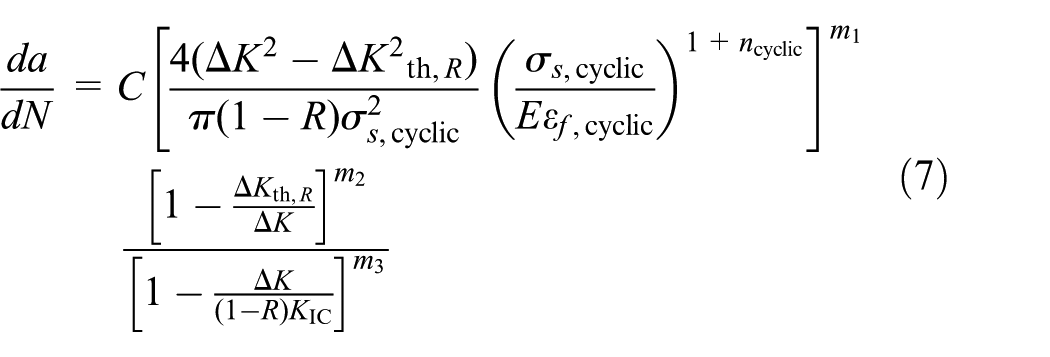
The modified model describes the whole process of crack growth rate more accurately, and it has explicit physical meaning and can describe the crack growth rate from
By considering the effects of relative ratio, crack propagation threshold is approached at different rate, respectively, near
Validation of the modified model
The validity of the presented model has been verified by experimental results for ZSGH4169 superalloy at room temperature and 650°C under different cyclic stress ratios. Nickel-based superalloy ZSGH4169 is one of the most widely used in aero engine components,42–46 especially is used for turbine disk component at 650°C.
47
In Xie,
48
the fatigue crack propagation experiment for GH4169 is carried out at 360°C, 550°C, and 650°C, corresponding to the wheel center, wheel width, and flange temperature of the turbine disk, respectively, under cyclic stress ratio
High-strength plastic material has no obvious yield strength
Material parameters and mechanical properties parameters of ZSGH4169 superalloy.
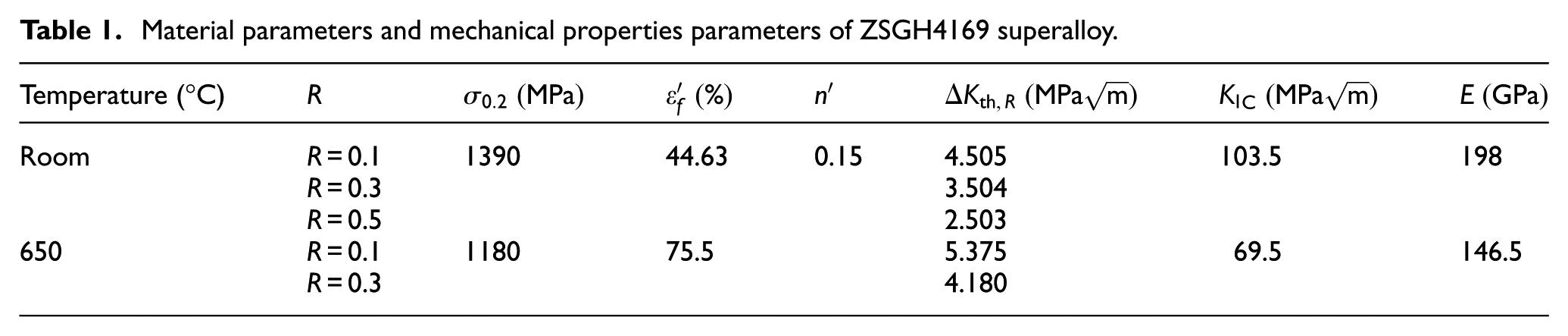
The parameters and mechanical properties of ZSGH4169 superalloy in Table 1 will be substituted into the new modified GPLM, GPLM, 19 YX Zhao model, 17 and PS Zhang model. 18
The data in Table 1 are substituted into modified GPLM, GPLM, YX Zhao model, and PS Zhang model at 650°C and R = 0.1, crack propagation rate is expressed as follows
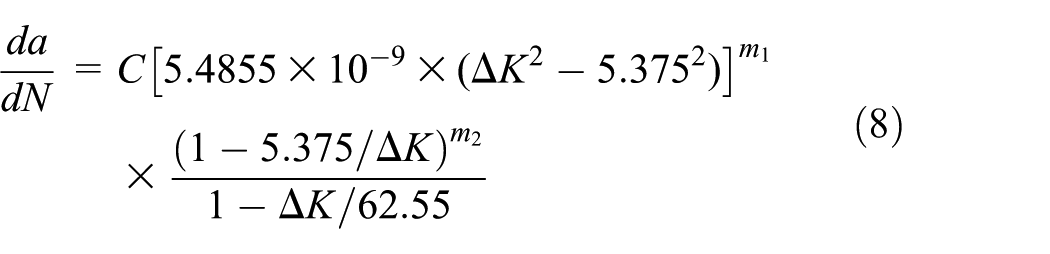



Using the linear regression method of two variables and least square iterative algorithm to fit parameters (50% survival rate) at 650°C, room temperature, and different R values. Through MATLAB coding, the compared results of the four models of fatigue crack propagation rate are shown in Figures 1–5.

Comparison of fatigue crack growth rate between the modified GPLM and the other three models (condition: 650°C, R=0.1).

Comparison of fatigue crack growth rate between the modified GPLM and the other three models (condition: 650 °C, R=0.3).

Comparison of fatigue crack growth rate between the modified GPLM and the other three models (condition: room temperature, R=0.1).

Comparison of fatigue crack growth rate between the modified GPLM and the other three models (condition: room temperature, R=0.3).

Comparison of fatigue crack growth rate between the modified GPLM and the other three models (condition: room temperature, R=0.5).
From Figures 1–5, the fitting effect of PS Zhang model is not as good as that of modified GPLM, GPLM, and YX Zhao model. The GPLM and YX Zhao model almost overlap; compared to the GPLM and YX Zhao models, the improved GPLM in this article is closer to experimental data scatter and almost coincides with the trajectory of fatigue crack propagation. Compared with other models, the modified GPLM well reflects fast propagation characteristics of cracks near critical fracturing point. This is because this presented model not only changed the approaching rate of crack threshold but also reflects the cyclic characteristics, the yield strength of the material, material parameter, and stress ratio on the fatigue crack growth rate, which result in a good agreement with experimental data, so the improved GPLM is presented in this section have shown higher precision than others.
Calculation of crack growth life
The original crack size, critical crack size, corresponding expression formula of stress intensity factor, and fatigue crack propagation rate of ZSGH4169 superalloy need to be known in order to derive fatigue crack growth life under different loadings. Stress intensity factor formula is given as50,54,55

where
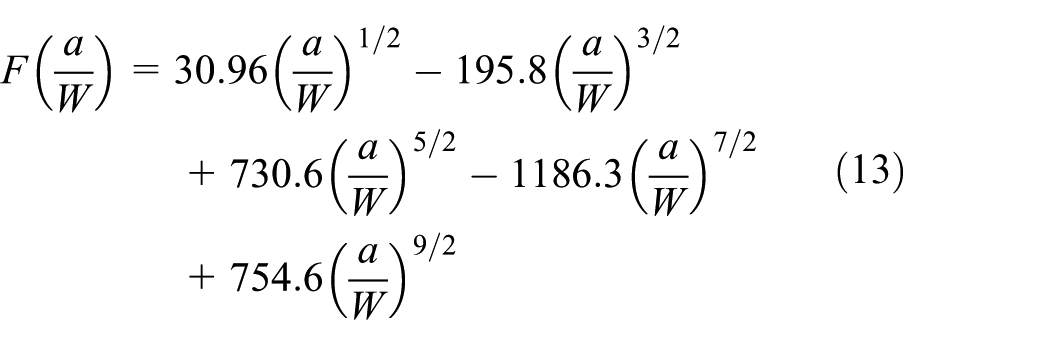
In equation (12), P is cyclic loading (kN), a is crack length (mm), B is sample thick (mm), and W is sample width (mm).
In Wang, 56 the minimum crack size observed in the crack initiation test is between 10 and 50 μm. For crack propagation test on GH4169 superalloy, the crack propagation length is between 500 and 1000 μm. In this section, 750 μm is taken as the critical size of fatigue growth crack, 250 μm is taken as the initial crack size, and the fatigue crack growth life is calculated. Experimental data of ZSGH4169 superalloy at 650°C and R = 0.149 were used to integrate equation (8), and the calculating formula of the fatigue crack growth life can be obtained by the improved GPLM and is expressed as

Predicted fatigue crack growth life under certain loading will be calculated by substituting corresponding value of stress strength factor into equation (14). Similarly, the fatigue crack growth life can be predicted by the other three models under different loadings, and the results are shown in Table 2, where all data are median life (50% survival rate). It can be seen in Table 2, when the loading of the turbine disk alloy is 10–15 kN, fatigue crack growth life derived from modified GPLM, GPLM, and YX Zhao model is very close at 650°C and the stress ratio R is 0.1; however, compared with the three models, fatigue crack growth life obtained from PS Zhang model has shown a large prediction error. When the load is 6–9 kN, the error of the PS Zhang model is much larger than that of the other three models, the fatigue crack growth life is derived from GPLM, and YX Zhao model is very consistent. Compared with GPLM and YX Zhao model, with the decrease in the loading, the gap of fatigue crack growth life between modified GPLM and the other two models increases gradually.
Fatigue crack growth life predicted on each model at 650°C and R = 0.1.

GPLM: generalized passivation-lancet model.
In general, reliability analysis of component is actually to transfer the stochastic uncertainty of input parameters to the output response. In order to obtain the statistical law of the output response (in the section, the output is the fatigue crack growth life predicted by the proposed modified GPLM), it is necessary to study the transfer problem from basic statistical regularity such as serving environment, material properties, geometry size, and loading these basic random variables to the output response, in order to get PDF and the corresponding results for reliability analysis. In the following, the maximum entropy method is introduced for reliability analysis of fatigue crack growth life.
Fatigue reliability analyses using maximum entropy method
Maximum entropy method is an efficient and high-precision method, and it is also superior to the MCS method in computational time and cost. 24 Maximum entropy method does not require any distribution assumptions for random variables in approximate unknown PDF distribution. Jaynes 57 suggested that the maximum entropy of Shannon should be made when the PDF of the unknown distribution is approximated. The unknown distribution estimated by the maximum entropy method can be given by57,58

The model should meet the following constraints


where

where

In order to determine the value of the Lagrange multipliers

where
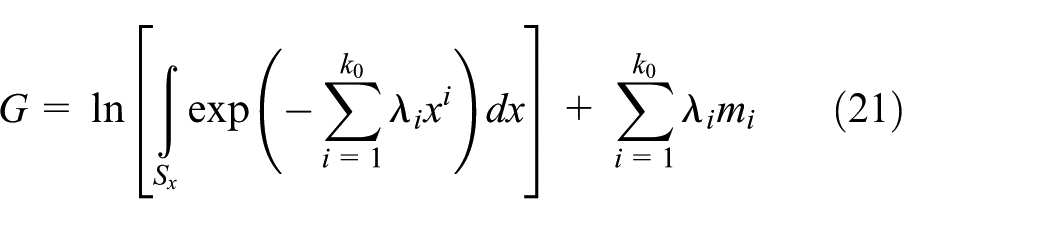

In addition


The research shows that the first four moments of equation (15) can meet the requirements of general anti-fatigue component design. When

where,
Validation of the proposed method for fatigue reliability analysis
To demonstrate the feasibility and accuracy of crack propagation model using maximum entropy method, relevant test data of ZSGH4169 superalloy for turbine disk from Aviation Industry Press 49 at 650°C can be utilized as samples of input random variables to the above proposed models, and with MATLAB coding, fatigue crack propagation lives predicted by these models are used in maximum entropy algorithm for fatigue reliability analysis.
In this section, the proposed fatigue crack propagation models are used to establish the performance functions, and maximum entropy method is utilized to established performance function for reliability assessment as follows

The performance function is determined by rewriting equation (14) in fatigue crack propagation rate model under certain loading, namely

Failure probability is calculated as

where
Under the action of 6-kN loading, different models will get different PDFs under certain design crack growth life. When the load is 6 kN, different failure probabilities are obtained in different design crack growth life and different models. Figure 6 shows PDFs derived from different fatigue crack growth life models by the maximum entropy method under 6-kN loading. As can be seen from Figure 6, PDF obtained by PS Zhang model differs greatly from the other three models, the Y value is centered around 80,000 to 100,000 times, but the Y values of the other three models are concentrated between 0 and 30,000 times, and the Y values of GPLM and YX Zhao models are concentrated between 1 and 30,000 times. Furthermore, Figure 7 shows the failure probability of fatigue crack growth life based on the maximum entropy method. As is shown in Figure 7, the failure probability based on PS Zhang model is different from that of the other three models. When the Y value is 100,000 times, the failure probability is about 50%. When the Y value is about 120,000 times, the failure probability is 100%. However, the failure probability of modified GPLM, GPLM, and YX Zhao models is almost 50% when the values of Y are about 10,000, 20,000, and 25,000, respectively, and when the Y value is about 30,000 times, the failure probability of the three models is almost 100%. Similarly, the PDF and probability of failure of fatigue crack growth life under different load levels can be estimated easily.

PDF of fatigue crack growth life of various models during 6 kN.
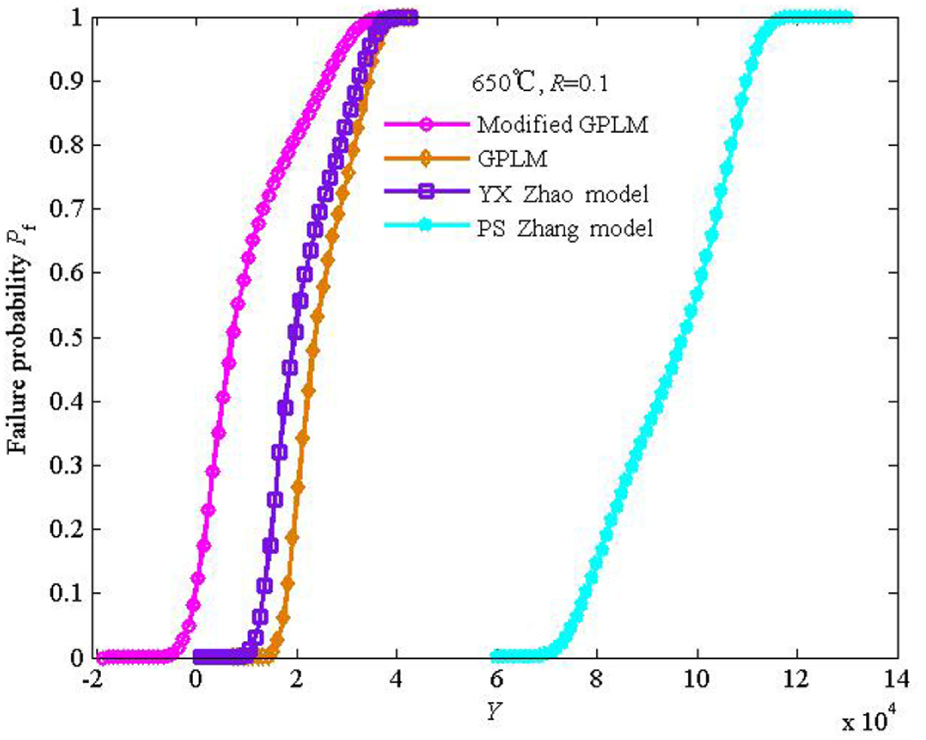
Failure probability of fatigue crack growth life of various models during 6 kN.
Conclusion
In this article, an improved GPLM is proposed based on the crack closure theory. The effective stress intensity factor
Footnotes
Appendix 1
Handling Editor: José Correia
Declaration of conflicting interests
The author(s) declared no potential conflicts of interest with respect to the research, authorship, and/or publication of this article.
Funding
The author(s) received no financial support for the research, authorship, and/or publication of this article.
