




Abstract
Nowadays, modern manufacturing enterprises pay more and more attention to reliability in order to ensure the mechatronic product quality. Since the reliability modeling and evaluation of mechatronic product are the bases of reliability engineering, the novel system full-state model and assessment method based on meta-action are proposed in this article. First, the “Function-Motion-Action” decomposition method and meta-action definition are introduced, and based on the thought of “Top-Down,” the mechatronic product is decomposed to the most basic motion unit—meta-action unit. Second, on the basis of the fact that the reliability of mechatronic product is determined by the reliability of meta-action unit, the complete new classification method is presented. This method divides the product operation states into the meta-action unit fault state and normal state. Third, the collaborative full-state model is established for mechatronic product, the Markov process with all states is combined, the model is solved by analytical method, and the reliability performance was evaluated. Finally, an example of the numerical control rotary table is analyzed to verify the effectiveness and feasibility of the methodology.
Introduction
With advances in technology, China pays attention to the development of real economy. As an important part of the real economy, the development of mechatronic products has a crucial influence on the national economy. However, failures of product are frequent and unpredictable in the working process. Therefore, the reliability is the greatest weakness of domestic mechatronic products, which seriously restricts the market competitiveness of products.1,2 Since modeling and evaluation are the bases of reliability design, prediction, and control, it is significant to establish an effective reliability model and evaluate the reliability performance of mechatronic products efficiently.
Scholars conducted research on this issue. Zhu et al. 3 established a probabilistic framework for fatigue reliability analysis and assessment by incorporating finite element (FE) simulations with Latin hypercube sampling to quantify the influence of material variability and load variations in turbine disks. Ding et al. 4 proposed a reliability prediction method for traction power supply equipment based on continuous-time Markov degradation process. Kang 5 presented a rolling bearing reliability prediction method based on the fractal dimension of mathematical morphology and improved fruit fly optimization algorithm—support vector regression. For structures with uncertain-but-bounded variables, Wang et al. 6 raised a non-probabilistic reliability optimization method. Hou et al. 7 studied the accuracy and computational speed of reliability assessment to propose an impact-increment-based decoupled approach. Zhong et al. 8 formulated a Bayesian network model by a modified version of non-parametric belief propagation for reliability assessment and analysis. Wang et al. 9 built a mathematical reliability model of the modular multilevel converter considering periodic preventive maintenance. Aminifar et al. 10 proposed the reliability modeling of phasor measurement unit and extended it to consider options for the hardware. Aggogeri et al. 11 introduced the definition of roadmap to provide prompt performances and duration and presented reliability activities to be integrated in the product process. In the field of computer numerical control (CNC) machine tools, Kharoufeh et al. 12 put forward the reliability model based on performance degradation and state space according to the complexity of the environment and Balakrishnan et al. 13 discussed the bootstrap accelerated correction method on account of increasing timely truncation and obtained the reliability interval estimation obeying exponential distribution. Also, for the impact of fault sequence on reliability assessment, Yang 14 developed the machine tool reliability modeling and evaluation method based on the time of failures from the perspective of time series. Peng and colleagues15,16 presented the reliability model of machine tool from the perspectives of failure time data analysis and performance deterioration. And it is considered one of the major trends to build reliability modeling from the perspective of performance deterioration of mechatronic product.
The function and performance of the mechatronic products are realized by motions of components. The function and performance of components’ motions are driven by a number of actions. While most of the researches carry out analysis in the component or part level, they neglected the fundamental characteristics of movement and cannot fully reflect the reliability of mechatronic product. Zhang et al. 17 developed a meta-action decomposition method to divide the mechatronic product in accordance with the Function-Motion-Action (FMA) mode. This method describes the most basic motion in mechatronic product, which provides a better way in reliability analysis. Using this method, Li et al.18,19 built the model of numerical control (NC) machine tool in the assembly process and established the meta-action assembly unit to control the assembly process reliability effectively. Moreover, in some studies the model is built based on the time series, but is complicated to solve and it cannot feed back the product design and manufacturing stage. So it is necessary to develop an effective model that takes the dynamic characteristics and reliability to production process into consideration.
The reliability of mechatronic product is decided by basic meta-action units (MAUs). In this article, a mechatronic product full-state reliability model based on MAU is built from a dynamic angle. It guarantees the whole machine reliability and to promote the ultimate quality. By utilizing the Markov process, the model not only illustrates the procedure of state conversion but also obtains the transfer probability to assess reliability indexes, which make it simple and convenient to grasp the condition of the system. Using the model, the operation process of mechatronic product is changed to state transitions and the MAUs that have higher failure probabilities can be found. Combining the failure mode and effect analysis (FMEA) with fault tree analysis (FTA),20,21 the manufacturer can take measures on the weaker MAUs to ensure the reliability of mechatronic product. This means that the reliability technology is applied to the production and the reliability performance will improve certainly.
Meta-action decomposition method
As is known to all, it is difficult to analyze the mechatronic product holistically, so we usually need to simplify the system. The most common method is “Assembly unit-Component-Part (ACP)” decomposition, which is used to guide product design and parts processing. Reliability is the products’s ability to perform its specified functions under the stated conditions for a given period of time. What we concern is whether the function can be realized. However, the ACP method decomposes the assembly unit into parts, which cannot reflect the motion characteristics of the mechatronic product. Therefore, the method is not entirely suitable for reliability analyses of dynamic systems. We proposed the meta-action decomposition method, and the mechatronic product is decomposed into several MAUs composed of several parts by FMA structured decomposition method. And it is proved that the method is adaptive and scientific for the reliability analysis of the product. The concrete steps of the meta-action decomposition method are described as follows:
Understand the mechatronic product by design project description or instruction manual and all the functions of mechatronic product must be analyzed;
According to the structure of mechatronic product, study the pattern to realize the function and determine the movements implementing certain function;
Analyze the transfer route from power part to actuator and obtain the meta-actions;
Depict the FMA tree including functions, movements, and meta-actions based on the above three steps;
Determine the elements to realize the meta-action and describe the MAUs.
FMA structured decomposition
In the service period of mechatronic product, it can realize many functions to satisfy people’s demand, such as drilling and milling of machining center. Ordinarily, the function is realized by some movements of mechanisms, such as rotational movement of spindle. Finally, the movement is achieved by the transmission of basic meta-action gradually. That is, the function of mechatronic product is realized by the movement and the movement is completed by different actions, so the reliability of the product is determined by those actions. The “FMA” structured decomposition is used to decompose the mechatronic product to the meta-action level and carry out the reliability analysis in the level of MAU. We can conduct the “FMA” structured decomposition as shown in Figure 1: first, all functions of the product must be explicit and the function layer is established; second, each function is realized by the mechanical movements and the motion layer is determined; finally, each mechanical movement is decomposed into mechanical action, and the basic action layer—MAU layer—is obtained.

FMA structured decomposition.
For example, the automatic pallet changer can exchange swap and release pallet. The exchange function is realized by the lifting movement and revolve movement of swap frame. Also, the swap frame revolve movement consists of the gyration-piston moving action, the rack moving action, and the gear shaft rotating action. The swap frame exchange function can be accomplished only if the basic actions run normally. The FMA structured decomposition tree of automatic pallet changer is built through the analysis and decomposition from the top to bottom, which is shown in Figure 2.

FMA tree of automatic pallet changer.
After FMA decomposition, the mechatronic product is decomposed into a series of basic actions (moving or rotating) and the function of the product is realized by the combination of these actions. The smallest mechanism in the mechatronic product is called meta-action, including the moving meta-action and rotating meta-action. For example, the worm rotation and worm wheel rotation are the typical rotating meta-actions, and relatively the piston movement is the moving meta-action.
MAU
MAU is an independent component assembled by a certain group of parts, which can meet the technical requirements of the meta-action and realize the required function of the meta-action in the assembly process. As the basic motion unit in mechatronic product, the MAU consists of the driven part, actuator, fasteners, support parts, and transmission part, the general model of which is shown in Figure 3. 22 Consequently, it can exist independently in other parts or components and be used for experiment, design, and analysis.

General model of the MAU.
According to the meta-action categories, there are the moving MAU and the rotating MAU: the former realizes the most basic moving action; for example, rack MAU achieves the movement of the rack and the piston MAU achieves the movement of the piston; moreover, the latter realizes the most basic rotating action, such as the gear MAU. The worm MAU realizing the rotation of the worm is taken as an example to show the method, which is shown in Figure 4.

Worm rotating MAU.
Obviously, MAU involves a few parts, which make the analysis simpler, while in the conventional reliability method, the modeling is accomplished in the component level and usually each component includes thousands of parts and hundreds of failure modes. In addition, the process of FTA is complicated because all failure modes and parts need to be considered. The traditional method considers parts itself, but neglects the complicated interaction of parts. However, it is proved that the meta-action decomposition method is comprehensive and systematic. The method considers not only the MAU motion characteristic and internal interaction but also the coupling effect of the units, which makes the analysis process more explicit.
Overview of Markov process
Markov process is used to describe system state change. In all the system states, the future state has nothing to do with the past, which is just related to the current state. Consider a random process
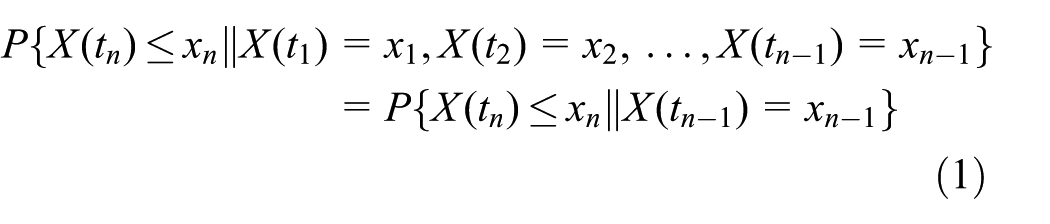
Then the
Markov process is a random process based on probability statistics and can well describe the state of a repairable system. So it is a powerful approach in reliability analysis, prediction, and assement of mechanical product. For example, Guo et al. 24 built the reliability model using Markov chains and the recursive method to evaluate modular multilevel converters under different redundancy schemes. Garrido et al. 25 presented a semi-analytical model by exploiting an absorbing Markov process. Meanwhile, there are many different methods in the reliability region, such as subset-simulation-based reliability analysis approach, 26 evidence-based reliability optimization method, 27 and fatigue accumulation model based on probabilistic framework.28,29
When mechatronic product has a failure, in general, fault position will be searched and the machine should be repaired until it returns to normal, which is a reciprocating cycle. The “state transition” is completely random from a state to another, and the conversion probability is independent with historical operation records, so the failure process of mechatronic product can be seen as the Markov process.
According to the “bathtub curve” of failure rate, the normal product-working period is the random failure period in which the failure and repair rates are constant and both the product life and maintenance time obey exponential distribution, which makes the process satisfy the hypothesis of Markov process.
30
If the mechatronic product is divided into m states, we will obtain the state j from the state i by a transfer and the probability of the transition is represented by

where
The transition probability matrix is

and the transition probability density matrix is
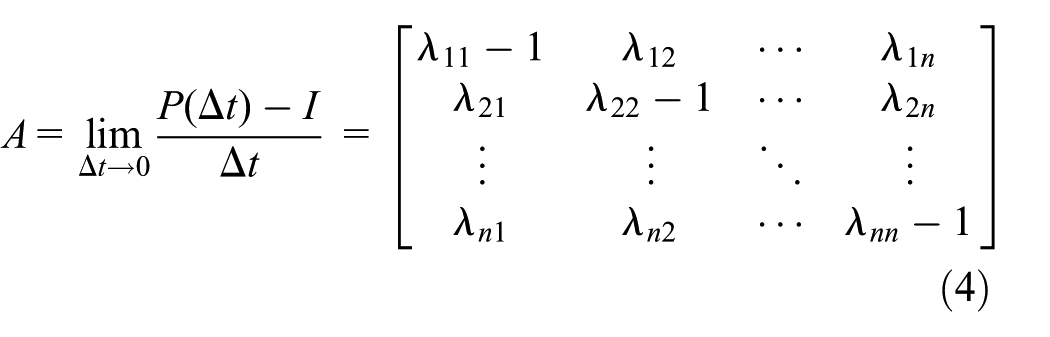
where
The probability of the mechatronic product in the stationary state is denoted as

Solve the equation

Then, the state probability of the mechatronic product can be obtained and other indexes can be calculated.
Full-state modeling of mechatronic product
Total states of mechatronic product
The condition of mechatronic product includes normal operation and failure outage state. A series of MAUs are obtained by FMA decomposition. Once an MAU breaks down, the movement will be affected. And the function of mechatronic product cannot be achieved, so the mechatronic product can be seen as a series system and each MAU is one part of the system. The product state can be divided into MAU normal and fault states. The original continuous process is simplified as a discontinuous process and uncountable state is simplified as countable states by this method. We can make the analysis briefer considering the transformation of these states. The product MAU is denoted as

State classification of mechatronic product.
Full-state transition model
If an MAU has a failure during the working process, other MAUs will stop running with the machine halt and will not be out of order until the system was repaired, so failure states will not transform mutually. We assumed that if an MAU has failed in time, the mechatronic product will stop instantaneously and at the instant all other MAUs are in good condition. So the condition of failure of two or more MAUs never appears and the failures of MAUs are independent of each other. According to the full-state classification of 3.1, the probability of mechatronic product in the normal state is

Markov state transition graph.
In formula (2), when


Therefore, at time

and the transfer density matrix is
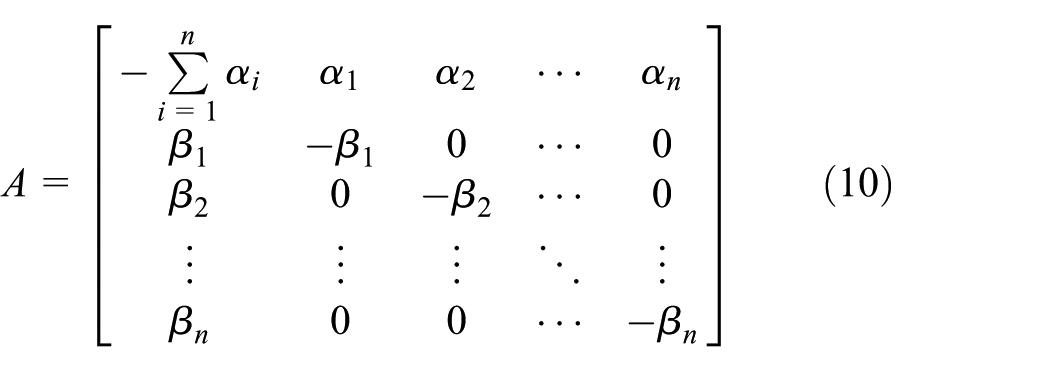
Solving the model
According to

The system state probabilities
Through this model, the other reliability indexes can be obtained to evaluate the reliability and Figure 4 is used to obtain the differential equations of the state transition probability of the system

The Laplace transform of the above formula is

and the solution is

Therefore, the system’s steady-state availability and failure frequency are

and

To go a step further, the mean time between failures (MTBF) and the mean time to repair (MTTR) the mechatronic product are

Case study
In this article, the NC rotary table of machining center is introduced to describe the multi-state reliability modeling and evaluation. As a key functional component of machining center, the rotary table is used to convert the position and surface of workpiece. In this way, it is able to process multi-surface at a time in a single set-up. In the processing condition, the NC rotary table is influenced by the severe working environment: the cutting fluid, workpiece chips, and cutting force for a long time. Therefore, its fault is frequent and its accuracy preservation is poor, seriously affecting the reliability of the machine.
NC rotary table full-state modeling
First, rotary table is decomposed according to the FMA method, and the FMA decomposition tree is established as shown in Figure 7. As we can see, there are 11 MAUs, denoted as A1–A11 MAUs. As long as all the MAUs are operated normally, the reliability of the turntable will be guaranteed.
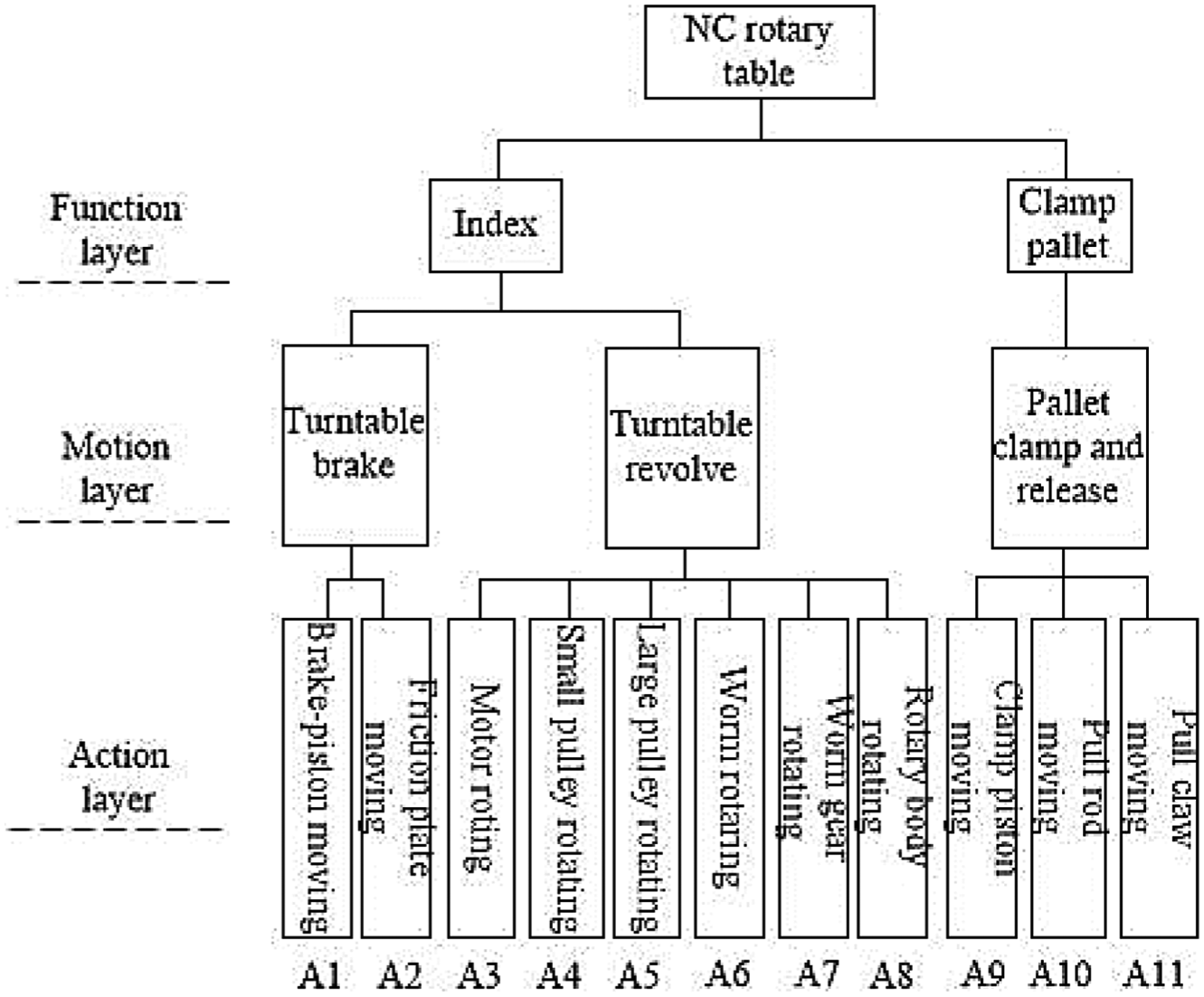
FMA tree of rotary table.
If some MAUs are faulted, the rotary table will be shut down for maintenance. Consider each MAU fault as a failure state of product and the rotary table will operate well, only if all MAUs are working normally; then the mechatronic product is divided into 11 failure states and a normal state. The combination is described using the formula
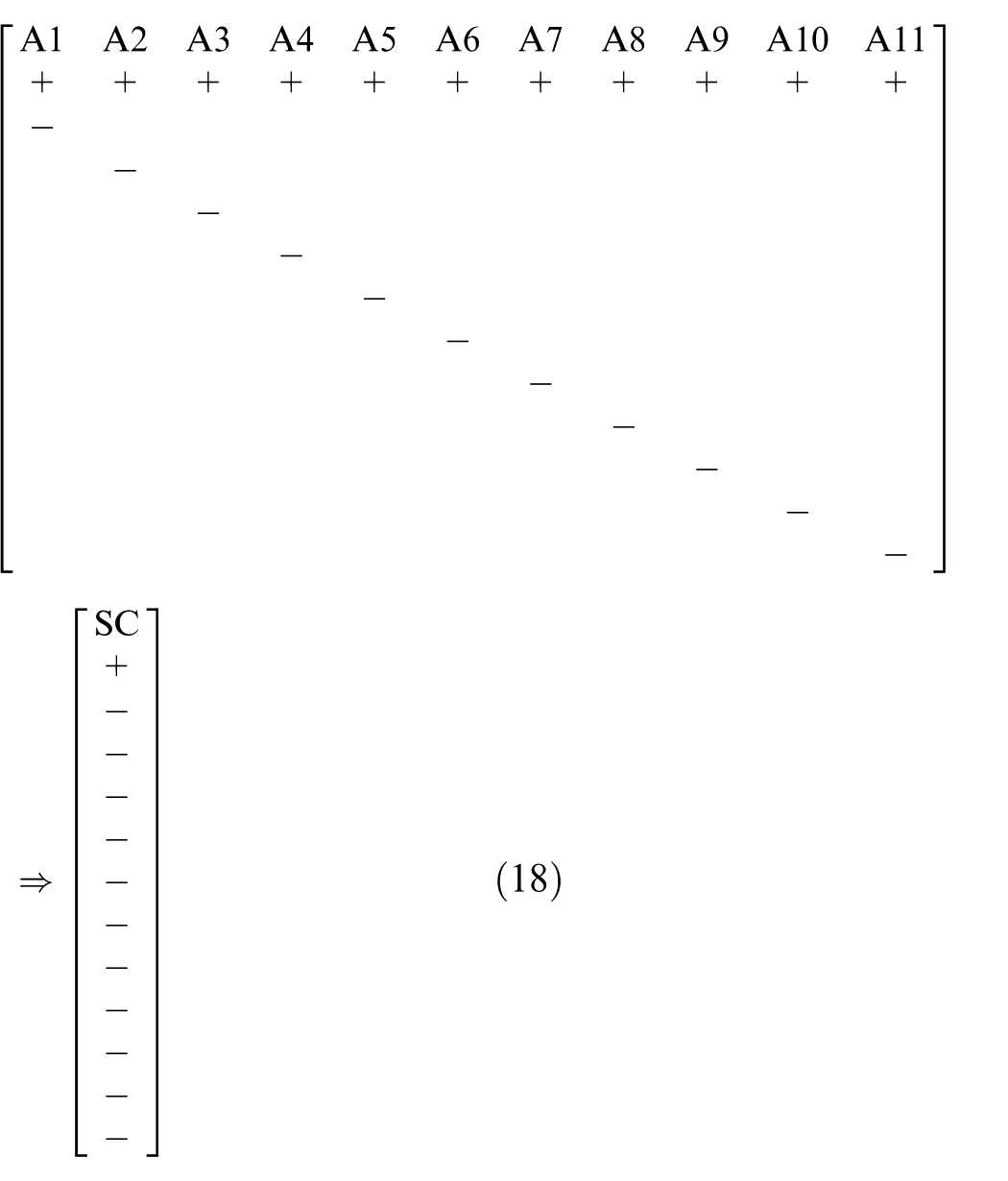
In the above formula, the left is the MAU state and the right means the system condition. The “+” and “–” are labeled as normal and failure, respectively.
The state transition diagram of the rotary table is established as shown in Figure 8.

State transition diagram of rotary table.
Solution of state equation
For each MAU of NC rotary table, the failure and maintenance rates have been collected as shown in Table 1.
Collected failure and maintenance rates.

MAU: meta-action unit.
Therefore, the state transfer density matrix is established as
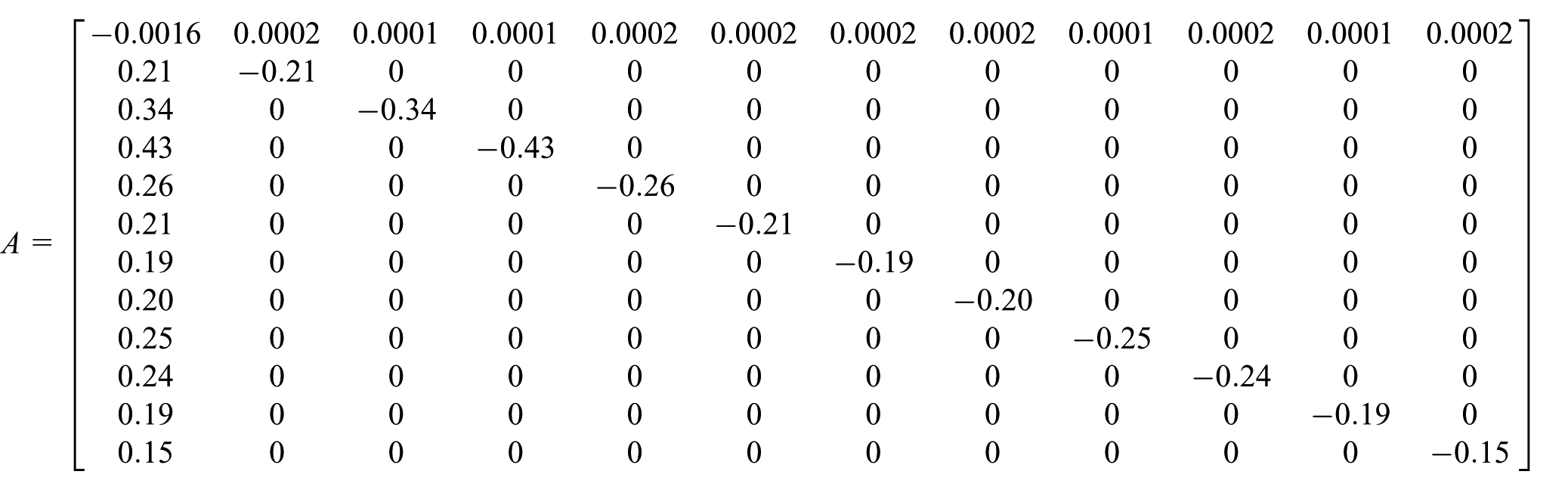
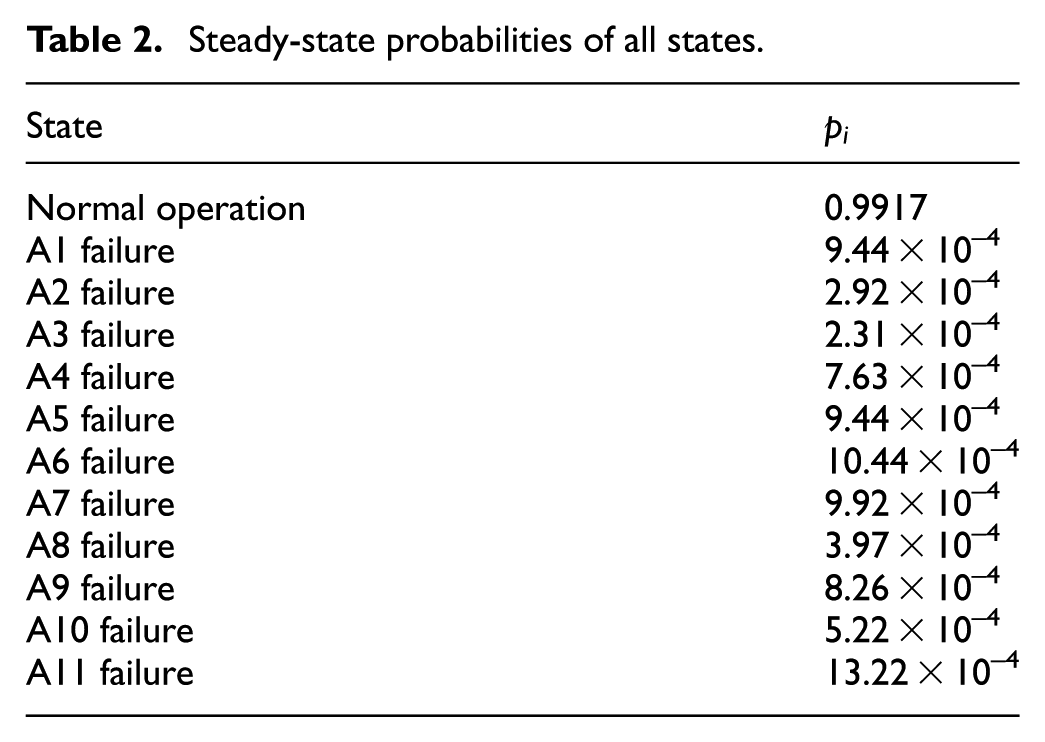
Using the sample data and equation (11) in MATLAB, the probabilities of the steady states are figured out, as shown in Table 2.
Steady-state probabilities of all states.
Finally, the reliability indexes of the NC rotary table are obtained by formulas (15)–(17)

Result and discussion
According to the solution, the normal operation state probability of the NC rotary table is 99.17%, so its reliability is relatively high. The highest failure probability of the rotary table is the claw moving MAU in Table 2. In the working process, it should be monitored and maintained especially, and the corresponding measures should be taken in time to improve the reliability and ensure the normal operation of the rotary table. The MTBF and MTTR are about 555 and 4.6 h, respectively, which are relatively weak, and it is necessary to improve the reliability and maintainence of the NC rotary table. The FMEA is the general reliability method and it can help us to know the failure modes and effects of mechatronic product. Moreover, the FMEA can analyze the causes for the failure mode and provide many improvement measures. The FTA method carried on mechatronic product can determine the specific position of failures. For the maintenance, the overall structure should be optimized by the designer and the level of maintenance worker should be improved.
As shown in Table 2, the failure state probabilities of the pull claw moving MAU and worm rotating MAU are 13.22 × 10⁻⁴and 10.44 × 10⁻⁴, respectively. By the Pareto principle, the claw moving MAU and worm rotating MAU are the weak links of the NC rotary table. It means that these MAUs almost decide the reliability of the product. So the two MAUs should be focused and some measures should be taken. However, we can spend less time on the MAUs that have lower state failure probabilities. Combing FMEA with FTA analysis, the main failure mode of the claw moving MAU is pull claw fracture. Therefore, suitable material of the pull claw needs to be selected in the manufacturing stage to ensure its strength. Meanwhile, in order to weaken the fatigue damage, the working pressure of the oil cylinder should be cut down to reduce the interaction force between the pull claw and nails without influencing the locking function. Moreover, the pallet could not exchange before the pull claw loosen, and thus the oil resistance should be reduced and the claw release speed should be accelerated.
The main failure mode of the worm rotating MAU is worm wear, which may lead to precision attenuation, even in vibration and noise. Hence, it is necessary to select the worm which has suitable strength and wear resistance. Besides, cleanliness should be inspected before assembly to ensure the neatness of the worm. Also, the lubricating medium should be replaced regularly to ensure superior lubrication. The clearance between the worm and the gear should be adjusted to avoid axial movement. By utilizing full-state model based on MAU, the reliability of mechatronic product can be improved greatly by taking measures in various production stages.
In short, this method helps assess the reliability performance of NC rotary table and master the overall state. Its modeling based on the MAU states is reasonable and simple and the calculation is convenient. By this method, we found the weaker links of NC rotary table quickly. So the method is feasible and efficient.
Conclusion
Actually, the mechatronic product is complicated and it is hard to be analyzed from the holistic perspective. Therefore, with the meta-action decomposition method, we decompose the mechatronic product to the MAU. The MAU fully considers the kinetic characteristic of the mechatronic product and focuses on reliability performance. Unlike the previous method where reliability is analyzed in the component level, this method makes the analysis more precise and accurate. At the same time, the method can be used in the design, manufacture, assembly, and experiment process of mechatronic products.
In this article, the meta-action decomposition method is introduced to describe the working process of mechatronic product, and a new state classification for system operation is studied. In view of the characteristics of mechatronic product, the product is decomposed to the smallest unit—MAU, and the running process was divided into MAU fault state and normal state. Therefore, the system operation is simplified as a non-continuous process. Modeling from state instead of time makes the reliability analysis of mechatronic easier, which can be used in many other researches of mechatronic products.
Besides, the full-state reliability model of the mechatronic product is established and Markov process, as an effective tool to represent the state transition of the system, is used to describe the transfer between all the states. By solving the model, the probabilities and reliability indexes under stable conditions are obtained; the operation and reliability conditions are clear. The reliability control points can be found out according to the key MAU and some measures can be taken to reduce the possibility of faults. In order to promote the reliability of the mechatronic product, it is significant to use the reliability technology in the production phase.
As a whole, the method that can assess the reliability performance and find out the weaker links of mechatronic product is an effective reliability approach.
Footnotes
Handling Editor: Shun-Peng Zhu
Declaration of conflicting interests
The author(s) declared no potential conflicts of interest with respect to the research, authorship, and/or publication of this article.
Funding
The author(s) disclosed receipt of the following financial support for the research, authorship, and/or publication of this article: This work was supported by the National Natural Science Foundation of China under Grant Number 51575070 and the National Major Scientific and Technological Special Project for “High-grade CNC and Basic Manufacturing Equipment,” China under Grant Numbers 2015ZX04003-003 and 2016ZX04004-005. At the same time, we would like to appreciate our friend Mengsheng Yao who gave us useful suggestion in section “Conclusion” and helped to correct the grammatical errors and typos.
