




Abstract
In order to clarify the effect of Ar dilution on the dynamic parameters of detonation quantitative, smoked foil records of C2H2–O2 with different Ar dilutions are investigated. With the Ar concentration increasing, the instability will decrease and detonation can fail more easily. Histograms, variance measurements, and studies of the autocorrelation function are systematically considered to quantitative define the irregularity parameters. The other kinetics characteristics, such as detonation limits, velocity, and cell size, are also analyzed to illustrate the dilution effects via the smoke foils from different Ar dilution. It was found that the results from histograms, variance studies, and the autocorrelation function consistently show the tendency that mixtures with different Ar dilutions exhibited different degrees of irregularity. Quantitative irregularity can be examined by the values of the ratio Max discrepancy/Relevant mean cell size of C2H2 + 2.5O2. For the mixtures with higher Ar concentration, the main cell size shown by the peak in the histogram and the first peak of the autocorrelation function were much closer to the cell size measured visually because of the stronger dominant mode and more regular trajectory of triple-point patterns. Predictions of the cell size considering the participation of Ar in the mixtures were also given.
Introduction
As a kind of flammable gas, acetylene use poses safety issues especially when mixed with pure oxygen. Acetylene requires more rigorous studies of its detonation parameters, for example, critical energy, 1 detonation velocity, cellular structure. 2 It is difficult to obtain unambiguously the representative cell size for so-called unstable mixtures, for example, C2H2–O2, where the transverse-wave pattern is highly irregular with many so-called substructures. 2 As the cellular structure of acetylene–oxygen is too irregular to illustrate, researchers 3 used argon to dilute the mixture so that they can get regular detonation structures.
Dilution has a significant influence on fuel combustion. SD Emami et al. 4 studied effectiveness of diluent gases on hydrogen flame propagation in pipe. B Zhang et al. 5 pointed out that the cellular detonation front starts to become more regular (or stable) when the argon dilution reaches more than 40%–50%. Ar dilution not only affects cellular structure, but also affects detonation velocity. Takai et al. 6 illustrated that the application of an inert gas caused a reduction of the size of the explosion detonation zone, while the detonation velocity was reduced and the regularity of the cellular structure was affected, although they did not give quantitative results.
Classification of smoked foils as “regular” and “irregular” is subjective and qualitative. Although the effect of Ar dilution on cellular structure has been qualitatively studied,7,8 the degrees of detonation instability of different argon dilution are showing a great deal of varieties from the irregularity of cellular structure recorded on smoked foils. This degree still needs some parameters to present for stable and unstable detonation. Quantitative irregularity parameters measured from experimental records are used to demonstrate the degree of how the Ar participation reduces detonation instability
Furthermore, it is highly desirable to provide a more objective quantitative interpretation of regular and irregular smoked foils, which should be investigated in a systematical method to measure the changes in irregularity due to Ar dilution. Attempts have been made by Lee et al. 9 and Lee and Garinis 10 and others to use digital image processing techniques for the analysis of smoked foils. Meanwhile, characteristics such as cellular structure should give cause for the consideration of more dynamic parameters which can describe the effect of Ar dilution on detonation limits, stability, and so on.
It is meaningful to research the cellular structure with different Ar dilutions. In addition, the degree of detonation instability needs to be described quantitatively. Hence, we carry experiments under different Ar dilutions with tenuous records of longitudinal smoked foils to record complex cellular structure. Then, digital processing analysis of records is performed to obtain kinetics parameters such as cell size, cellular structure irregularity, which can reflect quantitatively the regularity of smoked foils. Moreover, analyzing quantitatively the parameters of Ar dilution effect on fuel detonation can form the basis of a deeper understanding of fuel safety.
Experimental details
A polycarbonate tube with inner diameter of 50.8 mm and a length of 4 m was used in the detonation experiments (Figure 1). A small volume of more sensitive mixture (C2H2 + O2), contained in a steel driver section with a length of 1 m, is utilized to promote the initiation of the insensitive near-detonation limits. Premixed stoichiometric mixtures of C2H2 + O2 with 0%, 50%, 70%, and 85% Ar dilutions are used in the experiments. All the gases are purified gases (99.99% for oxygen, acetylene, 99.999% for argon).

Detonation tube diagram with an inner diameter of 50.8 mm.
The detonation velocity is measured by regularly spaced optical fibers terminating at photodiodes along the length of the test section. Although time-consuming and tedious, smoked foils can be an unparalleled method in observing the structure of cellular detonations via the trajectories of the triple points of the detonation front at the inner tube wall. One meter is the maximum length that the Mylar smoked foils can be conveniently inserted into the detonation tube to achieve the transverse-wave pattern. In the experiment, one-meter smoked foils are inserted into the end of the tube where steady propagation of the detonation wave is formed and the transverse-wave pattern can be recorded. The width of the smoked foil used is 150 mm in order to cover as much of the inner wall as possible, but the periphery of the tube cannot be covered completely to protect the record of the wave pattern. The maximum pressure and temperature in the experiments determined the thickness of the smoked foils, but higher interference occurs when the smoked foils are too thick. The range of initial pressures used was between 0.6 and 16 kPa. Normally, a thickness of 0.2 mm is chosen for experiments with initial pressures of less than 8 kPa, and 0.4 mm with initial pressures under 16 kPa. Each experiment is repeated not less than three times to ensure reliability.
All of the explosive mixtures were prepared using the partial-pressure method and were allowed to mix by diffusion for at least 24 h in order to ensure homogeneity. An Omega pressure transducer (Model PX309-015AI) and an Omega digital meter (Model DP24-E) are utilized to monitor the pressure for the experiments (Table 1).
Experimental conditions.

Results and discussion
Smoked foil records and velocity results
Typical smoked foil records for the four mixtures, which are presented as examples for each mixture, are illustrated in Figure 2. Visual observations can easily distinguish that a regular transverse-wave pattern was given by high Ar-diluted C2H2 + O2, while an irregular transverse-wave pattern by C2H2 + O2.
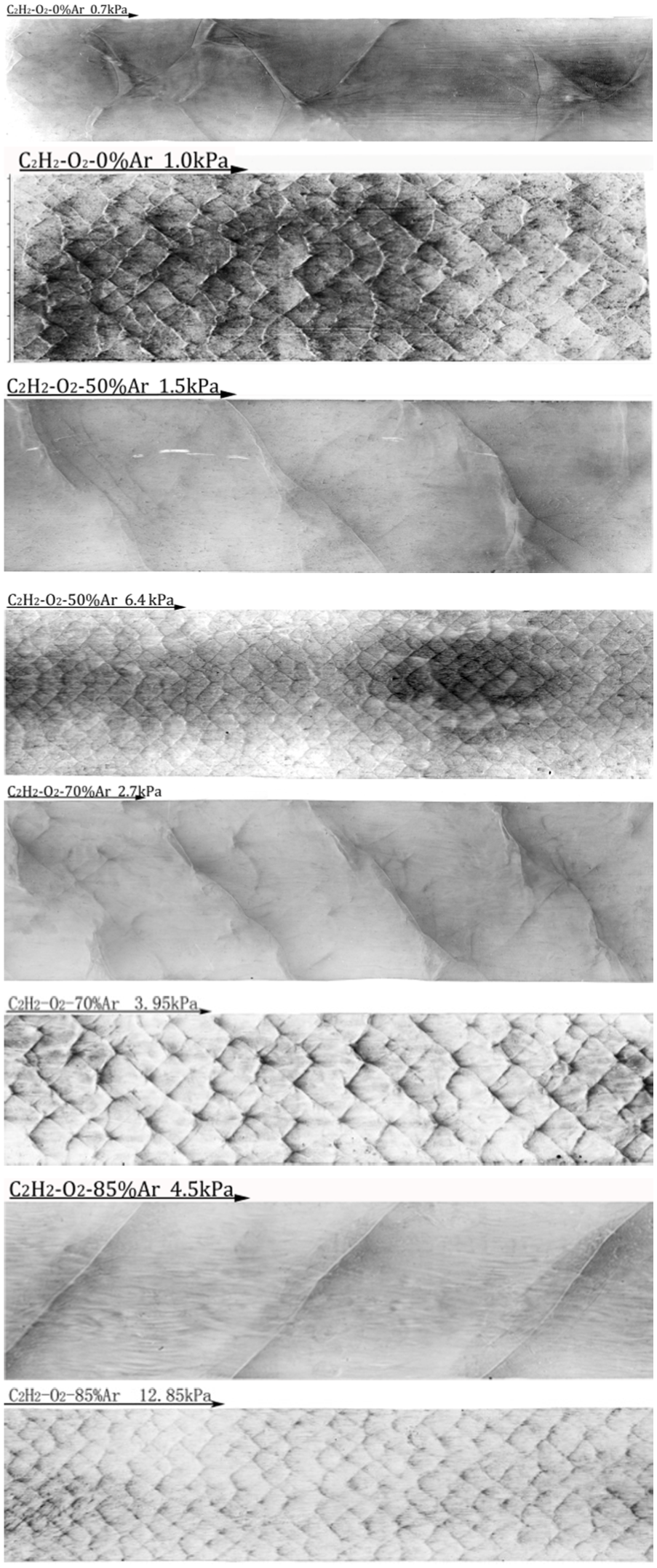
Cellular structure of premixed C2H2–O2 with different Ar dilutions in a tube of inner diameter of 50.8 mm.
It is effectively to use digital processing to divide the transverse-wave pattern recorded in a foil into left-running waves (θ–) and right-running waves (θ+). Then the foil gives two sets of waves. The distance between two left- and right-running waves is the cell size.
First, an Ar dilution ratio is introduced,

where
Figure 2 shows typical smoked foil records for the four mixtures. Both single-head and multi-head spin structures are illustrated. Regularity of transverse-wave patterns can be easily distinguished by eyes.
Significantly, the concentration of the Ar dilution influences the detonation experiment results of C2H2–O2. It is observed in Figure 2 that the cellular structure becomes more regular when the Ar concentration increases. The records of C2H2–O2-0% Ar range from single-head spinning detonation to double-head detonation under the initial pressure of 0.7 kPa; while we present only typical records observed under initial pressures of 0.7 and 1.0 kPa, there are, in fact, other results. Some substructures exist in the main cellular structure. The records of C2H2–O2-50% Ar under initial pressures of 1.5 and 6.4 kPa, the records of C2H2–O2-70% Ar under initial pressures of 2.7 and 3.95 kPa, and the records of C2H2–O2-85% Ar under initial pressures of 4.5 and 12.85 kPa are shown simultaneously to represent the cellular structures of the mixtures. Performance of the records, namely the triple-point trajectory pattern, is described more regularly with the increase of Ar concentration. Another, we can see less the disappearance, merging, or sudden appearance of the triple-point trajectories on the records with higher Ar dilution. The triple-point trajectory pattern cannot be absolutely regular because of the disturbance between transverse waves, and therefore, the cell size is a spectrum (the traditional cell size is a mean value measured visually) related to detonation stability.
The specific characteristics of a mixture drive its properties. The chemical reaction at the detonation front can be a factor to sustain the transverse vibration of a spinning detonation. The introduction of Ar reduces the molecular activity of mixture. Hence, the spinning-head detonation front releases chemical energy late, the transverse waves weaken, and the boundary-layer influence strengthens. The stability is influenced by Ar dilution, which can explain the differences in observation for the smoked foils records under different Ar dilutions. In addition, with the increase of Ar dilution concentration, the detonation limits increase, as illustrated in Figure 3. We can see instability is a key factor in the self-sustaining development of a detonation, and the detonation can be more easily achieved with the higher irregularity of the transverse waves.

Detonation velocity of C2H2–O2 at different Ar dilutions: (a) velocity of C2H2+2.5O2; (b) velocity of C2H2+2.5O2+50%Ar; (c) velocity of C2H2+2.5O2+70%Ar; (d) velocity of C2H2+2.5O2+85%Ar.
The comparison of the detonation velocity of C2H2 + 2.5O2 with different Ar dilutions is shown in Figure 3. For the very unstable mixtures of C2H2 + 2.5O2, the velocity fluctuations are quite large (see Figure 3(a)). When the initial pressure is decreased below a limiting value Plim, a continuous drop in the velocity is observed as the detonation propagates, rather than an abrupt drop indicating failure. The Plim value of C2H2 + 2.5O2 is approximately 0.6 kPa. The variations of the local velocity along the length of the tube for the stable C2H2 + 2.5O2 + 50% Ar mixture are shown in Figure 3(b). As the initial pressure is progressively decreased, the fluctuations of the detonation velocity increase. When the initial pressure is decreased past the limiting value, failure occurs abruptly, with a significant reduction in the velocity near the end of the tube. The Plim value of C2H2 + 2.5O2 + 50% Ar is approximately 1.5 kPa in the tube.
The velocity curve in C2H2 + 2.5O2 + 85% Ar (Figure 3(d)) fluctuates less than that of C2H2 + 2.5O2 + 70% Ar (Figure 3(c)). The detonation velocity along the tube remains fairly constant with small velocity fluctuations at initial pressures above Plim. Meanwhile, the Plim value of C2H2 + 2.5O2 + 85% Ar (3.5 kPa) is higher than that of C2H2 + 2.5O2 + 70% Ar (2.5 kPa).
The visual analysis of the change in detonation limits with different Ar dilutions is shown in Figure 4. It is significant, as shown in Figure 4, that detonation limits decrease when diluted by Ar; the relationship of detonation limits and Ar dilution can be described as

where

Detonation limits of C2H2–O2 at different Ar dilutions.
The Ar dilution affects the proportion of activated molecules in mixtures. If Ar concentration rises up, it may decrease the molecular collisions and reduce the energy released, which means the reaction length may increase. Hence, the size of the detonation zone is ultimately increased. In addition, the induction length can be slightly longer, but the reaction length changes longer than the induction length so that the pre-mixture is more stable with higher Ar dilution. 11
The average detonation velocity Vavg can be calculated by determining the local velocity values of the final meter of the travel of the detonation wave, as shown in Figure 3. The variations of the Vavg values of the mixtures with different dilutions with the initial pressure are shown in Figure 5. The velocity deficit increases slightly with decreasing pressure until the detonation fails with an abrupt reduction in the local velocity. For C2H2 + 2.5O2 + 85% Ar and C2H2 + 2.5O2 + 70% Ar, the failure velocity is about 82% VCJ, which had been partly shown previously by Wu and Lee 12 However, for C2H2 + 2.5O2, the failure velocity is higher approximately 91% VCJ. In Figure 3(d), the case 4.5 kPa shows failure at the end. It may be regarded as the fluctuation of detonation propagation at the end of the tube. That might be affected by the boundary condition so that the velocity shows a decrease.

Variation of the average detonation velocity of C2H2–O2 at different Ar dilutions.
To explain how Ar dilution affects detonation parameters, stability should be considered. The cellular structure should be carefully investigated to obtain cell size and other parameters with which to represent the stability of C2H2 + 2.5O2 at different Ar dilutions.
In these premixed mixtures, the reaction coefficient is 12; the volume ratio of C2H2 and O2 is stoichiometric ratio. Hence, the mole fraction of C2H2 and O2 is the function of

In Figure 5, the Vavg/VCJ are all in same range (0.75–0.95) while the maximum detonation velocity is negative proportional to the Ar mole fraction, which is 2567.3 m/s for C2H2 + O2 but 1148.3 m/s for C2H2 + O2 + 85% Ar. The experimental velocity phenomenon shows the same tendency. According to equation (3), the propagation velocity is related to the chemical reaction rate that is affected by Ar molar fraction.
Hand-tracing trajectories of transverse waves, as a method that can eliminate extraneous lines caused by noise or erratic, are utilized to achieve patterns for digital image. Usually, the procedure involves an initial determination of the dominant cell size on the smoked foil records by eyes. Two sets of left- and right-running waves are illustrated in Figure 6.

Digital image of the hand-traced triple-point trajectories for the C2H2–O2 with 70% Ar, 3.95 kPa and 85% Ar, 8 kPa.
After the digital analysis of the trajectory, the cell size with less error and other parameters can be shown in the methods listed below.
Histograms
Histograms of the cell size were calculated from the line-profile data. 13 In order to illustrate this method, C2H2–O2 with 70% and 85% Ar dilutions are made as examples and shown in Figure 7. It is interesting to note that the peak of the histogram is the most probable cell size. For the histogram in Figure 7, it is difficult to obtain a single dominant size because the histogram contains multiple peaks. The highest peak only occupies 20% of all of the cell size data, and it is difficult to describe the histogram as a Gaussian or log-normal function.

Histogram of the cell size for the C2H2–O2 with 70% Ar, 3.95 kPa and 85% Ar, 8 kPa.
It is significant that the distribution of histograms becomes sharper and more symmetrical when the Ar dilution increases. Meanwhile, the highest peak generates more cell size data easier. It is easier to determine the main column in the C2H2–O2 with 85% Ar than C2H2–O2 with 70% Ar. This phenomenon occurs because the triple-point trajectories become regular when diluted by Ar. Variance can be attributed to cellular pattern irregularity. The variance value can present the previously stated subjective categorization of mixture stability.
Using the ACF to quantify irregularity
The ACF, as a scale-free measurement for the strength of the statistical dependence, is often utilized as a tool to identify the repeating patterns obscured by noise. The ACF plots for the typical mixtures with different Ar dilutions are shown in Figure 8. It is somewhat difficult to discern the peaks due to the large fluctuations in amplitude and periodicity of the ACF peaks. There are still some other peaks even larger than the first peak, because the possibility of other dominant cell size exists. It can be caused by the irregular patterns due to a wider spread of transverse-wave energy among different vibrational modes. The highest peak is measured at a shift of 53.5 and 47.7 mm, respectively. With higher Ar dilution, a main peak can be produced with fewer other peaks by ACF.
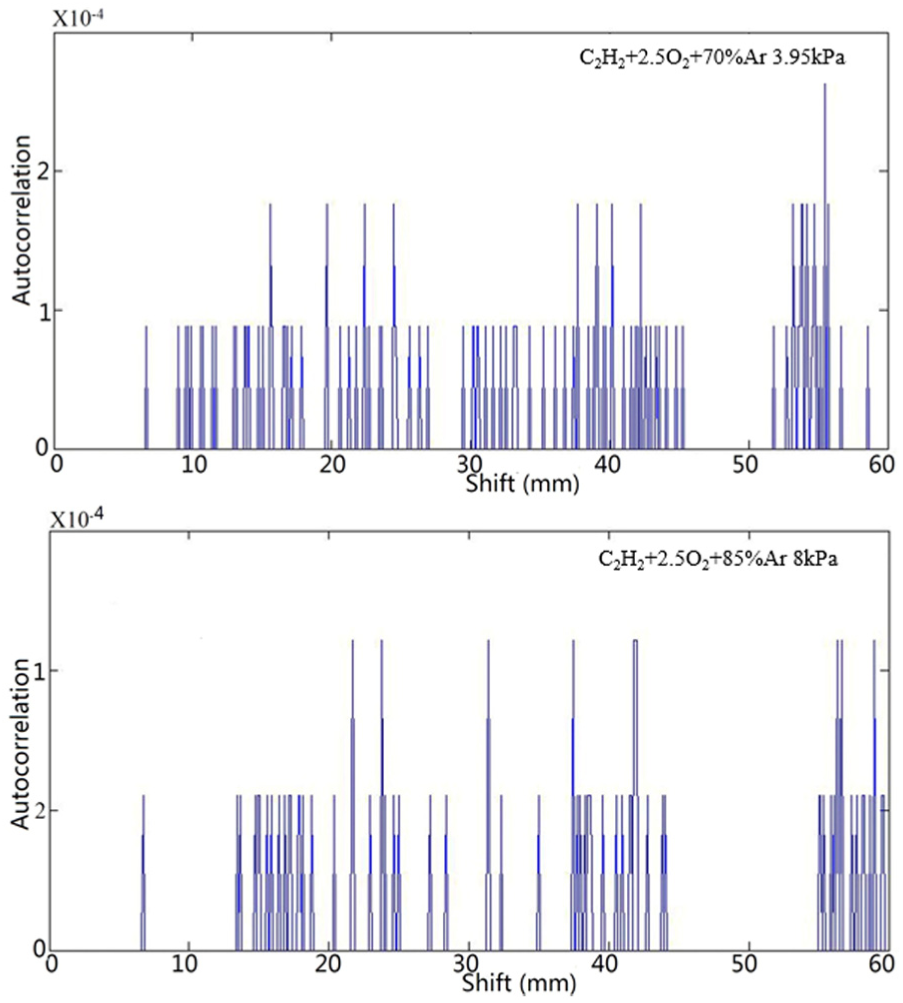
Average ACF of the triple-point trajectory for the C2H2–O2 with 70% Ar, 3.95 kPa and 85% Ar, 8 kPa.
Discrepancy of C2H2 + 2.5O2 with different Ar dilutions
The dominant cell size obtained from the largest histogram peak, the statistical average of all cell size data obtained from line profiles, and the shift of the first ACF peak all offer data on the cell size. The cell size data of C2H2 + 2.5O2 and C2H2 + 2.5O2 + 50% Ar are shown as a function of the initial pressure (Figures 9 and 10). In ideal cases, the cell size data provided by the largest histogram peak, statistical average, and the shift of the first ACF peak should agree with the value of the cell size measured visually within experimental error. That is why the cell size measured in C2H2 + 2.5O2 + 85% Ar coincides with each other and is very close to the previously measured cell sizes. The cell size from the highest histogram peak, statistical average, and the shift of the first ACF peak are not as close to each other for C2H2 + 2.5O2 + 70% Ar as for the C2H2 + 2.5O2 + 85% Ar. For C2H2 + 2.5O2 + 50% Ar and C2H2 + 2.5O2, the cell size from the highest histogram peak, statistical average, and the shift of the first ACF peak show an even larger discrepancy; the spread of values determined by the various methods of estimating the dominant cell size is shown in Figures 9 and 10.


Cell size of C2H2–O2+50% Ar measured by four methods and Desbordes (1988). 16
It is significant that the maximum discrepancy is undoubtedly closely related to the amount of Ar dilution. The values of the ratio
The mean cell size curves of C2H2 + 2.5O2 with different Ar dilutions are illustrated in Figure 11. It is significant that the addition of Ar dilution affects the distribution of the triple-point trajectory and makes the distance between the cellular patterns larger.

Variation of the cell size with C2H2–O2 at different Ar dilutions.
The four methods of analyzing the cell size of C2H2–O2 with different Ar dilutions obtain results close to each other in terms of acceptable error. Meanwhile, the statistical analysis results for C2H2 + 2.5O2 with 0% Ar, 50% Ar, 70% Ar, and 85% Ar dilution show that the variance of the cell size provides a reliable quantitative measure of the irregularity of smoked foils from different mixtures.
Detonations generally manifest multidimensional instabilities. A significant number of asymptotic studies have attempted to relate the instability mechanisms to the origin of the cellular detonation structure, including that by Buckmaster and Ludford. 18 From the above analysis, Ar dilution affects the cellular structure of C2H2 + 2.5O2 as well as the detonation stability of C2H2 + 2.5O2. Therefore, the prediction of cell size should consider parameters such as instability, which can be represented by variance.
On the other hand, the above relationships of the Ar dilution and detonation limits and detonation velocity are consistent with the energy equation. Actually, we can speculate that a shock wave is accumulated by electronic transition energy. Essentially, a shock wave is a wave. Thus, the energy of a shock wave is inversely proportional to the wavelength which appears to be the cell size at the macro level. Ar dilution affects the molecular reaction on the combustion surface, the release of the energy transition, and the compression wave superposition. It thereby affects the detonation wave energy. Finally, along with the increase of the Ar dilution, the cell size (which is the frequency of the shock wave) becomes smaller. In previous research, Zhang et al.
15
reproduced the cell size correlations as a function of initial pressure for seven amounts of Ar dilution according to Kaneshige and Shepherd
17
and Radulescu.
19
However, a system analysis needs to be provided. The cell size correlation for C2H2 + 2.5O2 + ϕAr Ar mixtures as a function of initial pressure is given by
A quantitative irregularity parameter can be considered when a cell size prediction is given

The variance significantly decreases with increasing amounts of Ar dilution. Ir(ϕAr) is the instability polynomial formula of the Ar dilution ratio

where Ir(α) is the instability polynomial formula and
Finally, the cell size for C2H2 + 2.5O2 +ϕAr% Ar mixtures can be predicted as follows

Furthermore, the prediction of the cell size for other mixtures diluted with Ar should be calculated with this formula with different Ir(ϕAr). The cell calculated via equation (6) can be seen as the line in Figure 11, which agree the experimental results well. In the calculation, C0 is 0.47, 2.48, 33.53, 80.43, respectively, and μ is 1.13, 1.244, 2.346, 1.88, respectively.
Concluding remarks
The quantitative effects of Ar dilution on C2H2 + 2.5O2 detonation stability, velocity, and cellular structure irregularity are systematically investigated. From the above analysis, the instability should be considered as an important parameter in the study of detonation mechanisms. We summarize our main conclusions as follows:
From the smoked foil records of C2H2 + 2.5O2 with high-concentration dilutions by Ar, it is clearly visible that high-concentration Ar dilutions make the cellular pattern become more regular, which means Ar dilution changes the instability of mixtures. Ar participation reduces the activity of gas molecules, and that activity controls the temperature-sensitive action that affects detonation stability. Furthermore, this phenomenon confirms the different roles of instability in the self-sustained propagation of the detonation of stable and unstable mixtures. This is consistent with the conclusions obtained by the simulation method of Radulescu, 19 because instability has lost the dominant role in the ignition and combustion processes in the detonation zone when Ar diluted the C2H2 + 2.5O2 mixture; the detonation sensitivity also significantly decreased.
The detonation limits are found to increase with increasing Ar dilution, which narrows the detonation zones while the propagation velocity of the detonation wave also becomes fairly constant. Due to the introduction of Ar into the mixture, the energy release in the detonation wave front is suppressed, and then the transverse-wave strength becomes weaker and the influence of the boundary layer becomes stronger. At a low initial pressure, the cellular structure is finally destroyed and the self-sustaining detonation fails when the Ar dilution is high enough. Hence, the greater the Ar concentration, the higher the instability of mixtures and the lower the detonation limits.
The parameters with which to characterize the instability of mixtures are programmed from digital processing analysis. In particular, the parameters are the histograms, the variance, and the ACF results. The result of calculations can provide both data on the cell size and a measurement method with less error than human visual measurements. The maximum discrepancy for C2H2 + 2.5O2 with different Ar dilutions provides a clear indication of the influence of Ar dilution.
The instability becomes lower along with increasing Ar dilution; the instability polynomial of the Ar dilution is calculated and provides the basis of selecting the amount of Ar dilution according to the required instability. The introduction of Ar in mixtures tends to allow the detonation structure to be regular and increases the cell size; thus, the instability should be taken into account when predicting the cell size and the formula to predict the cell size updated to consider the instability parameter.
Footnotes
Appendix 1
Acknowledgements
The authors would like to express the gratefulness and appreciation to the National Natural Science Foundation of China (grant no. 11602017), Fundamental Research Funds for the Central Universities (grant no. FRF-TP-15-105A1), and China Postdoctoral Science Foundation (grant no. 2015M580049). The authors would like to thank Lin Wei from China National University of Defense Technology and Wu Yuwen from Nanjing University of Aeronautics and Astronautics for their assistance in finishing the experiments.
Handling Editor: Assunta Andreozzi
Declaration of conflicting interests
The author(s) declared no potential conflicts of interest with respect to the research, authorship, and/or publication of this article.
Funding
The author(s) received no financial support for the research, authorship, and/or publication of this article.
