




Abstract
With the development of three-dimensional printing technologies, so-called “designer materials” including re-entrant, chiral, and rotating rigid structures have attracted much attention due to unusual properties. However, most studies ignore theoretical analysis and pay much attention to numerical simulation. In this article, a novel re-entrant cellular material is proposed and taken as an example to introduce the methods of theoretical study on relations between mechanical properties and geometric parameters of this “designer material.” This work starts from developing theoretical models of relative density using two-dimensional unit cell in terms of three geometric parameters: edge length, re-entrant distance, and cellular thickness. Then, linear-elastic mechanical properties including elastic modulus and shear modulus, and nonlinear mechanical properties are explored. Based on theoretical models, predominant compression failure mode of this material is plastic collapse. Finite element method is adopted to identify accuracy of static mechanical models. On this basis, dynamic mechanical model is put forward, the relationship of dynamic plateau stress and impact velocity, and structural parameters are established by empirical formula. Moreover, the relationship of unit volume energy absorption and geometric features, impact velocity are also established. Eventually, finite element method is utilized to prove that simulation results show a well coincidence to theoretical results.
Keywords
Introduction
Cellular materials with different shapes have emerged during the last decades as an exciting paradigm for developments of materials and have been studied further, no matter in mechanics or potential applications. For the cellular materials, geometric sensitivity is a vital important feature. Its mechanical properties are not only related to material itself but also determined by structural characteristics. Thus, establishing the relations of geometry and performance is always the research hot topics. 1
To date, substantial efforts have been devoted to study on simulation and experiment analyses of “designer materials.” Alderson et al. 2 presented that finite element (FE) models of conventional and re-entrant honeycombs show excellent agreement with the experimental values. Mizzi et al. 3 used a fairly new, but promising perforation method to emulate the re-entrant honeycomb mechanism. Based on the aforementioned research, Rad et al. 4 presented a successful analytical and FE approach for the modeling of three-dimensional (3D) re-entrant structures, in order to extend models’ application in various loading and material cases. Yang et al. 5 successfully established a novel analytical model, which was verified by FE modeling and experiments to be relatively accurate at predicting the performance of cellular structure. In addition, others used soft lithography for the microproduction of re-entrant hexagonal honeycombs. 6 Lakes and Elms 7 pointed out that concave foams showed better properties in yield strengths and energy absorptions than conventional foams of identical original density, a nonlinear auxetic novel vibration damper was proposed by FY Scarpa et al. 8 Several experiments have been performed to examine the properties of various foam specimens.9–17
Unlike most traditional studies on “designer materials” only involving simulation/experiment analysis and applications, this study takes re-entrant cellular materials as an example to introduce the methods of theoretical study on the static and dynamic mechanics of this “designer material” in elastic stage and plateau region. Owing to their rationally designed structural topology, re-entrant square cellular material and other re-entrant architected cellular materials exhibit unusual properties not usually found in nature.18,19 These novel mechanical properties or physical properties could be exploited for the development of materials with advanced functionalities, with applications in the developments of novel fields, such as soft robotics, biomedicine, soft electronics, and acoustic cloaking.20–22 This is not only for their unusual mechanical response found to originate from its geometry or microstructure, 23 but offers a route to attaining extreme values of other material properties, like a higher indentation resistance, shear resistance, energy absorption, hardness, and fracture toughness.10,23,24 These methods of theoretical study provide theoretical basis and data support for preliminary design and applications of cellular materials in the near future. In what follows, this article starts from geometry-relative density relationship. Subsequently, static mechanical properties, including linear-elastic property, nonlinear-elastic property, and plastic behavior, are analyzed. According to theoretical models in plateau, the critical stress formulae of plastic collapse and elastic buckling are acquired, and finally, plastic collapse proves to be the predominant failure mechanism. Subsequently, the overall mechanical properties of the cellular material are systematically analyzed using FE method and compared with theoretical models. Then, dynamic mechanics is proposed, the effects of impact velocity on dynamic plateau stress of this material are analyzed, and empirical formulae are given to estimate the dynamic plateau stresses. Meanwhile, the relationship between unit volume energy absorption and geometric features, impact velocity are also established. Eventually, FE method is utilized to prove that simulation results show a well coincidence to that of theoretical values, that is, the agreement between theory and simulation is good and the equations derived herein could predict measured properties well.
Relations between relative density and geometric parameters
Theoretical models of relative density
The re-entrant cellular material proposed is equipped with anisotropy. To deeply understand structural characteristics and deformation mechanism, the relations between three geometric parameters, including cellular thickness
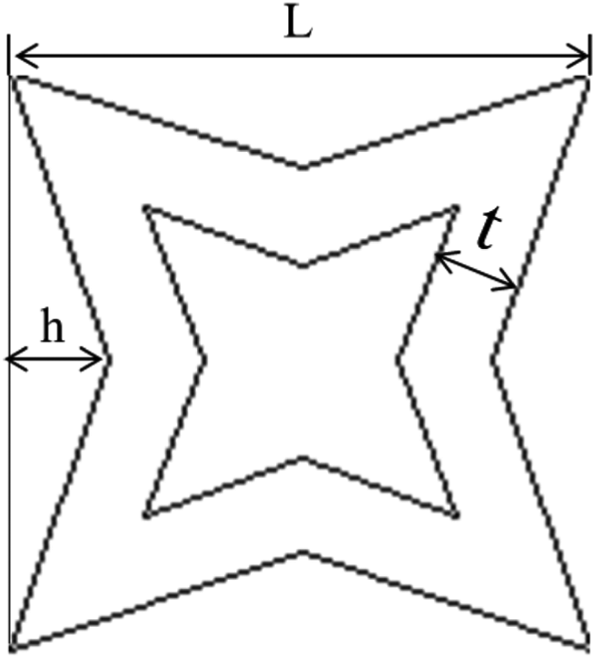
Re-entrant cellular material with three geometric parameters.
Relative density

where

Relative density of 2D re-entrant cells.
Therefore, relative density

where

Of this,



where

Subsequently,

Relative density

Analyses on relations of relative density and geometric parameters
Since relative density
To thoroughly illustrate the relations, thickness coefficient


With the restrictions of geometric features, too larger geometric parameters will lead to cell walls’ overlap; whereas, too smaller may eliminate re-entrant characteristics. Based on the conditions, the range of thickness coefficient
Value ranges of geometric parameters.

Figure 3 briefly depicts relevancy of relative density

(a) Relationship of relative density
Linear-elastic properties
Relations of elastic modulus and geometric features
For re-entrant, cells are arranged in order, as shown in Figure 4. It is very difficult to obtain effective mechanical properties of overall structure directly owing to the complexity of architected cellular structure. Whereas, as for the periodicity of this cellular material, macrostructure can be represented as periodic arrangement of unit cell with complicated microstructure along one or multiple directions. Among this, unit cell is also called as representative volume element (RVE). Based on the arrangement and macroscopic geometric features, this architected cellular structure is equivalent to continuum solid structure. Existing homogenization methods25–27 have provided effective means for multiscale modeling of continuum solids. The equivalent description, homogenization method, was put forward by Papanicolau et al.
28
and Sanchez-Palencia and Zaoui.
29
This homogenization method links up microscale analysis of RVE and macroscopic equivalent properties. From a mathematical point of view, the theory of homogenization is a limit theory using asymptotic expansion and assumption of periodicity to substitute differential equations with rapidly oscillating coefficients, with differential equations whose coefficients are constant or slowly varying in such a way that the solutions are close to the initial equations. In this case, the determination of the constitutive behavior can be performed on a mesoscopic level considering a RVE. In any region


The arranged re-entrant cellular material.
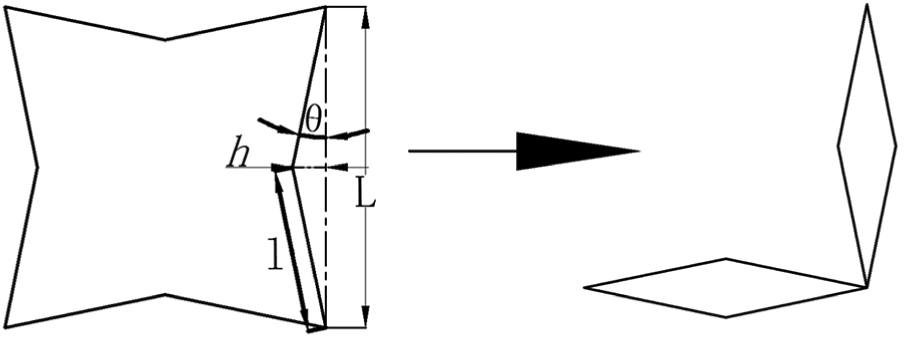
Double diamond structure as representative unit.
The macrostructure is regarded as continuous homogeneous solid structure, and its mechanical performance keeps the same everywhere. Thus, mechanical properties of overall structure can be obtained by solving mechanical performance of RVE. Summary of tensor distribution in each RVE is equivalent to surface tensor distribution in the entire macrostructure, 30 giving

where
Consider linear-elastic deformation of re-entrant cellular material shown in Figure 6, subjected to a force

Diamond structure subjected to force.
In consideration of structural symmetry and kinematic consistency,
32
mechanical model, simplified in Figures 7 and 8, shows cell wall deformation under the loading in

Simplified mechanical model under the loading in Y direction.
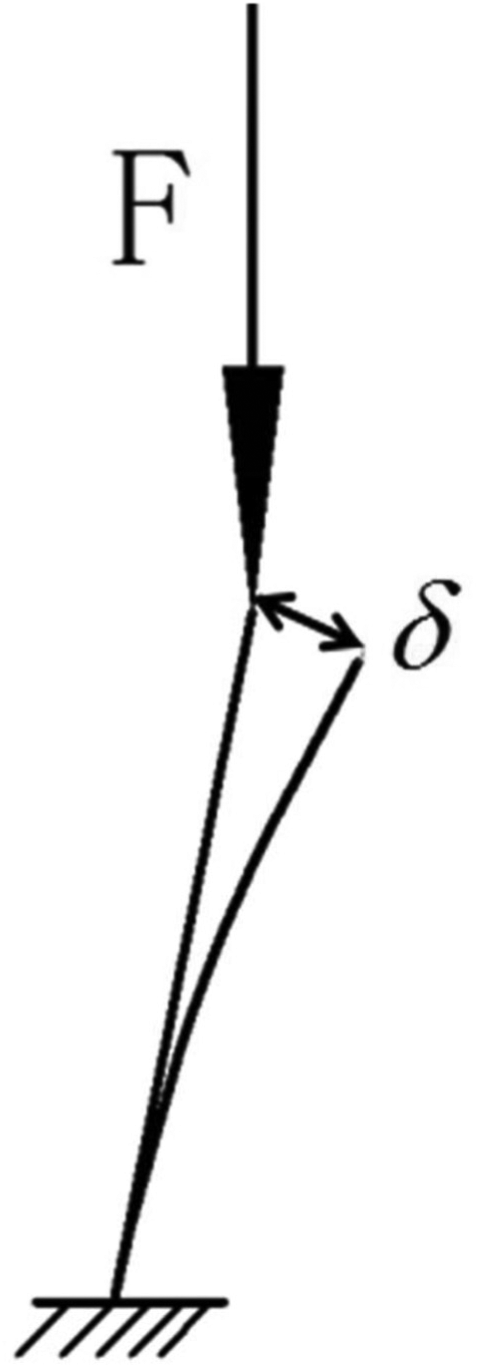
Cell wall deformation under the loading in
Based on actual stress situation, cell wall deflects by 33

Of this,

Subsequently, strain



Finally, elastic modulus parallel to

Relationship of shear modulus and geometric features
As it is subjected to loading in
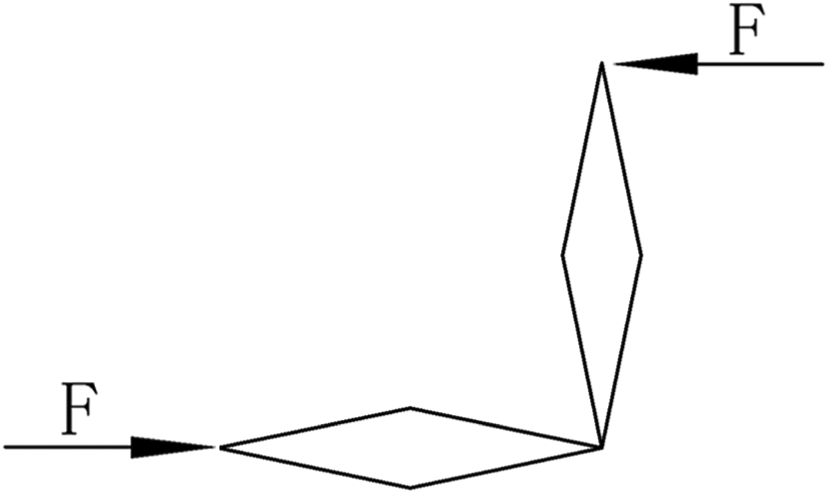
Re-entrant cells under shear force.
Like the calculation of elastic modulus, standard Timoshenko Beam is also utilized to analyze shear modulus of this cellular material, shown in Figure 9. It is concluded that force-deformation mainly attributes to diamond structure’s deformation with vertical shear stress. Similarly, the simplified mechanical model is obtained in Figure 10. Force Analysis of each beam on the left half are conducted in Figure 11.
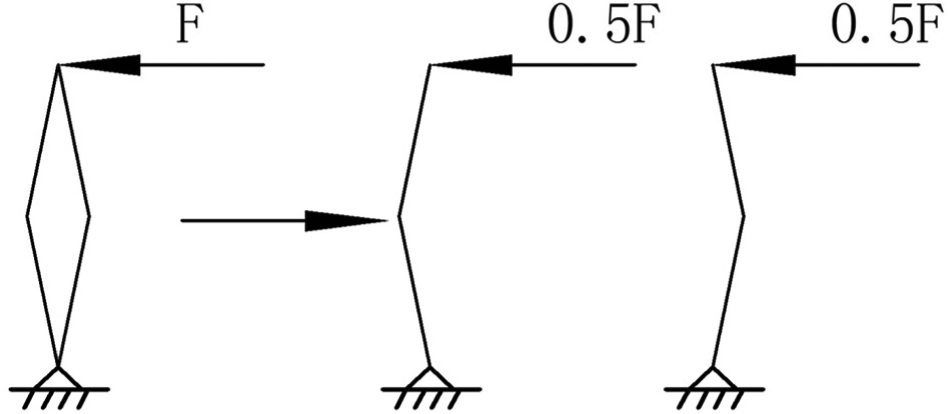
Simplified mechanical model under the loading in X direction.

Force analysis of cell beams: (a) upper left beam and (b) lower left beam.
As presented in Figure 11(a), the deflection

Hence, the deflection along

In Figure 11(b), the moment

Furthermore, the deflection

Among this


Subsequently

Thus, total deflection

Similarly, total deflection

That is, the left half exhibits the same deformation with the right, in accord with actual situation

The shear strain

And, the shear stress

Eventually, shear modulus

Confirmation of the theoretical model
To confirm the developed theoretical models, FE model is developed. Acrylonitrile Butadiene Styrene (ABS) material is adopted, and its Young’s modulus
Validation of elastic modulus theoretical model
For there exist a wealth of cells in architected cellular structure, it will need extremely extensive computational time and so much work, and often, it is impossible to achieve exact results. While ideal results can be acquired through emulation with the adoption of applying periodic boundary on RVE, it means that mechanical behavior of entire cellular structure can be obtained by just applying appropriate kinematic and kinetic constraints on RVE,32,34 that is, for periodic structures, their stress–strain fields present periodicity and continuity under external loading conditions. Thus, mechanical analysis model should be constructed under periodic stress or periodic displacement boundary conditions based on periodic unit cell (RVE), with the result of achieving reasonable stress distribution. As for continuous material with periodic unit cell structures, the boundary of unit cell should satisfy continuity conditions including continuous displacement and continuous stress. It should be guaranteed that grid nodes in corresponding axisymmetric planes should be one-to-one correspondence with the adoption of surface mesh offset.
Generally, periodic unit cell boundary planes are paired and axial symmetry, thus displacement field on corresponding axisymmetric boundary planes can be written as 35

where

Of which,
The previous work 36 indicates that the uniqueness of the solution and the continuity of the boundary stress can be guaranteed and satisfied through applying periodic displacement constraints based on equation (34), the stress satisfies the following equations

Periodic unit cell is regarded as anisotropic elastomer, and its constitutive equation can be expressed as 35

Here,

This article employs Hyperworks/ABAQUS software to emulate deformation behavior of this material. The material’s thickness is 1 mm and meshed with second-order tetrahedron solid elements to prevent “shear locking” and occurrence of “hour glassing mode.”37,38 In order to apply periodic displacement boundary conditions to unit cell, grid nodes of axisymmetric planes should be kept in one-to-one correspondence. Corresponding grids in relative axisymmetric boundary planes are generated by means of surface mesh translation in Hypermesh software, and the periodic displacement boundary conditions corresponding to equation (34) are applied by writing scripts in ABAQUS software, specific applying methods are illustrated in the literature.39,40 Subsequently, displacement freedoms of left-lower nodes along
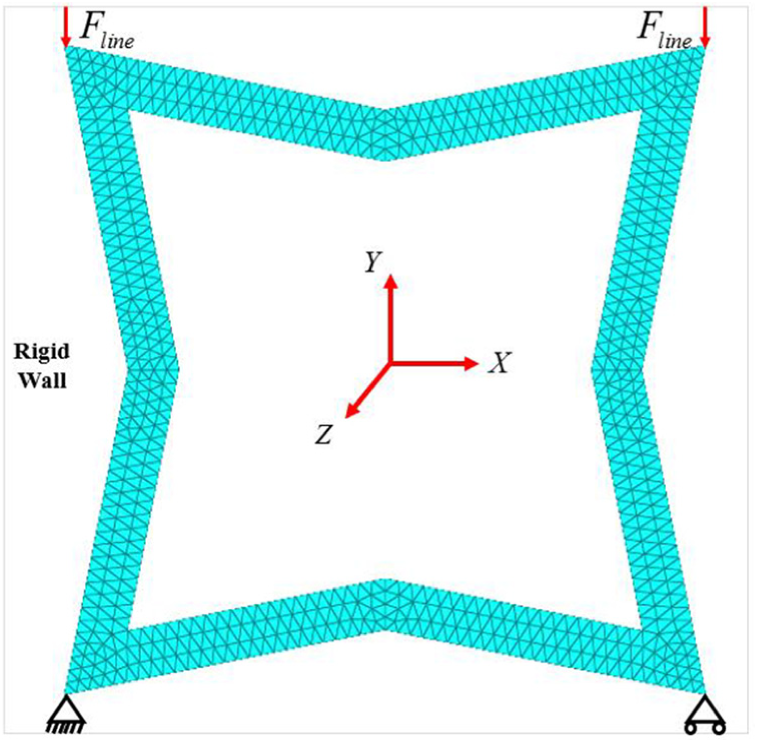
FE model for validation of elastic modulus theoretical model.
In order to verify the mesh-independency, the corresponding stress is calculated under various mesh density as strain is 0.035, the variation simulation results of stress with element number is shown in Figure 13. It can be seen that stress tends to be stable as number of mesh elements exceeds 5000. With regards to the mesh-independency verification for shear modulus, number of mesh elements is selected as 7560 to ensure that simulation results are independent with number of mesh elements.

Various simulation results of direct stress with element number.
First, three groups of geometric parameters are assigned in Table 2. Subsequently the simulation analysis is carried out. Finally, corresponding stress–strain curves are achieved (dashed lines in Figure 14) and elastic modulus
Three groups of geometric parameters selected in elastic region.

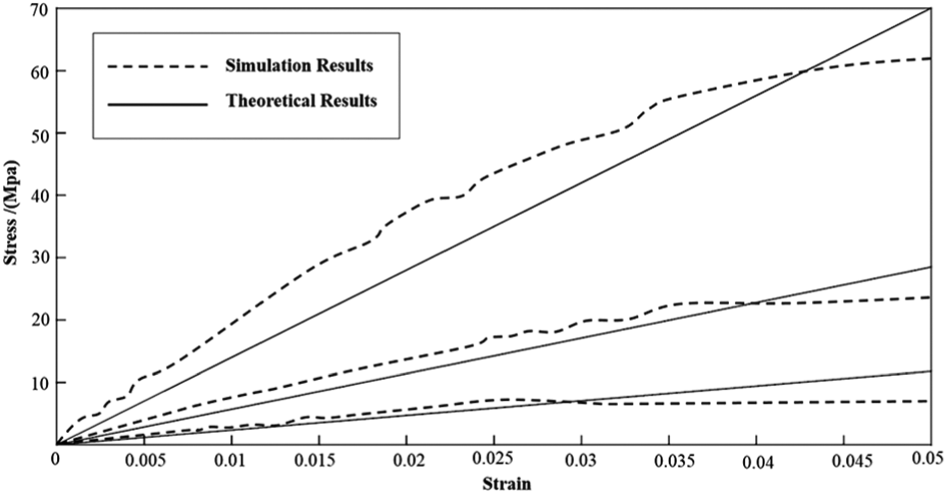
Stress–strain curves of simulation and theoretical analyses in elastic stage.
Comparison of theoretical results and simulation results.
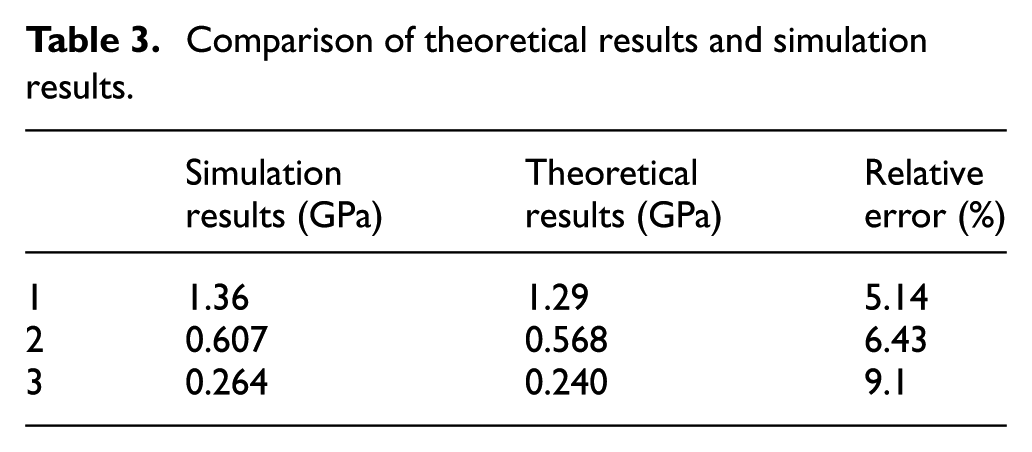
From Figure 14 and Table 3, it can be concluded that simulation results in elastic region is close to that of theoretical, simulation and theoretical results reach a higher agreement. All of these demonstrate the rationality and validity of theoretical models with relatively accurate at describing the performance of re-entrant cellular material.
As shown in Figure 14, the slope of simulation stress–strain curve tends to be smooth. There exists a reason to explain the situation; as the loading stress exceeds plastic collapse stress, plastic hinges will occur at the joints. Moreover, plastic hinges and instability result in the shift deformation of the cellular material. As structures with multiple cells are used to emulate, plastic hinges can be seen more clearly, as presented in Figure 15.

Shift deformation of cellular material due to plastic hinges and instability.
Validation of shear modulus theoretical model
Similar to validation of elastic modulus theoretical model, the same three groups of geometric parameters are chosen. Figure 16 reveals FE model for verifying shear modulus theoretical model. Periodic displacement boundary conditions based on equation (34) are also applied, displacement freedoms of left-upper nodes along

FE model for validation of shear modulus theoretical model.
Figure 17 demonstrates various simulation results of shear stress with different number of mesh elements as strain is 0.35. It can be seen that shear stress tends to be stable as number of mesh elements exceeds 7000. Thus, number of mesh elements is selected as 7560 to ensure that simulation results are independent with number of mesh elements.

Various simulation results of shear stress with element number.
Then, simulation analysis is carried out and corresponding stress–strain curves are achieved (dashed lines in Figure 18), and shear modulus

Shear stress–strain curves of simulation and theoretical analyses in elastic stage.
Comparison of theoretical results and simulation results of shear modulus.

From above discussion, Figure 18 and Table 4 also illustrate a higher agreement of simulation and theoretical results, proving the rationality and validity of theoretical models.
Analyses
From equations (19) and (32), the conclusion is that both relative elastic modulus
Relative elastic modulus
Due to the limitations of geometric features, thickness coefficient

(a) Relations of relative elastic modulus
Relative shear modulus
Like relative elastic modulus, Figure 20 exhibits the relevancy of relative shear modulus

(a) Relations of relative shear modulus
Nonlinear properties
Nonlinear-static properties
As the subjected stress exceeds the limit stress, deformation of the re-entrant cellular material will be more localized and cellular failures occur due to elastic buckling, plastic collapse, and brittle fracture. Afterward, a longer platform stage will appear in stress–strain curve, and the average stress of platform region is defined as plateau stress.
Higher plateau stress can effectively improve energy absorption abilities. Therefore, it is significantly meaningful to study failure mechanism and yield stress of this cellular material. For the re-entrant cellular material made of elastic–plastic materials, failure modes mainly cover elastic buckling and plastic collapse. Figure 21 describes actual deformation of local re-entrant cellular material in plateau region. This article focuses on constructing mechanical models of axial compression and constructing the relations between yield stress and re-entrant cellular material using single cell as representative unit.

Actual deformation of local re-entrant cellular material in plateau region.
Elastic buckling
Cellular materials collapse elastically by the cooperative elastic buckling of cell walls, allowing further large deformations at almost constant load. Under the loading of axial compression, cell walls can be simplified as beams with pressure of one end and constraint of the other end. Elastic buckling reveals while the applied load exceeds Euler buckling load. Therefore 33

where
As elastic buckling happens, the load

Besides, the axial force is

Finally, the limit stress of elastic buckling

The plastic behavior
As bending moment reaches or beyond the fully plastic moment, the re-entrant cellular material which has a plastic yield point will collapse plastically. Plastic collapse stress

Cell deformation during plastic collapse subjected to
Under the definition of generalized stress, single beam force

As plastic hinges occur, the work done by concentrated force

where all joints of cell wall rotate through the angle

As plastic hinges occur, the work done by concentrated force

Confirmation of predominant compression failure mode
As for plastic collapse stress

Simplified as

For conventional elastic materials, like metals and polymers, the magnitude of
Validation of plastic collapse theoretical model
With regard to the validation of plastic collapse theoretical model, meshing and simulation conditions including limitations and loading conditions are the same with that of elastic modulus exhibited as Figure 12.
Three groups of geometric parameters are assigned in Table 5 and then simulation analysis is carried out. The analysis of deformation process in plateau of structures with multiple cells shown in Figure 23 exhibits that plastic hinges emerge in the re-entrant points of unit cell and contact points of adjacent cells. It indicates that the failure mechanism attributes to plastic collapse.
Three groups of geometric parameters assigned in plateau.

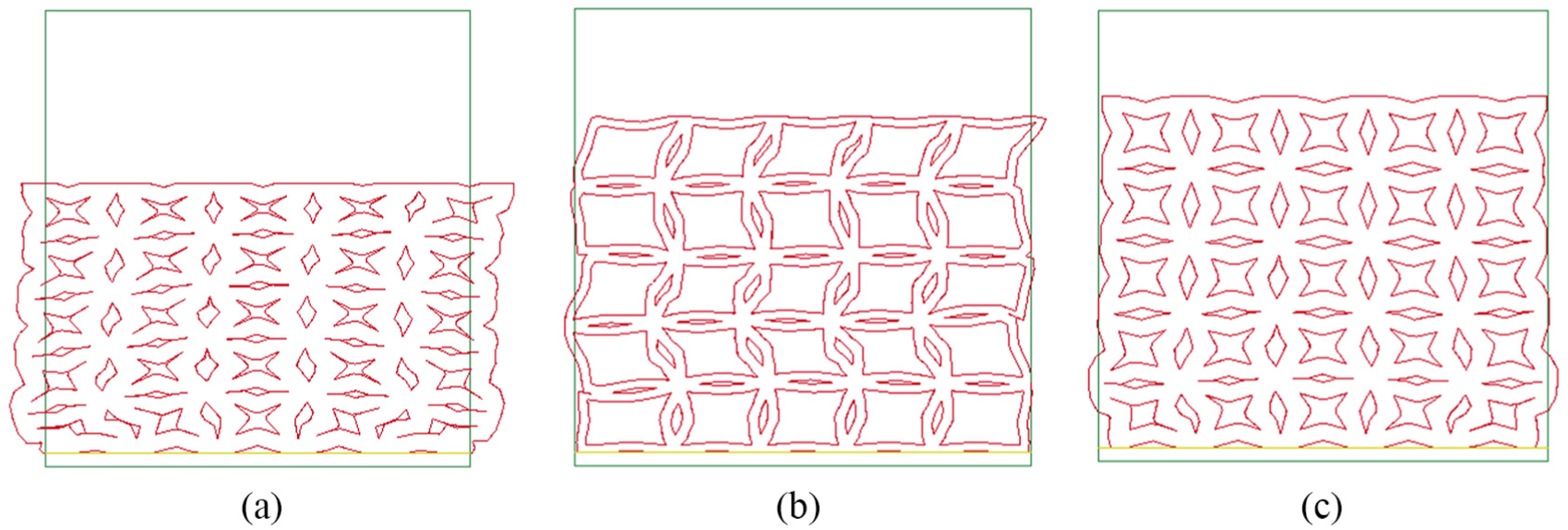
Deformation in plateau with three groups of geometric parameters: (a) first group, (b) second group, (c) third group.
As simulation results are not continuous data, numerical integration method is utilized herein to obtain nominal plastic collapse stress

Of this,
During the simulation calculation, plateau stress region starts at

(a) Description of

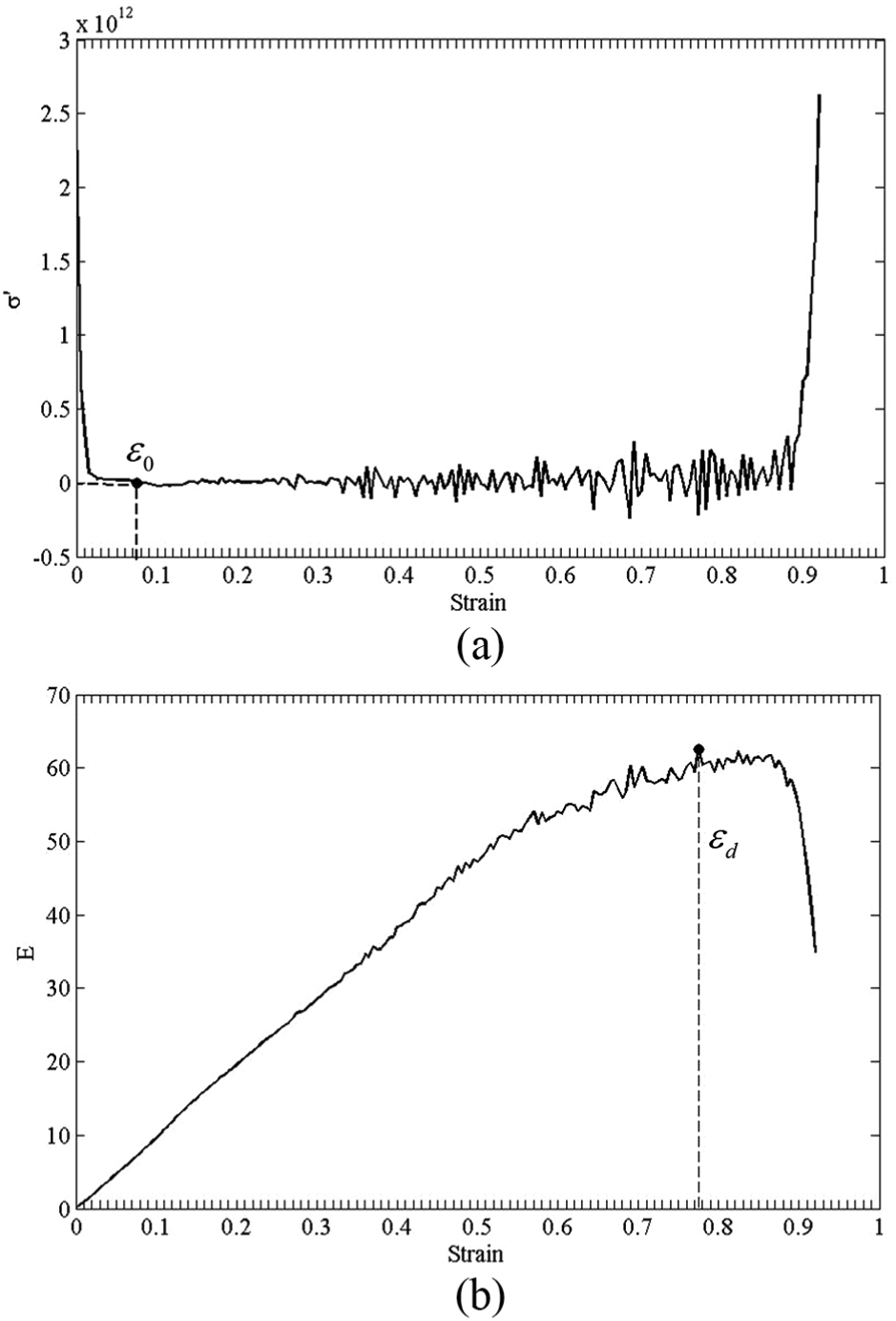
(a) Differential of stress–strain and (b) relation between energy absorption efficiency

where
Finally, the corresponding stress–strain curves are achieved in Figure 26, and nominal plastic collapse stress

Stress–strain curves of simulation and theoretical analyses in plateau stage.
Results of theoretical analysis and simulation analysis.

From Figure 26 and Table 6, it is seen that simulation fitted results in plateau are close to that of theoretical analysis and maintain a high accuracy. These demonstrate the rationality and validity of theoretical models.
Analyses
Similarly, plastic collapse stress

(a) Relations of plastic collapse stress
In-plane dynamic crushing behavior
Unlike pure solid materials, re-entrant cellular material owns special mechanical properties owing to re-entrant characteristics, and it shows outstanding energy absorption abilities than conventional ones in terms of unique deformation behaviors. 42 Energy absorption is characterized by stress–strain curve, a typical nominal stress–strain curve consists of three stages: linear-elastic stage, plateau region, and compression densification stage. The plateau region contributes greatly to energy absorption properties of cellular materials. Hence, it is very meaningful to explore the effects of impact velocity on plateau stress of the cellular materials.10,42
Theoretical models
In order to evaluate dynamic plateau stress of cellular materials, Reid and Li QM41,43 gave the relationship between dynamic impact stress and impact velocity according to one-dimensional (1D) shockwave theories, given by

Here,

Meanwhile, densification strain

As above-mentioned equation (45)

It can be seen from equation (54) that dynamic collapse stress
Validation and analyses of theoretical models
In dynamic impact, shock waves will spread in cellular materials, leading to the complexity of periodic boundary conditions along the direction of dynamic impact.
41
To simplify the calculation, this article adopts larger model with more cells to emulate the dynamic impact performance of materials approximately. Through simulation analysis, it shows that relative elastic modulus and relative platform stress tend to increase with the increment in number of cells, whereas growth rate becomes smaller gradually. As layers of cells reach more than 5, equivalent performances keep stable, as exhibited in Figure 28. Thus, this article employs
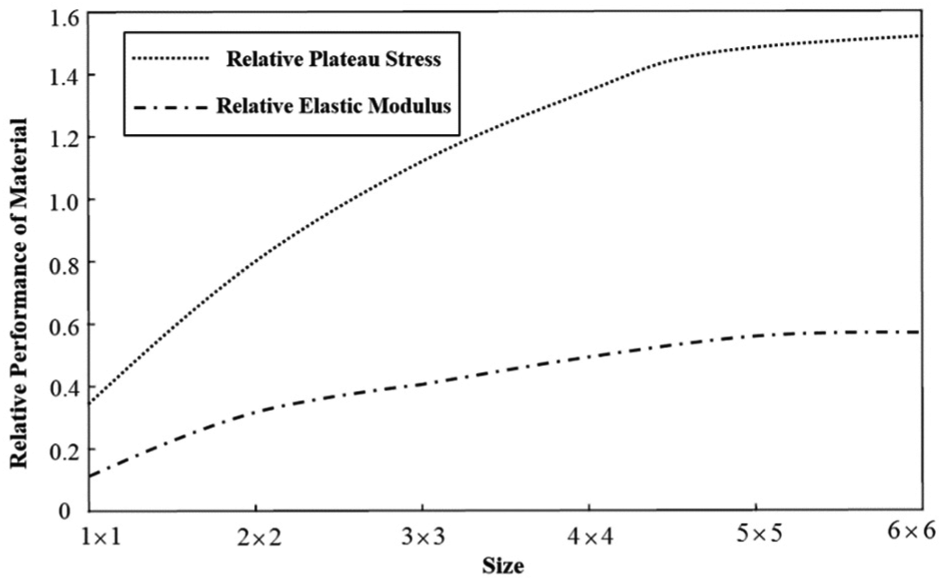
The relationships of re-entrant cellular materials between relative performances and size.
FE analysis on the dynamic crushing of this cellular material is carried out. Periodic boundary conditions are only applied along
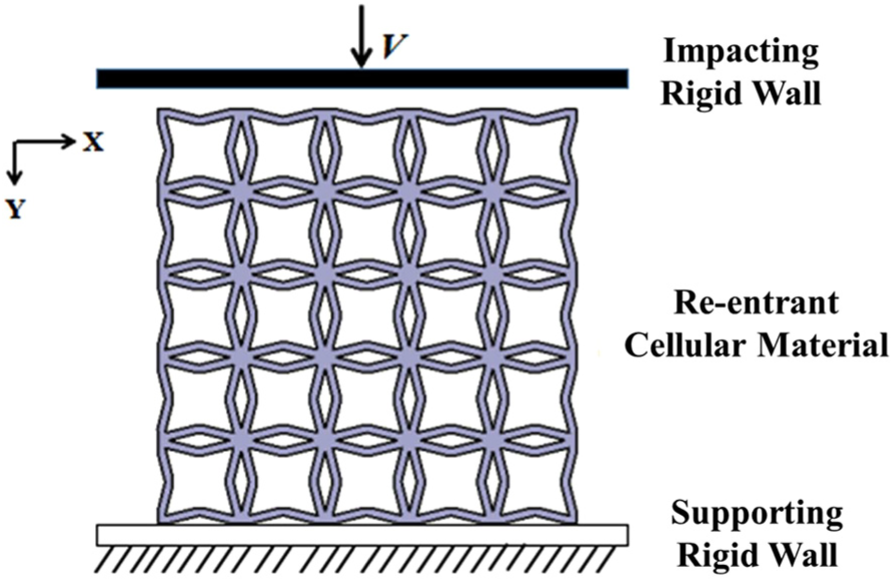
Simulation model for re-entrant cellular materials.
Figure 30 shows the trend of dynamic plateau stress
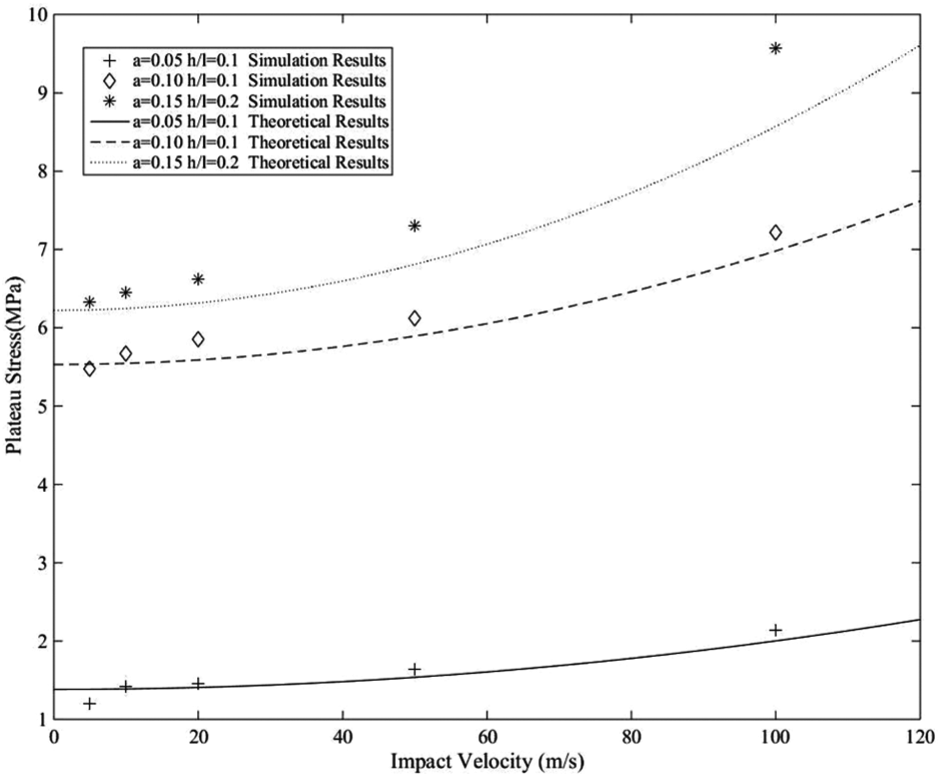
The trending of dynamic plateau stresses with the variation of impact velocity in terms of various re-entrant degree
For all the values of thickness coefficient
Characterization of energy absorption properties
Under impact loading condition, the surrounding area of stress–strain curve can represent unit volume energy absorption. The total unit volume energy absorption

Of this,

And also,

As stress reaches platform region, can be achieved

According to the simulation model in Figure 29, theoretical and simulation results of unit volume energy absorption are compared with various thickness coefficient
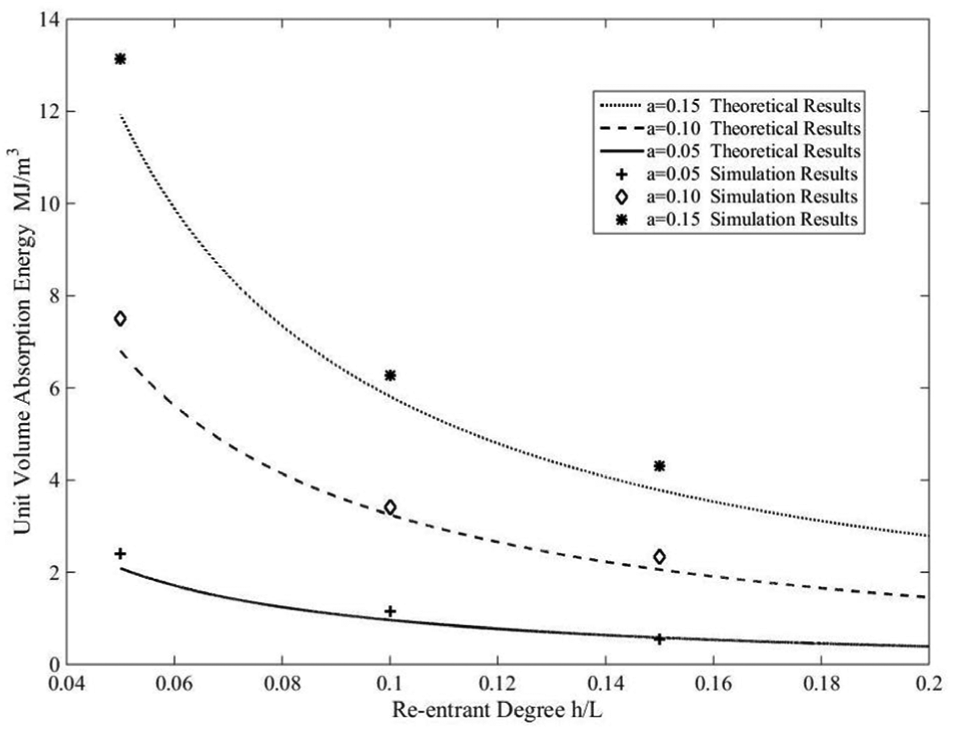
Theoretical and simulation results of unit volume energy absorption with various re-entrant degree

Theoretical and simulation results of unit volume energy absorption with various thickness coefficients
Discussion and conclusion
In this study, a novel re-entrant cellular material is proposed and taken as an example to introduce the methods of theoretical study on relationship between mechanical properties and geometric parameters of this “designer material.” This work initially presents the static mechanical models of the re-entrant cellular material, relative density
Much of this analysis of the re-entrant cellular material and its simulation confirmation is new and shows great contributions to guiding design and understanding cellular materials. Although this study focuses on 2D cellular material, an extended analysis of 3D re-entrant cellular material can be approached. Also, the results of this study obtained provide theoretical basis and data support for the application of cellular materials.
Footnotes
Handling Editor: Hiroshi Noguchi
Declaration of conflicting interests
The author(s) declared no potential conflicts of interest with respect to the research, authorship, and/or publication of this article.
Funding
The author(s) disclosed receipt of the following financial support for the research, authorship, and/or publication of this article: This paper was funded by the China Scholarship Council (Grant No. 201606170199).
