




Abstract
This article proposes a solar water heater system induced by natural convective flow using supercritical CO2 as a working fluid. In order to investigate the characteristics of the system, the dynamic characteristics and heat transfer property of the supercritical CO2 flow are measured under variable ambient conditions. The performance parameters such as the heat recovery efficiency, effective energy efficiency ratio, effective energy efficiency, highest temperature of the water, and the amount of hot water supplied by this heater system are presented and analyzed in detail. The effects of weather and season on the system performance are respectively examined. Furthermore, the methods to obtain higher efficiency of the system are also studied. The current results indicate that the circulation of supercritical CO2 flow in this solar heater system can be easily induced by natural convection. Without a driving pump, the highest heat recovery efficiency can be up to 90.4%, which is higher than the efficiencies of other conventional solar water heater systems. It is also found that the natural convection in the system is mainly affected by the intensity, stability, and continuity of solar radiation in a day. Furthermore, the amount of hot water supplied by this system is adequate for an ordinary house-hold usage with the highest temperature of the hot water in summer being 78°C.
Introduction
The use of solar energy has had a remarkable progression in the past decades.1–3 Besides its large proportion compared to other renewable energy, solar energy significantly addresses the global warming issue, the energy depletion, and the air pollution problem. There have been lots of effective utilizations of solar energy in practical engineering situation. One of them is to supply hot water using solar thermal energy. Solar water heater system proves to be an effective method to convert solar energy into thermal energy and has been extensively studied for many years.4–6
Most of the pioneering solar water heaters use water directly as a working fluid, which has a low specific heat capacity. In order to improve the thermodynamic performance of the heaters, some alternative fluids are chosen as the working medium. 7 In recent years, as the environmental protection is given large emphasis, people tend to choose some safe fluids (e.g. hydrocarbons and carbon dioxide) as the working fluid in solar water heaters systems. Chun et al. 8 systematically compared the performances of solar water heaters using water, methanol, acetone, and ethanol. Their results reveal that the system performance is relatively insensitive to the selection of working fluid. Lorentzen and Pettersen9,10 attempted to use CO2 as a working fluid. Their research reveals that CO2 can be one of the promising transfer media of heater systems. Besides being non-toxic, non-flammable, and stable at an ordinary temperature and having lower environmental impact, 11 CO2 also easily reaches the critical point (the critical pressure and temperature are 7.38 MPa and 31.1°C, respectively) and shows a favorable thermodynamic property at its supercritical state. 12 In this background, Yamaguchi and colleagues13–17 proposed a novel design of a solar Rankine cycle system (SRCS) to produce both electricity and thermal energy using CO2. The piston pumps were used to drive the circulation of the system. Their obtained results reveal that the CO2-based Rankine cycle powered by solar energy shows stability in its performance and is suitable for the thermal energy loads of water heaters.
Solar water heaters work under two modes: one is natural circulation mode and the other is forced circulation mode. 18 Most of the previous studies have been conducted in forced circulation mode only, while the studies pertaining to solar water heater system using natural circulation mode are not being explored. Some fundamentals of flow mechanics and heat transfer property of the supercritical CO2 natural convective flow are still not fully investigated. Also, the effects of some factors (e.g. weather and season) on the system performance still need thorough investigation. Accordingly, as an extension of Yamaguchi’s work, a solar water heater system using supercritical CO2 as the working fluid is developed in this study. Our experimental system contains two closed-loop subsystems. One is supercritical CO2–based circulation loop induced by natural convection and the other is a heat recovery water loop. The two subsystems are coupled by a heat exchanger. In this article, the natural convection circulation phenomenon of supercritical CO2 flow inside the system is investigated both experimentally and analytically. Then, in order to investigate the effects of weather and season on the system performance, a parametric analysis is conducted by examining some key performance parameters such as the heat recovery efficiency, the highest temperature of water, and the amount of hot water supplied by this heater system. The remainder of this article is structured as follows: Section “Solar water heater system using supercritical CO2” describes the experimental set-up of the natural circulation solar water heater system. Section “Experiment and evaluations” provides details on the experiment and findings. The investigated results and analysis are discussed in section “Results and discussion.” Finally, conclusions are summarized in section “Conclusion.”
Solar water heater system using supercritical CO2
Figure 1(a) and (b) illustrates the experimental set-up of the solar water heater system. The system consists of the following components: evacuated solar collectors, valves 1 and 2, heat exchanger, hot water tank, gear pump, flow meters, and data analysis apparatus. The overall system can also be divided into two loops which are coupled by a heat exchanger. The heat exchanger has a double-tube structure. CO2 flows inside the inner tube and transfers heat to the water in the outer tube. The diameters of the inner and outer tubes are, respectively, 12.7 and 34 mm. Heat exchanging area of the heat exchanger is about 1.0 m2. The evacuated solar collectors (Figure 2) have a maximum allowable working pressure of 12 MPa and can stand working temperature up to 250°C. The area of evacuated solar collector is 1.97 m2, while the effective heat collection area is 1.5 m2. The selective surface absorber coating on collector tubes has an absorption ratio of 92.7% and an emissivity of 1.93% on at the temperature of 100°C. The other details of the solar collectors have been prescribed in a previous work. 19 Except for the evacuated solar collector, the maximum permissible operating pressure of the other parts in the CO2-based circulation loop is 10 MPa. Unlike our previous studies,19,20 the feed pumps are not used in the CO2-based loop as shown in Figure 1. Valve 1 is used to adjust the flow rate of the CO2 with temperature higher than 60°C. Valve 2 is used to control the flow rate of the cooling water, so that the water flow rate can be maintained at 10 kg/h. An Iwaki MDG-M2S6B100 magnetic gear pump (with a maximum flow rate of 2.4 L/min and a rated power of 45 W) is used to power the water flow in the heat recovery loop. Two Coriolis effect mass flow meters are used to record the mass flow of the two loops, respectively. The flow meter installed in the CO2-based circulation loop provides a measurement range of approximately 0–70 kg/h with an accuracy of ±0.2%. Another one installed in the heat recovery water loop provides a measurement range of approximately 0–160 kg/h with an accuracy of ±0.2%. In addition, the solar radiation was recorded using a sun radiation sensor with an accuracy of ±0.2%.

The experimental set-up and prototype: (a) solar water heater system using supercritical CO2 as the working fluid and (b) the prototype of the solar water heater system.

A schematic of the solar collector.
Because of low critical temperature and high specific heat capacity at the supercritical state, CO2 is chosen as the working fluid in the CO2-based loop. First, the pressure and temperature of CO2 liquid are set at 6 MPa and 20°C, respectively. In the system operation, CO2 inside the solar collectors is heated by the solar energy, which is then converted into a high-temperature supercritical fluid. Then, the heat exchanger cools CO2 to a liquid state. The heat energy obtained in this process can be utilized effectively for generating the hot water. Finally, the liquefied CO2 goes back to the solar collectors.
Experiment and evaluations
Experiment
In order to collect more solar energy, the solar collector is faced toward the south direction. Experiments were carried out for some days selected from the four seasons in a year. Once the circular flow of CO2 is stopped, the experiments will end. The pressure and temperature in the system were measured using a number of K-type thermocouples (accuracy: ±0.1°C) and pressure transmitters (accuracy: ±0.2%). The specific measured quantities in the experiment include the following: CO2 pressure and temperature in the inlet and outlet of the solar collector, water temperature in the inlet of the heat exchanger, water temperature at the outlet of the throttling valve, CO2 mass flow rate in the outlet of the heat exchanger, water flow rate in the inlet of the heat exchanger, and solar radiation intensity.
In a typical measurement, the sampling period is about 10 s. All the measurement results are recorded by a data logger and saved in a computer. The measurement uncertainty during the present experiment is from error sources relating to temperature, pressure, mass flow rate, and measurement of solar radiation. The errors resulting from the measurements are ±0.1°C for CO2 temperature, ±0.2% for CO2 pressure, ±0.2% for CO2 mass flow rate, ±0.2°C for water temperature, ±0.2% for water mass flow rate, and ±0.2% for solar radiation. The total error of the experimental system can be evaluated in terms of the mean square root of the above errors, which is defined using equation (1) as follows

where
Evaluation
Related evaluation parameters
The solar radiation energy power J is defined as follows

where A = 1.5 is the effective area of the solar collector and I is the solar radiation intensity. The solar radiation quantity can be given by

The collected heat energy power of the solar collector QC can be given by

where GC is the mass flow rate of CO2 inside the solar collector and hC1 and hC2 are the CO2 enthalpy values at the inlet and outlet of the solar collector, respectively. The enthalpy values are referred from PROPATH V13.1. 21 Then, the collected heat quantity of the solar collector Qin can be calculated by

The recovered heat power of water QW is defined by

where Gw (kg/h) is the mass flow rate of water inside the heat exchanger, TW1 and TW2 are the water temperature at the inlet and outlet of the heat exchanger, respectively, C is the specific heat capacity coefficient of water, which in this study is C = 4.186/3.6 kJ/kg °C. The recovered heat quantity of hot water Qout can be given by

Finally, the heat recovery efficiency can be calculated by the ratio of the recovered heat quantity of hot water and solar radiation quantity, which is given as follows

Energy evaluation
The available energy is always used to assess the kinds of energy such as thermal energy, electrical energy, and chemical energy. Generally, the available energy can be further divided into available pressure energy and thermal available energy. In this study, the thermal available energy is used to assess the performance of this solar water heater system. A certain mass of water with a higher temperature implies that the thermal available energy provided by the system is larger.
The thermal available energy can be defined by

Then

where Q is the heat, TW1 and TW2 are the water temperature in the inlet and outlet of the heat exchanger, respectively, and MP is the specific heat capacity. Given that the heat energy is related to temperature and entropy, the thermal available energy can be calculated as follows

where s0 and s are the entropy of water in the inlet and outlet of the heat exchanger, respectively.
The collected thermal available energy in a day is defined by

The available ratio is defined by

Furthermore, the available energy efficiency is defined as follows

where QJE = kQJ, with k being an effective scaling factor.22,23 In this study, the value of k is 0.8.
Numerical analysis model
In order to further investigate the nature convection phenomenon of CO2, the prototype performance was also analyzed using a numerical method. The CO2-based loop formed by the solar collector and heat exchanger is first simplified to a numerical calculation model. Figure 3 shows a schematic illustration of the computational domain. Here H0 = 1000 mm, L =1000 mm, H = 600 mm, H1 = 200 mm, TL = 300 K, and TH = 350 K. The heated cells of solar collectors are marked with red color and the cooled portion inside the heat exchanger is marked with blue color. Furthermore, regions A and B are also marked. The velocity distributions in these two regions will be systematically investigated.

Model of numerical calculation.
The dimensionless governing equations for the two-dimensional, unsteady flow are as follows


where

The no-slip boundary conditions are prescribed at the wall. STAR-CCM +, 24 which is a general analysis software for heat transfer flow, is used to solve the above governing equations. The total amount of computational grid is 105. The SIMPLE algorithm is employed to deal with the coupling between the pressure and velocity. The physical parameters such as density, viscosity, specific heat, and thermal conductivity are referred to PROPATH V13.1. 21
Results and discussion
Natural circulation of CO2-based circulation loop
In this section, the results of numerical simulation for the simplified CO2-based circulation loop are discussed in detail. Figure 4(a) and (b) shows the images of density in the whole CO2-based loop and in region B, respectively. It is evident that there is a density difference inside the CO2-based working loop. The density difference between the solar collector and the heat exchanger ensures that the convection cycle is performing effectively. Furthermore, it is also found that the density of CO2 flow in the left area of region B is slightly larger than that in the right area (Figure 4(b)). Figure 5 shows the distribution of velocity inside regions A and B (Figure 3). The CO2 fluid in the tube of the CO2-based working loop is driven by the density difference between the solar collector and the heat exchanger. The above simulation results reveal that the heat transport cycle in the CO2-based loop of the system can be completed just by the natural circulation. Moreover, it can also be seen from Figure 5(a) that the distribution of the velocity in the top and bottom of the tube in region A is not axially symmetrical. This study found that this radial difference of velocity of the CO2 fluid is influenced by the bending parts of the tube in the computational domain.

Chart of density.

Chart of velocity: (a)velocity at A and (b) velocity at B.
Apart from the above numerical investigation, the solar water heater system was tested to further examine the transient characteristics of the natural circulation flow. These experimental investigations were carried out from 2013 to December 2014 in Kyoto region in Japan. Some representative results on 3 November 2014 are shown in Figures 6–8. Figure 6 shows the experimental results of CO2 mass flow rate and Reynolds number from 9:00 to 17:00. It is found that the maximum mass flow rate of CO2 inside the system is 16.5 kg/h. The maximum Reynolds number calculated based on the collector outlet temperature and pressure is about 6500. Furthermore, it can also be observed that there is a dramatic variation in CO2 mass flow rate (marked with red circle as shown in Figure 6), when the natural solar radiation is in a low level from 16:00 to 17:00. During this time, the solar energy collected by the collectors is too few to sustain the system cycle continuous and smooth running, resulting in the CO2 mass flow rate suddenly drop to a very low value at some instant. After the transient drop, the CO2 flow starts circulating again and then the CO2 mass flow rate dramatically increases to a higher value as shown in Figure 6. Moreover, as shown in Figure 7, the pressure of the CO2 flow at the outlet of the solar collectors also has a very small increment (marked with red circle) when the restart process happens. Similar phenomenon was also observed by Zhang and collegues.25,26 They considered that this dramatic variation accompanied with the low-level solar radiation is mainly induced by continuous long-time drop of solar radiation after 15:00.

Variation of CO2 mass flow rate and Re on 3 November 2014.

Variation of CO2 temperature at the inlet and outlet of the collector, water temperature at the inlet and outlet of the heat exchanger, and pressure at the outlet of the collector on 3 November 2014.

P–H diagrams for the CO2-based circulation loop on 3 November 2014. “C.P” represents the critical point.
To demonstrate the schematic natural circulation of the CO2-based loop in our system, the P–H diagram is illustrated in Figure 8. The CO2 fluid status before the experiment is marked with blue line and the status of the solar collector inlet and outlet CO2 fluid at the beginning of the natural cycle are marked with red line. Furthermore, it can be observed from Figure 7 that the temperature and pressure of CO2 flow at the outlet of the solar collector are substantially greater than the critical pressure and temperature of CO2 during the cycle. These observations indicate that the CO2 fluid between the solar collector inlet and outlet works basically in the supercritical region during the heating process of the natural circulation.
Weather and season influent on the system performance
In order to investigate the effect of season, the performance of this system was tested in every season of two years. The quantity of the CO2 filled in the working loop is 3.3 kg in summer and 3.5 kg in the other three seasons. In a typical experiment, the quantity of hot water, the temperature of which is above 50°C, is considered to evaluate the output of this system. The effect of weather is also examined in every season.
Table 1 gives the measurement results of three representative days in autumn of 2013. 1 November is a sunny day, while 15 November is a cloudy day. It is found that the heat recovery efficiency of a sunny day (e.g. 90.4% on 1 November) is higher than that of a cloudy day (e.g. 69.0% on 15 November). The hot water with an average temperature of about 50°C, collected in the sunny day, is also more than that of the cloudy day (e.g. 121 L on 1 November and 15 L on 15 November). Figure 9(a) and (b), respectively, shows the hourly results of solar radiation, heat quantity collected by the CO2 fluid in the solar collector, and heat quantity recovered by hot water in the two representative days from 9:00 to 17:00. It is shown that this solar water heater system began collecting heat at about 2 h after the start of the experiment in the cloudy day, which spent much longer time than that in the sunny day. Consequently, the time for the system to effectively collect heat quantity in the cloudy day is not as long as that in the sunny day. Figure 10 shows the inlet and outlet CO2 temperature and pressure of the solar collector in the two representative days, also including the inlet and outlet water temperature of the heat exchanger. It can be seen from Figure 10(a) that the outlet water temperature of the heat exchanger is almost above 50°C from about 10:00 AM to 15:00 PM in the sunny day, while the time period with the same condition is correspondingly shorter in the cloudy day. The above observations indicate that the natural circulation of CO2 inside the system is slightly more difficult in the cloudy days. The sustained solar radiation in a sunny day is very helpful to enhance the performance of the natural circulation solar water heater system. Despite the fact that the heat recovery efficiency of this system is much lower in the cloudy day, it should be noted that this supercritical CO2 solar water heater system can provide higher heat recovery efficiency than the traditional solar water heaters (usually less than 60%). To further investigate the characteristics of this natural convection system in cloudy days, the experimental results of another representative cloudy day (9 November 2013) are presented in Figure 9(c) and Table 1, which are used for analysis and comparison. It was observed that the averaged solar radiations of two selective cloudy days are almost the same (i.e. 300 and 314 W). However, the effective outputs in the two cloudy days are very different. The hot water with an average temperature of about 50°C cannot be collected by the system on 9 November. This difference is more likely due to the sensitivity of supercritical CO2 fluids in response to the intensity of hourly solar radiation. As shown in Figure 9(b) and (c), the maximum solar radiation at 12:00 on 15 November 9 is more than 800 W, which is bigger than the maximum value of 460 W at 11:00 on 9 November. This observation reveals that the larger hourly solar radiation intensity in the cloudy days is helpful to improve the natural circulation in the system, and more CO2 mass flow rate inside the CO2-based loop of the system will be induced. Consequently, the collected heat quantity of the whole system will be increased. In addition, the system was also tested and measured in spring. It is found that the results of spring were very similar to those of autumn.
Condition and result in autumn.


Solar radiation, heat quantity collected by the solar collector, and hot water of three representative days: (a) a representative sunny day (1 November 2013), (b) a representative cloudy day (15 November 2013), and (c) another representative cloudy day (9 November 2013).

Variation of CO2 temperature at the inlet and outlet of the collector, water temperature at the inlet and outlet of the heat exchanger, and pressure at the inlet and outlet of the collector in two representative days: (a) results on 1 November 2013 and (b) results on 15 November 2013.
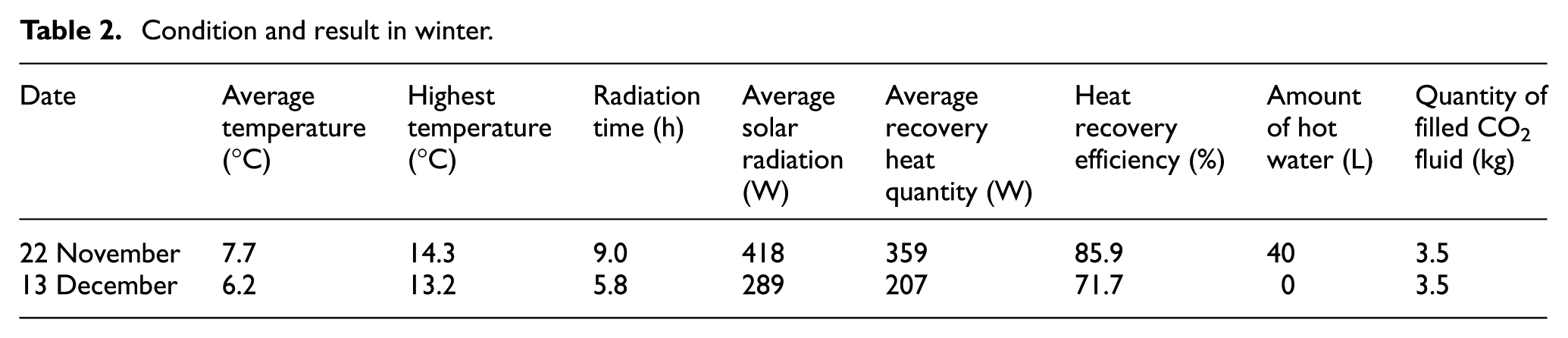
Table 2 gives the measurement results of a sunny day (22 November) and a cloudy day (13 December) in winter of 2014. From the experiments performed in autumn and spring, it was found that both heat recovery efficiency and the amount of collected hot water on the sunny days (e.g. 86% and 40 L) are also higher than those observed on the cloudy days (e.g. 72% and 0 L) in winter. Figure 11(a) and (b) illustrates the hourly results of solar radiation, heat quantity collected by the CO2 fluid in the solar collector, and heat quantity recovered by hot water in the two representative days. Results show that before the system starts collecting the heat quantity the preheating process of CO2 fluid inside the solar collector needs a longer time in winter than in autumn and spring. The variation of the measured solar radiation and CO2 mass flow rate in the sunny day and cloudy day is shown in Figure 12(a) and (b), respectively. As shown in Figure 12(a), before about 13:30, the solar radiation in the sunny day is more stable than that in the cloudy day, which induced a much stable mass flow rate and a larger maximum mass flow (e.g. about 14 kg/h in sunny day). After about 13:30, the solar radiation in the sunny day became increasingly weak and unstable, and then the CO2 mass flow showed a decrease (as shown in Figure 12(b)). However, in the cloudy day, apart from the low level of averaged solar radiations, the distribution of the solar radiation with time is also unstable. Therefore, the corresponding CO2 mass flow rate is low and the highest temperature of the collected warm water is only about 46°C on 13 December. These observations reveal that besides the solar radiation intensity the stable and continuity of solar radiation also have an important effect on the natural circulation of this solar water heater system.
Condition and result in winter.

Solar radiation, heat quantity collected by the solar collector, and hot water in two representative days: (a) a representative sunny day in winter (22 November 2014) and (b) a representative cloudy day in winter (13 December 2014).

Variation of solar radiation and CO2 mass flow rate in the two representative days of winter: (a) solar radiation on 22 November and 13 December 2014; (b) CO2 mass flow rate on 22 November and 13 December 2014.
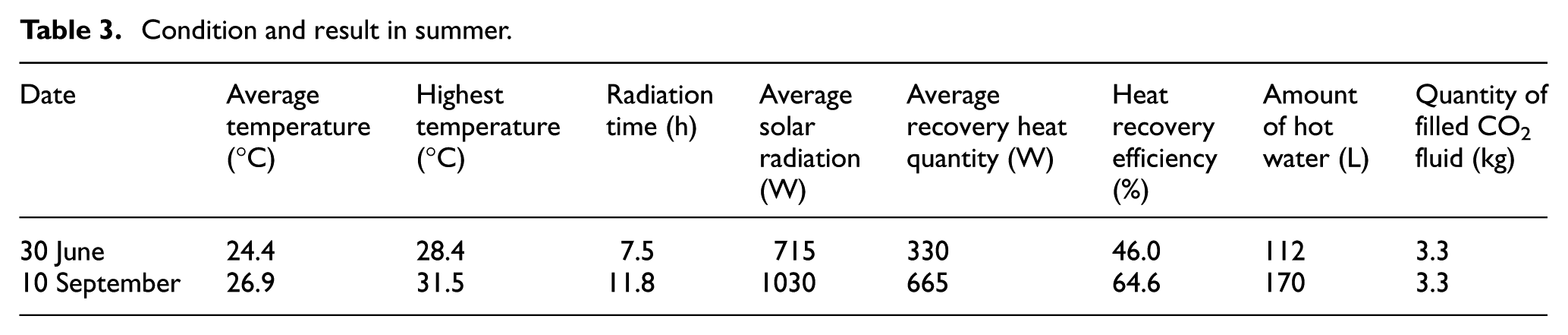
For the experiments performed in the summer season, it is found that the internal pressure of the system is easy to be enhanced by either the strong solar radiation or the high ambient temperature. To ensure that this natural circulation solar hot water system works in a safe status, the filling quantity of CO2 is adjusted from 3.5 to 3.3 kg, which can keep the operating pressure in summer always below the maximum permissible value of 10 MPa. Table 3 gives the measurement results of the selected two days in summer. 30 June is a cloudy day, while 10 September is a sunny day. Both the heat recovery efficiency and the collected hot water on the sunny day (e.g. 64.6% and 170 L) are higher than those observed on the cloudy days (e.g. 46% and112 L). Meanwhile, compared with the results of the other three seasons, the heat recovery efficiency in summer is slightly lower. The decrease of the filling quantity of CO2 will cause a relatively less CO2 mass flow rate in the natural circulation. As a consequence, the heat recovery efficiency of the solar hot water system decreases. Nevertheless, the amounts of output hot water in summer are still larger than those of the other three seasons (e.g. as shown in Table 3). This can be attributed to the stronger solar radiation in summer. Moreover, our study also found that the preheating process of CO2 fluid will increase with the decrease of the filling quantity of CO2. When the filling quantity of CO2 is less than certain lower limit values, the natural convection in the system will not happen. The exact lower limit value of CO2 filling quantity is mainly decided by the solar radiation intensity and ambient temperature of the day. The hourly results of solar radiation, heat quantity collected by the CO2 fluid in the solar collector, and heat quantity recovered by hot water in the two representative days in summer are shown in Figure 13. Note that the natural convection inside the system is easy to be started in summer and the time for system to effectively collect heat quantity in 1 day is normally longer than those in the other three seasons. Furthermore, from the comprehensive observation of the measured results in the four seasons, it is found that both the ambient temperature and stability of solar radiation have an important influence on the starting performance of the system. A higher ambient temperature and a stable solar radiation can be helpful to improve the starting performance of the system. Furthermore, in terms of the current results, a moderate adjustment of CO2 filling quantity based on the seasons is considered as an effective method for the highly efficient utilization of this natural circulation solar hot water system in the whole year.
Condition and result in summer.

Solar radiation, heat quantity collected by the solar collector, and hot water in two representative days in summer: (a) a representative sunny day in summer (10 September2014) and (b) a representative cloudy day in summer (30 June 2014).
Analysis of output available energy
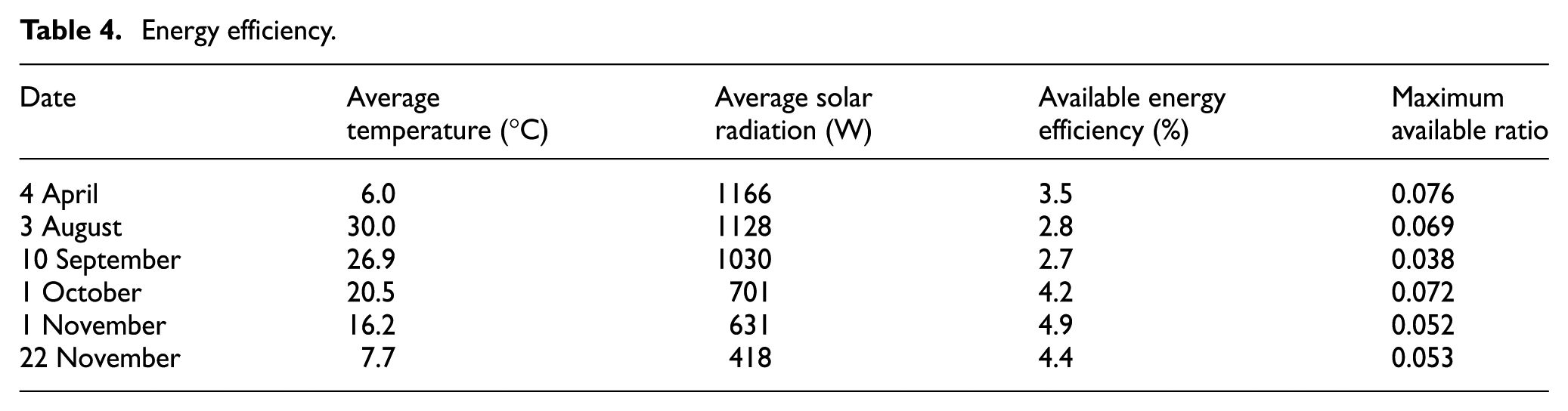
In the two years, the averaged heat collection efficiency of the system is 54% in sunny days and 42% in cloudy days. To further evaluate the thermal conversion of the water heater system, the highest temperature of output hot water is measured when the cooling water flow rate of was kept at 10 kg/h. Figure 14(a)–(c) shows the variation of CO2 and water temperature with respect to time in three representative days which are, respectively, selected from summer, autumn, and winter. It is seen that the highest temperature of output hot water in summer (e.g. 78°C on 3 August 2013) is higher than those obtained in the other seasons (e.g. 74.2°C on 1 October 2014 and 69.5°C on 4 April 2014). This observation indicates that the system can provide much more thermal available energy in the summer days. Table 4 shows the available energy efficiency and maximum available ratios of the whole water heater system containing the average solar radiation in some representative days. Note that the available energy efficiency in summer is not as large as expected. The available energy efficiencies in spring and autumn (e.g. 4.9%) are higher than those in winter and summer. This observation indicates that the energy efficiency is based on the comprehensive seasonal environment. Because the ambient temperature in summer is higher, the energy efficiency in summer is slightly smaller than those in the other seasons. Furthermore, as shown in Table 4, the maximum available ratio of this system can be up to 0.076, which is larger than the most conventional solar water heaters having a maximum available ratio of about 0.06. Therefore, these advantages ensure that this prototype system can provide enough hot water for normal usage in families.

Variation of CO2 temperature at the inlet and outlet of the collector and water temperature at the inlet and outlet of the heat exchanger in three representative days: (a) results on 3 August 2013, (b) results on 1 October 2014, and (c) results of 4 April 2014.
Energy efficiency.
Conclusion
This research is focused on investigating the characteristics of supercritical CO2 solar water heater system under variable conditions by measuring the flow and heat transfer properties. It is found that the natural convective flow is well induced in this designed system. Without using a pump to drive the CO2 flow, the higher heat recovery efficiency and higher temperature of output hot water can be achieved. Furthermore, the obtained result shows that the maximum mass flow rate of CO2 in the system is 16.5 kg/h. The maximum available ratio is 0.076. The highest temperature of output hot water can be up to 78°C. The quantity of CO2 filled in the working loop, the condition of solar radiation, and the seasonal environment all have significant effects on the present CO2 water heater system. The larger solar radiation intensity and more stable and continuous solar radiation are all helpful to enhance the efficient output of this system. This study also indicates that a moderate CO2 filling quantity based on seasons is very important for the effective utilization and safety of the system. Therefore, the optimization of the filling quantity of CO2 inside this supercritical CO2 solar water heater system is very necessary. Moreover, it will be interesting to perform comprehensive optimization by the inclusion effect of factors such as the inclination of the solar collector and the specific shape of the pipes in the system.
Footnotes
Appendix 1
Handling Editor: Hongwei Wu
Declaration of conflicting interests
The author(s) declared no potential conflicts of interest with respect to the research, authorship, and/or publication of this article.
Funding
The author(s) disclosed receipt of the following financial support for the research, authorship, and/or publication of this article: This study was supported by the National Youth Natural Science Foundation of China (Grant No. 51405279), the National Natural Science Foundation of China (Grant No. 11372168), and the Academic Frontier Research Project on “Next Generation Zero-emission Energy Conversion System” of Ministry of Education, Culture, Sports, Science and Technology in Japan. The financial support is gratefully acknowledged.